
Uniforms of the 1st Volga Army Corps:
1st Samara, 3rd Simbirsk and 13th Kazan Rifle Divisions
Material and reconstructions by A. Karevskiy
Uniforms in Memoirs and Historiography
Order to the 1st Volga Army Corps, 20 March 1919, Kurgan
§6. To this day, some officers of the corps continue to wear St. George ribbons on their caps and hats, which were temporarily introduced in the units of the People's Army. With the formation of a unified state authority and army, Order No. 7 of the Supreme Commander-in-Chief established a uniform distinction for military units for headgear: the previous model of cockade with a three-coloured enamel ribbon in the national colours. I order that the St. George ribbon be replaced with the established cockade and, in extreme cases, in the absence of such, with a tricolour ribbon in the national colours.
Signed: Acting Commander of the Corps, Major-General Pribylovich.
Document kindly provided by Moscow researcher V.V. Romanov.
Order to the 1st Volga Army Corps, No. 74 of 4 April 1919, Kurgan
From Monday, 7 April, I authorise the Corps Quartermaster to begin issuing English uniforms and equipment to the corps units. In order to ensure consistent wear of these uniforms, I order:
1) First and foremost, issue uniforms to all available officers, NCOs and soldiers of combat units, headquarters and administrations.
2) The distribution to rear units and institutions (divisional supply trains, divisional infirmaries and transports, artillery and engineering parks) should be temporarily delayed until the arrival of the next deliveries of uniforms.
3) Distribution to the units is permitted only after all officers and NCOs have been familiarised with the fit of the uniforms and equipment, and on condition that complete sets are issued to all units at the same time, to avoid some men dressed in Russian uniforms and others in English uniforms.
4) Officers who are required to be on horseback in formation shall be issued boots or low boots with puttees, and gaiters to go with them.
5) Small entrenching tools shall not be issued to cavalry and engineering units.
6) I authorise officers to alter (tailor) the issued uniforms, but without deviating from the style.
7) Field exercises should be conducted in Russian uniforms and English equipment in order to preserve the uniforms.
8) Under no circumstances should a mix of uniforms be worn, i.e. Russian trousers or caps with English uniforms, etc.
9) When sending komands on assignments, all komand members must be dressed in either Russian or English uniforms.
10) Wearing English uniforms is permitted only with Russian shoulder-boards.
11) The corps quartermaster shall take all measures to issue shoulder-boards as soon as possible. I draw the attention of all corps officers to the need to treat the new uniforms with care: they should be kept in good condition until the corps goes to the front.
Signed: Corps Commander, General Kappel'
This document was kindly provided by Moscow researcher V.V. Romanov.
Kurgan, January-April 1919
The troops were still sporting the same rags they had worn when they arrived from the Volga. No wonder the residents of Kurgan shook their heads in disbelief when they saw them: "Could these ragged creatures really have fought on the Volga?" Moreover, from a functional point of view, this made it impossible to demand all the external manifestations of military discipline. ... January passed, February arrived, and the Volga soldiers were still sporting the same sheepskin coats and greatcoats. They had been patched up as best they could and cleaned, but this did not improve their appearance.
Fedorovich, A. A. in "General Kappel", Melbourne, 1967, pp.60-61.
Kurgan, January-April 1919
The appearance of the Volga men in the unit was very diverse. They were often dressed in rags and wore felt boots with holes; instead of military papakhi they wore Tatar skullcaps at best.
Vorypaev, V. O. in "The Kappelevtsy // Admiral Kolchak's Eastern Front", Moscow, 2004, p.358.
The mere sight of the Kappelevtsy white shoulder-boards enraged the Red executioners.
Pavlovsky, B. A. in "Combat operations of Colonel Nechaev's Independent Volga Cavalry Brigade of General Kappel's 1st Volga Corps in the Siberian Army from the Urals to the Irtysh River in 1919 // Kappel and the Kappelevtsy", Moscow, 2003, p.469.
Volga Dragoon Regiment of the Volga Cavalry Brigade
During the retreat from the river near Volynsk, Corporal Muryinov was seriously wounded during a fierce skirmish. ... He asked to be left to die without removing his white Kappelevtsy shoulder-boards and well-deserved awards.
Balmassov, S. S. in "The Campaign of the Cavalry Units of the Independent Volga Cavalry Brigade and the Independent Volga Horse Jaeger Divizion of General V. O. Kappel's Corps // Kappel and the Kappelevtsy", Moscow, 2003, p.484.
Help from the Allies
Officers and soldiers of the 1st Volga Corps arrived in the city of Omsk on official business.
The officers and soldiers are dressed in British uniforms, which have just been received via the Far East. The entire corps will be dressed in the style of the British army.
The officers and soldiers are extremely satisfied with this uniform. It consists of 22 items combined and adapted in such a way that it not only meets all the needs of military life, but also makes it considerably more comfortable.
The greatcoat, made of soft, magnificent cloth, is designed to completely protect the face and head from the cold wind, and a whole system of hooks makes it possible to adjust it in muddy conditions, turning it into comfortable and rather attractive short outer wear.
The cap is waterproof and has side slits for ventilation.
The trousers and tunic, also made of magnificent cloth, are equipped with a whole system of pockets for various purposes. They are convenient for storing documents, small maps, matches and cigarettes.
The belts are made of jute, extremely comfortable, durable, lightweight and elastic, equipped with buckles, thanks to which it is convenient to attach entrenching tools, ammunition pouches and mess tins with flasks.
The flasks are covered with blue enamel and canvas, and the mess tins have lids with folding handles. The backpacks are like chests with lots of compartments, portable to the highest degree of perfection. They can easily hold two sets of soldiers' underwear, stationery and accessories, shaving kit, etc., without any risk. There is also a compartment for cologne.
The thick woollen jacket is made in the form of a sleeveless vest. The woollen scarf can serve as both a scarf and a nightcap for sleeping.
Elegant black gloves (woollen) allow for easy shooting with rifles and machine guns.
The footwear consists of a pair of sturdy, completely waterproof, soft leather boots.
The boots come in six different sizes, making it easy to find the right fit. Then there are warm, soft socks and woollen puttees.
Men dressed in such clothing feel comfortable and free, and at the same time they look beautiful, both individually and as a group.
The rifles are Russian-style, but manufactured by the English Remington factory.
'Our Region" [newspaper], 8 May 1919. Document kindly provided by Ufa researcher S. G. Shushpanov.
15 May 1919
In the morning, an urgent order was given to board and send all the units of General Kappel's group to the front: this was considered of decisive importance. ... Unfortunately, when someone inspected Kappel's men, they appeared to be very smartly dressed thanks to their brand new English uniforms and equipment, and they marched excellently in ceremonial formation.
Budberg, A. P. in "Diary of a White Guard // Archive of the Russian Revolution, Vol. 12", Berlin, 1923, p.248.
May 1919
The first stop was in Kurgan, where the last units of the Volga Corps were loaded onto trains. The units made a good impression, greatly aided by their appearance: brand new English uniforms with white Russian shoulder-boards. The men were well shod and had enough underwear, and everyone had greatcoats.
Sakharov, K. V. in "White Siberia (The Civil War 1918-1920)", Munich, 1923, p.97.
May 1919
By this time, Kappel' had arrived at the front and taken command of the Samara sector. ... The Simbirsk Division gave us a terrible surprise. ... It arrived splendidly dressed, the men looked good, and they carried out orders promptly.
Petrov, P. P. in "From the Volga to the Pacific Ocean in the ranks of the Whites, 1918-1922 // Admiral Kolchak's Eastern Front", Moscow, 2004, p.33.
Colonel Kappel's newly formed corps is stationed in the villages and towns adjacent to the railway line between Chelyabinsk and Omsk. ... The corps numbers up to 50,000 men, consisting of volunteers and conscripts from various cities, most of whom are educated. This number includes 15,000 prisoners of war, former Red Army soldiers. They are armed mainly with Japanese rifles. They are dressed in dark grey cloth greatcoats, khaki-coloured blouses and trousers, and boots. The uniforms were obtained from England at a cost of 2,000 rubles per set: greatcoat, blouse, trousers, boots, bag, mess tin and canteen.
"Siberian Bureau of the Central Committee of the Russian Communist Party (Bolshevik), 1918-1920: collection of documents. Part 1", Novosibirsk, 1978. p.170.
Shchepikhin's testimony is interesting, in which he describes the supply of Kappel's troops and the role of the English representative, Knox, in this.
Knox's energy is tireless. ... He has now taken charge of Kappel's corps and dressed it in all new English uniforms. ... Knox also has complete control over Kappel's corps, conducting inspections, sending his English instructors there, and so on. Omsk had to turn a blind eye to this interference until the hand that gave grew weary.
"Kappel and the Kappelevtsy", Frankfurt am Main, 2007 at militera.lib.ru/memo/0/pdf/russian/sb_kappel.pdf
Reconstructions
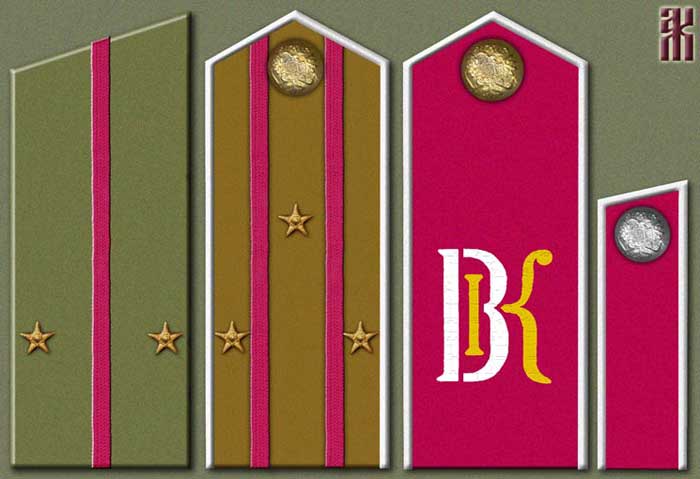
Insignia of the 1st Volga Army Corps
1 and 2 – second-lieutenant and lieutenant-colonel (based on a photograph);
3 – private of the 1st Volga General Kappel' Rifle Regiment; 4 – greatcoat collar tab
The monogram of the 1st Volga General Kappel' Rifle Regiment is reconstructed from the cipher on the banner presented to the corps by the residents of Kurgan, based on B. B. Filimonov's information. That monogram consisted of the intertwined letters "ВГКп".
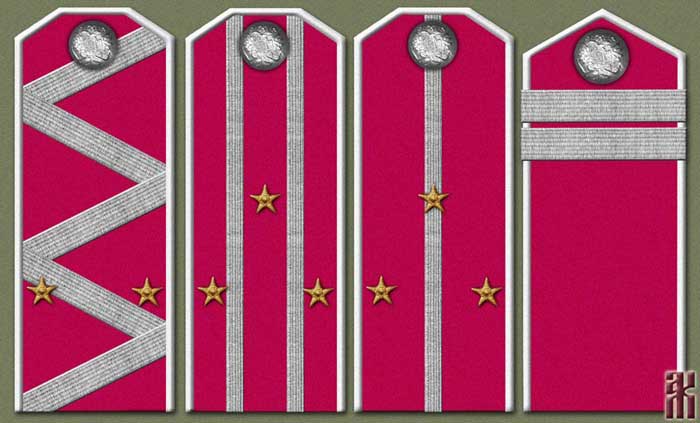
Shoulder-boards of the 1st Volga Army Corps (Volga Army Group)
Note: The question of the metal remains open as to whether it was silver or gold. As infantry units, the Kappelevtsy would normally have had gold, but the available photographs of the corps leans in favor of silver – it stands out much more brightly against a dark background.
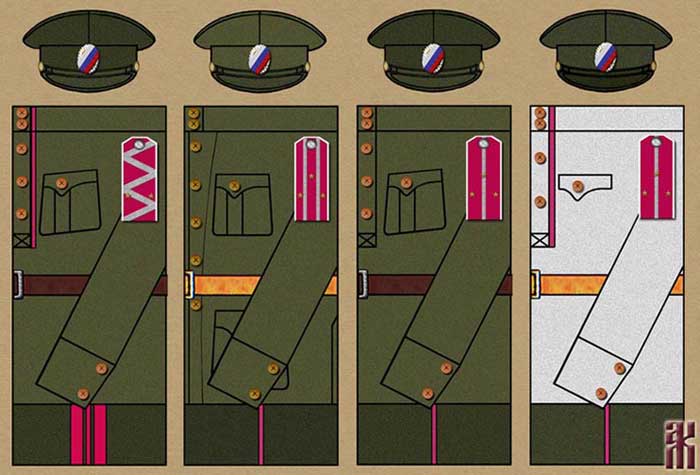
Uniforms of the 1st Volga Army Corps:
1 – general; 2 – staff officer; 3 – lieutenant; 4 – staff lieutenant
Figure 1 is based on photographs of the commanders of the 13th Kazan and 1st Samara Rifle Divisions, Generals Yastrebtsov and General Sakharov. Figure 2 is based on photographs of the 1st Volga Army Corps headquarters. Figures 3 and 4 are based on photographs of the Volga Army Group.
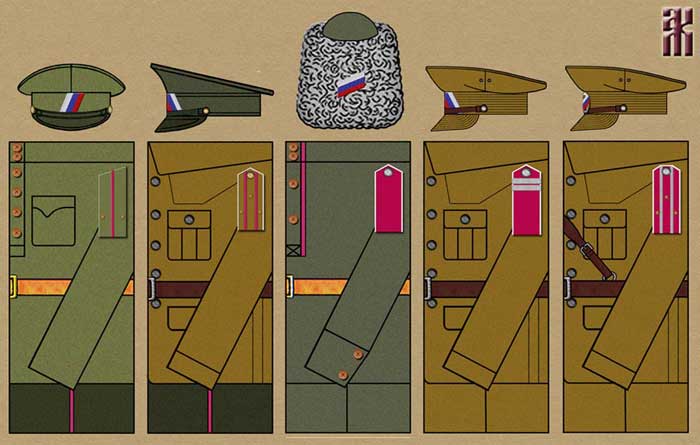
Uniforms of the 1st Volga Army Corps:
1 – field officer; 2 – staff officer; 3 – private; 4 – corporal; 5 – lieutenant-colonel
Figure 1 has sewn-on shoulder-boards without buttons. Figure 2 is based on a photograph of the 1st Volga Army Corps headquarters. It shows shoulder-boards sewn onto a British tunic, but it is unclear if they are Russian shoulder-boards or the original straps of the tunic, piped and sewn. Figures 4 and 5 show British uniform with Russian shoulder-boards.
Home — State Symbols — Flags — Uniforms — Badges & Medals — Money — Other
Pygmy Wars Notes
The original for this page is at kolchakiya.ru/uniformology/Kappel_units.htm.
The shoulder-board shown with the letters "ВГКп" ("VGKp", for Volga General Kappel' Regiment) is from the Primor'e period, long after the Corps had been folded.
The uniforms of the corps cavalry, the Independent Volga Cavalry Brigade, are discussed here.
Other units attached the to corps in late 1919 also have pages: 12th Ural Division, Orenburg Cossacks, Ufa Hussars and Hetman Sahaidachnyy Regiment, and the Serbian Detachment.
The following illustration by A. Lebedeva was in the original page but later removed.
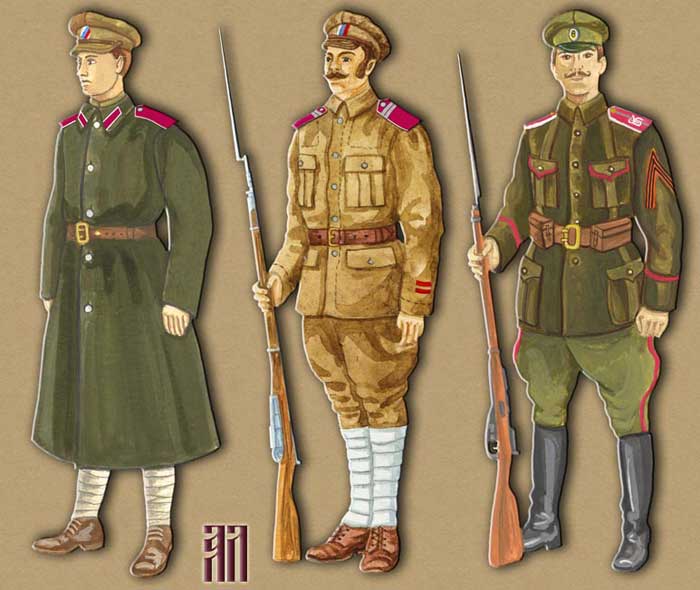
1 – Soldier of the 3rd Simbirsk Rifle Division, 1919 (former Red Army soldier);
2 – Corporal of the 1st Samara Rifle Division, 1919 (old volunteer);
3 – officer of the 1st Volga General Kappel' Rifle regiment, Primor'e 1921
Discussion on the translation choices I have made can be found here.
Flags
The corps' banner is known, but would not have been flown in battle.
Early on the original regiments flew largely red flags or those in the colours of St George (yellow and black stripes). A conjectured reconstruction of one for the 2nd Samara Regiment is shown on this page.
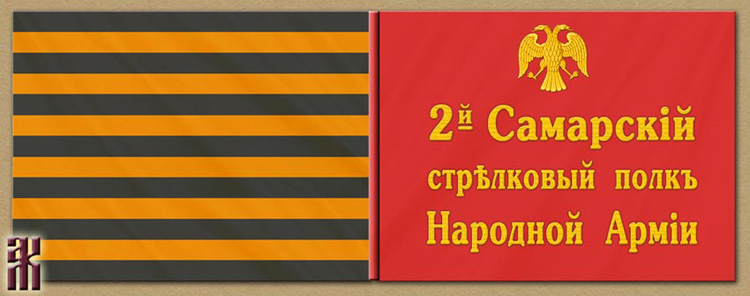
I think it unlikely that the red flags would have survived far into Kolchak's army, and certainly not the reference to the People's Army, but the St George colours likely did.
There is a description of a Kappel'evtsy flag in the Primor'e period. However it must have been a very late one, as it had a picture of the medal for the Great Ice Campaign.
It seems unlikely that these units had former Imperial flags.
History of the 1st Volga Corps
Taken from Volkov
The origins of this corps was the People's Army Samara Group, made up of the 1st Samara, 2nd Kazan, and 3rd Simbirsk Independent Brigades and 1st Troitsk Reserve Regiment. At that point they did not wear shoulder-boards. It was largely volunteers, with a lot of officers, and very good. It fought alongside the Czechs.
They were withdrawn from the front and reorganised, coming back as the 1st Volga Corps in January 1919, with the 1st Samara, 3rd Simbirsk and 13th Kazan Rifle Divisions and the Volga Cavalry Brigade. Each division was three rifle regiments, a jaeger battalion, a horse divizion and an artillery divizion. The quality was diluted somewhat in this expansion by the addition of many POWs and conscripts, but the units were still quite small.
In May 1919 it was part of the Independent Western Army. Soon after the 12th Ural Division, 3rd Ufa-Samara and 6th Issetsco-Stavropol Orenburg Cossacks, Ufa Hussars and 3rd Ukrainian Hetman Sahaidachnyy Regiment, Voivode Kiselev Serbian Detachment, an armoured divizion and the 3rd air divizion were added to the corps.
The corps took heavy losses near Kemchug and disintegrated in the retreat to Chita. In Transbaikalia the remnants became the Independent Volga Brigade (70% from the former Samara Division, the rest mainly the Kazan Division plus some Dragoons).
When Semenov fell the unit left via the Chinese Eastern Railway. The remaining men now formed the 1st Volga "General Kappel" Rifle Regiment and 3rd Volga "General Kappel" Battery in Primor'e (the cavalry remained almost entirely in Harbin).
1st Samara Division
This contained the 1st Volga, 2nd Samara and 3rd Stavropol' Rifle Regiments, a jaeger battalion and the 1st Samara Rifle Artillery Divizion. The 4th Orenburg Cossack Regiment was attached to the division and operated under its command.
Despite having been effectively reduced to a regiment as early as the start of the Siberian Ice Campaign in the Novo-Nikolaevsk area, and soon after having its entire HQ wiped out, the division survived near Krasnoyarsk and reached Chita in significant numbers.
3rd Simbirsk Division
Originally formed in November 1918 as the Simbirsk Independent Brigade. On 3 January 1919, when it moved to the 1st Volga Army Corps, it was designated as the 3rd Brigade, then in February 1919 it became a division. In mid-1919 it had the 9th Simbirsk, 10th Bugulma, 11th Sengileev and 12th Buzuluk Rifle Regiments, the 3rd Simbirsk Rifle Artillery divizion, the 3rd Jaeger Battalion, 3rd Simbirsk Horse divizion, an independent howitzer battery and an artillery park.
In May 1919 the Bugulma Regiment was surrounded by the enemy and, after a failed attempt to break through, surrendered to the Reds. On 19 November 1919 the division was placed in reserve. Effectively reduced to a regiment at the start of the Siberian Ice Campaign in the Novo-Nikolaevsk area, it was disbanded at the end of December 1919.
13th Kazan Rifle Division
Formerly the 1st Kazan Rifle Division of the People's Army, it included: the 49th Kazan, 50th Arsk, and 51st Urzhum Rifle Regiments. It may not have had an artillery divizion by mid-1919.
Effectively reduced to a regiment as early as the start of the Siberian Ice Campaign in the Novo-Nikolaevsk area, the division was entirely wiped out near Krasnoyarsk (only the division commander and his staff reached Chita).