
Uniforms of the Cavalry Formations of the Supreme Ruler's Army
(New Formations)
Contents:
Chelyabinsk Cavalry Instructor School
Izhevsk Horse Regiment and the Votkinsk Horse Divizion
Independent Cavalry Brigade, Partisan Division of Ataman Annenkov
Independent Achinsk Horse Divizion of the Independent Krasnoufimsk Partisan Brigade
Material and reconstructions by A. Karevskiy, unless noted otherwise
2nd Cavalry Division
Omsk, Autumn 1919
Far away, the lances of the Cossack sotnias and the 2nd Ufa Cavalry Division, under the command of Major-General Dzhunkovskiy, were twitching at a trot. It included regiments ... of hussars, lancers and dragoons, but without the formerly splendid equipment and bearing, since the Tatar and Bashkir squadrons were mostly led by infantry officers.
Cherkashin, N. A. in "Admiral Kolchak // Admirals of the Rebel Fleets", Moscow, 2004, pp.220, 228.
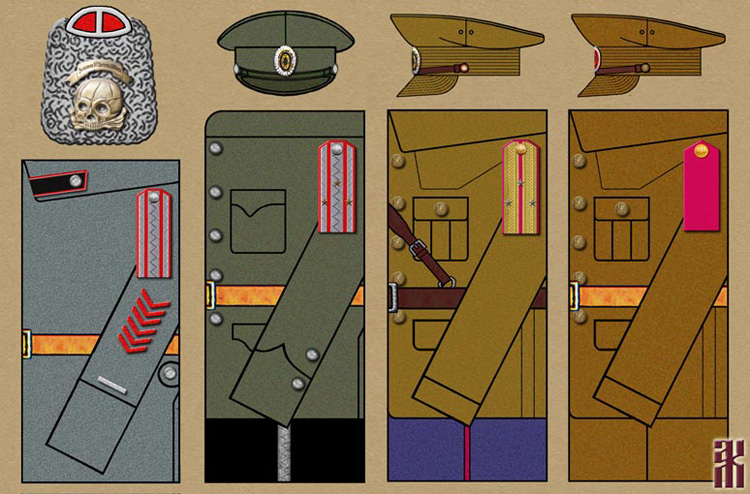
Uniforms of the 2nd Ufa Cavalry Division:
1 - division chief of staff, Colonel V. A. Petrushevskiy; 2 – colonel; 3 – lieutenant; 4 – private
Figure 1 is based on a photograph at blackhussars.ru. Figure 2 is based on a photograph of the commander of one of the regiments, Colonel A. N. Lenkov, published at forum.vgd.ru. Figure 3 is an extrapolation of the officer's uniform to British version. Figure 4 is a reconstruction based on a photograph of a cavalry group, published at www.ecpad.fr.
blackhussars.ru/publ/poslednjaja_paradnaja_forma_quot_bessmertnykh_quot_gusar_chast_3_ja/1-1-0-81 [link dead]
forum.vgd.ru/?a=list_warn2&m=feed&u=92405
http://www.ecpad.fr/la-mission-de-la-spca-1918-1919 [link dead]
1st Ural Hussar Regiment
This would later become the Cavalry Divizion of the 6th Ural Mountain Rifle Division, then of 7th Ural Mountain Rifle Division.
A Chapaevets wrote in his memoirs about a certain detachment of Kolchak's hussars in the Urals: the officers of the captured White detachment were dressed in sturdy light blue jackets similar to those of the hussars, grey-blue breeches and caps with blue crowns and red bands. When asked what regiment it was, he was told: "The First Hussar Regiment"!
pehota.zbord.ru/viewtopic.php?t=462 [link dead]
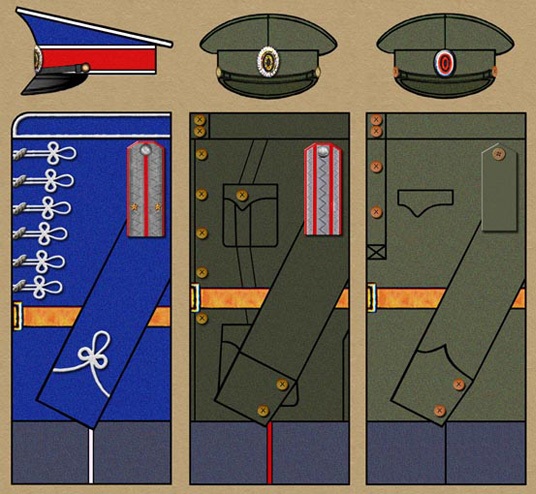
Uniforms of the 1st Ural Hussar Regiment
Figure 1 is based on the description given at the pehota.zbord.ru reference. Figure 2 is based on a photograph of an unidentified cavalry unit. Figure 3 is based on a photograph at sammler.ru of an unidentified cavalry unit, apparently from Autumn 1918.
www.sammler.ru/index.php?showtopic=73189&st=0&;
Chelyabinsk Cavalry Instructor School
The school uniform was blue shoulder-boards, khaki blouse, red breeches and field equipment.
Elenevskiy A. Military schools in Siberia (1918-1922)// Cadets and Junkers in the White Struggle and abroad. M., 2003, p.452.
Izhevsk Horse Regiment and the Votkinsk Horse Divizion
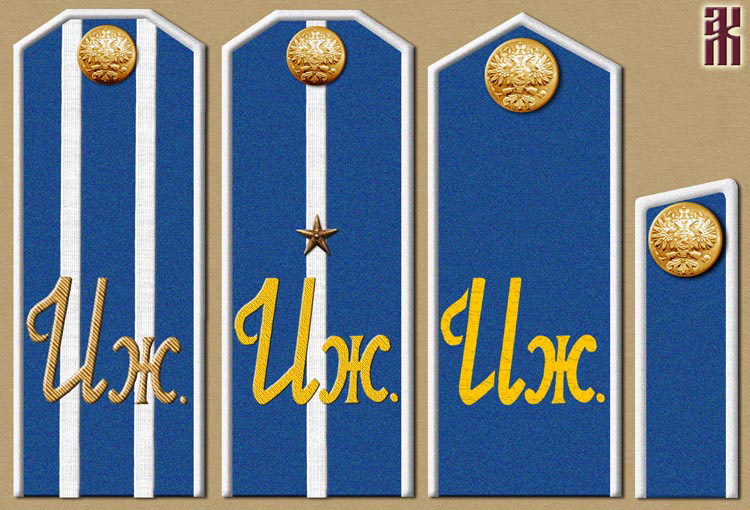
Shoulder-boards of the Izhevsk Horse Regiment of the Izhevsk Rifle Division.
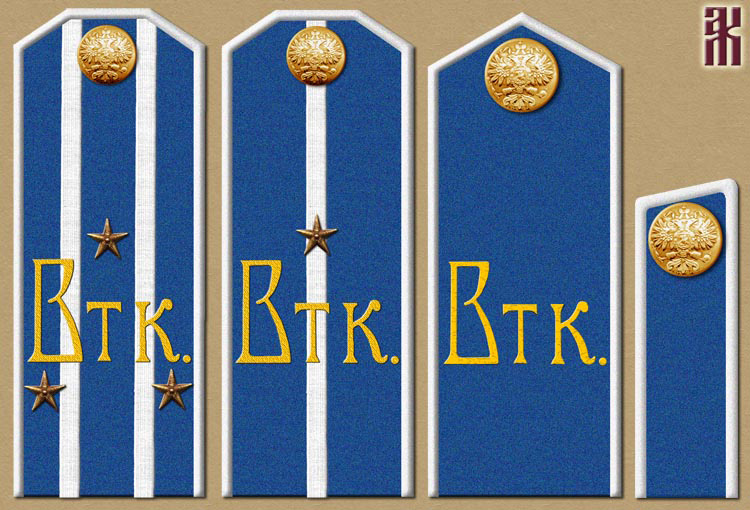
Shoulder-boards of the Votkinsk Horse Divizion of the 15th Votkinsk Rifle Division.
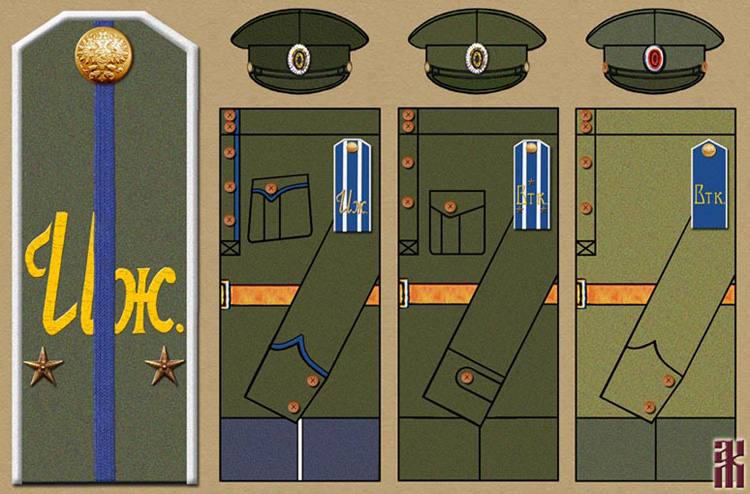
Uniforms of the Izhevsk Horse Regiment and the Votkinsk Horse Divizion.
The khaki version of the shoulder-board is based on a photograph of Second Lieutenant Y. B. Bagints. Figure 3 is a reconstruction based on a photograph of V. N. Drobinin.
Independent Cavalry Brigade, Partisan Division of Ataman Annenkov
It remains unknown whether B. V. Annenkov, when designing the uniforms for the regiments of the Independent Cavalry Brigade of his Partisan Division, was guided by the regiments with similar names – the 5th Aleksandria Hussar Regiment ("Black Hussars") and the 10th Odessa Lancer Regiment ("Blue Lancers"). Some say that while serving in the Imperial Russian Army, he got to know these units well, which is why they stuck in his mind. But whatever the case, it's safe to say that there was no direct revival of the old regiments, nor was there any literal borrowing of their uniforms and symbols.
Barnaul Regiment (the Blue Lancers)
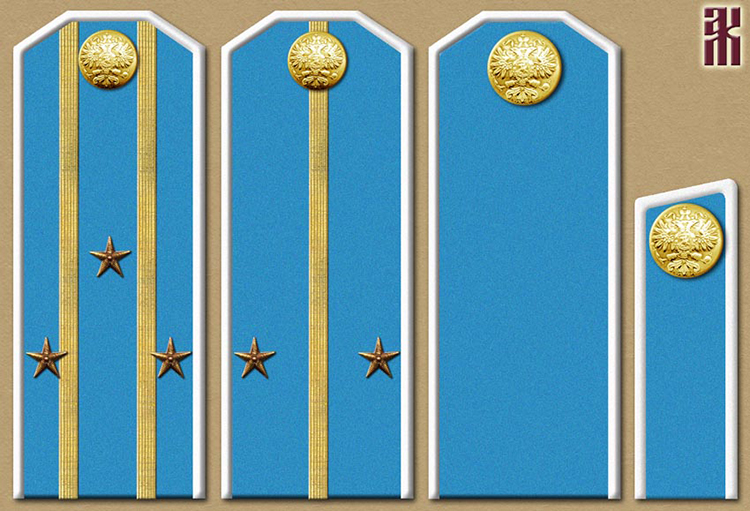
Shoulder-boards of the Barnaul Regiment, the Blue Lancers
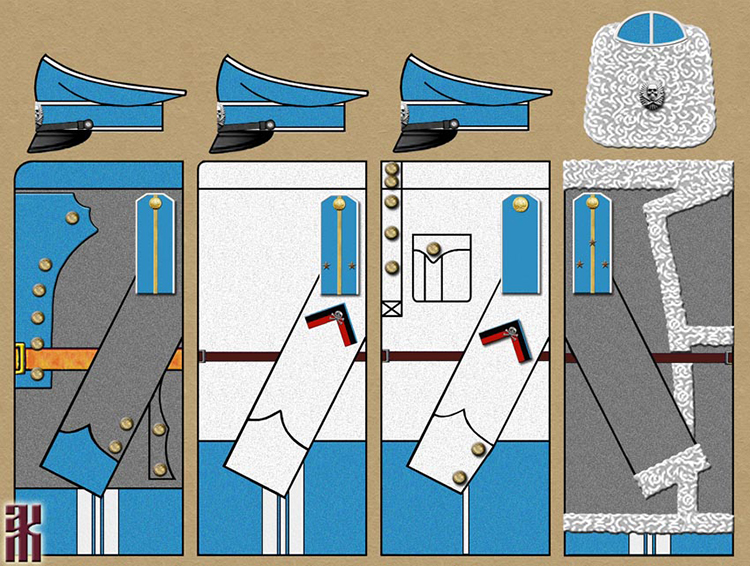
Uniforms of the Barnaul Regiment, the Blue Lancers
The shoulder-boards are shown with gold metal, as this was the metal used by the 10th Odessa Lancer Regiment, and with white piping, characteristic of the non-Cossack regiments of the Partisan Division.
Figure 1 is the original parade uniform, which appeared when the regiment was formed in Barnaul (the memoirs below mention "grey overcoat cloth with blue lapels", and this is how we interpret a uniform "with lapels". The trouser stripes are shown as double-rowed, which is again characteristic of the Lancer uniforms until the end of the 19th century. Double-rowed stripes were generally common in the regiments of the Partisan Division. Figures 2 and 3 are the regiment's full dress uniform when it became part of the Independent Cavalry Brigade. One blouse is modelled on that of the Chernigov Hussars, only white in colour, and the other a blouse with a standard opening and two breast pockets, which is the version at the pygmywars page for this unit. The breeches have wide stripes for the second-lieutenant and one thin for the private. Figure 4 is in a bekesha with white fur and a papakha.
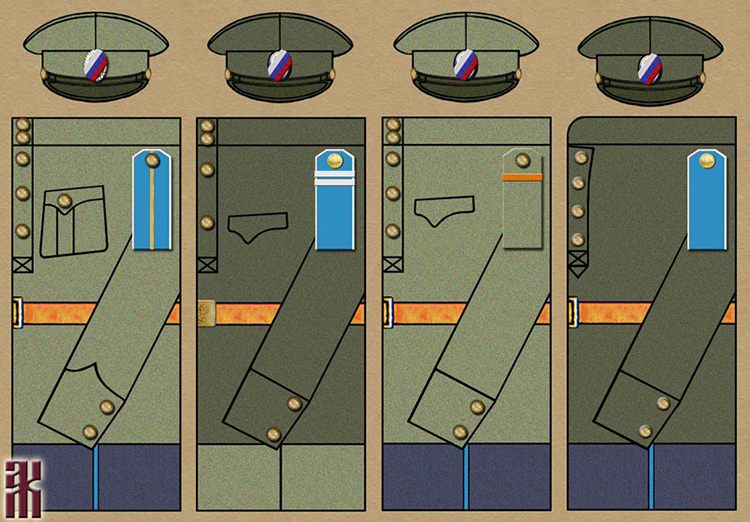
Uniforms of the Barnaul Regiment, the Blue Lancers
Two well-known photographs of the Blue Lancers regiment, cited in Goncharov's article were used in these reconstructions. The reality of the regiment's service at the front, far from Semirech'e and the Partisan Division, was reflected in the appearance of its officers, who preferred to wear ordinary khaki uniforms and cockades intertwined with ribbons of national colours, differing only in the shoulder-boards of the regimental colour.
Goncharov, Yu. I. in "The Commander of the Barnaul Regiment of the Blue Lancers of the Independent Cavalry Brigade of the Partisan Division of Ataman Annenkov, Nikolai Stepanovich Andrushkevich // White Army, White Cause, No. 23", Ekaterinburg, 2017, pp.82-84.
The regiment of blue lancers had blue shoulder-boards, blue caps and general partisan insignia ...
Goltsov, V. A. in "Siberian Vendee: The Fate of Ataman Annenkov", Moscow, 2009, pp.127-129.
The commander of the machine gunners, Lieutenant Andrushkevich, also a Belarussian, was the brother of Colonel Andrushkevich, commander of the Blue Lancers regiment, which struck fear and awe into all dissidents in Barnaul. This regiment had its own uniform, which was predominantly blue in colour, which is why they were nicknamed the "Blue Lancers" and, by the common people, "shrikes". The shrike is a winter bird in Siberia, like blue tits, whose colourful plumage resembled that of the lancers. Even Colonel Andrushkevich's wife sewed herself a blue uniform and rode around the city on horseback, like some kind of regimental commander. The regiment was made up of the sons of the local urban nobility and the wealthy elite of the city.
Polkovnikov, V.L. in "On the waves of the sea of life // ZAO Polygraphic Enterprise No. 3", St. Petersburg, 2013, p.85. Material kindly provided by Voronezh researcher N. Zayats.
In 1919, the unit had more than 1,000 men and more than 1,200 horses. The regiment had its own insignia: blue lapels, blue breeches, caps with blue crown and tricolour cockades
Goncharov, Yu. I. in "The Commander of the Barnaul Regiment of the Blue Lancers of the Independent Cavalry Brigade of the Partisan Division of Ataman Annenkov, Nikolai Stepanovich Andrushkevich // White Army, White Cause, No. 23", Ekaterinburg, 2017, p.83, citing KGKU GAAK F.2r Op.7 D.307 L.395.
Archival criminal cases reveal that in early November 1918, due to a tense relationship between the commandant of Barnaul and the commander of the cavalry sotnia created to guard the city, the latter was sent to Semipalatinsk. There it was transformed into a divizion and then into the regiment of "blue lancers". The regiment differed from other units in its distinctive uniform: grey greatcoat cloth with blue lapels, stripes and a death emblem (skull and crossbones) on the cap and shoulder-boards.
siberia.forum24.ru/?1-4-0-00000071-000-0-1-1358691412
Ataman Annenkov's "blue lancers" left a strange memory among the city's residents. On their sleeves, they wore an image of a human skull with two crossed bones.
"Kamyshlov", Sverdlovsk, 1968, p.34 at kam-news.ru/?p=15180
Lebedev: What White Army units were in Semipalatinsk in 1919 and what were the major headquarters?
Merkuryev: I don't know, except for the training detachment, Annenkov's komand, whose soldiers and officers wore a skull and crossed bones on their caps and shoulders.
Lebedev: Did your lancer regiment wear the same insignia?
Merkuryev: No, we wore tricolour cockades.
Goncharov, Yu. I. at siberia.forum24.ru/?1-4-0-00000071-000-0-0-1340879241
Raid by Tomin's cavalry group near Tyumen, 1919
By the end of the day, we had driven the Whites into the marshy lowlands between the lakes. Almost all Kolchak's troops surrendered. A squadron of lancers dressed in blue uniforms fought desperately and was completely wiped out.
Medvedev, A. I. in "Through Valleys and Hills", Moscow, 1960, p.144.
The Black Hussars Regiment
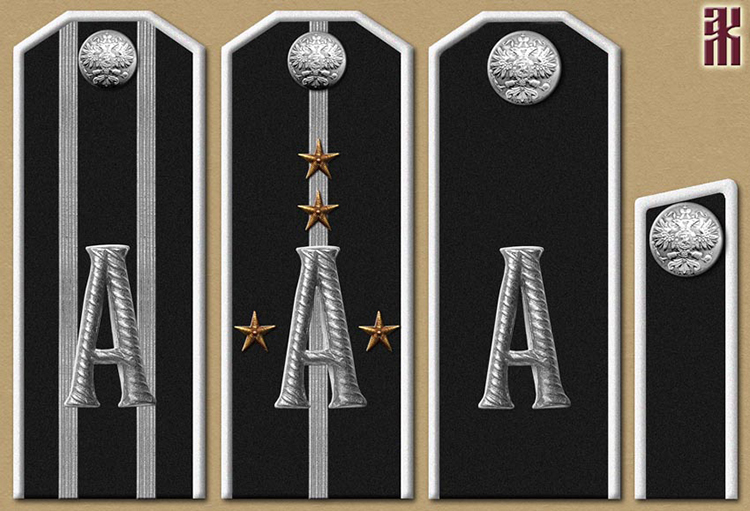
Distinguishing insignia of the Black Hussars Regiment
There is a debate in the literature regarding the monograms: researcher V. A. Goltsov denies their existence, but almost all memoirs mention the "А.А." monogram (for Ataman Annenkov). Numerous photographs of the regiment's shoulder-boards show only one letter "A", quite narrow, tall and straight (without curls). This is the version that has been reconstructed here.
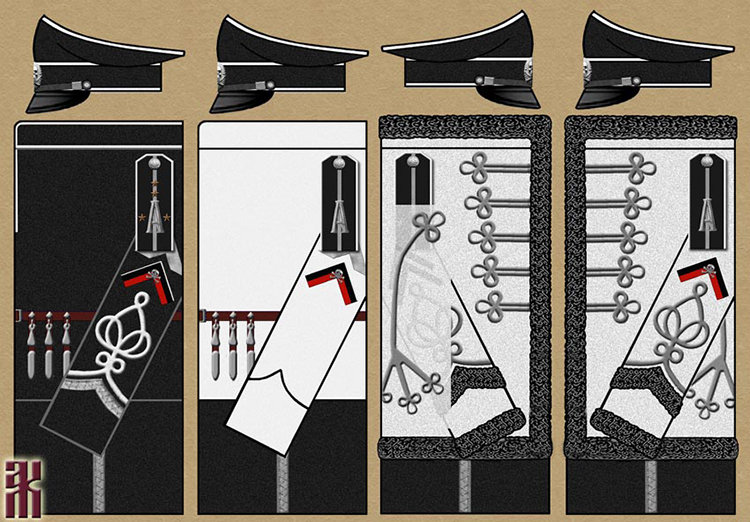
Uniform of the officers of the Black Hussars Regiment
Figure 1 is in full dress uniform with sleeve knots and a Caucasian belt. Figure 2 is in a summer white blouse. Figures 3 and 4 are in [hussar] dolmens (figure 3 has part of the uniform shown transparent in order to depict the braiding of the cords on the back of the dolmen).
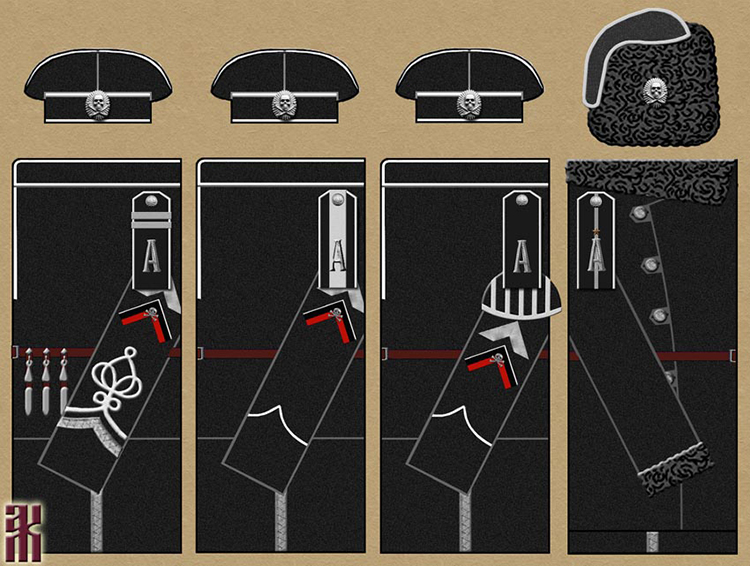
Uniform of other ranks of the Black Hussars Regiment
Figure 1 is in full dress uniform with sleeve knots and a Caucasian belt. Figure 2 is in an everyday blouse (without hussar knots and belt). Figure 3 has the "wings" of a regimental orchestra musician. Figure 4 is in a black cloth-lined sheepskin coat and papakha hat with a black hussar bag.
The regiment of black hussars wore black shoulder-boards, black caps with white piping, black blouses and partisan insignia, as well as silver Caucasian belts and bright red bashlyki. According to G. K. Gins, the Black Hussars stood out from all the other military personnel and were mistaken for the admiral's escort. ... As for the shoulder-boards with the "AA" (Ataman Annenkov) stencil, despite references to this in the literature, I will not confirm their presence or absence. Annenkov does not mention such shoulder-boards.
Goltsov, V. A. "Siberian Vendee: The Fate of Ataman Annenkov", Moscow, 2009. pp.127-129.
Annenkov's men wore a special uniform. They had bright red bashlyki hanging behind their backs. They stood out from all the other soldiers and were mistaken for the admiral's escort. In reality, Kolchak's escort wore the standard English-style uniform for Omsk.
Gins, G. K. in "Siberia, the Allies and Kolchak", Moscow, 2007, p.530.
The Black Hussars and the Life-Ataman (or Escort) Regiments stood out for their uniforms. The former wore entirely black caps with white piping and a skull and crossbones instead of a cockade, black blouses (with knots on the sleeves), trousers with stripes, red shoulder-boards with white piping and the letters "A.A.", white belts with black edging and boots with rosettes, on which a skull and crossbones was attached.
From 23 October 1918 a black and red partisan chevron [was added].
From 11 November 1919 black chevrons for length of service [were added].
Deryabin, A. I. in "Civil War in Russia 1917-1922: The White Army", Moscow, 1998. p.30.
Only on 18 and 19 September 1919 did a cavalry brigade under the command of Colonel Belavents begin to arrive at the front in the Petropavlovsk trakt area. The Black Hussars cavalry regiment was part of the brigade: commanded by Captain Danilenko, it had been formed in the city of Petropavlovsk, mostly from volunteers. After training at Stenetskaya hamlet, 40 kilometres west of Isil-Kul, the regiment marched to the front line through Bogodukhovo. It consisted of four squadrons, commanded by Second Lieutenant Vishnevetskiy, Lieutenant Khrenkov, Second Lieutenant Antsiferov and Lieutenant Kiselev, with a total of about 550 sabres and 8 machine guns. The appearance of the soldiers attracted attention with their unusual uniform. Their black visor-less caps with white piping and a skull and crossbones instead of a cockade were particularly striking. Their uniforms were complemented by black blouses and trousers with stripes, black shoulder-boards with white piping and the letters "AA". The regiment's soldiers wore a shock chevron with a skull and crossbones on their sleeves, and they were all armed with sabres. Another equally striking part of the brigade was the Barnaul "Blue Lancers" cavalry regiment, commanded by Colonel Andrushkevich. At the same time, a battery of MacLean guns arrived.
Information from Moscow researcher O. Vinokurov at www.siberia.forum24.ru/?1-4-0-00000035-000-10001-0-1286712022
Independent Achinsk Horse Divizion of the Independent Krasnoufimsk Partisan Brigade
This unit started as the Achinsk Horse-Partisan Detachment.
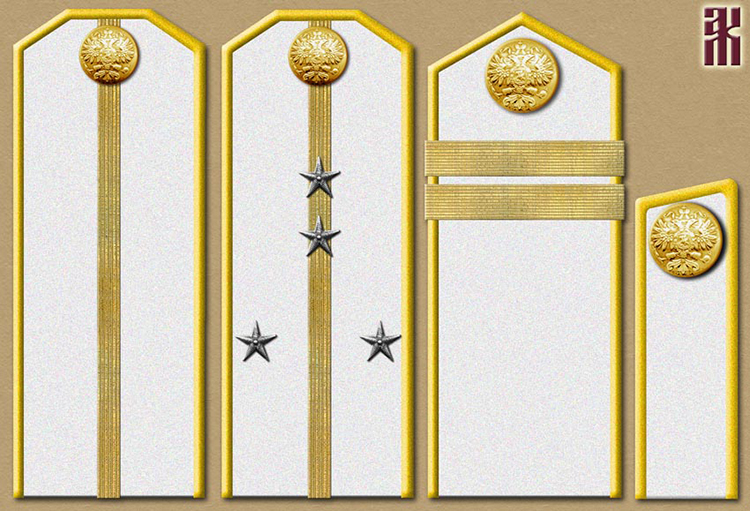
Insignia of the Achinsk Cavalry Divizion
The founder and first commander of the divizion, Captain E. G. Freyberg, was an officer of the 14th Yamburg Lancer Regiment. When forming the Achinsk Horse-Partisan Detachment, he considered it a continuation of his former regiment, which was later even recognised by the Yamburg Regiment Association in exile. However, historian and researcher of White Movement awards P. V. Pashkov notes the white shoulder-boards and greatcoat tabs of the divizion, whereas the Yamburg Lancers wore yellow shoulder-boards with dark blue piping (silver braid for the officers).
Apparently, the colours of the original detachment, and so later the divizion, were determined by the predominance in its early composition of cadets from the 1st Siberian Cadet Corps, who had white shoulder-boards with yellow piping. Their officers had gold braid (here you can see how the corps' metal insignia was transformed into golden braid highlights on cloth shoulder-boards).
.jpg)
Uniforms of the Achinsk Cavalry Divizion:
Figure 1 is of Captain Freyberg. Judging by the surviving photographs, he continued to wear the regimental uniform of the 14th Yamburg Lancer Regiment (with the corresponding shoulder-boards and breeches with light blue stripe). However, P. V. Pashkov mentions the white stripes that existed in the divizion – here they are shown, as was traditional for lancer regiments, in two rows.
Its motto was "For Faith, Tsar and Fatherland", and distinguishing it from the Siberian Army, which did not wear shoulder-boards, were white shoulder-boards, greatcoat tabs and [trouser] stripes. They used the old cockades instead of the white and green ribbons of the other units.
Pashkov, P. V. in "Orders and Distinctions of the Civil War of 1917-1922 // Voennaya Byl, No. 1", Paris, 1961, p.21.
Home — State Symbols — Flags — Uniforms — Badges & Medals — Money — Other
Pygmy Wars Notes
The original for this page is at kolchakiya.ru/uniformology/kav_units.htm. It has been split into two, as it was getting too unwieldy. The units descended from former Imperial units are here.
For the 2nd Ufa CD, the photo of Petrushevskiy is this one here. The reconstruction of Colonel Lenkov is based on this one here. The private may be based on this one here. The sammler.ru photograph of the 1st Ural Hussar Regiment is this one here.
The original page has V. N. Drobinin as the wrong figure. I think the photograph in question is this one here, which does not have any coloured features on the blouse. In any event Drobinin served with the Votkintsy, not the Izhevtsy, so cannot be Figure 2.
Lancers in the Imperial army had dark blue piping on their shoulder-boards, not light blue. The figure for Captain Freyberg, being the uniform of the Imperial 14th Yamburg Lancer Regiment, has therefore been amended on this page to reflect the correct colours: a yellow field with dark blue piping.
Discussion on the translation choices I have made can be found here.
Flags
The flags for the Black Hussars and Blue Lancers of Ataman Annenkov's Partisan Division are shown on the page for that division.
History of the 2nd Ufa Cavalry Division
Formed in November 1918 from the Ufa Cavalry Brigade, whose regiments had been established in the summer of 1918 in the Urals. From January 1919 it was temporarily incorporated into the 2nd Ufa Army Corps of the Western Independent Army. At the end of May, during the reorganisation of the army, the division became part of the Ural Group. From July 1919 it was part of the Cavalry Group of the 2nd Army, and from August the Cavalry Group of the Composite Cossack Corps.
It was made up of a dragoon (formerly the 1st Independent Russian-Czech Cavalry Partisan Detachment), hussar, lancer and Cossack Ufa Regiments and the 2nd Horse Artillery Divizion. The officers were mainly former infantry, whilst the soldiers were mostly Tatars and Bashkirs. Although inferior in drill, the division was almost indistinguishable from the 1st Cavalry Division in terms of combat capabilities. Around June 1919 the 1st Ural Hussar Regiment may have joined.
In June 1919 the main regiments each were three or four sotnias, with 200-350 sabres and 4-6 MGs, although the Ural Hussars were much smaller. In total, the division in June 1919 had 19 hundreds, 89 bayonets, 1,118 sabres, 22 machine guns and 2 guns.
It suffered heavy losses and, upon arrival in Chita, was merged into the Ufa Hussar (Cavalry) Regiment, with around 450 sabres, as part of the 2nd Ufa Rifle Division. In Primor'e the men went into the Composite Cavalry Regiment.
History of the 1st Ural Hussar Regiment
This has proved hard to track. The Kolchakiya page states that it acted as divisional cavalry for the 6th Ural Mountain Rifle Division, and then the 7th, but they are not included in histories for those units than I can find. Another source has it included as part of the 2nd Ufa Cavalry Division. However these are not necessarily incompatible, as it may have been detached. In any event, it was always a small unit, probably never more than 200 sabres, in two sotnias.
History of the The Chelyabinsk Cavalry School
Established on the Eastern Front in May 1919. Composed of two squadrons – a training squadron and a cadet squadron – each of 80 men. Following the Siberian Ice Campaign its cadets were promoted to cornet (2nd-lieutenant) rank in Chita, and it was reorganised into the "Bartenyev Squadron", which saw action until 1922.
History of the Izhevsk Horse Regiment
Formed alongside the Izhevsk units after the rebellion. By the end of November 1919 the regiment had 25 officers and 700 soldiers in active service. It seems to disappear after that, so may not have survived the Ice March.
History of the Votkinsk Horse Divizion
Formed alongside the Votkinsk units after the rebellion from the cavalry units of the Votkinsk People's Revolutionary Army. Throughout its history it had very few Tsarist officers – almost all the officers were promoted from the ranks. It was part of the 15th Votkinsk Rifle Division and survived the merger with the 16th Sarapul Division.
It was part of the Izhevsk-Votkinsk Brigade in Transbaikalia and was independent in Primor'e. During the Khabarovsk campaign in late November 1921 it fielded 184 combat personnel, including 32 officers and 3–4 machine guns. In August 1922, it was renamed the Prikama Cavalry Divizion (druzhina) as part of the Prikama Regiment of the Volga Group. As of 1 September 1922 it numbered 110 sabres.
History of the Independent Cavalry Brigade of Ataman Annenkov
Information on these units can be found here. Note that while officially brigaded together, they seem to have never fought together. The Black Hussars went to the Semirechensk and then China, whereas after the collapse of the Siberian Front the Blue Lancers appear to have fled east and drop from the record.
History of the Achinsk Cavalry Partisan Detachment
Formed in February 1918 in Krasnoyarsk as a small infantry partisan detachment from cadets from the Siberian Cadet Corps and other young students. In March 1918 it became the Achinsk Partisan Detachment, which soon became a mounted unit. It operated within the Krasnoyarsk-Minusinsk-Achinsk triangle. In June 1918 it was reorganised into a squadron and incorporated into the Siberian Army.