
Uniforms of the Cavalry Formations of the Supreme Ruler's Army(Former Imperial Units)
Contents:
Overview of the Regular Cavalry in the East of Russia
Independent Volga Cavalry Brigade
Irkutsk Hussar (Cavalry) Divizion of Ataman Krasilnikov's Partisan Brigade
Material and reconstructions by A. Karevskiy, unless noted otherwise
Overview of the Regular Cavalry in the East of Russia
The 1st Cavalry Division was considered the successor to the 5th Cavalry Division of the Russian Imperial Army: the Kazan Dragoon Regiment inherited the traditions and uniform of the 5th Kargopol' Dragoon Regiment, and the Simbirsk Lancer Regiment inherited those of the 5th Lithuanian Lancer Regiment. However, B. B. Filimonov points out that the Kazan Regiment had red shoulder-boards with coloured piping, while their predecessors, the Kargopol' Regiment, had white shoulder-boards with green piping. At the same time, the 9th Kazan Dragoon Regiment of the Russian Imperial Army had red shoulder-boards with white piping. This contradiction can only be resolved by finding the relevant documents.
The Independent Volga Cavalry Brigade (formed around members of the previous regiments that did not go into the units mentioned above) also considered itself the successor to the 5th Cavalry Division: the Samara Hussar Regiment was a successor to the 5th Aleksandria Hussar Regiment, and the Volga Dragoon Regiment a successor to the 5th Kargopol' Dragoon Regiment.
Among the newly formed units, the 1st Tomsk Siberian Hussar Regiment copied (although it did not have the right to directly succeed) the 5th Aleksandria Hussar Regiment, and only the Ekaterinburg Lancer Regiment received its own external distinctions.
In Irkutsk, an attempt was made to revive the 16th Irkutsk Hussar Regiment, which later became the Irkutsk Hussar (Cavalry) Divizion, part of I. N. Krasilnikov's Partisan Detachment (Brigade). Finally, the Primor'e Dragoon Regiment was restored under its own name, not as part of any formation and continued to be stationed in Razdol'noe.
See: Volkov, S. V. "Encyclopedia of the Civil War: The White Movement", Moscow, 2003, pp.87, 233, 444, 487, 520.
| Unit of Kolchak's Army |
Unit of Imperial Army |
Officer shoulder-boards |
Ranks shoulder-boards |
Cap |
Trousers (breeches) |
|
|---|---|---|---|---|---|---|
| Tomsk Hussar Regiment | 5th Aleksandria Hussar Regiment | Silver, red stripes and piping |
Red | Black crown and red band, white piping |
Black, silver or white stripe |
|
| Samara Hussar Regiment | 5th Aleksandria Hussar Regiment | Silver, red stripes and piping |
Red | Black crown and red band, white piping |
Black, silver or white stripe |
|
| Kazan Dragoon Regiment | 5th Kargopol' Dragoon Regiment | Gold, white stripes, dark green piping |
White, dark green piping |
White crown, green piping, green band, white piping | grey-blue, white stripe |
|
| Volga Dragoon Regiment | 5th Kargopol' Dragoon Regiment | Gold, white stripes, dark green piping |
White, dark green piping |
White crown, green piping, green band, white piping | grey-blue, white stripe |
|
| Simbirsk Lancer Regiment | 5th Lithuanian Lancer Regiment | Silver, red stripes and piping |
Red, blue piping |
Blue crown, red piping, red band, blue piping |
grey-blue, red stripe |
|
| Ekaterinburg Lancer Regiment | – | Gold, raspberry stripes and piping |
Raspberry, blue piping |
– | Grey-blue, raspberry stripe |
|
| Primor'e Dragoon Regiment | Primor'e Dragoon Regiment | Gold, yellow stripes and piping |
Yellow | Yellow crown, dark green piping, green band, yellow piping | Grey-blue, yellow stripe |
|
| Irkutsk Hussar Divizion | 16th Irkutsk Hussar Regiment | Gold, raspberry stripes and piping |
Raspberry | Dark green crown and raspberry band, yellow piping | Raspberry, gold or yellow stripe |
|
| Horse Artillery Divizion | – | Gold, red stripes and edging, blue piping |
Red, blue piping |
Black crown and band, red piping | Grey-blue, red stripe |
Order to the Far Eastern Army Units, No. 6 of 15 May 1920, Chita
In an amendment to the Order No. 68 to the units of the Russian Eastern Frontier, dated 30 April of this year, in accordance with the instructions of the Commander-in-Chief, the Army Commander orders that officers be prohibited from wearing red cloth breeches and coloured caps with their wartime uniforms.
Signed: Chief of Staff of the General Staff, Major-General Akintievskiy
Document kindly provided by Moscow researcher V. V. Romanov.
Order to the Far Eastern Army Units, No. 25 of 28 May 1920, Chita.
The army commander orders: a) a confirmation of the prohibition on officers wearing coloured caps as part of their wartime uniform (the cap must be khaki).
Signed by Major-General Akintievsky and Duty General, Major-General Gafner
Document kindly provided by Moscow researcher V. V. Romanov.
1st Cavalry Division
Formation
There was an absence of cavalry regiments in the Volga region, Siberia and the Urals – there were only the Aleksandriytsy in Samara, Litovtsy in Simbirsk, Kargopol'tsy in Kazan and Primortsy in Razdol'noe. This led to a shortage of cavalrymen, so the cavalry regiments were manned by infantry officers.
Elenevskiy, A. in "Military Schools in Siberia (1918-1922) // Cadets and Junker in the White Struggle and Abroad", Moscow, 2003, p.452.
The Great Siberian Ice Campaign, Autumn 1919
At Taishet Station I received an order from the Army Commander appointing me as commander of the 1st Cavalry Division. ... I went to the village of Almaznoe, where I took command. ... The division greeted me in mounted formation. It looked like the old Imperial Army and made a pleasant impression on me.
Kislitsyn, V. A. in "In the Fire of the Civil War", p.75.
Troops of the Amur Provisional Government, Winter 1921-1922
The shoulder-boards of the 1st Cavalry Regiment were raspberry with blue piping and the number "1", but many officers of the regiment wore the shoulder-boards of their former units – the Ekaterinburg, Kazan and Simbirsk Squadrons.
The officers of the Composite Cavalry Divizion (Composite Horse Regiment – A.K.) wore the uniforms of their former units: i.e. the Simbirsk, Kazan and Ekaterinburg Regiments and the Horse Artillery Divizion. The first two had red shoulder-boards with coloured piping, the Ekaterinburg Regiment had raspberry shoulder-boards with the letter "E" and blue piping, and the horse artillery had the shoulder-boards appropriate for that branch of the military, i.e. red with blue piping.
Filimonov, B. B. in "White Rebels: The Khabarovsk Campaign, Winter 1921-1922, Book 1". Shanghai, 1932, p.46.
Simbirsk Lancer Regiment
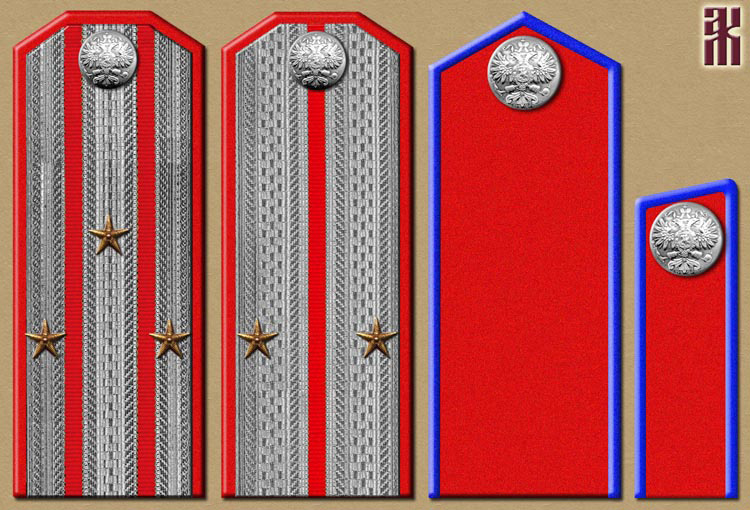
Shoulder-boards of the Simbirsk Lancer Regiment
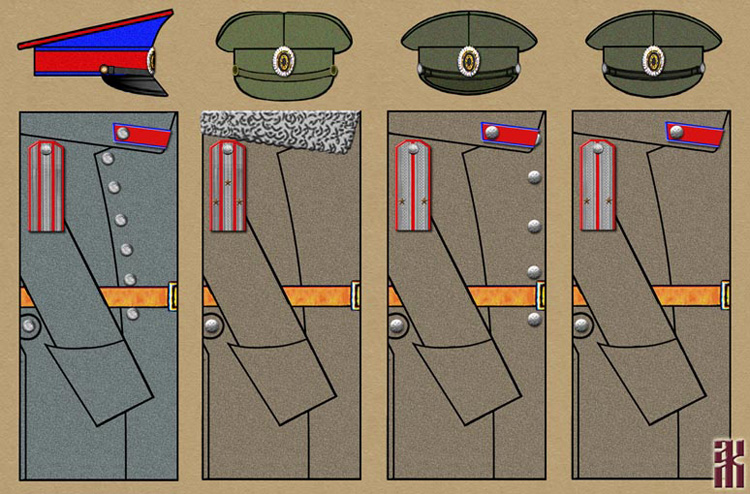
Uniforms of the Simbirsk Lancer Regiment
This unit was a successor to the 5th Lithuanian Lancer Regiment of the Imperial Army.
The reconstructions based on a photograph entitled "Admiral Kolchak among the officers of the Simbirsk Lancer Regiment on the anniversary of its formation. The village of Nikolaevka near Omsk".
Published at forums-su.com/viewtopic.php?f=195&t=438846.
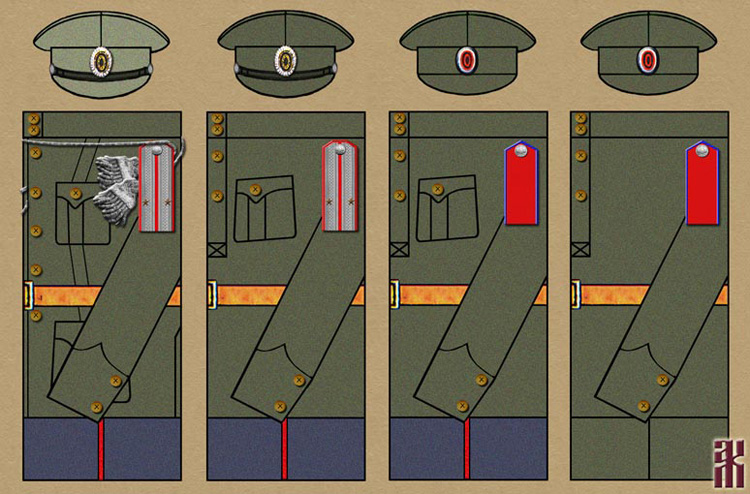
Uniforms of the Simbirsk Lancer Regiment
Figure 1 is a reconstruction based on a photograph, with the tassels of the lancer headgear visible under the shoulder-boards.
Tomsk Hussar Regiment
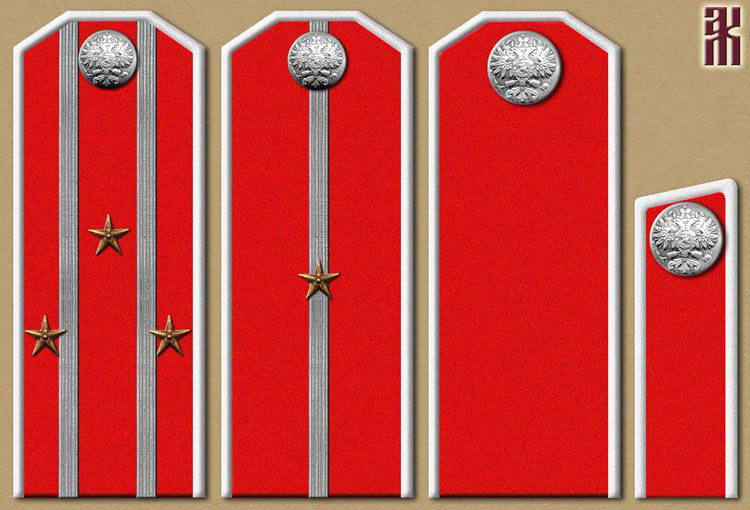
Shoulder-boards of the Tomsk Hussar Regiment
Although the regiment was formally considered the successor to the 5th Aleksandria Hussar Regiment of the Imperial Russian Army, photographs show that this is not reflected in the uniforms. In the photo below, all the shoulder-boards of the regiment's officers are made of soft cloth with white piping, and those of the lower ranks, like those of the officers, are hexagonal.
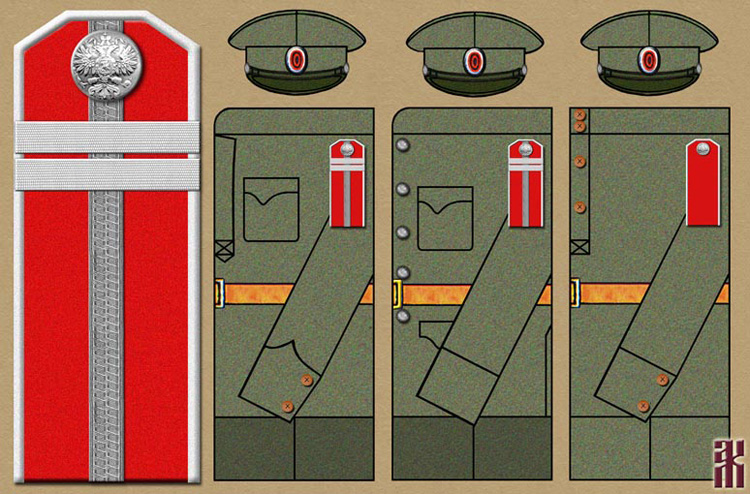
Uniforms of the Tomsk Hussar Regiment:
1 – shoulder-board of a corporal
Reconstruction of the uniforms is based on a photograph published at forum.kladoiskatel.ru.
Published at forum.kladoiskatel.ru/viewtopic.php?t=8732 [link dead].
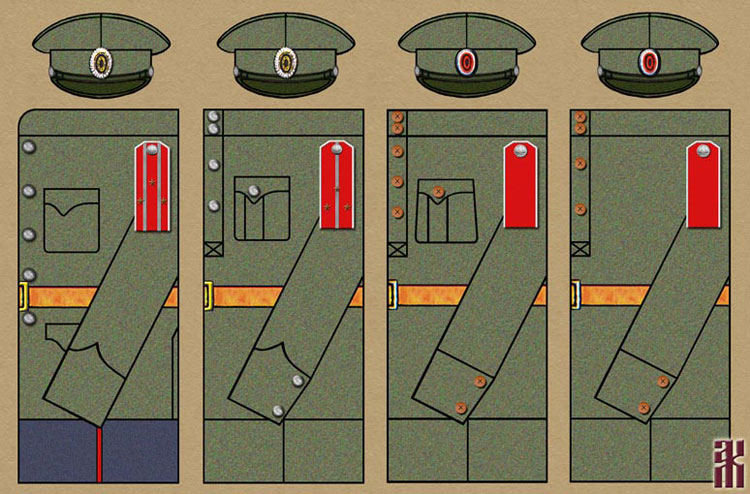
Uniforms of the Tomsk Hussar Regiment
The reconstruction is based on a photograph at sammler.ru.
Ekaterinburg Lancer Regiment
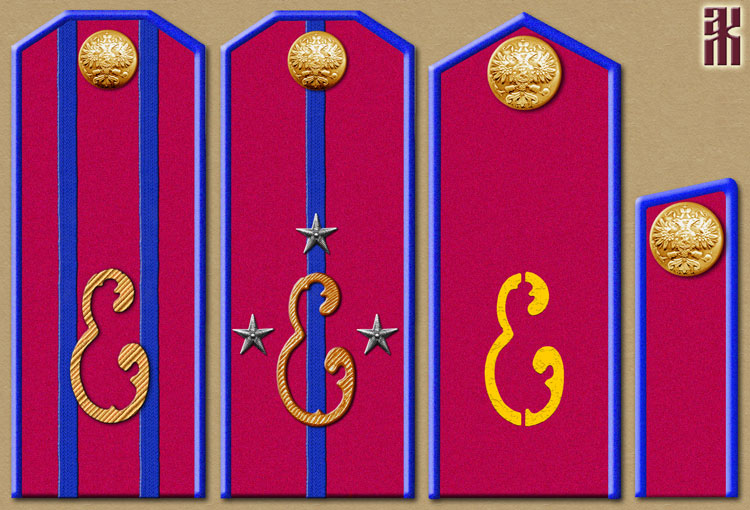
Shoulder-boards of the Ekaterinburg Lancer Regiment
The reconstruction is based on the description by B. B. Filimonov, as well as on a photograph depicting the review of the Ekaterinburg Lancer Regiment in the winter of 1919.
cdm16635.contentdm.oclc.org/cdm/fullbrowser/collection/p16635coll22/id/499/rv/singleitem [link dead].
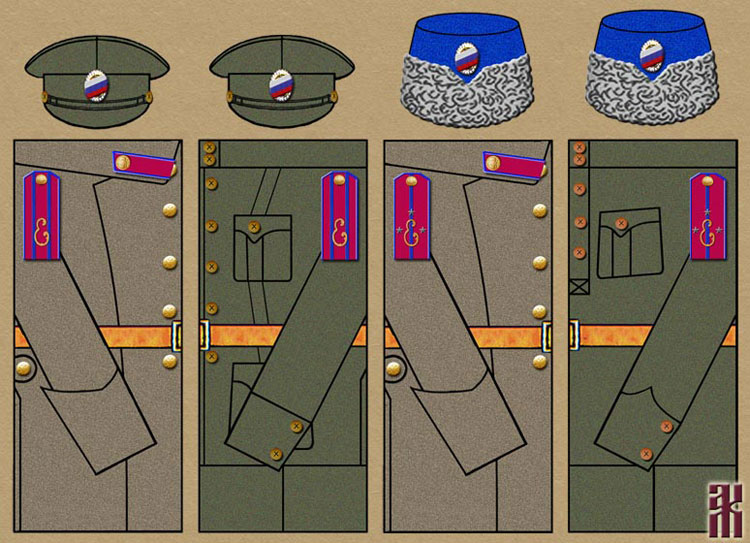
Uniforms of the Ekaterinburg Lancer Regiment:
1 and 2 – regiment commander, Colonel Domontovich; 3 and 4 – lieutenant
The reconstruction of the colonel is based on the well-known photograph "Admiral Kolchak at the headquarters of the Siberian Army" (Domontovich is seated in the front row on the right) as well as the photograph above, where Domontovich is in the foreground inspecting the ranks. In the photograph of the review the regimental officer in the foreground is wearing a coarse cloth overcoat with a single row of buttons and peaked cavalry cuffs. All the ranks of the regiment, except for the commander himself, wear headgear with a fur crown and a cloth base, very similar to the headgear assigned to dragoon regiments in 1883.
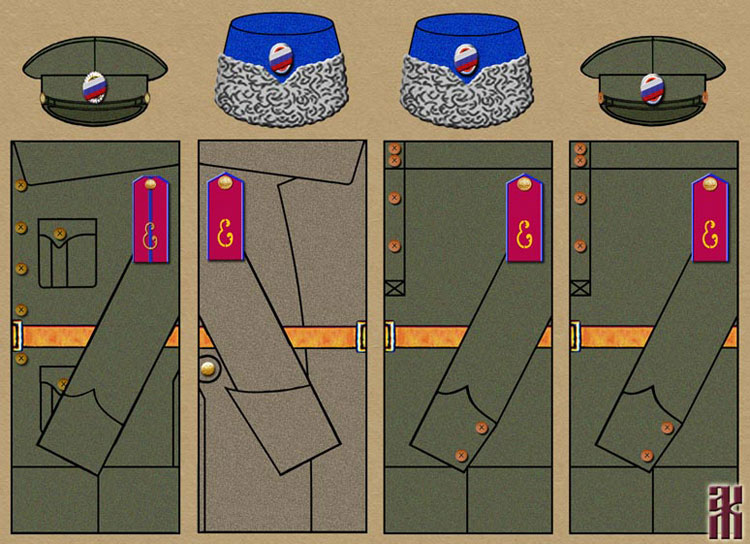
Uniforms of the Ekaterinburg Lancer Regiment:
1 – captain in "French" tunic with a turn-down collar; 2 to 4 – privates
Judging by the same photograph from the review, the "dragoon caps" were the same for officers and other ranks, differing only in the cockade. An interesting detail is that the collars of the lower ranks' greatcoats had no buttonholes or tabs.
Kazan Dragoon Regiment
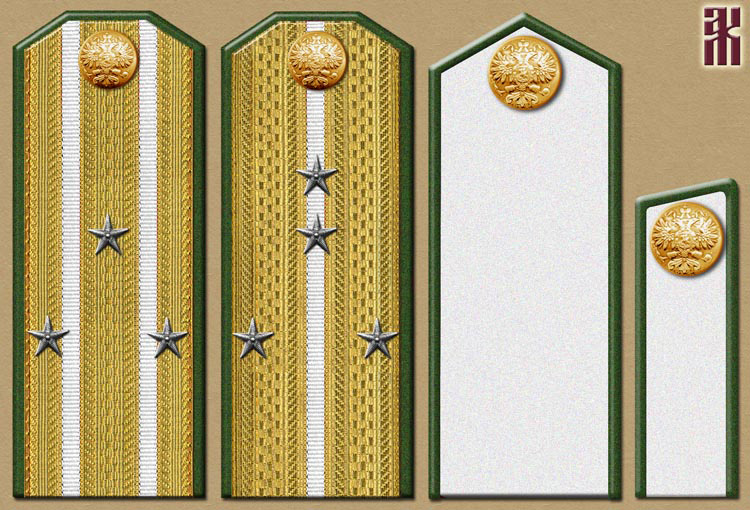
Shoulder-boards of the Kazan Dragoon Regiment
This regiment was a successor to the 5th Kargopol' Dragoon Regiment of the Russian Imperial Army.
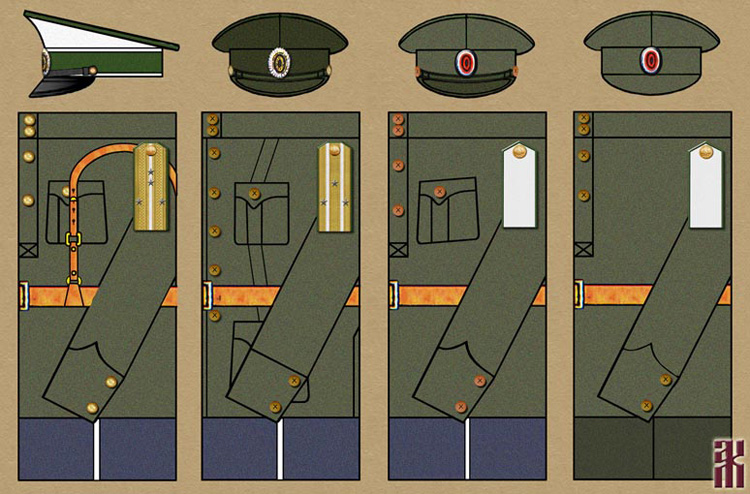
Uniforms of the Kazan Dragoon Regiment, possible variants.
Horse Artillery Divizion of the 1st Cavalry Division
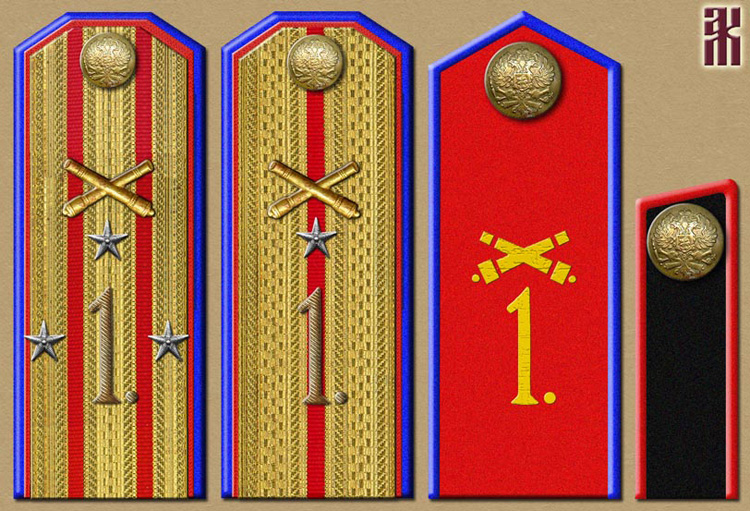
Shoulder-boards of the Horse Artillery Divizion, 1st Cavalry Division
The reconstruction is based on the description by B. B. Filimonov.
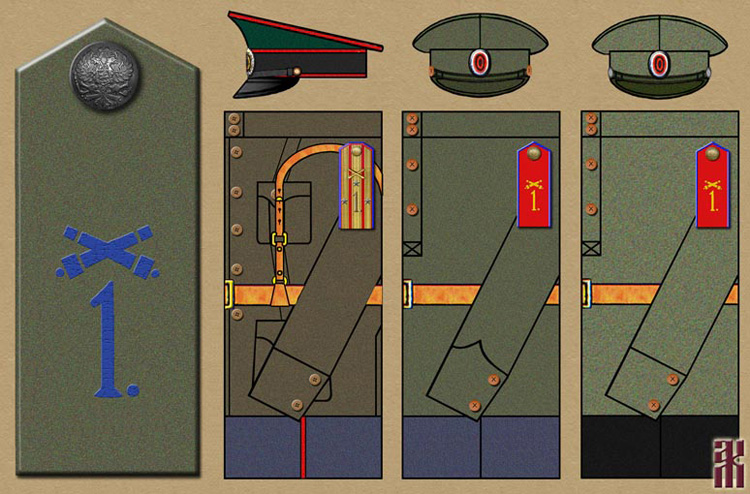
Uniforms of the Horse Artillery Divizion, 1st Cavalry Division, possible variants.
Independent Volga Cavalry Brigade
Volga Dragoon Regiment
The Volga Dragoon Regiment was another successor to the 5th Kargopol' Dragoon Regiment of the Imperial Russian Army, and so likely wore uniforms more or less identical to those of the Kazan Dragoon Regiment of the 1st Cavalry Division, shown above.
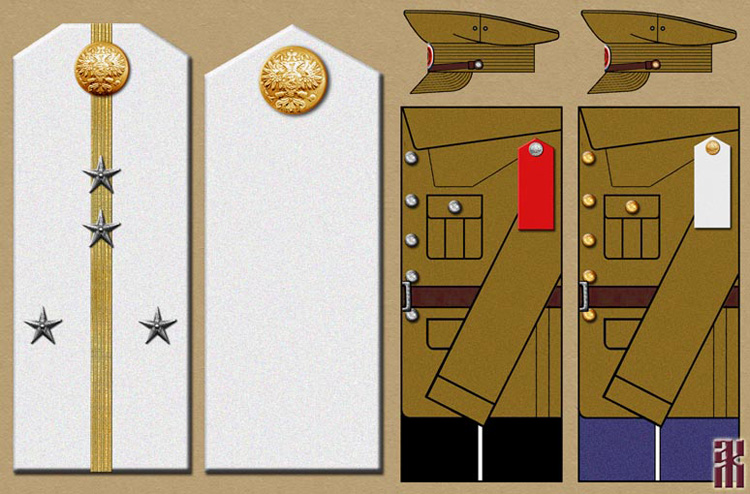
Alternative shoulder-boards and uniforms of the Volga Dragoon Regiment
This reconstruction based on the description by B. A. Pavlovskiy. British uniforms are shown as they were supplied to the 1st Volga Army Corps, to which the brigade was attached.
1919
During the retreat from the river near Volynsk, Corporal Muryinov was seriously wounded during a fierce skirmish. He asked to be left to die without removing his white Kappel' shoulder-boards and well-deserved awards.
Balmassov, S. S. in "The Campaigns of the Horse Units of the Independent Volga Cavalry Brigade and the Independent Volga Horse-Jaeger Divizion of General V. O. Kappel's corps // Kappel and the Kappelevtsy", Moscow, 2003, pp.469, 484. citing Pavlovskiy, B. A. "Combat operations of Colonel Nechaev's Independent Volga Cavalry Brigade of General Kappel's 1st Volga Corps in the Siberian Army from the Urals to the Irtysh River in 1919".
Samara Hussar Regiment
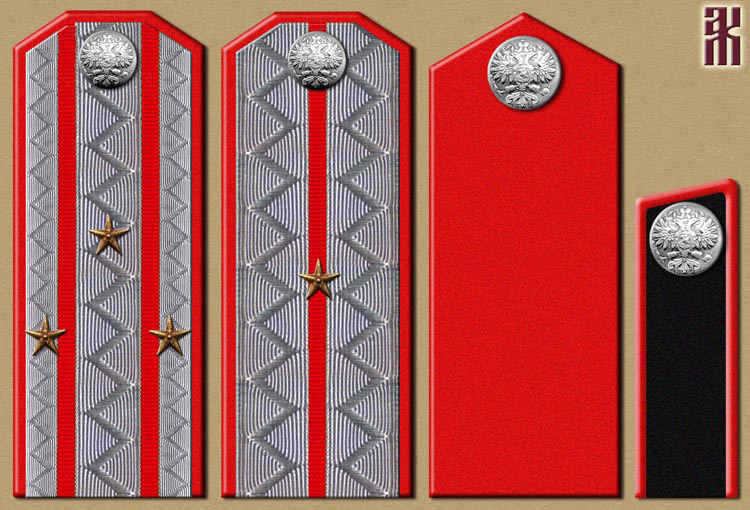
Shoulder-boards of the Samara Hussar Regiment
This unit was a successor to the 5th Aleksandria Hussar Regiment of the Imperial Russian Army.
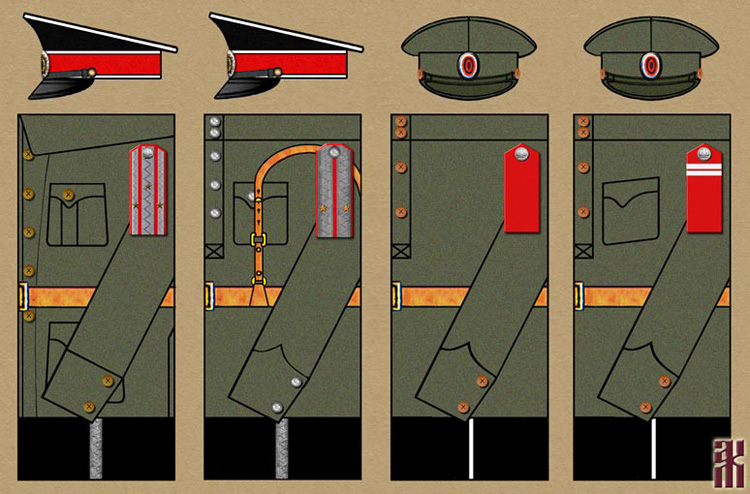
Uniforms of the Samara Hussar Regiment, possible variants
Primor'e Dragoon Regiment
This unit was a successor to the Primor'e Dragoon Regiment of the Imperial Russian Army.
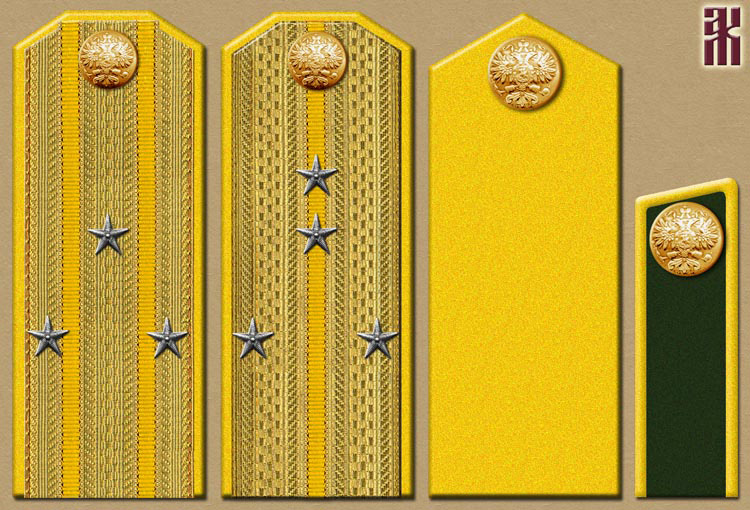
Shoulder-boards of the Primor'e Dragoon Regiment
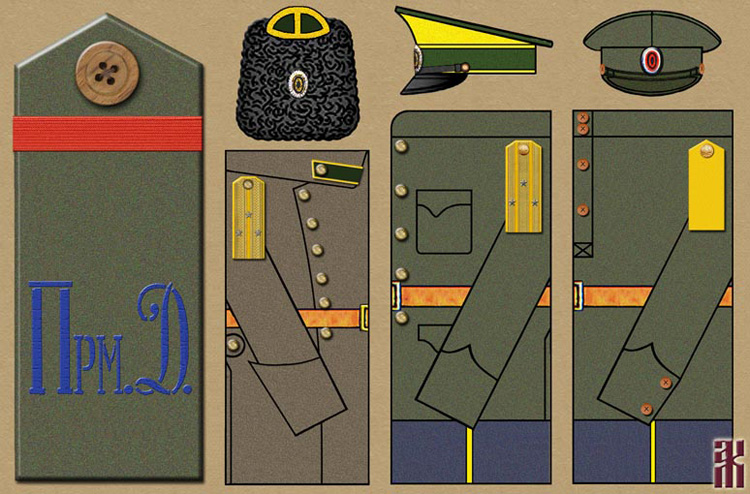
Uniforms of the Primor'e Dragoon Regiment, possible variants
Irkutsk Hussar (Cavalry) Divizion of Ataman Krasilnikov's Partisan Brigade
On 20 September 1918 the formation of the 4th Irkutsk Cavalry Brigade began in Irkutsk, which included the Irkutsk Cossack and Irkutsk Hussar Regiments. The latter inherited the red symbols of the 16th Irkutsk Hussar Regiment of the Imperial Army – raspberry shoulder-boards, cap bands, etc. Due to its small size, the Irkutsk Hussar Regiment was transformed into a cavalry divizion of the Partisan Brigade named for Captain Krasilnikov. The term "Krasilnikov's Red Hussars" appeared.
Novikov P.A. The Civil War in Eastern Siberia. Moscow, 2005, p.108.
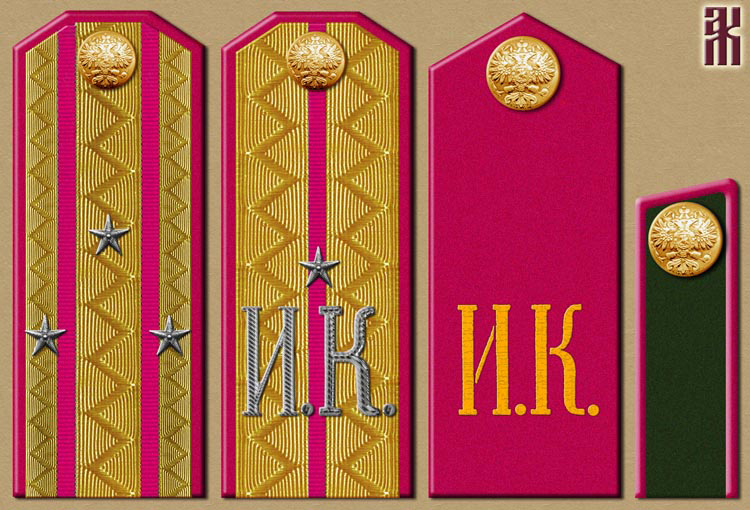
Shoulder-boards of the Irkutsk Horse Divizion
Formally the successor to the 16th Irkutsk Hussar Regiment of the Russian Imperial Army. The reconstruction of ciphers is based on a photograph.
siberia.forum24.ru/?1-8-0-00000028-000-40-0.
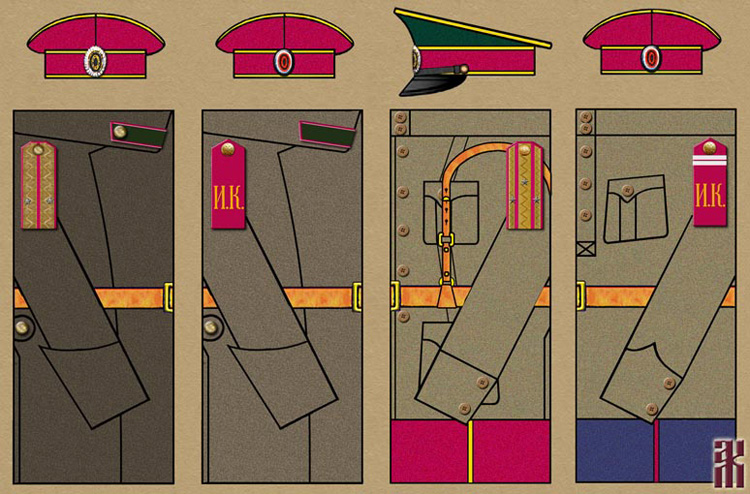
Uniforms of the Irkutsk Horse Divizion
The reconstructions are based on eyewitness accounts by V. Y. Zazubrin in his novel "Two Worlds".
Home — State Symbols — Flags — Uniforms — Badges & Medals — Money — Other
Pygmy Wars Notes
The original for this page is at kolchakiya.ru/uniformology/kav_units.htm. However this is only the former Imperial units from that page, as it was too unwieldy. The other line cavalry are here
The quote from Elenevskiy about the "absence of cavalry regiments in the Volga region, Siberia and the Urals" is in respect to regular line cavalry. There was plenty of Cossack cavalry. The Aleksandriytsy in Samara was the 5th Aleksandria Hussars; the Litovtsy in Simbirsk was the 5th Litovsk (Lithuanian) Lancers; and the Kargopol'tsy in Kazan were the 5th Kargopol' Dragoons, all part of the Imperial 5th Cavalry Division. The Primortsy in Razdol'noe were the Primor'e Dragoons, an independent unit and the only regular cavalry east of the Volga.
The photograph of the Simbirsk Lancers is this one here. The Tomsk Hussar Regiment photograph is this one here. The photograph "Admiral Kolchak at the headquarters of the Siberian Army" is this one here.
The original Irkutsk Hussars were stationed in the Far East, but disbanded in 1833. The later reformed unit was stationed in the Minsk area, Belarus.
More information for the Irkutsk Horse Divizion can be seen at the page for the Partisan Brigade. The uniforms of the rest of the Krasilnikov Brigade can be found here.
Discussion on the translation choices I have made can be found here.
Flags
As descendants of Imperial regiments, you would expect them to have Imperial flags. We know the Simbirsk Lancers inherited the banner of the 14th Lithuanian Dragoon Regiment, see here.
Mostly taken from Volkov.
History of the 1st Cavalry Division
Formed on the Eastern Front between February and April 1919 in Omsk from the Tomsk Hussar, Kazan Dragoon, Simbirsk Lancer and Ekaterinburg Lancer Regiments, and the 1st Horse Artillery Divizion. It was part of the newly formed Independent Siberian Army.
In May 1919 it was transferred to Ekaterinburg. In June it was fought in the Krasnoufimsk area. It was part of the 2nd Army, from September 1919 the 1st Army, and by January 1920 the 3rd Army.
After the Siberian Ice Campaign, it was reduced to a separate brigade in Chita in March 1920, as part of the 1st Manchurian Horse Division.
Tomsk Hussar Regiment
Formed in the summer of 1918 in Siberia. In early 1919 it was part of the 1st Cavalry Division. On 14 January 1920 the entire regiment was taken prisoner near Kansk.
Kazan Dragoon Regiment
This unit was reconstituted on the Volga under combat conditions in the summer of 1918. From early 1919 it formed part of the 1st Cavalry Division. From March 1920 it formed a separate squadron within the 1st Manchurian Horse Division. In Primor'e it was a squadron in the Composite Cavalry Regiment and then from spring 1921 it was part of the 1st Cavalry Regiment.
Simbirsk Uhlan Regiment
This unit was reconstituted on the Volga under combat conditions in the summer of 1918. From early 1919 it formed part of the 1st Cavalry Division. From March 1920 it formed a separate squadron within the 1st Manchurian Horse Division. In Primor'e it was a squadron in the Composite Cavalry Regiment and then from spring 1921 it was part of the 1st Cavalry Regiment.
Ekaterinburg Lancer Regiment
Formed in the summer of 1918 in the Urals. From early 1919 it was part of the 1st Cavalry Division (temporarily attached to the 3rd Ural Mountain Rifle Corps). From March 1920 it formed a separate squadron within the 1st Manchurian Horse Division. In Primor'e it was a squadron in the Composite Cavalry Regiment and then from spring 1921 it was part of the 1st Cavalry Regiment.
History of the Independent Volga Cavalry Brigade
Formed in early 1919 from the Samara Hussar Regiment and the Volga Dragoon Regiment, each of four squadrons, and an Independent Volga Horse Battery. The Independent Volga Horse-Jaeger Divizion may have been brigaded with it.
It was part of the 1st Volga Army Corps of the Western Army. In February-May 1919 it was the Commander-in-Chief's Reserve, with the units stationed in the Kurgan and Chelyabinsk districts. It returned to fight in the Ufa, Zlatoust, Chelyabinsk and Tobolsk-Petropavlovsk operations. Upon arrival in Chita the brigade was merged into the Volga Dragoon Regiment.
Samara Hussar Regiment
This unit was re-established on the Volga under combat conditions in the summer of 1918.
Volga Dragoon Regiment
Formed on the Volga under combat conditions in the summer of 1918 members of 5th Kargopol Dragoon Regiment of the Imperial Army which had not been incorporated into the Kazan Dragoon Regiment.
History of the Primor'e Dragoon Regiment
It was reconstituted around members of the former Imperial Army unit. It was not incorporated into any larger formations, not being sent to the main fronts, and was stationed in Razdol'noe, near Vladivostok, its pre-war garrison town.
History of the Irkutsk Hussar Divizion
Krasilnikov began to recruit in the Omsk area immediately upon the revolution, mostly recruiting former officers. By December he had assembled a small Irkutsk Hussar "Regiment". It had wanted to join the front line as part of the regular cavalry there, but in January 1919 the whole partisan brigade was ordered to the Irkutsk and Enesei areas, to combat partisans. With the collapse of the front, the brigade was moved to face the advancing Red Army in late 1919, attached to the 1st Siberian Rifle Division.