
Uniforms of Ukrainian Units in the Russian Army of the Supreme Ruler
All material and reconstructions are by A. Karevskiy unless noted otherwise.
Taras Shevchenko Kuren (Regiment)
Part of the 11th and 12th Ural Divisions
The formation of the Shevchenko Kuren took place under very favourable conditions. Judging by memoirs, the kuren was well equipped and supplied. According to the recollections of contemporaries, the kuren's soldiers were dressed in sturdy brown bearskin hats, greatcoats and boots. The Ukrainian insignia were yellow shoulder-boards with blue piping, with white rank stripes [for NCOs]. Officers wore grey fur hats with a long bag (probably blue) and gold tassels. The cockade on the hats was of the normal Russian type.
Tinchenko, Ya. in "Ukrainian Armies, 1917-1920", Moscow, 2002, p.104.
Chelyabinsk, January 1919
I wore the uniform of the special kuren named after Taras Shevchenko: a brown fur papakha with a cockade of the Tsarist model. On my shoulders were yellow shoulder-boards with blue piping – the emblem of the "yellow-blue samostiyniky". There were three white stripes on the shoulder-boards. I was a sergeant.
Lebedinsky D.E. Shevchenko's Kuren – Lenin's Regiment // Combat Past: Memoirs", Kuibyshev, 1958, p.202-222. Also at scepsis.ru/library/id_1673.html
Saray-Gir Station near Ufa, March 1919
The kuren began to hastily prepare for the march. New uniforms, boots and underwear arrived. New Russian-style rifles were brought in boxes. The lads soon discovered the markings on the rifles: "Made in the USA".
They entered the village in high spirits, as they say, with panache. The regiment looked quite good: sturdy greatcoats and boots, yellow shoulder-boards with blue piping, fur hats cocked jauntily to one side, officers in grey fur hats with plumes and gold tassels.
Lebedinsky D.E. Shevchenko's Kuren – Lenin's Regiment // Combat Past: Memoirs", Kuibyshev, 1958, p.202-222. Also at scepsis.ru/library/id_1673.html
On the evening of 1 May, reinforcements arrived in the village from Saray-Gir: it was a special Ukrainian regiment named after Taras Shevchenko, formed by White Russians from Ukrainian settlers in Siberia and Altai.
The ataman, who could be recognised by the yellow tassel on his papakha, rode ahead of the regiment on horseback. The ataman stopped his regiment in the square, not far from the headquarters of one of the regiments stationed in the village. The soldiers were told that they would have a two-hour rest here. They laid their rifles in racks, and most of them immediately settled down to rest.
Popov, F. G. in "Troubled Years // Combat Past: Memoirs", Kuibyshev, 1958, pp.223-235 at scepsis.ru/library/id_1678.html
So, we were "Cossacks", as the soldiers in the regiment were called. We had yellow shoulder-boards, piped with blue. These were the colours of yellow-blue Ukraine, whose "independence" the bourgeois nationalists dreamed of. The officers, who fiercely hated Soviet power, wore papakhi with a yellow bag hanging down on one side – a shlyk.
Lebedinsky D.S. The Bayonets Turned // Unforgettable. Moscow, Voenizdat, 1961. p.121.
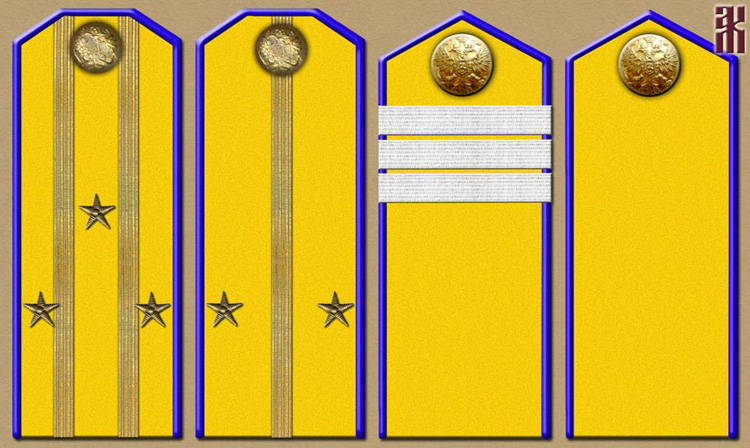
Shoulder-boards of the Taras Shevchenko Regiment
In the reconstruction by K. Novikov at bergenschild.com the metal of the shoulder-board buttons and officer's insignia is shown as silver. However, there is a mention in the memoirs of "golden tassels" on the hats: it is thought that they corresponded to the metal fittings of the regiment.
bergenschild.com/Reconstruction/depot/civil_war/ukr_units.htm [link dead]
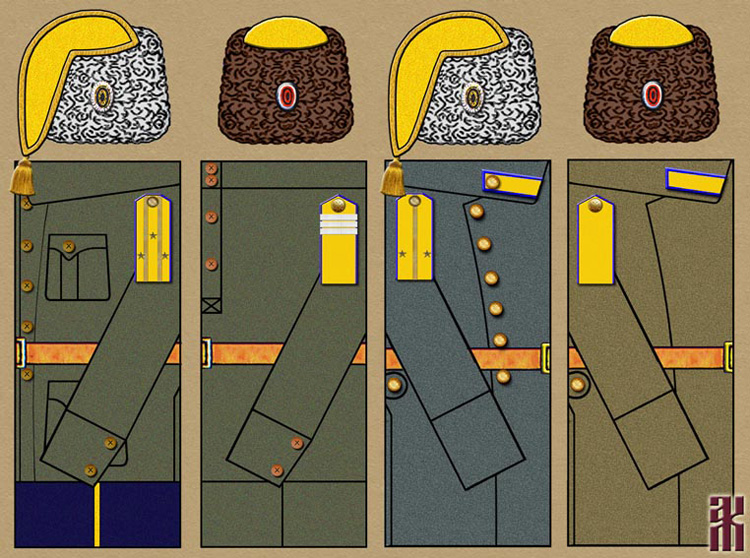
Uniforms of the Taras Shevchenko Regiment
Figure 1(a lieutenant-colonel) is depicted wearing a "French" and coloured trousers – this is not mentioned in the literature, but it can be assumed that a well-equipped regiment could afford some "luxuries". The papakha is grey astrakhan with a yellow bag. In the work by Tinchenko, cited, it is suggested that the bag was blue, but Lebedinskiy's memoirs clearly indicate it as yellow. It seems that the papakha may have existed as the regiment's main headgear for the same reasons of "military beauty" and emphasising the national characteristics of the unit.
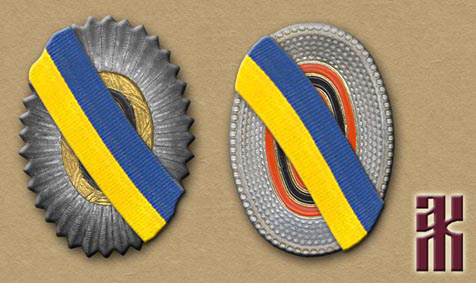
The literature only mentions the old-style cockades, but it would be logical to assume that, following the example of the many Russian units that draped their cockades with white-blue-red ribbons (as well as Siberian units that continued to wear white-green ribbons), the Ukrainian servicemen also sought to emphasise the national character of their unit.
1st Rifle Regiment, named for Hetman Sahaydachnyy
On 18 November 1919 the 3rd Combined Partisan Rifle Regiment, the 2nd Ust'-Kamenogorsk Cossack Regiment and the Engineer Divizion of the Partisan Division left the crossing they were guarding near the village of Cherlak and withdrew south to Pavlodar. Apparently, the commander of the Cossack brigade, Colonel Vinogradskiy, was with this group. In addition to units of the Combined Partisan Division, the remains of the Ukrainian regiment named after Sahaydachnyy, which were attached to the division, were also in Cherlak. According to G. Zimmering, by that time only two hundred soldiers, three officers and a priest remained in the regiment, But the Ukrainian soldiers said that they would fight their way east: "...we will not break through, we will die, but we will not go over to the Reds". And this was said by soldiers who had almost no blouses, no boots, no sheepskin coats, who have sewn themselves robe-like clothes from felt which they walked around in.
Zimmering, G> in "From Omsk to Chuguchak", at GARF F.5881 Op.2 D.349, L.5ob, excerpt at d-m-vestnik.livejournal.com/521987.html
21 October 1919
According to the testimony of prisoners, soldiers of the 1st Ukrainian Rifle Kuren (regiment) named after Hetman Sahaydachnyy "... wore red trousers".
RGVA F.1372 Op.2 D.265 L.181. Information provided by Moscow researcher O. Vinokurov.
Formation of the first Ukrainian units as part of the Siberian Army, Tyumen concentration camp, Summer 1919
So that we would actually look like real White soldiers, Vasya promised to bring two blouses and two caps with yellow and blue ribbons over the visor in a few days.
Shcherbakov, K. F. in "In captivity under Kolchak", Voronezh, 1934, pp.53-54
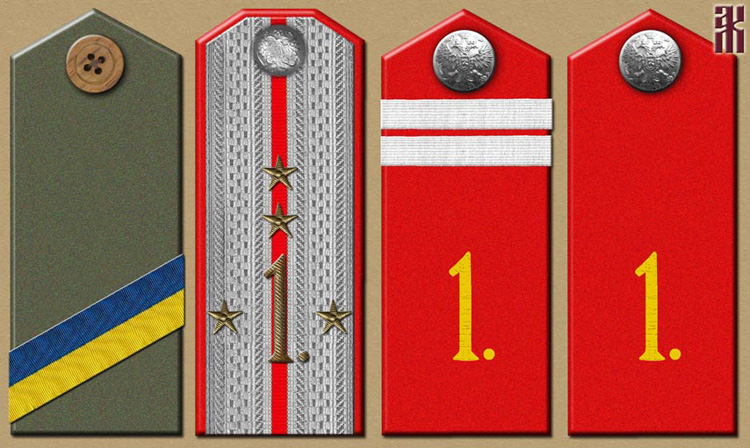
Shoulder-boards of the 1st Rifle Regiment named after Hetman Sahaydachnyy
The author of the reconstruction came across a khaki shoulder-board with a ribbon of Ukrainian national colours sewn diagonally across it in a private collection, and it was claimed that it came from the Siberian region of the anti-Bolshevik struggle. Hetman Sahaydachnyy's kuren was first mentioned in the combat lists of the Siberian Army on 21 July 1918 and remained the only Ukrainian unit until the autumn of that year. It is logical to assume that the shoulder-boards appeared after 6 September 1918, that is, after the order of the new Commander-in-Chief, General P. P. Ivanov-Rinov, to return to using shoulder-boards.
The reconstruction of the regiment's "coloured" shoulder-boards dates to 1919 and is based on a photograph published at fotki.yandex.ru. The shoulder-boards bear the cipher "1." (which is logical, given the number assigned to the regiment). The officer's shoulder-boards were reconstructed approximately. It would seem logical that those involved in forming the regiment were familiar with the experience of creating the first Ukrainian units, such as the regiments named after Bohdan Khmelnytskiy or Petro Polubotko, which were characterised by silver braid (with metal fittings in gold).
fotki.yandex.ru/users/beloe-primorie/album/158707/ [link dead]
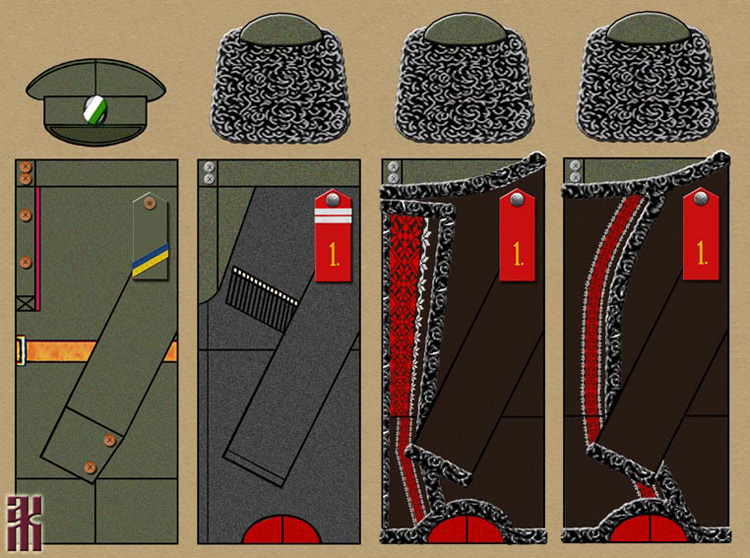
Uniform of the 1st Rifle Regiment named after Hetman Sahaydachnyy
As noted above, the Hetman Sahaydachnyy Regiment was first mentioned on 21 July 1918 – under the command of Colonel Mandryka. It was part of the 2nd Steppe-Siberian Army Corps. On 9 August 1918 it was listed in the 2nd Steppe-Siberian Rifle Division, but by 2 October was not included in the division. Therefore, the first uniform of the regiment's officers is shown in relation to the rifle units of the Siberian Army as of autumn 1918.
The reconstruction of the second version of the regiment's uniform is also based on a photograph published at fotki.yandex.ru. It is interesting to note that Ukrainian sheepskin coats covered with cloth, with characteristic appliqué panels in the style of vyshyvankas and with sewn-on shoulder-boards, were used as winter clothing.
Ranks
The Ukrainian units in eastern Russia used the same ranks that had been introduced in the Ukrainian national units in 1917:
| Ukrainian | Cossack equivalent | Russian equivalent | English equivalent |
| Kozak | Kazak | Ryadovoy | Private |
| Prikazniy | Prikanzniy | Efreytor | Lance-corporal |
| Molodshiy uryadnik | Uryadnik | Maladshiy unter-ofitser | Corporal |
| Starshiy uryadnik | Starshiy unter-ofitser | Sergeant | |
| Bunchuzhniy | Vakhmistr | Feldfebel' | Sergeant-major |
| Pidkhorunzhiy | Podkhorunzhiy | Podpraphorshchik | Sub-ensign |
| Praporshchik | Praporshchik | Ensign | |
| Khorunzhiy | Khorunzhiy | Podporuchik | Second-lieutenant |
| Sotnik | Sotnik | Poruchik | Lieutenant |
| Pidosavul | Podesaul | Shtabs-Kapitan | Staff Captain |
| Osavul | Esaul | Kapitan | Captain |
| Viys'koviy Starshina | Voiskovoy Starshina | Podpolkovnik | Lieutenant-Colonel |
| Polkovnik | Polkovnik | Colonel |
The table was compiled using material from: www.uarmy.com.ua/almanah/almanah03/article13/art13.html
Home — State Symbols — Flags — Uniforms — Badges & Medals — Money — Other
Pygmy Wars Notes
The original for this page is at kolchakiya.ru/uniformology/Ukrain_units.htm.
Hetman Sahaydachnyy was famous for his military successes leading the Zaporizhian Cossacks in the early 1600's. He is also spelled as Sahaidachny, and Sagaydachny in the Russian version of his name.
Samostiyniky indicated separatists of the Ukrainian Party of Independent Socialists.
A copy of the bergenschild.com material is here.
The Hetman Sahaydachnyy Regiment seems to have spent 1919 with the 1st Volga Army Corps.
The original ranks table had the Ukrainian ranks, the approximate Russian pronunciation of them and the matching Russian ranks. I have changed it to be somewhat more useful to readers in English.
Discussion on the translation choices I have made can be found here.