
Translation Issues for the Uniform Pages
Translation always involves compromises, but particularly in this case, as Russian tends to have different nouns for what in English would be distinguished with adjectives.
Uniform items
There are some distinctions in the Russian which I have collapsed into single English terms, for lack of useful alternatives:
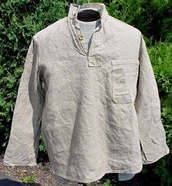
✦ the gymastërka and rubashka were the standard pull-over top with part opening in the officer and other ranks versions respectively. I have translated them all as "blouse", as English lacks any good alternative.
I have tried to save the word "shirt" only for those tops that opened all the way down the front. They were almost always obtained from Allied, especially British, stocks. Note though, that if the original has rubashka then I keep it as "blouse", even if I think the item is actually a shirt.
A summer rubashka is shown to the right (although, as usual, it was labelled on the original site as gymastërka). The winter versions were knitted wool rather than cotton.
✦ kittel has been translated as "tunic", but so have a number of other similar items. I have tried to indicate if it is a "French" however.
✦ as you can imagine, Russian has vast range of names for winter coats. For the military shinel', and any other long thick broadcloth coat (e.g. pal'to), I have generally used "greatcoat". For others I have tended just to be specific, so polushubki are "short sheepskin coats".
✦ generally "boot" means the knee high Russian military variety, either infantry or cavalry. Otherwise I have used "low boot" for botinki unless it is clearly that in context (e.g. British boots).
✦ I have used "felt boot" for all varieties, not just valenki.
✦ I have not generally distinguished between trousers and breeches (bryuki or shtany versus sharovari or sometimes reytuzy), unless it is important in the context.
✦ I have translated the normal Russian cap, the furashka, as "field cap". I have translated beskozyrka as "visor-less cap".
✦ mostly the Russian soldiers of the period did not wear socks, but portyanki– "foot cloths" – which were wound around the feet instead.
✦ the word petlitsy is "buttonhole" but in the context of uniforms is the coloured patches around the buttonhole on the collars of greatcoats in the Imperial uniform – and also tunic collars in some civil war uniforms. I have used "tabs", which is the standard translation of the term.
Ranks
Russian ranks of the time mostly translate in a fairly straight-forward way into English, except:
✦ In field service the ranks went lieutenant – staff-captain – captain – lieutenant-colonel, so a Russian "captain" fills the place of an English "major". There was the rank major, but it may have just been a leftover from Tsarist practice, and was very rare.
✦ The rank of podpraporshchik was for aspirant officers. It is often translated as "warrant officer" – but that gives the wrong sense relative to most of the English speaking world – or "cadet" – but that confuses them with actual trainee cadets. I have gone with "sub-ensign", which indicates that they are officers, but also that they are very low ranking and not yet commissioned. Cadet is then used for trainees only.
✦ The Russian ranks of the time often had different terms for the various ranks in the different services, which I have not bothered to distinguish. So a "captain" might be an infantry kapitan, a cavalry rotmistr or a Cossack esaul.
✦ I have omitted "of the General Staff" from ranks. So it is just "General Kappel", not "General of the General Staff Kappel", in accordance with English usage.
✦ Quartermaster was the lowest NCO rank in the navy, followed by boatswain's mate, boatswain, senior boatswain and conductor. Conductor was a rank specific to the Russian Naval forces, being a specialist but not an officer. Midshipman was the equivalent of the military ensign. The NCO ranks can be seen at Russian Wikipedia.
Shoulder-boards
I have translated pogony according to context: "shoulder-boards" when refering to Tsarist practice and those using the large and colourful rank markings in imitation of that, but "shoulder-strap" when the context is for soft, non-coloured and smaller straps.
The layout of shoulder-boards was usually described in the Russian in terms of "gaps" in the braid, because originally the silver and gold of officers was laid on top of the field, leaving a gap or two according to rank. That is somewhat confusing to beginners, so I have described it in terms stripes on top of the metal colour, especially as civil war ones were often made that way.
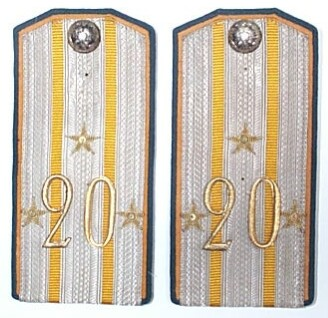
So the shoulderboards above have been described as being "silver metal, with two yellow stripes and edging and black piping", even though actually made in this instance by laying silver braid over yellow cloth and leaving two gaps.
Colours
✦ "Raspberry" is the literal translation of malinovy and is used for a colour that is a dark reddish-pink. An acceptable alternative would be "dark crimson".
✦ I have often translated alyy, technically scarlet, as simply "red" because in practice there was no distinction between that and krasnyy or chervonnyy.
Measurement Units
✦ The Russians used the same inch as the British, so 1 inch = 25.4 mm
✦ One vershok (plural vershka) is 44.5 mm.
✦ One arshin was 71 cm.
Unit Names
✦ I have translated udarnyy as "shock", since that is the standard form, especially with respect to the Kornilov regiments, but other alternatives are used elsewhere. To distinguish the shturm units I have called them "assault", though obviously "storm" is often seen instead.
✦ Units are "reserve" regardless of whether they are zapas or kadre, the former being Imperial practice and the latter a Civil War innovation.
✦ I have translated druzhina as "militia".
✦ I have used "Composite" for svodnyy but "Combined" is often seen.
✦ The word for police was politsiya up to the revolution, but as the first law enforcements were self-raised militias, quickly the word militsiya transformed became the word for the police (and remained that way until 2011). Machine translators sometimes struggle with this and translate militsiya as "militia' (which, to be fair, it is in other contexts). For some reason the Whites in Siberia did not revert back to the Tsarist form, like they did with most things, and so all their police appear to have all been militsiya as well.
✦ I had significant issues with the different types of police (city, rural etc), their equipment and their ranks, as many of the terms don't translate easily. In particular, while English generally talks about all police being "police officers", I have stuck to calling the ranks "policemen" and only the commanders as "officers'.
Territories
In English "Siberia" is any part of Russia east of the Urals, which is often the Russian usage too. However, at the time of the Russian Civil War it was common for Russians to regard "Siberia" as not including east of Lake Baikal: instead the eastern-most areas were the "Far East" (TransBaikalia and the Maritime Provinces). Kolchakiya uses these more restrictive term, and uses "in the East of Russia" for the broader area.
The "Ural" area generally refers to the area of the Ural River, south-west of the mountain line.
For towns I have generally used the 1917 name, as in the text, indicating the modern variant in the notes if it seems relevant.
Flags
The main flag page has some notes about the translation of the various Russian words for flag.
Home — State Symbols — Flags — Uniforms — Badges & Medals — Money — Other