
Ordinary Banners in the Army of the Supreme Ruler
1st Volga Army Corps
Most likely this was made and presented on behalf of the residents of the city of Kurgan in the spring of 1919, where the corps' units were deployed. This is indirectly evidenced by the inscriptions on the banner, as KomKor General Kappel' was strongly opposed to immortalising himself in the names and symbols of his subordinate units.
It was a rectangular green silk double-sided banner with a wide light green border with a narrow crimson one outside it. At the top are the colours of the white-blue-red national flag across the entire length. On the front is the intertwined monogram "ВК" (the В is embroidered in silver, the К in gold). On the reverse is the inscription in three lines "Volzhane General Kappel". [1]
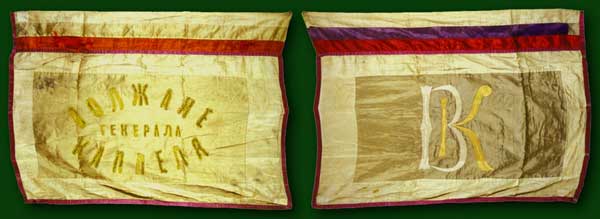
Photo from Rudichenko
The banner was captured by the enemy during the defeat of the detachment commanded by Colonel Malitskiy in February 1920 near Bratsk in the Irkutsk Region. Currently on display at the Central Museum of the Armed Forces.
Rudichenko, A. I. and Durov, V. A. in "Awards and insignia of the White armies and governments", Moscow, 2005, p. 225.
Votkinsk and Izhevsk Rifle Regiments
These regiments preserved the banners made during the uprising at the Votkinsk factory. They appeared during the parade on 12 February 1920 at Innokentyevskaya station near Irkutsk.c
They were rectangular double-sided green silk banners trimmed with a narrow red border. On the front was the factory's emblem embroidered in gold – a crossed wrench and hammer framed by a wreath of wheat ears. On the reverse was an inscription in Slavonic script (white or scarlet) with the number and name of the regiments.
The green color symbolized the color of the Motherland, its hopes, its fields and forests, while the red color symbolised belonging to the working class and solidarity with the labour movement.
Kobzev, I. in "From Izhevsk to Harbin // Udmurtia: Monuments of the Fatherland", Moscow, 1995, p. 163.
Lekomtsev, V. in "On the history of the Votkinsk plant: the civil war of 1918-1919", Votkinsk, 1998, p. 47.
Plotnikov, I. F. in "On the history of the formation and combats of the Izhevsk Division (White Forces) // History of White Siberia: Abstracts of the 3rd scientific conference, 2-3 February 1999", Kemerovo, 1999, p. 27.
3rd (59th) Osinsk Rifle Regiment named for Minin and Pozharsky
A unit of the 15th Votinsk Rifle Division.
The people of Osinsk wanted the regiment of the Votkinsk Division to pass through their town. At 11 a.m. on 27 March the regiment entered the city to the sounds of an orchestra. A prayer service was held in Bazarnaya Square. The city presented the regiment with an icon of St. George the Victorious. The division commander addressed the regiment with a speech in which he emphasised that the regiment is named in honour of the glorious memory of the fighters Kozma Minin and Prince Pozharskiy, who saved our homeland, and that he wished the regiment to continue to follow their example. After that, the regiment, to the sounds of the orchestra, marched ceremoniously out of the city. The city is making a banner, which will be presented to the regiment in the near future.
"Our Ural [Newspaper]", Ekaterinburg, 13 April 1919. Kindly provided by Votkinsk researcher S. K. Prostnev.
1st Siberian Assault Brigade (Battalion Banners)
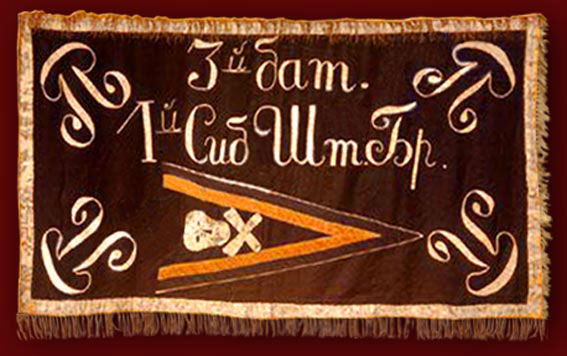
Photograph of the front of the banner of the 3rd Battalion of the 1st Siberian Assault Brigade
Published on the website: http://www.phorus.ru
Most likely made during the brigade's deployment in Perm in February-March 1919.
It is a black satin banner measuring 77 by 135 cm, trimmed with silver braid and silver fringe. On the reverse is the image of a skull and cross-bones made in silver brocade. The front features a chevron placed to the left with a skull and bones in the "V", the inscription "3rd Battalion, 1st Siberian Brigade," and stylised monograms "П" (for Pepelyaev) in the corners.
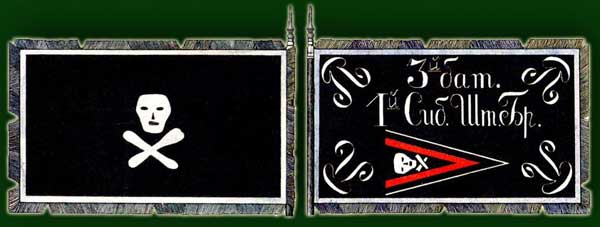
The banner of the 3rd Battalion was captured by the enemy in mid-December 1919 during the mutiny of units of the 1st Army in Tomsk and Taiga Station. It is currently on display at the Central Museum of the Armed Forces.
Kornakov, P. K. in "Banners of the Civil War in Russia // Stage Equipment and Technology, No. 6", Moscow, 1983, p. 29.
3rd Irkutsk Siberian Rifle Division
Presented by the head of the Irkutsk City Council, M. S. Stravinsky, and Archimandrite Sofroniy to the division commander, Colonel P. P. Grivin, on Tikhvinskaya Square in Irkutsk on 27 July 1918.
The banner depicted St. Innocent, patron saint of Siberia, on the front and the inscription "God is with us" on the reverse. [3]
"Svobodny Krai [Newspaper]" 30 July 1918.
Novikov, P. A. in "3rd Irkutsk Siberian Rifle Division // White Army, White Cause, No. 10", Ekaterinburg, 2002, p. 11.
16th Ishim Siberian Rifle Regiment
Made by nuns of the Verkhotur'e Pokrovsk Convent in gratitude to the 16th Ishim Siberian Rifle Regiment for liberating the city from the Bolsheviks on 13 October 1918, after a decision by the local council and citizens of Verkhoturye. It was presented by Archimandrite Xenophon to the regiment's commander, Colonel N. N. Kazagrandi, in early December 1918 at Kushva Station. It remained with the regiment throughout the Civil War.
It was a woven banner with the image of St. Nicholas the Wonderworker and the words "God is with us". [3]
Telitsyn, V. L. in "The 16th Ishim Siberian Rifle Regiment and its commander N. G. Kazagrandi // History of White Siberia: Materials from the 5th International Scientific Conference, 4-5 February 2003", Kemerovo, 2003, p. 164.
Sitnikov, M. G. in "Colonel N. N. Kazagrandi and his Combat Units // White Army, White Cause, No. 17", Ekaterinburg, 2009, p. 14.
From the testimony of Archimandrite Xenophon (Konstantin Petrovich Medvedev), the last abbot of the Verkhotur'e Nikolaev Monastery, during interrogation at the Provincial Cheka on 18 December 1920:
For its liberation from the Bolsheviks, on the initiative of the city and the zemstvo, the regiment was presented with a banner bearing the inscription "God is with us" and depicting the Holy Image of the Saviour, an ancient copy gilded with gold. This banner was ordered by me on behalf of the chairman of the zemstvo administration, Morozov, and the city mayor, Bezsonov. I had to present this banner to the regiment with representatives from the city and the zemstvo, Bezsonov and Bezgelitsyn, as Morozov was arrested at that time as a Socialist Revolutionary. In addition, Hegumen Averky, Archdeacon Veniamin Zykov, and the choir of the convent traveled with us on the honorary train to Kushva Station (the regiment had already left Verkhotur'e by that time – author's note). This was on 19 December during the regimental holiday, where I had to serve a prayer service and present the banner. The presentation was according to church protocol, and I gave a speech calling on those around me to join the ranks of the White Army to defend the Faith and the Fatherland.
"Hegumen Tikhon (Zatekin) and Hieromonk Panteleimon (Laptev): The Fate of the Archimandrite", Verkhoturye, 1998 at siberia.forum24.ru/?1-4-0-00000027-000-60-0
Presentation
In the morning units of the 8th Ishim Rifle Regiment gathered at the Factory Cathedral for the parade. Citizens crowded the streets and church fences in large numbers. Everyone is in a festive and happy mood. The clergy were dressed in rich clothes, the cathedral was illuminated with colored lights, and was overflowing with worshipers. The liturgy was celebrated by the Archimandrite of the Verkhotur'e Monastery.
After the service a brocade banner with the image of the face of Christ the Savior was brought to the square near the cathedral and a prayer service was held. A fierce speech from the archimandrite was said that the people from Verkhotur'e all the way to Ekaterinburg, touched to the core by the glorious military exploits of the Ishim Regiment against the rapists and destroyers of the fatherland, presented the holy banner to the saviors of the people and the dear Motherland.
The banner was handed over to the regiment in the traditional manner.
This is the first banner with which the peasantry blessed their regiment, carrying their lives to the altar of the Motherland.
This is the first banner of the young army, which will proudly be unfurled on the snowy battlefields, before the eyes of traitors to Russia; it will be a clear reproach to everyone who has forgotten their Motherland and will awaken their conscience.
"With this you will win."... Those who walk with the banner of Christ in their hands and in their souls – with the truth of Christ – will defeat everyone.
"Military Gazette No. 85", 14 March 1919. Material courtesy of Voronezh researcher N. Zayats.
18th Tobolsk Rifle Regiment
This was single red banner with a wide yellow border of 95 by 125 cm. In the centre of the front is an Orthodox eight-pointed cross (appliquéd in gold brocade) and the motto "With this sign you will conquer" (appliquéd in silver braid). Decorated with a white and green banner ribbon with a tricolour white, blue and red bow. The finial and pole were of the 1883 model.
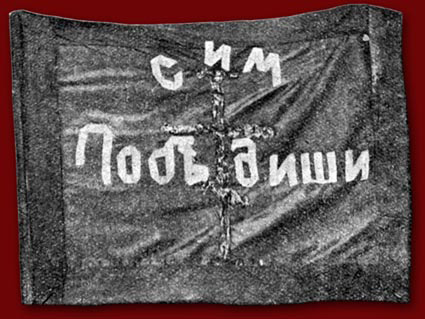
Photo from the magazine "Bezbozhnik".
Published at siberia.forum24.ru/?1-4-0-00000029-000-100-0
Taken by the enemy in January 1920 during the capture of units of the 7th Siberian Rifle Division in the Mariinsk and Krasnoyarsk area. Originally stored in the Museum of the History of Religion and Atheism (in Kazan Cathedral in St. Petersburg). Exhibited in the Central Museum of the Armed Forces (without the pole, finial and ribbons).
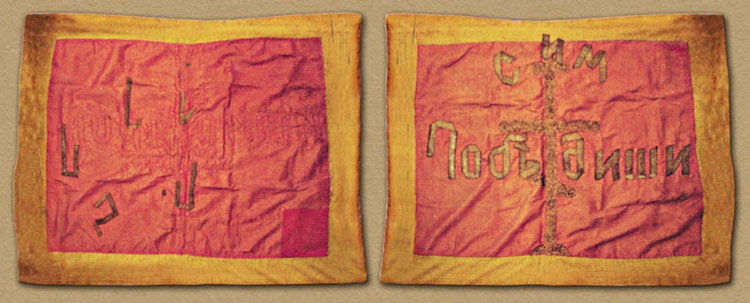
Banner of the 18th Tobolsk Rifle Regiment. Photo from Karpov
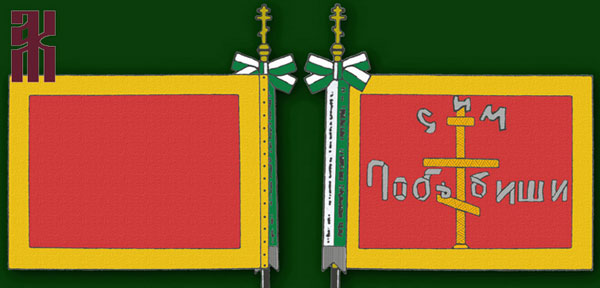
Karpov, N. D. in "The Crusaders: Kolchak's Last Reserve", Moscow, 2014.
Kornakov, P. K. in "Banners of the Civil War in Russia // Stage Equipment and Technology, No. 6:, Moscow, 1983, p. 30.
25th Tobolsk Rifle Regiment
Made by the sisters of the St. John the Theologian Convent in Cherdyn after the liberation of the city by troops of the 7th Siberian Rifle Division. It was presented by the abbess of the convent, Mother Rufina, to the regiment commander, Colonel A. V. Bordzilovskiy, on Alina Square in Cherdyn during the Easter procession on 24 March 1919.
According to one version, the banner was a white cloth. On front was the iconographer M. M. Korolev, and on the reverse was embroidered a double-headed eagle and the inscription "To the valiant 25th Tobolsk Siberian Rifle Regiment from the grateful citizens of Cherdyn, the monastery and the district. 21.04.1919."
According to another version, the banner measured 130 by 108 cm. The front was made of green moiré in the middle, edged with white brocade. The coat of arms of the Provisional Government was embroidered on the moiré with silk and sequins. The brocade was embroidered with patterns of green silk with sequins. The reverse was made of white brocade, without any images, edged with a green strip with a pattern embroidered with sequins. Attached to the upper right corner of the front was a white and green moiré ribbon with the inscription "To the valiant 25th Tobolsk Siberian Rifle Regiment from the grateful citizens of Cherdyn, the monastery and the district, 21/IV 1919." Two bows were attached to the ribbon: one in national colours and the other in Siberian colours. According to the memoirs of A. V. Ogorodova, the reverse of the banner depicted the image of the Saviour Not Made by Hands with the inscription "The Image of the Saviour Not Made by Hands, painted at Pokcha Korolev."
According to another version, the banner generally copied the 1883-1900 models. It was a double-sided silk cloth (108 by 125 cm). The front was white with a green border, and the reverse was green with a white border. In the centre of the front was an icon of St. Nicholas the Wonderworker, and on the reverse was a golden image of the double-headed eagle of the Provisional Government (in appliqué). The "Russian pattern" on the border was made of silver braid. The pole and finial were the same as those on the 1883 model flags. An inscription similar to the one above was placed on three-coloured (white, blue and red) ribbons.
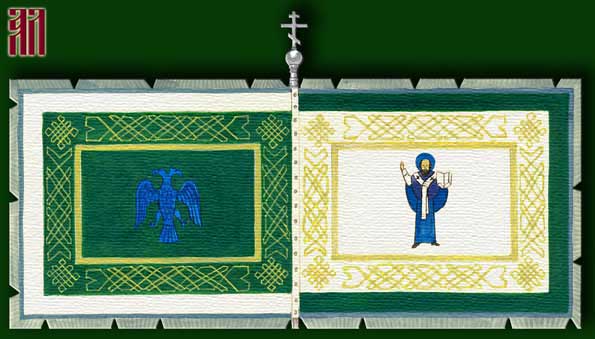
Reconstruction based on Kharitonov and Gorshkov. Artwork by A. V. Lebedeva.
It was taken by the enemy in January 1920 during the capture of units of the 7th Siberian Rifle Division in the Mariinsk and Krasnoyarsk area. However, the regiment's officers removed and hid the icon from the banner. Exhibited at the Central Museum of the Armed Forces (without the pole, finial and ribbons).
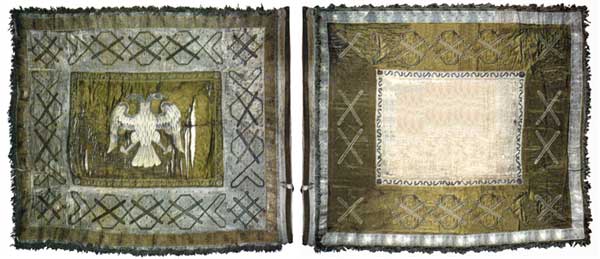
Photo from Durov
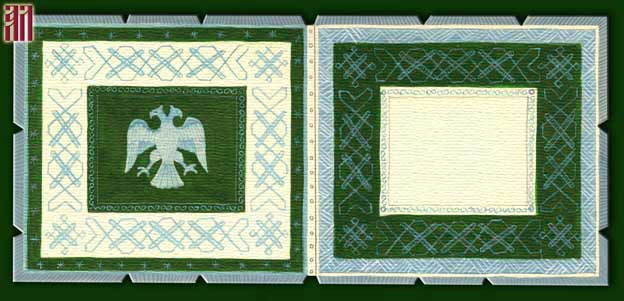
Drawing of the banner from the original by A. V. Lebedeva
The Vestnik Priuralya newspaper recorded the presentation of the banner at Cherdyn, Perm Province:
On Sunday, 4 May, a solemn consecration and presentation of the banner to the Siberian Rifle Regiment took place in Cherdyn on behalf of the local city government, the zemstvo, and the Cherdyn Ioanno-Bologovsky Convent.
Vyatkin quotes:
...at Easter, when the processions from all the churches came to Alina Square, Mother Rufina solemnly presented the commander with a white silk banner, which she had embroidered herself together with her sisters. On one side, the icon painter M.M. Korolev, from the suburban village of Pokcha, had painted the image of the Saviour, and on the other side, a double-headed eagle and the inscription: "To the valiant 25th Tobolsk Siberian Rifle Regiment from the grateful citizens of Cherdyn, the monastery and the district. 21 April 1919." At the same time, Mother Rufina gave a fiery speech:
Where are our best and most respected archpastors and pastors of the Orthodox Church? Where are the best and most ardently patriotic faithful sons of our Fatherland? How many of them have perished, having first been subjected to torment and torture? Bolshevism, like a ferocious wild beast, has torn Russia to pieces, defiled and humiliated it, and removed it from the ranks of the great powers. Know, Christ-loving warriors, that you are bringing liberation to your long-suffering homeland and its long-suffering people; you are bringing light to the world, and if any of you are destined to die on the battlefield, know that, in the words of Christ the Saviour, "there is no greater love than to lay down one's life for one's friends".
Durov, V. I. in "Awards of the White Movement // Rodina, No. 5", Moscow, 2000, p. 139.
Kharitonov, O. V. and Gorshkov, V. V. in "The Russian Army 1917-1920", St. Petersburg, 1997.
Vyatkin, V. in "Through Perfect Love", Perm, 2000. (A partial publication is at vera.mrezha.ru)
Kornakov, P.K. in "Banners of the Civil War in Russia // Stage Equipment and Technology, No. 6", Moscow, 1983, p. 30.
"Vestnik Priuralya [newspaper]", 17 June 1919. Published at siberia.forum24.ru/?1-4-0-00000027-000-10001-1.
19th (27th) Verkhotur'e Siberian Rifle Regiment
For outstanding military distinctions in the fight against the Bolsheviks, the commander of the III Steppe Siberian Corps, General G. A. Verzhbitskiy, renamed the battalion the Verkhotur'e Siberian Rifle Regiment on 15 January 1919 and appointed Captain A. A. Kurenkov as its commander. "I am confident," Verzhbitskiy wrote to Kurenkov, "that the Verkhotur'e soldiers will cover themselves with unfading glory and take an honourable place among the regiments of the Russian army. I congratulate the glorious Verkhotur'e Regiment, led by you, its valiant commander. May St. Simeon of Verkhotur'e, the Wonderworker, be the heavenly patron of the regiment". The day before, on 12 January, the citizens of Solikamsk presented Captain Kurenkov's battalion with a banner bearing the inscription "To the Independent Battalion named after Captain Kurenkov".
Simonov, D. G. in "The White Siberian Army in 1918", Novosibirsk, 2010, p. 205.
The residents of Verkhotur'e took it upon themselves to embroider a banner and present it to Captain A. A. Kurenkov's 19th Petropavlovsk Siberian Rifle Regiment (formerly the Shadrinsk Volunteer Detachment). From that time on the regiment began to be called the 19th Verkhotur'e Siberian Rifle Regiment and recognised Verkhoturye as its base. Later, after joining the 7th Siberian Rifle Division, it became the 27th Verkhotur'e Regiment.
Kruchinin, A. M. in "Under the White-Green Banner: Essays on the History of Military Operations in Trans-Urals in the Summer and Autumn of 1918", Ekaterinburg, 2008, p. 74 citing Filimonov, B. B. in "The Struggle in the Trans-Urals: Actions of the West Siberian Detachment, Autumn 1918 // Bulletin of the Society of Veterans of the Great War, July-December 1941", p. 21.
Made by the residents of Solikamsk and presented in early January 1919 to Captain A. A. Kurenkov's independent rifle battalion, which had been formed in Shadrinsk in the summer of 1918. It served as the regimental banner of the 27th Regiment (formed from the battalion on 3 January 1919). It was preserved through the Great Siberian Campaign by the regiment's commander, A. A. Kurenkov, and taken into exile. In the 1950s, after Kurenkov moved to San Francisco, he transferred it to the Museum and Archives of Russian Culture in San Francisco, where it is stored and exhibited to this day.
The flag is a white rectangle of cloth edged with a narrow green border. On the reverse is the inscription: "To the Independent Battalion named after Captain Kurenkov from Solikamsk and its district." The front has been reconstructed approximately with the image of the coat of arms of the city of Solikamsk.
Gunger, Yu. V. in "The 27th Verkhoturye Rifle Regiment and its commander Alexander Alexandrovich Kurenkov // Bulletin of the History of the Verkhotur'e District, Issue 2", Verkhoturye, 2010.
The banner is a white rectangle of cloth edged with a narrow green border. On the front is an image of the state coat of arms – a double-headed eagle without regalia. The dates "1918 – 1919" are placed on the eagle's wings; in its talons it holds a laurel branch crossed with a sword; and the inscription "All-Russian Government" is placed in an oval medallion on its chest. On the reverse is the inscription: "To the Independent Battalion named after Captain Kurenkov from Solikamsk and its district".
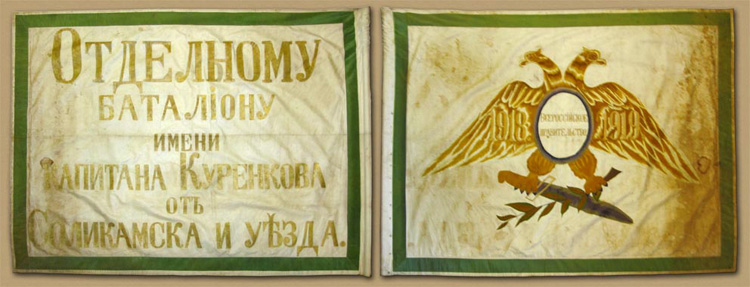
The banner of the 19th (27th) Verkhotur'e Siberian Rifle Regiment
Photo courtesy of Yves Francien.
29th Birsk Rifle Regiment
This had a banner, which was kept by the Chief of Logistics and traveled with the 2nd class supply train. Together with the supply train, it was captured by the Reds in Novonikolaevsk in the winter of 1919.
Filimonov, B. B. in "Admiral Kolchak's White Army", Moscow, 1997, p. 37.
42nd Troitsk Rifle Regiment
Awarded after the regiment was transferred from the General Staff reserve to the Orenburg Army in March-April 1919.
It is on silk red cloth measuring 105 by 123 cm. In the upper centre of the front there is a double-headed eagle with outstretched wings, below which is a picture of St. George the Victorious; the two sides have silver floral ornamentation; and along the bottom is the motto "God is with us". The reverse has in the centre the coat of arms of Orenburg province without a crown; above is the date "1919"; curved below it is the inscription "42nd Troitsk Rifle Regiment"; on both sides is a silver floral pattern; and at the bottom is the motto "For the freedom of Russia". All images and inscriptions are painted. The finial is in the form of a spear on a sphere.
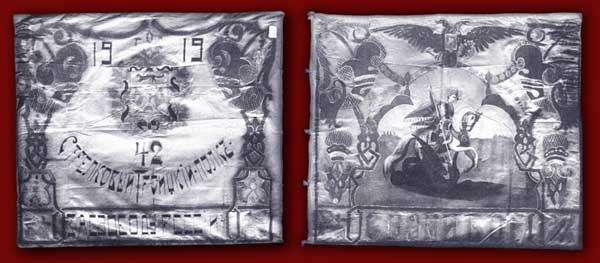
Photo from Ganin
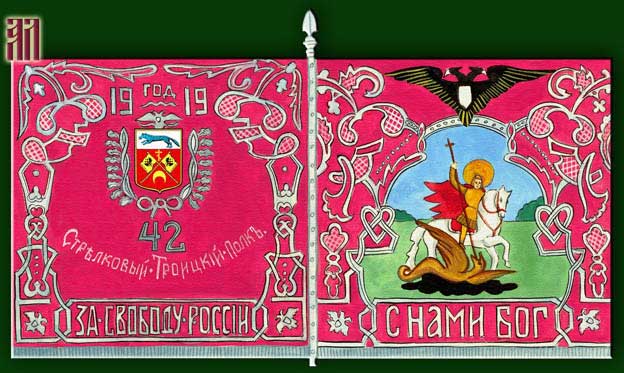
Drawing of the flag by A. V. Lebedeva
Taken by the enemy when the regiment defected to their side on 2 September 1919. Currently stored in the State Historical Museum in Moscow.
Ganin, A.V. in "Ataman A. I. Dutov", Moscow, 2006, p. 417.
Kornakov, P. K. in "Banners of the Civil War in Russia // Stage Equipment and Technology, No. 6", Moscow, 1983, p. 30.
Akulin, I. G. in "The Orenburg Cossack Army in the Struggle Against the Bolsheviks // Admiral Kolchak's Eastern Front", Moscow, 2004, pp. 519, 529.
49th, 50th, and 51st Siberian Rifle Regiments
In July 1919, after being sent to the front from the reserve of the 13th Siberian Rifle Division, they stood with their banners unfurled during a parade in Omsk in the presence of the Supreme Ruler of Russia, Admiral A.V. Kolchak.
The 49th Regiment attacked near the village of Ushlanka with its regimental banner unfurled and accompanied by a military band.
Meybom, F. F. in "The Thorny Path // Pervopokhodnik, No. 28", Los Angeles, 1975, pp. 16, 18.
71st Siberian Rifle Regiment
Formerly the 1st Kungur Reserve Regiment, the 71st Siberian Rifle Regiment was part of the 18th Siberian Rifle Division, formed on 19 April 1919 (the number 71 was assigned on 27 June 1919). The regiment's flag was captured by the 265th and 267th Rifle Regiments of the Red 30th Rifle Division on 28 July 1919 during a battle at Dolmatovo Station during the retreat of the 18th Division along the Dolmatovo-Shadrinsk-Tobol route.
Sitnikov, M. G. in "Colonel N. N. Kazagrandi and his Combat Units // White Army, White Cause, No. 17", Ekaterinburg, 2009, pp. 32, 34.
Independent Horse-Jaeger Divizion
(Attached to the 4th Siberian Rifle Division).
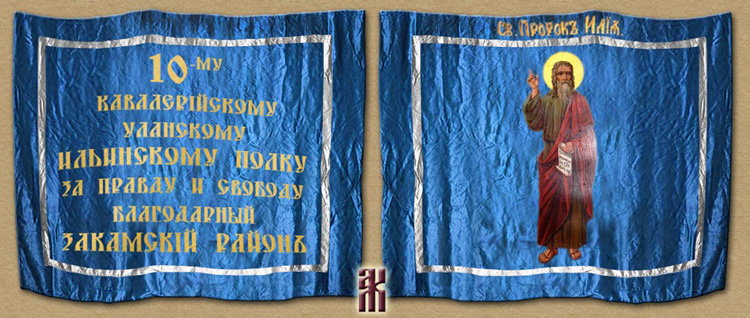
Reconstruction of the banner of the 10th Ilinsk Lancer Regiment by A. A. Karevskiy.
The blue colour was chosen because it was the border colour of the standard of the 6th Volyn Lancer Regiment, which was stationed in Perm for some time.
This flag originally belonged to the 10th Cavalry Regiment of the 3rd Steppe Siberian Army Corps (from January to March 1919, temporarily part of the 1st Central Siberian Army Corps). After suffering losses, in March 1919 it was disbanded, and the remnants were used to form the horse jaeger divizion of the 18th Siberian Rifle Division and the horse divizion of the 7th Steppe Division. The standard was inherited by Captain Manzhetnyy's Independent Horse Jaeger divizion and accompanied it on its journey to Primor'e.
The 10th Cavalry Regiment played a leading role in liberating the Zakamsk districts from the Bolsheviks. A meeting of nine districts of the Zakamsk region of the Perm province, held on 5 January 1919, passed a resolution: "For liberating the population from the godless and hateful Bolsheviks, in order to further commemorate the invaluable services of the regiment". They petitioned the commander of the Northern Detachment to name the 10th Cavalry the "Ilinsk" Lancer Regiment; and ordered a folding icon of St. Elijah the Prophet and a standard with his image and the inscription: "To the 10th Cavalry Ilyinsk Lancer Regiment for truth and freedom, with gratitude from the Zakamsk District." To this end, 200 rubles were collected from each parish, of which there were 12 in total.
Sitnikov, M in "The Ilyinsk Uprising" at Perm GANI. F.90. op.4. d.947. l.2-3. Published at siberia.forum24.ru/?1-4-0-00000121-000-0-0-1393180938 and siberia.forum24.ru/?1-4-0-00000027-000-0-1-1392578799.
The flag was presented in the spring of 1919 by the "grateful population of the liberated Kama region." It made its way to Primor'e with the divizion's officers.
Telitsyn, V. L. in "Commander of the Horse-Jaeger Divizion Mikhail Manzhetnyy // History of White Siberia, Proceedings of the 6th International Scientific Conference, 7-8 February 2005", Kemerovo, 2005, p. 386.
Volkov, V.V. in "Encyclopedia of the Civil War: The White Movement", Moscow, 2003, p. 386.
The flag was presented to the Horse-Jaeger Divizion by the grateful population of the Kama region, most likely in Sarapul, which it entered first as part of Colonel Kazagrandi's combat column. It was a remarkable operation: after the liberation of Votkinsk by Lieutenant-Colonel Metelov's 16th Ishim Regiment: the divizion fought its way along the right bank of the Kama River, taking Sarapul from the rear, i.e. inside the so-called Sarapul Fortified District, covering a distance of more than 1,000 km. It bypassed Izhevsk and Votkinsk (approximately 40 km to the north), went through Stepanovo, crossed the Kama River, moved along the Piz River, crossed the Ekaterinburg rail line in the area of the Rybak Station, and turned towards Elabuga. One of the Sarapul newspapers, referring to the Omsk newspaper Nasha Gazeta (the newspaper of Kazagrandi's Combat Column), wrote: "Sarapul was taken after a four-hour battle. 2,500 prisoners were taken, along with about 2,000 rifles, an armoured train, 15 machine guns, etc."
Material kindly provided by Votkinsk researcher S. K. Prostnev.
13th Ufa Rifle Regiment
Part of the 4th General Kornilov Ufa Rifle Division.
During the period when Kolchak's forces were in Ufa, one of the neighbourhood committees collected 2,250 rubles to sew a banner for the 13th Ufa Regiment, but it is not known whether the banner was actually sewn.
"Ufa Life [newspaper]", 14 May 1919.
According to the writer Konstantin Sedykh, author of the famous novel "Dauria", V. O. Kappel's coffin was covered with the banners of the 8th Kamsk and 4th Ufa Divisions.
Shushpanov, S. G. in "The Forgotten Division", Ufa, 2011, pp. 98, 179.
1st Immortal Shock General Gaida Regiment
From a photograph at bergenschild.com. The time and circumstances of its establishment, as well as its fate, are unknown.
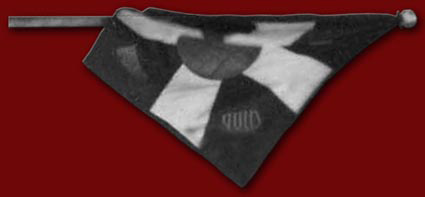
www.bergenschild.com/Reconstruction/photosaloon/civil_war/white/chronicle_people/yekaterinburg_1919_02.jpg [link dead]
2nd Cherdyn Rifle Regiment
For June 1919 it is recorded:
The 2nd Cherdyn Regiment of the White Army was stationed at the Zalzninsk factory and to the right of the Vyatka River. It was part of the 1st Perm Division, which the Whites formed after taking Perm. ... On the second day, the Kizelovtsy continued their offensive and finally defeated the White 2nd Cherdyn Regiment near the village of Krasnoglinnoe, the remnants of which fled into the forest. That regiment lost its banner near Afanasyevskoe. It was taken by the 23rd (Verkhnekamsk) Regiment, which replaced the Kizelovtsy.
The banner is now in the Museum of the Soviet Army, in Moscow.
Udnikov, S. N. in "The glory of those days will never fade // In the smoke of gunpowder: Collection of memoirs of participants in the Civil War in the Kama Region", Perm, 1961, pp. 80-81. Quoted from: siberia.forum24.ru/?1-4-0-00000027-000-10001-1.
General Volkov's Volunteer Detachment
In early June 1919 a Special Vladivostok Officer Detachment was formed in Vladivostok under the command of General V. A. Volkov. The detachment departed for the front (probably to the Urals). The detachment was presented with a banner by the Vladivostok City Council. It was in the national colours, bearing the coat of arms of Vladivostok.
"Amurskaya Zhizn [newspaper]", 12 June 1919.
siberia.forum24.ru/?1-4-0-00000027-000-10001-0.
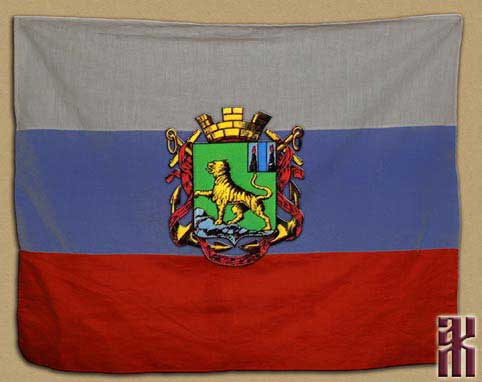
Vasily Danilovich Zhiganov commanded the company until his transfer to the 36th Siberian Rifle Regiment. In May 1919 he went with a group of 100 officers (the General Volkov Volunteer Detachment) from Vladivostok to Omsk, carrying the detachment's banner, which had been presented by the city of Vladivostok. Zhiganov spent his time with the White Army in Siberia in the Model Jaeger Division, first as a junior officer and then as the head of a machine-gun komand.
The album "Russians in Shanghai", Shanghai. Information kindly provided by Votkin researcher S. K. Prostnev.
Ataman B.V. Annenkov's Independent Partisan Division
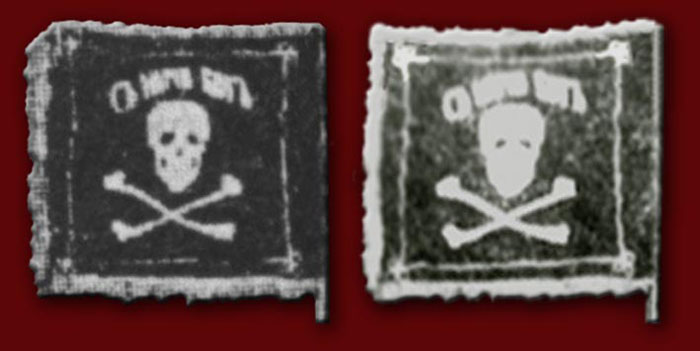
Photographs of the banner of Ataman B. V. Annenkov's Independent Partisan Division. The first is from a photo of Annenkov with his escort, with the banner unfurled behind him.
"Ogonyok, No. 32(228)", 7 August 1927.
Only the detachment (division) as a whole had a banner. It was black with the inscription "God is with us." The words "and Ataman Annenkov" were not on it: "This is fiction," Annenkov claimed. There were no banners with the regiments, only regimental pennons. They were square pieces of cloth of various colours, measuring one arshin and a quarter [90 cm], with a skull and crossbones, the name of the regiment and the inscription "God is with us". That of the Cuirassier Regiment, for example, was yellow.
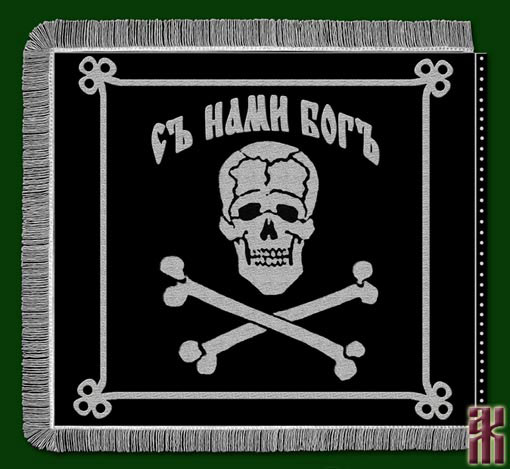
Reconstruction of the banner of Ataman B.V. Annenkov's Independent Partisan Division.
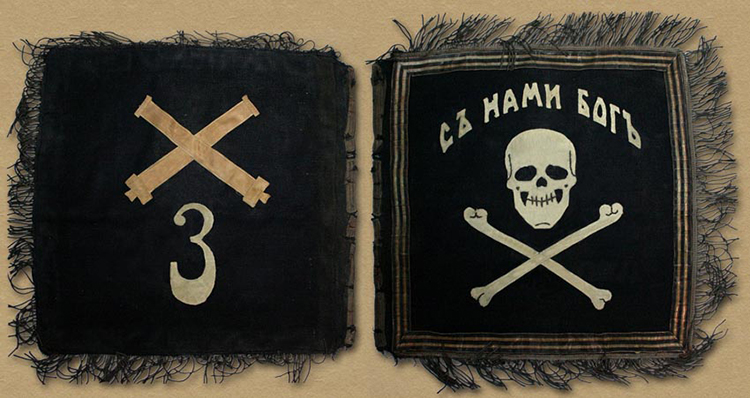
Marker of one of the artillery units of the Independent Partisan Division
oldthing.ru/1086-shtandart-art-podrazdeleniya-annenkova.html
This is a square black panel, surrounded with a silver fringe. The front side is surrounded with a wide St. George ribbon. The images are made using white cloth appliqué technique: on the front is a skull and bones and the inscription "God is with us", while the reverse has crossed artillery barrels and under them the number "3". On the site it is attributed as a standard, but it is known that the Partisan Division had only one – divisional – banner, and all other units and formations used simple markers.
The inscription "God is with us" was already his official slogan during the First World War, and was written everywhere, including on the soldiers' heated railway carriages. Annenkov retained the slogan in his detachment (division): on the detachment's banner, on regimental badges and on other objects chosen by the partisans. The words "and the Ataman" were added by the partisans themselves on their own initiative and were not mandatory.
During the retreat of the remnants of the division to China in May 1920, the banner was taken to the Borotalinsk Valley near Bole (Jimpan). In August 1920 it was transferred to the Urumqi area (the town of Sanji), and in October 1920 to Xinjiang (the city of Guchen), where it remained until Annenkov's arrest by the Chinese and the dispersal of his detachment. Its further fate is unknown.
Goltsov, V. A. in "Siberian Vendée: The Fate of Ataman Annenkov", Moscow, 2009, pp. 128, 310-311.
In Semirech'e, the enemy attacked Kopal on 6 December, surrounded it, but was repelled: details are not yet known. On 30 November, there was an attack on Dzharkent: a captured Cossack revealed that the detachment has a green banner with a white crescent. The enemy's official forms are stamped: "Special Representative for the Organisation of Troops in the Tarbagatai Province. Col. Bryantsev." The detachment's headquarters is in Nikolaevsk. Its task is to advance to the rear of Dzharkent as part of Annenkov's detachment, which has promised to send another 5,000 Cossacks.
Frunze, M. V. in "On the Fronts of the Civil War", Moscow, Voenizdat, 1941, p. 240.
For the November 1919 abandonment of Kopal:
The remnants of the 2nd Steppe Siberian Corps, reinforced by the retreating detachments of Belov and Dutov's armies, numbered a total of around 9,000 soldiers. Annenkov's units, which included Tatar, Taranchi and Alash [Kazakh] sotnias, were also located in the Dzharkent-Przevalsk area. They numbered 48 men. There were also combined units of Cossack regiments. Red Army intelligence reported that the sotnias had no guns or machine guns, with:
20 to 60 rounds of ammunition per person. The standard-bearer has a green flag with a white skull and crossbones and the inscription "God is with us," and on the other side, a white crescent with a star and the Muslim inscription "Alash". The bags on the papakhi of the Cossacks are red, those of the Taranchi are green, and those of the Alash are white. The Muslim population's attitude towards the Whites is friendly.
Amanzholova, D. in "Kazakh autonomism and Russia: History of the Alash movement", Moscow, 1994, p. 179.
Marine Rifle Brigade
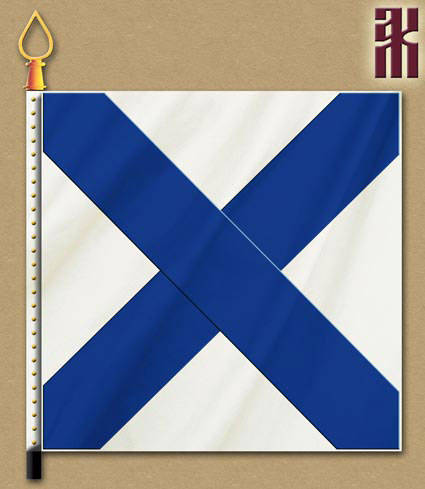
On Sunday 13 April, at 3 o'clock in the afternoon, a ceremony was held at the Supreme Ruler's residence to attach the banner of the Marine Rifle Brigade, which was leaving for the front, to its pole. The pole and the Great St. Andrew's Flag were placed on a large table in one of the rooms of the house. Officers, one platoon of riflemen, and one platoon of the brigade's special company were lined up along the walls. ... The Supreme Ruler arrived and greeted the officers and soldiers lined up in front of him. He hammered in the first nail attaching the flag to the pole. Following him the officers and soldiers present at the ceremony approached the table and hammered in the remaining nails.
On Monday 14 April, on the square near the Judicial Institutions building, the chief priest of the army and navy, Archpriest Kasatkin, assisted by clergymen of the Naval Department, performed the ceremony of consecration of the banner of the naval riflemen. One battalion of Marine Riflemen, two special companies, and platoons of infantry and Cossack units of the garrison were lined up on the square. At the end of the service and the consecration of the banner, the Supreme Ruler took the banner from the hands of Archpriest Kasatkin and handed it to Captain Stepanov, who knelt before him, and he in turn handed it to the standard-bearer. After that, the Supreme Ruler had the troops march past him in a formal parade. In orderly rows, with cheerful, happy faces, riflemen in grey greatcoats with black shoulder-boards and soldiers of special companies in black greatcoats marched past the Ruler to the sounds of the brigade orchestra.
"Russian Army No. 79", 16 April 1919.
siberia.forum24.ru/?1-4-0-00000027-000-0-1-1348497886.
Banner of an unidentified unit
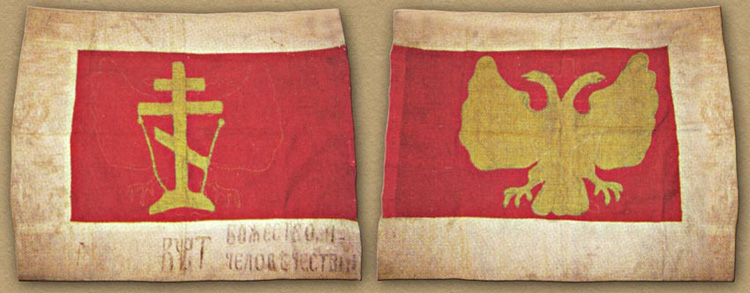
Photo from Karpov.
Double-sided red cotton cloth banner trimmed with white cloth of the same type. The front side features a yellow fabric appliqué in the form of a double-headed eagle without state regalia. On the reverse side there is an appliqué made of the same fabric in the form of an eight-pointed Orthodox cross with the instruments of the Passion (a sponge and a spear). On the border of the reverse side, there is an inscription made with a chemical pencil: "Down with inhumanity. Long live divinity and humanity." The size of the banner is 90 by 73 cm. It is stored in the banner collection of the Central Museum of the Armed Forces in Moscow.
Karpov, N.D. in "Crusaders: Kolchak's Last Reserve", Moscow, 2014.
16th Ishim Siberian Rifle Regiment
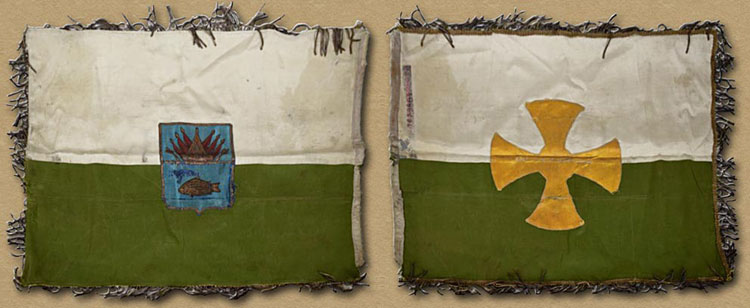
Published at www.vexillographia.ru/russia/beloe.htm
with reference to researcher V. Emelyanov
Double-sided split in half white over green with a wide gold fringe. On the front there is a golden Militia Cross. On the reverse there is the coat of arms of the city of Ishim: the upper part of the shield has the arms of Tobolsk, and below there is a golden carp on a blue field (there are many lakes in the vicinity of this city, which abound in exceptionally sized fish of this type).
Home — State Symbols — Flags — Uniforms — Badges & Medals — Money — Other
Pygmy Wars Notes
The original of this page is at kolchakiya.ru/vexillology/ordinary_flags.htm.
1) A Volzhanin is a resident of the Volga region, and Volzhane is the plural form. So this and the "VK" on the front refer to the men, not the General personally.
2) A reconstruction of one of these flags is given on the insurgent flags page. Other flags and banners of these units are also given on the St George banners page, the emigration flags page.
3) Given the context, it is likely that the base of the banner was white over green.