
Banners of anti-Bolshevik Armed Formations in 1918
All material and recontructions by A. Karevskiy unless otherwise noted.
Regiments of the KOMUCH People's Army
Established by Orders Nos. 1, 11 and 17 of the People's Army of 8 June 1918. ("On the establishment of St. George cockades and St. George banners for the troops").
Ezeev, A. B. in "On the question of "admissibility", "legitimacy" and "authority" ... // Military Reality, No. 4", Moscow, 1993, p. 15.
12 June 1918. KOMUCH decided to urgently order three red banners, with the inscription: "Power to the people – power to the Constituent Assembly" for presentation to the People's Army and Cossack units.
Trotsky, V. in "The Revolution of 1917-1918 in the Samara Province: Chronicle of Events, Volume 2", Samara, 1929, p. 116.
Many memoirs of that time, relating to the period of the People's Army's independent existence, emphasised the fact that most of the soldiers "would steadfastly refuse to go into battle under the red flag." So the banners of the People's Army represented a compromise between traditional military and revolutionary symbols: the front of the banners were red, and the reverse were in the colours of the Order of St. George the Victorious (the same as the military cockade).
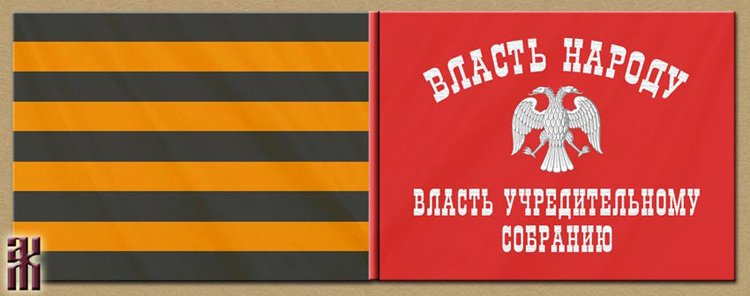
Reconstruction of the first version of the People's Army flag
According to the Siberian researcher V. Zhuravlev, published on the website www.vexillographia.ru, in one of the photographs the banner of an unidentified unit of the People's Army had nine stripes – five black and four orange.
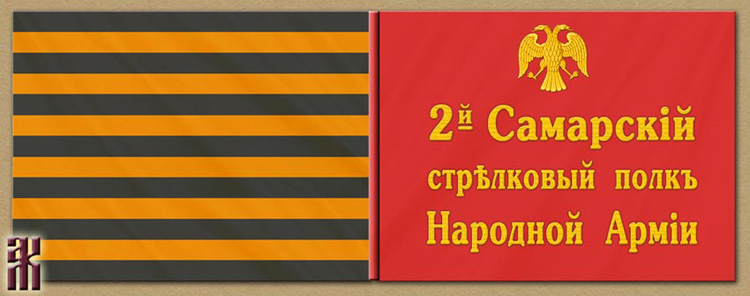
Reconstruction of the second version of the People's Army flag
The reconstruction by the Samara Military History Club is based on the assumption that there were 13 stripes on the reverse of the flag (7 black and 6 orange), and the name of the military unit was placed on the red front.
Flags of the Volga Combat Flotilla
July 1918, Batraki village, Samara region
The next morning, two cadets killed on the Milutin in the battle near Batraki were buried. Their coffins were covered with St. George flags – the flags of the People's Army. The fact is that the People's Army ... introduced St. George ribbons instead of cockades on hats, and Midshipman M., instead of the St. Andrew's flag, initially raised a black and yellow flag on his ships, in the form of a large ribbon, following the example of Kappel's army.
Lieutenant M. in "The War on the Volga in 1918 // From the Shores of America: Jubilee Historical Collection of the Society of Russian Naval Officers in America 1923-1938", New York, 1939, p. 291.

Reconstruction of the first version of the flags of the Volga combat flotilla
August 1918
In August, after the capture of Kazan, St. Andrew's flags were raised on the flotilla's ships instead of the black and yellow St. George flag, as had been introduced in the People's Army.
Kadesnikov, N. Z. in "A Brief Essay on the White Struggle under the St. Andrew's Flag on Land, Seas, Lakes and Rivers of Russia in 1917-1922", St. Petersburg, 1992, p. 60.
Early August 1918, near Sengiley:
Soon we were to reach the town of Sengiley, already occupied by the Whites. Not far from it, a White tugboat armed with cannons and machine guns was coming towards us under a tricolour flag and signalled us to stop.
War and Revolution: Memoirs of Colonel N. I. De-Lippe-Lipsksiy of the 2nd Tsarskoye Selo Rifle Regiment // Memorable Days: From the Memoirs of the Guards Riflemen", Tallinn, 1939, p. 80.
West Siberian Independent Army
The state symbols of autonomous Provisional Siberian Government Siberia were used. According to the resolution of the Conference of Public Organisations of Siberia of 5 August 1917:
The National Siberian flag is a combination of two colours – white and green. White represents the snow of Siberia, and green represents the Siberian taiga. The flag is rectangular in shape, divided into two parts by a diagonal line connecting the upper left corner to the lower right corner, with the upper part being green and the lower part being white.
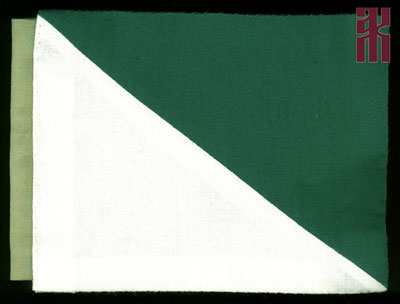
During the period of the united Siberian underground, it was often used without modification. The first Siberian volunteer units greeted the Czechoslovaks under this banner in Tomsk on 29 May 1918. White and green banners were used by the regiments of the 1st Central Siberian Corps – they appeared when the corps entered liberated Perm on 24 December 1918.
There were also other banners featuring white and green colours. For example, two banners from 1918 are known (a detailed description is given in the section Ordinary Flags in the Army of the Supreme Ruler:
- 3rd Irkutsk Rifle Division. (On the front was an image of St. Innocent, the patron saint of Siberia, and on the back was the inscription "God is with us".)
- 18th Tobolsk Rifle Regiment. (A red banner with a wide yellow border of 95 by 125 cm. In the centre of the front was an Orthodox eight-pointed cross and the motto "With this sign you will conquer". Decorated with a white and green ribbon with a tricolour white, blue and red bow.).
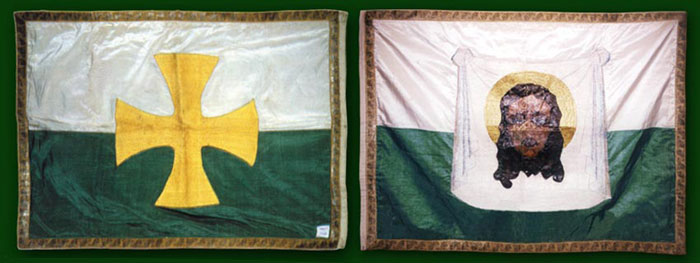
Unattributed banner from the collections of the Central Museum of the Armed Forces.
Finally, the Central Museum of the Armed Forces exhibits an unattributed banner, which also clearly belonged to one of the Siberian units. It is a double-sided rectangular silk cloth, divided horizontally into two equal halves, with the upper half white, and the lower half green. It measures 103 by 77 cm. On the front is the image of Christ Not Made by Hands, painted in oils, and on the back is an image of the Militia Cross, sewn on in gold brocade. The edges are trimmed with wide gold zigzag braid (gold brocade ribbon).
A photo of the reverse is in Durov. A photo of the front is posted on vexillographia.ru
Durov, V. I. In "Awards of the White Movement // Rodina, No. 5", Moscow, 2000, p. 139.
Zhuravlev, V. V. in "State Symbols of 'White' Siberia // History of 'White' Siberia: Abstracts of the scientific conference (7-8 February 1995)", Kemerovo, 1995, p. 12-14.
Sitnikov, M. G. Colonel in "E. I. Urbanovsky and his stormtroopers // White Army, The White Cause, No. 12", Ekaterinburg, 2003, pp. 28, 44.
Kirilov, A. A. in "The Siberian Army in the Struggle for Liberation // Free Siberia, Vol. 4", Prague, 1928, pp. 44, 63.
Kornakov, P. K. in "The Banners of the Civil War in Russia // Stage Technology and Technology, No. 6", Moscow, 1983, p. 30.
Novikov, P. A. in "The 3rd Irkutsk Siberian Rifle Division // White Army, White Cause, No. 10", Ekaterinburg, 2002, p. 11.
"Rodina, No. 5", Moscow, 2005.
Lieutenant Surov's Partisan Detachment
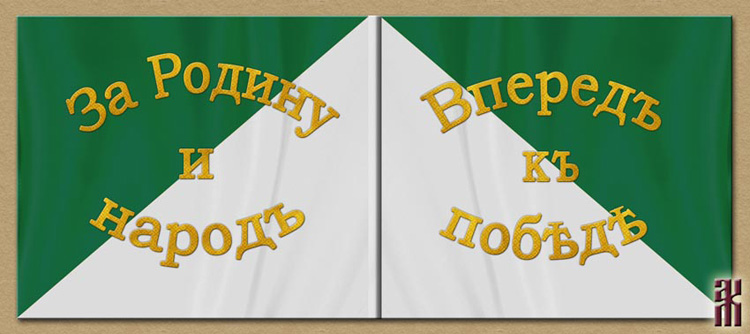
4 July 1918
To the commander of the military detachment of the provisional Siberian government, Staff-Captain A. T. Aldmanovich.
Your unit was tasked with the difficult mission of clearing the route from Tomsk to Kuznetsk of Red Guards. Travelling by steamboat with a small unit, you achieved a complete victory over the Soviet troops, who outnumbered you many times over and had five steamboats at their disposal. By eliminating Soviet power in this way, you freed the population of the Kuznetsk district from the violence that was inflicted on us by the Soviets. We, as representatives of the city of Kuznetsk and the district, ask you, Alfons Teofilovich, and Lieutenant V. A. Surov, who took an especially active part in all the operations, to accept our sincere gratitude on behalf of the entire district. As a memento, let your valiant detachment have a banner with the colours of the provisional Siberian government (green and white) and the slogans "Forward to victory" and "For the motherland and the people".
Signed: Chairman of the District [...] Council M. Nilov.
Kuznetsk City Mayor Mi[...]vich. For secretary Khomenko.
4 July 1918.
"Siberian Life, No. 80", 9 August 1918. Published at siberia.forum24.ru/?1-8-0-00000044-000-0-1-1345318925.
Izhevsk and Votkinsk People's Armies
These appeared no earlier than the second half of September 1918, after the reorganisation of individual workers' companies into regiments and their incorporation into the Votkinsk Division and Izhevsk Brigade.
They were a rectangular green silk cloth, trimmed with a narrow red border. On the front is an inscription (white or scarlet) in Slavonic script with the number and name of the regiment. On the reverse is the emblem of the factories embroidered in gold – a crossed wrench and hammer framed by a wreath of wheat ears. The finial was a slotted spear.
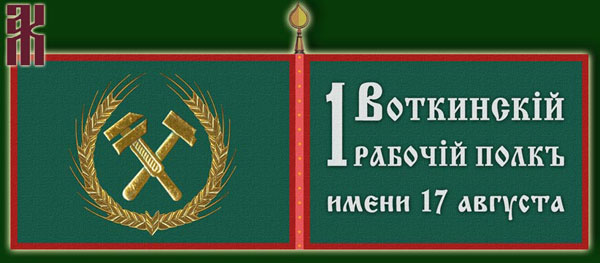
Reconstruction by local historian I. A. Dobrovolskiy
The green symbolised the colour of the Motherland, its hopes, its fields and forests, while red symbolised belonging to the working class and solidarity with the labour movement.
Six such banners (probably four from Votkinsk and two from Izhevsk) appeared during the parade on 12 February 1920 at Innokentyevskaya Station near Irkutsk.
Lekomtsev, V. in "On the history of the Votkinsk plant: Civil war (1918-1919)", Votkinsk, 1998, p. 47.
Plotnikov, I. F. in "On the history of the formation and combat path of the Izhevsk Division (White Brigade) // History of White Siberia: Abstracts of the 3rd Scientific Conference, 2-3 February 1999", Kemerovo, 1999, p. 27.
Kobzev, I. I. in "From Izhevsk to Harbin // Monuments of the Fatherland", Udmurtia. Moscow, 1993, p. 163.
I. I. Kobzev, Doctor of Historical Sciences from Izhevsk, gave me his excerpts from the diary of our famous local historian I. A. Dobrovolskiy (born in 1911), which were considered lost forever, for a few days. Keeping his diary, copying his mother's diary, which she had kept since the February Revolution, relying on his memory and references from other people (lists), entries by Votkinsk Archpriest P. N. Luppov (whose diary was confiscated in 1939, and who threw himself under a train in a state of terrible depression), Dobrovolskiy gives descriptions of the banners in three places:
The banners of the Izhevsk and Votkinsk regiments were identical, except for the peasant regiment, differing only in their inscriptions: 1st Votkinsk Workers' Regiment or 2nd Izhevsk Regiment, etc. On the green field of the banner was the emblem of the factories – a crossed wrench and hammer framed by ears of wheat. The green colour of the banner was framed by a red border. The peasant regiment had a different banner. On a white background was the face of Jesus Christ, and below it the inscription "God is with us". Another inscription (probably on the other side – S.P.) read "Votkinsk Peasant Regiment".
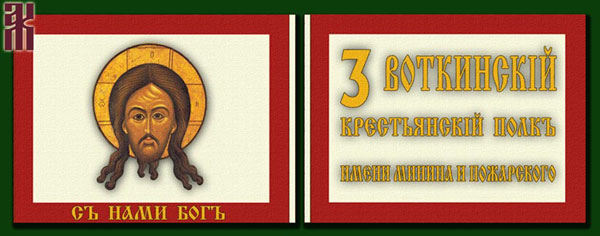
Reconstruction of the flag of the Votkinsk Peasant Regiment,
although it has "3rd Votkinsk Peasant Regiment"
And further on in the diary:
The people of Izhevsk and Votkin had green banners with a wide red stripe around them. In the centre of the field there was a picture of a wrench and a hammer. The peasant regiment also had a banner, which is shown in the photo – the face of Christ on a white background. The inscriptions – the name and number of the regiment – were located on the border.
From the memories of others:
There was no uniform. There was an economic and medical unit and a brass band. The rebels did not yet have banners; they were handed out to the regiments after they were organised.
In one of the drawings, the rectangle of the banner is indicated by an arrow and written in "gold letters".
I. A. Dobrovolskiy lists in his diary those who took part in the parade on 12 February 1920 at Innokentyevskaya Station (near Irkutsk). The 1st, 2nd, and 4th Votkinsk Regiments and the 3rd Peasant Regiment, followed by the 1st and 2nd Izhevsk Regiments. Artillery and machine gun crews did not participate. The 10-year-old Dobrovolskiy probably confuses the Izhevsk Division, which had left Innokentyevskaya on 8 February, and the 15th Votkinsk Division with the so-called Izhevsk-Votkinsk Division, formed on a territorial basis in Irkutsk in November 1919 from refugees, demobilised soldiers, officers and officials of the Irkutsk province which marched along the road in the column of the Eastern Front Headquarters. Although this division took part in only one battle near of Taiga Station, according to the letters of Irkutsk resident P. A. Novikov, it was very well equipped and armed. It is possible that only a few battalion banners were presented to it before it was sent to the front – these were the ones Dobrovolskiy saw at the parade.
According Dobrovolskiy, the surviving banners of the Izhevsk and Votkinsk units were kept in the Harbin Museum until 1945. (Probably in the Izhevsk-Votkinsk Union, which was in the Far Eastern Department of the ROVS, and stood for irreconcilable armed struggle against communism. It participated in partisan warfare and sabotage on the territory of the USSR. It is not to be confused with the Izhevsk-Votkinsk Union of Shanghai or such).
Notes by local historian K. S. Prostnev (Votkinsk), edited by A. Karevskiy.
"White Army, White Cause, No. 11"
Unidentified Votkinsk unit
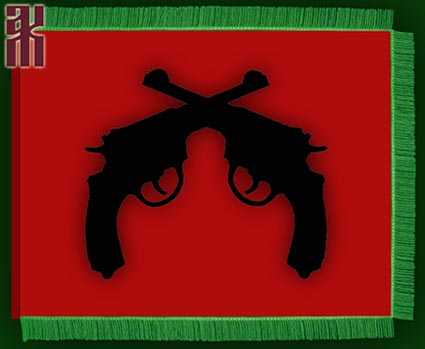
Discovered in the 1930s-1940s in the attic of a house. It was used as a tablecloth, then, as it wore out in the 1950s, it was cut into pieces and completely destroyed. According to surviving eyewitness accounts, it was a red silk cloth with an appliqué in the form of two large crossed black revolvers, trimmed with green fringe.
Private communication from Votkinsk local historian S. K. Prostnev.
Colonel Vlasov's Immortal Battalion (Izhevsk People's Army)
Under the shadow of a sacred banner with the image of St. Nicholas the Wonderworker, pierced by fourteen bullets, a handful of people smashed entire regiments of reds. Izhevsk was in agony – the Bolsheviks were crushing with force, smashing it with artillery. The troops were overworked and could not hold. They needed help. Who? The shock troops. They gathered quickly. They went to the cathedral. They knelt down. They prayed. They set off. The orchestra was playing ... They lined up in battle formation. The banner was at the front. It was carried by a sixty-year-old man, a worker named Lozovskiy, strong, stocky, with a large beard. He walked with a firm step. Next to him was a colonel. And behind them follow the others. The Reds were asleep, the guards were dozing. The first shot, the second ... a firefight. The machine guns start firing. Someone shouted, "Ura!" Others joined in. Attack. The enemy was stunned, rans, fireed back. The first casualties. The ranks were thinning. The "warriors of death" knew no danger, they only saw the enemy. There was the old standard-bearer. He was hit by a machine gun – five bullets pierced right through him. He staggered, took a step forward and fell. Another man picked up the flag. Forward again...
L. A.-V. in "Military Gazette, No. 22", 17 December 1918
Home — State Symbols — Flags — Uniforms — Badges & Medals — Money — Other
Pygmy Wars Notes
The original of this page is at kolchakiya.ru/vexillology/insurgent_flags.htm.
The reconstructions, especially for the Volga fleet flag, are shown quite orange for the St George stripes. At that time it was often more yellow-black than orange-black.