
Uniforms of Units under the Command of Ataman Dutov, 1918-1920
Material and reconstructions by A. Karevskiy, unless noted otherwise.
1. Ataman Divizion of the Orenburg Cossack Host
Order No. 135 of the Orenburg Cossack Host, 4 September 1918, Orenburg
§2. I hereby announce to the host, for the information of those concerned, a copy of the decree of the Host Government, dated 16 August of this year, No. 652, on the establishment of a cipher on the shoulder-boards of the Ataman Cossack Sotnia.
Army Ataman, Lieutenant-General Dutov
This document was kindly provided by Moscow researcher V. V. Romanov.
Decree No. 652 of the Military Government of the Orenburg Cossack Host, 12 August 1918
The Military Government has decided: to establish for the Ataman Cossack Sotnia: the cipher "Ат" on the shoulder-boards, in white paint using a stencil for ordinary Cossacks, and the same letters embroidered with white thread for officers.
Chairman of the Military Government, Ataman Lieutenant-General Dutov
This document was kindly provided by Moscow researcher V.V. Romanov.
Dutov, Kolchak, members of the government and representatives of the Allies attended the funeral service for General L. G. Kornilov on 13 April 1919 According to an eyewitness, the Orenburg ataman wore shoulder-boards with the letters "Ат". Shoulder-boards with this cipher were established for the Ataman Cossack Sotnia, later reorganised into a two sotnia Ataman Divizion, whose shoulder-boards Dutov wore.
Ganin A. V. in "Ataman A. I. Dutov", Moscow, 2006, pp.252, 394.
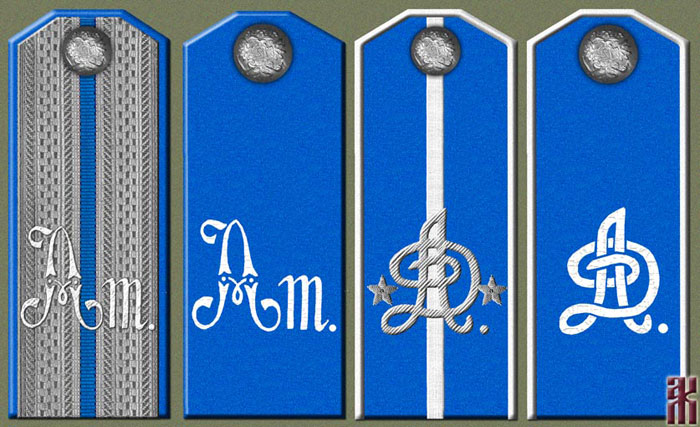
Shoulder-boards of the "Ataman" units of the Orenburg Cossack Host:
1 and 2 – shoulder-boards of the Ataman Cossack Sotnia, 1918;
3 and 4 – shoulder-boards of the Ataman Cossack Divizion, 1919-1920
The reconstructions are based on photographs from Ganin's book
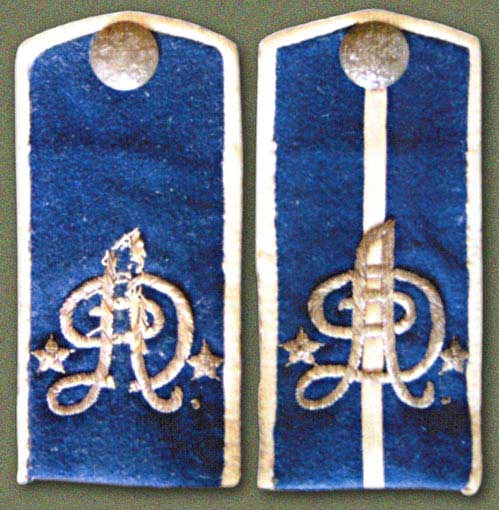
Shoulder-boards of Second-Lieutenant M. K. Rechkalov of the Ataman Divizion
From the collection of D. M. Rechkalov, published in Kokunko, G. V. and Tabolina, T. V. "Cossacks Abroad", Moscow, 2008, p.210.
2. Kirghiz Escort of the Ataman of the Orenburg Cossack Host
Troitsk, 15 February 1919
The Supreme Ruler, together with Ataman Dutov and his retinue, set off on troikas, accompanied by an honorary Cossack escort and Kirghiz horsemen in bright red turbans.
Ganin, A. V. in "Ataman A. I. Dutov", Moscow, 2006, p.323, quoting the "Government Gazette, No. 72", Omsk, 19 February 1919, p.2.
Omsk, 9 April 1919
Dutov appeared at breakfast accompanied by Kirghiz guards wearing fur hats and raspberry uniforms.
Zhanen, M. in "Excerpts from my Siberian Diary // Siberian Lights, No. 4", Novosibirsk, 1927, p.143.
Dutov's personal Kirghiz escort wore a special uniform – cherkeska coats, red beshmet undercoats and red topped fur hats.
Khvostov, M. in "The Russian Civil War, (2) White Armies // Men-at-Arms, No. 305", Oxford, 2004, p.36
3. Orenburg "Ataman Dutov" Volunteer Rifle Regiment
By Order No. 275 of 13 September 1918, the 18th Orenburg Rifle Regiment of the 5th Rifle Division of the People's Army was renamed the Orenburg Volunteer Rifle Regiment named for Ataman Dutov. However, on 24 September, Order No. 336 cancelled this decision: the 18th Regiment was to remain unchanged, and the volunteer regiment was to be reformed and included in the division as the fifth regiment.
Design for the shoulder-boards of the regiment were approved by Dutov on 28 October 1918.
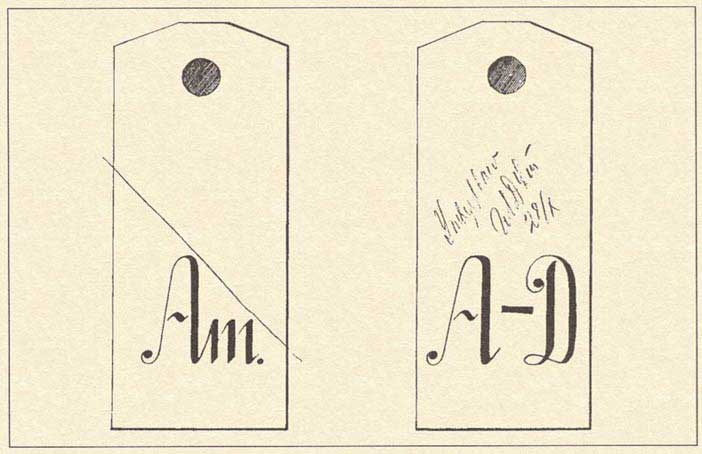
Appendix to the order giving the appearance of the shoulder-boards for the
Orenburg Ataman Dutov Volunteer Rifle Regiment
Ganin, A.V. in "Ataman A. I. Dutov", Moscow, 2006 from RGVA F.39477 Op.1 D.8 L.225, 226, 288, 347.
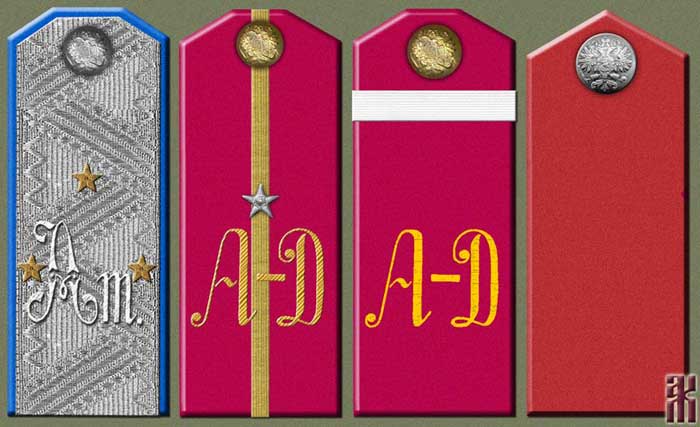
1 – lieutenant-general's shoulder-board for the Orenburg Host (i.e. Dutov);
2 and 3 – shoulder-boards of the Orenburg Ataman Dutov Volunteer Rifle Regiment;
4 – shoulder-boards of the personal Kirghiz escort of Ataman Dutov
The reconstruction of the escort insignia is based on a drawing by A. Karashchuk in Rodina magazine.
"Rodina No. 5", Moscow, 2000, p.138.
4. 16th Karagay Ataman Dutov Cossack Regiment
Ataman Dutov's patronage was established on 5 October 1918 by the 3rd Extraordinary Military Krug of the Orenburg Cossack Host (renaming the 16th Orenburg Cossack Regiment).
A photograph of the shoulder-boards is provided by Ganin.
Ganin, A. V. in "Ataman A. I. Dutov", Moscow, 2006, p.252, 254.
5. Other units
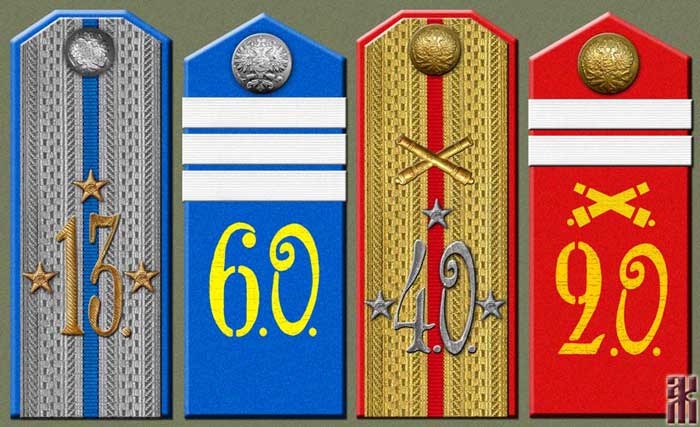
1 and 2 – shoulder-boards of the Orenburg Cossack Host's cavalry regiments
(here the 13th and 6th Orenburg Cossack Regiments);
3 and 4 – shoulder-boards of the Orenburg Cossack Host's artillery units
(here the 4th and 2nd Orenburg Cossack Batteries)
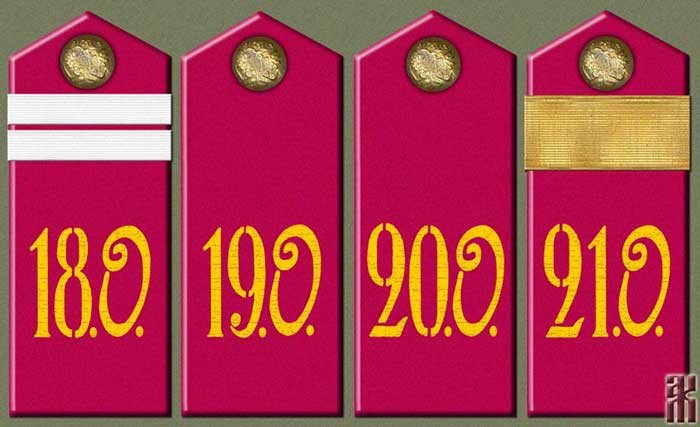
Shoulder-boards of the 5th Orenburg Rifle Division – 18th, 19th, 20th and 21st Orenburg Rifle Regiments
This was formerly the 5th Rifle Division of the People's Army. The idea for the reconstruction came from Orenburg researcher Yu. Davydov.
6. Wound Markings
Decree No. 335 of the Military Government of the Orenburg Cossack Host
Turgai, 21 May 1918
The Military Government, considering the issue of the fight against Bolshevism, has decided:
All those wounded in the defence of the host shall wear a blue patch on their left sleeve, modelled on the patch for the wounded announced in Order No. 710 of the War Department, 1916.
Ganin A. Distinguishing marks of the Orenburg Cossack troops. 1918-1919// Tseikhgauz. Moscow, 2002. No. 19, p.39. (RGVA F.39503 Op.1 D.1 L.20)
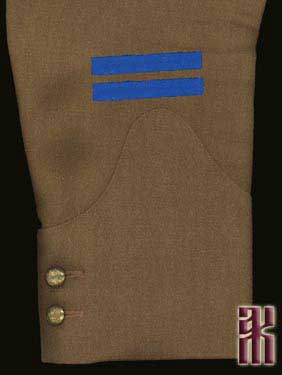
Wound markings established for officers of the Orenburg Cossack Host
7. Badge for those who distinguished themselves in battle against the Bolsheviks
Order No. 40 of the Chief of Defence of the Orenburg Cossack Host
9 May 1918, Turgai
§1. Resolution No. 337 of the Host Government of 8 May of this year, on awarding those who distinguished themselves in battle against the Bolsheviks with a breast badge is hereby announced.
The Host Government, considering the issue of the struggle against Bolshevism and wishing to honour the zealous defenders of the Orenburg Cossack Host, has decided:
To establish a distinctive badge in the form of a blue ribbon combined with a St. George ribbon, worn in the buttonhole of a greatcoat or on the side of a blouse (or tunic) modelled on the St. George ribbon.
To award this distinction, an awards committee shall be established, consisting of five people who have earned the St. George Cross, who shall be guided by the statutes of the St. George Cross when awarding the distinction.
§2. In accordance with Decree No. 337 of the Military Government, the following are appointed to the awards committee: Chairman, Colonel Panov; members – Lieutenant Savin, Second-Lieutenant Medvedev, Lieutenant Doradet and Corporal Kotychev.
Reserve members – Ensign Shutov and Sergeant-Major Gorshenin.
§3. All matters concerning representations shall be dealt with in accordance with the St. George Statute and forwarded to the command.
Chief of Defence of the Orenburg Cossack Host, Colonel A. I. Dutov
Chief of Staff of the Orenburg Cossack Host, Colonel N. A. Polyakov
Ganin, A. V. in "Awards of the Orenburg Cossack Host, 1918-1919 // Tseikhgauz, No. 19", Moscow, 2002, p.38, citing RGVA F.40327 Op.1 D.1 L.22.
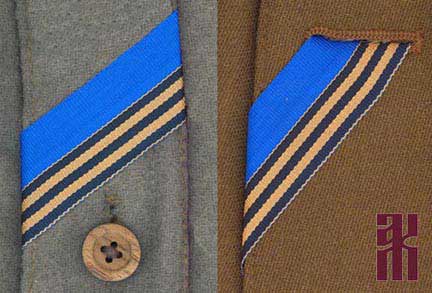
"Distinction ribbon" of the Orenburg Cossack Host
variants of placement on a blouse and a tunic
Order No. 34 of 31 June 1918 – 16 people.
Order No. 4 of 20 July 1918 – 1 person.
Order No. 16/447 of 24 July 1918 – 22 people.
Order No. 36 of 31 July 1918 – 15 people.
Order No. 52 of 9 August 1918 – 1 person.
Order No. 140 of 5 September 1918 – 5 people.
Order No. 154 of 9 September 1918 – 42 people.
Order No. 165 of 13 September 1918 – 61 people.
Order No. 204 of 19 September 1918 – 41 people.
Order (without number) dated 22 September 1918 – 1 person.
Order No. 244 dated 30 September 1918 – 89 people.
Order No. 334 of 22 October 1918 – 1 person.
Further awards were discontinued due to the transfer of authority to Supreme Ruler and Supreme Commander-in-Chief Admiral Kolchak and the establishment of a unified award system, which was a continuation of the previous Russian award system of 1917.
Rudichenko, A. I. and Durov, V. A. in "Awards and Insignia of the White Armies and Governments", Moscow, 2005, p.19.
8. General
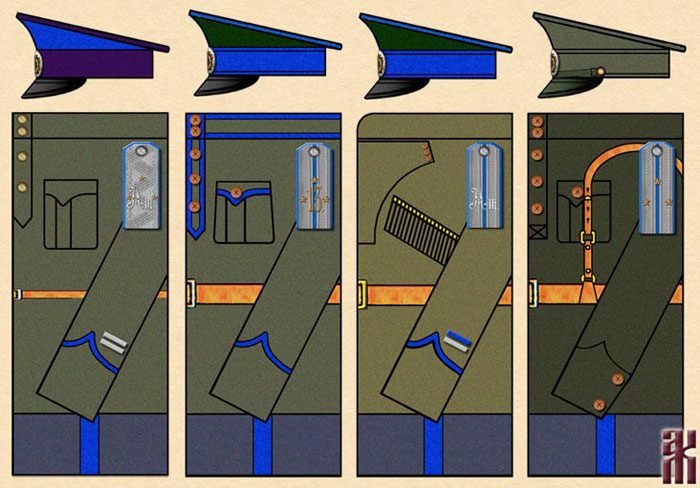
Uniforms of officers of the Orenburg Cossack Host reconstructed from photographs:
1 – Ataman A. I. Dutov; 2 – General I. G. Akulin;
3 – Captain Mishukov, Ataman Dutov's personal orderly; 4 – unknown Cossack officer
Ganin, A. V. in "Ataman A. I. Dutov", Moscow, 2006, p.252, 254.
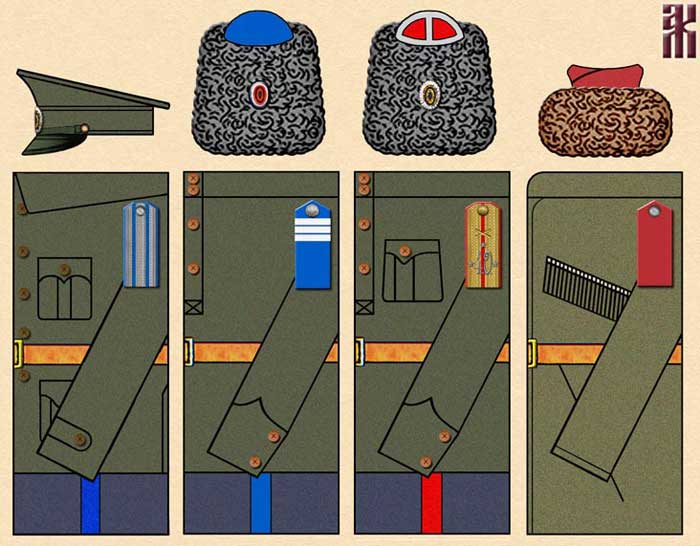
1 – reconstruction based on a photograph of an officer of Ataman Dutov's staff;
2 – a Cossack of the Orenburg Cossack Hosts's cavalry regiments;
3
– an officer of the Orenburg Cossack Hosts's artillery units;
4 – a Kirghiz member of Ataman Dutov's personal escort
Ataman Dutov's appearance
He ... is dressed in a blue blouse with general's shoulder-boards and a narrow black belt with silver fixings tied around his waist.
"Ataman Dutov // Siberian Life, No. 80", 8 August 1918.
From the depths of the stage appears a blue mass of officers, sparkling with silver shoulder-boards and jingling spurs.
"Dutov's speech // Northern Commune: Organ of the Central Executive Committee of the Union of Communes of the Northern Region and the Petrograd Soviet, No. 115.", 25 September 1918.
In the latest battles around Orenburg, some "Chinese" surrendered to us. It turned out to be a masquerade invented by Dutov. Underneath the Chinese clothing were Bashkirs, Tatars, and others who had been forcibly mobilised and put in Chinese dress.
"Red North, No. 5", 7 May 1919.
Dutov's report in Kokchetav to General Kappel', commander of the Moscow Group, on the state of the Orenburg Army, 5 November 1919.
The most significant and main shortcoming is the lack of clothing; there are absolutely no trousers, sheepskin coats, felt boots, or any outerwear or underwear in general. All my attempts to obtain anything have been unsuccessful; I have not even received a response. Army Chief of Staff has also taken steps, but without success. We are now living only on local resources, stripping the population and turning them into Bolsheviks.
Markovchin, V. V. in "Three Atamans: A. Dutov, G. Semenov, D. Tundutov-Dundukov", Moscow, 2003, p.83.
Suidin, China, 1921
In order to prevent inconsistencies and mistakes in the actions of his troops, Dutov gave orders to prepare distinctive marks on their uniforms. For Orthodox Christians, a cross was sewn on, and for Muslims, a crescent and star.
Markovchin, V. V. in "Three Atamans: A. Dutov, G. Semenov, D. Tundutov-Dundukov", Moscow, 2003, p.104.
Home — State Symbols — Flags — Uniforms — Badges & Medals — Money — Other
Pygmy Wars Notes
The original for this page is at kolchakiya.ru/uniformology/Orenburg_cossacs.htm.
Note: the Cyrillic "t" looks like a rounded Latin "m" when written in italic.
Dutov's report in Kokchetav is after the Orenburg Cossacks had been decisively defeated and retreated into the Kazakh steppe. It is not indicative of how they might have been dressed during the period previously.
The following illustration by A. Lebedeva was originally on the page but later taken out.
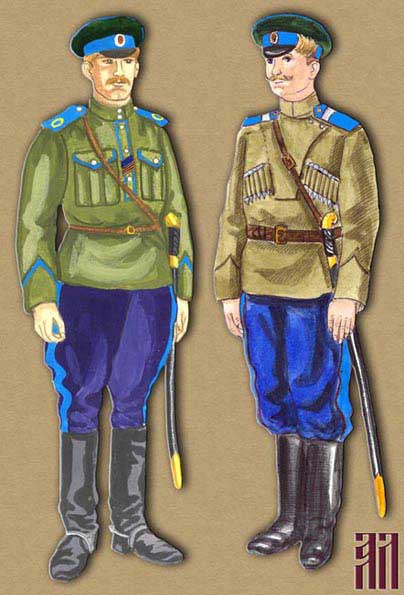
Cossack private and sergeant-major of a horse regiment of the Orenburg Cossack Host
Discussion on the translation choices I have made can be found here.
Flags
Some information about the known flags for the Orenburg host are here.
History of the Orenburg Host
More information about the Orenburg Host in the Civil War is here.
Unlike the more eastern hosts, the Orenburg host realised immediately that they were a battle to the death with the Bolsheviks. As a result they cooperated with KOMUCH right from the start: Orenburg Cossack regiments were spread across the People's Army, providing much needed cavalry.
That cooperation continued with Kolchak. Orenburg cavalry continued to be integrated into the Russian Army's regular divisions. In return Kolchak supplied the 2nd Syzran Rifle Division, providing the Host with badly needed infantry, as well as uniforms and ammunition.