
Uniforms of Yugoslav Units in the East of Russia, 1918-20
All material and reconstructions are by A. Karevskiy unless noted otherwise.
The following sources were used for the reconstruction of the uniforms of the Yugoslav armed formations in the East of Russia:
Kapustin, L. G. "Uniforms and uniform differences of the Serbo-Yugoslav units in the East of Russia, 1918-1920 // White Army, White Cause No. 24", Ekaterinburg, 2017, pp.62-78.
Kapustin, L. G. and Ladygin, I. V. "Serbian and other Yugoslav volunteers in Siberia during the Civil War of 1918-1922 at bsk.nios.ru/content/serbskie-i-drugie-yugoslavyanskie-dobrovolcy-v-sibiri-v-gody-grazhdanskoy-voyny-1918-1922-gg
Thomas, N. and Babac, D. "Armies in the Balkans // Men-at-Arms No. 356", Oxford, 2001.
North, J. "Soldiers of the First World War, 1914-1918: Uniforms, insignia, equipment and weapons", Moscow, 2015, pp.180-181.
Funken, L. and Funken, F. "World War I 1914-1918: Encyclopedia of Weapons and Military Costume, Vol. 1", Moscow, 2002, pp.74-76.
The following Yugoslav armed formations appeared in the East of Russia in the period 1918-1920:
As part of the People's Army (KOMUCH):
✦ Serbian Battalion of Major M. Blagotić;
✦ Chelyabinsk Serbian Battalion of Second Lieutenant J. Kovacević;
✦ Samara Serbian Detachment of Captain I. Bozić;
✦ Serbian Company of Lieutenant Dibić.
As part of the Siberian Army of the Provisional Siberian Government (Ufa Directory):
✦ Serbian Half-company of the 2nd Steppe Siberian Corps HQ escort;
✦ 1st Tomsk Serbian Battalion of Captain A. Rukavin;
✦ Novonikolaevsk Serbian Company of Captain L. Sertić.
As part of the Russian Army (Kolchak):
✦ Volunteer Regiment of Serbs, Croats and Slovenes named after Major M. Blagotić (3rd Ural Army Corps);
✦ Vladivostok Serbian Detachment of Lieutenant R. Ristić;
✦ Tyumen Serbian Commandant's Unit of Ensign Perko;
✦ Serbian Detachment of Captain B. Djurdjilov (Omsk);
✦ Ekaterinburg Serbian Detachment of Voivode V. Voskar;
✦ 1st Independent Russian-Serbian Jaeger Partisan Battalion (Ekaterinburg);
✦ Serbian Detachment of Ensign Mandić (Orenburg-Troitsk);
✦ Serbian Company of Captain S. Djordjević (Semipalatinsk);
✦ Serbian Detachment of Voivode Kiselyov (Barnaul, then 1st Volga Army Corps);
✦ Irkutsk Volunteer Slavic Detachment;
✦ Serbian Horse Divizion of Ž. Magarašević (Krasnoyarsk).
As part of the forces of Atamans Semenov, Annenkov or Horvath:
✦ 3rd Serbian Battalion of the 1st Semenov Infantry Regiment of the Special Manchurian Detachment;
✦ Serbian Horse Divizion of the Ataman's Escort, then Serbian Divizion of the 1st Ataman Semenov Horse Regiment;
✦ Independent National Jaeger Battalion of Serbs, Croats and Slovenes (1920);
✦ Serbian Company and Serbian Horse Squadron of Lieutenant D. Milosević (Annenkov);
✦ Serbian Detachment of the FER escort guard (Harbin).
At part of the Independent Czechoslovak Corps:
✦ 1st Yugoslav Regiment named after M. Gubec (Tomsk).
As an independent intervention unit, combining all the remaining Serbian units remaining in 1920:
✦ Yugoslav Regiment (Vladivostok).
Serbian Units of the "Democratic Counterrevolution" Governments
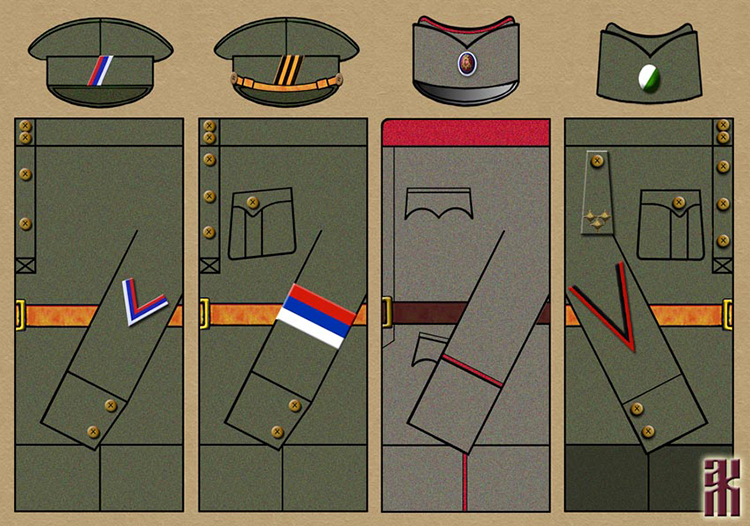
1 – Lieutenant Dibić's Serbian Company; 2 – Captain Božić's Samara Serbian Detachment;
3 – Major Blagotić's Serbian Battalion; 4 – Lieutenant Sertić's Novonikolaevsk Company
Figure 1 is in Russian uniform with insignia in the colours of the Serbian flag. Figure 2 is in Russian uniform with the insignia like that of the People's Army, except the arm-band is in the colours of the Serbian flag instead of the white one used in Russian units. Judging by surviving photographs, the officers of Major Blagotić's Serbian Battalion continued to wear the uniform of the Royal Serbian Army, but without shoulder-boards and cockades, during joint operations with the People's Army.
Figure 4 is shown in Russian uniform, but with Serbian šajkača headgear with the white-green cockade of the Siberian Army. Sertić's company was the remnants of the 1st Serbian (Kiev) Shock Battalion of the Serbian Volunteer Corps in Russia and so the sleeve retains the chevron of the Russian Army's shock units, which the Siberian Army permitted for servicemen who had served in those units in 1917.
The Serbian Company of Lieutenant Dibić, belonging to the People's Army of the Committee of Members of the Constituent Assembly, which entered Chistopol in the summer of 1918, was characterised by a complete lack of rank markings, with "only tricolour stripes on the sleeves and brims of the caps". It is likely that the colours of the Serbian national flags (white, blue and red) were used, as well as St. George ribbons on headgear.
In 1918 white cockades with a green ribbon were also used, indicating membership of the Siberian Army.
Kapustin, pp.65, 68.
1st Yugoslav "Matija Gubec" Regiment
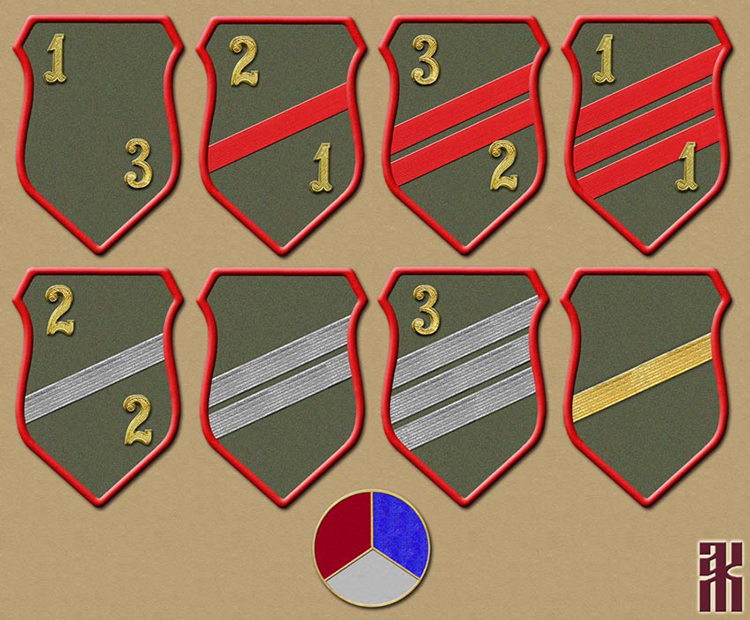
Rank markings of servicemen of the 1st Yugoslav "Matija Gubec" Regiment:
1 – private (red ); 2– lance-corporal (kaplar); 3 – corporal (podnarednik);
4 – sergeant (narednik); 5 – second lieutenant; 6 – lieutenant;
7 – captain; 8 – major; 9 – regimental cockade
The company number was in the top left, the battalion number in the bottom right (with none for the Technical Battalion). The 1st Battalion was Serbian, the 2nd was Croatian and the 3rd was Slovenian. The regiment's commander, L. Sertić, was the only major.
The 1st Yugoslav Regiment, named in honour of Matija Gubec, also had its own insignia. When the unit was formed in the summer and autumn of 1918, Russian field uniforms (blouses, trousers, greatcoats) were apparently widely used. It was supplied to the regiment by the Czechs from their own stocks, since it was subordinate to the Czechoslovaks in terms of supplies. Until the formation of the new state of the Kingdom of the Serbs, Croats and Slovenes (1 December 1918), the regiment's officers tried not to wear the insignia of the Royal Serbian Army. Their headgear had its own round cockade, divided into three fields: red on the left, blue on the right, and white at the bottom. ... At that time, most officers and lower ranks wore Czechoslovakian caps with soft crowns.
The influence of the Czechoslovak Army was also evident in the insignia the Yugovichi (as the regiment's officers were unofficially called), adopted in 1918 and modelled on the insignia of the Czechoslovak Army. The sleeve shield was curved (rather than straight, as for the Czechs), in khaki (very occasionally coloured), with a scarlet border. It was sewn onto the left sleeve of the blouse, tunic and greatcoat above the elbow. Ranks were indicated by diagonal stripes (whereas the Czechoslovaks had chevrons): in gold braid for senior officers, silver for junior officers, and red for NCOs. However, only the regiment commander, Major L. Sertić, had insignia for a senior officer, as his was the highest rank in the regiment. The major had one gold diagonal stripe; a captain had three silver stripes, a lieutenant had two silver stripes, a second lieutenant had one silver stripe, a sergeant had three red stripes, a corporal had two red stripes, and a lance-corporal had one red stripe. The shields of the privates had no stripes. Arabic numerals in the upper left corner (above the diagonal stripes) of the shield indicated the number of the battalion in the regiment (1 Serbian, 2 Croatian, 3 Slovenian), and the same numerals below the stripes indicated the number of the company in the battalion. Straight dark blue cloth stripes were sewn at an angle on the right sleeve of the tunic, blouse and greatcoat, between the shoulder and elbow, to indicate the length of service.
Kapustin, pp.68-69.
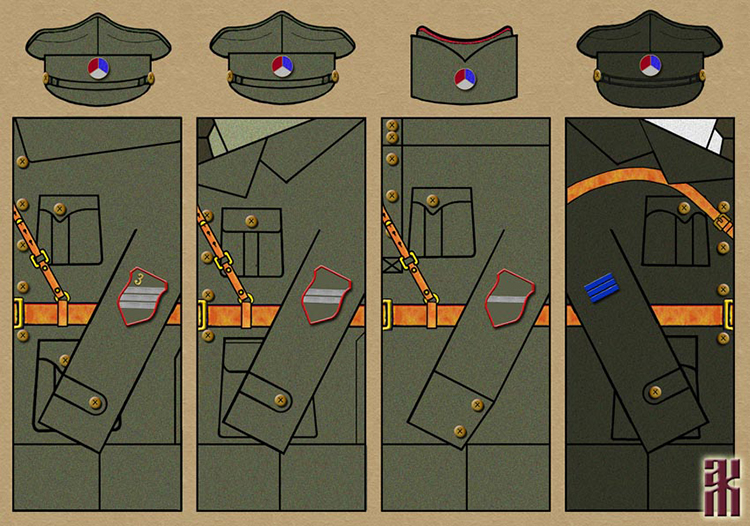
Uniforms of officers of the 1st Yugoslav "Matija Gubec" Regiment
Figure 4 shows blue stripes on the right sleeve indicating the number of years of service.
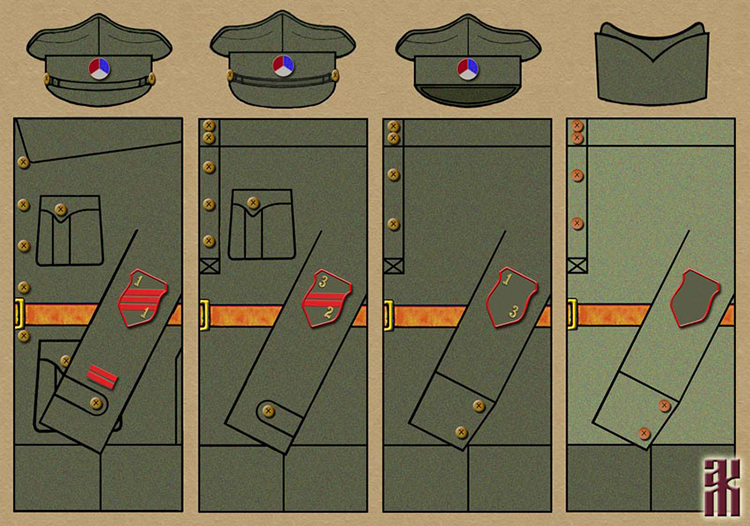
Uniforms of other ranks of the 1st Yugoslav "Matija Gubec" Regiment
Figure 1 has red stripes on the left sleeve for wounds.
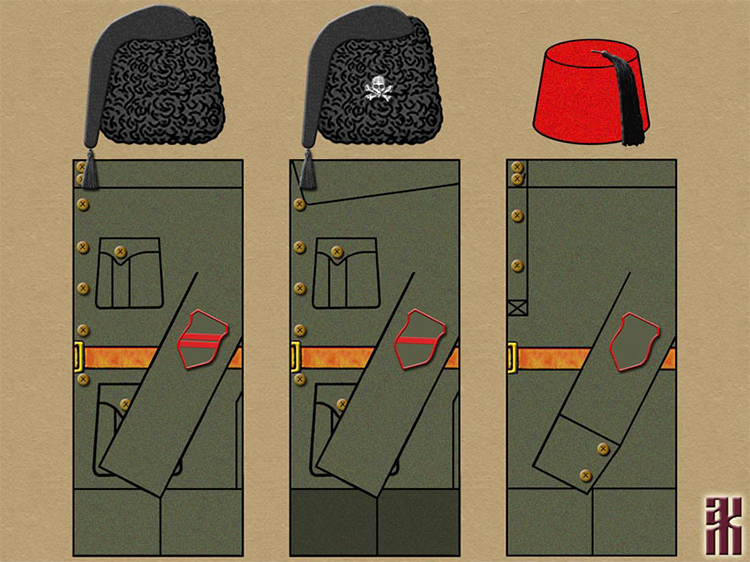
Uniforms of the Shock Companies of the 1st Yugoslav "Matija Gubec" Regiment
There were Serbian, Bosnian and mixed shock companies. Figures 1 and 2 show the headgear of Serbian Četnici. Figure 3 shows a Bosnian fez.
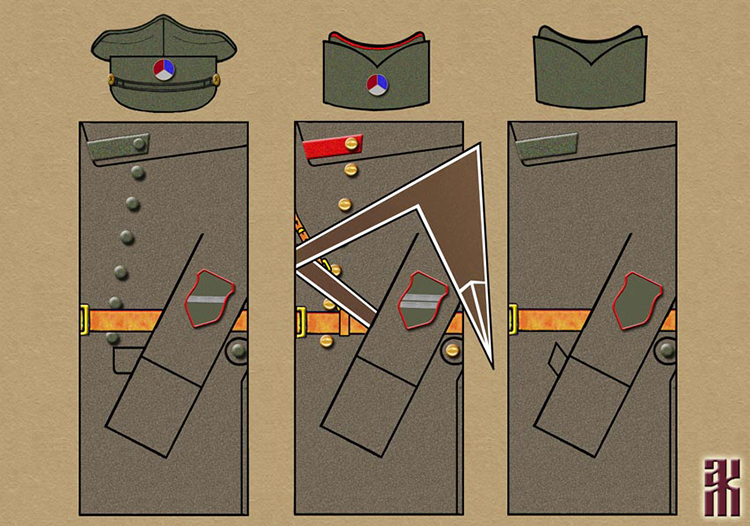
Winter uniforms of the Shock Companies of the 1st Yugoslav "Matija Gubec" Regiment
These reconstructions are based on photographs. The greatcoats are shown with Russian collar tabs, although in Siberia it was sometimes customary to alter them to resemble Serbian ones – rectangular for lower ranks and shaped for officers, with curves in at the sides and a pointed triangular end at the button.
In 1919, judging by surviving photographs, the regiment's ranks wore Russian caps and papakhi (of various types and shades, mainly white), Serbian šajkači (infrequently), and the caps with soft crowns, ... used in 1918 by the Czechoslovaks.
The uniform consisted of French-style tunics with a stiff stand-up collar, fastened with five large buttons, with four large patch pockets, so beloved by Czech legionnaires; British officer's tunics of the 1914 Model (both original and replicas, similar only in general features to the original) with an open lapel collar and a shirt with a tie; Russian khaki (also white) blouses and baggy trousers. ...
During the cold season, single-breasted and double-breasted Russian-style greatcoats (with hooks or buttons) with bashlyki, sheepskin coats, mittens, gloves, and felt boots were worn.
To a limited extent the regiment ... continued to use the wound badges adopted by the Russian army. ... These insignia were worn above the left cuff of the blouse, tunic or greatcoat and consisted of horizontal stripes measuring 1.5 by 0.2 vershki (67 by 10 mm) for officers – in braid of the colour of the metal fittings, and red braid for lower ranks.
Kapustin, pp.69-70.
This probably refers to fez hats, the traditional headgear of Bosnian units of the Austro-Hungarian army. It is quite possible that similar headgear was worn by Bosnian Muslims in the shock companies of the 1st Yugoslav "Matija Gubec" Regiment. It is also possible that this refers to the headgear adopted in the Serbian military tradition (along with šajkača), which was often seen among the Četnici, the Serbian partisans of 1903-1914. Those were black papakhi, tapering towards the top, with a long black bag with a tassel.
Kapustin, p.66.
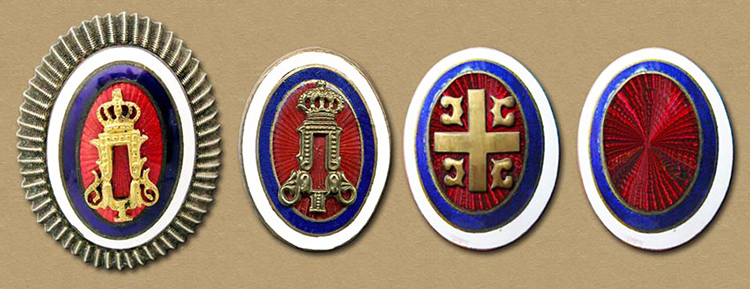
Variants of cockades used by Serbian units in the east of Russia:
1 – officer's cockade; 2 to 4 – everyday cockades
Figures 1 and 2 carry the monogram of King Petar I. Figure 3 carries a "Serbian cross" (based on a tetragrammic cross emblem of the Palaiologos dynasty of the Byzantine Empire).
"Major Matija Blagotić" Volunteer Regiment of Serbs, Croats and Slovenes
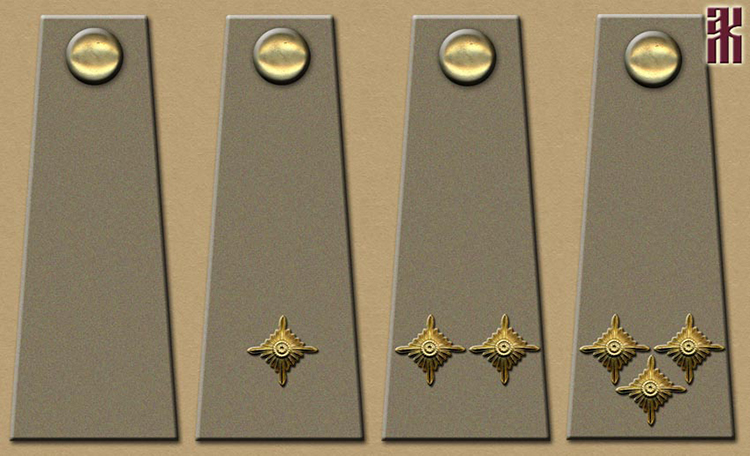
Insignia of the Royal Serbian Army used the Blagotić Volunteer Regiment:
1 – private; 2 – lance-corporal; 3 – corporal; 4 – sergeant
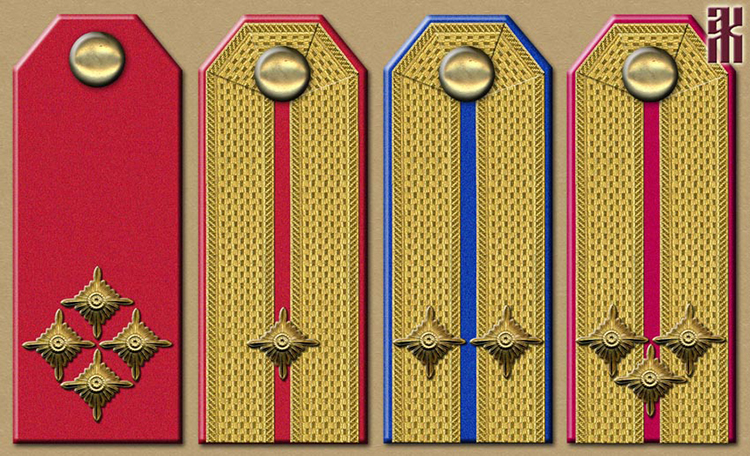
Insignia of the Royal Serbian Army used by the Blagotić Volunteer Regiment:
1 – sergeant-major (infantry); 2 – second lieutenant (infantry);
3 – lieutenant (cavalry); 4 – captain 2nd class (engineers)
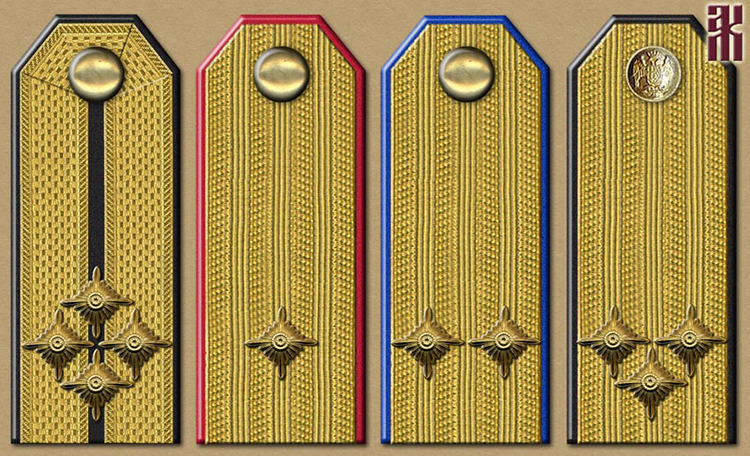
Insignia of the Royal Serbian Army used by the Blagotić Volunteer Regiment:
1 – captain 1st class (artillery); 2 – major (infantry);
3 – lieutenant-colonel (cavalry); 4 – colonel (artillery)
The rank of major was the highest among the command staff. The military mission in Vladivostok was led by Lieutenant-Colonel J. Micić, and Colonel M. Lukičević served as the special representative of the Serbian government.
The officers of the Blagotić Regiment, as well as most of the smaller units, tried to use the insignia system of the Royal Serbian Army – shoulder-boards of the 1908 model. ... Privates wore plain shoulder-boards without stars. NCOs had shoulder-boards with one to four four-pointed stars (lance-corporals – 1 star, corporals – 2, sergeants – 3 in a "V", sergeant-majors – 4 stars in a diamond) and no stripes. Officers wore shoulder-boards with one stripe (second-lieutenant – 1 star, lieutenant – 2, captain 2nd class – 3 in a "V", captain 1st class – 4 stars in a diamond). Senior officers (of the military mission in Vladivostok) had shoulder-boards without stripes (major – 1 star, lieutenant-colonel – 2, colonel – 3 stars in a "V"). The branch of service colours of the Serbian army were used (infantry – red, cavalry – blue, artillery – black, engineers units – raspberry).
Kapustin, pp.72-73.
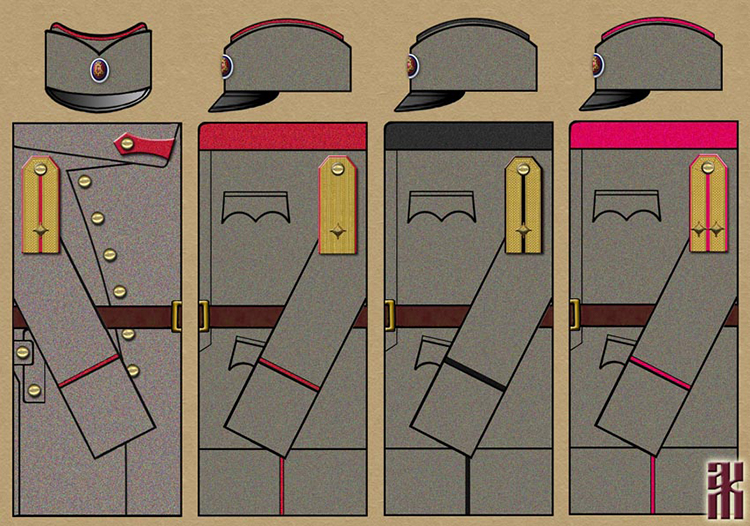
"Model" uniforms of officers of the Blagotićh Volunteer Regiment:
1 – infantry officer in a greatcoat; 2 – infantry officer in tunic;
3 – artillery officer in tunic; 4 – engineer officer in tunic
This is based on the 1912-Model officer uniform of the Royal Serbian Army.
The Blagotićh Volunteer Regiment was formed on the basis of Major M. Blagotić's Serbian Battalion, Second-Lieutenant Y. Kovačević's Chelyabinsk Serbian detachment, and Captain I. Bojić's Samara Serbian Detachment, which had plenty of Serbian officers from the former Serbian Volunteer Corps in Russia, specially sent from Corfu to fill command positions, and who retained the uniforms and insignia of the Royal Serbian Army.
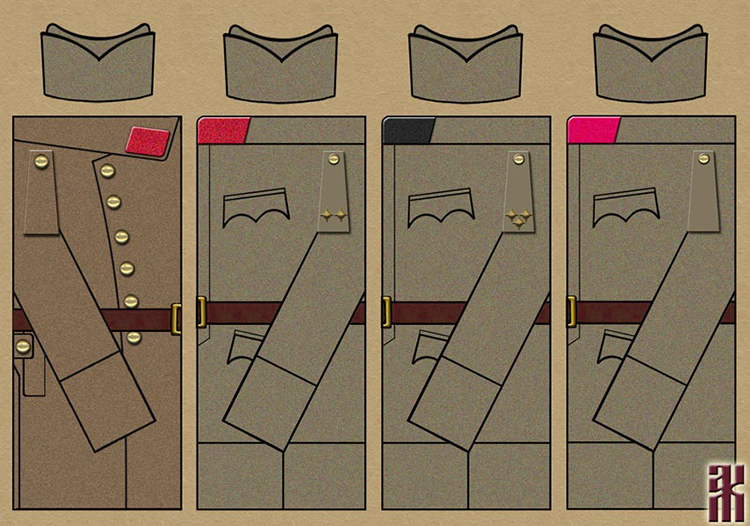
"Model" uniforms of other ranks of the Blagotićh Volunteer Regiment:
1 – infantry private in greatcoat; 2 – infantry corporal in tunic;
3 – artillery sergeant in tunic; 4 – sapper (private) in tunic
These are based on the 1912-Model other ranks uniform of the Royal Serbian Army.
At the same time, Serbian army officers arriving from Corfu to fill command positions in the division retained their officer's uniforms, insignia, cockades and awards from their home country's army. Some Serbian officers appeared in Siberia for the first time in this uniform at the beginning of 1918: "The Bolsheviks viewed Serbian officers who wore shoulder-boards, cockades, orders and sabres with suspicion..." Serbian Consul J. Milanković, speaking about one of the officers, mentioned "that he had removed and sewn on Serbian shoulder-boards five times".
Kapustin, p.65.
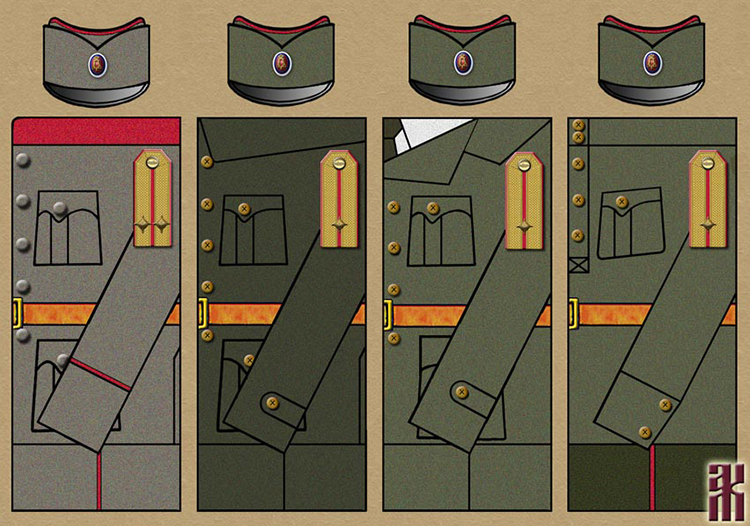
Uniforms of the officers of the Blagotićh Volunteer Regiment.
Figure 1 shows a uniform sewn in Siberia based on the 1912-Model of the Royal Serbian Army officer's uniform, with significant deviations. Figures 2 and 3 show officers in tunics of various cuts. Figure 4 shows an officer in a Russian blouse.
Often (this practice existed until 1920), uniforms were sewn in imitation of the British 1914-Model officer uniform or the Serbian 1912-Model officer uniform, most likely privately, but differing from the originals in the size of the collar, pockets, buttons, etc.
Kapustin, p.75.
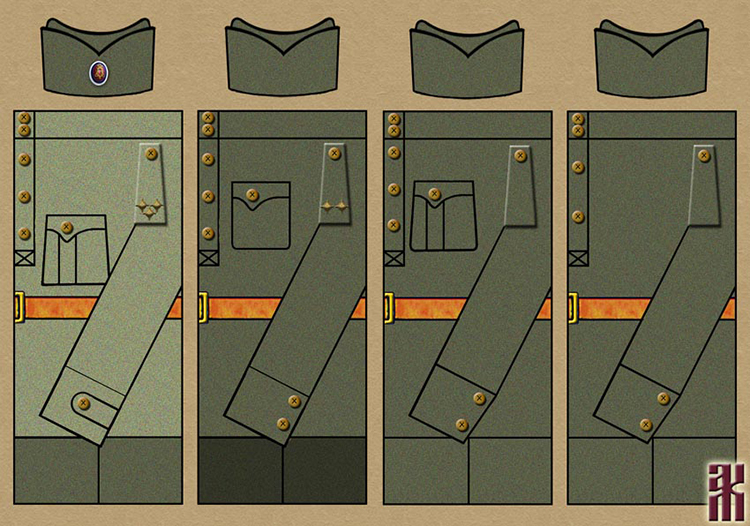
Uniforms of the other ranks of the Blagotićh Volunteer Regiment
Judging by photographs, Russian uniforms (blouses of various cuts) prevailed among the lower ranks of the regiment, worn with soft sewn-in shoulder-boards with Serbian insignia.
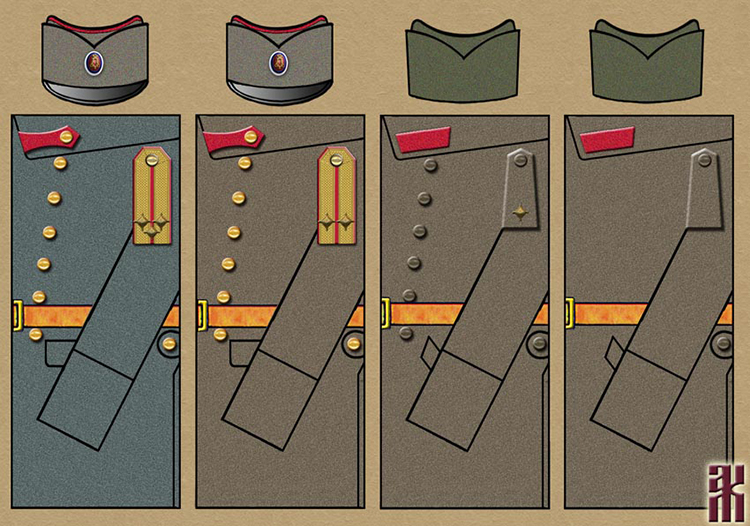
Winter uniforms of the Blagotićh Volunteer Regiment
The greatcoats are shown with Serbian-style collar tabs for the officers (these can be seen in the photograph from the Chelyabinsk parade) and Russian tabs, altered to the Serbian style (with the lower edge set back), for lower ranks.
The situation prompted Serbian Consul Milanković to appeal on 15 October 1918 to the inspector of the Czech Corps headquarters and the head of the military department of the Czechoslovak National Council in Russia with a request to leave the Yugoslav units within the Ural Corps for supply purposes. As a result, the shaykachi (officers and other ranks of the 1st "Major Blagotić" Volunteer Regiment of Serbs, Croats and Slovenes) had Russian greatcoats and equipment when they were captured by French documentary film-makers at a 1919 parade in Chelyabinsk. The buttonhole tabs on the greatcoats can be seen, but it is difficult to say unequivocally whether they are Serbian or Russian in style. .... In general the small Serbian units, most of whom wore Russian field uniforms, in imitation of the original Serbian ones, stood out with their kepi caps – šajkača, sewn in Siberia according to Serbian patterns. However those were not available to everyone, and men sometimes retained other items of the Serbian Army's uniform, as confirmed by the few surviving photographs. Servicemen wore cockades of the Royal Serbian Army in the national colours, with the royal monogram or the Serbian cross in the middle.
Kapustin, p.71.
1st Serbian Horse Divizion of Captain J. Magarašević
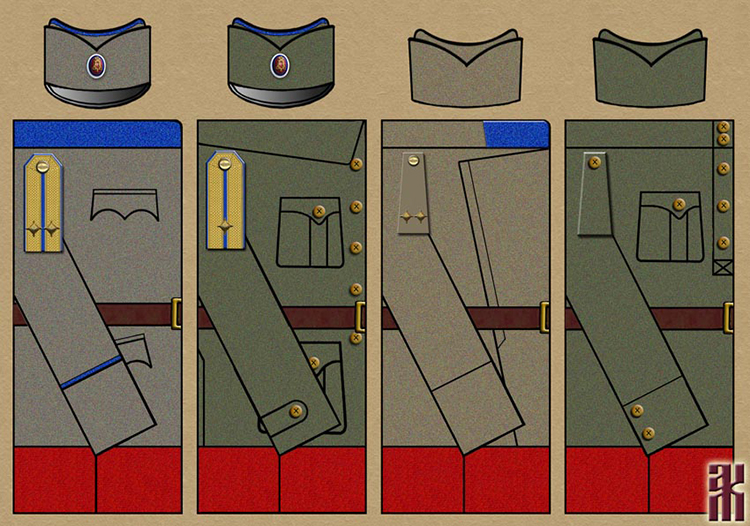
Uniforms of the 1st Serbian Horse Divizion of Captain J. Magarašević:
1 – cavalry officer in 1912-Model Serbian uniform with blue piping;
2 – officer in Russian tunic with red trousers; 3 – corporal in Serbian 1908-Model uniform;
4 – private in Russian blouse with red trousers
Due to an acute shortage of new uniforms during the war, a significant part of the army was equipped from previous stocks, as confirmed by numerous photographs.
This unit was part of the Krasnoyarsk garrison.
It is quite possible that the Serbian cavalrymen imitated their colleagues in the Royal Serbian Army and the Cossack Army. This is indicated by some details of their uniforms. According to Consul Milanković, the cavalry divizion of the Blagotić Regiment in Chelyabinsk "had... good equipment, weapons, new clothing (red trousers)..." An eyewitness described Serbian cavalrymen in Barnaul as "wearing red trousers and feathers in their hats".
Kapustin, p.74.
The Serbs in Krasnoyarsk are dressed in serge coats with wide collars with black piping. They wear sidecaps with cockades in their national colours. They have shoulder-boards. There are no more than 300 of them. They were disarmed in January or February. The reason for the disarmament was that the Serbs were selling rifles and machine guns and exchanging good horses for bad ones. The Italians and Russians carried out the disarmament, during which there was a shootout, with casualties on both sides. Some of those disarmed were put on trial and shot, while the rest were given back their weapons.
"Interrogation of Ensign Anatoly Shapiro of the 4th Enisei Regiment, who defected on 6 June 1919 in the 30th Division sector" at TsDOOSO F.41 Op.1 D.83 L.112-112ob. Material kindly provided by Ekaterinburg researcher D. V. Kadochnikov.
Lieutenant R. Ristić's Vladivostok detachment
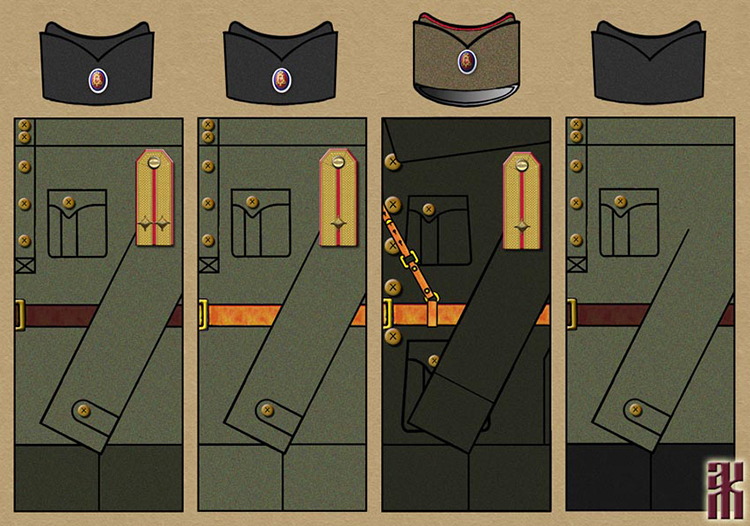
Uniforms of Lieutenant R. Ristić's Vladivostok detachment.
Judging by surviving photographs, the majority of Serbian soldiers wore šajkača hats and items of arbitrary cut (blouses, "French" tunics, trousers) that only vaguely resembled standard Russian uniforms. This practice had already appeared in the final stages of the Great War in 1916-1917, when discipline had weakened and the situation with uniforms left much to be desired. The footwear worn consisted mainly of low boots with puttees, high boots, and sometimes boots with gaiters (following the example of some Czechoslovak officers and other ranks). ... Photographs show that Russian and Serbian shoulder-boards with Serbian four-pointed stars were used. When wearing British-style field uniforms the stars were attached to the shoulder-straps (whereas the British army did not use them to indicate rank).
Kapustin, p.65.
Serbian Detachment of the International Military Police in Vladivostok
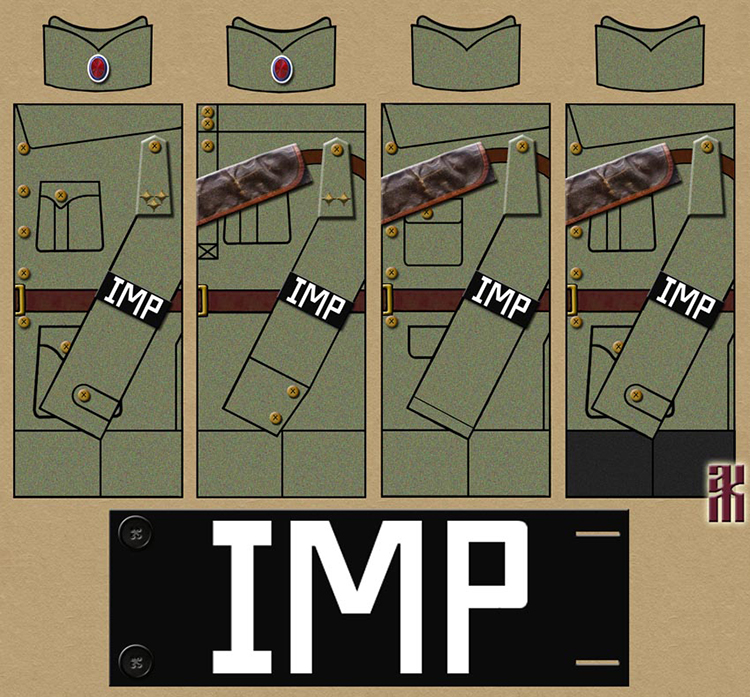
Uniforms of the Serbian Detachment of the International Military Police in Vladivostok.
Judging by a group photo of military police contingents from various foreign armies represented in Vladivostok, the distinctive features of the Serbian detachment were šajkači (with or without cockades) and breast cartridge pouches. Underneath is a reconstruction of the arm-band with the abbreviation "IMP".
Serbian officers of the International Military Police in Vladivostok wore "French" coats with stand-up collars and Russian blouses, trousers, šajkača, nalogi [?] and boots with puttees. They used Russian equipment – canvas cartridge pouches and leather belts with single-pin buckles. The left sleeve, as with other foreign police officers, had a black arm-band with the inscription "IMP" ("International Military Police") or "MP" in white letters.
Kapustin, p.71.
Serbian Detachment of Voivode V. Voskar (Ekaterinburg) and the
Serbian Company of Captain S. Djordjević (Semipalatinsk)
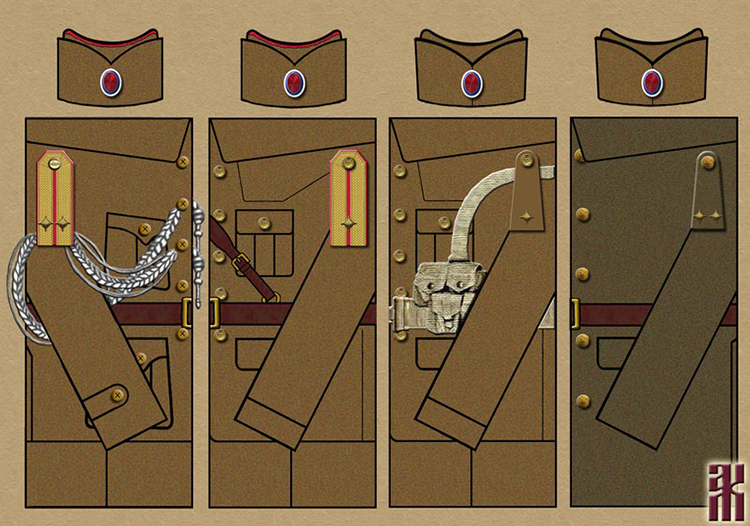
Uniforms of the Serbian Detachment of Voivode V. Voskar (Ekaterinburg)
The reconstructions are based on a photograph taken in May 1919 during a review of the unit by the Supreme Ruler. Figure 1 shows a jacket of arbitrary design with Russian shoulder-boards. Figures 2 and 3 show British other ranks uniforms (the officer is distinguished from the lance-corporal by his leather equipment, sword belt, shoulder-boards and cap with coloured piping). Figure 4 shows a winter coat, which was rolled up in the photograph.
British uniforms and equipment began to appear in some Yugoslav units in 1919. A number of Serbian units, for example that of Voivode V. Voskar in Ekaterinburg, wore šajkači, British other ranks 1902-Model field uniforms, as well as British 1908-Model canvas equipment. In photographs from that time, NCOs can also be seen wearing belts with revolver holsters. Officer equipment included a belt with a shoulder strap and a revolver holster. This is evidenced by a photograph of parade held on 9 May 1919 in Ekaterinburg in front of the Supreme Ruler of Russia, Admiral Kolchak, and the commander of the Siberian Army, General R. Gaida. ... Apparently, Captain S. Djordjević's Serbian Company in Semipalatinsk also had British uniforms. This is indicated by the testimony of an eyewitness from the opposing side: "Our soldiers took ... a lot of British uniforms and combat equipment from the Serbs."
Kapustin, pp.70-71.
Voivode V. Voskar, commander of the Royal Serbian Volunteer Corps, Omsk-Ekaterinburg, January-March 1919:
He looked at the Russian generals, who wore wide gold shoulder-boards, with something between envy and contempt. He wore a braid insignia on his sleeve, his old distinction as an ataman, and he was proud of it...
Passing through our carriage, they looked at me strangely, especially since, although I was considered a military officer, I did not wear shoulder-boards.
Almost all the Serbs wore civilian clothes. Gaida thought that was a problem and a week later dressed all the Serbs in identical uniforms with Serbian insignia. But it did not help. During class they wore the uniforms, but in the evening they wore whatever they wanted. The Serbian NCOs sewed themselves shoulder-boards with red stripes and stars (Serbs use white stars instead of stripes), and the Russian soldiers and junior officers saluted them while they laughed. Gaida called on Voskar once more.
"The Serbian detachment of Voivode Vlada Mihailovich Voskar", TsDOOSO F.41 Op.2 D.196 L.79, 86, 89-90. Material kindly provided by Ekaterinburg researcher D. V. Kadochnikov.
Serbian company of Captain S. Djordjević, Semipalatinsk, 28-29 November 1919:
Noticing the approach of the Serbs, Syrkin and Shchetinin took energetic measures. With a bold and decisive strike, they completely destroyed the punitive detachment on duty. At the same time, they surrounded the barracks of the Serbian company. The 200 half-drunk Serbian volunteers who were there were disarmed. Those thugs were preparing to shoot all the political prisoners in the Semipalatinsk prison that night. Our fighters took large trophies from the Serbs: more than 300 rifles, four French machine guns, and a lot of English uniforms and combat equipment.
Rodichkin, N. in "Unforgettable Days", Alma-Ata, 1958, p.104.
Sometimes his comrades visited him. A Serb named Djovičiċ came wearing a headdress that was unheard of in Krasnoyarsk at the time, similar to a modern peaked cap. The cap had crimson piping. A red star adorned the place where the cockade had been removed, leaving a trace in the form of an oval of almost unfaded green cloth. It was said that Djovičiċ was a second lieutenant. That is, he had previously been a second lieutenant.
Kublitskiy, G. I. in "The River Flows to the Ocean", Moscow, 1980, p.226.
1st Serbian Cavalry Divizion of Captain J. Magaračević and
Serbian Squadron of Lieutenant D. Milosević,
of the Independent Partisan Division of Ataman Annenkov
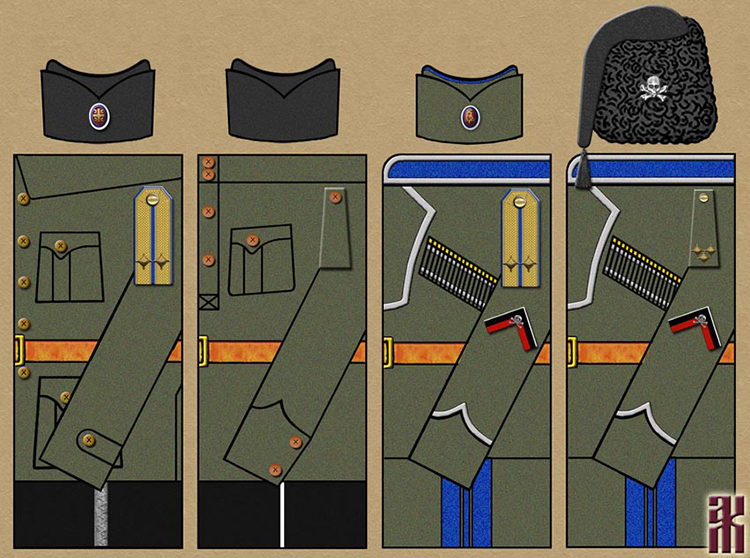
1 and 2 – 1st Serbian Cavalry Divizion of Captain Ž. Magaračević
3 and 4 – Serbian Squadron of Lieutenant D. Milosević, wearing ermakovka with gazyri
The 1st Serbian Cavalry Divizion has its the distinctive features in the form of black šajkači. It has been suggested that the officers of the detachment also used black breeches of the former 5th Aleksandria Hussar Regiment, whose regimental station was in Samara, from where Magarašević's cavalrymen began their journey.
Figure 3 is based on a photograph of Milosević himself, who was captured in an ermakovka blouse, trousers with double stripes and a šajkača. Figure 4 shows a Četnici cap with a skull and crossbones cockade.
The Serbian cavalry was well equipped and uniformed. During the stay of Magarašević's 1st Serbian Divizion in Krasnoyarsk, a local newspaper wrote: "The brave appearance of Serbian soldiers and their magnificent horses involuntarily attract the attention of the public." Magarašević's Serbs wore black šajkači, which earned them the nick-name of the "Black Hussars" from the Russians. Their uniforms were probably Russian field uniforms, received when the detachment was formed in Samara.
Kapustin, p.74.
The Serbs who served in Ataman Annenkov's Partisan Division wore "Turkish-style caps with tassels". This probably refers to fez hats, the traditional headgear of Bosnian units of the Austro-Hungarian army. ... It is also possible that this refers to another headgear long accepted in Serbian military tradition (along with the šajkača), often seen among the Četnici – Serbian partisans – ... in the form of a black papakha, tapering towards the top with a long black bag with tassel. The emblem of the "Death's head", also characteristic of the Serbian partisan tradition, fits well with the similar "partisan" symbolism adopted by Ataman Annenkov.
Judging by the only photograph known to the author of a Serb from Annenkov's Partisan Division, kept in the State Museum of Contemporary History of Russia, the Yugoslavs (at least the officers) wore the division's uniform – an ermakovka blouse with a breast cover and gazyri, trimmed with braid on the collar, cuffs and breast piece, and striped breeches. The uniform was complemented by a šajkača with a cockade.
Kapustin, p.66.
Yugoslav Regiment, Vladivostok, 1920
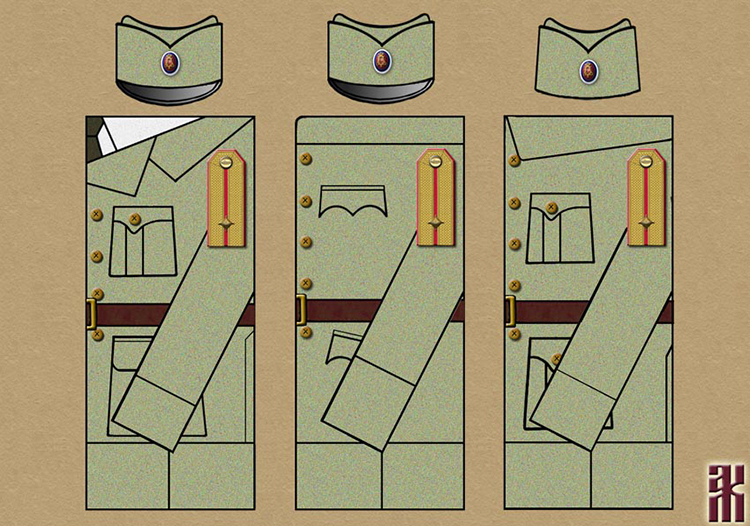
Uniforms of officers of the Yugoslav Regiment
Judging by photographs, during the final stage of the Serbs' stay in Russia, light-coloured tunics made of light material were widespread in the regiment, including those styled after the 1912 Model of the Royal Serbian Army (Figure 2).
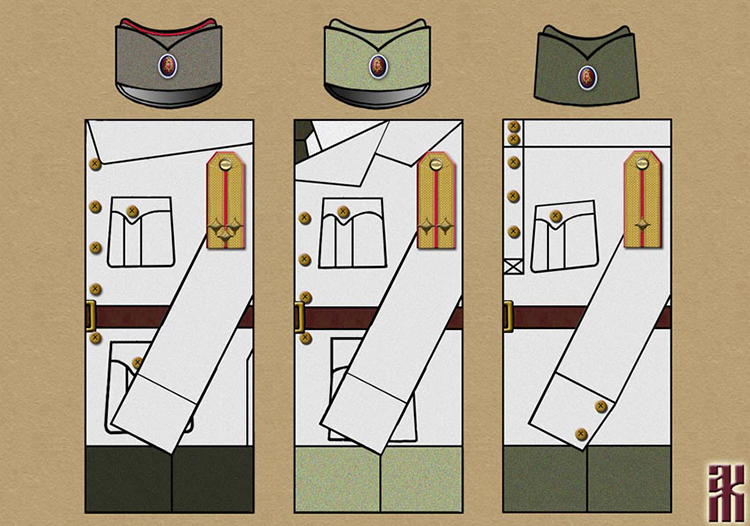
Uniforms of officers of the Yugoslav Regiment
White tunics and blouses were also popular among the regiment's officers.
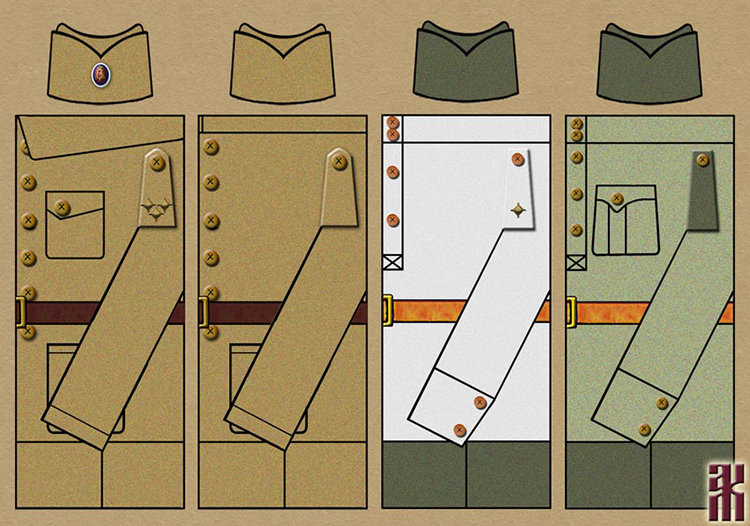
Uniforms of other ranks of the Yugoslav Regiment:
1 and 2 – French colonial uniforms (sergeant and soldier models);
3 and 4 – Russian blouses.
The uniforms of the lower ranks, like those of the officers, were varied.
The regiment's uniform was clearly oriented towards Serbian military tradition (headgear, cockades, insignia). In the summer of 1920, the Yugoslav Regiment was partially outfitted in French tropical uniforms of light khaki, 1901 Model, made for colonial infantry units stationed in French possessions in Southeast Asia. ... The uniform included a loose-fitting tunic with a low stand-up collar and wide sewn-in shoulder-straps, fastened with six large plastic buttons, two large hip pockets without flaps (there were no breast pockets), and straight trousers, also loose-fitting. Sometimes the trousers were replaced by dark khaki baggy trousers. The tunic for sergeant-majors (also worn by the regiment's officers) differed in that it had a turn-down collar and breast pockets. In addition, lower-ranking Yugoslavs used Russian blouses (khaki and white) and French tunics, apparently carried over from the previous uniform. All soldiers wore šajkača of various shades. Officers were equipped with officer šajkača with visors, British open officer tunics (both original and replicas, "based on" the original), worn with khaki or white shirts with ties, closed French-style tunics with stand-up collars, and French tropical uniforms. Sometimes white tunics (closed and open) were used with light khaki trousers (from the French set). Officers of the KSCS military mission wore the 1912-Model Serbian officer's uniform.
It should also be noted that the regiment's officers wore tricolour ribbons in the colours of the KSCS national flag (red, blue and white). ... Serbian shoulder-boards were used as insignia. Very occasionally some lower ranks retained the sleeve insignia of the "Matija Gubec" Regiment. The cockades of the Royal Serbian Army were used (oval, with a scarlet centre and blue and white edging, both with and without the monogram of King Petar I). Often the other ranks wore no cockades nor insignia at all. Equipment consisted of belts and cartridge pouches (Russian) and officer's sword belts (British).
Kapustin, pp.74-75.
Home — State Symbols — Flags — Uniforms — Badges & Medals — Money — Other
Pygmy Wars Notes
The original for this page is at kolchakiya.ru/uniformology/serbs.htm.
Četnici is often translated into English as "Chetnicks", a term that was revived in WWII. Their history in WWI can be found at Wikipedia. Discussion on other translation choices I have made can be found here.