
Uniforms of the 15th Votkinsk and Izhevsk Rifle Divisions in 1919
and Izhevsk-Votkinsk Brigade of the Far Eastern Army, 1920-1922
Material and reconstructions by A. Karevskiy, unless noted otherwise.
Uniform Issues regarding the Izhevtsy and Votkintsy
The first insignia of the Izhevtsy and Votkintsy was an arm-band worn on the left sleeve. In relation to the Votkinsk People's Army, its description was announced signed by the Chief of Staff Zebziev and Senior Adjutant Kotsyuba in the newspaper "Izhevsk Defender" of 3 September 1918, which said:
The People's Army of Votkinsk has a distinctive sign on the left sleeve – a red bandage on which two black stripes are depicted (in the shape of St. Andrew's Cross, the newspaper has a drawing, A.K.). At the top is a revolver, on the sides there are letters "НА", which means "People's Army" and printed under is "г. Воткинск". The is in contrast to the Red Army soldiers, who do not have any distinctive markings. Comrade soldiers are asked to remember this in order to avoid misunderstandings and mistakes.
As for the Izhevtsy, it is more difficult to say anything definite. The Izhevsk People's Army paid less attention to strictly organisational issues. However the article by I. Kobzev provides a description of a sleeve insignia – crossed revolvers for the Votkintsy and crossed rifles for the Izhevtsy.
Officer ranks in both armies were not formally abolished, but were not used either, so we can say with confidence that shoulder-boards were not worn. Those who used uniform headgear wore St. George ribbons modelled on the KOMUCH People's Army (to which they formally submitted politically). However, according to the respected D. Lobanov, some of those adhering to an Siberian orientation could also wear white-green, as there were no regulations in this regard.
With the retreat beyond the River Kama, the former Armed Forces of the Kama Region, were reorganized into the Votkinsk Division and the Izhevsk Brigade, becoming part of the Kama Army Group (under General S. N. Lupov). They thus fell under the relevant regulations made for the Russian Army by the Ufa Directory. According to Commander-in-Chief Boldyrev's Order No. 7 of 2 October 1918, the campaign uniform of the previous army was established with the appropriate insignia and a cockade entwined with white-blue-red ribbon ("until the development of a new cockade"). It is difficult to say whether this happened in the rebel units. Probably most of them wore just ribbons sewn obliquely onto the hatband of their caps instead of a cockade. As continuity, a sleeve insignia of a red triangular chevron with two crossed revolvers appeared in the Composite Votkinsk Infantry Division. This was done with the aim of externally distinguishing the division from the rest of the army, as well as to emphasize the commonality of the Votkinsk soldiers in the absence of distinguishing uniforms (see review of the units by General Timanov and described by Colonel Efimov).
Most likely, it was in Kolchak's Russian Army that the Izhevtsy and Votkintsy received their famous blue shoulder-boards and tabs with white piping and stripes. According to information that has not yet been verified, they also had coloured caps – a dark green crown, piped white, and a blue hatband, piped white. There is still debate about the appearance of their "Иж" and "Втк" monograms. No clear image has survived, so there are two opinions on this matter: either they were standard or italic. The first option is supported by the image of the monogram on the St. George Banner of the Izhevsk Division. The colour of the shoulder-boards is also debatable: all known photographs show something darker than white for the letters of both the Izhevtsy and Votkintsy and the Izhevtsy banner has the letters in yellow. However, the metal of these units was officially silver (white). Finally, in terms of manufacture, they were most likely stencilled for the lower ranks and sewn for the officers (satin stitch, coloured silk). All had soft shoulder-boards, anything metal or applied would be immediately obvious in the photographs.
At an exhibition on the Russian Army held at the Istra Regional Museum of Local Lore, the supposedly authentic uniform of Colonel Efimov, the last commander of the Izhevsk-Votkinsk Brigade, was exhibited. It consists of dark blue jodhpurs trousers with a white cloth stripe, a light green half-woollen blouse with two patch pockets (without coloured lace) and smooth brass buttons. There are dark blue cloth sewn-on shoulder-boards with white cloth piping and stripes and yellow non-italic letters "Иж". The belt is French, without a sword knot. The cap was missing. However, I consider the origin of this uniform to be more than questionable: the collector who provided it refused to explain where it came from and how it ended up in his possession.
Another controversial issue was the existence of unit numbers on shoulder-boards. In the available photographs the officers have neither letters nor numbers; on the other hand, numbers were mandatory on the shoulder-boards of other regiments in the army, and it is unlikely that an exception was made for the Izhevtsy or Votkintsy. Our reconstructions present these possible options for shoulder-boards, some with numbers and letters.
Uniforms of the 15th Votkinsk and Izhevsk Rifle Divisions
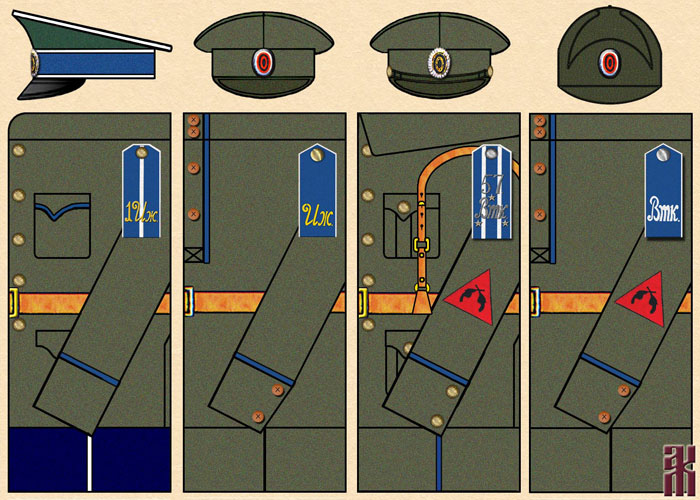
Uniforms of the ranks of the Izhevsk and Votkinsk Rifle Divisions
1 – captain of the 1st Izhevsk Rifle Regiment; 2 – private of a Izhevsk Rifle Battalion;
3 – colonel of the 57th Votkinsk Rifle Regiment; 4 – private of a Votkinsk Rifle Regiment
The Izhevtsy and Votkintsy considered blue – the colour of their shoulder-boards, lace and greatcoat tabs to be a symbol of an inseparable connection with their factories of iron and steel. The letters "Иж" were on the shoulder-boards of the Izhevtsy and the letters "Втк" were on the Votkintsy. Officers and ensigns of the Izhevsk-Votkinsk units never wore metal braid shoulder-boards: theirs were the same blue and had white stripes, zigzags, and piping.
Filimonov B.B. White rebels. Khabarovsk campaign. Winter 1921-1922. Shanghai: The Word, 1932. Book 1. p.32
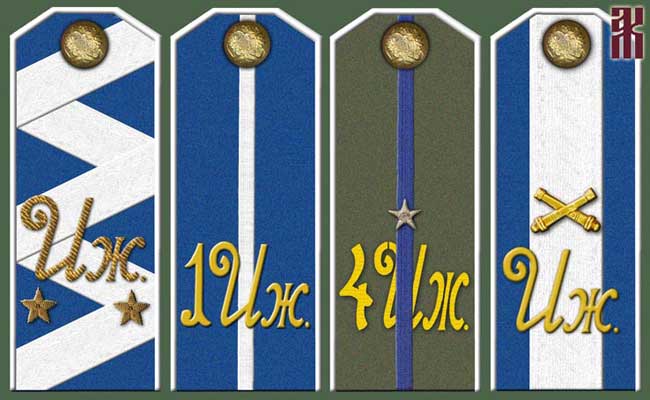
Shoulder-boards of the Independent Izhevsk Rifle Division, as at August 1919:
1 – Major-General Molchanov, division commander;
2 – captain of the 1st Izhevsk Rifle Regiment;
3 – ensign of the 4th Izhevsk Rifle Regiment (version sent by Kolchak in September 1919);
4 – ensign of the Izhevsk Artillery Divizion
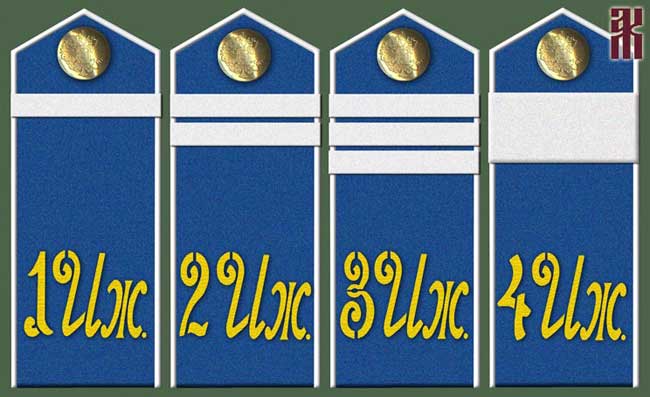
Shoulder-boards of the Independent Izhevsk Rifle Division, as at August 1919:
1 – lance-corporal of the 1st Izhevsk Rifle Regiment;
2 – corporal of the 2nd Izhevsk Rifle Regiment;
3 – sergeant of the 3rd Izhevsk Rifle Regiment;
4 – sergeant-major of the 4th Izhevsk Rifle Regiment
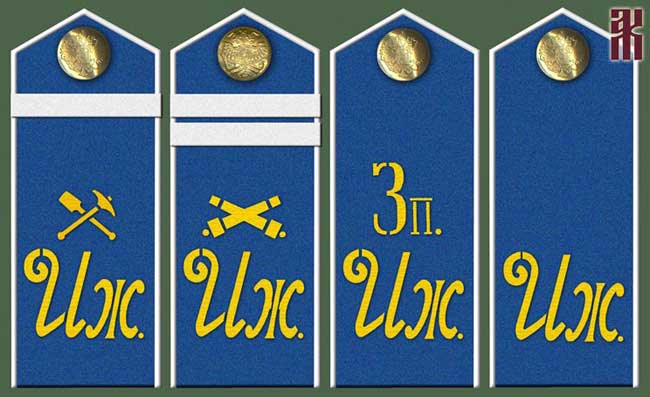
Shoulder-boards of the Independent Izhevsk Rifle Division, as at August 1919:
1 – lance-corporal of the Izhevsk Engineer Battalion (later Company);
2 – corporal of the Izhevsk Artillery Divizion ;
s – private of the Izhevsk Reserve Battalion;
4 – private of the Izhevsk Horse Regiment or Izhevsk Jaeger Battalion
Prikam'e, December 1918
The units of the People's Army consolidated into the division became known as the Combined Votkinsk Infantry Division. Their distinctive sign was a red triangular chevron on the left arm with two painted crossed revolvers.
Prostnev, S. K. in "The 15th Votkinsk Rifle Division in the Armies of Admiral Kolchak and the Governments of the Far East // Votkinsk mosaic, Part 1", Votkinsk, 2003, p.119.
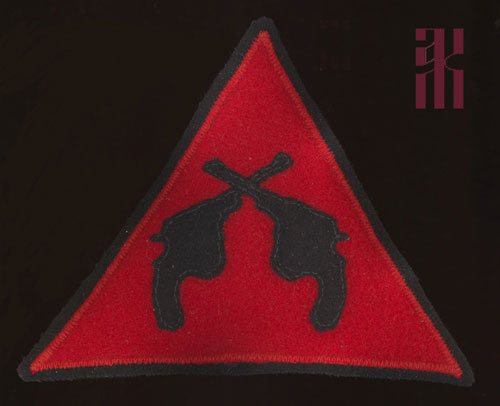
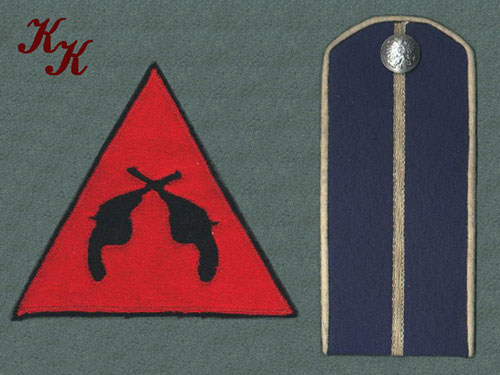
Reconstructions of Votkinsk sleeve insignia and shoulder-boards (right by K. Kulagin)
Tobol Operation, September 1919
Back in September, during the attack on the Tobol, Admiral Kolchak, anticipating the possibility of complications in the rear, was going to send a proven, reliable unit with an energetic commander to Irkutsk to maintain order and tranquillity at that important point. His choice fell on the Izhevsk Division under the command of General Molchanov. As a preliminary preparation for the division's shift, Admiral Kolchak sent the general a staff officer from his headquarters. That envoy arrived bearing khaki shoulder-boards for the entire division, as a gift from Admiral Kolchak.
Efimov, A. G. in "Izhevtsy and Votkintsy // Pioneer Herald", Los Angeles, 1970, p.41.
Scout-skier of the 1st Votkinsk Regiment
There were terrible frosts. And then the carriages with shoulder-boards arrived. We were ordered to put on shoulder-boards. That's what we said: "They sent a car full of shoulder-boards". Before this, we wore arm-bands with the sign of the People's Army and entire companies with officers joined the people's militia and volunteers came from the villages. With the arrival of shoulder-boards, this stopped.
Naumov, V. M. in "My Memories", San Francisco, 1975, p.19. Material kindly provided by Votkinsk researcher S. K. Prostnev.
Kamyshlov, July 1919
Without reaching St. Egorshino, the Votkintsy had to again engage in battle with the advancing Reds. A battalion under the command of Lieutenant Bulygin from the 60th Chistopol Regiment was cut off. We assembled a battalion and ordered everyone to remove (not cut off! - S.P.) their shoulder-boards, and then led the riflemen through the forests, trying to avoid the roads and populated areas, until we reached the town of Kamyshlov.
"Memo about the struggle of Izhevtsy and Votkinsk with the Bolsheviks", p.12. Material kindly provided by Votkinsk researcher S. K. Prostnev.
August 1919
They say about this division that it is not far from what it was before; they still don't wear shoulder-boards; the men are not disciplined, they do not salute, etc. This is all noted. The Votkintsy really didn't like to wear shoulder-boards, because they often carry out reconnaissance, which is completely impossible to do with shoulder-boards. In addition, the Votkintsy had all volunteered for combat during the creation of the People's Army, when shoulder-boards and saluting were not required. Officers and soldiers treat each other simply, often in a brotherly way, which is always observed in troops living for a long time at the front in a purely combat situation.
"The Votkintsy // Nasha Zarya newspaper", Omsk, 15 August 1919. Material kindly provided by Votkinsk researcher S. .K. Prostnev.
Izhevsk Brigade, January 1919
In the 2nd Regiment, the soldiers were mainly from villages around the Izhevsk plant. That regiment was lined up to welcome me, with an orchestra of about sixty people. They had practically no uniforms. For example, one of the orchestra members was in civilian clothes, some were wearing ordinary boots, some were wearing felt boots. They were dressed God knows how, but they played excellently. ... The 1st Regiment was less disciplined than the others during the review, but they certainly knew how to handle rifles. I walked slowly around and examined their formation. Their orchestra was the same as the one I had already heard. I told them: "I will not take any of you into battle unless you are properly dressed". The 7th Company of the 1st Regiment consisted exclusively of former tradesmen of the Izhevsk plant. These were educated people, and people said of them: "They do not like discipline, but in battle they are always the first." I didn't place much importance on discipline during the review, but I understood that the first thing I had to do was bring them into "a Christian form", as far as clothing and uniforms were concerned. At the time I called them "the ragamuffins". ... The uniforms were terrible in the cavalry divizion and most of the 2nd Squadron had pillows rather than saddles.
Molchanov, V. M. in "Interview recorded by B. Raymond in 1970 // Molchanov V. M.: The Last White General", Moscow, 2009, pp.113,115,117.
March 1919
Shortly after the review, I received orders to move my brigade to forward positions by 6 March 1919 and prepare for a general offensive. I was included in the 3rd Army Corps, commanded by General Golitsyn. One day he came to us to review the brigade. Afterwards he didn't say anything, but from the expression on his face I realised that he considered us complete ragamuffins. This was caused by the fact that some of his other regiments, for example the 7th Ural Division, were trained according to pre-war Prussian standards.
Molchanov, V. M. in "Interview recorded by B. Raymond in 1970 // Molchanov V. M.: The Last White General", Moscow, 2009, p.117.
April 1919
Then I learned that Admiral Kolchak, as the Supreme Ruler, promoted me to the rank of major-general. The soldiers heard about this and handed me general's trousers with stripes, I had the only ones.
Molchanov, V. M. in "Interview recorded by B. Raymond in 1970 // Molchanov V. M.: The Last White General", Moscow, 2009, p.125
September 1919
When I was still with the division on the Tobol River, an officer of the General Staff, a colonel from Kolchak, came to me and brought shoulder-boards with "Izh" to the entire division (2nd "Izh", 3rd, 4th and so on). I was wearing shoulder-boards. I told him:
"We can keep these shoulder-boards, but when we go into battle, we don't have officers, we don't have any ranks, we are just all privates. And if one is captured, no one will ever hand over the officer. This is our first condition."
"So that the Reds don't shoot them?"
Yes, because we were all the same. I said:
"I can only wear these markings when I'm in the rear. When I go into battle, I have no markings."
Molchanov, V. M. in "Interview recorded by B. Raymond in 1970 // Molchanov V. M.: The Last White General", Moscow, 2009, p.141.
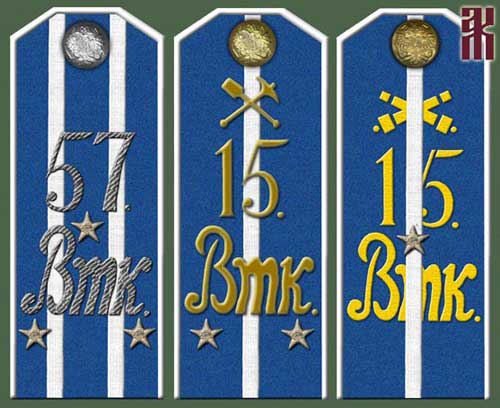
Shoulder-boards of the 15th Votkinsk Rifle Division, as at May 1919:
1 – lieutenant-colonel of the 57th "17 August" Votkinsk Rifle Regiment:
2 – second-lieutenant of the 15th Votkinsk Engineer Battalion;
3 – ensign of the 15th Votkinsk Light Artillery Divizion
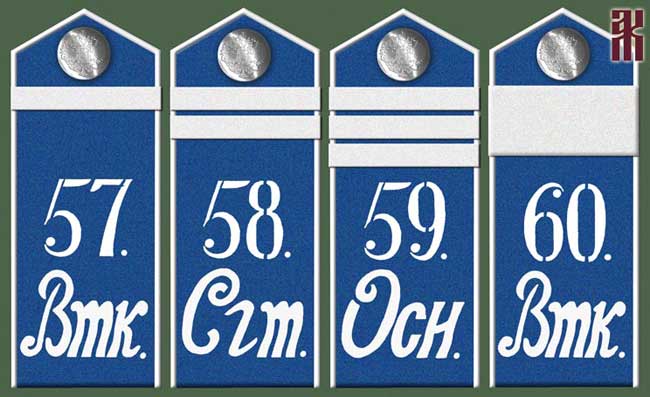
Shoulder-boards of the 15th Votkinsk Rifle Division, as at May 1919:
1 – lance-corporal of the 57th Votkinsk "17 August" Rifle Regiment;
2 – corporal of the 58th Saigatsk "Czechoslovakian" Rifle Regiment;
3 – sergeant of the 59th Osinsk "Minin and Pozharskiy" Rifle Regiment;
4 – sergeant-major of the 60th Votkinsk "Allied Powers" Rifle Regiment
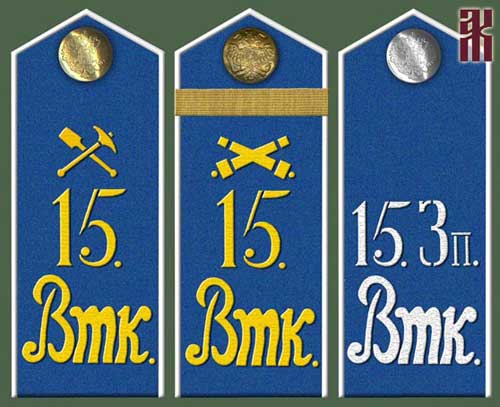
Shoulder-boards of the 15th Votkinsk Rifle Division, as at May 1919;
1 – private of the 15th Votkinsk Engineer Battalion;
2 – lance-corporal of the 15th Votkinsk Light Artillery Divizion ;
3 – private of the 15th Votkinsk Reserve Regiment
Uniforms of the Izhevsk-Votkinsk Brigade of the Far Eastern Army, 1920-1922
Transbaikalia, 1920
The dashing Votkinsk artillerymen had a special difference – St. George cord on their shoulder-boards. They formed an extremely united artillery family around their regiment commander, Colonel Almazov. They amazed everyone by being the only ones in the entire Siberian Army who brought all their guns with them from the Ice Campaign.
Lotkov, S. N. in "The Kamsk-Votkinsk Plant and its Workers // The Ural and Kama region, November 1918-January 1919: Popular Resistance to Communism in Russia", Paris, 1982, p.439.
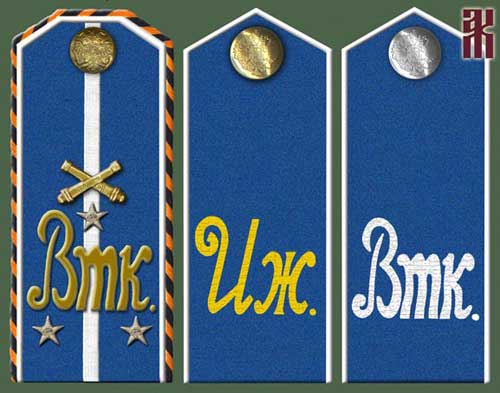
Shoulder-boards of the Izhevsk-Votkinsk Rifle Brigade, for 1920-1922;
1 – lieutenant of the Votkinsk Artillery Divizion, with orange-black St George cord ;
2 – private of the Izhevsk Rifle Regiment; 3 – private of the Votkinsk Rifle Regiment
Transbaikalia, 1920
The Votkintsy retained their artillery throughout the Siberian campaign and brought it with them to Transbaikalia. For this, the divizion's members were awarded St. George greatcoat tabs.
Efimov, A. G. in "Izhevtsy and Votkintsy // Pioneer Herald", Los Angeles, 1970, p.22.
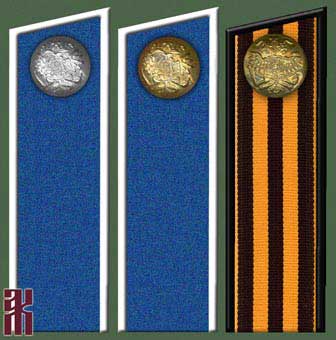
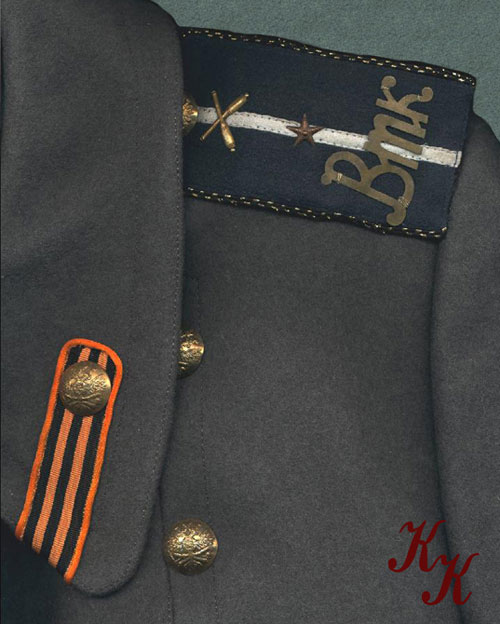
Greatcoat tabs: 1 – Votkinsk units; 2 – Izhevsk units; 3 – Votkinsk Artillery Divizion
4 – Reconstruction by K. Kulagin of an greatcoat showing the tab and shoulder-board of an ensign of the 1st Votkinsk Artillery Divizion
Chita district, March 1920
Then it began: when I arrived, we tried to get the troops in order somehow, dress them. Spring was coming soon, everything had to be sorted out.
Molchanov, V. M. in "Interview recorded by B. Raymond in 1970 // Molchanov V. M.: The Last White General", Moscow, 2009, p.162
Khabarovsk campaign, Winter 1921-1922
The Izhevsk-Votkinsk and Volga Rifle Brigades were inadequately equipped. The troops operated in old Russian-style greatcoats and boots or low boots. Some wore papakhi, but the vast majority wore cloth caps with ear flaps, which had been adopted by the Siberian Army under Admiral Kolchak. Some of the troops were issued warm knitted blouses. On their hands they had rifle gloves made of goatskin.
The units went to the front like that. Once there, the front-line units (the Izhevsk-Votkinsk, Volga, 1st Rifle and 2nd Rifle Brigades) were issued a significant number of high American rubber galoshes in Inman. Such footwear was unsuitable for marching: when worn over boots, it became an unnecessary burden. Without high boots, however, they were unusable in the conditions of Siberian marches because: 1) when warm the rubber releases moisture, causing the socks to get wet, and then when exposed to the cold, they quickly freeze, increasing the likelihood of frostbite, 2) for infantrymen wandering through bushes, hills and stones, rubber tears very quickly. Lightweight and comfortable in peacetime, galoshes were completely unsuitable for military campaigns. Rumour had it that the galoshes were supplied by the Merkulov brothers themselves.
The soldiers' equipment consisted of leather artillery knapsacks or various types of duffel bags, including English dry bags. Ammunition was placed in cartridge pouches (of the old Russian design), a pair per soldier, and cartridge belts sewn from drill. These cartridge belts were useless, as the cartridges often fell out.
Filimonov, B. B. in "White Rebels: the Khabarovsk Campaign, Winter 1921/22 // Last battles in the Far East", Moscow, 2005. p.85-87.
Izhevsk-Votkinsk Brigade, January 1922
Colonel Efimov decided in his orders to call the regiments by numbers: 1st, 2nd and Kondiv [Horse Divizion], but so that there would be no misunderstandings when meeting with his own men added "Blue" to the numbers – the colour of their shoulder-boards
Filimonov, B. B. in "White Rebels: the Khabarovsk Campaign, Winter 1921-22 //Last Battles in the Far East", Moscow, 2005, p.346.
Shoulder-boards and overcoat of Lieutenant-General Molchanov (camp in Girin, China, 1923)
[the general] in a gray soldier's overcoat with blue tabs, piping and shoulder-boards with white piping, rather than silver, a general's zigzag and the letters "Izh" on them.
Filimonov, B. B. in "White rebels // The White Army of Admiral Kolchak", Moscow, 1997, p.126.
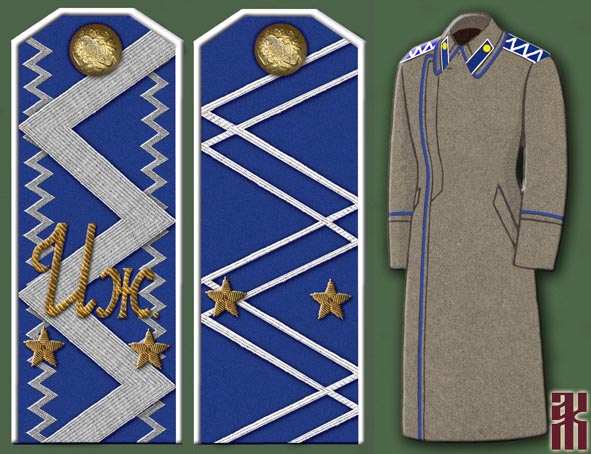
Reconstruction of General Molchanov's uniform, based on photographs in Efimov
Efimov, A. G. in "Izhevtsy and Votkintsy: The struggle against the Bolsheviks 1918- 1920. Moscow, 2008. p.321.
Home — State Symbols — Flags — Uniforms — Badges & Medals — Money — Other
Pygmy Wars Notes
The original for this page is at kolchakiya.ru/uniformology/ij_vtk_rebels_2.htm.
This covers the Izhevsk and Votinsk units from once they had become fully regular divisions in Kolchak's Russian Army. The early days of the units are discussed here. The cavalry is discussed here. The jaeger unit is dicussed here. The 1920 period in the Far East is also discussed here.
"Иж" and "Втк" are abbreviations of the names, being "Izh" and "Vtk" in transliteration. Note, Cyrillic italics are often quite different from the standard form and, in particular, the Cyrillic "i" or "и", looks like a Roman "u" and the Cyrillic "t" looks like a Roman "m". So what appears to be different ciphers shown in the illustrations are actually merely differences in font choice.
"г. Воткинск" means "Votkinsk Town".
The following illustrations by A. Lebedeva were in the original version of this page, but have since been removed.
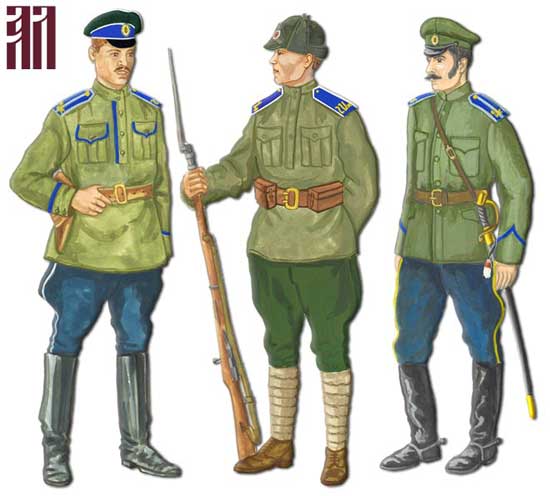
1 – officer of rifle unit wearing the coloured cap (which were rare);
2 – rifleman of the 2nd Izhevsk Rifle Regiment in Kolchakovka cap;
3 – officer of the Izhevsk Horse Regiment (formerly Izhevsk Cavalry Divizion)
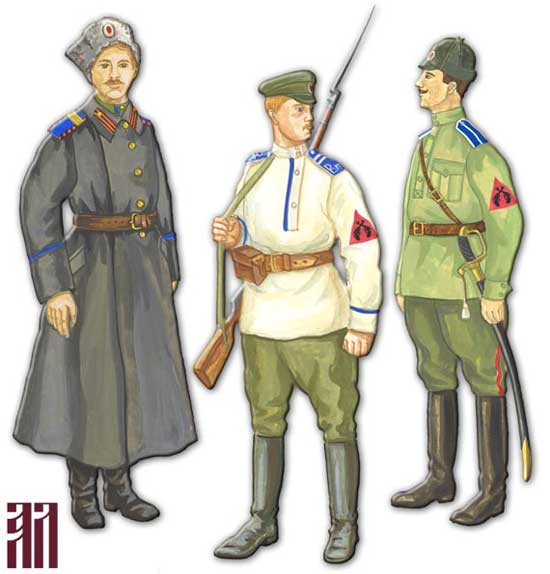
1 – sergeant-major of the Votkinsk Artillery Divizion (in Transbaikalia and Primor'e);
2 – corporal of a Votkinsk Rifle unit; 3 – officer of a Votkinsk Rifle unit
Discussion on the translation choices I have made can be found here.
Flags
Some banners for the 1st and 3rd Votkinsk Regiments have been reconstructed here. There is also a flag of crossed revolvers, which would make a good marker for a Votkinsk battalion, since it is a known emblem.
A few banners are known from late 1919, discussed here. These all use a St Andrew's cross in St George ribbon, so perhaps that was a theme by this time.
A Votkinsk infantry battalion marker is known: a simple Russian tricolour, here, carried on a bayonet. Also shown on that page is a Votkinsk artillery battery marker: it is from the Primor'e period, but it is likely that they flew similar variants (with battery numbers or ciphers) in the period before.
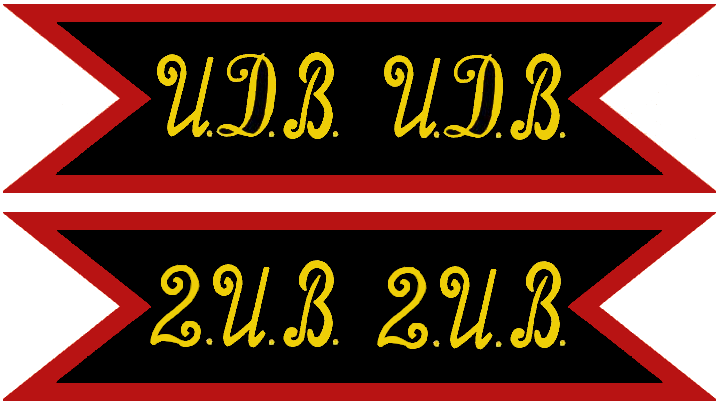
Actual (1922) above, and below conjectured for 1919
History of the Izhevsk Division
Formed from the rebellious workers of the Izhevsk factory. In the second half of November 1918 the remnants of the rebels broke through to the Kama, where they joined forces with units of the KOMUCH People's Army. In January 1919 the Independent Izhevsk Rifle Brigade was formed, with over 2,000 men, and incorporated into the 2nd Ufa Army Corps. Initially the entire command staff consisted of junior officers: the commander and chief of staff were staff captains, regiments were commanded by lieutenants and second lieutenants, etc.
From March to mid-April 1919 the brigade lost 37 officers and 746 soldiers. In August 1919 it was expanded into a division, having been reinforced by 52 officers and 842 soldiers. By the end of August it numbered 182 officers and 1,309 privates and NCOs (and with attached units, 41 officers and 309 men).
By mid-December 1919 it had only 400 men remaining in active service. Following the Siberian Ice Campaign, it was reorganised into the Izhevsk Rifle Regiment.
History of the Votkinsk Division
Formed from rebels of Votkinsk and the surrounding areas. After retreating beyond the Kama in the second half of November 1918, the Votkinsk units were incorporated into the Composite Rifle Division of the Western Army, renamed the Votkinsk Division in February 1919, and the 15th Votkinsk Rifle Division from April.
In January 1919 it consisted of: the 1st, 2nd, 3rd and 4th Votkinsk Regiments, the Independent Votkinsk Horse Divizion and the Independent Votkinsk Artillery Rifle Divizion. It took part in the spring offensive as part of the 1st Combined Siberian Corps of the Independent Siberian Army, but was immediately disbanded and sent home following the liberation of its home factory from the Reds.
However, it soon began to reform from volunteers and conscripts. By 9 May 1919 it included the 57th Votkinsk Factory "17 August" Regiment, the 58th Saigat "Czechoslovak" Regiment, the 59th Osinsk "Minin and Pozharsky" Regiment, the 60th Votkinsk "Allied Powers" Regiment, the 15th Frontline (Reserve) Regiment, the 15th Light Artillery Divizion and the 16th Sapper Battalion. In May it changed from a volunteer to a regular unit.
In June 1919, it was merged with the 16th Kazan (Sarapul) Rifle Division, with which, from June 1919, it formed part of the 8th Kama Army Corps. Following the merger, the division comprised: the 57th Votkinsk, 58th Kazan, 59th Laishev, and 60th Chistopol Rifle Regiments, the Independent Votkinsk Horse Divizion, and the 15th Independent Votkinsk Artillery Rifle Divizion. From July 1919 it was part of the 1st Army, and from September the Tobolsk Group.
The Votkinsk Reserve Regiment was almost entirely wiped out during the Siberian Ice Campaign in the Shcheglovskaya taiga on 25 December 1919, while the 58th and 59th Regiments were taken prisoner in early January 1920 near Krasnoyarsk. In Transbaikalia the division's infantry units were consolidated into the Votkinsk Rifle Detachment of the Far Eastern Army, later becoming the Votkinsk Rifle Regiment.
History of the Izhevsk-Votkinsk Brigade
The Votkinsk and Izhevsk Rifle Regiments, formed from the remnants of the former divisions, were brigaded together in Transbaikalia in the spring of 1920. That unit then retreated to Primor'e. In March 1921, including the Votkinsk Cavalry Divizion, the Votkintsy had 109 officers and 553 soldiers, while the Izhevtsy had 86 officers and 509 soldiers. In August 1922 they were reformed as the Votkinsk Battalion and Izhevsk Battalion of the Prikama Regiment. The battalions slowly dropped to companies at the final retreat into China.
History of the Votkinsk Artillery Divizion
Formed in early 1919 on the front line beyond the Kama River from the artillery units of the Votkinsk People's Revolutionary Army. It was part of the 15th Votkinsk Rifle Division, alongside the other Votkintsy.
The Votkinsk unit was the only one that did not abandon its artillery in Siberia and transported all 11 of its guns to Chita. It remained an independent unit in the summer of 1920 in Transbaikalia. Afterwards the Votkinsk Light Rifle Battery, formed on its basis, was temporarily attached to the Omsk Rifle Division due to a surplus of artillery in the Votkinsk Rifle Detachment while the Omsk Rifle Division lacked any. It remained with that division even after the Votkinsk Detachment transferred from the 2nd Corps to the 3rd. The battery numbered around 20 officers and over 120 soldiers, and was considered one of the army's model units.
In Primor'e it formed part of the 2nd Separate Siberian Artillery Divizion of the 2nd Corps as the 2nd Independent Votkinsk Battery. After the Khabarovsk campaign it was incorporated under the same name into the 2nd Rifle Brigade of that corps. By spring 1922 it had two guns, 10-12 officers and over 100 soldiers. In August 1922 it was renamed the West Siberian Battery and became part of the West Siberian Regiment.