
Uniforms of the Jaeger Units of the Russian Army of the Supreme Ruler
Material and reconstructions by A. Karevskiy
The jaeger units in Kolchak's Russian Army can be divided into two categories:
"Army". These were the most reliable and combat-ready units, used as strike forces. The intention was to form a jaeger brigade for each army corps and, accordingly, a jaeger battalion for each rifle division. Soviet historian E. F. Ogorodnikov, who was the first to address this topic, accepted this plan for the deployment and strengthening of the Russian Army had already been implemented in the spring of 1919 . However, according to another Soviet researcher, G. K. Eike:
In reality, such brigades were a rare exception. They were completely absent from the Western, Orenburg, and Ural Armies, as well as the Southern Army Group, and were not present in all corps of the Siberian Army. The situation was similar with regard to the presence of jaeger battalions in infantry divisions.
The Kharitonov and Gorshkov book contains an image of the "jaeger battalion shoulder-board" – dark green with yellow piping and a gold button. However, it seems doubtful that a uniform shoulder-board was introduced for the jaeger units of the rifle divisions. Most likely, there was considerable scope for local initiative in that area. This is indirectly confirmed by B. B. Filimonov's mention of black shoulder-boards with red piping for the Jaeger Battalion of the 11th Ural Rifle Division.
"Guards". An independent jaeger battalion was created specifically as a cadre for the Preobrazhenskiy Life Guard Regiment, and was formed and equipped accordingly. The remaining units can be considered, with a certain degree of convention, as the "new guards", together with the 8th, 11th, 12th, 13th and 14th Siberian Rifle Divisions. Vyrypaev says in his memoirs, that the Independent Jaeger Brigade, stationed in Omsk, was planned as the future garrison for Moscow. In the summer of 1919, the Jaeger Battalion of the General Headquarters was deployed in the Jaeger Division, consisting of two infantry and one cavalry regiments, and was kept until the last moment as one of the best reserve units – its reliability and combat capability were demonstrated during the Great Siberian Campaign and the subsequent fighting in Transbaikalia and Primor'e. Such units, accordingly, had their own distinctions: a characteristic detail of the "new guard" was British uniforms.
Ogorodnikov, E. F. in "Strike against Kolchak in the Spring of 1919, Moscow, 1938.
Eike, G. K. in "Kolchak's Ufa Adventure", Moscow, 1960, p.6.
Kharitonov, O. V. and Gorshkov, V. V. in "The Russian Army, 1917-1920", St. Petersburg, 1991.
Vyrypaev, V. O. in "The Kappelevtsy // Admiral Kolchak's Eastern Front", Moscow, 2004, p.356.
The 1st and 2nd Jaeger Regiments of the Siberian Army
On 20 April there were two regiments in Ekaterinburg, known as the 1st and 2nd Immortal Regiments named for Gaida. They were formed from volunteers and ruffians, smartly dressed, with the greatcoats, blouses and trousers of the parade uniform altered and tailored to fit. The trousers had a narrow yellow stripe, a yellow cord with tassels was sewn onto the chest of the blouse, forming an angle with the sides towards the shoulders, and an image of a was skull sewn onto one of the sleeves with yellow thread. Yellow shoulder-boards were worn. They were armed with Russian-style three-line rifles. They were kept satisfied with reinforced rations.
"Siberian Bureau of the Central Committee of the Russian Communist Party (Bolshevik), 1918-1920: Collection of documents, Part 1", Novosibirsk, 1978, p.170.
There was only one Immortal Regiment named for General Gaida, whose uniform features are known and are not at all similar to the description above. Presumably then, we are talking about the 1st and 2nd Jaeger Regiments, which were also formed in Ekaterinburg at the same time as the "immortals-Gaidovtsy". In May 1919 they formed a Special Brigade directly subordinate to the Siberian Army Headquarters.
In June, together with the regiments of the Assault Brigade, they formed the Composite Division of the Southern Group of the Siberian Army. Then, together with the 1st and 2nd Frontline Reserve Regiments, they were merged into the 18th Siberian Rifle Division, receiving the numbers 69 and 70 and losing their independence.
It is difficult to say why yellow was chosen as the insignia colour – that colour had belonged to the grenadier regiments in the Russian Imperial Army, whereas the insignia colour of the Life Guards Jaeger Regiment was dark green.
The reconstruction of the uniforms of these regiments is based on the assumption that "a yellow cord on the chest of the blouse, forming an angle with the sides towards the shoulders" is simply a rather clumsy description of a lapel with yellow piping, modelled on the lapel that existed in the 1st Immortal Regiment (only there the piping was black). The same applies to skull – it is unlikely that the embroidery was done directly on the sleeve: it would be more logical to assume that it was done on khaki backing and simply blended in with the fabric of the blouse. The insignia for the shoulder-boards were reconstructed based on the insignia of the jaeger regiments of the 1st and 2nd Siberian Rifle Divisions.
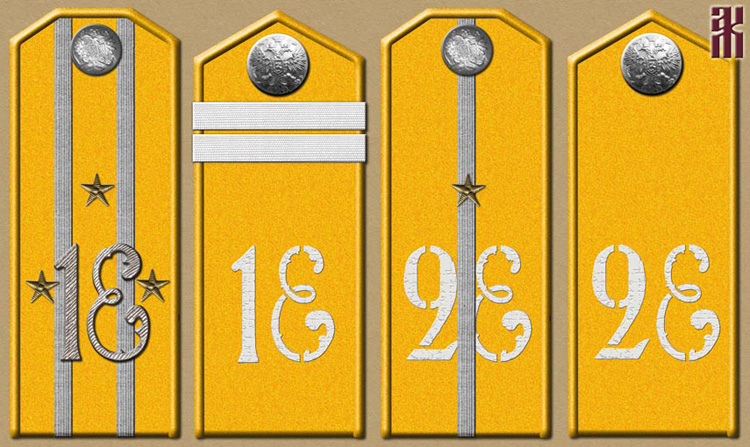
Shoulder-boards of the 1st and 2nd Jaeger regiments of the Siberian Army
(approximate reconstruction)
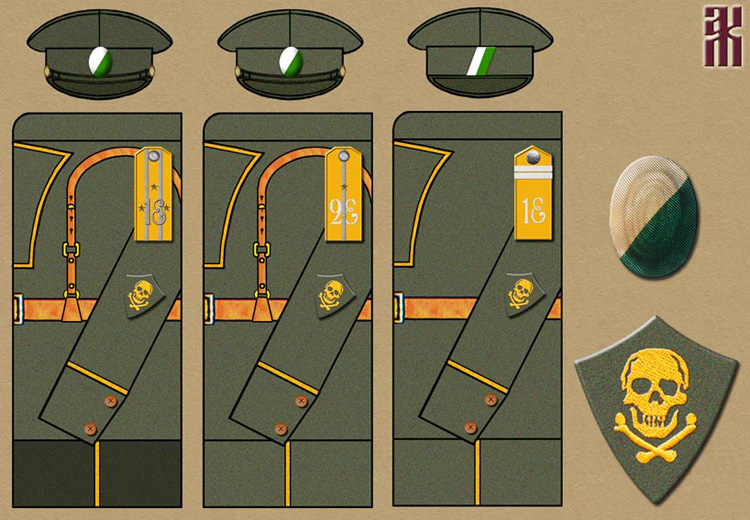
1, 2 and 3 – uniforms of the 1st and 2nd Jaeger Regiments of the Siberian Army;
4 – cockade with a white and green ribbon; 5 – sleeve chevron with skull and bones
(approximate reconstructions)
Independent Horse-Jaeger Regiment of Colonel Vrashtel
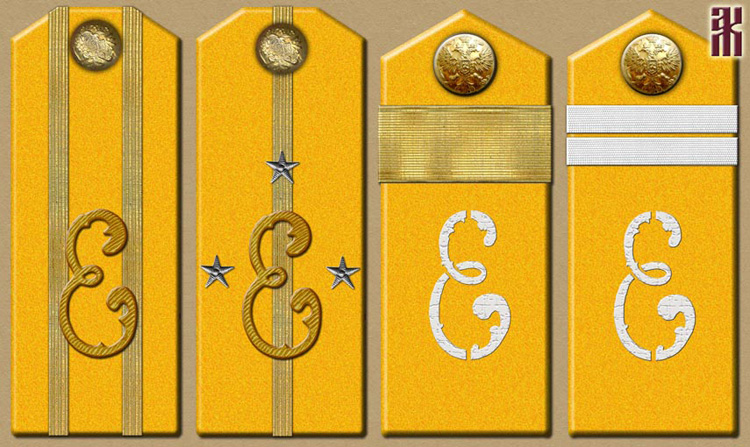
Shoulder-boards of the Independent Horse-Jaeger Regiment of Colonel Vrashtel
This reconstruction is based on a photograph published at medalirus.narod.ru, as well as materials kindly provided by a visitor there known as "Rotmistr Ivanov". This unit was formed in the Far East, on the basis of the former Primor'e Dragoon Regiment, which determined the yellow colour for the uniform.
medalirus.narod.ru/Foto2/mfoto50.jpg.
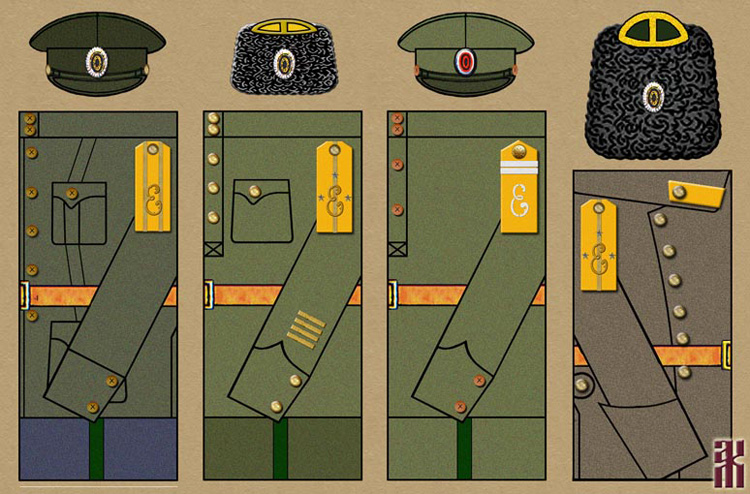
Uniform of the Independent Horse-Jaeger Regiment of Colonel Vrashtel
Figure 3 is reconstructed based on the above photograph. Figure 4 is a variant using the uniform of the Primor'e Dragoon Regiment (with the regimental dark green tabs with yellow piping replaced with pure yellow ones).
"Comrade" Orlov was dressed in a railwayman's uniform, but after a while he appeared in military uniform. It later turned out that the entire uniform had been taken from the commander of the Horse-Jaeger Regiment, Colonel Vrashtel, a recipient of the Order of St. George, but with the stripes removed.
guran-ussury.livejournal.com/31557.html.
rys-arhipelag.ucoz.ru/publ/sudba_polkovnika/24-1-0-5692.
Independent Horse-Jaeger Divizion, attached to the 4th Siberian Rifle Division
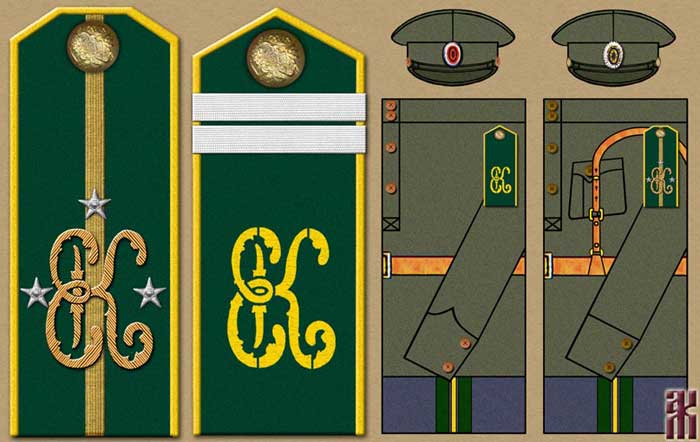
Uniforms of the Independent Horse-Jaeger Divizion of Colonel Manzhetnyy
1 – lieutenant; 2 – corporal; 3 – private; 4 – lieutenant
The form of the monogram has been reconstructed based on Filimonov's description.
The division had a special uniform: green shoulder-boards with yellow piping; the same greatcoat tabs; intertwined yellow letters ""ЕК on the shoulder-boards; and double green stripes with yellow piping in the middle on the trousers.
Filimonov, B. B. in "White Rebels: The Khabarovsk Campaign, Winter 1921-1922. Book 1", Shanghai, 1932, p.41.
Jaeger Battalion of the Supreme Commander-in-Chief's Headquarters,
later the Independent Jaeger Regiment and then the Jaeger Division
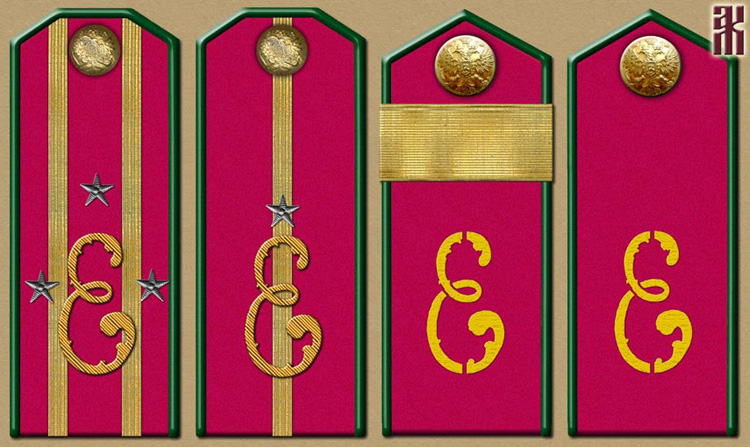
Shoulder-boards of the Supreme Commander's HQ Jaeger Battalion
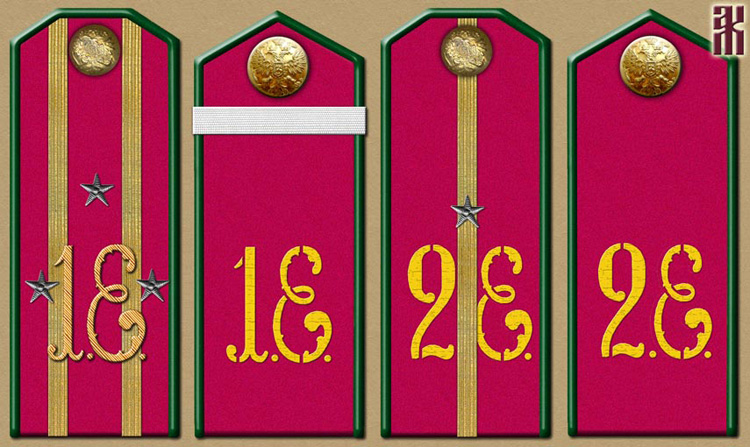
Shoulder-boards of the 1st and 2nd Jaeger Regiments of the Jaeger Division
The presence of regiment numbers before the "Е" is in uncertain.
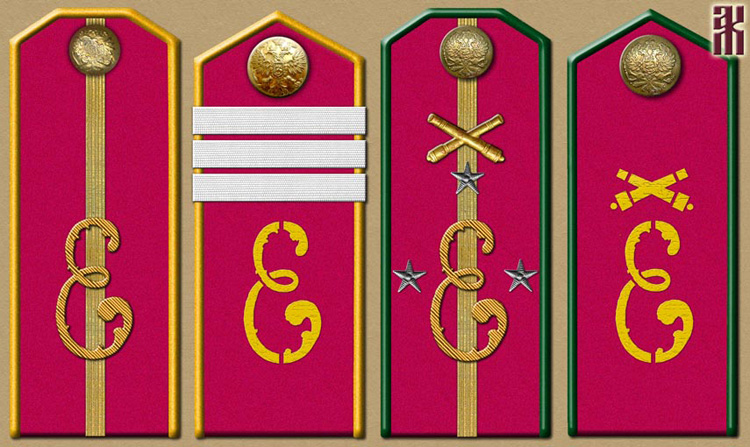
Shoulder-boards of the Horse-Jaeger Regiment and the Jaeger Artillery Divizion
Note: Filimonov mentions a raspberry shoulder-board with yellow piping for the Horse-Jaegers, but does not mention the cipher "E".
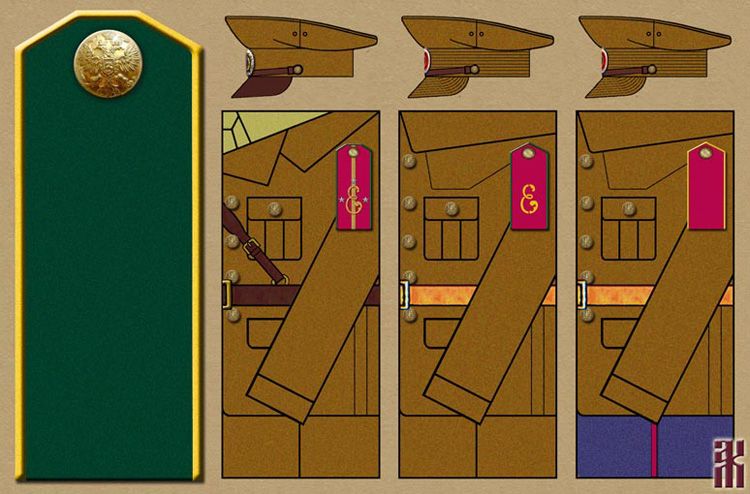
1 – shoulder-board of the Russian Army's Jaeger Battalions of the Supreme Ruler;
2 – lieutenant of the Jaeger Division; 3 – private in the Jaeger Division;
4 – private of the Horse-Jaeger Regiment
Figure 1 is taken from a drawing in Kharitonov and Gorshkov. That drawing is clearly taken from another publication, and is probably not the authors' own work. The specific units to which they belong are not indicated.
O.V. Kharitonov and V.V. Gorshkov, "The Russian Army. 1917-1920. St. Petersburg, 1997
Jaeger Battalion of the Supreme Commander-in-Chief's HQ, Omsk, Summer 1919
The battalion was well trained, armed with English rifles, dressed in English uniforms, and made an excellent impression on observers.
Shuldyakov, V. A. in "The Demise of the Siberian Cossack Army, 1917-1920, Book 1", Moscow, 2004, pp.660-661.
Jaeger Regiment in Primor'e
The jaegers had raspberry shoulder-boards with green piping and a curlicue yellow letter "E". The left sleeve had a chevron in the national colours, the same as that of the Urals.
Filimonov, B. B. in "The White Rebels: The Khabarovsk Campaign, Winter 1921-1922, Book 1", Shanghai, 1932, p.44.
Horse-Jaegers
The shoulder-boards were raspberry with yellow piping.
Filimonov, B. B. in "The White Rebels: The Khabarovsk Campaign, Winter 1921-1922, Book 1", Shanghai, 1932, p.44.
Model Jaeger Division (Model Jaeger Brigade)
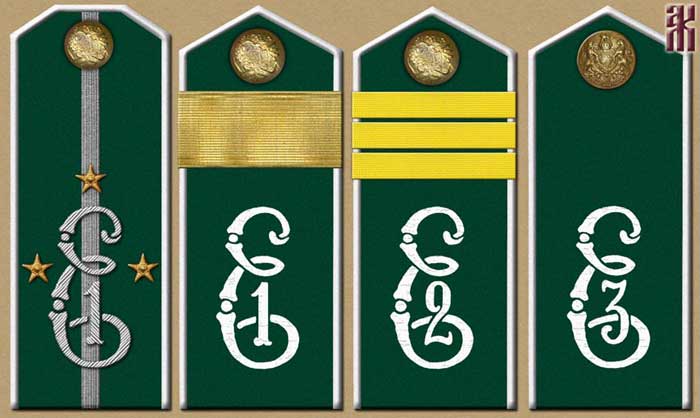
Shoulder-boards of the Model Jaeger Division (Model Jaeger Brigade)
The reconstruction of the monogram is based on a photograph at www.novonikolaevsk.com/glava4.htm [link dead].
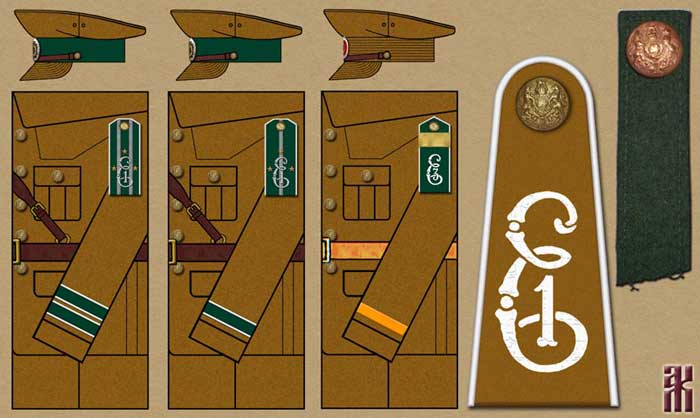
1 to 3 – uniforms of the Model Jaeger Division (Model Jaeger Brigade);
2 – shoulder-board of the 1st Model Jaeger Regiment;
4 – great coat tab (reconstruction by "Rotmistr Ivanov")
Judging from the photograph mentioned above, it was the practice to use British tunic shoulder-boards with white piping and stencils sewn into the shoulder-strap instead of Russian shoulder-boards.
Due to a shortage of Russian buttons, the Jaeger battalions often used British ones. The same buttons can be seen on the Russian shoulder-board of the Jaeger on the previous panel.
Since the Model Jaeger Brigade was formed from the Jaeger battalions of the 11th, 12th and 13th Siberian Rifle Divisions, renamed the 1st, 2nd and 3rd Model Jaeger Battalions, then expanded to regiments, the units continued to wear the uniforms and insignia of the Siberian Rifles, as established by Order of the War Department No. 161 of 30 April 1919.
Order of the War Department No. 161 of 30 April 1919, Omsk.
The Supreme Ruler and Supreme Commander-in-Chief orders that the newly formed 8th, 11th, 12th, 13th and 14th Siberian Rifle Divisions be issued with army-standard field uniforms with the following distinctions:
For soldiers: shoulder-boards are 6½ cm wide, made of dark green cloth with white cloth piping. They have the unit number as cipher: for riflemen, jaegers and headquarters personnel in white, for artillerymen in red, for engineering and technical troops in yellow. Distinctive insignia corresponding to the branch of service is to be placed above the unit number. For junior NCOs: transverse stripes of narrow ¾-inch yellow tape. For sergeant-majors in [wide] yellow braid. The cuffs for privates are without markings. For NCOs the cuffs are trimmed with narrow (1 cm) braid. The cap is khaki.
For officers: the same model as for soldiers, but with narrow (½ cm) silver braid, sewn in a zigzag pattern for generals, and the appropriate number of lengthways stripes down the shoulder-board for staff and senior officers (one or two) and with the corresponding number of gilded stars for each rank. Unit numbers and distinctive insignia for different branches of the military are made of white metal, gilded in the artillery.
Collar tabs are made of dark green cloth with white piping in rifle units, and dark green cloth without piping in jaeger units. For artillery, engineer and technical units, they are made of black velvet with red piping. Headquarters are to have red cloth with white piping. Generals and staff officers have the same shoulder-boards, but with metal buttons, gilded in artillery units and silver-plated in all others. Cuffs are trimmed, according to the attached drawings, with dark green braid with white piping: 2½ cm wide for generals, 2 cm wide in two rows for staff officers, and the same width in one row for senior officers. The cap is to have a khaki crown, visor of the same colour and material and with the band the same colour and piping as the shoulder-boards.
Signed: Minister of War Major General Stepanov
Document kindly provided by Moscow researcher V.V. Romanov
Omsk, Winter 1919
In Omsk itself, an independent jaeger brigade was formed, who openly called themselves the "Moscow garrison", dreaming of Moscow. ... Almost all of them perished before reaching Krasnoyarsk during their retreat from Omsk in the winter of 1919. The jaegers were also not equipped with winter clothing for the march across Siberia.
Vyrypaev, V. O. in "The Kappelevtsy // Admiral Kolchak's Eastern Front" Moscow, 2004, p.356.
14th Independent Jaeger Battalion
Formerly the Jaeger Battalion of the 14th Siberian Rifle Division.
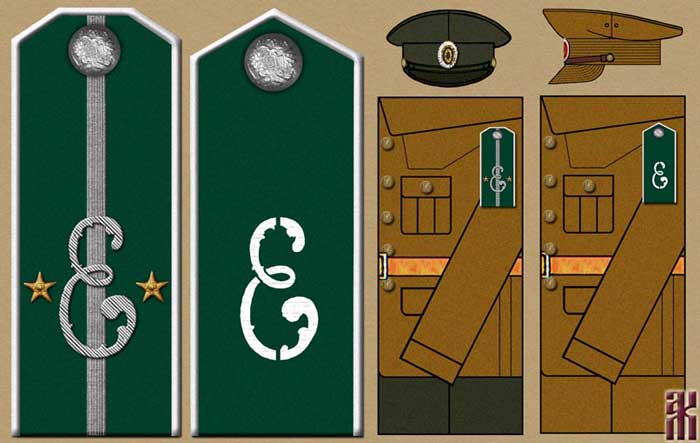
Shoulder boards and uniforms of the 14th Independent Jaeger Battalion;
1 and 3 – second-lieutenant; 2 and 4 – private
This reconstruction based on a photograph published at russiamilitaria.ru [link dead]
Although British uniforms with appropriate insignia were issued to the 14th Siberian Rifle Division, a significant number of its officers continued to wear Russian uniforms.
1st Jaeger Battalion of the 2nd Army Headquarters
Formed around members of the Life Guard Preobrazhenskiy Regiment.
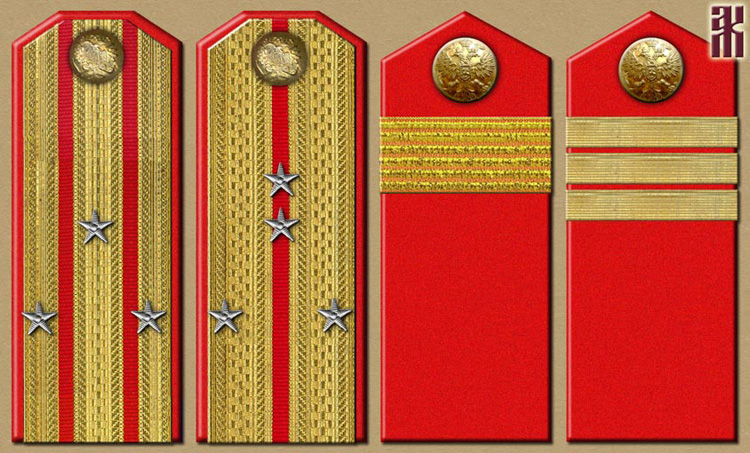
Shoulder-boards of the 1st Jaeger Battalion of the 2nd Army Headquarters
A distinctive feature of the shoulder-boards of the Guards units was that the ranks of lance-corporal and corporals were indicated by gold braid, while those of sergeant-major were indicated by silver braid.
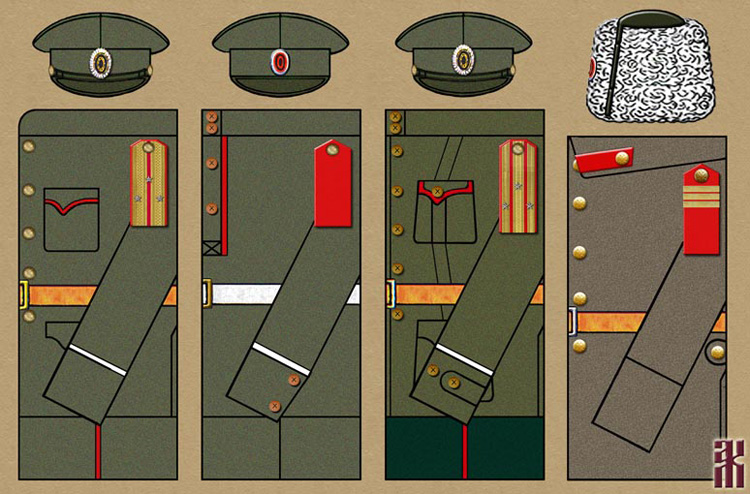
Uniforms of the officers of the 1st Jaeger Battalion of the 2nd Army HQ
We presume that while the battalion was not more than 150 men, that Russian-style uniforms with guard distinctions were used (coloured piping on officers' tunics and coloured braid on the blouses of the lower ranks). Figure 3 is based on a photograph of Colonel A. A. Stakhovich
www.sammler.ru/uploads/post-276-1320306575.jpg.
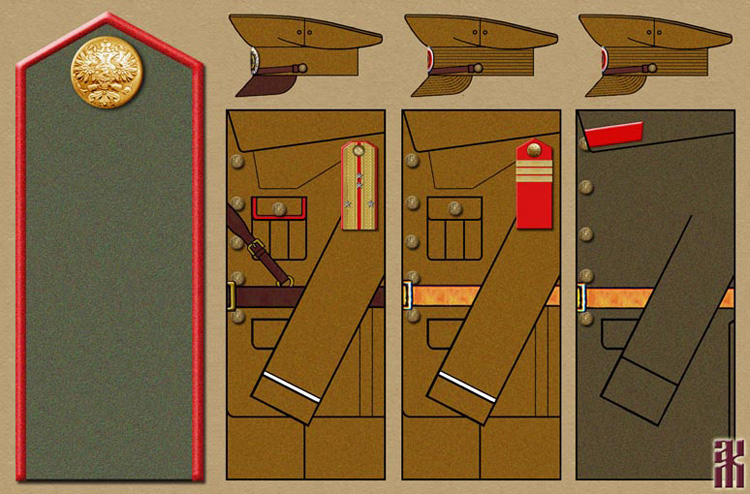
1 – field version of the Jaeger Battalion shoulder-boards;
2 to 4 – uniforms of the 1st Jaeger Battalion of the 2nd Army HQ, in British uniforms.
It is not known whether the battalion used khaki or coloured shoulder-boards for lower ranks.
Petropavlovsk District, mid-August 1919
It has been secretly granted to us, the Preobrazhenskiy Regiment, to form a unit, while retaining our uniform and full selection of officers.
"Diary of Captain D. D. Litovchenko of the Life Guard Preobrazhenskiy Regiment // Zvezda, No. 2", St. Petersburg, 1995, p.13.
Kolchak entrusted Colonel Khvoshchinskiy with forming the first guard unit – initially a battalion of the future Preobrazhenskiy Regiment. Khvoshchinskiy and the officers who arrived with him formed the command core of the Jaeger Battalion. They received everything they needed: money, Russian-style greatcoats and boots, and most importantly, the right to select recruits from among the Siberian lads who had been called up.
Cherkashin, N. A. in "Admirals of the Rebel Fleets", Moscow, 2004, p.220, quoting the memoirs of Captain A. Stakhevich.
First, according to historical custom, the Preobrazhenskiy Company of the Jaeger Battalion marched past the admiral, then formed into a more or less orderly square. Only the soldiers of the oldest regiment in the Russian army, revived as a battalion by a handful of its officers here in Omsk, were dressed in Russian-style greatcoats and armed with Russian rifles.
Cherkashin, N. A. in "Admirals of the Rebel Fleets", Moscow, 2004, p.220, quoting the memoirs of Captain A. Stakhevich.
... almost simultaneously, I saw several cockades of national colours, introduced after the February Revolution in 1917, which were worn by soldiers of the 2nd and 3rd companies. ... But no matter how hard I tried ... I did not see a single cockade in the 1st Company. With great difficulty, I was the only one who managed to obtain old imperial-style cockades for my entire company in Omsk.
Cherkashin, N. A. in "Admirals of the Rebel Fleets", Moscow, 2004, p.220, quoting the memoirs of Captain A. Stakhevich.
Enisei, January 1920
There was a tall, slender colonel, dressed in a thin grey soldier's overcoat, but with the shoulder-boards and uniform of his native guard regiment ...
Sakharov, K. V. in "The Siberian Ice Campaign // The Great Siberian Ice Campaign", Moscow, 2004, p.62.
... the complete material success of the formation. The richest allied warehouses were opened to us thanks to the patronage of our acquaintances in St. Petersburg: General Knox, Colonel P. P. Rodzianko, who served in his cavalry guard, and his lovely English wife, as well as Mrs Novitskaya, who worked for the American Red Cross. The battalion was dressed in brand new English uniforms, was richly armed, and the officers earned the right to wear the uniform of their guard regiment.
(A. A. Stakhovich mentions that he kept his "Preobrazhenskiy" greatcoat from the Great War, but took great care of it and wore it only on special occasions, using the English greatcoat issued to him for everyday wear. Meanwhile, Admiral A. V. Kolchak's armies experienced an acute shortage of greatcoats, so that in the summer of 1919, some units were simply not issued with them, replacing them with blankets.)
Petrov, A. A. in "The Preobrazhentsy in Siberia in 1919: an unsuccessful attempt at formation" at beloedelo.ru/researches/article/?30#sdendnote9anc [link dead]
Jaeger Battalion of the 11th Ural Rifle Division
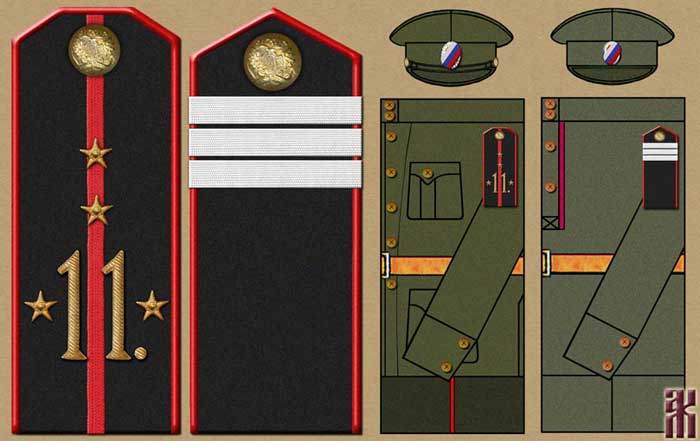
The shoulder-boards and uniforms of a staff-captain and sergeant in the
Jaeger Battalion of the 11th Ural Rifle Division
Whether there where ciphers or not is still unknown.
... black – the colour of the Jaeger Battalion of the 11th Ural Division. Shoulder-boards were black with red piping, same greatcoat tabs. Officers had red stripes on the same shoulder-boards.
Filimonov, B. B. "White Rebels: The Khabarovsk Campaign, Winter 1921-1922, Book 1", Shanghai, 1932, p.43.
Jaeger Regiments of the 1st and 2nd Siberian Rifle Divisions
On 22 March 1919 prisoners revealed that an assault battalion formed from companies of the Novonikolaevsk, Barabinsk, Eniseysk, and Barnaul Regiments, with scouts and machine gunners, had been mobilised from the Perm province. The battalion was formed in Perm, sent to the front in early March, and served as a reserve for the advancing regiments. The battalion moved through Ocher, where the commander of the 1st Central Siberian Corps, General Pepelyaev, conducted a review of the troops of the 1st Siberian Division on 17 March. The assault troops wear black shoulder-boards piped with white and green cord.
Pazdnikov, N. F. in "The Struggle for Perm: Perm Events in the Civil War", Perm, 1988, p.118. originally from the website: www.bergenschild.narod.ru (link now dead)
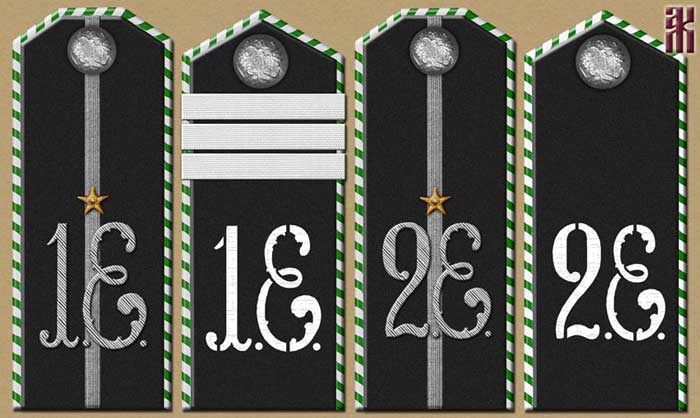
Possible shoulder-boards of the jaeger regiments of the 1st and 2nd Siberian Rifle Divisions.
Perm researcher K. Novikov reconstructed the shoulder-boards with the ciphers being "1.Сб.", "2.Сб." etc. We believe that the ciphers were different, in order to distinguish them from those of the regiments of the 1st Siberian Rifle Division.
www.bergenschild.narod.ru/Reconstruction/depot/civil_war/sib_eger_reg.htm [link dead].
Jaeger Battalion of the Izhevsk Rifle Division
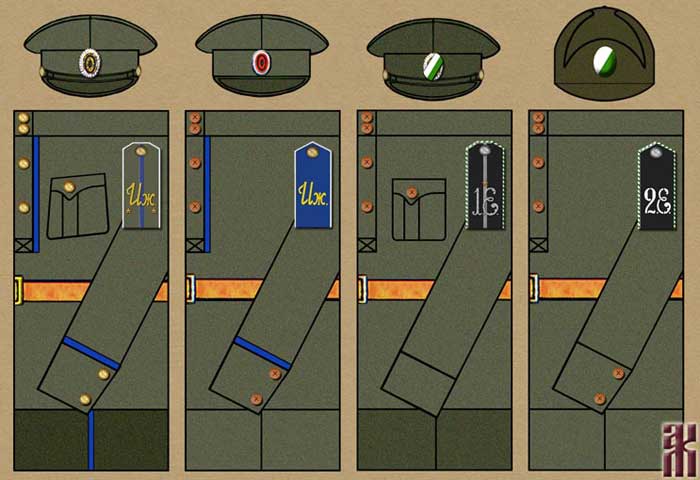
1 and 2 – Uniforms of the Jaeger Battalion of the Izhevsk Rifle Division
3 and 4 – Uniforms of the Siberian Jaeger Regiments, 1st and 2nd Siberian Rifle Divisions
It is noteworthy that the units of the 1st Central Siberian Corps, commonly wore the headdress known colloquially known as the "Kolchakovka".
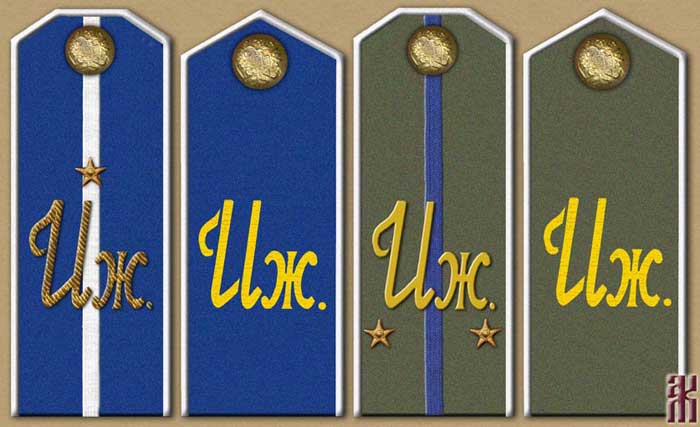
Shoulder-boards of the Izhevsk Rifle Division's Jaeger Battalion
Home — State Symbols — Flags — Uniforms — Badges & Medals — Money — Other
Pygmy Wars Notes
The original for this page is at kolchakiya.ru/uniformology/eger_units.htm.
The photograph of the Model Jaeger Division at novonikolaevsk.com can be seen here. The photograph of Colonel A. A. Stakhovich at sammler.ru can be seen here. The reconstruction at www.bergenschild.narod.ru is no longer available, but a copy of the uniform schemes can be seen here.
Most of these units were the jaeger units for division, which have pages separately: Izhevsk Division, 14th Siberian Division, 11th Ural Rifle Division, 1st and 2nd Siberian Rifle Divisions.
The following illustrations by A. Lebedeva were in the original pages but have since been removed.
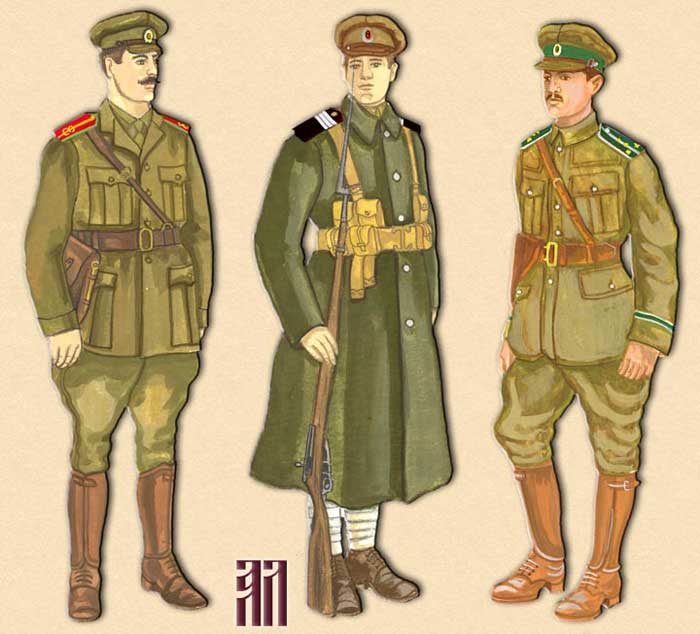
1 – officer of the Jaeger Battalion of the HQ of the Supreme Commander-in-Chief;
2 – sergeant of the Jaeger Battalion of the 11th Ural Rifle Division;
3 – officer of the Jaeger battalions of the Siberian Rifle Divisions
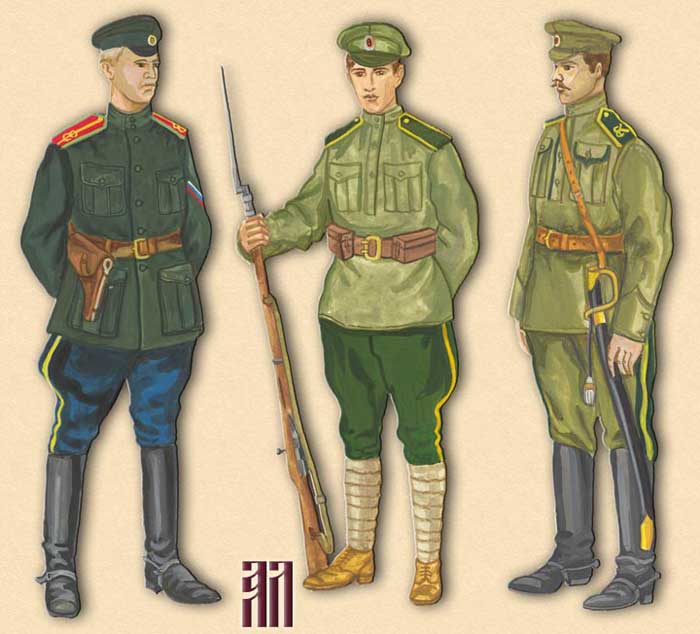
1 – officer of the Jaeger Regiment of the 1st Rifle Brigade, Primor'e, 1921;
2 – private of the Jaeger battalion of a rifle division (according to Kharitonov and Gorshkov);
3 – private of the Independent Horse-Jaeger Divizion of Colonel Manzhetnyy
The illustration includes the Independent Horse-Jaeger Divizion of Captain (Colonel) Manzhetnyy. They wore green shoulder-boards with yellow piping and an intertwined "ЕК" cipher. The greatcoat tabs were in the same colours and the trousers had and double green stripes with yellow piping down the centre.
The illustration includes a matching hat-band, which would certainly be quite normal, as would cavalry piping on the cuffs.
Originally the page also had a reconstruction for Manzhetnyy's jaegers, shown below, which was similarly removed:
Discussion on the translation choices I have made can be found here.
Flags
The jaeger battalions inside divisions would not have had banners, but would have had unit flags. We do not know the banners of the Jaeger divisions.
The flag of Captain Manzhetnyy's Independent Horse-Jaeger Divizion, however, is known.
History of the 1st and 2nd Jaeger Regiments
These existed only briefly as Jaeger Regiments, before being moved into the Composite Division, which became the 18th Siberian Rifle Division. Its uniforms and history are here.
History of the Jaeger Battalion/Regiment/Division
Formed on the Eastern Front in the summer of 1919 in Omsk, originally as the Jaeger Battalion guarding the Headquarters of the Supreme Commander-in-Chief. Later expanded into a detachment equivalent in strength to a regiment.
The young unit saw its first action and performed very well in September of that year, on the Tobol River. Finding itself in a difficult position due to the withdrawal of neighbouring units, the regiment extricated itself with honour, leaving not a single one of its wounded behind.
Subsequently a battalion from the Steppe Group was attached and the detachment was expanded into a division of two jaeger regiments, a horse-jaeger regiment and an artillery divizion.
They survived the march across Siberia well, using remote trails and defeating the partisan detachments encountered along the way. In Transbaikalia the detachment, was incorporated into the 1st Composite Division. The Jaeger Regiment now consisted of two battalions and a mounted divizion.
Upon arrival in Primor'e the Jaeger Regiment left the 3rd Corps and joined the Grodek Forces Group (the Semenovtsy). The regiment was now designated the 1st Jaeger Regiment and was joined by some Uraltsy, followed by the Ufa artillery, to form the 1st Rifle Brigade. In the autumn of 1921 the regiment consisted of three rifle companies, two MG companies, two squadrons (the 1st Bessmertny Squadron and the 2nd Altai Squadron), a non-combat company, a signals detachment and a commandant's detachment. At the start of 1922 the regiment had 52 officers and 239 soldiers.
After the Khabarovsk campaign it was designated the 3rd Jaeger Regiment. A quarter of the men were of Tatars and Bashkirs, and only two of the commanders were career officers.
History of Vrashtel's Horse Jaeger Regiment
The detachment formed in early 1918 around members of the former Primor'e Dragoon Regiment in China. It seems to have been one of the few reliable units in the Far East. In April 1918 the detachment, which now included a 4-gun battery, was sent to strengthen the Special Manchurian Detachment of Ataman Semenov at the Dauriya station. It returned to China following their defeat, but by now Red power was collapsing in Siberia and anti-Bolshevik regimes began to take control. However in August 1918 Shevchenko's Red detachments appeared in the area of Lake Khanka and tried to strike behind the lines of the Allied military group on the Ussuri front. A military expedition was equipped against them, which included the divizion.
In early 1919 it formally became the Horse Jaeger Regiment and was part of the Independent Ussuri Cavalry Brigade. It fought Red partisans in the Nikolsk-Ussuriysk district.
In January 1920 Nikolsk fell to Red Partisans. After brief resistance, Vrashtel attempted to move to China with half his unit, but was detained by Red forces. Later he and his men were massacred.
Confusingly a Regiment of Horse Jaegers appears in the forces of the Provisional Amur government, fighting in the Khabarovsk campaign in November 1921, still under Vrashtel. It may have been the other half of his unit that moved to the hills rather than flee to China.
History of the Model Jaeger Brigade/Division
Formed in June 1919 by brigading jaeger battalions of the 11th, 12th and 13th Siberian Rifle Divisions, as the 1st, 2nd and 3rd Independent Model Jaeger Battalions. In autumn it became the Model Jaeger Division of three regiments.
Information is sketchy, but seems to have been held in the C-in-C's reserve initially, then moved to defend Omsk but did not have time to get there before it was taken. Its first combat was Tebisskoe, then in Novo-Nikolaevsk (Novosibirsk). It fell apart soon after in the chaos of the retreat.
However it seems that the 3rd Regiment was formed in Novonikolavsk and was used extensively against partisans in the Altai, where it was badly defeated, losing almost all its officers.
History of the 14th Independent Jaeger Battalion
This unit fought with the 14th Siberian Rifle Division and their history is discussed here.
History of the Jaeger Battalion of the 11th Ural Rifle Division
This unit fought with the 11th Ural Rifle Division and their history is discussed here.
History of the Jaeger Regiments of the 1st and 2nd Siberian Rifle Divisions
These units fought with the 1st and 2nd Siberian Rifle Divisions and their history is discussed here.
History of the Jaeger Battalion of the Izhevsk Rifle Division
This unit fought with the Izhevsk Rifle Division and their history is discussed here.
History of the Independent Horse-Jaeger Divizion of Captain Manzhetnyy
At the end of 1918 the Bolsheviks formed the 10th Perm Cavalry Regiment by mobilising former cavalry soldiers from the Perm and Vyatka provinces, around 450 men. It then defected to the White side, where it immediately joined Colonel Kazagrandi's detachment. Captain Manzhetnyy was ordered to select up to 300 of the best horsemen and form an independent Horse-Jaeger Divizion.
From mid-1919 the divizion was with the 4th Siberian Division, with which it arrived in Transbaikalia. In the summer of 1920 a group of so-called "Pepelyaevtsy" were incorporated to replenish its losses. Whilst passing through the Chinese Eastern Railway exclusion zone, Colonel Manzhetnyy remained in Harbin with some of his men, but a group of around 200 men in Primor'e, and in August 1921 were incorporated into the Composite Siberian Horse Regiment.