
Uniforms of the Izhevsk and Votkinsk People's Armies,
August-November 1918
Material and reconstructions by A. Karevskiy
The beginning of the uprising, the first distinguishing insignia
The Votkinsk Museum of History and Culture received Anna Iosifovna Brysova's diary from Alushta, sent by her relatives. A student of the Golitsyn Agricultural School, she had come to visit her grandfather, V. K. Krapivin, a merchant from Votkinsk, before the uprising. In the early days of the Mishkinsk uprising she lost two people close to her in one day: her brother Fyodor Iosifovich (19 years old) and her fiancé Nikolai Ivanovich Mordvin (24 years old). So she remembered those days well. Describing the events of 17 August, including the religious processions, prayer services, and funerals of the first rebels who died, she also mentions the white arm-bands, which were soon replaced by red ones.
Private communication from Votkinsk historian S. K. Prostnev, citing VMiK O.F.4019-4026.
August 1918 (From the memoirs of a barge worker)
Armed men with white arm-bands (to avoid confusion with the Reds) prowled around, looking for victims, arresting anyone who had anything to do with the Soviets.
Churakov, D. O. in "Rebellious Proletarians: Worker Protests in Soviet Russia (1917-1930s)", Moscow, 2007, p.331.
Rebel Insignia
Minutes of the meeting of the Executive Committee, the People's Army HQ, the Formation Headquarters and representatives of the front-line soldiers on 23 August 1918.
§7 On Distinctions:
Taking into account that the gradual partial awarding of ribbons in buttonholes causes discord among the soldiers, who are equal defenders of Izhevsk, this session has unanimously decided to award all the soldiers who participated in the defence of Izhevsk , as well as to allow all citizens who sympathise with the liberation of Izhevsk to wear the established ribbons as a symbol of the liberation of Izhevsk.
GAPO F.r-656 Op.1 D.31 L.13, first published at www.bergenschild.narod.ru/Reconstruction/depot/civil_war/izh-vtk-19182.htm [link dead]
From the diary of Pavel Alekseevich Nikolaev, manager of the Izhevsk City Public Bank
14 August. Strong Bolshevik offensive from Golyan. Fighting in Karlutka and Chemashura. The Bolsheviks are repelled and flee.
15 August. Red offensive from Agryz with artillery fire: explosions near the factory – front-line soldiers drive them away.
16 August. No change ... Funeral of 28 victims. Medals presented.
Zhilin, S. A. in "From the Kama Region to Primor'e", Izhevsk, 2008, p.113,citing TsGA UR F.r-1061 Op.1 D.16 L.28-29.
In the rebels' newspaper Izhevsky Zashchitnik No. 1, the name of gunsmith V. A. Lukin is listed in the "List of people nominated for medals for combat distinctions on the battlefield for the freedom of Izhevsk."
Zhilin, S. A. in "From Prikama to Primor'e", Izhevsk, 2008, p.131.
The final version of the insignia of the Izhevsk and Votkinsk People's Armies:
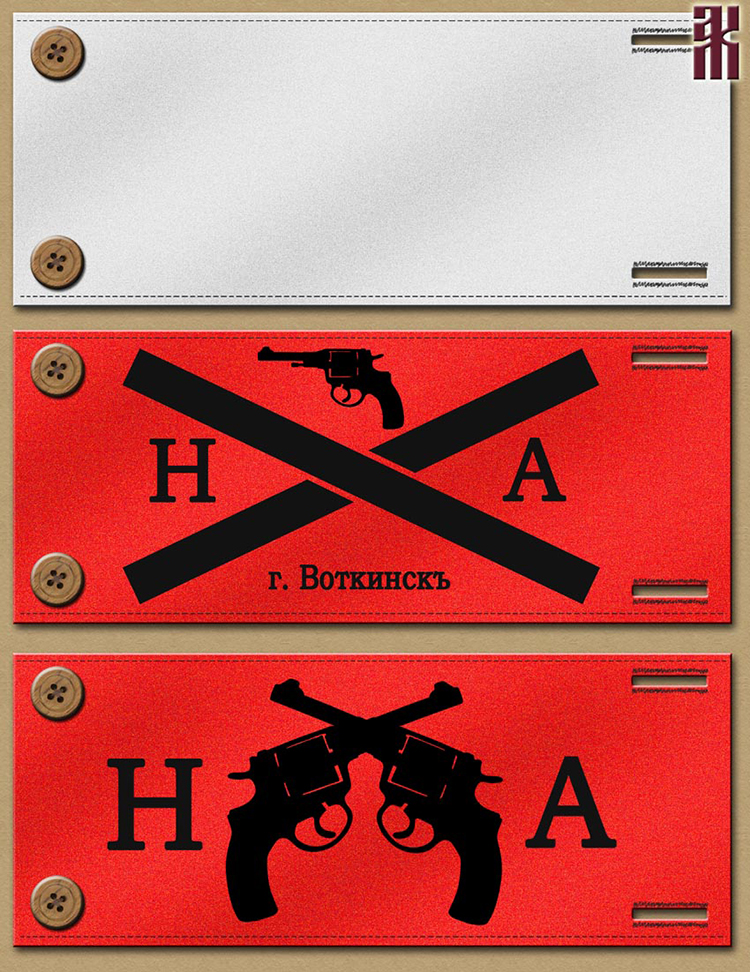
Arm bands of the Votkinsk People's Army (initial, basic and simplified versions).
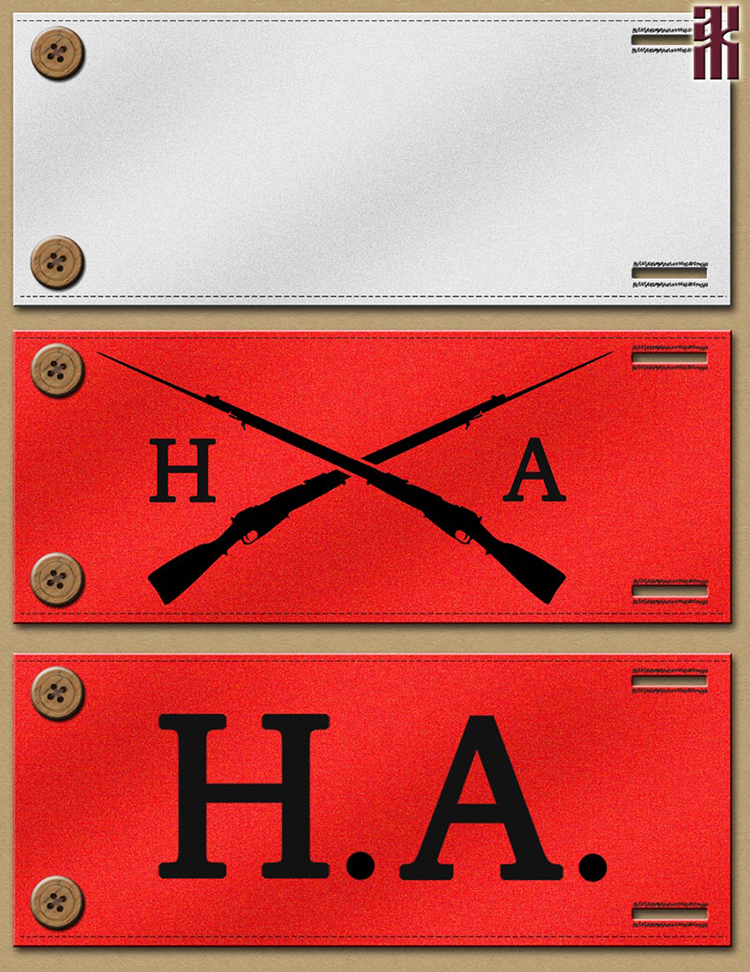
Arm bands of the Izhevsk People's Army (initial, basic and simplified versions).
Liberation of Votinsk, 17 August 1918
Finally, at around 9 o'clock, armed men appeared in the market square and on the streets of the eastern part of the factory. Most of them looked like workers wearing white arm-bands, so they could rightly be called White Guards. When asked who they were, they replied: 'We are Izhevtsy, freed from the Bolsheviks, and we have come to liberate you and call on you to join us."
Zhilin, S. A. in "From the Kama Region to Primor'e. Izhevsk, 2008, p.158, citing the memoirs of Petr Nikolaevich Lupov, an employee of the Votkinsk factory, at TsGA UR. F.R-1061 Op.1 D.33 L.37-43ob
Votkinsk, September 1918
To shape public opinion and for the benefit of society, a newspaper was published as the organ of the Executive Committee. Although it looked respectable, its content was nothing but lies. In refined bourgeois expressions, it praised the exploits of individual units of the White Guard, which soon after the occupation of Votkinsk began to be called the "People's Army" and wore red arm-bands instead of white ones.
Zhilin, S. A. in "From the Kama Region to Primor'e. Izhevsk, 2008, p.161.
Formal announcements
Announcement:
The Votkinsk People's Army has a distinctive mark on the left sleeve – a red arm-band with two black stripes, a revolver at the top, and the letters "Н" and "A" on the sides, which stand for "People's Army". At the bottom is printed: "Votkinsk".
This is done in contrast to the Red Army soldiers, who have no distinctive marks.
We ask our fellow soldiers to remember this in order to avoid misunderstandings and mistakes.
Chief of Staff Zebziev
Senior Adjutant Kotsyuba
"Izhevsk Defender, No. 5", 3 September 1918.
Order No. 11 of the Chief of Staff of the Votkinsk People's Army Yuryev on military matters, dated 4 September 1918.
Paragraph 4: All ranks of the People's Army must wear the established distinctive arm-band while performing their official duties. Military units on the march are considered to be performing their official duties.
R-548 Op.1 D.1 L.679, at ruguard.ru/forum/index.php/topic,29.30.html
Order No. 30 dated 29 September 1918
Paragraph 3: For your information, I hereby announce that Czechoslovakian servicemen serving in the Votkinsk People's Army will have a red and white ribbon on the brim of their caps, in the place where the cockade used to be attached.
R-548 Op.1 D.1 L.713, at ruguard.ru/forum/index.php/topic,29.30.html
It is clear that the rebels distinguished their commanders in some way. Thus, one of the orders for the Votkinsk People's Army states that not everyone wears a (red) arm-band, but only those who hold rank. Logically, it would have been difficult to find enough red cloth for all the soldiers.
Those who served in the army sewed red and white ribbons onto their cockades.
Private message from Votkinsk historian and local historian S.K. Prostnev.
The Workers' and Peasants' People's Army – the rebels did not consider themselves White Guards – had a commander-in-chief and its own uniform: red arm-bands with rifles painted on them for the Izhevsk troops and revolvers for the Votkinsk troops. They did not recognise shoulder-boards or Tsarist awards. They wore work jackets and civilian coats.
Kobzev, I. in "From Izhevsk to Harbin // Udmurtia. Series 'Monuments of the Fatherland', No. 33", Moscow, 1995, p.157.
A shabby little man entered. After questioning him, Cheverev learned that an uprising was being prepared in the rear. A merchant was preparing it. He lived on his own farm and was on very friendly terms with the kulaks. People had already been recruited into the detachment; they were just waiting for instructors from Izhevsk. They had weapons. The Izhevsk instructors would arrive under the guise of Red intelligence.
"They have a secret sign to recognise each other."
The coachman showed him a Tsarist rouble. Cheverev began to examine it. In the centre of the coin was a hole in the shape of a St. George cross.
"Well, what do they do with it?" asked Cheverev.
"When they meet, they greet each other with the rouble clasped in their hands."
Early in the morning a reconnaissance unit of twelve horsemen with red ribbons on their chests arrived at the farm. None of Cheverev's men near Izhevsk wore such ribbons. These were the "instructors" from Izhevsk. They were taken prisoner by Cheverev's men.
Kuchkin, A. P. in "Alexei Cheverev", Moscow, 1957. pp.70-72.
Agryz Front, November 1918
When we crossed the Izh River, we encountered almost no organised resistance. The Whites blew up the railway tracks and burned down stations. But nothing could save them. They did not retreat, but fled in panic. The word "Azin" became synonymous with something powerful and formidable for them. The White soldiers tore off their raspberry shoulder-boards: thousands of those shoulder-boards lay scattered along our path.
Melnikov, G. D. in "Unforgettable Days // For the Power of the Soviets: A collection of memoirs of participants in the October Revolution in the Vyatka Province", Kirov, 1957, p.177.
As far as we know, this is the only mention of shoulder-boards in the rebel armies of the Kama region. All other sources emphasise the fact that the Izhevsk and Votkinsk workers did not wear shoulder-boards, even after leaving their native factories and joining the regular armed forces.
It was a fine October day. Two men were sitting at a table made of rough-hewn planks not far from the hitching post. I knew one of them well. He was Fyodor Gordeev, head of intelligence, a worker at the Likinsky factory, who came there with the first group of volunteers from Moscow. Next to him is an old Udmurt man in bast shoes, a coarse woollen coat and a fur hat. They were having a leisurely conversation.
"Arudiev, you ask, is there much? Of course there is! I was talking, in a simple way, with a soldier. He had a bandage on his sleeve and the letters "Н. A.". "Tsarist letters", I said. That stands for Nikolai Alexandrovich [i.e. Tsar Nikolai]. And he threatened: "Be quiet, sir! Those letters are a serious matter. They are the people's army, that's what!" And he pointed to the priest's house near the church, from which terrible cries came. Women were shouting at the kombedchiki [Red food requisition squad] that they were hanging there.
The old man took off his rabbit-fur hat and continued:
"The whole village hid in the cellars. And then they rounded us up, and the general shouted his speech. This and that. He said that they had beaten the commissars and would continue to beat them. And anyone who helped such is a traitor to Russia and to God. The men who remained and the more capable boys, as is well known, were taken into the army. Some were given greatcoats, and all were given rifles. They had a lot of rifles."
Azarkh, R. M. in "At the Great Origins", Moscow, 1967. pp.53-54. Available at militera.lib.ru/memo/russian/azarh_rm/02.html
October 1918
Soldiers from the peasantry in bast shoes and straw sandals; soldiers from the Votkinsk factory in boots, patent leather shoes and short half-coats or simple jackets; all with light or half-empty knapsacks and few cartridges. It seemed as if they had gone out for a day; a few wore grey military caps, the rest wore caps or light hats. They all came from villages and hamlets ravaged by the Bolsheviks, bound together by a common hatred and desire for revenge, proud of the red arm-band on their sleeves with the initials "Н.А." printed on them.
Drobinin, K. in "Battle on the Feast of the Holy Virgin // The Votkintsy in the Izhevsk-Votkinsk Uprising", p.245.
Votkinsk area, first half of September 1918
One of our comrades ran far ahead, almost to the edge of the village, and, standing up, began waving his arm at us to hurry up and join him. At that moment, a Red Army soldier lying next to me shot him and killed him instantly. "What are you doing?" I snapped at him. "I thought he was a White," he replied sadly.
It was difficult to distinguish between us and the Whites: we were both either in identical uniforms or without any uniforms at all. It is true that during this battle the Whites had white rags tied around their sleeves, but it was difficult to distinguish them even at a fairly close distances.
At archetype.izhevsk.ru/?p=497
Lieutenant-Colonel Vlasov's Izhevsk "Immortal" Shock Battalion and the HQ Escort of the Commander-in-Chief of the Prikama People's Army, Colonel Fedichkin
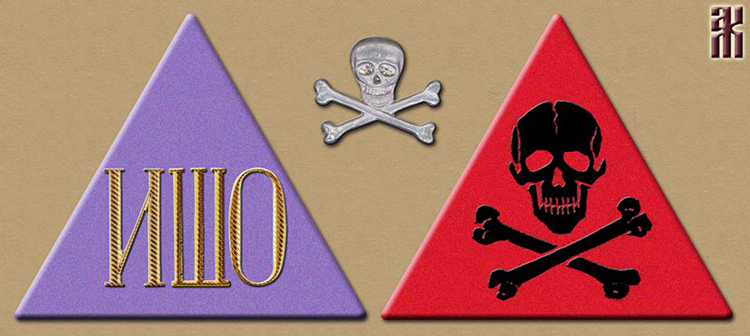
Sleeve chevrons of the escort of the Commander-in-Chief of the Prikama People's Army, Colonel D. I. Fedichkin and the Izhevsk "Immortal" Shock Battalion of Lieutenant Colonel A. A. Vlasov. In the centre is a variant of the shock troops' cockade.
The cipher "ИШО" is for "Izhevsk Staff Detachment".
The chevrons were reconstructed in the form of an equilateral triangle , as the same shape would later be used for the insignia of the Izhevsk Rifle Brigade and the Votkinsk Rifle Division as part of the Supreme Ruler's army (the first with crossed black rifles, the second with crossed black revolvers). It is for this reason that the skull and crossbones are shown here in black rather than white. In addition, the presence of Czechoslovak soldiers in the Izhevsk and Votkinsk People's Armies speaks in favour of this particular shape for the "immortals". In the Czechoslovak Corps of the time, membership of the Shock Battalion was indicated by a red cloth triangle with a metal skull on it – borrowing could have taken place from them, which was quite characteristic of the armies of the Democratic Counter-Revolution period.
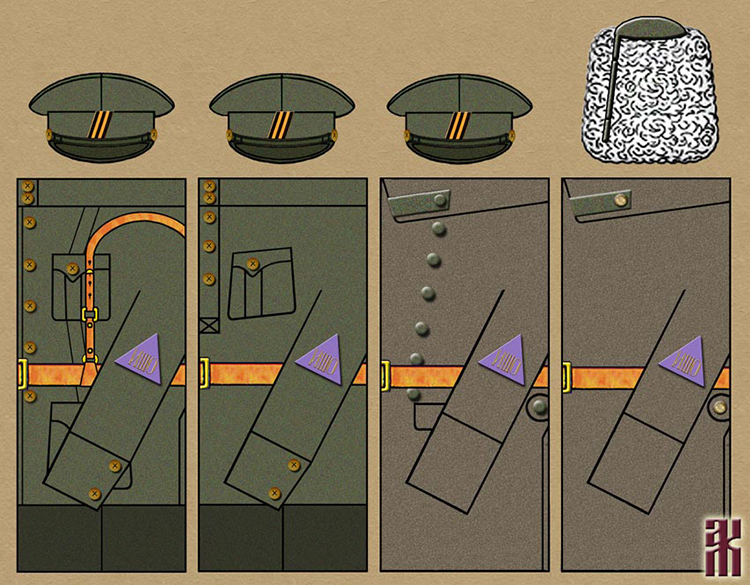
Uniforms of the HQ escort of the Commander-in-Chief of the Prikama People's Army,
Colonel D. I. Fedichkin.
The headgear is shown here with a St. George ribbon in place of the cockade, as was customary in the KOMUCH Volga People's Army and was sometimes used in the Kama region.
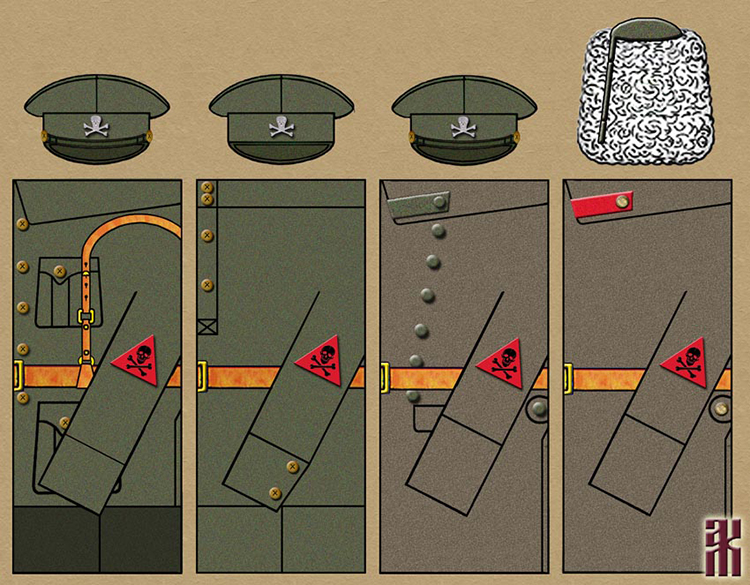
Uniform of Colonel Vlasov's Izhevsk Shock "Immortal" Battalion: 1 – officer;
The headgear has cockades in the form of a skull and crossbones, modelled on those used by assault units in 1917. Figure 4 has the red greatcoat tabs of a 1st regiment of a Tsarist infantry division.
Lieutenant-Colonel Vlasov's Izhevsk "Immortal" Battalion
Selflessly brave.
All wounded or shell-shocked. Their wounds have not yet healed, their scars have not yet healed, but they are asking to be sent to the front as soon as possible. Their faces are tanned by gunpowder and their eyes are determined and calm. On the sleeves of their grey greatcoats are skulls and crossbones – the symbol of shock troops. These are the remnants of Lieutenant-Colonel A. A. Vlasov's Immortal Battalion. "Military Records, No. 22", 17 December 1918. Material kindly provided by Voronezh researcher N. Zayats. Thus, disguised as refugees and taking small children from a woman, at 4 a.m. on 8 November 1918 they attempted to pass through the White Guard outpost, set up by punitive detachments (with skulls on their sleeves), but they were not very strong. "Memoirs of M. Kh. Soshnikov" from TsDOOSO F.41 Op.2 D.385 L.60. Material kindly provided by Ekaterinburg researcher D. V. Kadochnikov. Shorin studied the situation in the enemy camp long and carefully, eagerly awaiting reports from his military intelligence officers sent to Izhevsk. They reported that the city was a tough nut to crack, that 18,000 elite troops were concentrated there, including many officers, and that there was even one unit with most of the officers. They were all dressed in black uniforms with red triangles on their sleeves. The scouts suggested that this was a strike force. Kulikov, K. I. in "In the battles for Soviet Udmurtia", Izhevsk, 1982, p.152. According to Voronezh researcher N. Zayats, this could be either Lieutenant-Colonel Vlasov's "Immortal" battalion or the personal escort of Colonel Fedichkin, Commander-in-Chief of the Prikama People's Army. The latter had a uniform "with green and purple triangles and an iron emblem of the 'ИШО' (Izhevsk Assault Detachment)". www.forum.osvag.ru [link dead] The cavalry units sewed "a distinctive mark on their trousers – stripes three fingers wide". Order No. 14 of the Votkinsk People's Army of 7 September 1918, §10. Order No. 21 of the Izhevsk People's Army, §11. at R-548 Op.1 L.10 The newspaper "Izhevsk-Votkinsk Anniversary", timed to coincide with the first anniversary of the uprising and published in Omsk on 17 August 1919, also wrote on page 3: "To scare the Reds, who were becoming restless at that time, some units sewed red stripes onto their trousers, pretending to be Cossacks!" Private communication from Votkinsk historian S. K. Prostnev. List of soldiers of the 1st Squadron of the Izhevsk People's Army, who had been in the arms and steel factories on 14 September 1918. ... Uniforms issued to the entire squadron: Greatcoats – 3; Boots – 41; Field caps – 1; Blouses – 28; Quilted jackets – 12; Trousers – 29. At archetype.izhevsk.ru/?p=587 Types of uniforms worn by former WWI front-line soldiers in the Izhevsk People's Army: Types of uniforms worn by former factory workers in the Izhevsk People's Army: Types of uniforms worn by former WWI front-line soldiers in the Votkinsk People's Army: Types of uniforms worn by former factory workers in the Votkinsk People's Army: Judging by surviving photographs, the cartridge boxes were worn in front on a belt in the Izhevsk and Votkinsk post-revolutionary units, rather than over the shoulder, as they had been in WWI. Types of uniforms worn by other soldiers of the Votkinsk People's Army: In conditions of acute shortage of funds for the maintenance of the rebel army, there were constant appeals to the consciousness and patriotism of the workers. One of the appeals from the Izhevsk authorities called on the population to:
Immediately donate or sell, at given prices, warm items that they have in duplicate or those that they can do without, such as: fur coats, sheepskin coats, greatcoats, jackets, boots, felt boots, socks, footcloths, mittens, underwear, tunics, blouses; ... do not be shy if the items donated or sold are not brand new; the need is great, and the Army will be very grateful for anything given. The authorities in Votkinsk issued similar appeals: We appeal to our comrades, workers and other citizens: help the city by sewing underwear for the People's Army free of charge. Fathers, ask your wives and adult daughters to sew at least one pair of underwear free of charge. ... Knowing the responsiveness of the working masses and citizens, we flatter ourselves with the hope that they will respond sympathetically to our request and help in this difficult moment of national rebirth. Churakov, D. O. in "The Third Force in Power", Izhevsk, 1918, citing the "Izhevsk Defender", 15 October 1918 and "Votkinsk Life", 17 January 1918 at www.portal-slovo.ru/history/35390.php?element_id=35390 Private M. V. Naumov of the Prikama Rebel Army wrote in his memoirs about the killing of prisoners and looting as acts of valour. In one of the battles, he recounts, the soldiers of his unit "took out the commissar". An order had been sent to send him to the rear, but he was not sent. Ignoring basic military discipline, the ordinary rebels took the law into their own hands. Two brothers serving in the detachment had a younger brother apparently shot by the Reds. "And they," Naumov continues his story, "decided to stab the commissar on the spot, reasoning that he would escape from the rear, and their trial was short." Naumov himself did not lose his head. While his colleagues were "restoring justice" with improvised means, he was dealing with his own issues with ammunition. "The commissar's weapon," he continues, "was stripped, and I decided to take his greatcoat. It was late autumn, and I was freezing without my sheepskin coat." The prisoners had their boots, trousers, warm clothes, underwear, and money taken away, and party membership cards were particularly sought after. By mid-autumn, all the prisoners' outer clothing had been taken away, on the grounds that the rebel army needed warm uniforms, and that those condemned to death did not need clothes anyway. Churakov, D. O. in "White Terror under Red Banners". citing Naumov, V. M. "My Memoirs", San Francisco, 1975, p.19 and TsDNI UR F.350 Op.3 D.14 L.30-33, published at www.toyota-club.net/files/08-01-10/08-05-10_lib_terror.htm [link dead] November 1918 The ranks of the Izhevsk soldiers made a strange impression. They stood as if they were well-trained soldiers, but they were dressed in a motley assortment of jackets, coats, some in greatcoats, in sheepskin coats. ... On their heads were caps, berets, felt hats, papakhi. ... On their feet were boots, ankle boots, felt boots or shoes with puttees. Most of their clothes were worn out, mended, patched, and long past their prime. Efimov, A. G. in "The Izhevtsy and Votkintsy //Vestnik Pervopokhodnik, No. 63-64", Los Angeles, 1967, p.11. Votkinsk units, November 1918 They bore little resemblance to military units, resembling more the Zaporozhian Cossacks. They were poorly armed and dressed in whatever they could find: unattractive in appearance, but strong and unshakable in their national spirit. Lotkov, S. N. in "The Kamsk-Votkinsk Plant and its Workers // Ural and Prikama, November 1918-January 1919: Popular Resistance to Communism in Russia: Documents and Materials", Paris, 1982, p.433, citing the Krasnoyarsk newspaper "Svobodnaya Sibir", 10 May 1919. Anyone who knew and knows the Votkinsk Division will say it is "holy". Without leaving the front for seven whole months it, as an exclusively volunteer force, received no uniforms from anyone (only now are they beginning to arrive). So three-quarters of the riflemen spent the whole winter in the clothes they had worn when they joined the army (in August last year), which were their summer clothes: peasants in bast shoes, blouses and caps, and workers in their usual light quilted jackets. Only an extraordinary belief in the righteousness of their cause and a sincere desire to defeat evil kept these heroes in position in 30-40 degree frosts. It was not for nothing that the Reds called this division the "cursed bast shoe division". Representing a motley crowd in terms of clothing, it was unusually united, strong in spirit and disciplined. How could it not be "cursed" by the Reds. Zhilin, S. A. in "From the Kama Region to the Primor'e", Izhevsk, 2008, p.82. Nikita did not know who the Izhevsk People's Army was fighting alongside, nor what political platform it was using. He only vaguely remembered the slogans that, on the instructions of some shaggy-haired committee member, a young worker from their painting workshop had diligently painted on a piece of red calico. Protopopov, A. A. in "The Votkintsy (Votkinsk People's Army, 1918), Book 1", Harbin, 1943, p.121. Material kindly provided by Votkinsk researcher S.K. Prostnev When the Volga-Volunteer turned around and drew level with the barge, we saw about ten armed men on its deck. One of them was dressed in the uniform of a Tsarist policeman. Leontiev, A. S. in "The Glory of Those Days Will Never Fade", Moscow, 1958, p.48. Although a work of fiction, the author was very familiar with local materials and used them repeatedly in his work. Votkinsk, September 1918 "It's time to turn the volunteers into soldiers. You are no longer the commander of a volunteer detachment, but the commander of the Votkinsk Workers' Division, Captain. And since there is a division, it must have its own banners, its own insignia." "Our own banners? What kind? Distinguishing marks? What are they – shoulder-boards, shoulder straps?" "Tsarist shoulder-boards are not suitable for a workers' division. We will introduce arm-bands." "White arm-bands with a black skull and crossbones?" "On the contrary, red ones. And white revolvers on them. Let the workers revel in their revolutionary scarlet colour and think that no one is encroaching on their freedom. And the revolvers will remind the people of Votkinsk of their native factory. People love the things they make. Aldan-Semenov, A. I. in "The Reds and the Whites", Moscow, 1987, p.150. Evidence that there was no special cockade in the Izhevsk People's Army, Izhevsk, October 1918 An officer in a greatcoat and cap with traces of a cockade. Aldan-Semenov, A. I. in "The Reds and the Whites", Moscow, 1987, p.224. Votkinsk, October 1918 Men in officer's overcoats, soldiers with red arm-bands: the arm-bands bear crossed revolvers – the symbolic insignia of the Izhevsk rebels. Aldan-Semenov, A. I. in "The Reds and the Whites", Moscow, 1987, p.268. (The author combines the Izhevsk and Votkinsk rebels into one concept, the "Izhevsk rebels"). Cavalry units of the Izhevsk and Votkinsk People's Armies
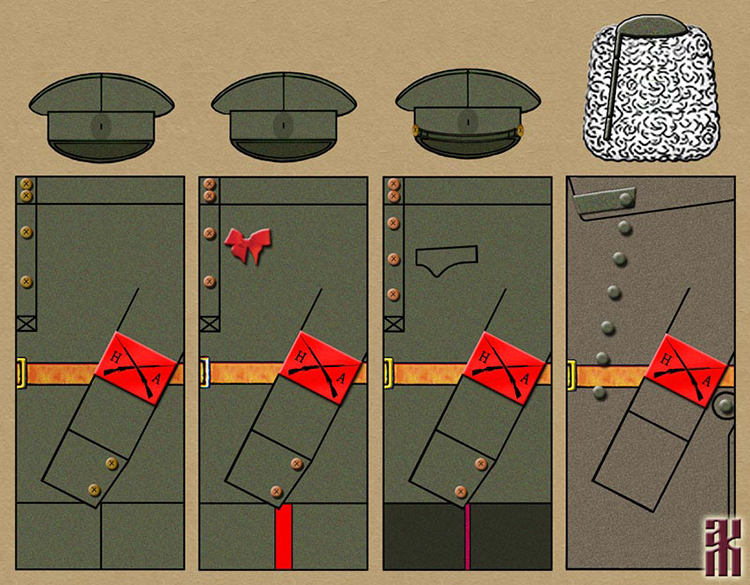
1 – private rifleman; 2 – cavalryman, with red stripes on trousers and bow on the blouse;
3 – former officer company commander, trousers with raspberry stripe (ex rifle unit)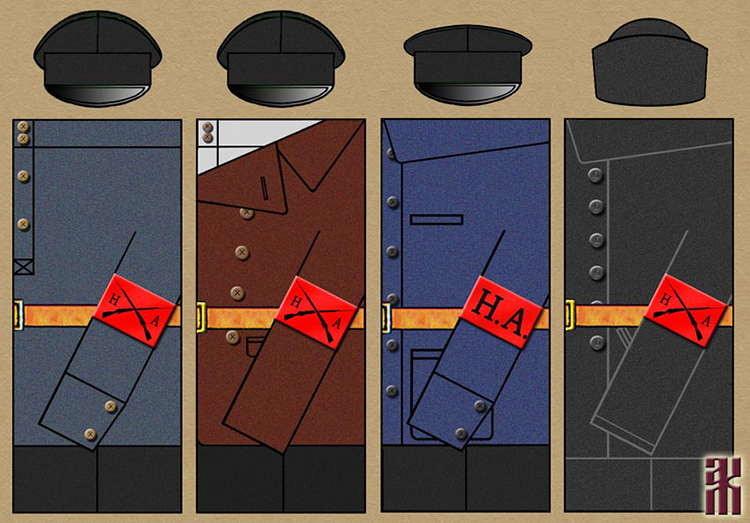
3 – in work blouse; 4 – in cloth pea jacket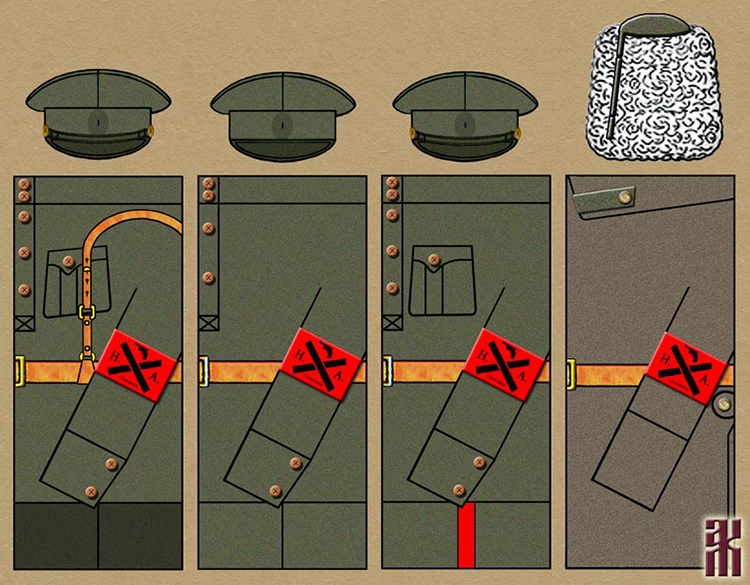
1 – officer commander; 2 – private; 3 – cavalryman, with red trouser stripe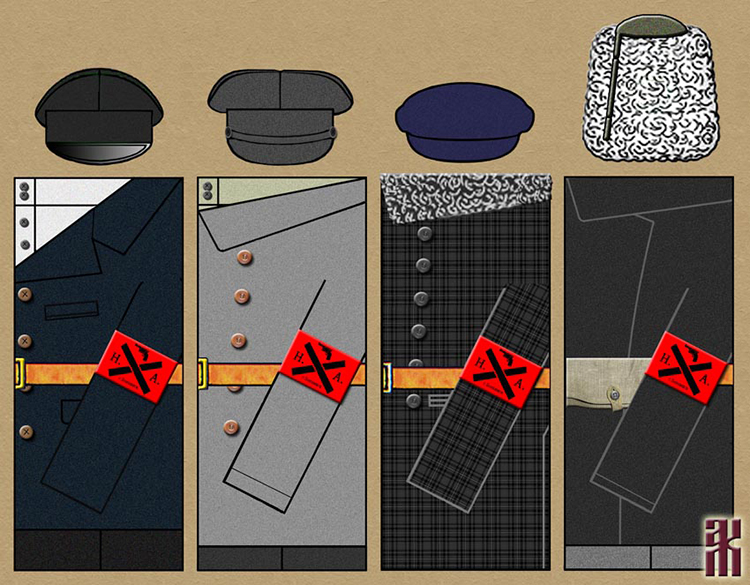
1 – in jacket; 2 – in civilian overcoat; 3 – in civilian coat; 4 – with canvas cartridge pouch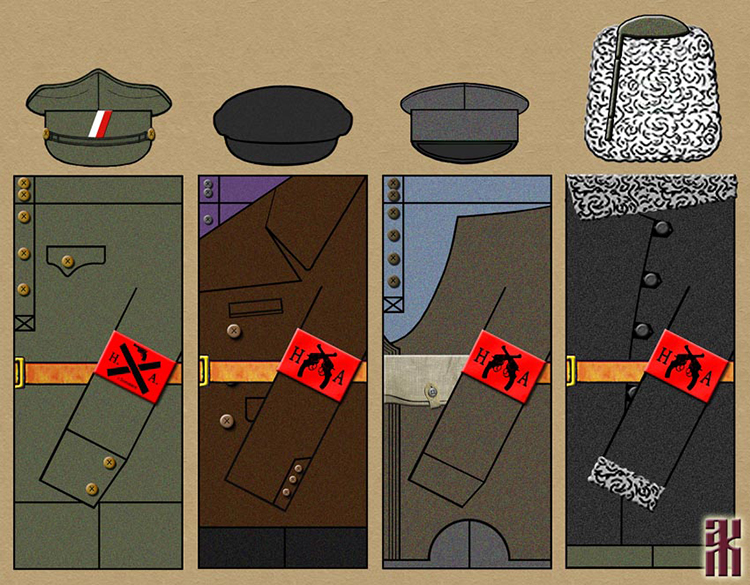
1 – Czechoslovak soldier; 2 to 4 – peasant rebels (later soldiers of the Peasant Regiment)Motley appearance of soldiers of the Izhevsk and Votkinsk People's Armies
"The Reds and the Whites" by Aldan-Semenov
Home — State Symbols — Flags — Uniforms — Badges & Medals — Money — Other
Pygmy Wars Notes
The original for this page is at http://kolchakiya.ru/uniformology/ij_vtk_rebels_01.htm.
This page is only for the period before the Izhevtsy and Votkintsy merged with the regular White forces. That later period is covered on this page.
Note that "Prikama" is effectively identically to "Kama" in this context. Discussion on the translation choices I have made can be found here.
The following illustration by A. Lebedeva was in the original page but later removed.
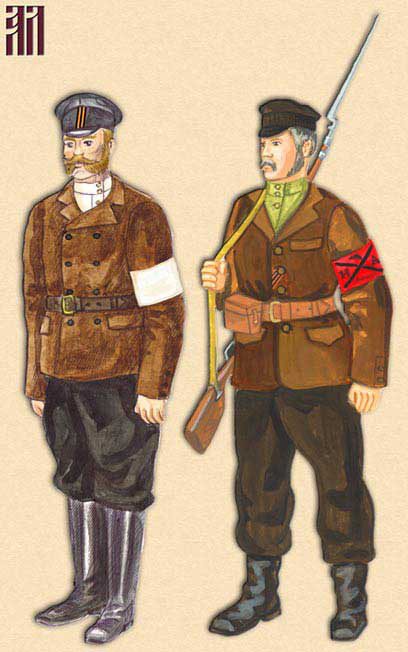
Votkinsk rebels 1918
Brief History of the Kama People's Army
Largely taken from Wikipedia.ru.
The Kama People's Army was created in August 1918, in the Kama region (NE Perm province), following the anti-Bolshevik Izhevsk and Votkinsk uprisings, to coordinate their military actions.
Initially it was entirely volunteer detachments of workers from Izhevsk and Votkinsk, and then peasant partisan formations (such as the Saigat and Osinsk Peasant Regiments) as well as Lieutenant Zhulanov's detachment in the Osinsk district. Later is resorted to conscription. The eventual total strength of the army is estimated at 25,000, although some make it much smaller. In was commanded by Colonel D. I. Fedichkin (appointed on 7 September by KOMUCH) then from 20 October 1918 by Captain G. N. Yuryev.
Politically left wing, the Army had good relations with the similar People's Army of Komuch and Czechoslovak Corps. Civilian power was through soviets. The local peasants actively supported the rebels, selling bread in exchange for rifles, rather than being coerced.
The army successfully defended the factories of Izhevsk and Votkinsk against the Red Army under Shorin, even temporarily capturing Sarapul. Then in September the Red Army took Kazan, freeing up forces for use against the Kama rebels. In October the Kama People's Army begins to suffer defeats – a lack of ammunition and artillery being a large reason. Some of their units went over to the side of the Reds. Active collaboration with KOMUCH and then the Directory was not successful. In November Izhevsk and Votinsk fell. The remnants of the army retreated and joined with Kolchak's forces.