
Uniforms of the Far Eastern Army,
the Provisional Priamur Government Army, and
the Priamur Zemsky Army, 1921-1922
Material and reconstructions by A. Karevskiy
Photographs published in the following publications were used in the preparation of the uniform reconstructions:
Zhumenko, V. "The White Army: Photo Album", Paris, 2007.
"White Russia: Photo Album", Moscow, 2003.
"Kappel' and the Kappelevtsy", Moscow, 2007.
Molchanov, V. M. "The Last White General", Moscow, 2009.
Efimov, A. G. "Izhevsk and Votkinsk", Moscow, 2008.
Filimonov, B. B. "White Rebels: The Khabarovsk Campaign, Winter 1921-1922, Book 1", Shanghai, 1932.
Transbaikalia
The Izhevsk and Votkinsk Rifle Regiments
The colour blue – the colour of their shoulder-boards, piping and greatcoat tabs – was considered by the Izhevtsy and Votkintsy to be a symbol of the unbreakable bond with their factories – iron and steel . The letters "Из" were on the shoulder-boards of the Izhevtsy, and the letters "Вт" were on those of the Votkintsy. Officers of the Izhevsk-Votkinsk units never wore braided shoulder-boards: theirs were the same blue with white stripes, zigzags, and piping.
Filimonov, p.32.
Transbaikalia, 1920
The dashing Votkinsk artillerymen had a special distinction – St. George cord on their shoulder-boards. Led by their commander, Colonel Almazov, they formed an unusually close-knit artillery family. To everyone's amazement, they were able to bring all their guns back from the Ice Campaign, the only ones in the entire Siberian army to do so.
Lotkov, S. N. in "The Kamsk-Votkinsk Plant and its Workers // Ural and Prikam'e, November 1918-January 1919: popular resistance to communism in Russia", Paris, 1982, p.439.
The Votkinsk workers preserved their artillery throughout the Siberian campaign and brought it with them to Transbaikalia. For that the divizion was awarded St. George ribbons.
Efimov, A. G. in "Izhevtsy and Votkintsy // Vestnik Pervopokhodnika, Nos. 71-72", Los Angeles, 1967, p.22.

Shoulder-boards of the Izhevsk Rifle Regiment
The colour of the ciphers is shown in yellow based on the cipher on the unit's St. George Banner.

Uniforms of the Izhevsk Rifle Regiment (1 – Efimov; 2 – Zuev; 3 – Smolin)

Uniforms of the Izhevsk Rifle Regiment

Uniforms of the Izhevsk and 4th Ufa General Kornilov Rifle Regiments (3 – Sidamonidze)
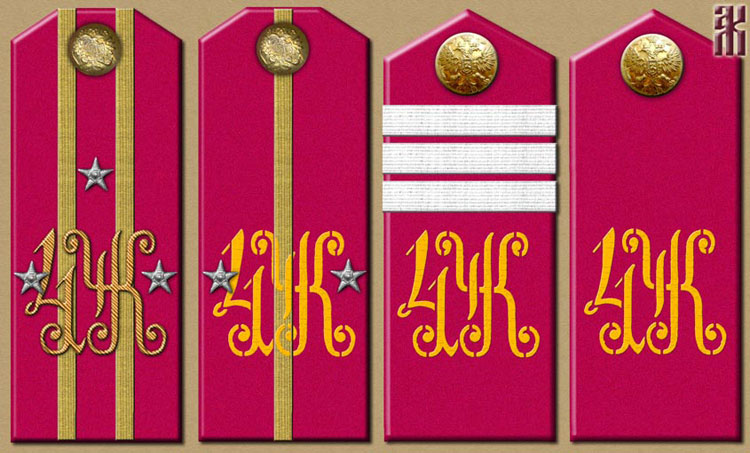
Shoulder-boards of the 4th Ufa General Kornilov Rifle Regiment
This reconstruction is based on the appearance of the monogram of the 1st Volga General Kappel' Rifle Regiment. It is logical to assume that the monogram "УГКП" mentioned by Filimonov would in fact have been much shorter and included the number "4" and the letters "УК" – for Ufa Kornilov.
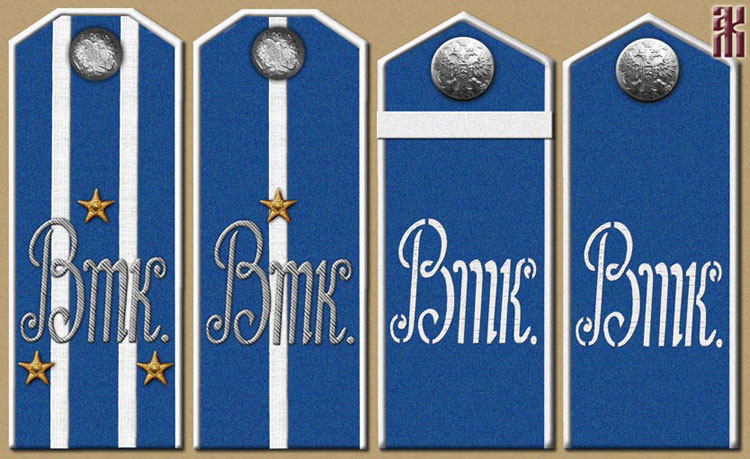
Shoulder-boards of the Votkinsk Rifle Regiment, assuming the ciphers were in white
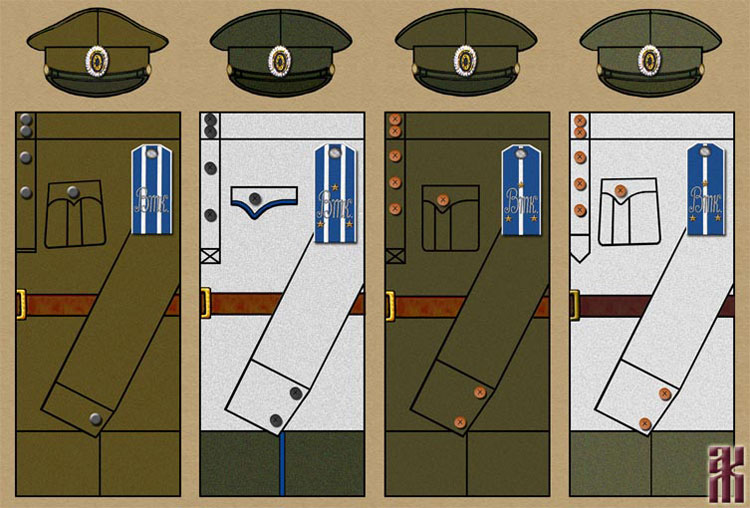
Uniforms of the Votkinsk Rifle Regiment (1 – fon Vakh).
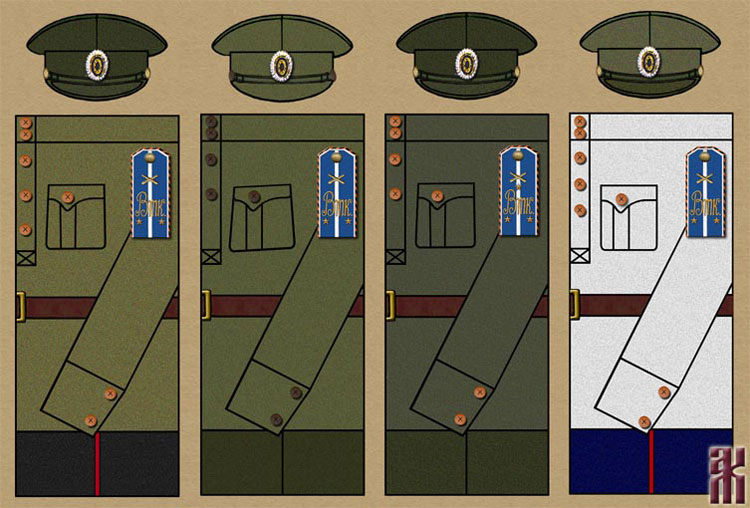
Uniforms of officers of the Votkinsk Artillery Divizion (later Battery)
4th Ufa and 8th Kama Rifle Regiments
As rifle units, the Ufa and Kama Regiments had raspberry shoulder-boards, piping and greatcoat tabs. Under the admiral's insignia, the Kama Regiment had "AK" – for "Admiral Kolchak", while the Ufa Regiment wore the intertwined monogram "УГКП" – "4th Ufa General Kornilov Regiment".
Filimonov, p.34.
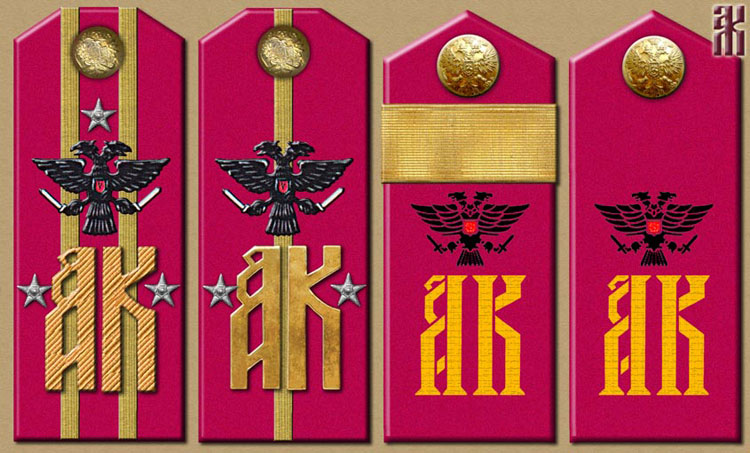
Shoulder-boards of the 8th Kama Admiral Kolchak Rifle Regiment

Shoulder-boards of the Izhevsk and 8th Kama Rifle Regiments
The wearing of khaki shoulder-boards is mentioned in memoirs.

Uniforms of the 8th Kama Admiral Kolchak Rifle Regiment (1 – Sotnikov)
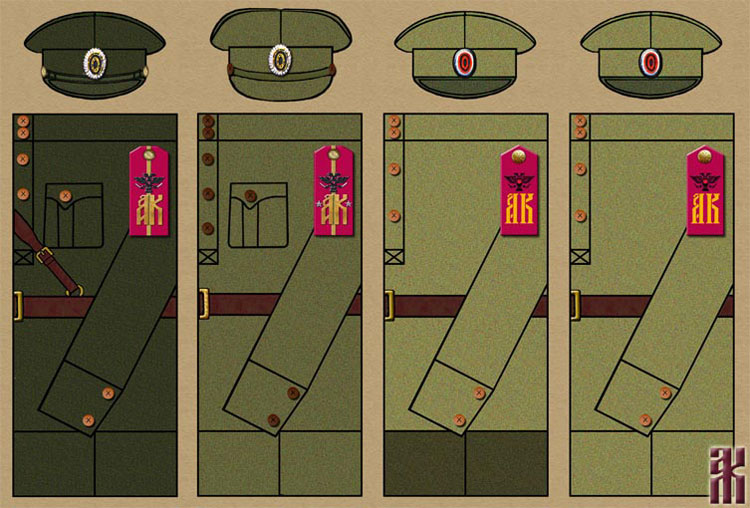
Uniforms of the 8th Kama Admiral Kolchak Rifle Regiment
1st Volga Rifle Regiment
There were two Volga units in Primor'e: the 1st Volga General Kappel' Rifle Regiment and the 3rd Volga General Kappel' Battery. The former wore an intertwined monogram on their shoulder-boards – "ВГКп", the latter – "3ГК" under the crossed guns. The shoulder-boards, greatcoat tabs and piping of the Volgans were raspberry.
Filimonov, p.36.
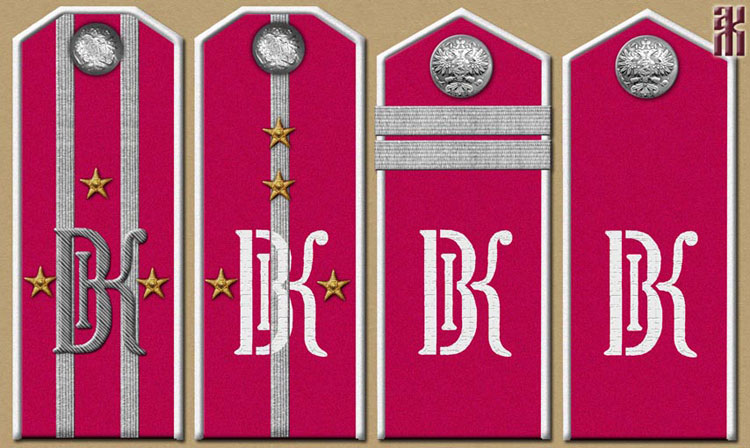
Shoulder-boards of the 1st Volga General Kappel Rifle Regiment
Contrary to Filimonov that the cipher on the shoulder-boards was an intertwined "VGKP", a photograph published in Zhumenko clearly shows the letters "ВК" for "Volga Kappel".
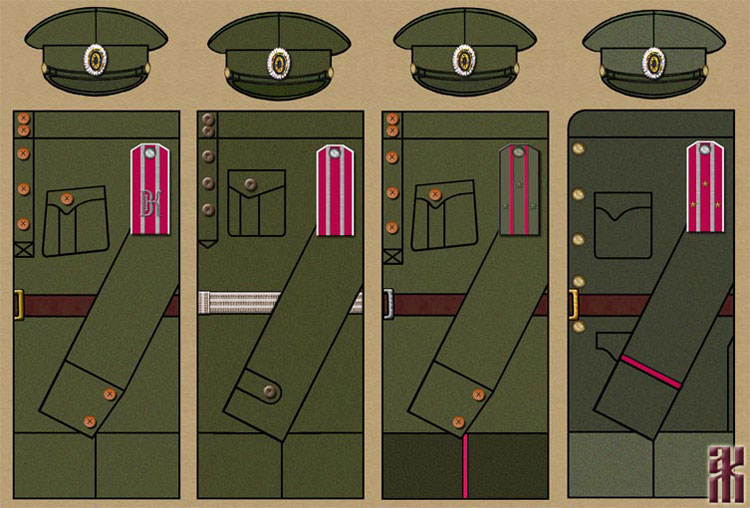
Uniforms of the 1st Volga General Kappel' Rifle Regiment (1 – Belyanushkhn)
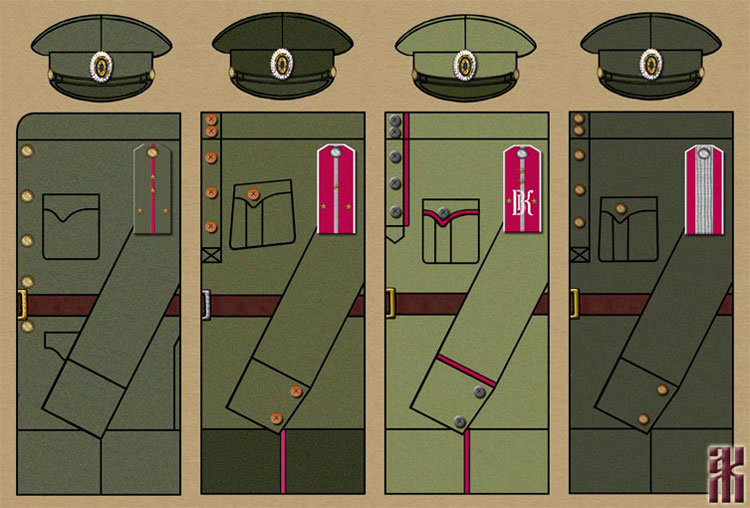
Uniforms of the 1st Volga General Kappel' Rifle Regiment
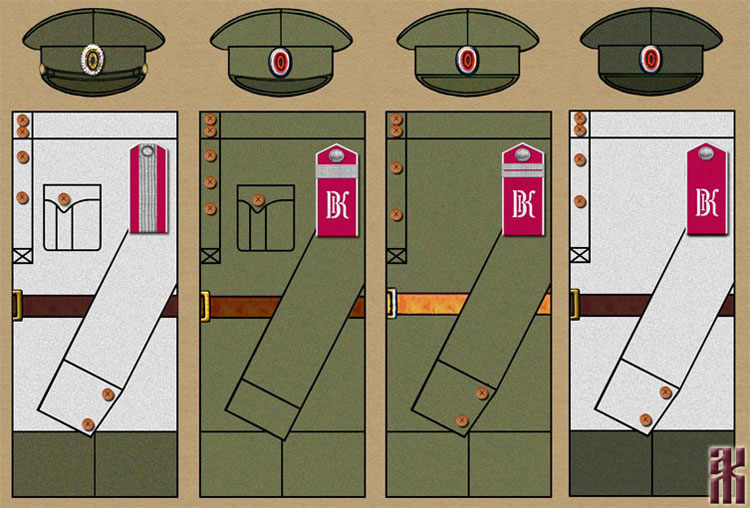
Uniforms of the 1st Volga General Kappel' Rifle Regiment
Ural-Altai Cavalry Regiment
The Ural-Altaytsy also wore their own uniforms: black shoulder-boards with white stripes and white piping.
Filimonov, p.43.
Ural Rifle Regiment (later 2nd Ural Rifle Regiment)
The regiment's colour was black – the colour of the Jaeger Battalion of the 11th Ural Division. The shoulder-boards were black with red piping, as were the greatcoat tabs. The officers had red stripes on the same shoulder-boards. ... In addition, the Uraltsy, like the ranks of the 1st Rifle Brigade, wore a national chevron on their left sleeve, with the tip pointing downwards.
Filimonov, p.43.
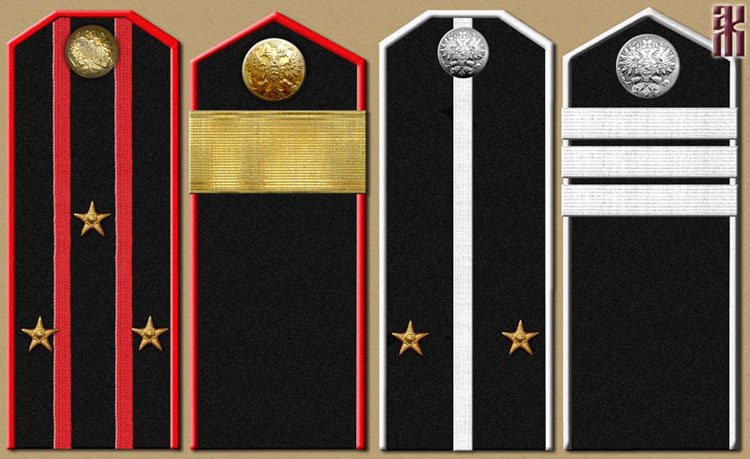
Shoulder-boards of the 2nd Ural Rifle and Ural-Altai Cavalry Regiments
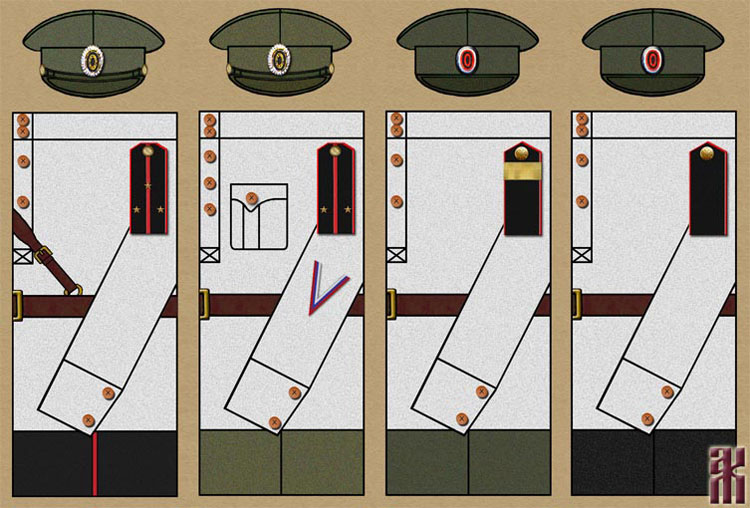
Uniforms of the 2nd Ural Rifle Regiment
Volunteer Brigade (Transbaikalia), 1st and 3rd Volunteer Regiments (Primor'e)
The volunteers wore black shoulder-boards with red piping, while their officers wore the same shoulder-boards with red stripes. The shoulder-boards bore a large capital letter "D". Volunteer officers did not wear golden shoulder-boards at all.
Filimonov, p.45.
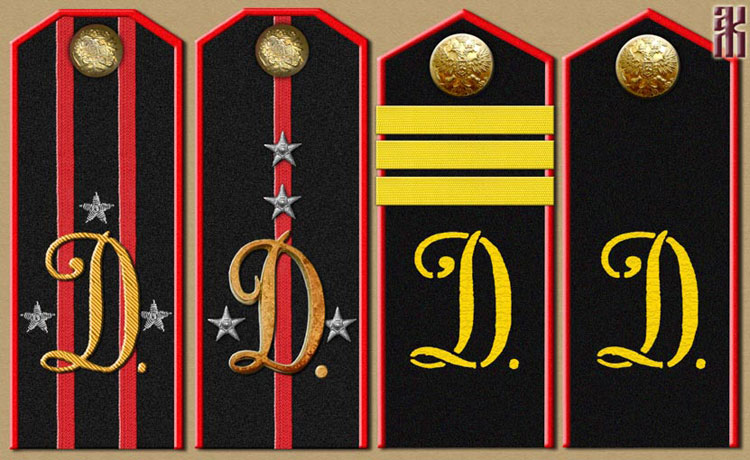
Shoulder-boards of the 3rd Volunteer Rifle Regiment
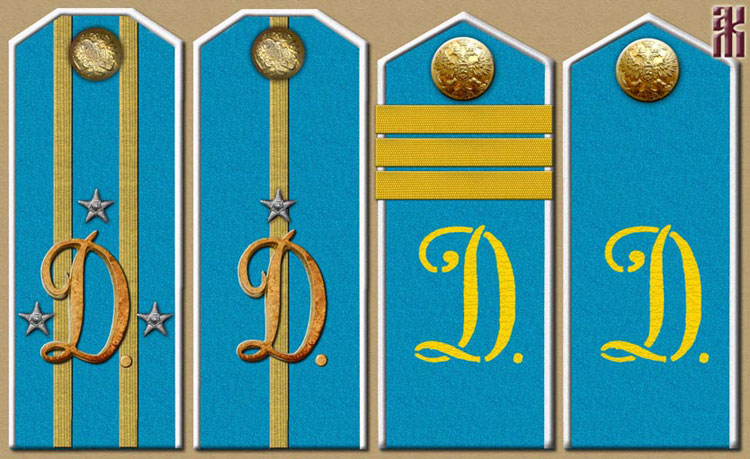
Shoulder-boards of the 1st Volunteer Rifle Regiment
There is some confusion in Filimonov's memoirs, where the shoulder-boards of the Volunteer regiments are first stated as black with red piping and stripes, and then twice later mentioned as blue. Both versions are shown here in relation to the two Volunteer regiments that existed.
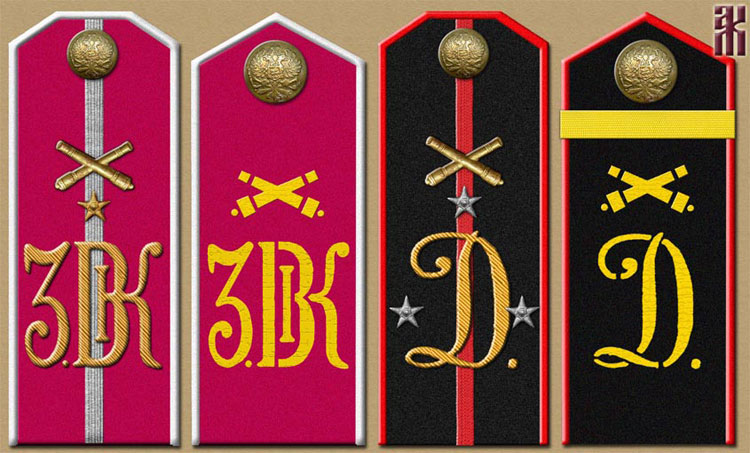
Shoulder-boards of the 3rd Volga and Volunteer Artillery Batteries
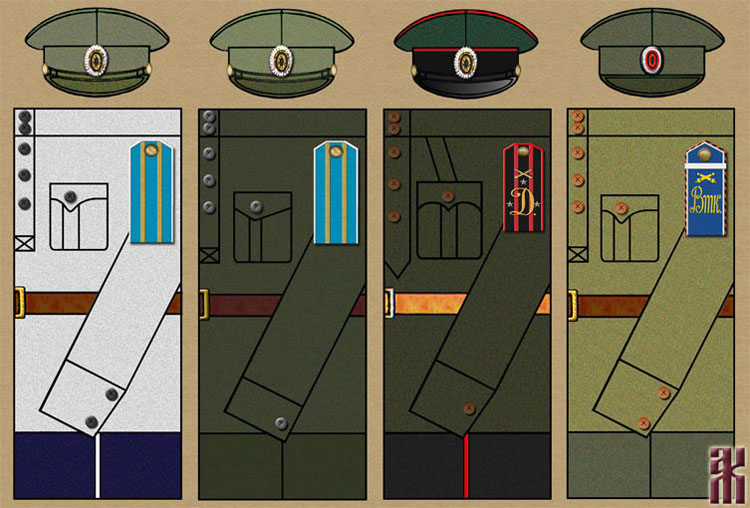
Uniforms of the Volunteer Regiment:
1 and 2 – colonel (Cherkes); 3 – Volunteer Battery (Gaikovich); 4 – Votkinsk Battery
Independent Horse-Jaeger Divizion
The divizion had a special uniform: green shoulder-boards with yellow piping, the same greatcoat tabs, intertwined yellow letters "EK" on the shoulder-boards, and double green stripes with yellow piping in the middle on the trousers.
Filimonov, p.41.
Jaeger Regiment (later 1st Jaeger Regiment)
The jaegers had raspberry shoulder-boards with green piping and a curlicue yellow letter "E". On the left sleeve was a chevron in the national colours, the same as that of the Uraltsy.
Filimonov, p.44.
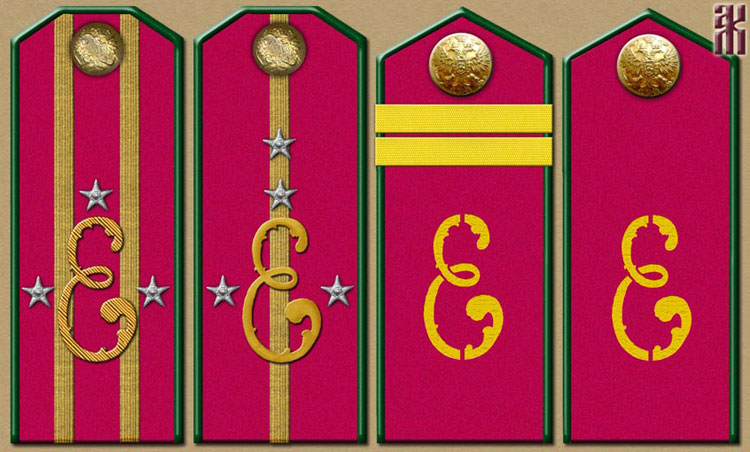
Shoulder-boards of the 1st Jaeger Regiment
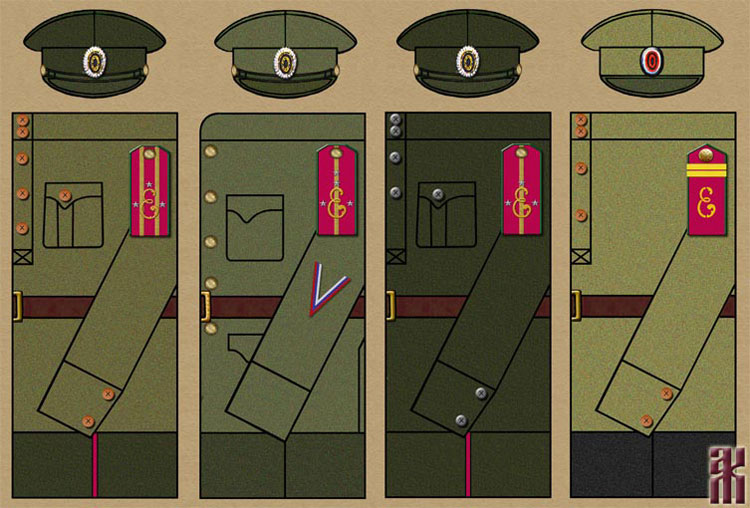
Uniforms of the 1st Jaeger Regiment
Horse Jaeger Regiment (later 1st Horse Jaeger Regiment)
Shoulder-boards – raspberry with yellow piping.
Filimonov, p.44.
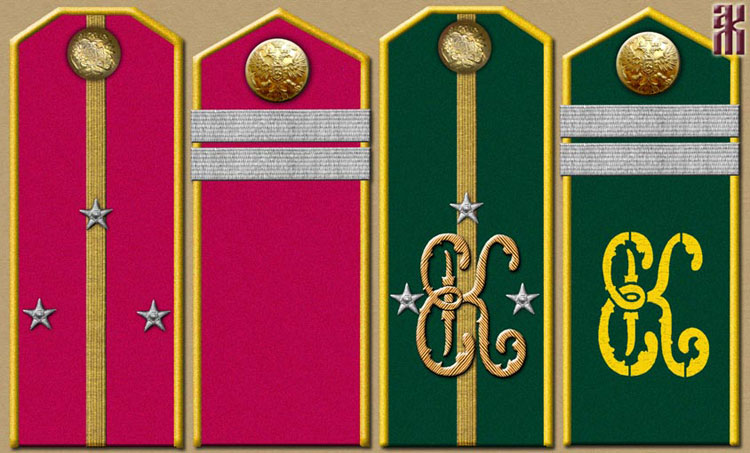
Shoulder-boards of the Horse Jaeger Regiment (1st Rifle Brigade)
and the Independent Horse Jaeger Divizion
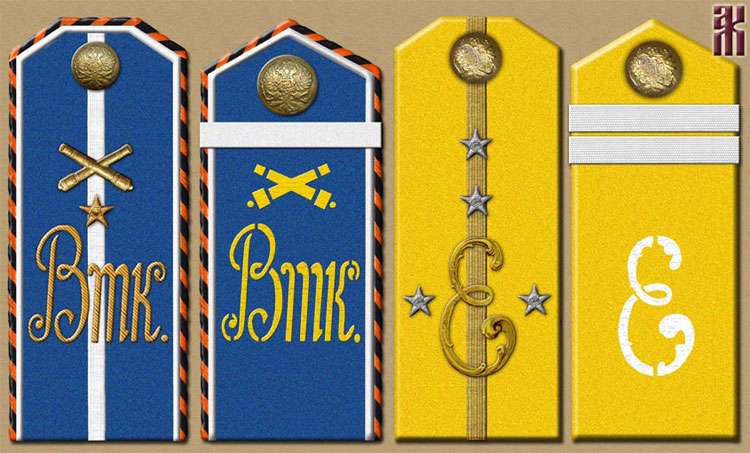
Shoulder-boards of the Votkinsk Artillery Battery (previously Divizion)
and Vrashtil's Independent Horse Jaeger Regiment (later Divizion)
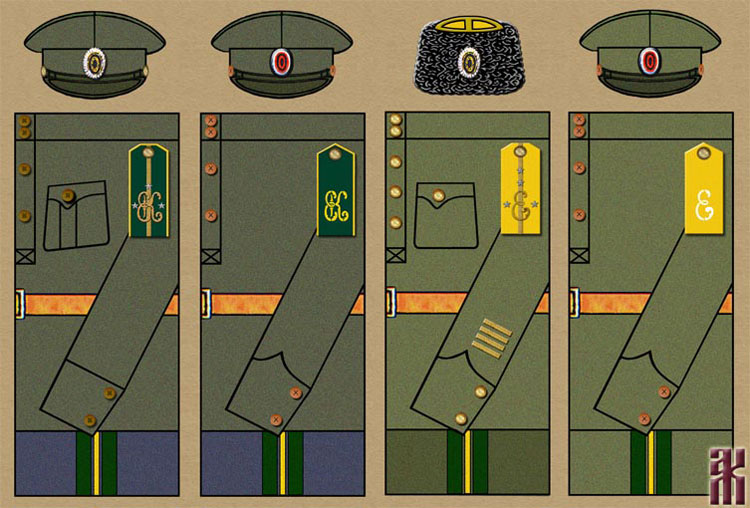
Uniforms of the Horse Jaeger Divizion : 1 and 2 – Manzhetniy; 3 and 4 – Vrashtil
1st Cavalry Regiment
The shoulder-boards of the 1st Cavalry Regiment were raspberry with blue piping and the number "1", but many officers of the regiment wore the shoulder-boards of their former units – in the Ekaterinburg, Kazan and Simbirsk Squadrons. The officers of the Composite Cavalry Divizion also wore the uniforms of their former units, i.e. the Simbirsk, Kazan and Ekaterinburg Regiments and the Horse Artillery Divizion. The first two had red shoulder-boards with coloured piping, the Ekaterinburg Regiment had raspberry shoulder-boards with the letter "E" and blue piping, and the horse artillery had the shoulder-boards appropriate for that branch of the military, i.e. red with blue piping.
Filimonov, p.46.
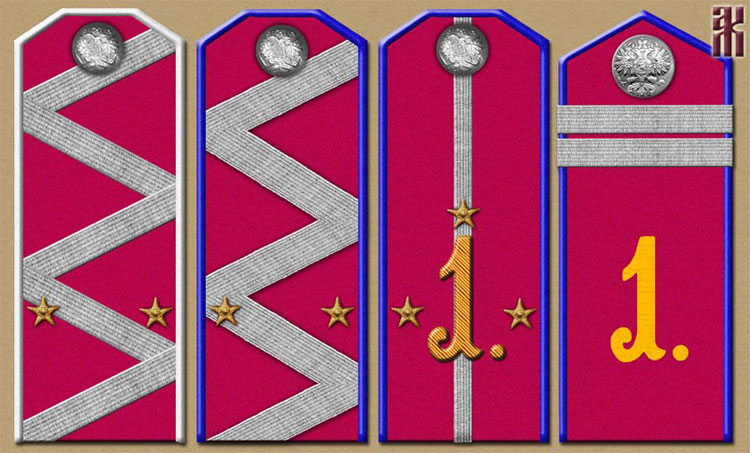
Shoulder-boards of senior commanders and the 1st Cavalry Regiment:
1 – General Sakharov; 2 – General Khrushchev;
3 and 4 – lieutenant and corporal of the 1st Cavalry Regiment
Others
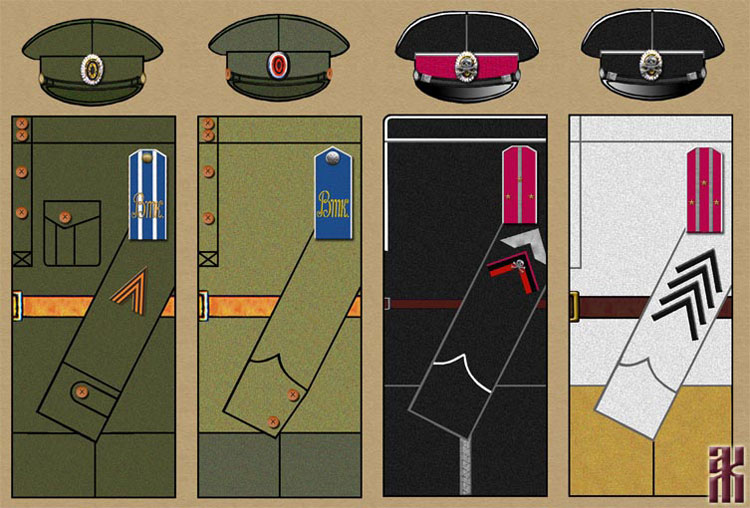
Uniforms of the Votkinsk and Annenkov Cavalry Divizions
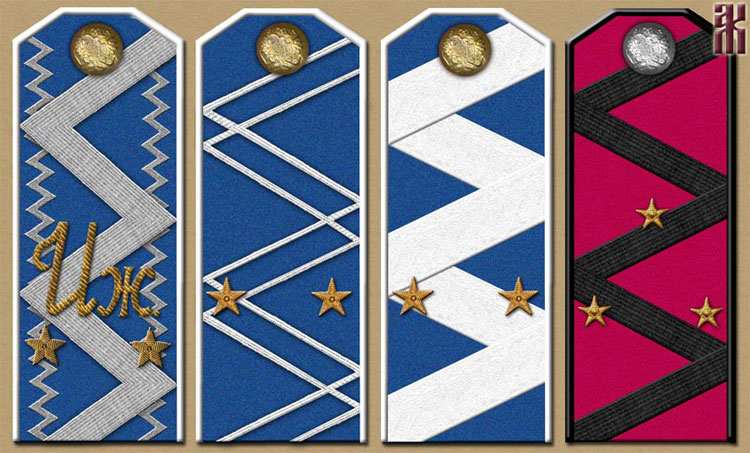
Shoulder-boards of the army's senior command:
1, 2 and 3 – General Molchanov; 4 – General Smolin
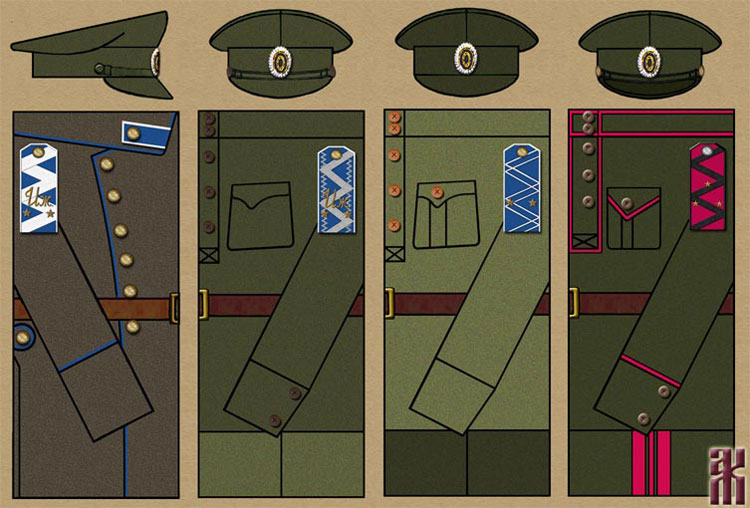
Uniforms of the army's senior command:
1, 2 and 3 – General Molchanov; 4 – General Smolin
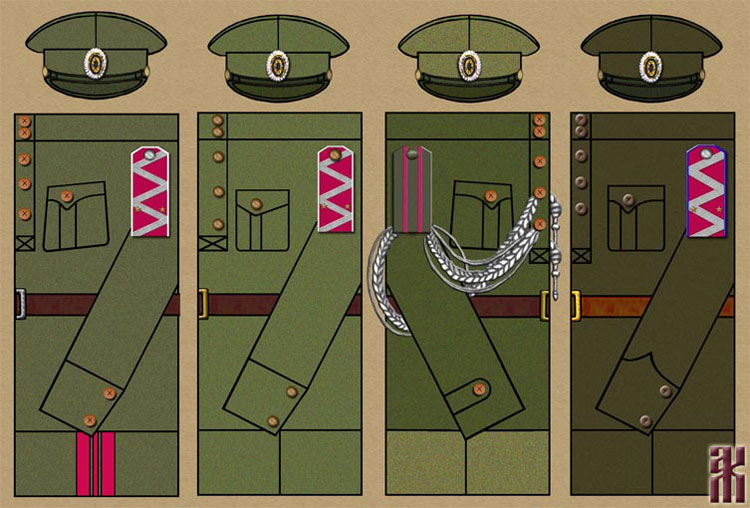
Uniforms of the army's senior command:
1 – Sakharov; 2 – Yastrebtsov; 3 – Savchuk; 4 – Khrushchev
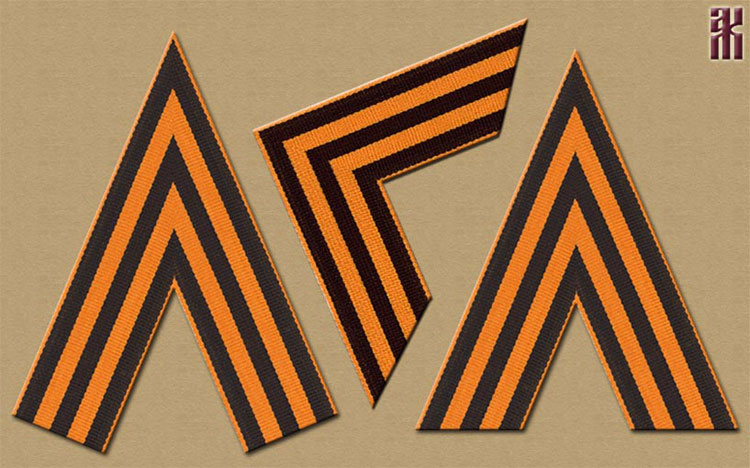
Varieties of sleeve chevrons for those who took part in the Great Siberian Campaign
Priamur
Decree No. 49 of the Governor of the Priamur Zemstvo Region, 26 September 1922
4) Under the care of the city authorities, soldiers who do not have sufficient footwear and warm clothing must be provided with such. There is no need to adhere to the uniform, for strength lies not in it, but in the spirit of the fighter for a holy and righteous cause. To distinguish them, they should wear a national arm-band on their left sleeve and a simple tin militia cross on their headgear.
"Russian Army [newspaper], No. 179", Vladivostok, 1922.
Provisional Priamur Army, Summer 1921, Primor'e
There is no need to mention their outward appearance, insignia, or uniforms. Although all the White soldiers wore shoulder-boards and did not like to appear in tattered uniforms, there were no special requirements in this regard, nor could there be, since the army did not receive uniforms or pay after its arrival in Primor'e.
Filimonov,p.71.
The army, having lost a significant part of its property in the trains abandoned during the retreat to Manchuria Station, sold off and distributed the rest of it along the Chinese Eastern Railway line. In March and April 1921 Grodekov's units received yellow drill uniforms and boots in Primor'e. They were expecting to receive and issue greatcoats. Kappel's units received nothing from anyone at that time. After the May coup, the situation changed. The Kappelevtsy quartermaster's office took control of some quartermaster's warehouses in the cities of Vladivostok and Nikolsk, which had previously been at the disposal of the Reds. The Kappelevtsy units received underwear, thin green cheviot and greatcoat cloth. The doors of the quartermaster's warehouses were not opened so wide for the units that later came to the government but were not Kappelevtsy. The 1st Rifle Brigade and the Orenburg Cossack Brigade received blue linen, but were not issued with cheviot. Incidentally, the 1st Rifle Brigade did not receive cheviot even in the summer of 1922, although some was available in the warehouses. The most disadvantaged were the units of the Transbaikal Cossack Division and the Grodekovtsy (later the 3rd Plastun Brigade). Those units received neither cheviot nor linen on the pretext that in the spring they had been issued with drill uniforms by Ataman Semenov. They did not receive any greatcoats, and no reason was given.
Filimonov, p.75.
The uniforms of the Izhevsk-Votkinsk and Volga Rifle Brigades were inadequate. The units marched in old Russian-style greatcoats, boots or low boots. Some wore papakhi, but the vast majority wore the cloth caps with earflaps which had been adopted by the Siberian Army under Admiral Kolchak. Some of the troops were issued with warm knitted blouses. For their hands, they had rifle gloves made of goatskin.
The uniforms of the 1st Rifle Brigade could be described as poor. Before the march, some of the troops were issued with half-rotten sheepskin coats, some went out in old torn greatcoats (received in Transbaikalia in 1920), and some even in raincoats (red-brown in colour, used in Admiral Kolchak's army and also worn by the 5th Polish Division). The headgear was the same as in the Izhevsk-Votkinsk and Volga brigades, but a certain percentage wore field caps. No knitted blouses were issued at all. The blouses and trousers were made of linen. On their feet they wore low boots. The gloves issued were the same as those in the Izhevsk-Votkinsk Brigade.
The uniforms of the 2nd Rifle Brigade (Major-General Osipov) were inadequate. The officers were generally better dressed than those of the 1st Brigade, but worse than those of the Izhevsk-Votkinsk and Volga Brigades. Specifically, those who did not have sheepskin coats all had knitted blouses.
The uniforms of the Siberian Brigade (Colonel Argunov's Primor'e Detachment) can be considered adequate and decent. This brigade was better dressed than all the others, for which its soldiers owed thanks to Major-General Smolin and Colonel Argunov. The men of this brigade wore sheepskin coats and also had knitted blouses. Their headgear consisted of papakhi or warm caps.
Formed later than the others, the 3rd Plastun Brigade had appalling uniforms. There were no decent greatcoats or sheepskin coats. The men came out wearing old rags left over from their time in Transbaikalia, while most wore red-brown raincoats issued to the Grodekovtsy units by the ataman. Knitted blouses were not issued, and many wore their raincoats over their drill uniforms. They wore old boots, many of which had been altered to be narrower, so that only one thin summer footcloth could be worn. No gloves or headgear were issued. As a result, the men wrapped themselves in various rags and could not stand still in the cold. Sending the brigade to the front in such a state was unjustifiable, as it sent not so much fighters to the front as frostbitten soldiers to the hospitals. The White Army believed that this brigade was sent to the front in such a state because it had been the mainstay of Ataman Semenov during his time.
The units of the Transbaikal Cossack Division were very poorly dressed. Its horses were completely exhausted, emaciated and, to top it all off, sick. The division's lack of fodder in the summer of 1921 was due to political motives – to further subdue a division that was not sufficiently loyal. The Orenburg Cossack Brigade was decently equipped: the men were dressed in greatcoats, knitted blouses and linen.
The units went to the front in this state. Once there, the front line units (the Izhevsk-Votkinsk, Volga, 1st Rifle and 2nd Rifle Brigades) were issued with a large number of American rubber galoshes in Iman. Such footwear was unsuitable for marching: when worn over boots, it became an unnecessary burden. Without boots, however, it was unusable in the conditions of Russian Siberian marches because: 1) in warm times, rubber releases moisture, causing footcloths to get wet, and when exposed to the cold, they quickly freeze, increasing the likelihood of frostbite, 2) for infantry marching through bushes, bumps and rocks, rubber tears very quickly. Lightweight and comfortable in peacetime, galoshes were completely unsuitable for military campaigns. Rumour had it that the galoshes were supplied by the Merkulov brothers themselves.
The soldiers' equipment consisted of leather artillery knapsacks or various types of supply bags, including English dry bags. Ammunition was placed in cartridge pouches (of the old Russian type), a pair per soldier, and cartridge belts sewn from drill. Those cartridge belts were useless, as the clips fell out easily.
Filimonov, pp.85-87.
Ussuri Station, November 1921
Military units were transported along the railway line disguised as police. Therefore, each officer and soldier had tricolour arm-bands with their personal police number sewn onto the left sleeve above the elbow.
Filimonov, p.115.
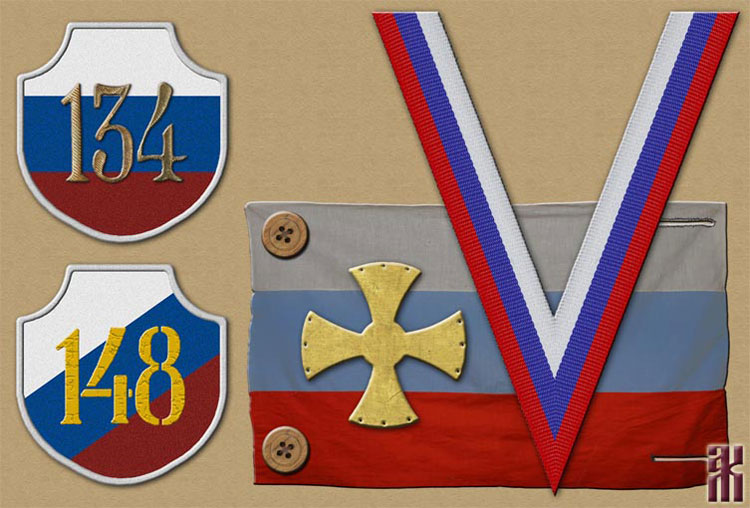
Sleeve markings of the Provisional Amur Government police; sleeve chevron of the 1st Rifle Brigade; arm-band and headgear insignia of the Amur Zemstvo Army reserve
The "Immortal" cavalry squadron of Ensign Kochenin, Vladimirovka, 23 December 1921
Lieutenant Essen was dressed in a green English greatcoat, with no coloured or gold shoulder-boards. The other horsemen were dressed in sheepskin coats or tattered greatcoats. Ensign Kochenin had something like a Tatar coat.
Filimonov, p.260.
Arm-bands
By the end of December 1921, the Whites had established that in recent battles, the Reds had begun to use white arm-bands, which were customary among the White rebels. This led to misunderstandings during encounters, which only worked to the disadvantage of the White soldiers. Therefore, after the battle of Iman, all ranks of the White rebel units were ordered to remove the white arm-bands from their sleeves and not to wear them under any circumstances.
Filimonov, p.347.
4th Ufa Rifle Regiment, Khabarovsk, 6 January 1922
The soldiers' uniforms were quite decent, but their footwear was an exception – all the ranks of the regiment had low boots, as a result of which, during the very first march from Pokrovka to Volochaevka (7 January), 30 officers froze.
Filimonov, p.417.
Order No. 12, 11 January 1922, Khabarovsk.
I have repeatedly stated in orders and conversations with officers and soldiers that we are the remnants of the great Russian army, that the army is united, that we serve our homeland, not names. This is indeed the case, according to the inner convictions of every Russian soldier. But I must note that outwardly we are not yet united, due to differences in uniforms, and some officers of the Grodekov group wear clearly biased "АС" monograms on their shoulder-boards. The people watch us and fear the atamanism even more than communism. Until the population sees us as their Russian army without any hint of the atamanism they have experienced, we will be alone, and the people will not support us. Believe me, all my endeavours are motivated solely by love for my homeland and fear for the sacred cause of liberating our Fatherland, as well as the experience I have gained over four years of civil war, experience gained with the blood of many of Russia's finest sons. Until the army is finally brought to a single type, I order:
1) Remove "АС" insignia from the shoulder-boards,
2) Remove metal lace shoulder-boards,
3) Remove all sleeve insignia, except for the chevron of St. George ribbon, for those who completed the Great Ice March.
4) To consider the actions of Ataman Semenov after the army's departure from Transbaikalia to be null and void, on the basis of the Decree of the Provisional Amur Government. All of the above measures are to be implemented as soon as possible and reported to me.
Major-General Molchanov
Filimonov, pp. 460-461.
It should also be noted that none of the four points of the order were fully implemented: 1) the Semenovtsy did not remove the "АС" insignia, but on the contrary, some who did not wear them before the order now put them on, 2) some generals, staff officers, senior officers and warrant officers continued to wear gold shoulder-boards; they wore them not because they were exclusively in favour of the "old regime" golden shoulder-boards, but because they looked more elegant, or because simple khaki shoulder-boards were not available, 3) The Gludkintsy did not remove their national volunteer chevron, and no one forced them to do so, just as the former SMD and Kalmyks did not. As for the St. George chevron, not all those who had the right to do so wore it before and after the campaign, but also those who either greatly respected that distinction or loved beauty. 4) There was also no reversion of Ataman Semenov's ranks: not only did the Plastun and 1st Rifle ("Gludkin") Brigades continue to keep their ranks, named and listed in the Semenovtsy, but the units of the Volga Brigade and Colonel Argunov's 2nd Detachment also kept the ranks of any former Grodetskovtsy.
Filimonov, p.462.
1st Rifle Artillery Divizion (formerly the 1st Rifle Brigade, then part of the Siberian Cossack Army) Officers and soldiers appeared in black velvet artillery caps. Filimonov, p.188. The Merkulov coup on 26 May 1921 Soon, White Guards captured on the streets, mostly officers or cadets, began to be brought to the school. They wore officer's uniforms with shoulder-boards and tricolour ribbons on their sleeves, the colours of the Tsarist flag. Fedichkin, D. G. in "Cadets of the Party School in Battle // The Civil War in the Far East", Moscow, 1973, pp.274-275. Military coup in Vladivostok In one of the houses, representatives of the organisations preparing the coup were waiting and put national colour arm-bands on everyone. Hidden tricolour flags were hastily attached to the houses. "On the 40th anniversary of the capture of Vladivostok by White soldiers on 26-27 May 1921) // Russian Life (San Francisco), No. 4852", 25 May 1961, appendix "Crusade in the name of truth". Published by Efimov, A. G. in "With the Izhevtsy and Votkintsy on the Eastern Front", Moscow, 2013, p.56. Kangauz Station in the Suchan Valley, May (?) 1921 But when we approached the well, we saw Cossacks on horseback with red, white and blue arm-bands on their sleeves. Kazakova, O. A. (Shebrovskaya) in "Liaison // Civil War in the Far East", Moscow, 1973, p.283 At that time, Colonel Yuri Konstantinovich Sidamonidze, commander of the 4th Ufa General Kornilov Regiment, arrived at headquarters and immediately agreed that Mr. Korneev could be invited to lunch at the detachment headquarters. The other unit commanders also had no objections, agreeing with the chief of staff's arguments about the usefulness of inviting him, and so he was invited to that lunch by the chief of staff. ... Korneev sat next to Colonel Sidamonidze, who had the General Kornilov initial on his shoulder-boards. Kornilov's initial "-K-", and Lieutenant Ushanov sat next to him. In the middle of the lunch, the detachment priest, Father Ioann Gulyaev, arrived at headquarters. "The memoirs of N. A. Martynov // Chelyabinsk: Russian Atlantis magazine, No. 43", 2011. Published at t-rm.livejournal.com/130561.html Volochaevka district, 9 December 1921 Instead of opening fire and stunning the enemy, Lebedev hesitated, looking at the approaching unit. He was confused by the appearance of the White Guards, who were dressed in Japanese sheepskin coats and grey goatskin hats and resembled our soldiers. Moreover, they were infantrymen, and Lebedev had expected to encounter cavalry, since he had heard at the front headquarters that only White cavalry units were moving along the Ussuri River. All this made him wonder whether this was one of our units. "Which unit are you from?" he asked the commander, whose officer's shoulder-boards he could not see under his sheepskin coat. Instead of answering, the officer quickly drew his revolver and shot Lebedev dead on the spot. Popov, V. in "Taiga Expeditions: A Collection of Episodes from the History of the Civil War in the Far East", Moscow, 1935. at www.biografia.ru/about/pohod17.html Vladimirovka, 23 December 1921 A group of Gludkintsy artillerymen approached the column coming out of Amur. The soldiers coming from Amur must have noticed the white arm-bands worn by almost every rifleman in the column coming down the main street. The shoulder-boards and cockades, and especially the several peacetime artillery caps with black velvet crowns and white cockades, must have had a certain effect on the officers coming from Amur. Filimonov, pp.263-264. Introduction of colour names based on the colour of the equipment, January 1922 The 4th Omsk Rifle Regiment became the 1st Green Regiment, and the 3rd Volunteer Regiment became the 2nd Blue Regiment [in the 2nd Rifle Brigade] [Izhevsk-Votkinsk Brigade] Colonel Efimov decided to refer to the regiments by number in his orders: the 1st, 2nd and KonDiv [Horse Divizion], but in order to avoid misunderstandings when meeting his own units ... he added "Blue" to the numbers – the colour of the shoulder-boards. With the arrival of the 1st Volunteer Regiment in the Izhevsk-Votkinsk Brigade, it became the "3rd Blue". ... The volunteers sometimes also called themselves "Blue" or "3rd Blue", since a significant number of the officers of that regiment had blue shoulder-boards. In the 1st Independent Rifle Brigade ... the 2nd Ural Regiment became the "Black Regiment" due to the colour of its shoulder-boards. The 1st Horse Jaeger Regiment was named the "1st Yellow Regiment". Filimonov, pp.346-347. Limited supplies in 1922 Just before Easter, the units received a wide variety of blouses, English trousers, English low boots with puttees, boots, a small amount of underwear and blankets. However, all this was issued in insignificant quantities and did not allow the units' needs to be fully met or their appearance to be made uniform. Filimonov, 497. Battles near Olgokht, April 1922 The military commander of that squadron, V. P. Shishkin, recalled the fierce battles near Olgokht. The officer battalion of the Izhevsk Regiment was destroyed, and the 1st Transbaikal Volunteer Regiment suffered heavy losses: The wounded Izhevsk soldiers arrived, each with two or three stars on their shoulder-boards, medals, some with crosses. These were stubborn people, they hardly spoke, but the wounded came to us from the battlefield. With the help of Japanese military advisers, the White Guard command, masking their affiliation with the 5th Kappel' Army, changed the names of their regiments near Volochaevka. The Omsk Infantry Regiment became known as the "Green Detachment", the Izhevsk-Votkinsk Infantry Regiment as the "Blue Detachment", the 1st Rifle Brigade became the "Yellow Detachment", and the 2nd Volunteer Corps became the "Light Blue Detachment". Avdeeva, N. A. in "The Battle of Volochaevka and the Liberation of the Khabarovsk Amur Region in 1922 // The History of the Civil War and Intervention in the Far East", Khabarovsk, 1978, pp.67, 70, citing TsGASA F.25890 Op.1 D.13 L.149-150. In Station, January 1922 Although the White Army units here were strong – some kind of volunteer regiment, made up of the very best – they said that there were no non-commissioned officers or lower ranks. They advanced beautifully, as if in training, and their commands could be heard far away. They were all dressed very well, in greatcoats, English outfits, warm and light underwear, but we defeated them. Panteleev, N. in "Private in the People's Army // Taiga Campaigns", Khabarovsk, 1972. pp.579-580 Khabarovsk, 1922 At the same time, the White Army troops standing on the carriageway of Muravyov-Amurskaya Street, not far from the bridge where we were all located, turned towards the station and marched towards it in formation. The soldiers were dressed in long grey greatcoats, with puttees on their legs, their heads wrapped in bashlyki, the ends of which were blown in different directions by the wind. Much later, I learned the historical significance of what I had seen on that momentous day. Blyukher, G. in "Six Years with Vasily Konstantinovich Blyukher // Military History Journal, No. 6", 1980, p.80 The Northern Expeditionary Detachment of Captain Birich, Petropavlovsk (Kamchatka), 1921-22 The Reds began identifying "accomplices of the White Bandits" immediately after the final restoration of their power. During interrogations in the "Duma case", they found out who made the kamleiki. The mayor in 1922, E. A. Kolmakov, explained that local residents wore them in bad weather (in order to protect their fur clothing from snow and getting wet, as contemporary art historian M. I. Belov explains), while the detachment members needed to blend in with the snow. In other words, kamleikas replaced camouflage coats. "Bastards, scoundrels! They wounded one and killed one behind Seroglazka because the partisans have white covers and are invisible. Ours are black, they can kill all of our men", said E. I. Boreisha to G. Zagorulko, who, fearing arrest, gave her his kamleika as a sample. He then clarified: "Our ladies all took them to be sewn, Father Mikhail was cutting them." "Our ladies" turned out to be the wives of the head of the customs post, Kodylev – Elizaveta Ignatievna, the accountant, Oshev – Anna Semenovna, the doctor, Rubetskiy – Agrippina Petrovna, and the priest of the Cathedral of Saints Peter and Paul, Erokhin – Lyudmila Ivanovna. Three more women sewed the kamleiki: their husbands, I. Lazarev, M. Orlov, and G. Pozdnyakov, were listed as members of the Petropavlovsk volunteer guard. All of the seamstresses worked for no money. V. I. Svyatoy, like G. Zagorulko, a sympathiser of the communists, pointed out the existence of an entire workshop in M. Erokhin's apartment for the manufacture of not only clothing, but also "various insignia for the Whites". However, according to A. S. Osheva, the women were only given materials and the finished products were taken away; her father, Mikhail, took them to the commandant's office. Thus, the detachment received ten "three-line rifles" and eighty-one Winchester rifles of various calibres. The detachment's most pressing needs for winter clothing and essential supplies (in order to avoid a mass outbreak of scurvy) forced General Polyakov to compel the largest firms, such as Wittenberg and Seidenberg and Churin and Co. to issue all this in exchange for debt obligations, which were to be paid by the Provisional Amur Government. The military caused H. P. Birich a lot of trouble. In a report to the chairman of the government, Spiridon Denisovich Merkulov, he wrote: "Even while the steamer Kishinev was moored in the Petropavlovsk roads, I began to receive demands from the command to supply the detachment with provisions and uniforms, as well as equipment and furnishings for their quarters. These demands were presented in such a way that I was forced to summon representatives of local trading firms to find a way out of the situation that had arisen for me as the "detachment quartermaster". Meanwhile, the situation in Petropavlovsk became even more complicated due to "unrest" among the military and, above all, because of the privileged position of Polyakov's personal escort, which consisted of 10-12 people. Exempt from guard duty, they were supplied with provisions and uniforms in considerable excess compared to other ranks of the detachment. Plus alcohol (or, in the absence of such, denatured alcohol), thanks to which, according to Birich, the escort, led by the general's adjutant, Cornet Tatarovsky, "became, in the full sense of the word, a bogeyman for the local population". "The entire crew of the Svir have worn out their clothes, they have nothing to wear. They need forty-three sets of full uniforms, a delivery of coal, repair materials. ... All the misunderstandings are being resolved with great difficulty. Pustovit, V. P. in "Confrontation: Essays on the History of the Civil War in the Okhotsk-Kamchatka region // www.npacific.ru/np/library/publikacii/historykam/istkam1-3.htm
Home — State Symbols — Flags — Uniforms — Badges & Medals — Money — Other
Pygmy Wars Notes
The original for this page is at kolchakiya.ru/uniformology/dva.htm.
The letters "Из" are "Iz" for Izhevsk, but note that the italic form of the "И" looks like a Latin "U". The letters "Вт" are "Vt" for Votkinsk, but note that the italic form of "т" looks like a rounded Latin "m".
The "D" for the volunteers was a Latin "D", not a "Д".
A kamleika is a type of coat made by the indigenous peoples of the Far East (originally Aleuts) from sea mammal intestines.
Note that this page does not contain all the references to the uniforms in the Far East. This page has some further information on the former Kolchaktsy supplied by V. Romanov, and the primarily Cossack units are dealt with separately (Semenov, Kalmykov, Annenkov etc).
Discussion on the translation choices I have made can be found here.
Flags
Many of the units in the Far Eastern Army and the Primor'e carried their flags with them. They can be seen in the pages for the various starting units. However, many banners were lost in the Ice March, so they need to be checked.