
St George Banners in the Army of the Supreme Ruler
Izhevsk Rifle Division
Awarded by the Supreme Ruler of Russia, Admiral Kolchak, on 9 September 1919 for the battles on the Tobol River, which was announced to them personally during his visit to the division. The official order for the award was issued at Petukhovo Station on 16 September 1919:
The Izhevsk Rifle Division, formed from volunteer workers from Izhevsk and, more recently, from other factories in the Urals, since its inception has consistently demonstrated high valour and exemplary steadfastness in the fierce struggle against the enemy for the benefit of a resurgent Russia. The Izhevsk Rifle Division distinguished itself with particularly heroic feats of arms during the period from 30 August to 5 September this year in the battles near the villages of Bogatyy, Dubrovnyy, Sundzharskiy, and the villages of Bolshoe and Maloe Priyutnoye. At that time it broke the enemy's resistance with particularly fierce blows, inflicting enormous losses on them, and captured a large number of trophies and prisoners, forcing the enemy to flee to the west. In recognition of its valiant heroic deeds, courage and bravery, I award the Izhevsk Rifle Division a St. George flag. This banner shall be honoured and preserved in accordance with the appropriate regulations.
Admiral Kolchak
It was a white rectangular double-sided cloth measuring 115.5 x 105 cm, made of silk, embroidered with silk thread. On the front, on a white background was a border with yellow edges, and inscription on the border in Slavonic script "Psalm 88 Verse 24: And I will cut down his enemies before his face, and I will put to flight them that hate him." Inside was a St. Andrew's Cross made of a wide St. George ribbon, with the image of Christ Not Made by Hands in the centre. On the reverse, on a white background, was a border with yellow edges, and an inscription in Slavonic script "Izhevsk Division" (at the top), and "1918. 1919" (at the bottom). Inside, on a St. Andrew's Cross made of a wide St. George ribbon, there is an image of a black double-headed eagle with a golden sword in its right talon, a burning grenade in its left talon, and an oval medallion with the image of St. George the Victorious on its chest.
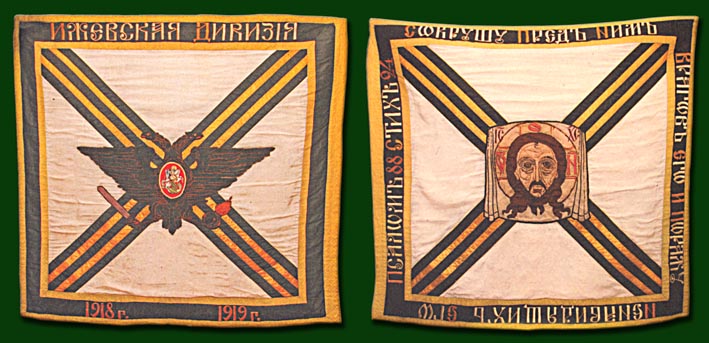
Photograph by L. Tremtsina, published in Efimov
It was not presented then because it was not yet finished at the time of the announcement, although it had already been approved and ordered. It was made in December 1919 by embroiderers from the Znamensk Convent. It was on the train of the Supreme Ruler and was captured by Irkutsk rebels. In 1924 it was transferred to the Irkutsk Museum of the Revolution from the headquarters of the 12th Rifle Corps of the Transbaikal Military District of the Red Army. When the museum closed in 1935 it was transferred to the Irkutsk Regional Museum. It was first exhibited in December 1987. On 18 May 2008 it was placed in temporary storage in connection with the celebration of the 90th anniversary of the Izhevsk-Votkinsk uprising to the K. Gerd National Museum of the Udmurt Republic (Izhevsk).
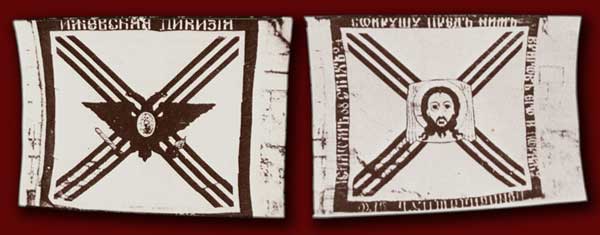
Photo from Kobzev. A distinctive feature is the presence of white margins on either side
of the border with the inscription. These margins are absent in modern photographs.
Kobzev, I. in "From Izhevsk to Harbin // Udmurtia: Monuments of the Fatherland", Moscow, 1995, pp. 156-174.
Efimov, A. G. in "Izhevtsy and Votkinsy: The Struggle Against the Bolsheviks, 1918–1920", Moscow, 2008.
Peters, D. I. in "Material on the history of awards during the Civil War and the White Movement, 1918-1922", Philadelphia, 1996, p. 14.
Bushin, A. Y. in "Comments" // White Army, White Cause No. 4", Ekaterinburg, 1997, p. 167.
Petrov, A. A. in "On the Banners of the Izhevsk Rifle Division // Izhevtsy and Votkinsy: The Struggle Against the Bolsheviks, 1918-1920", Moscow, 2008, pp. 371-374.
Battle flag of the Izhevsk Rifle Division
This flag is a substitute for the St. George banner above. It was made independently at the end of 1919, prior to the presentation of the official banner by the Supreme Ruler. It appeared during the division's parade at Innokentyevskaya Station in February 1920, where it was carried by the officer battalion.
It was a rectangular cloth divided into two equal parts. The left half was white with a diagonal cross made of a wide St. George ribbon. In the upper corner of the cross was the date "7/VIII 1918", and in the lower corner was the date "9/IX 1919" in Slavonic script (the dates being the beginning of the Izhevsk factory uprising and the awarding of the St. George banner to the division). On the right half are the colours of the Russian flag (white, blue and red) with the letters "Иж" in Italic form in gold in the centre of the blue stripe.
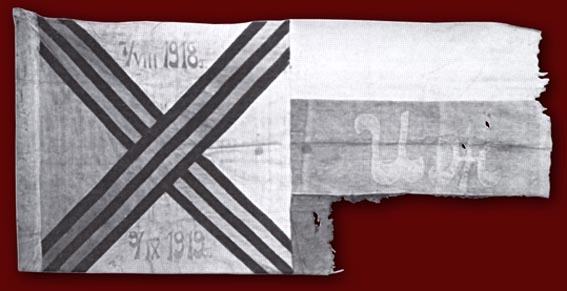
Photograph from the archives of the Museum of Russian Culture in San Francisco.
Published in Efimov.
During the evacuation from Primor'e, it was taken to China and then to the United States. It was kept at the Izhevsk-Votkinsk Association in San Francisco. On 29 September 1968, during the celebration of the 50th anniversary of the uprising at the factories, where it decorated the stage. Its current location is unknown (possibly lost).
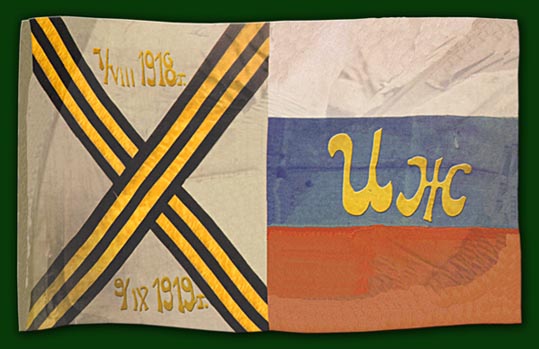
Kobzev, I. in "From Izhevsk to Harbin // Udmurtia: Monuments of the Fatherland", Moscow, 1995, p. 163.
Efimov, A. G. in "Izhevtsy and Votkinsy: The Struggle Against the Bolsheviks, 1918–1920", Moscow, 2008.
Petrov, A. A. in "On the Banners of the Izhevsk Rifle Division // Izhevtsy and Votkinsy: The Struggle Against the Bolsheviks, 1918-1920", Moscow, 2008, p. 374.
"Pervokhodnik, No. 7", Los Angeles, 1972, p. 54.
Blinov, M. Y. "Izhevsk-Votkinsk Residents // Bulletin of the Society of Russian Veterans of the Great War, No. 275", Moscow, 2000, pp. 15-16.
"Bulletin of the Pioneer, No. 7", Los Angeles, 1972, p. 54.
Votkinsk Artillery Divizion
Awarded in Transbaikalia by the commander of the Far Eastern Army, General S. N. Voitsekhovskiy, for the saving of guns during the Great Siberian Campaign.
It is based on the banner of the Izhevsk Division. It was a white rectangular double-sided cloth with St. George ribbons sewn in the shape of St. Andrew's Cross in a narrow rectangular frame. On the front in the centre of the crossed ribbons was an icon of Christ Not Made by Hands. Above and below the frame is an inscription in Slavonic script: "God is with us". On the reverse is an image of a black double-headed eagle with a golden sword in its right talon, a flaming grenade in its left talon, and an oval medallion with an image of St. George the Victorious on its chest centred on the crossed ribbons. Above and below the frame is an inscription in Slavonic script: "The Salvation of Russia in its victory".
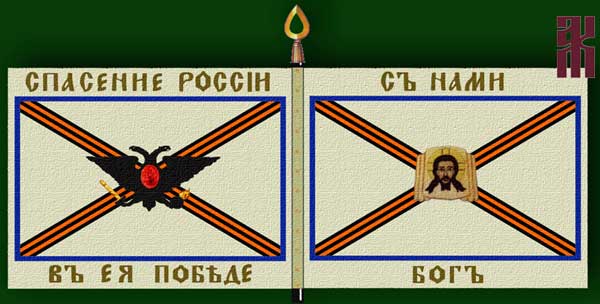
On display at the Central Museum of the Armed Forces
Ezeev, A. B. in "On the question of "admissibility," "legitimacy," and "authority" // Military Reality, No. 4", Moscow, 1993, p. 15.
Irkutsk Artillery Divizion
Awarded in Transbaikalia by order of the Commander of the Far Eastern Army, General S.N. Voitsekhovskiy, for saving cannons during the Great Siberian Campaign.
Most likely it was more or less identical to the St. George banner of the Votkinsk Artillery Divizion. They might differ in the colour of the frames – blue for Votkinsk and green for Irkutsk (based on the units' colours).
Ezeev, A. B. in "On the question of "admissibility," "legitimacy," and "authority" // Military Reality, No. 4", Moscow, 1993, p. 15.
Home — State Symbols — Flags — Uniforms — Badges & Medals — Money — Other
Pygmy Wars Notes
The original of this page is at kolchakiya.ru/vexillology/georg_flags.htm.
The "St George" is a reference to the black and yellow stripes, associated with the Order of St. George. Such flags were associated with "shock" regiments formed in WWI composed entirely of St George award winners.
Note that in modern Russia the stripes are black and orange, but in Tsarist times they were much more yellow/gold and you can see the difference in the pictures of the originals compared to the reconstructions above.