
Uniforms of the 14th Siberian Rifle Division
Material and reconstructions by A. Karevskiy
This reconstruction is based on the fact that, unlike the 11th, 12th and 13th Siberian Rifle Divisions, the 14th Siberian Rifle Division, which was formed in the Irkutsk Military District (based on the 3rd Siberian Reserve Division of the 4th East Siberian Army Corps), wore predominantly Russian-style uniforms. Stepanov shares this view in his article, and it is indirectly confirmed by available photographs, in particular, photos of officers of the division's Jaeger Battalion who died during the Irkutsk mutiny.
Stepanov, A. in "The People's Revolutionary Army of the Political Centre and the East Siberian Soviet Army (1920) // Tseykhgauz, No. 13", Moscow, 2001, pp.40-42.
russiamilitaria.ru/index.php?&act=attach&type=post&id=2267 [link dead]
Order of the War Department, No. 161 of 30 April 1919 (Omsk)
The Supreme Ruler and Supreme Commander-in-Chief orders that the newly formed 8th, 11th, 12th, 13th and 14th Siberian Rifle Divisions be issued with army-standard field uniforms with the following distinctions:
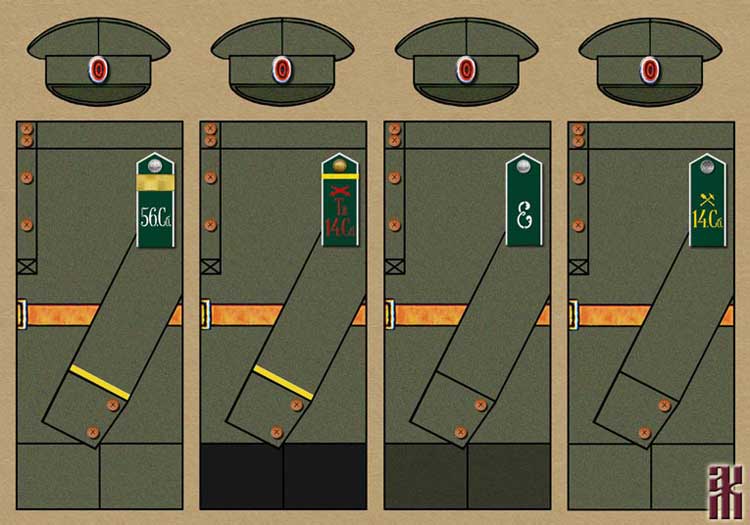
For soldiers: shoulder-boards are 6½ cm wide, made of dark green cloth with white cloth piping. They have the unit number as cipher: for riflemen, jaegers and headquarters personnel in white, for artillerymen in red, for engineering and technical troops in yellow. Distinctive insignia corresponding to the branch of service is to be placed above the unit number. For non-commissioned officers: transverse stripes of narrow ¾-inch yellow tape. For sergeant-majors in [wide] yellow braid. The cuffs for privates are without markings. For NCOs the cuffs are trimmed with narrow (1 cm) braid. The cap is khaki.
For officers: the same model as for soldiers, but with narrow (½ cm) silver braid, sewn in a zigzag pattern for generals, and lengthways down the shoulder-board for staff and other officers, appropriate number (one or two) and with the corresponding number of gilded stars for each rank. Unit numbers and distinctive insignia for different branches of the military are made of white metal, gilded in the artillery.
Shoulder-boards are made of dark green cloth with white piping in rifle units, and dark green cloth without piping in jaeger units. For artillery, engineer and technical units, they are made of black velvet with red piping. Headquarters are to have red cloth with white piping. Generals and staff officers have the same shoulder-boards, but with metal buttons, gilded in artillery units and silver-plated in all others. Cuffs are trimmed, according to the attached drawings, with dark green braid with white piping: 2½ cm wide for generals, 2 cm wide in two rows for staff officers, and the same width in one row for other officers. The cap is to have a khaki crown, visor of the same colour and material and with the band the same colour and piping as the shoulder-boards.
Signed: Minister of War Major General Stepanov
Document kindly provided by Moscow researcher V. V. Romanov
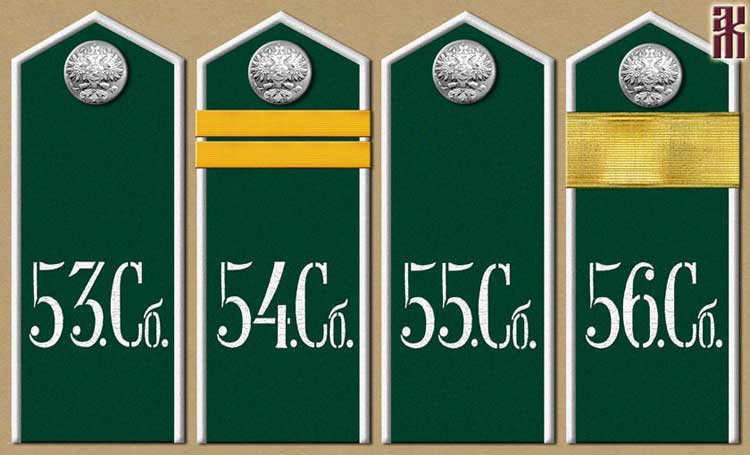
Shoulder-boards of other ranks of rifle regiments of the 14th Siberian Rifle Division.
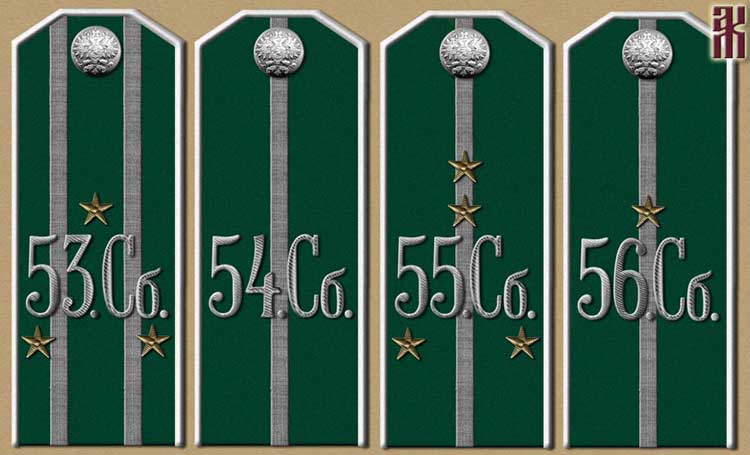
Shoulder-boards of officers of rifle regiments of the 14th Siberian Rifle Division
The insignia are shown as white metal with a ribbed surface, although they could also be smooth.
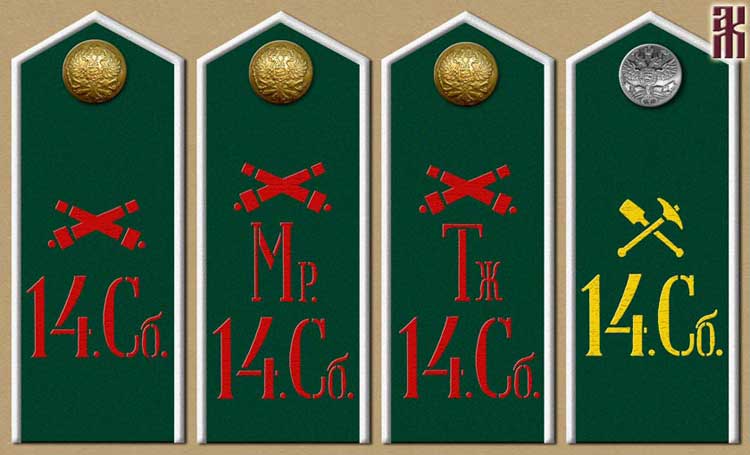
Shoulder-boards of privates in artillery and engineer units of the 14th Siberian Rifle Division:
1 – 14th Siberian Light Artillery Divizion ; 2 – 14th Siberian Light Howitzer Divizion ;
3 – 14th Independent Heavy Artillery Battery; 4 – 14th Siberian Engineer Divizion
The division's artillery units (light, howitzer and heavy) combined to form the 14th Siberian Artillery Brigade.
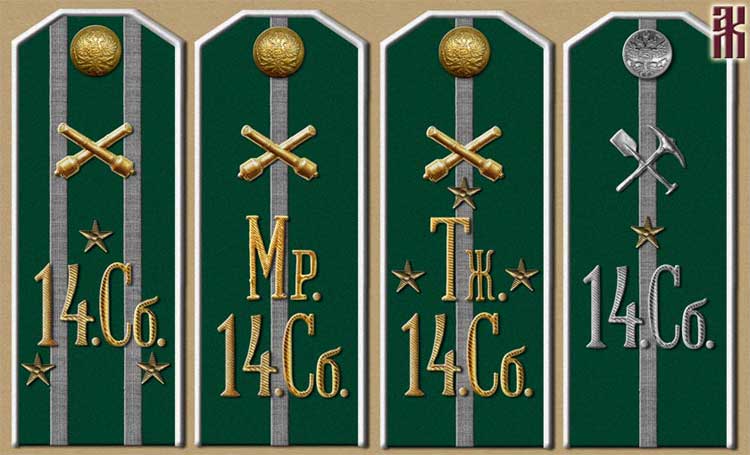
Shoulder-boards of officers in artillery and engineer units of the 14th Siberian Rifle Division
1 – lieutenant-colonel in the 14th Siberian Light Artillery Divizion ;
2 – captain in the 14th Siberian Light Howitzer Divizion ;
3 – lieutenant in the 14th Independent Heavy Artillery Battery;
4 – ensign in the 14th Siberian Engineer Divizion
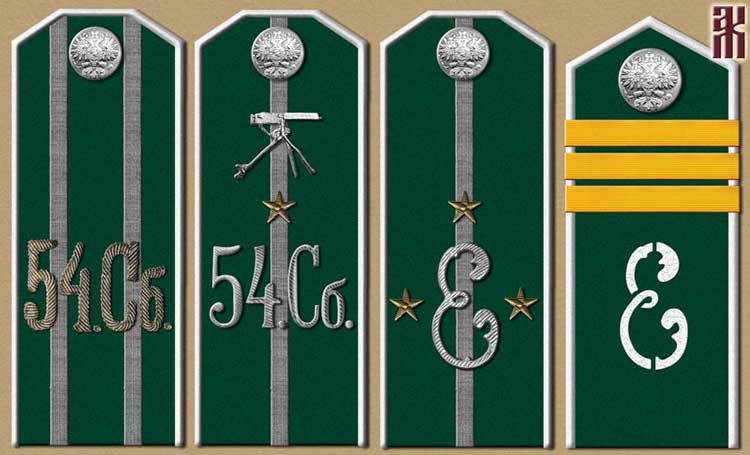
Shoulder-boards of officers the 14th Siberian Rifle Division
1 – colonel of the 54th Siberian Rifle Regiment (variant with embroidered cipher);
2 – ensign of the Machine-gun Komand of the 54th Siberian Rifle Regiment;
3 – lieutenant in the Jaeger Battalion of the 14th Siberian Rifle Division;
4 – sergeant in the Jaeger Battalion of the 14th Siberian Rifle Division
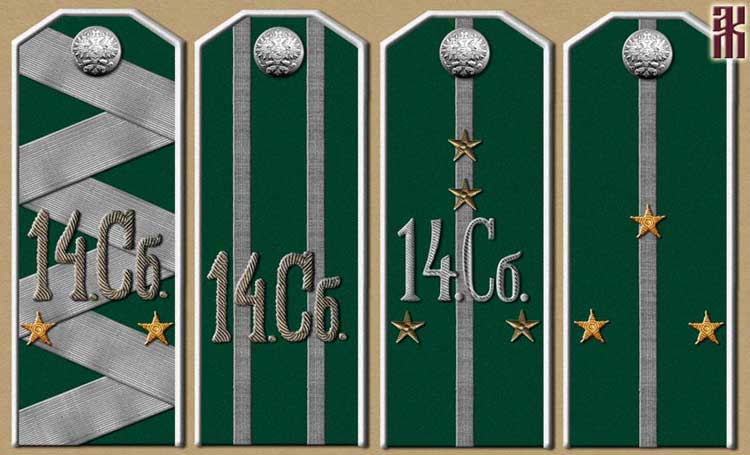
Shoulder-boards of the command and staff officers of the 14th Siberian Rifle Division
Officially general's zigzag was to be of 5 mm silver braid, but judging by the photographs, it was often wider (for example, the shoulder-boards of the chief of staff of the 11th Siberian Rifle Division, General S. I. Lyashchik).
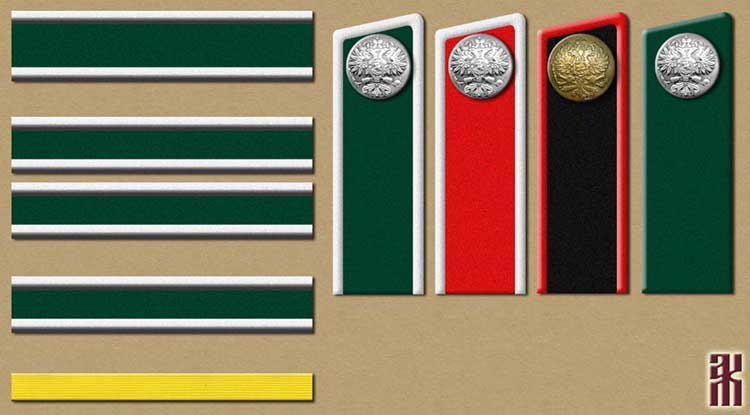
Sleeve braid and greatcoat tabs of the 14th Siberian Rifle Division
Braid: 1 – generals; 2 – staff officers (double); 3 – other officers; 4 – NCOs
Greatcoat tabs: 1 – rifles and engineer; 2 – headquarters; 3 – artillery; 4 – jaeger battalion
(with buttons for staff officers and generals).
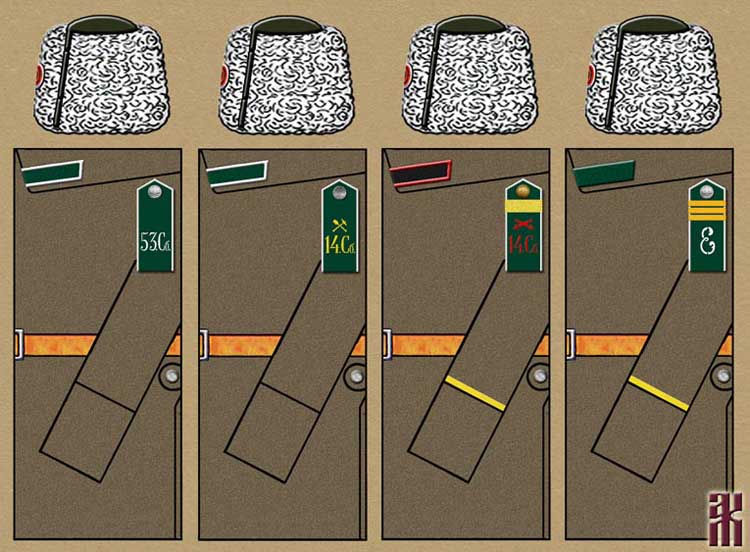
Winter uniform for other ranks of the 14th Siberian Rifle Division (1910 model papakhi )
Summer uniform for the other ranks of the 14th Siberian Rifle Division
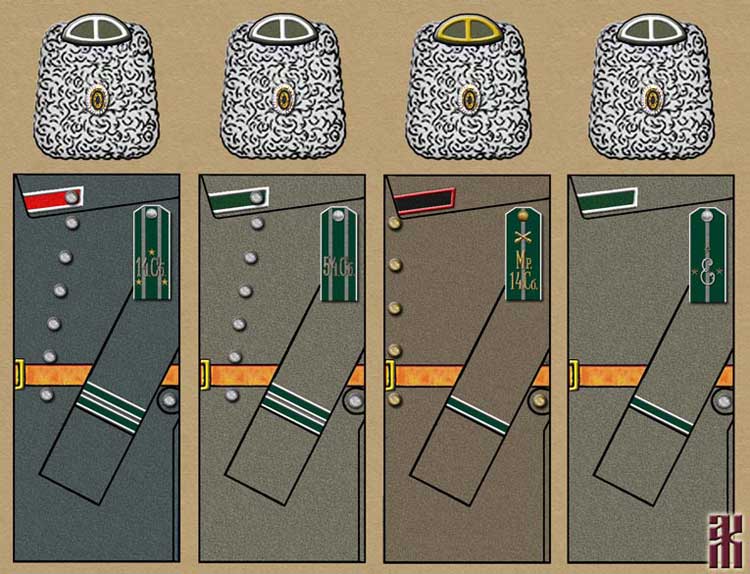
Winter uniform for officers of the 14th Siberian Rifle Division
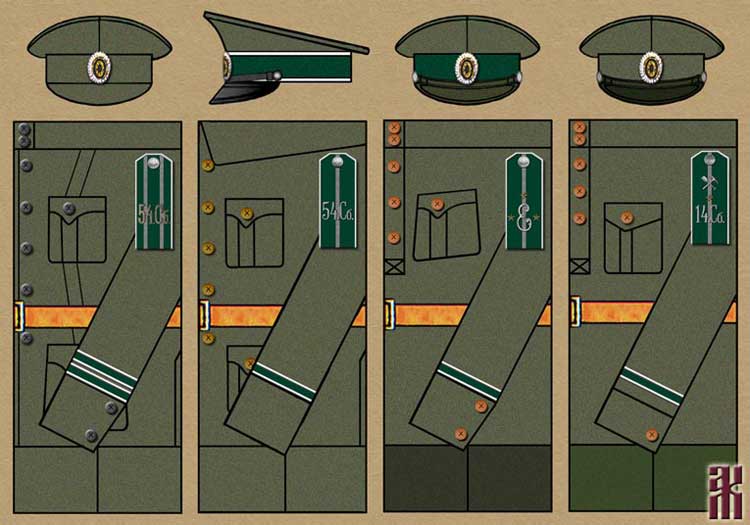
Summer uniform of rifle, jaeger and engineer officers of the 14th Siberian Rifle Division
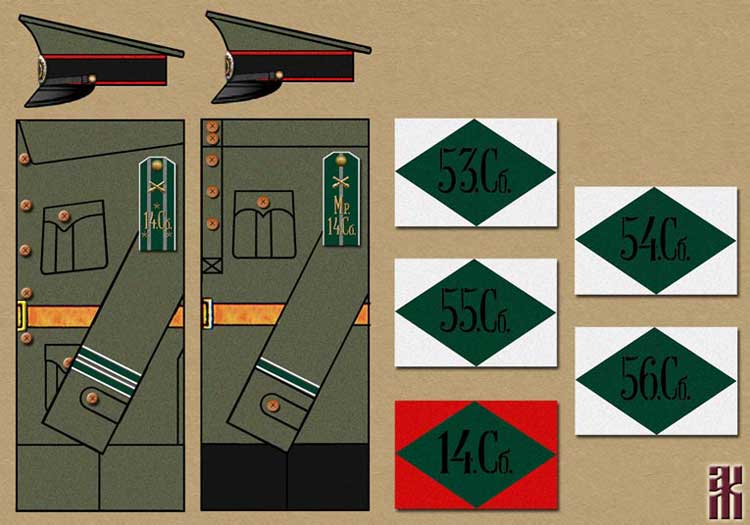
1 and 2 – summer uniform of artillery officers of the 14th Siberian Rifle Division
3 to 7 – staff flags of the rifle regiments and artillery brigade of the 14th Siberian RD
The flags were reconstructed based on a photograph of a parade of the 51st Regiment of the 13th Siberian Rifle Division in June 1919.
siberia.forum24.ru/?1-4-0-00000027-000-10001-1.
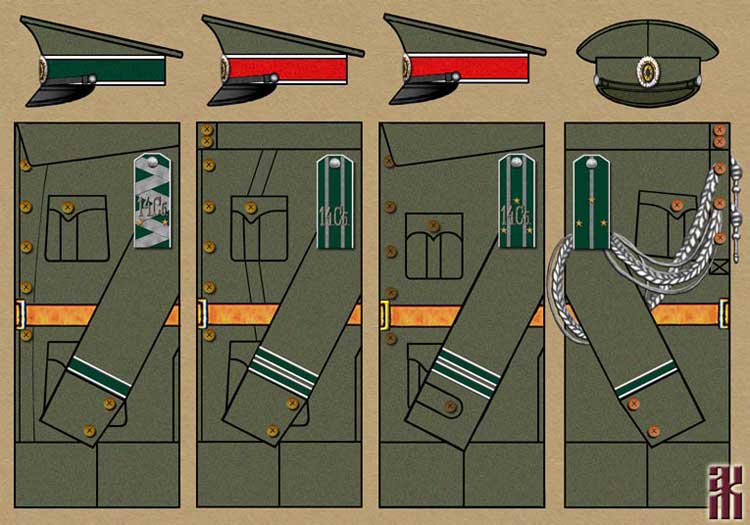
Summer uniforms of command and staff officers of the 14th Siberian Rifle Division
Home — State Symbols — Flags — Uniforms — Badges & Medals — Money — Other
Pygmy Wars Notes
The original for this page is at kolchakiya.ru/uniformology/14_Sib_rifles_div.htm.
The uniforms of the Jaeger Battalion for this division are < target="_blank" href="jaeger_units-eng.html">discussed here.
Discussion on the translation choices I have made can be found here.
Flags
The flags in the second last reconstruction are based on the standard Imperial practice for a camp colour but with Siberian white-green instead of divisional colours. They are not regimental banners, but markers for an HQ. The photograph they are based on is this one. Note: the green in the reconstruction appears too dark, both compared to the photograph and the usual Siberian green.
History of the 14th Siberian Rifle Division
In September 1918 the 3rd Irkutsk Reserve Rifle Brigade was formed in Irkutsk as part of the 4th East Siberian Army Corps: it included the Irkutsk, Baikal, Nizhneudinsk and Verkhneudinsk Regiments, a jaeger battalion, a sapper company, an engineer company, a telegraph cable detachment, and the 1st and 2nd East Siberian Artillery Divizions. Soon after the regiments were numbered from 9th to 12th and it was renamed the 3rd Irkutsk Reserve Rifle Brigade.
In December 1918 it was renamed the 3rd Siberian Reserve Rifle Division, and then in March 1919 the 14th Siberian Rifle Division, while at the same time the regiments were renumbered as the 53rd to 56th Siberian Rifle Regiments. It also had the 14th Independent Jaeger Battalion, the 14th Siberian Rifle Artillery Divizion, and the 14th Siberian Engineer Divizion (1st Reserve Engineer Company, a Sapper Company and the 7th Telegraph Cable Detachment).
In November 1919 it was reorganised as the 4th Siberian Rifle Brigade.
The 53rd Regiment, the most heavily propagandised, was the core of the Irkutsk rebellion against Kolchak of December 1919-January 1920. The Jaeger Battalion, the most reliable unit, also defected to the rebels after some hesitation, but returned the following day.