
Uniforms of the 11th Ural Rifle Division
41st Regiment of the 11th Ural Rifle Division, Saray-Gir
Taking advantage of the "rest", we carried out reconnaissance. It turned out that in the house on the square next to us was the headquarters of the 41st Regiment of the 11th Ural Division. Soldiers in black caps were on guard at the HQ and regimental banner. They were called either "textbooks" (from the training komand) or punitive forces.
Lebedinsky, D. S. in "The Bayonets Turned // Unforgettable", Moscow, 1961, p.127-128.
Home — State Symbols — Flags — Uniforms — Badges & Medals — Money — Other
Pygmy Wars Notes
The original for this page is at kolchakiya.ru/uniformology/11_shooter_div.htm.
The uniforms of the Taras Shevchenko Regiment, which fought with this division are here. The uniforms of the division's jaeger battalion are here.
Flags
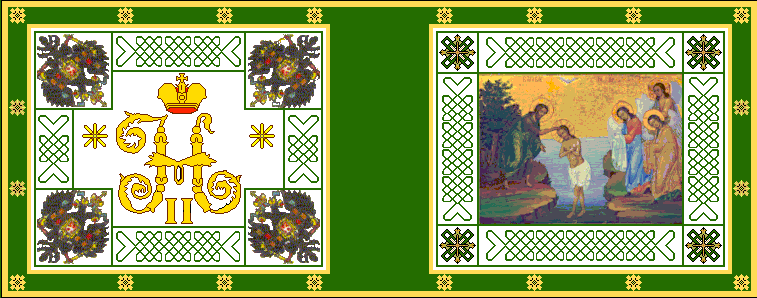
All four regiments apparently were given Nikolais of the 1900 model, in dark green: See here. They would have looked more or less like this:
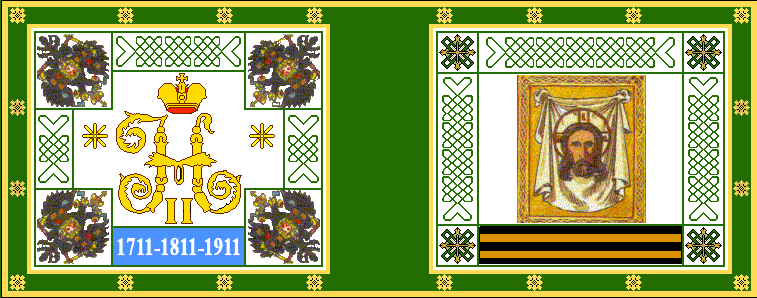
The 43rd Regiment bore the standard of the Insar Infantry Regiment of the Imperial Army, which had a painting of the Epiphany as its religious icon. This became the banner of the 2nd Ural Rifle Regiment in Transbaikalia.
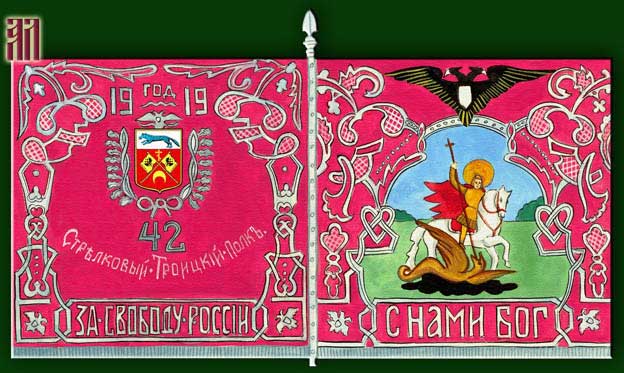
However the 42nd Regiment was given another, well attested banner, after it was separated from the rest of the division to fight with the Orenburg Army.
The Taras Shevchenko Regiment apparently had a "magnificent" banner, based on the yellow and blue of Ukraine.
History of the 11th Ural Rifle Division
Mostly taken from Volkov:
Formed mainly from conscripts in October 1918 in Chelyabinsk as part of the 3rd Ural Army Corps. Initially known as the 1st Reserve Rifle Division, made up of the 1st, 2nd, 3rd and 5th Ural Reserve Mountain Rifle Regiments (renamed the 1st-4th Reserve Rifle Regiments), the 1st Reserve Engineer Company, an NCO Training School and the Taras Shevchenko Ukrainian Company.
On 7 December 1918 it was renamed the 11th Ural Rifle Division with new regimental designations: the 41st Ural, the 42nd Troitsk, the 43rd Verkhneuralsk, and the 44th Kustanai Rifle Regiments and the 11th Independent Ural Rifle Artillery Divizion. The 41st Regiment included a Jaeger company, which in May 1919 was expanded into a battalion of three companies. The Taras Shevchenko company grew into a regiment.
It was deployed to the front in late autumn-winter 1918, took part in the spring offensive, and by the end of summer 1919 was severely depleted and understrength. Reinforcements arriving from Siberia were heavily influenced by enemy propaganda and defected to the enemy. Following the disbandment of the 6th Ural Rifle Corps and the reorganisation of the Western Army, the division became part of the Ural Group in May 1919.
From January 1919 the division was part of the 6th Ural Army Corps.
However the 42nd Regiment operated separately from the division from March 1919, serving first in the Independent Orenburg Army and then in the Southern Army. It surrendered in September 1919.
In August 1919 the disbanded 12th Siberian Rifle Division was incorporated into it, with its 45th Regiment renamed the 42nd Troitsk Regiment. It was destroyed in January 1920 near Krasnoyarsk. The remnants of the division, after reaching Transbaikalia, were reorganised into the 2nd Ural Rifle Regiment.