
Uniforms of the 1st Central Siberian Army Corps
This material was prepared with the participation of K. Novikov (Perm Military History Museum) and S. Shushpanov (Ufa Military History Museum). Reconstructions by A. Karevskiy
In Memoirs and Historiography
Initially, during the formation of the 1st Central Siberian Army Corps as a unit of the Siberian Army (in the Provisional Siberian Government), its units used the former field uniform of the Russian Imperial Army, but without cockades and shoulder-boards, which were replaced by white and green ribbons and sleeve insignia, as established by Order No. 10 of the War Department on 24 July 1918. At the same time, it was assumed that they would be trimmed with cloth on the chest opening of the blouses and the cuffs of Russian and "French" tunics (raspberry for riflemen, red for everyone else).
An example of what the command staff of the corps looked like in the autumn of 1918 can be seen in a photograph capturing the meeting of units of the 1st Central Siberian Corps and the Eastern Detachment of the Czechoslovak Corps with units of the Vladivostok Group of the Czechoslovak Corps at Olovnaya station on 6 September 1918.
Novikov, P. A. in "Units of the Czechoslovak Corps in Eastern Siberia (May-August 1918) // White Army, White Cause, No. 8", Ekaterinburg, 2000, p.17.
The reinstatement of shoulder-boards (by the commander of the Siberian Army, P. P. Ivanov-Rinov, in Order No. 64 of 6 September 1918, and the Commander-in-Chief of Russian forces, V.G. Boldyrev in Order No. 7 of 2 October 1918) was met with mixed reactions by the corps command. An article in the Omsk Historical and Local History Dictionary states that General Pepelyaev was the last in the Siberian Army to introduce the wearing of shoulder-boards in the units under his command. Most likely the corps commander, known for his democratic views, strictly followed the regulations and introduced only khaki shoulder-straps as long as he could, avoiding braided and coloured ones, and striving to follow the traditions of the field uniform of the former army.
Vibe, P. P., Mikheev, A. P. and Pugacheva, N. M. in "Omsk Historical and Local History Dictionary", Moscow, 1994, p.207.
Lieutenant-General Boldyrev, who conducted the review on 12 November, noted that the units of the 1st Central Siberian Corps that had arrived in Ekaterinburg to reinforce the North Ural Front presented themselves as regular units of the former Russian army. However, malicious tongues (through the mouth of V. D. Vegman) claimed that Pepelyaev had only put forward composite battalions of veteran volunteers for the parade. According to R. Gaida's assessment, the majority of the units that arrived were not very combat-ready and were sent to the rear for additional training.
Boldyrev, V. G. in "The Directory, Kolchak, the Interventionists", Novonikolaevsk, 1925. pp.97, 529.
Fedorov, A. in "The Perm Catastrophe and the Counteroffensive of the Eastern Front", Moscow, 1939, p.43.
Reconstructing the uniforms of the units of the 1st Central Siberian Corps, it can be stated with a certain degree of confidence that the old campaign uniform with khaki shoulder-straps and white-green cockades or ribbons was used en masse, and sometimes with newly installed details in the form of raspberry braid on the blouses of the riflemen and red braid on those of the artillerymen and engineers. The question of ciphers remains open, but there is information about the existence of shoulder-boards with the cipher "3.СЬ." in the 3rd Barnaul Siberian Rifle Regiment. An example of the appearance of the Siberian troops can be seen in photographs dated spring-summer 1919 and conditionally attributed to the Northern Group of General R. Gaida's Independent Siberian Army.
Another characteristic detail, based on a number of references in memoirs, is that gradually throughout 1919, Russian field caps were replaced by the cloth hats known as "Kolchakovka" caps in the units of the 1st Central Siberian Corps.
1st Central Siberian Army Corps, Perm, February 1919
The corps units preferred the white-green flag, which was hoisted over Perm on 24 December 1918. The white-green ribbons on the headgear of soldiers and officers were officially retained in the formation.
Sitnikov, M. G. in "The Perm Period in the Life of General Rudolf Gaida // White Army, White Cause, No. 14", Ekaterinburg, 2005, p.36, quoting the "Liberation of Russia" newspaper for 3 April 1919.
Perm, December 1919
The residents of the city, who had grown fond of the soldiers in their cloth caps with fir branches, reacted differently to the liberation of the city from the Bolsheviks.
Sitnikov, M. G. in "Perm has fallen! // White Army, White Cause, No. 13", Ekaterinburg, 2005, p.40.
Pepelyaev has seized all the supplies found in Perm and does not want to share them with anyone; he also forced all the wool factories to work only for his corps; Grivin, Verzhbitskiy, and Kazagrandi are doing the same and are not following anyone's orders; as a result, some units have an abundance of supplies, while others are starving and destitute...
Budberg, A. P. in "Diary of a White Guard // Archive of the Russian Revolution, Vol. 14", Berlin, 1924, p.237.
On the night of 24 December 1918, armed enemy soldiers appeared in the city, wearing white arm-bands, which initially misled us.
Zvezdov, A. A. in "The Grey Urals in the Civil War" at TsDOOSO F.41 Op.2 D.86 L.95. Material kindly provided by Ekaterinburg researcher D.V. Kadochnikov
3rd Barnaul Siberian Rifle Regiment, January 1920
To conceal ... the size and composition of the column, we ... adopted code names for the regiments. ... The "Green Regiment" was the 3rd Barnaul, in honour of the old 12th Siberian Barnaul Reserve Regiment which had the colour green.
Kambalin, A. I. in "The 3rd Barnaul Siberian Rifle Regiment in the Ice Campaign // White Guard, No. 3", Moscow, 1999-2000, p.81.
At one point, an entire battalion of conscript soldiers from the Vyatka province surrendered to me. They were all dressed in new black beaver overcoats and stood out strangely against the white snow. Someone must have persuaded them in advance to surrender, because they came to us in crowds, sticking their rifles into the snow. I assured them that no harm would come to them, but how bitter and angry I was when I later learned that all those who had surrendered had been stripped of their clothes in the rear. Their new overcoats were taken away under the pretext of "for the needs of the quartermaster", and they were dressed in various rags. Then I saw how even the officers of our regiment, led by the commander himself, made themselves tunics and trousers from those overcoats.
Polkovnikov, V. L. in "On the Waves of the Sea of Life // St. Petersburg: ZAO Polygraphic Enterprise No. 3", 2013. pp.95-96.
4th Eniseysk Siberian Rifle Regiment, Perm, 26 December 1918
Soldiers in ushanka fur hats with spruce twigs tucked in them, wearing sturdy sheepskin coats. On their shoulders were shoulder-boards.
Ivanov V.N. Exodus. A story about time and about myself // Far East, No. 12", 1994, p.4.
Perm, 26 December 1918
When dawn had already broken, the first patrols of White Siberians appeared on the streets of the city, wearing green fir branches on their headgear.
Klerzhe, G. I. in "The Civil War in Siberia // Admiral Kolchak's Eastern Front", Moscow, 2004, p.279.
The story "Comrades and Parfenychi" tells of the Russian Army's occupation of one of the Ural cities.
"They're here!"
"Who?"
"They are. The Whites. From Eniseysk."
I lifted the curtain. Yes. Definitely. They're coming. Blue shoulder-boards, tired but cheerful, laughing.
"Siberian Riflemen [newspaper]", 9 April 1919, p.2. at www.siberia.forum24.ru/?1-8-0-00000005-000-0-1-1290858754.
In winter the lack of warm clothing and underwear was particularly acute. There is a shortage of underwear, tobacco and sugar. At that time the uniforms came from England: green cloth overcoats, large leather pouches, belts with officer shoulder straps, black leather boots. Weapons were also obtained from England: Russian-style 3-line rifles manufactured by New Inglant. America supplied the same rifles manufactured by Remington-Amori. Japan supplied its own model rifles and leather boots. ... There was a shortage of uniforms. There was no underwear at all. The uniforms were made of handmade peasant cloth, both tops and trousers.
Interview with Ensign Anatoly Shapiro of the 4th Eniseysk Regiment, who defected on 6 June 1919 in the 30th Division sector, at TsDOOSO F.41 Op.1 D.83 L.111, 113. Material kindly provided by Ekaterinburg researcher D. V. Kadochnikov.
2nd Siberian Rifle Division, Tomsk, Mid-December 1919
Military units and supply trains stretched endlessly along the snow-covered streets of Tomsk... All the soldiers wore white and green ribbons on their Kolchakovka caps.
Ivanov, V. N. in "Exodus: A story about the times and about myself // Far East, No. 12", 1994, p.44.
Reconstructions
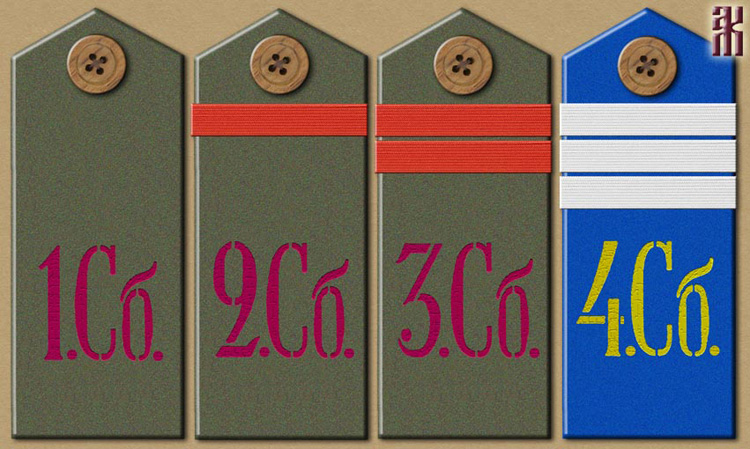
Shoulder-boards of lower ranks of rifle regiments of the 1st Siberian Rifle Division:
1 – Novonikolaevsk; 2 – Barabinsk; 3 – Barnaul; 4 – Eniseysk Siberian Rifle Regiments).
The shoulder-boards of the 4th Eniseysk Regiment are shown as the result of an article in the newspaper Sibirskie Strelki of 9 April 1919, where blue shoulder-boards are mentioned in the account of the events of 1918 among the ranks of the regiment that came from Eniseysk. Information on the 1st Central Siberian Army Corps, dated 16 October 1918, has only the 4th Eniseysk Siberian Rifle Regiment being quartered in Eniseysk.
In the 2nd Siberian Rifle Division, the codes were respectively, "5.СЬ.", "6.СЬ.", "7.СЬ." and "8.СЬ." for the 5th Tomsk, 6th Mariinsk, 7th Kuznetsk and 8th Biysk Siberian Rifle Regiments.
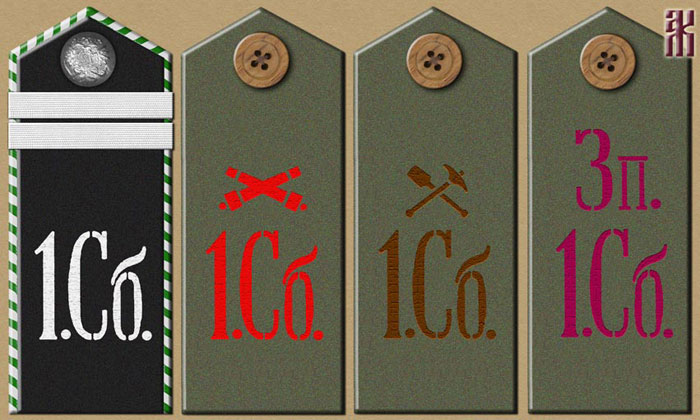
Shoulder-boards of the lower ranks of the 1st Siberian Rifle Division:
1 – 1st Siberian Jaeger Regiment; 2 – 1st Central Siberian Artillery Divizion ;
3 – 1st Central Siberian Engineer Divizion ; 4 – 1st Siberian Frontline (Reserve) Regiment
The shoulder-boards of the 1st Siberian Jaeger Regiment were taken from a reconstruction by Perm researcher K. Novikov at www.bergenschild.narod.ru [link dead].
In the 2nd Siberian Rifle Division the codes were similar, but with the "1" replaced by "2".
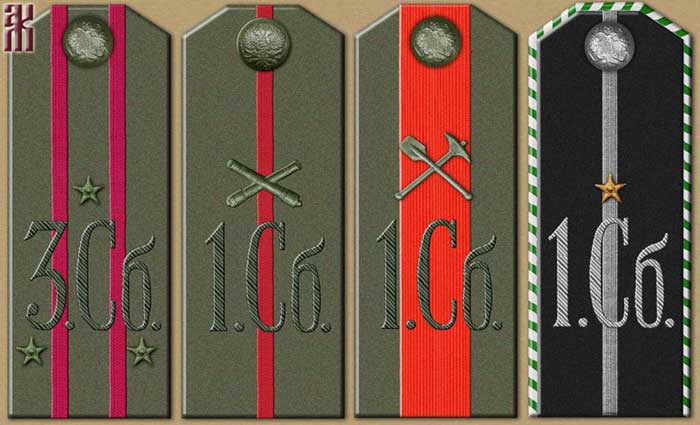
Shoulder-boards of officers of the 1st Central Siberian Army Corps
1 – 3rd Barnaul Siberian Rifle Regiment; 2 – 1st Central Siberian Artillery Divizion ;
3 – 1st Central Siberian Engineer Divizion ; 4 – 1st Siberian Jaeger Regiment
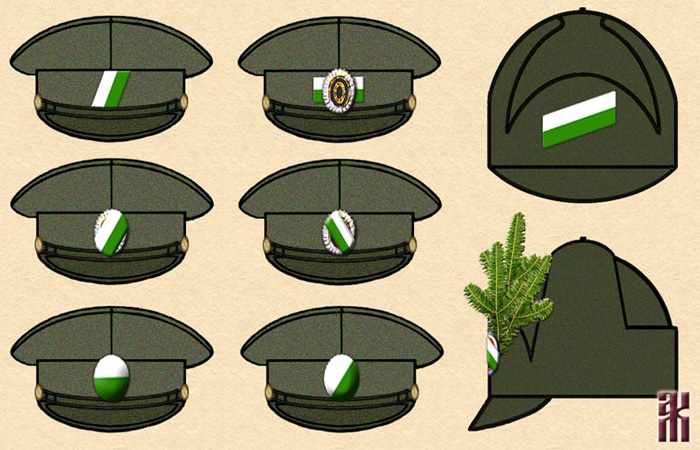
White-green ribbons worn on the headgear of officers of the Siberian Independent Army (late 1918-first half of 1919)
On the right is a woollen cap that was extremely common in the units of the Russian Army of the Supreme Ruler, known as the "Kolchakovka". Wearing fir branches on hats was a distinctive symbol of the Siberian Army and was introduced in the summer of 1918, although it was not officially regulated anywhere. Most likely this was copied from the Czechoslovak Corps, whose soldiers often wore linden branches. They in turn had copied it from the Austro-Hungarian Army, whose officers wore oak branches.
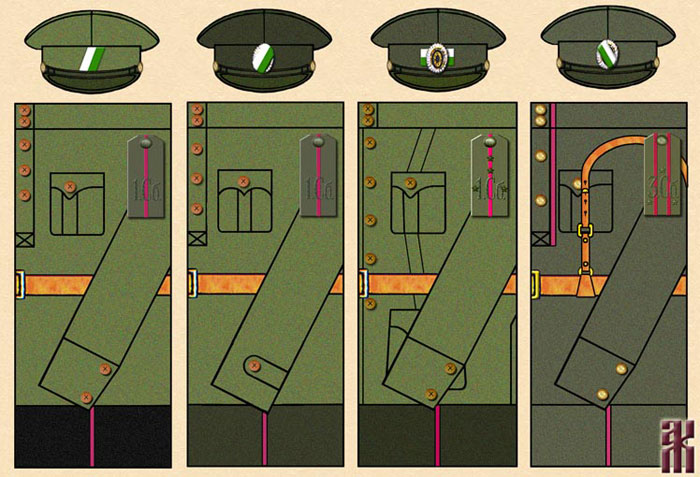
Uniforms of the Siberian Independent Army
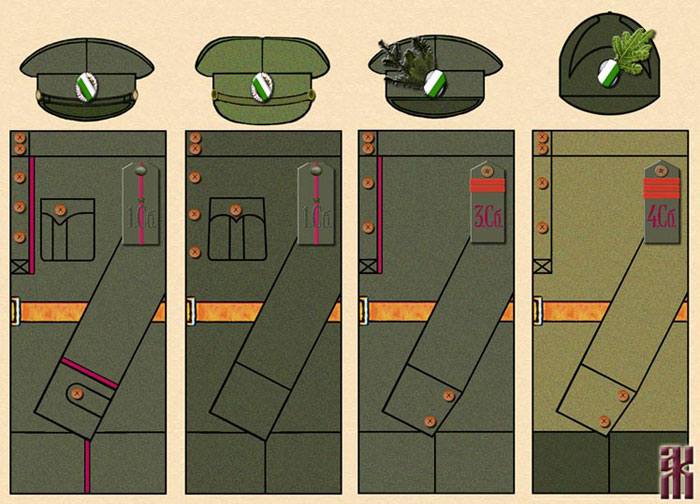
Uniforms of the Siberian Independent Army
The uniform reconstructions are based on the photographs mentioned at the start.
Personal Escort and Pennon of the Commander of the 1st Central Siberian Corps,
A. N. Pepelyaev
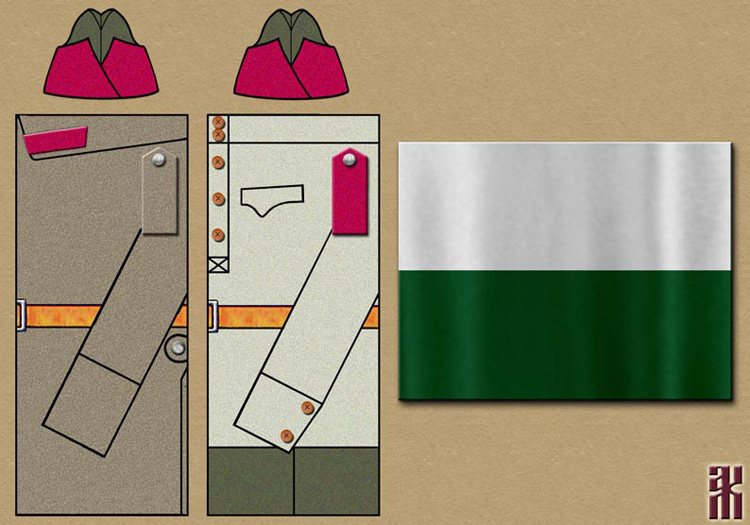
Presumed version of the uniform of the personal escort of the commander of the 1st Central Siberian Corps and the commander's flag.
Yuzefovich quotes the recollections of one of the corps officers relating to the winter of 1918-1919:
[General Pepelyaev] rode a white horse under a white and green flag in a whirlwind of clear swirling snow on Sennaya Square in Perm, along the long frontage of the Perm Division, which had just been formed to fight the Reds. Behind him, to the sound of "hurrahs", flew his escort in hats with raspberry tops.
Yuzefovich, L. A. in "General A. N. Pepelyaev and Anarchist I. Ya. Strod in Yakutia, 1922-1923", Moscow, 2015, p.83,
GASO has a photograph, taken in Ekaterinburg in 1919 and usually titled "Privates of Kolchak's army cavalry unit". It shows a group of soldiers in greatcoats with straight (not pointed) lapels, coloured greatcoat tabs and shoulder-boards made of greatcoat cloth. The most interesting thing about them is their headgear: a high folded cap (like a sidecap), coloured cloth on the inside and a triangular cutout at the front. There are no cockades or ribbons. We venture to suggest that this is the escort of the commander of the 1st Central Siberian Corps.
1723.ru/forums/uploads/post-3566-1444674250.jpg
The insignia of the corps commander is also shown in a photograph.
http://tomskmap.tomsk.ru/39-томский-пехотнй/белый-томск [link dead]
Home — State Symbols — Flags — Uniforms — Badges & Medals — Money — Other
Pygmy Wars Notes
The original for this page is at kolchakiya.ru/uniformology/1sib_army_corp.htm.
The photograph of the command staff of the Corps in Autumn 1918 is this one. The 1919 photograph in Ekaterinburg of Pepelyaev's escort is this one. The photograph showing the insignia of the corps commander is this one. The reconstruction of the shoulder-boards of the 1st Siberian Jaeger Regiment by K. Novikov can be seen here.
The first two regiments of an Imperial infantry division had red shoulder-boards and the third and fourth had blue, hence the choice of colour for the Eniseysk Siberian Rifle Regiment. If the others went to coloured shoulder-boards, it was presumably in the same scheme.
The uniforms of other units of the corps are elsewhere in Kolchakiya: the 16th Siberian Rifle Division, the 1st Independent Siberian Shock Brigade and the 1st and 2nd Jaeger Regiments.
Discussion on the translation choices I have made can be found here.
Flags
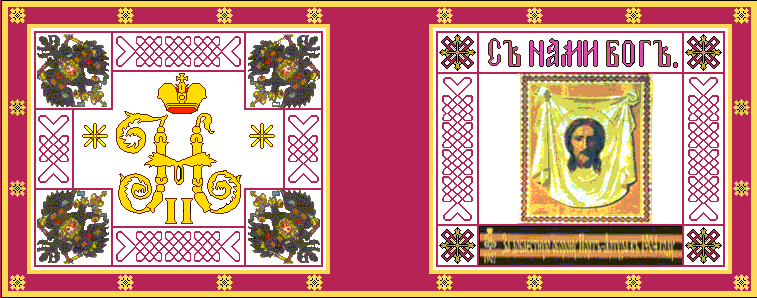
It is known that the 3rd Siberian Division had some old Imperial Siberian Rifle banners: see here. A printable version is below:
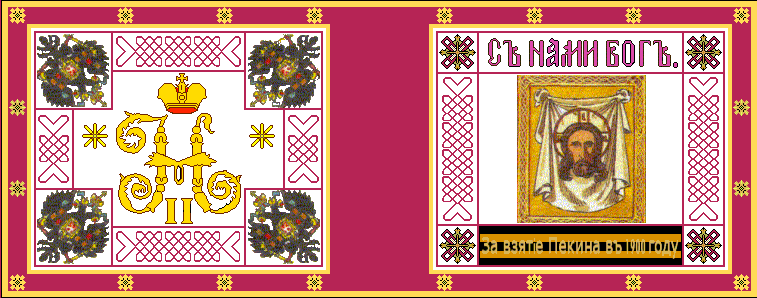
They differed only in the particular depiction of Christ "not made by human hands" and the writing on the St George ribbon underneath.
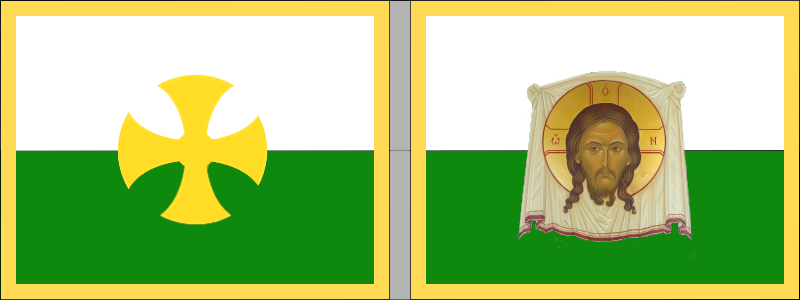
The other units may well have had flags based on the white-green of Siberia, since we know that other Siberian Rifle units had them and the division did as well. One such flag, of unknown unit, is this one:
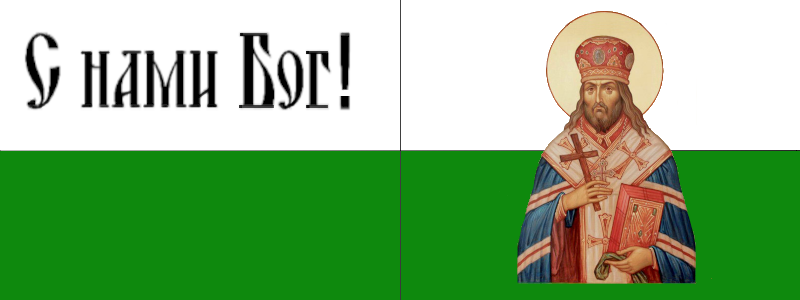
The Division's flag has not survived, but is known to be St. Innocent, patron saint of Siberia, on the front and the inscription "God is with us" on the reverse. It presumably looked something like this:
A banner for a battalion of the Shock Regiment is also known.
History of the 1st Central Siberian Army Corps
Mostly taken from Volkov:
The base was volunteer officer detachments that hastily formed in June 1918. Three detachments – from Tomsk, Novo-Nikolaevsk and Barnaul – were placed under the overall command of Lieutenant-Colonel Pepelyaev and joined Captain Gaida's Czech units. They moved from central Siberia eastwards into Transbaikalia, clearing the area of Red forces.
After that they were reinforced and reformed as the Central Siberian Corps: on 26 August renamed the 1st Siberian Corps, then from 30 September an Army Corps. The initial units in the corps were the 1st Tomsk, 2nd Rifle, and 3rd Irkutsk Siberian Divisions, plus some small Cossack units. Originally it consisted entirely of volunteers, mainly members of underground organisations. Upon reaching Lake Baikal the corps had at least 5,000 men. Losses were regularly replenished by new volunteers, and by the end of the summer it numbered between 7,000 and 8,000, not counting local partisan detachments. Of the 5,261 riflemen in September, 2,929 were officers. With its formation as an Army Corps on 4 October 1918, the corps's reserve brigades were reorganised into the 1st and 2nd Reserve Divisions, each comprising four regiments, but the 3rd Division was detached.
The corps undertook a famous march to Perm and later fought at Glazov. It was part of the North Ural Front, then the Ekaterinburg Group of the Siberian Army, and from the end of December 1918, the newly formed Independent Siberian Army. In February-March 1919 it included the 1st and 2nd Central Siberian Divisions, the 16th Siberian (Perm) Rifle Division, and the 1st Independent Siberian Shock Brigade. By May it had also added the 17th Independent Siberian Rifle Brigade, a independent heavy and long-range artillery batteries, an escort half-company and a telegraph company. The divisions' reserve regiments were combined into a "frontline" brigade. The 11th Orenburg Cossack Regiment was also attached to it.
From July 1919 it formed part of the 1st Army. By the end of October 1919, having lost more than three-quarters of its strength in combat and to epidemics, the corps' units were withdrawn from the front to the rear, where they disintegrated and disbanded during December 1919. In January 1920 the only unit remaining of the entire corps was the 3rd Barnaul Siberian Rifle Regiment, which safely withdrew to Transbaikalia. Other than that, only a few individuals from the corps made their way to Chita.
1st Siberian Rifle Division
Formed from volunteer units in July 1918 as the 2nd Rifle Division, with the 1st and 2nd Novonikolaevsk, 1st Enisei Siberian and Barnaul Rifle Regiments. On 26 August it was renamed the 1st Siberian Division, with the 1st Novonikolaevsk, the 2nd Barabinsk, the 3rd Barnaul, and the 4th Yenisei Siberian Rifle Regiments, as well as the 1st Central Siberian Rifle Artillery Divizion.
In 9 May 1919 it had the same regiments with the 1st Composite Siberian Artillery Divizion, the 1st Siberian Engineer Divizion, the 1st Siberian Jaeger Regiment and the 1st Siberian Frontline (Reserve) Regiment.
On 8 November 1919, it was sent to the rear for reinforcement. In January 1920 it was captured in the Mariinsk-Krasnoyarsk area.
2nd Siberian Rifle Division
Formed from volunteer units in July 1918 as the 1st Tomsk Division, with the 1st, 2nd, 3rd and 4th Tomsk Siberian Rifle Regiments, the 2nd Siberian Rifle Artillery Regiment, engineer and cavalry detachments. Soon after it added the 2nd Jaeger Battalion (later regiment). In August it was renamed the 2nd Siberian Division, as part of the 1st Central Siberian Rifle Corps.
The units were renamed the 5th Tomsk, 6th Mariinsk, 7th Kuznetsk, and 8th Biysk Siberian Rifle Regiments and the 2nd Central Siberian Rifle Artillery Divizion. In May 1919 it included the same rifle regiments, the 2nd Composite Siberian Artillery Divizion, the 2nd Siberian Engineer Divizion, the 2nd Siberian Jaeger Regiment and the 2nd Siberian Frontline (Reserve) Regiment. On 8 November 1919, it was sent to the rear for reinforcement. In January 1920, it was captured in the Mariinsk-Krasnoyarsk area.
3rd Irkutsk Siberian Rifle Division
Immediately after the capture of Irkutsk by Czech and Russian forces in the summer of 1918, Colonel P. P. Grivin began forming the Irkutsk Detachment. A few days later, that brigade, of three battalions, marched to the front, where it took an active part in the battles for control of the Krug-Baikal Railway, the rout of the Reds near Tanhoy and Posolskaya, and their pursuit until they joined forces with Ataman Semenov's detachment.
In June 1918 the Irkutsk Division was formed as part of the 1st Central Siberian Corps, with the Irkutsk, Baikal, Nizhneudinsk and Khamardaban Regiments, drawn from volunteer detachments of the same names. On 26 August 1918 it became the 3rd Siberian Division, with the regiments numbered from the 9th to the 12th. It was transferred to Ekaterinburg, from where it marched to the Bisertsk factory, occupied Krasnoufimsk, fought at Peschannaya Gora, near Osa, Sarapul and other engagements, in the course of which it took heavy casualties.
In October 1918 it was temporarily incorporated into the 2nd Steppe Siberian Corps. In January units of the 4th East Siberian Army Corps were assigned to reinforce it. From March 1919 it became part of the 4th Siberian Army Corps. It included the 9th Irkutsk, 10th Baikal, 11th Nizhneudinsk, and 12th Verkhneudinsk Siberian Rifle Regiments, the 3rd Irkutsk Siberian Rifle Artillery Divizion, the 3rd Siberian Engineer Divizion and the 3rd Front-line (Reserve) Regiment.
It remained a division during the Ice March and was incorporated into the 2nd Corps of the Far Eastern Army from March 1920. With the withdrawal from Transbaikalia, many officers of the division, unwilling to stray far from their native lands, left its ranks and joined the Asiatic Horse Division, which had withdrawn to Mongolia. In Primor'e it was reorganised into the 3rd Irkutsk Rifle Regiment.
17th Siberian Independent Rifle Brigade
Formed in the spring of 1919, it was part of the 1st Central Siberian Rifle Corps. It included the 65th Ob and 66th Altai Siberian Rifle Regiments, the 17th Siberian Rifle Artillery Divizion, the 17th Siberian Engineer Divizion and the 17th Siberian Jaeger Divizion.