
Uniforms of the 18th Siberian Rifle Division (April-December 1919)
Material and reconstructions by A. Karevskiy
18th Siberian Composite Division (April-June 1919)
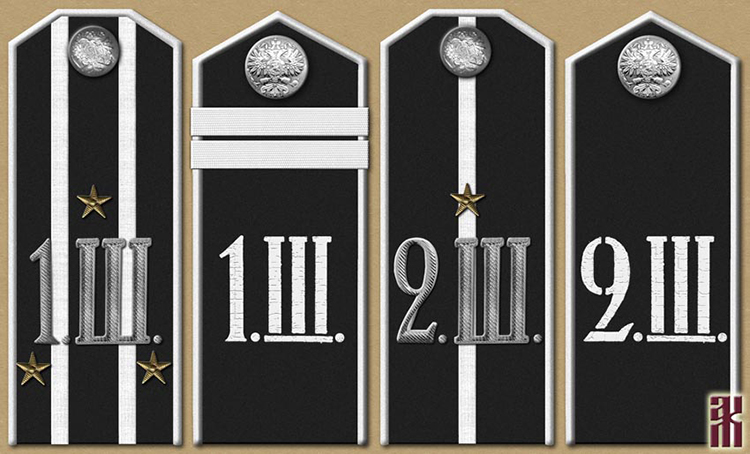
Insignia of the 2nd Siberian Assault Brigade:
1 and 2 – lieutenant-colonel and corporal in the 1st Assault Regiment;
3 and 4 – ensign and private in the 2nd Assault Regiment
It is assumed that the brigade's insignia was modelled on that of the 1st Siberian Assault Brigade: black shoulder-boards with white piping and stripes; with ciphers for the regiments – 1st Assault Regiment would be "1.Ш.", 2nd Assault Regiment would be "2.Ш.". [But see note at end]
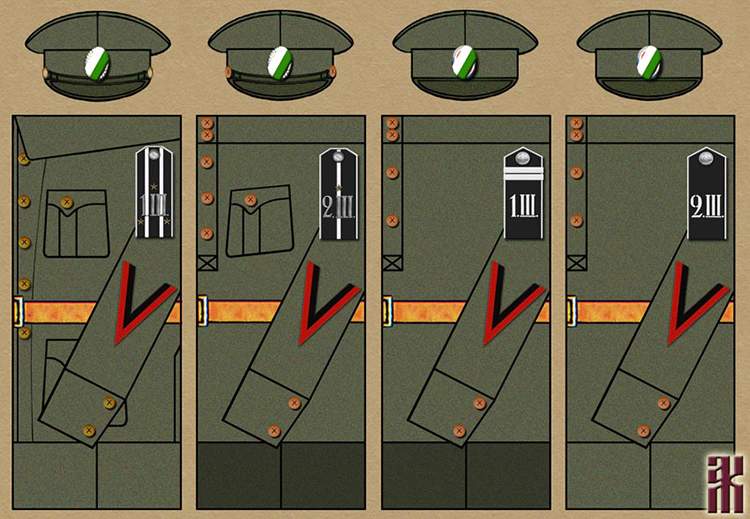
Uniform of the 2nd Siberian Assault Brigade
The brigade's "assault" status implied the presence of a black and red chevron on the left sleeve. Subsequently the brigade proved itself incapable of performing assault tasks and lost this status, along with the corresponding insignia. The cockades shown here are covered with white and green ribbons, as was customary in the units of the Siberian Army.
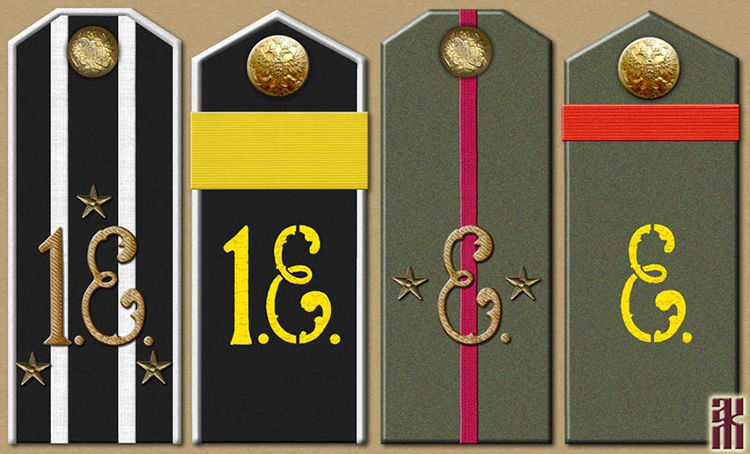
Insignia of the 1st Jaeger Regiment (1 and 2 – lieutenant-colonel and sergeant-major) and the Jaeger Battalion of the 7th Tobolsk Siberian Rifle Division (3 and 4 – second-lieutenant and lance-corporal) of the 18th Siberian Composite Division's second brigade
According to some sources, the 1st Jaeger Regiment was reorganised from the newly formed 1st Siberian Assault Regiment, so the colour of its shoulder-boards is also shown as black with white piping and stripes (inherited from the assault and shock units), with the addition of the traditional cipher for the Supreme Ruler's jaeger units in the form of a curlicue letter "Е". The shoulder-boards of the Jaeger Battalion of the 7th Tobolsk Siberian Rifle Division are shown as khaki (as was used throughout the division) with the corresponding ciphers. This battalion was officially assigned to the 2nd Jaeger Regiment, but in reality its reorganisation was never completed during the period.
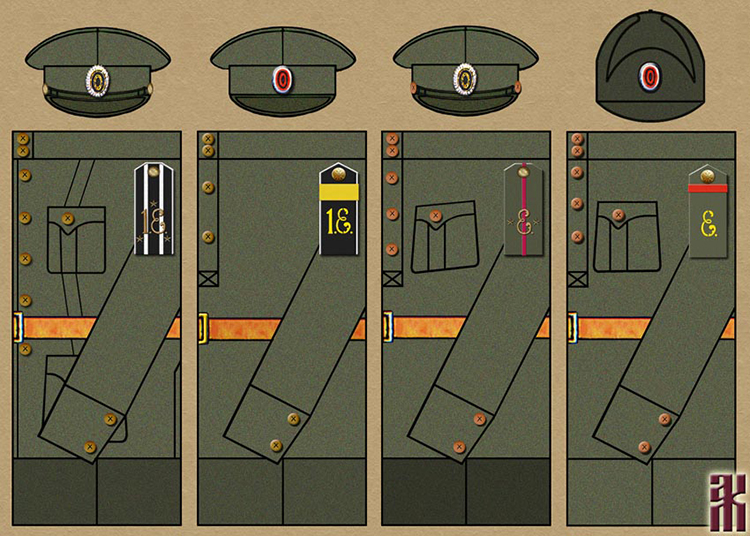
Uniforms of the 1st Jaeger Regiment and the Jaeger Battalion of the 7th Tobolsk Siberian Rifle Division
Judging by photographs, the widely used headgear commonly nicknamed the "shapki-kolchakovski", Kolchak caps, were widespread in the units of the 7th Tobolsk Siberian Rifle Division. It is logical to assume that they were also found in the division's Jaeger Battalion, which became part of the 18th Siberian Composite Division.
18th Siberian Rifle Division (June-December 1919)
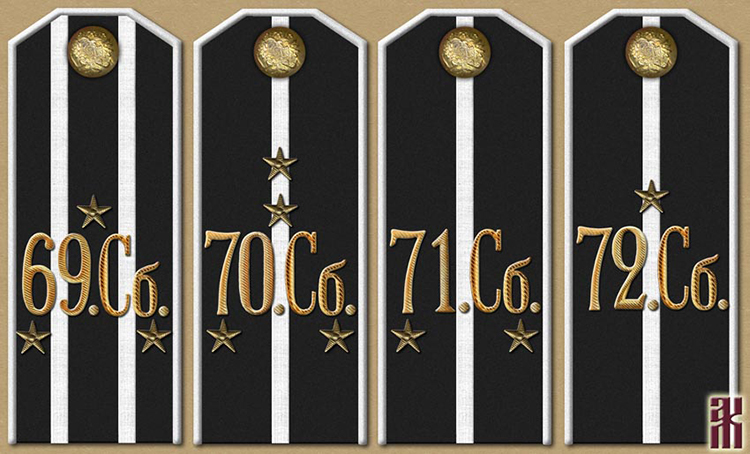
Insignia of officers of the rifle regiments of the 18th Siberian Rifle Division
Since the backbone of the newly formed division was made up of regiments of the 2nd Siberian Assault Brigade, it is logical to assume that the latter's regiments inherited the corresponding insignia colour – black with white piping and stripes (especially since the shoulder-boards of the 1st Jaeger Regiment were the same).
This assumption is supported by the fact that Colonel N. N. Kazagrandi, the former commander of the 16th Ishim Siberian Rifle Regiment, had introduced similar black shoulder-boards into that unit, in memory of his 1917 service in the Revel Marine Death Battalion. It seems likely the commander could not help but take advantage of such favourable circumstances to revive the colours that were dear to him.
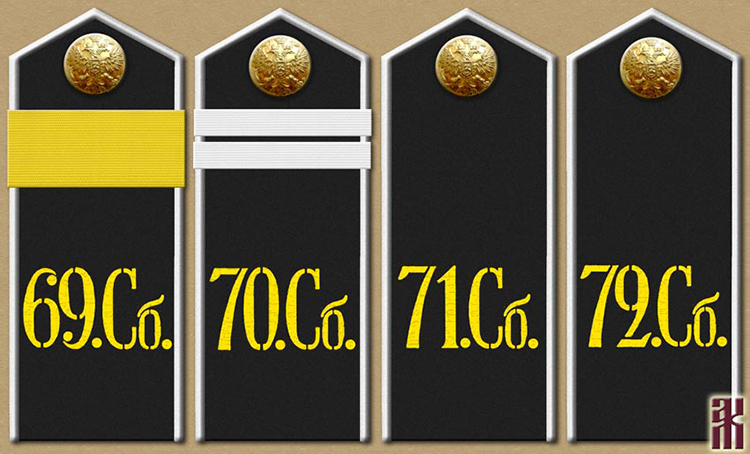
Insignia of other ranks of the rifle regiments of the 18th Siberian Rifle Division
The insignia shown here are gold for officers and yellow stenciled for lower ranks, as was customary in infantry (rifle and jaeger) units. The insignia in the Ishim Regiment were white (silver) in memory of the Revel Battalion.
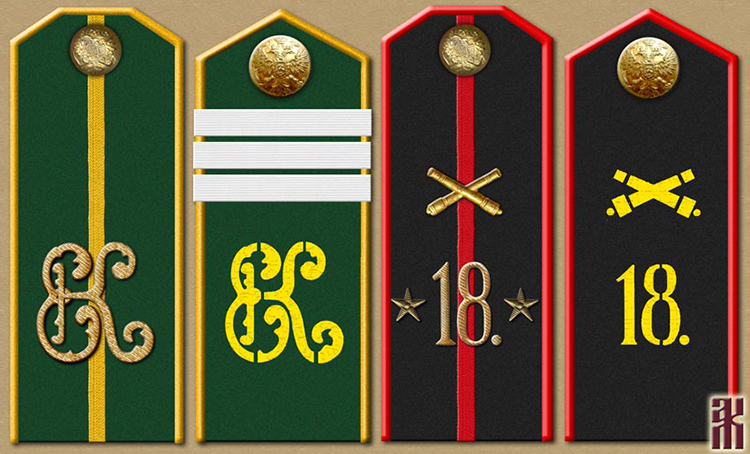
Shoulder-boards of the 18th Siberian Division:
1 and 2 – 18th Cavalry Divizion; 3 and 4 – 18th Artillery Divizion
The cavalry was the former Horse-Jaeger Divizion of Captain, later Colonel, M. M. Manzhetniy. Its shoulder-boards have been reconstructed based on the work of historian and eyewitness B. B. Filimonov, who gave the following description:
Green shoulder-boards with yellow piping and the same greatcoat tabs. The shoulder-boards had the intertwined yellow letters: "ЕК".
Filimonov, B. B. in "The White Rebels: the Khabarovsk campaign, Winter 1921-1922. Book 1", Shanghai, 1932, p.41.
The divizion's uniform began to take shape even before it became part of the 18th Siberian Rifle Division, during the period when Manzhetniy was forming his unit on the basis of the former Soviet 10th Cavalry Regiment, which had gone over to the Whites. While part of the 18th Siberian Composite Division, the divizion was reinforced by a horse komand from the 16th Ishim Siberian Rifle Regiment, which wore black regimental shoulder-boards with white piping and stripes.
The shoulder-boards of the 18th Artillery Divizion have been reconstructed based on the assumption that the black colour of the division was retained here, with the white colour of the rifle regiments replaced by the [normal] red colour of artillery.
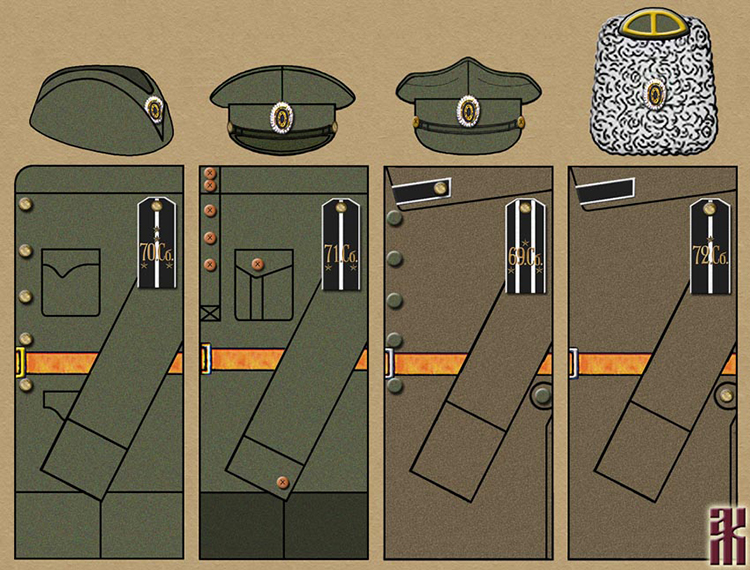
Uniform of officers of the rifle regiments of the 18th Siberian Rifle Division
According to memoirs, division commander N. N. Kazagrandi was a good manager and knew how to obtain the necessary uniforms for his units. But as in all Kolchak's army, a huge variety in individual items remained characteristic.
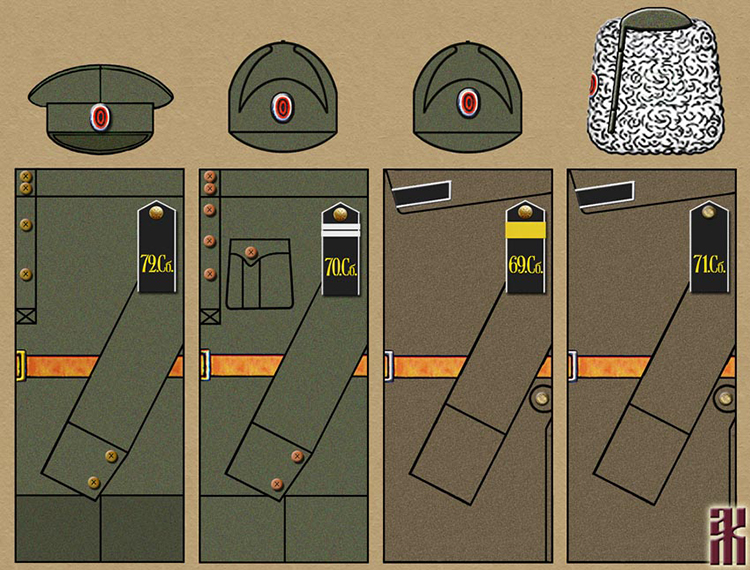
Uniform of the lower ranks of the rifle regiments of the 18th Siberian Rifle Division
Figures 2 and 3 show Kolchakovki hats. Here they are shown with cockades on the peak, but in practice such headgear was often worn without cockades, since their appearance alone clearly indicated that the soldier belonged to the armed forces of the Supreme Ruler.
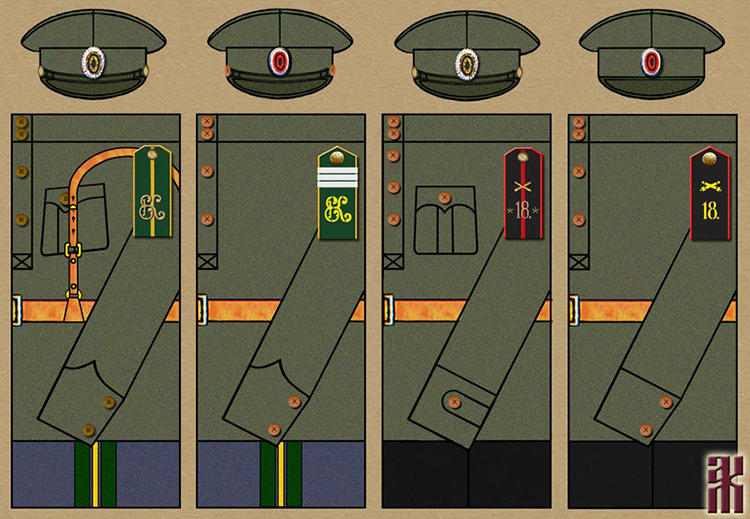
Uniforms of the Horse-Jaeger Divizion (18th Horse Divizion) and the 18th Artillery Divizion
Filimonov mentions the uniform of the Horse-Jaeger Divizion as follows:
The divizion had a special uniform: green shoulder-boards with yellow piping and the same greatcoat tabs. The shoulder-boards had the intertwined yellow letters: "ЕК". The trousers had double green stripes with yellow piping in the middle.
Grey-blue cavalry breeches are shown here, but it is quite possible that, due to a lack of appropriate uniforms, that normal khaki trousers were used.
Filimonov, B. B. in "The White Rebels: the Khabarovsk campaign, Winter 1921-1922. Book 1", Shanghai, 1932, p.41.
Home — State Symbols — Flags — Uniforms — Badges & Medals — Money — Other
Pygmy Wars Notes
The original for this page is at kolchakiya.ru/uniformology/18_Sib_rifles_div.htm.
Based on numbering on the 2nd Assault Brigde the first two reconstruction schemes shown above would appear to be wrong. The units were the 3rd and 4th Assault Regiments, not the 1st and 2nd (those were in the 1st Assault Brigade) and so should have "3" and "4" on their shoulder-boards, not "1" and "2". Even then the system is at odds with the one shown for the 1st Assault Brigade, which have the form "1.Сб.Ш.Б.".
The letter "Е" on the shoulder-boards is for eger, the Russian spelling of jaeger. The "Ш" is an "Sh" for shturm, which I have translated as "assault" but is often given as "storm". Discussion on other translation choices I have made can be found here.
The 2nd Siberian Assault Brigade, around which this unit was formed, is discussed here.
Flags
The flags of the infantry units are not known.
However the flag of Manzhetniy's horse jaegers is shown here.
History of the 18th Siberian Rifle Division
Largely taken from Volkov.
The 2nd Siberian Assault Brigade was formed in late January 1919 on the model of the 1st Siberian Assault Brigade, with the 3rd and 4th Siberian Assault Regiments and the 2nd Siberian Assault Artillery Divizion. However, due to the brigade's composition being unsuitable for carrying out "assault" tasks it was decided to reform it as a regular unit.
On 19 April 1919 the Composite Siberian Rifle Division was formed from the 2nd Siberian Assault Brigade, two Jaeger battalions (one from the 16th Ishim Rifle Regiment, the other from the 7th Tobolsk Siberian Rifle Division) and a cavalry divizion.
On 27 June 1919 it was renamed the 18th Siberian Division, and the regiments given new names. It was part of the 3rd Steppe Siberian Army Corps, then from 26 July 1919 the Southern Group of the 2nd Army.
It was made up of the 69th (formerly 3rd Assault), 70th (formerly 4th Assault), 71st (former Jaeger Battalion), and 72nd (former Jaeger Battalion) Siberian Rifle Regiments, plus a Horse-Jaeger Divizion and presumably the 18th Artillery Divizion. On 17 August 1919 the 71st Regiment was separated from the division and attached to the group's assault brigade.
This division was created and promoted by Colonel Kazagrandi. His removal, due to intrigues, led to a decline in the division's morale and its collapse. It surrendered in early January 1920 near Krasnoyarsk.