
Former Imperial Banners in the Army of the Supreme Ruler
All reconstructions by A. Karevskiy
7th Urals Mountain Rifle Division
25th Ekaterinburg Admiral Kolchak Mountain Rifle Regiment
A St. George pattern flag was granted in 1878 to the 1st Battalion of the 162nd Akhaltsikhe Infantry Regiment. It later became the main banner of the regiment. It had light blue medallions, a St. George finial from 1867, and a black pole. The inscription reads: "For distinction in the Turkish War of 1877 and 1878". It was used during the Russo-Japanese War and World War I. It was saved during hand-to-hand combat in the Battle of Mukden on 25 February 1905. It was kept in Japanese captivity by NCO Grishanov.
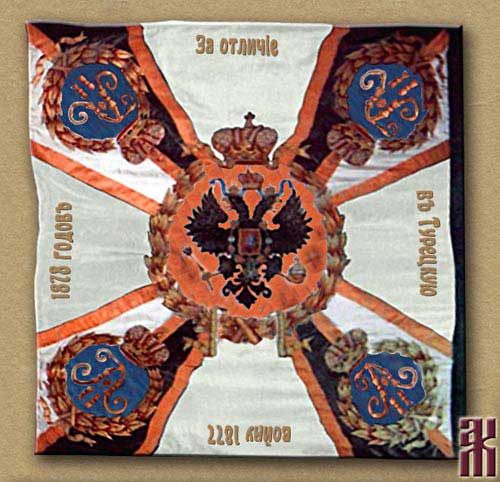
Reconstruction of the flag of the 162nd Akhaltsikhe Infantry Regiment
It was presented by Supreme Ruler Kolchak to the 25th Regiment's commander, Lieutenant-Colonel B. A. Gerasimov, on 23 February 1919 at Cathedral Square in Ekaterinburg. During Kolchak's retreat it was captured by partisans sixty kilometres south of the railway to Krasnoyarsk and taken by them to Tomsk. Its further fate is unknown.
"Siberian Voice [Newspaper]" of 26 February 1919.
Kruchinin, A. M. in "From the Ural Mountains to the Shcheglovsk Taiga: A Brief History of the 7th Urals Mountain Rifle Division // White Army, White Cause No. 11", Ekaterinburg, 2002, p. 46.
Kruchinin, A. M. in "From the Ural Mountains to the Shcheglovsk Taiga: A Brief History of the 7th Urals Mountain Rifle Division // White Army, White Cause No. 12", Ekaterinburg, 2003, p. 56.
Shevyakov, T. N. in "Banners and Standards of the Russian Imperial Army of the Late 19th to Early 20th Centuries", Moscow, 2002.
27th Kamyshlovo-Orovai Mountain Rifle Regiment
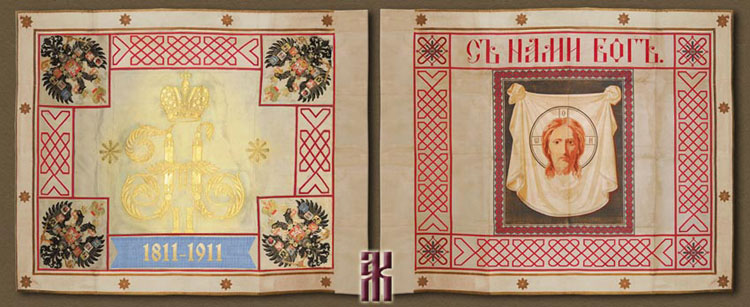
Reconstruction of the flag of the 195th Orovai Infantry Regiment
This was a simple anniversary flag of the 1900 model with a white border and gold embroidery. It was granted on 27 March 1911, in honour of the 195th Infantry Regiment's 100th anniversary. The inscriptions on the St. Andrew's ribbon is "1811-1911".
RGVA F.39512 Op.1 D.58 L.108; F.39617 Op.1 D.256 L.28ob.
28th Irbit-Pernovsk Mountain Rifle Regiment
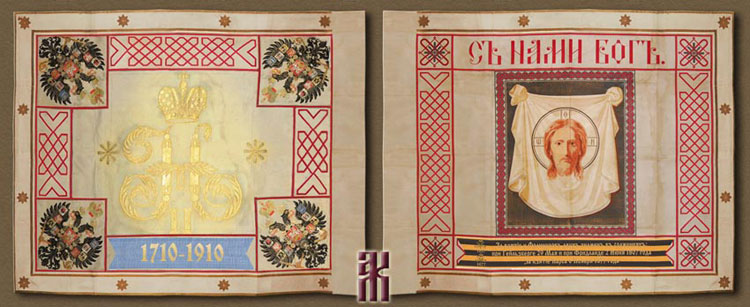
Reconstruction of the flag of the 3rd Pernovsk Grenadier Regiment
A St. George Model 1900 Jubilee flag, with a white border and gold embroidery, was granted on 29 June 1910 to the 3rd Pernovsk Grenadier Regiment in honour of its 200th anniversary. The inscription on the section of St. George ribbon read: "A I. 1807. For capturing two banners from the French in the battles of Geilsberg on 29 May and Friedland on 2 June 1807. A II. 1877. For the capture of Kars on 6 November 1877." The inscription on the section of the St. Andrew's ribbon was: "1710-1910."
This flag was taken to Siberia by officers of the regiment: Ensigns V. Z. Kossopolyan, A. A. Alexandrovich, Lieutenant-Colonel Yu. A. Milyukov, and handed over to the commander of the 7th Urals Mountain Rifle Division, Major-General V. V. Golitsyn.
Order No. 30 of the Siberian Army for 4 September 1918, renamed the 28th Krasnoufimsk Mountain Rifle Regiment to the 28th Irbit-Pernovsk Regiment.
The flag was presented by the Minister of War, A. V. Kolchak, to the regimental commander, Colonel M. N. Nekrasov, in Monastyrskaya Square in Ekaterinburg on 13 November 1918. After the capture of the remnants of the regiment near Achinsk, it was taken to Shanghai, where it was kept in the Nikolskaya military Church.
Smirnov, S. V. in "Once More about the Banner of the Pernovtsy // White Army, White Cause No. 9", Ekaterinburg, 2001, p. 105.
Kruchinin, A. M. and Neuymin, N.B. in "The banner of the Irbit-Pernovsk Regiment should be sought in Russia // White Army, White Cause No. 10", Ekaterinburg, 2002, p. 117-118.
3rd Irkutsk Siberian Rifle Division
11th Nizhneudinsk Siberian Rifle Regiment
The 11th Siberian Rifle Regiment was awarded a Model 1900 St. George flag on 17 December 1906. It had a raspberry border and the inscription on the St. George ribbon read: "For Tyurenchen, 17-18 April, Liaoyang, 15-17 August 1904, and for the February battles of 1905".
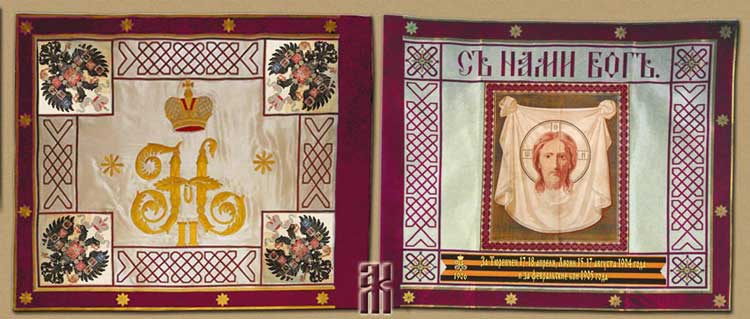
Reconstruction of the flag of the 11th Siberian Rifle Regiment
On 10 November 1918 it was presented by the Minister of War Kolchak, to the 11th Nizhneudinsk Siberian Rifle Regiment of the 3rd Siberian (Irkutsk) Rifle Division. The memoirs of J. Ward have:
We attended the ceremony of awarding a flag to the 11th Siberian Rifle Regiment. It was a beautiful sight, the significance of which was enhanced by the fact that three officers of the regiment had liberated this flag from the Bolshevik revolutionaries, spending months making their way through Bolshevik lines disguised as peddlers or peasants, until they safely delivered them to the new regiment.
Ward, J. in "Allied Intervention in Siberia, 1918-1919. Notes of Colonel John Ward, Commander of the British Expeditionary Force", Moscow-Petrograd, 1923, p. 75.
siberia.forum24.ru/?1-4-0-00000027-000-10001-0
9th Irkutsk, 10th Baikal, and 12th Verkhneudinsk Rifle Regiments
An unknown number of regimental flags came from the former 7th Siberian Rifle Division of the Imperial Army. That division consisted of the 25th Major-General Kondratenko, 26th, 27th and 28th Siberian Rifle Regiments. On 6 August 1907 they had all been awarded St. George flags of the 1900 model, with a raspberry border, gold embroidery, a 1867 model finial (St. George Army), a black pole and an inscription on the St. George ribbon of: "For the valiant defence of Port Arthur in 1904".
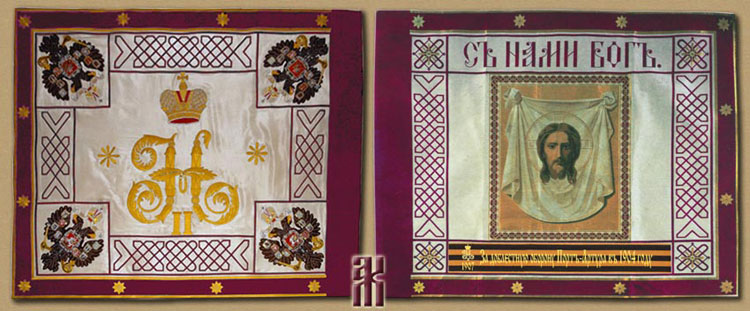
Reconstruction of a flag of the 7th Siberian Rifle Division
They remained in the division when it became part of the 2nd Siberian Rifle Corps in Transbaikalia. They were with the 3rd Irkutsk Rifle Regiment in Primor'e. They were taken to Shanghai.
GARF F.5873 Op.1 D.8 L.145.
Novikov P. A. in "The 3rd Irkutsk Siberian Rifle Division // White Army, White Cause No. 10", Ekaterinburg, 2002, p. 20.
mosgrenadier.narod.ru/dip/srifle.htm
11th Ural Rifle Division
43rd Verkhneuralsk Rifle Regiment
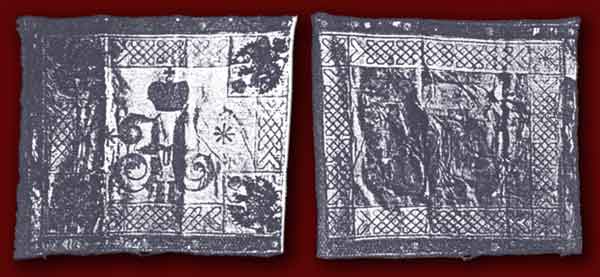
Banner of the 2nd Ural Rifle Regiment (1922)
Filimonov, B. B. in "White Rebels: The Khabarovsk Campaign, Winter 1921-1922", Shanghai, 1932
On 5 January 1897 the Insar Reserve Battalion was granted a flag, along with the right to become an independent military unit. It was a simple banner of the 1883 model (modified in 1896) with a dark green border and gold embroidery. On the front there was an icon of the Epiphany of the Lord, made in oil painting technique (in honor of the unit's holiday of the Epiphany of the Lord, 6 January). The unit grew until on 20 February 1910 it became the 196th Insar Infantry Regiment, retaining its banner, although its seniority was for 27 March 1811, based on the seniority of the 223rd Skopin Reserve Infantry Regiment, with which it had been merged.
(However, according Zvegintsev the banner of the Insar Reserve Battalion had a red border and embroidery).
On 27 March 1911, in connection with its 100th anniversary, the 196th Insar Infantry Regiment received a new jubilee flag –a simple banner of the 1900 model with a green border and an icon of Christ Not Made by Hands on the front, with St. Andrew's ribbon with the dates "1811-1911" on the reverse on the anniversary Alexander ribbon. It was placed in the regimental church (consecrated on 26 November 1913). It was possibly issued to the 336th Chelyabinsk Infantry Regiment, which was formed on the basis of the regiment, though that information is not verified.
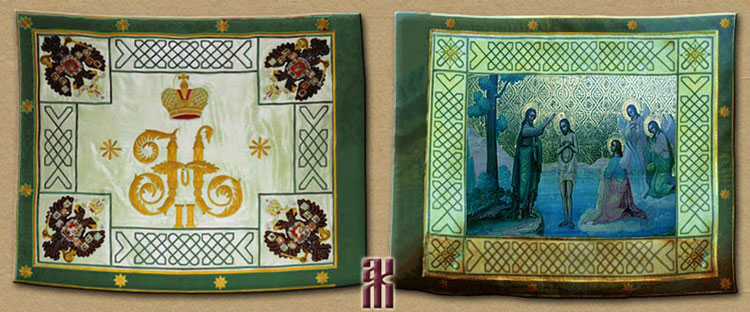
Reconstruction of the first banner of the 196th Insar Infantry Regiment
After the 196th Regiment returned to its permanent base in Chelyabinsk and was demobilised on 26 March 1918, the banner was saved by the officers. With the outbreak of the Civil War and the transfer of Chelyabinsk to the control of the Provisional Siberian Government, the flag was handed over to the command of the 1st Mountain Rifle Division of the 3rd Ural Corps, which was being formed in the city. On 4 October 1918 it was handed over to the 3rd Ural Mountain Rifle Regiment (Colonel I. F. Azarov). On 7 December 1918 the division was reorganised into the 11th Ural Rifle Division, and the 3rd Regiment was renamed the 43rd Verkhneuralsk Rifle Regiment. The division was merged into the Ural Rifle Regiment in Transbaikalia, which inherited the flag from the 43rd Verkhneuralsk Rifle Regiment.
Filimonov mentions in "Admiral Kolchak's White Army" that the 43rd Verkhneuralsk Rifle Regiment had the banner of the 196th Insar Infantry Regiment. In "White Rebels" he writes that the 42nd Siberian Rifle Regiment had the flag of the 2nd Ural Regiment, but provides a photograph and description that correspond to the first banner of the 196th Insar Infantry Regiment. Apparently, the confusion here was caused by the similarity of the banners (both have a green border and are the same model). The regimental holiday of the 2nd Ural Regiment was that of St. Alexander Nevsky (30 August) – the regimental holiday of the 42nd Siberian Rifle Regiment, and not the Epiphany – the regimental holiday of the 196th Insar Infantry Regiment.
Filimonov, B. B. in "Admiral Kolchak's White Army", Moscow, 1997, p. 42.
Filimonov, B. B. in "The White Rebels: The Khabarovsk Campaign Winter 1921-1922", Shanghai, 1932, p.164.
www.e-mordovia.ru/main/news/detail.php?ID=3787
www.book-chel.ru/ind.php?what=card&id=395
regiment.ru/reg/II/B/196/1.htm
www.imha.ru/knowledge_base/base-15/1144528895-pexotnyj-196-go-insarskij-polk.html
The 41st Ural, 42nd Troitsk, and 44th Kustanai Rifle Regiments
According to Efimov, these regiments had three regimental banners of the 1900 model. After the Great Siberian Campaign these banners were saved by a group led by Major General A. V. Kruglevskiy and taken to Transbaikalia. Their further fate is unknown.
According to unverified information, among them was the St. George flag of the 42nd Siberian Rifle Regiment. This banner was originally granted to the 8th Siberian Tomsk Infantry Regiment in 1905 with the inscription "For distinction on 26-30 September 1904 at Tsuno and Khamytan and 23-26 February 1905 at Mukden". From 1906 it was the banner of the 8th Tomsk Infantry Reserve Regiment, then on July 1910 the banner of the 42nd Siberian Rifle Regiment (after merger with the 7th Krasnoyarsk Reserve Regiment).
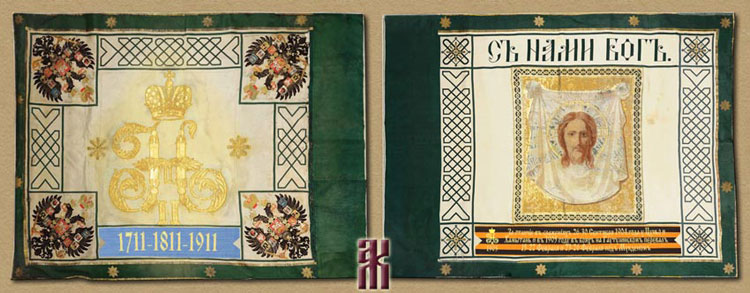
Reconstruction of the flag of the 42nd Siberian Rifle Regiment (formerly the 8th Siberian Tomsk Infantry Regiment)
The banner is of the 1900 model with a dark green border and gold embroidery; the finial is of the 1867 model (St. George Army, black pole). The inscription on the St. George ribbon read: "For excellence in battle on 26-30 September 1904 at Tsuno and Khamytan and in 1905 in the battles at the Gautulin Pass on 15-22 February and 23-26 February near Mukden." In memory of its 200th anniversary the regiment was awarded an anniversary Alexander Ribbon with the inscriptions "1911" and "1711 Arkhangelsk Garrison Tobolsk Regiment" and on the reverse of the flag the St. Andrew's ribbon had the dates "1711-1811-1911" sewn on.
This banner may have been transferred to one of the 12th Siberian Rifle Division regiments formed in March 1919 in Tomsk (which was conceived as the successor to the former division of the Imperial Army), which in August 1919 was disbanded due to its apparent inability to fight and was used to replenish the 11th Ural Rifle Division. This is how the banner could have ended up in Transbaikalia and then in Primor'e, where Filimonov saw it.
Efimov, A. G. in "Izhevtsy and Votkinsy: The Great Siberian Ice March", Moscow, 2004, p. 341.
mosgrenadier.narod.ru/dip/srifle.htm
www.if.tsu.ru/Students/officers/8.htm
regiment.ru/reg/II/F/42/1.htm
window.edu.ru/window_catalog/pdf2txt?p_id=23295&p_page=33
12th Ural Rifle Division
47th Tagil Rifle Regiment
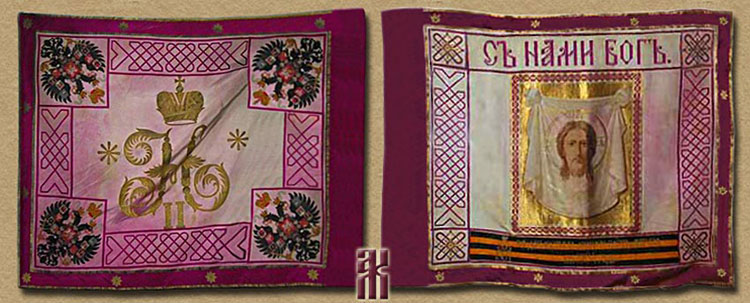
The left side is the flag of the 23rd East Siberian Rifle Regiment. The right side is the flag of the 26th East Siberian Rifle Regiment (Irkutsk Regional Museum of Local History).
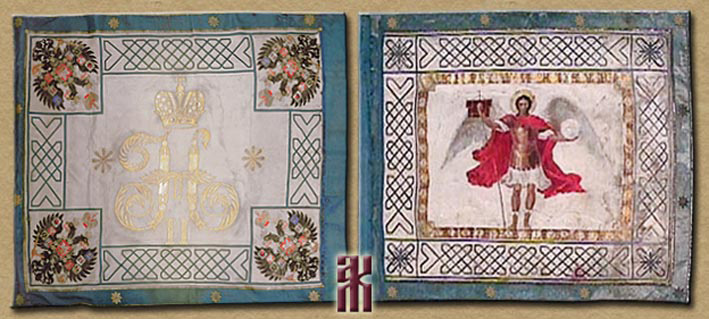
The banner of the 8th East Siberian Line Battalion,
later transferred to the 18th East Siberian Rifle Regiment
Filimonov wrote in "Admiral Kolchak's White Army":
When the [47th Tagil Rifle] regiment marched to the front from Ekaterinburg on 9 December 1918, the Chief of Staff of the Siberian Army, Colonel Bogoslovskiy, presented the regiment with the banner of the 18th East Siberian Rifle Regiment, which had belonged to some old "line battalion", following a request for it from the commander of the 47th Regiment, Colonel Vanyukov.
Zvegintsev records that the 3rd East Siberian Line Battalion had been granted a banner on 5 June 1897 (?) with light blue border and an image of St. Michael the Archangel.
The 18th Siberian Rifle Regiment was granted on 12 June 1906 a flag of the 1900 model, with gold embroidery, the 1867 model finial, on a black pole. The inscription on the St. George ribbon was: "For distinction in the war with Japan in 1904 and 1905".
Order No. 41 of 7 December 1918 (Ekaterinburg).
Today, Major-General Gaida, commander of the Ekaterinburg Group, is transferring to my division the battle flag of the 18th East Siberian Rifle Regiment, which was saved by the Czechs. Accepting this sacred object as a blessing from the former Great Russian Army to the young units of the 12th Ural Rifle Division being formed under my command, I order the banner of the 18th East Siberian Rifle Regiment to be transferred to the 47th Tagil Rifle Regiment, the youngest of the division's regiments, which has made incredible efforts and labours to prepare itself in the shortest possible time for a further encounter with the enemy on the battlefield. It will make every effort to revive the former glory of the valiant Siberian Rifle Regiments through its exploits.
Division Commander Colonel Bangerskiy.
The banner followed the remnants of the regiment to Transbaikalia and was transferred to the 12th Ural Rifle Regiment of the Ufa Division, formed from the remains of the division. After leaving Transbaikalia, it was taken to Harbin.
Zvegintsev, V. in "Banners and Standards of the Russian Army of the 16th Century-1914", Moscow, 2008, p. 121.
RGVA F.39629 Op.1 D.6: "Orders for the 12th Ural Rifle Division for 1918-19", p. 69. (Document kindly provided by Ekaterinburg researcher A. M. Kruchinin).
Volkov S. V. in "The White Movement: Encyclopedia of the Civil War", St. Petersburg, 2003, pp. 153, 534.
http://mosgrenadier.narod.ru/dip/srifle.htm
1st Cavalry Division
Simbirsk Lancer Regiment
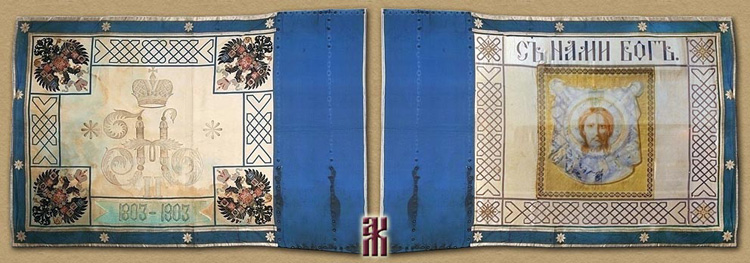
This standard was bestowed upon the 14th Lithuanian Dragoon Regiment on 29 March 1903, the day of its 100th anniversary. It has a white cloth with a light blue border and silver stitching, with the inscription "1803-1903" on the St. Andrew ribbon. An anniversary Alexander ribbon was attached to the pole. In 1907, the regiment was renamed the 5th Lithuanian Lancer Regiment.
After the regiment was disbanded in early 1918, the standard was saved by the officers and taken to eastern Russia (probably to the regiment's base in Simbirsk). In April 1919 it was presented by Admiral Kolchak to the commander of the Simbirsk Lancer Regiment, Captain Oshanin, during a parade in Omsk.
During the Great Siberian (Ice) Campaign in early January 1920, in order to prevent its capture by enemy partisans, the regiment's commander, Colonel Oshanin, ordered it placed under the ice of the Enisei River. (However, General Sakharov claimed there was no real threat to the standard.)
Sakharov, K. V. in "The Siberian Ice Campaign // The Great Siberian Ice Campaign", Moscow, 2004, p. 176.
Kislitsyn, V. A. in "In the Fire of the Civil War", Harbin, 1936, p. 75.
Vladimir Knyazev, V. in "Life for All and Death for All", electronic publication.
Amur Provisional Government
The Simbirsk Cadet Corps was granted a flag on 12 November 1903. It was a simple banner of the 1900 model with a light blue border and gold embroidery. It had a guard finial of the 1857 model and a black pole.
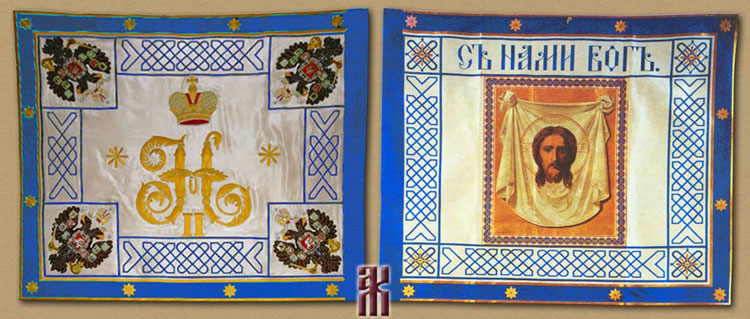
The banner of the Simbirsk Cadet Corps
The flag was saved and hidden by Simbirsk cadets and considered the flag of the White Army during its Khabarovsk campaign in the winter of 1921-1922. It is currently located in the Cathedral of the Holy Mother of God of All Who Grieve in San Francisco.
Tabolina, T. in "Relics of Destiny // Nezavisimaya Gazeta. No. 137", 10 July 2002.
www.vexillographia.ru
Banners Not Issued to Units
- 609th Akmolinsk Infantry Company of the State Militia (raspberry banner with the inscription "For Faith, Tsar and Fatherland").
- 630th Irkutsk Company of the State Militia (green banner from 1855 with the Militia Cross and the inscription "For Faith, Tsar and Fatherland").
- St. George Standard of the 1st Chita Cossack Regiment (1900 banner with the inscription "For Distinction in Battles with Japan 1904-1905").
- 10th East Siberian Rifle Regiment (simple banner of the 1900 model).
These were kept at the HQ of the Transbaikal Cossack Host in Chita. During the retreat from Transbaikalia they were first evacuated to Dauria Station and then to Manchuria Station. Fearing capture by the Chinese, they were transported under the guise of church banners to the church at Grodekovo Station, and then to Nikolsk-Ussuriysk, where they were stored at the HQ of the Transbaikal Cossack Division. When they left Primor'e in October 1922 they were taken to Genzan and in August 1923 they were delivered to Shanghai, where they were stored in the Nikolskaya military Church. In 1937, with the start of the Sino-Japanese War, they were placed in the Shanghai-Hong Kong Bank by their custodian, Colonel Kazakov. In 1944 they were transported by Ataman Semenov's representative, Captain Portnyagin, to Manchuria (Trekhrech'e) and placed in the cathedral in Dragotsensk. In August 1945 they were handed over to representatives of the Soviet Army and taken to the USSR.
Shevyakov, T. N. in "Banners and Standards of the Russian Imperial Army of the Late 19th - Early 20th Centuries", Moscow, 2002, pp. 14-15.
Vilinkov, G. V. in "Russian Banners", St. Petersburg, 2005, p. 175.
During the evacuation from Primor'e via Korea to Shanghai, 34 banners were taken out, which were kept in the Epiphany Church in Chapae. In 1946 the keeper of the banners, Colonel V. G. Kazakov, handed some over to a Soviet military agent in Shanghai, while the rest were taken to San Francisco, where they are now kept in the Museum of the Great War Veterans Society.
Kruchinin, A. M. and Neuymin, N.B. in "The banner of the Irbit-Pernovsk Regiment should be sought in Russia // White Army, White Cause No. 10", Ekaterinburg, 2002, pp. 117-118.
6th Siberian Rifle Regiment
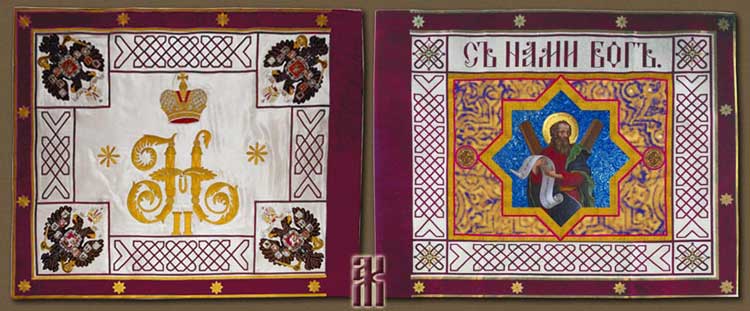
On 6 May 1897 the 10th East Siberian Rifle Battalion was granted a flag. In 1904 it became the 10th East Siberian Rifle Regiment and in 1911 the 6th Siberian Rifle Regiment. It was a simple banner of the 1883 model (modified in 1896): it had a raspberry border, gold embroidery, a finial of the 1857 model (army), and a black pole. The icon was St. Andrew the First-Called, with a background of light blue. The apostle is depicted with a belt, with a golden halo outlined in red, an ochre robe, and a light brown cross behind his back. The frame around the icon (in the form of an eight-pointed star) and the edges of the rectangle are gold, with red outlines. The field on the sides of the icon is pink-beige, with blue patterns and two gold circles with red outlines and dark crosses.
It remains unknown whether this banner was issued to one of Kolchak's units. In 1922 it was evacuated to Shanghai, where it was kept until 1945. It was then taken to the USSR.
Zvegintsev, V. V. in "Banners and Standards of the Russian Army, 16th Century - 1914 and Naval Flags", Moscow, 2008, pp. 117, 119.
mosgrenadier.narod.ru/dip/srifle.htm
2nd or 3rd Astrakhan Cossack Regiment
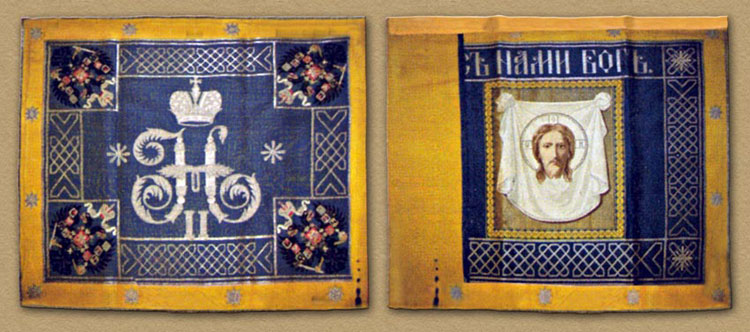
Flag of one of the horse regiments of the Astrakhan Cossack Host.
Presumably this 1900-model banner would have belonged to either the 2nd or 3rd Astrakhan Cossack Regiment, which were granted such flags in 1914. It ended up in the units of the 4th Orenburg Army Corps in eastern Russia. It was captured by Red Mongolians from the units of Lieutenant-General Bakich in September 1921. It was handed over to the Soviets along with the prisoners. It is stored in the banner collection of the Central Museum of the Armed Forces in Moscow.
Photo from Karpov N. D. "Crusaders – Kolchak's Last Reserve", Moscow, 2014.
Home — State Symbols — Flags — Uniforms — Badges & Medals — Money — Other
Pygmy Wars Notes
The original of this page is at kolchakiya.ru/vexillology/rus_imper_flags.htm.