
Uniforms of the Independent Siberian Shock Brigade (later Division),
Independent Immortal Shock Battalion, and
1st Immortal Shock Regiment
Material and reconstructions by A. Karevskiy
Siberian Army Order No. 109 of 5 March 1919, Ekaterinburg
§6 Uniform of the units of the Independent Siberian Shock Brigade and the Independent Immortal Shock Battalion.
Headgear: papakha light fur hat, shapka thick fur hat, or field cap, of the established variety with a white-green ribbon diagonally across the cockade.
Blouse: khaki, standard issue.
Shoulder-boards:
- black with green piping (for officers with green stripes);
- black with red piping and stripes in the artillery divizion;
- khaki with black piping in the Immortal Shock Battalion (black velvet may be used).
Stencil on shoulder-boards:
- in the Shock battalions include the battalion number (1, 2, 3);
- in machine-gun battalion, the machine-gun symbol;
- in the artillery divizion, cannons;
- in the engineer company, the engineer symbol.
The colour of the stencilled cipher for officers is silver, for soldiers it is white (silver if desired). In the Immortal Battalion, the letters "Б" and "У" are intertwined, with the "Б" in red and the "У" in black.
Trousers
- black with green stripes 1½ fingers wide (green velvet is permitted);
- red stripes in the artillery divizion;
- khaki trousers with black stripes in the Immortal Battalion.
Insignia: on the left sleeve above the elbow, according to the drawings. Separately for the greatcoat and for the blouse.
GASO F.1956rs Op.1 D.40 L.204.
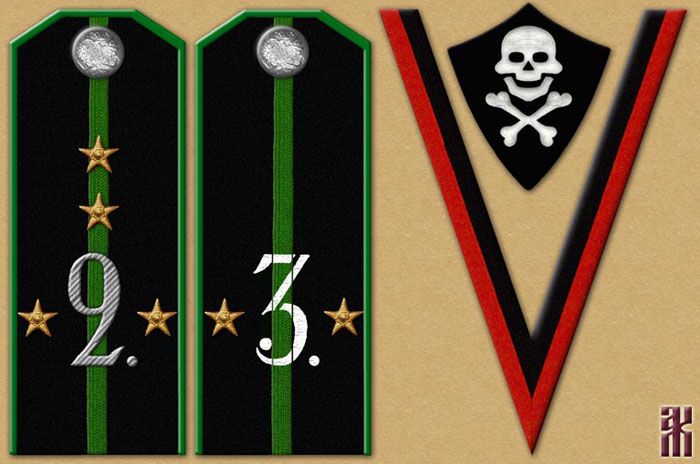
Shoulder-boards of the 1st Independent Siberian Shock Division (Brigade):
1 – staff-captain; 2 – second-lieutenant; 3 – sleeve chevron
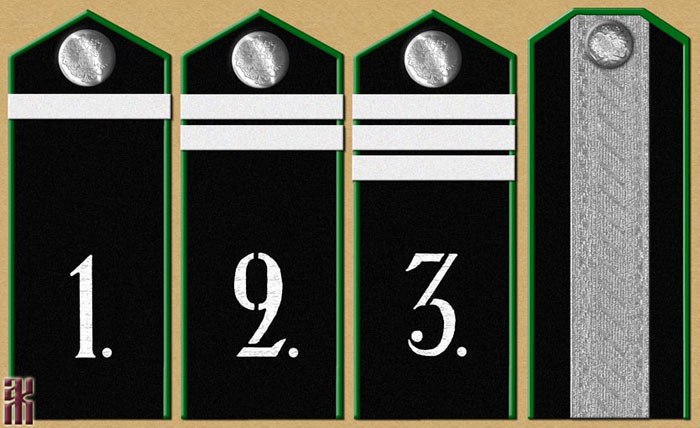
Shoulder-boards of the 1st, 2nd and 3rd Siberian Shock Regiments (Battalions):
1 – lance-corporal; 2 – corporal; 3 – sergeant; 4 – sergeant-major
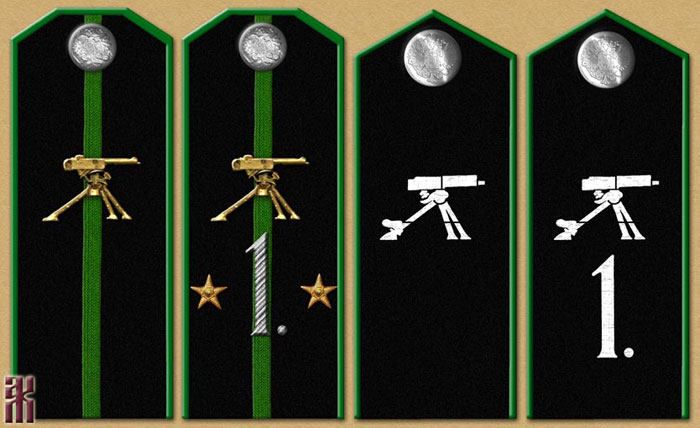
Shoulder-boards of the Machine Gun Shock Battalion of the 1st Independent Siberian Shock Division (Brigade)
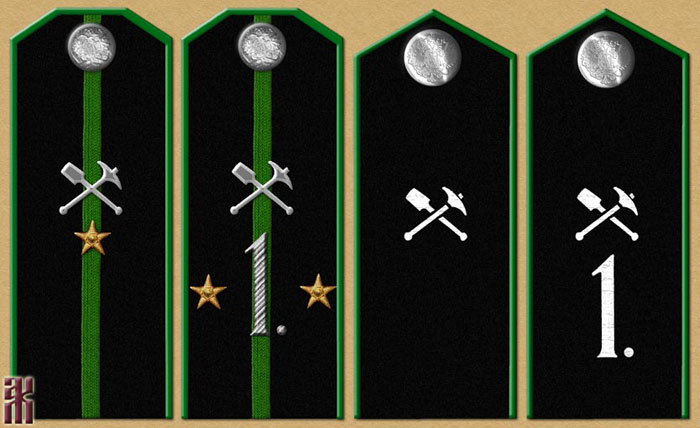
Shoulder boards of the Engineer Shock Company of the 1st Independent Siberian Shock Division (Brigade)
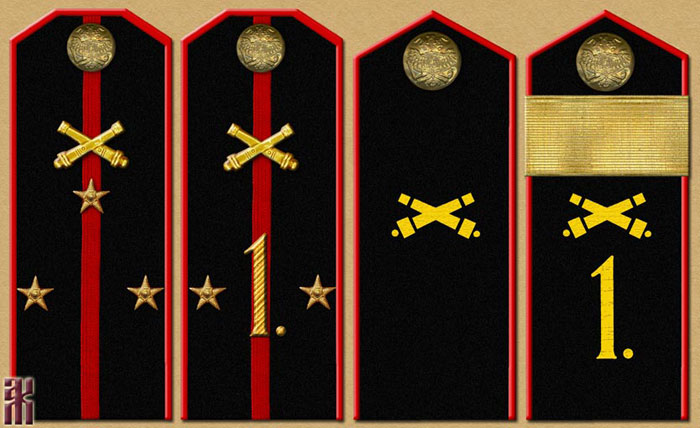
Shoulder-boards of the Artillery Shock Divizion of the 1st Independent Siberian Shock Division (Brigade)
The numbers appeared for the machine-gun battalion, engineers and artillery only after the formation of the 2nd Independent Siberian Shock Brigade.
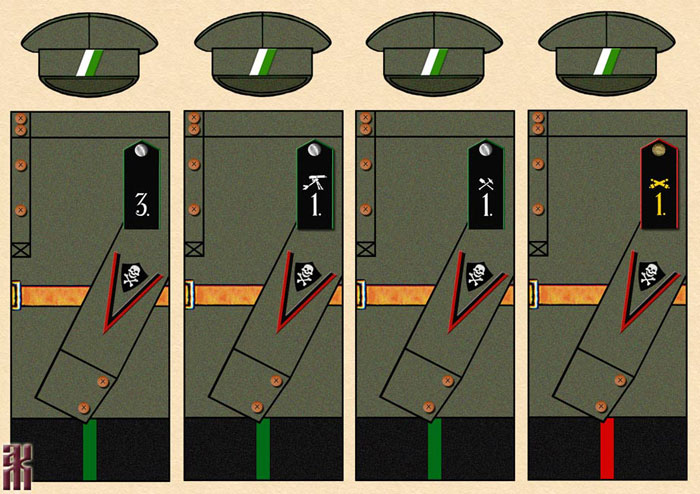
Uniforms of officers of the 1st Independent Siberian Shock Division (Brigade)
1 – Siberian Shock Regiments (Battalions, in this case the 3rd);
2 – MG Shock Battalion; 3 – Engineer Shock Company, 4 – Artillery Shock Divizion
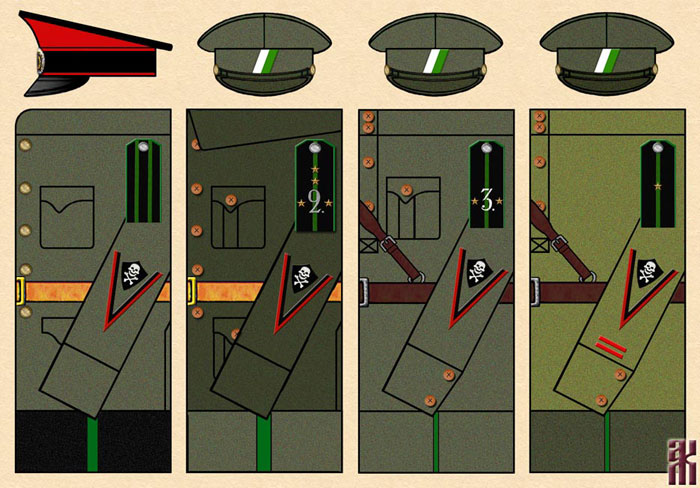
Uniforms of officers of the 1st Independent Siberian Shock Division
These reconstructions of various officers are based on a photograph. Figure 1 is the division commander, Colonel Labuntsov.
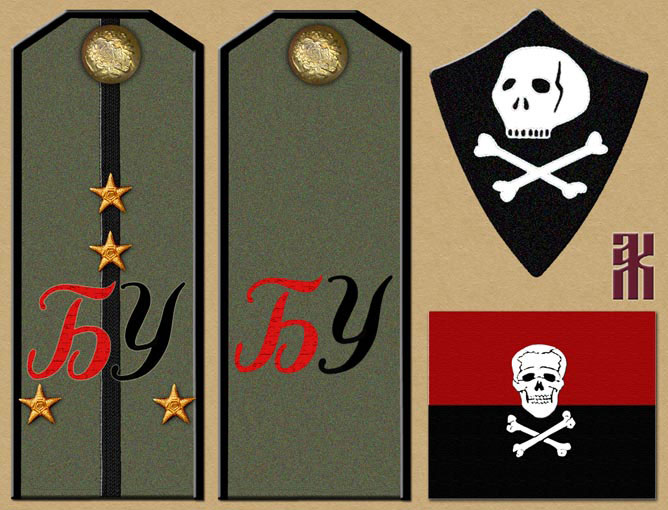
Independent Immortal Shock Battalion and Regiment: 1 – staff-captain; 2 – private;
3 – sleeve insignia of the Independent Immortal Shock Battalion/Regiment;
4 – company pennon of the 1st Immortal Shock Regiment
Order of the Siberian Army No. 192 of 9 April 1919 (Ekaterinburg)
Uniform of the 1st Immortal Shock Regiment
1. Headgear: papakha and kepi with black piping, as in the 25th Ekaterinburg Admiral Kolchak Mountain Rifle Regiment.
2. Trousers: khaki with black stripe.
3. Blouse: khaki with black lace on the collar and cuffs. On the chest, a shield piped with black and two cartridge pockets piped with black.
4. Shoulder-boards: khaki with intertwined letters: "Б" in red, "У" in black, and above these two, "Г" in white.
5. Shoulder-boards, buttonhole tabs, collar and cuffs of the overcoat are piped with black.
6. Sleeve insignia is a small skull and bones on a black shield, worn on the left sleeve above the elbow.
GASO F.1956.rs Op.1 D.40 L.375.
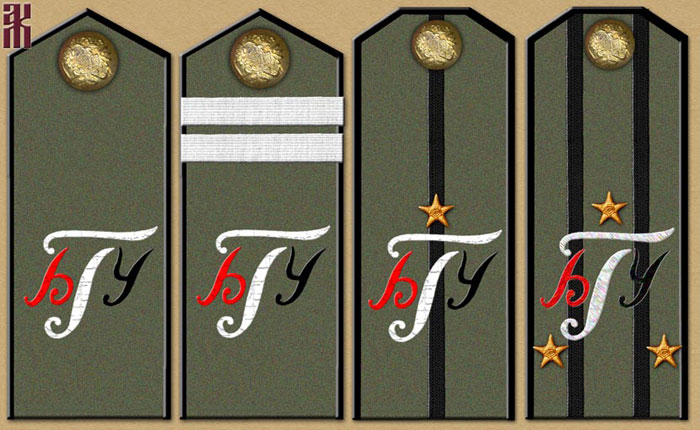
Shoulder-boards of the 1st Immortal Shock Regiment:
1 – private; 2 – corporal; 3 – ensign (monogram made with oil paint stencil)
4 – lieutenant-colonel (monogram made with satin stitch)
The monogram is drawn from a description by an eyewitness, V. K. Nekrasov of Ekaterinburg.

1 and 2 – Independent Immortal Shock Battalion; 3 and 4 – 1st Immortal Shock Regiment

Reconstructions based on a photograph
www.siberia.forum24.ru/?1-4-0-00000014-000-0-0#013 [picture link now dead]
The main differences from the previous reconstruction are 1) no piping on the trousers, 2) a chest plastron with rounded ends, 3) a high stand-up collar fastened with two buttons, 4) high straight cuffs without buttons, 5) seven cartridge pockets on each side of the lapel, 6) a different shape of the sleeve shield, 7) flat topped shoulder-boards instead of pointed ones for lower ranks, and 8) a different arrangement of the monogram.
Ekaterinburg, 9 May 1919
This was followed by a review of the Shock corps, which was formed in Ekaterinburg and constituted Gaida's reserve. As a curiosity, it included the "Immortal Battalion named after General Gaida" with brown shoulder-boards and the cipher "Б.Б.И.Г.Г." on them. The entire corps had lace on their sleeves and black and red chevrons, as in the days of the Kerensky government. ... The men looked good, and their uniforms were quite decent.
Sakharov, K. V. in "White Siberia (The Civil War of 1918-1920)", Munich, 1923, p.93
Ekaterinburg, 8 May 1919
At the station, we were met by the commander of the Siberian Army, General Gaida. An honour guard from the Gaida Shock Regiment, with his monograms on their shoulder-boards, immortal lace and other regalia.
Budberg A. P. in "Diary of a White Guard // Archive of the Russian Revolution, Vol. 14", Berlin, 1922, p.234.
July 1919
On 20 April there were two regiments in Ekaterinburg, known as the 1st and 2nd Immortal Regiments named after Gaida, formed from volunteers and ruffians. They were smartly dressed in greatcoats, blouses and trousers of parade uniform, altered and tailored to fit, with a narrow yellow stripe sewn into the trousers, a yellow cord with tassels sewn onto the chest of the blouse, forming an angle with the sides towards the shoulders, and an image of a skull sewn onto one of the sleeves with yellow thread. Yellow shoulder-boards. Armed with Russian three-line rifles.
"Siberian Bureau of the Central Committee of the Russian Communist Party (Bolshevik), 1918-1920: collection of documents, Part 1", Novosibirsk, 1978, p.170.
Among the prisoners were many soldiers of the "Immortal Regiment" with silver shields on their sleeves depicting a skull and two crossed bones beneath it.
Fedorov, P. in "Under the Red Star: The war record of the 27th Omsk Rifle Division named after the Italian proletariat", Moscow-Leningrad, 1928, p.45.
Usy, July 1919
Stories about individual skirmishes, jokes and questions poured out. About 500 prisoners were taken, maybe more: it was difficult to count. There were 1,500 brand new American-made rifles, four machine guns, an artillery piece, 2,000 shells, millions of cartridges, etc.
Almost the entire regiment had received a "gift from Kolchak" of magnificent English greatcoats, boots, and various other items. The Red Army soldiers had already dressed in all these new clothes, and only red ribbons distinguished them from the prisoners.
... Only now did we realise who we had been fighting yesterday. Interrogation of the prisoners revealed that there were at least four Shock regiments and a marine battalion in the village of Usy. The fresh regiments numbered 2-2,500 bayonets. The talkative prisoners, happy to be alive, told how they had been trained all winter in Ekaterinburg, considering them to be exemplary units. At the solemn and crowded send-off to the front, one of the "high-ranking" generals, addressing them in his speech, proclaimed, like Napoleon:
"Soldiers, all of Europe is watching you. You must decide the fate of our beloved homeland."
Kavraisky, V. in "The Struggle for the Urals and Siberia: Memoirs and Articles by Participants in the Struggle against the Uchitelov and Kolchak Counter-revolution" Moscow, 1926, pp.48-49.
Home — State Symbols — Flags — Uniforms — Badges & Medals — Money — Other
Pygmy Wars Notes
The original for this page is at kolchakiya.ru/uniformology/sib_shock_brigade.htm.
The blouse in the final reconstruction is an ermakovka. That was a traditionally Siberian design and made somewhat of a come-back in the Civil War.
The reconstructions for the Immortal Battalion are primarily based on photographs of the parade in Ekaterinburg, which can be seen here (with back-up copies here, here, here and here).
Discussion on the translation choices I have made can be found here.
Flags
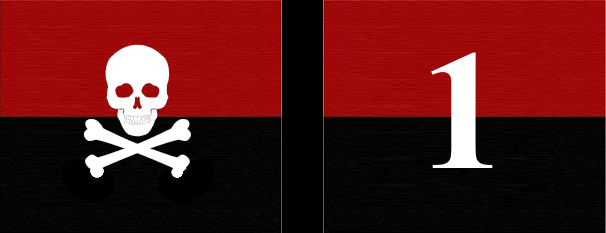
A unit marker, I would guess a company marker, is shown in a photograph. The colours are presumed to be red and black, since that was the standard for shock regiments. I would not be surprised if the front was the unit number, since that seems to have been most common, so like this:
History of the 1st Siberian Shock Rifle Division
The 1st Independent Siberian Shock Rifle Brigade formed on 5 February 1919, then in April 1919 expanded to a division. It was part of the Composite Siberian Shock Rifle Corps. It contained the 1st, 2nd and 3rd Siberian Shock Rifle Regiments (formerly independent battalions), the 1st Independent Siberian Shock Rifle Artillery Divizion, the 1st Independent Siberian Shock Engineer Divizion and the 1st Independent Siberian Shock Cavalry Divizion (formerly a independent squadron, possibly called the "black hussars").
Disbanded on 30 July 1919 after it collapsed almost immediately at the front lines. The remnants were placed in the 25th Ekaterinburg Rifle Division.
History of the Siberian Shock Corps
This was to consist of the 1st Shock Siberian Division, a similar 2nd Shock Siberian Division (5th to 7th Regiments), the 1st and 2nd Shock Siberian Artillery Brigades, the 1st and 2nd Shock Siberian Howitzer Divizions, the Shock Siberian Hussar Regiment (formerly 1st and 2nd Shock Siberian Squadrons, then Shock Siberian Hussar Divizion), and the Shock Siberian Engineer Battalion (two companies).
Despite the effort and material poured into them, these units were hopeless and were disbanded almost immediately. The artillery went to the Model Jaeger Brigade, the infantry to the Ekaterinburg Rifle Division.
History of the 1st Gaida Immortal Shock Regiment
Also known as the Siberian Shock Regiment. It was created in April 1919 in Ekaterinburg, at the request of General Gaida.
As far as I can tell, this was the 4th Regiment of the Siberian Shock Division, which is why the division only has three regiments. It disappears soon after entering battle in June 1919. It is possible that it lasted better than the others, staying a regiment in the newly reformed Ekaterinburg Rifle Division.