
Uniforms of the 16th Siberian Rifle Division,
originally the 1st Perm Rifle Division
Reconstructions by A. Karevskiy
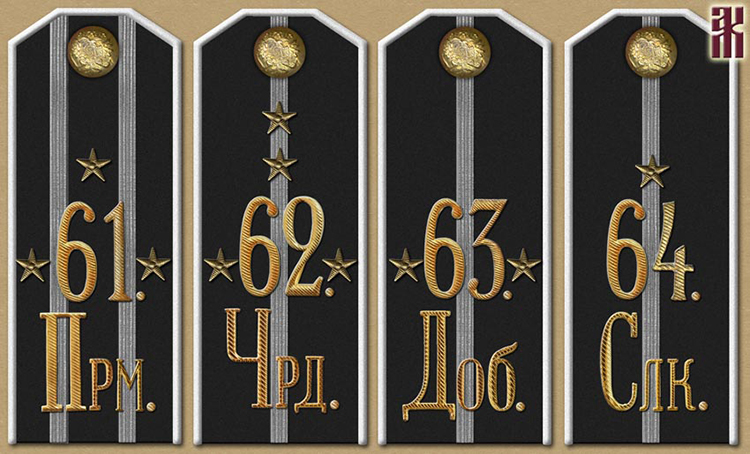
Shoulder-boards of officers of the 16th Siberian Rifle Division:
61st Perm, 62nd Cherdyn, 63rd Dobryansk and 64th Solikamsk Siberian Rifle Regiments
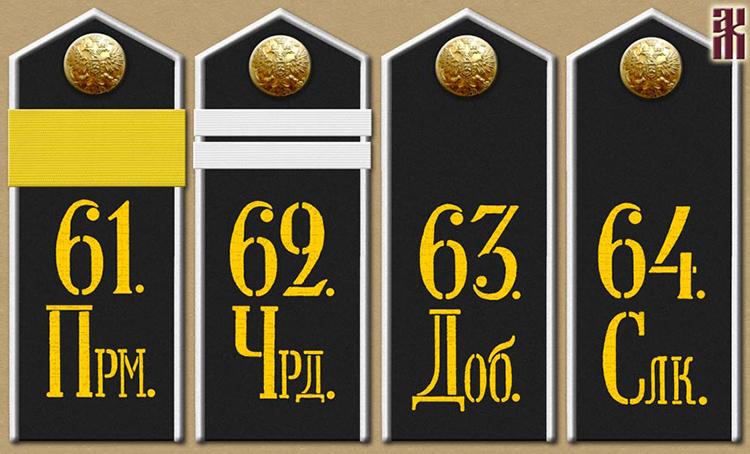
Shoulder-boards of the other ranks of the 16th Siberian Rifle Division:
61st Perm, 62nd Cherdyn, 63rd Dobryansk and 64th Solikamsk Siberian Rifle Regiments
The ciphers in the two schemes above are best guesses, by analogy with the 6th, 7th and 12th Ural Divisions. Gold metal for officers and yellow stencil for other ranks is indicated by analogy with the 18th Siberian Rifle Division.
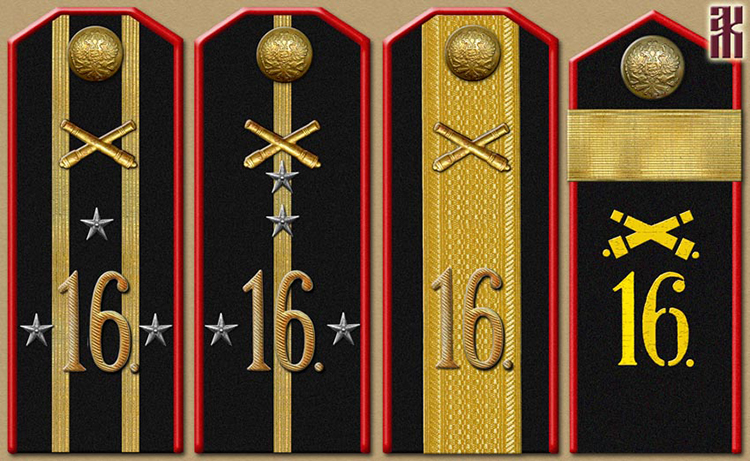
Shoulder-boards of the 16th Siberian Rifle Artillery Divizion
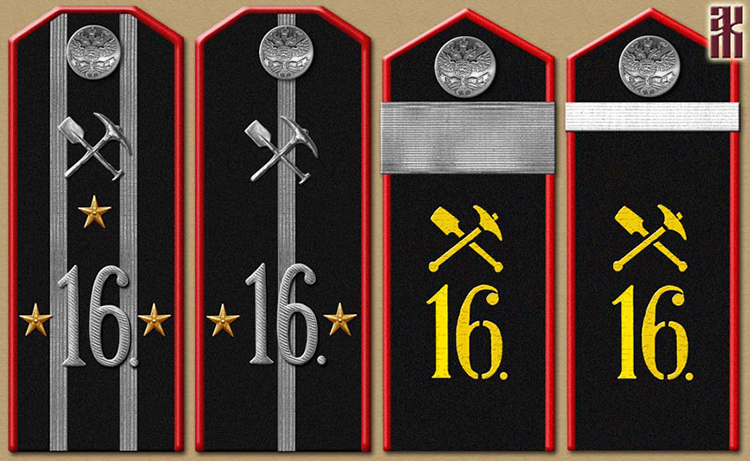
Shoulder-boards of the 16th Siberian Engineer Divizion
The "16" may have been followed by "Сб" [for Siberian] for the previous two schemes.
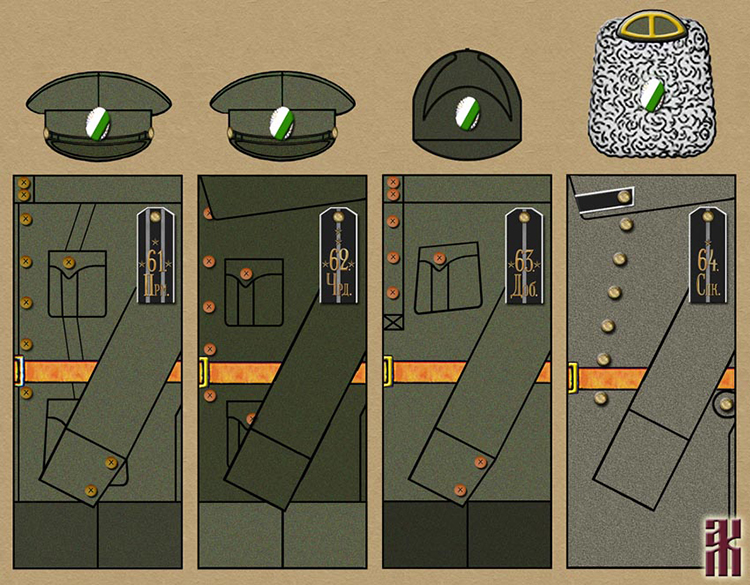
Uniforms of officers of the rifle regiments of the 16th Siberian Rifle Division
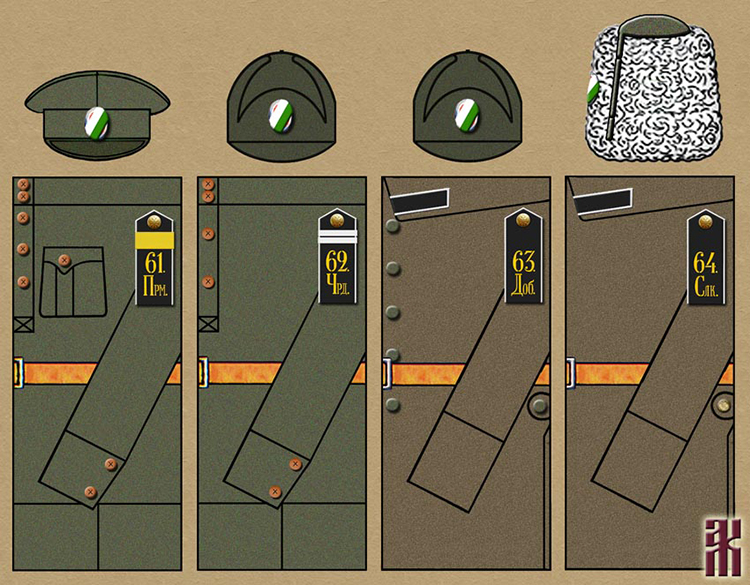
Uniforms of other ranks of rifle regiments of the 16th Siberian Rifle Division
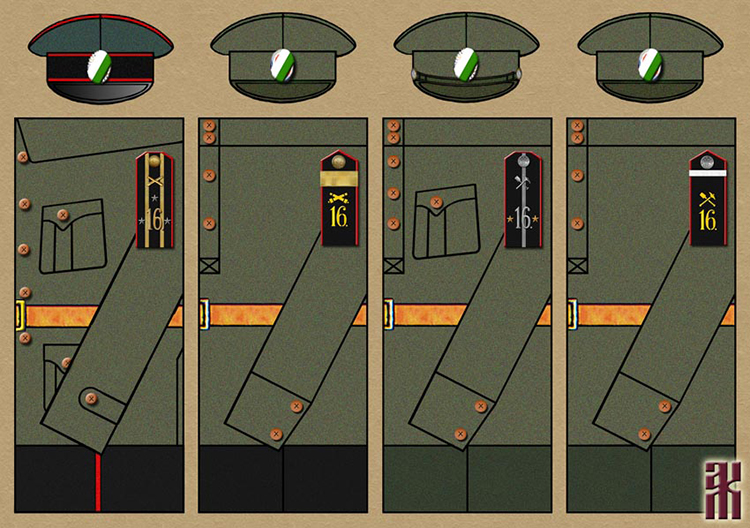
Uniforms of officers of the 16th Siberian Rifle Artillery Divizion and the 16th Siberian Engineer Divizion
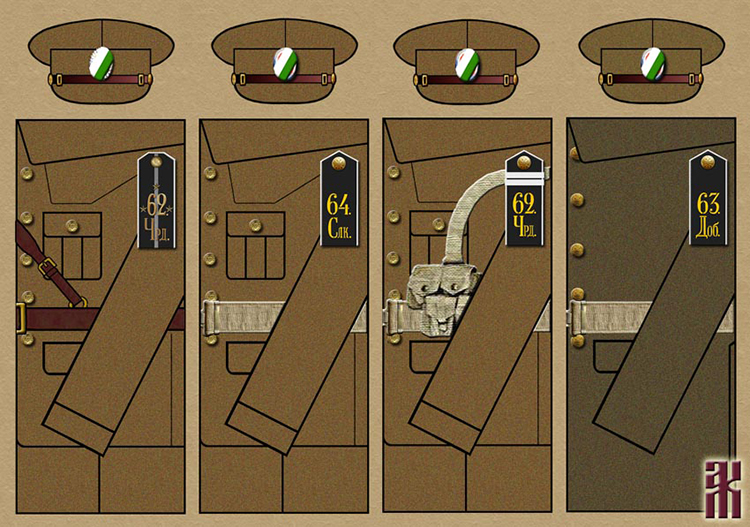
Uniforms of officers of the 16th Siberian Rifle Division in British uniforms.
In Memoirs
Yugo-Kamsk Plant, 29-30 June 1919
Suddenly, the shutters of one of the suburban houses opened and a head with black shoulder-boards on peered out.
The scouts went to the window and pulled out a "ranker" with three white stripes on his shoulder-boards. The "ranker", straightening his blouse, muttered fearfully, still half asleep: "Mobilised. From the 62nd Division's supply train. We were garrisoned in partisan houses, but the Czechs were defeated and we all surrendered."
"I'm not alone, there are 12 of us, tired, having come from Perm as reinforcements. We fell asleep in a hayloft and overslept, and the units left. In the morning, the owners said, 'The Reds seem to have taken the factory'."
...
Green, swaying rows of hidden "Englishmen", judging by their uniforms, who later turned out to be just Vankas and Petkas from among the Perm peasantry. There we were, equals. At first, we were stunned. And then there were brotherly kisses, hugs, and in some places tears of joy at the meeting. We became brothers.
From the memoirs of A. I. Medvedev, a soldier in the [Soviet] 30th Rifle Division, at TsDOOSO F.41 Op.2 D.199 L.31-32. Material kindly provided by Ekaterinburg researcher D. V. Kadochnikov
Commentary by Voronezh researcher N. Zayats: Perhaps he meant the 62nd Cherdynsk Regiment of the 16th Siberian Division. The surrender of soldiers refers to the surrender on 30 June near Kosoturikhi (28 km south-west of Perm) without a fight of the 63rd Dobryansk and 64th Solikamsk Regiments from the same division – a total of about a thousand soldiers together with the commander of one of the regiments and six officers with seven machine guns.
Novoselovo near Turinsk, Tobol province, 14 August 1918
Having received reinforcements of 60 workers from Nadezhda and Kyshtym and one machine gun, we attacked Turinsk. On 14 August we took the village of Novoselovo, after a battle, where the Whites had been commanded by officers. This was beyond doubt, because we found still hot tea and an open suitcase containing documents belonging to a colonel of the 1st Reserve Guards Regiment. Photographic cards and spare underwear were left in the headquarters. Secondly, a tunic with ensign's shoulder-boards was left behind on the roof, apparently an observation post, and the White Guards killed in battle were found to have good English uniforms and 3-line rifles.
From the memoirs of Red Guard V. Zotov in TsDOOSO F.41 Op.2 D.199 Ll.33-34. Material kindly provided by Ekaterinburg researcher D. V. Kadochnikov
Home — State Symbols — Flags — Uniforms — Badges & Medals — Money — Other
Pygmy Wars Notes
The original for this page is at kolchakiya.ru/uniformology/16_Perm_div.htm.
Discussion on the translation choices I have made can be found here.
History of the 16th Siberian (Perm) Rifle Division
Formed in January 1919 following the liberation of Perm. It was part of the 1st Central Siberian Rifle Corps. From late February to early July 1919 it saw action along the Perm-Vyatka and Perm-Kungur railway lines. It was made up of the 61st Perm, 62nd Cherdyn, 63rd Dobryansk and 64th Solikamsk Rifle Regiments, the 16th Siberian Artillery Divizion, the 16th Siberian Engineer Divizion, and the 16th Siberian Frontline (Reserve) Regiment,
At the end of May the division became part of the newly formed V Siberian Army Corps. In early June it had about 4,600 bayonets, 31 MGs and 12 guns.
The Dobryansk and Solikamsk Regiments defected to the Reds in late June 1919 after the defeats near Perm, and it would seem the division largely fell apart at that time. The Perm Rifle Regiment is mentioned in the account of a battle near Taiga station in the second half of December 1919, but it is possible that this was the Perm School of Ensigns. After Krasnoyarsk the Cherdyn Regiment had about 300 men.