
Uniforms of the Independent Jaeger Brigade of Ataman I.N. Krasilnikov
Material and reconstructions by A. Karevskiy, unless noted otherwise.
Initially formed as a partisan detachment under Ataman Krasilnikov, on 1 November 1918 the commander of the 1st Central Siberian Army Corps ordered it be formed into the Independent Partisan Brigade named after Captain Krasilnikov, to be made up of a rifle regiment and a horse divizion. On 18 July 1919 the Chief of Staff of the Supreme Commander-in-Chief, after adding a special purpose battalion, ordered that the brigade be reorganised into a regular Independent Jaeger Brigade (consisting of the 1st and 2nd Jaeger Regiments, the Irkutsk Cavalry Divizion and a Jaeger Artillery Divizion.
Drokov, S. V. in "Admiral Kolchak and the Court of History", Moscow, 2009, p.234.
Simonov, D. G. in "The White Siberian Army (May-December 1918) // Dissertation", Novosibirsk, 2000, pp.117-118 (link at kappel.ru now dead)
Regarding the Irkutsk Cavalry Divizion, a description of the peculiarities of its uniforms is contained in Novikov's book:
On 20 September 1918 the formation of the 4th Irkutsk Horse Brigade began in Irkutsk ... which included the Irkutsk Cossack ... and Irkutsk Hussar ... Regiments. The latter inherited red insignia from the 16th Irkutsk Hussar Regiment of the Imperial Army – raspberry shoulder straps, cap band, etc. ... The Irkutsk Hussar Regiment was transformed into a cavalry divizion in Captain Krasilnikov's Partisan Brigade due to its small size. The term "Krasilnikov's Red Hussars" appeared.
Novikov, P. A. in "The Civil War in Eastern Siberia", Moscow, 2005, p.108.
Participants on a number of specialised forums question this information, rightly pointing out that the 16th Irkutsk Hussar Regiment of the Russian Imperial Army had red as its colour and that its regimental base was located in Riga (Latvia), so there could be no regimental HQ in Siberia. There is a theory that the continuity between these units was purely conditional, based on the territorial name. Regimental distinctions would be made on the spot from improvised materials, thus the red cloth being replaced by raspberry (and so new traditions were vividly intertwined with the old ones).
www.novonikolaevsk.com/forum/viewtopic.php?f=31&t=970
siberia.forum24.ru/?1-8-0-00000028-000-10001-0
This possibility is indirectly confirmed by a shoulder-board from the time of the Civil War found in an Irkutsk attic. Artistically made, of raspberry cloth, with the cipher "И.К." applied with a chemical pencil. There are different opinions about those letters, but most tend to see them as standing for either "Irkutsk Horse" or "Irkutsk Krasilnikov".
Photos and description of the item are at http://siberia.forum24.ru/?1-8-0-00000028-000-40-0
In addition, there is a curious mention regarding the uniform of the Irkutsk Divizion contained in Zazubrin's novel. Although fiction, the author can be considered an eyewitness as Zazubrin served in the army of the Supreme Ruler from the summer of 1919, before joining the Reds in October. He then caught typhus at the end of the year, and wrote the novel in Kansk, where he was recovering at his future wife's house. Almost every scene featuring the Irkutsk Hussars highlights their unusual headdress, in the form of a red cap, which served as a special distinction of the unit and the pride of its ranks.
Zazubrin, V. Ya. "Two worlds", Moscow, 2008.
The uniforms of the jaeger regiments are presumably shown in a surviving photograph of one of the rank-and-file soldiers. The signature on the reverse side dates it to 6 October 1919 and refers to the village of Kolchugino, Kuznetsk District, Tomsk Province. On the soldier's folding cap (sidecap) you can distinguish a two-tone ribbon, with the dark color upward. A two-row cipher is placed on the shoulder straps: in the upper part there is a curlicue "Е" with a Latin numeral woven into its middle, in the lower part there are the two letters "ПП".
The photos were put up for auction at forums-su.com/viewtopic.php?f=195&t=623160
This photo was the subject of discussion at the "Civil War in Siberia" forum, where it was suggested that the soldier belonged to a Independent Jaeger brigade. The ribbon on the cap is thought to be white and green, indicating affiliation to the 1st Army (which included the brigade in October 1919), and even earlier to the 1st Central Siberian Army Corps. The characteristic curlicue "E" indicates a jaeger unit, and the Latin numeral "II" woven into its middle might mean the number of the regiment in the brigade (as seen in the shoulder straps of the Model Jaeger Brigade). The letters "ПП" can be interpreted in different ways, but "Partisan Regiment" or "Partisan Infantry" seem to be the most plausible. Partisan would be in memory of a Independent Partisan Brigade, from which the Independent Jaeger Regiment was descended. The word "infantry" in relation to the brigade's jaeger regiments is mentioned by Captain A. V. Shemyakin, who served in it:
At that time, Krasilnikov's detachment was transformed into a regular unit, called the Jaeger Brigade. That brigade included two infantry regiments, a horse divizion ..., and an artillery divizion, although without cannons at that time.
siberia.forum24.ru/?1-8-0-00000005-000-80-0 and siberia.forum24.ru/?1-8-0-00000005-000-100-0
Drokov, A. V. in "Protocol No. 3 of the Survey by Captain Alexander Vasilyevich Shemyakin on 12 February 1920 // Admiral Kolchak and the Court of History", Moscow, 2009, p.234.
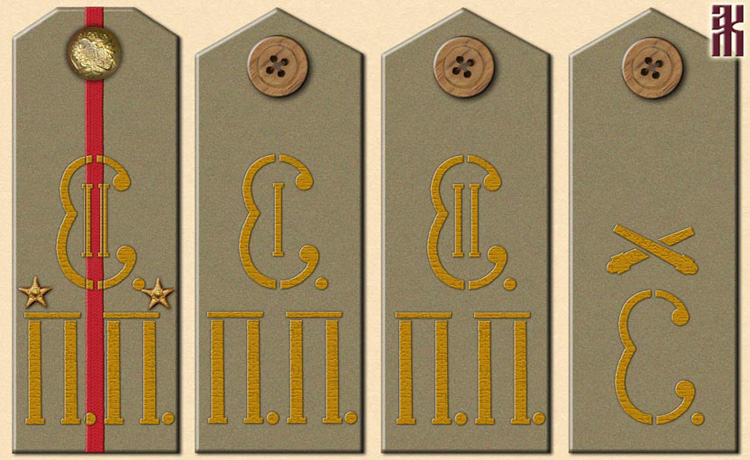
Shoulder-boards of the jaeger units of the Ataman Krasilnikov Independent Jaeger Brigade:
1 – second lieutenant of the 2nd Jaeger Partisan Regiment;
2 - private of the 1st Jaeger Partisan Regiment;
3 – private of the 2nd Jaeger Partisan Regiment,
4 – private of the Jaeger Artillery Divizion
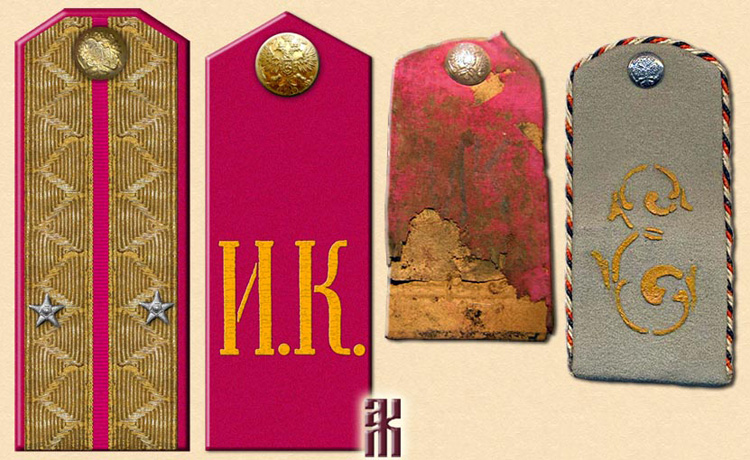
Shoulder-boards of the Irkutsk Cavalry Divizion
1 – second-lieutenant; 2 – private;
3 – authentic shoulder-board with the cipher "И.К.", found in Irkutsk (I. Butakov collection);
4 – modern reconstruction of a shoulder-board of a jaeger unit in Kolchak's Russian Army
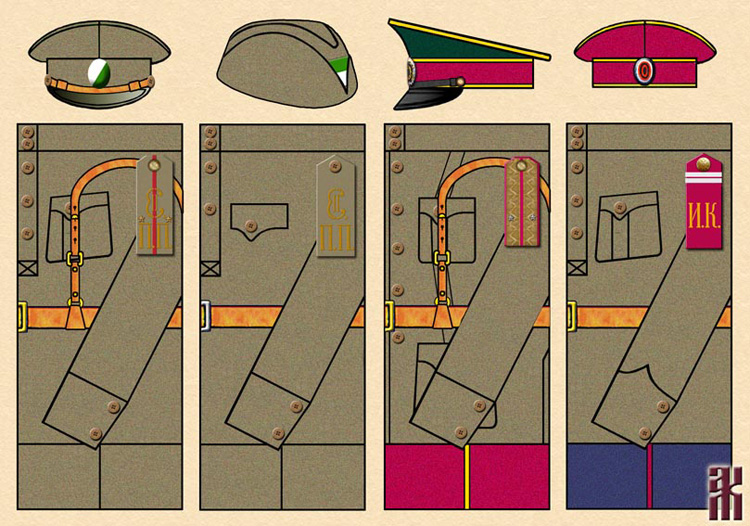
Uniforms of the Independent Jaeger Brigade of Ataman Krasilnikov:
1 – second-lieutenant of a jaeger regiment; 2 – private of a jaeger regiment;
3 – officer of the Irkutsk Cavalry Divizion ; 4 – corporal of the Irkutsk Cavalry Divizion
Figure 2 is based on the photograph above. Figure 4 is reconstructed based on the descriptions by V. Ya. Zazubrin.
Home — State Symbols — Flags — Uniforms — Badges & Medals — Money — Other
Pygmy Wars Notes
The original for this page is at kolchakiya.ru/uniformology/Krasilnikov%27s_jagers.htm.
The page about the unit when it was still partisans is here. Further information on the cavalry unit is here.
The photographs from forums-su.com are here and here.
Discussion on the translation choices I have made can be found here.
History of Krasilnikov's Independent Jaeger Brigade
From studopedia.net:
With the formation of the Jaeger brigade from the former partisan unit, in September 1919 the unit left for the Eastern Front (although some units likely remained in the Irkutsk and Enisei provinces). Initially part of the 3rd Army near Kurgan, it was then transferred to the 1st Army and moved to the Yalutorovsk-Zavodoukovskoe area. Initially successful, they were nevertheless swept away by the general defeat.
Krasilnikov died in January 1920 in Irkutsk, during the Ice Campaign. His unit made it to Transbaikalia.