
Flags of the Emigration Period
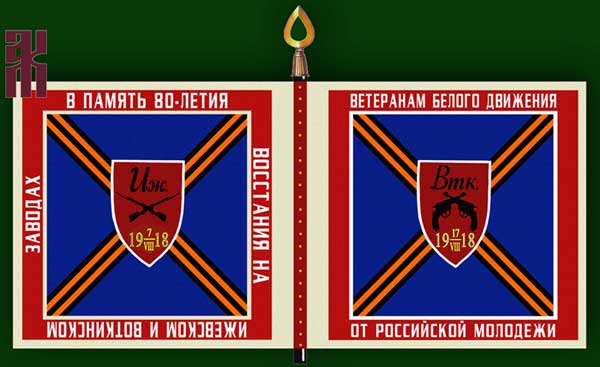
In memory of the 80th anniversary of the uprising at the Izhevsk and Votkinsk factories
Made on the initiative of a group of Russian patriotic youth in 1998. Authentic materials preserved since the early 20th century were used in the construction of the banner. These included materials donated by General Zuev's wife, which she brought to Moscow upon her return from exile in China.
Delivered to San Francisco, where the pole and finial were made in collaboration with Society member S. N. Zabelin. On 6 May 1999, on the feast day of St. George the Victorious, it was handed over to the oldest member of the Izhevsk-Votkinsk Association, Lieutenant E. A. Leontiev, who performed the ceremony of nailing the banner to the pole. It was consecrated on 15 September 1999. It is currently kept at the Society of Russian Veterans of the Great War and is brought out during ceremonial events.
It is a rectangular blue double-sided banner with a wide square red border and a narrow inner white frame. Inside that, the front has a diagonal cross made of St. George ribbon, with a red shield with the capital letters "VTK", an emblem of crossed revolvers, and the date "17.VIII.1918". The border has the inscription "To the veterans of the White movement, from the youth of Russia". The reverse has a diagonal cross made of St. George ribbon, with a red shield with the capital letters "IZH", an emblem of crossed rifles and the date "7.VIII.1918". The inscription in the border reads: "In memory of the 80th Anniversary of the uprising at the Izhevsk and Votkinsk factories" The dates are embroidered with gold thread, and the inscriptions on the frame are laid out with silver braid.
"Izhevtsy-Votkintsy // Bulletin of the Society of Russian Veterans of the Great War, No. 275", Moscow, 2000, pp.16–19.
Special Manchurian Detachment
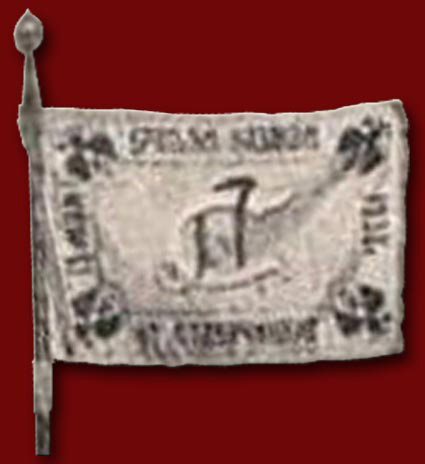
The banner appears in a photograph dedicated to the opening of the Khabarovsk branch of the Cossack Union in the Far East – along with the national flags of Russia, Japan and China, it adorns the wall behind the presidium of the solemn assembly.
It is most likely that the banner is made of yellow silk. In the centre is a two-colour image of the monogram of Ataman G. M. Semënov (the intertwined letters "A.S."). In the corners are the state coats of arms of the Russian Empire, and along the edge is an illegible inscription. Only the date for May (on the left vertical edge) and "1937" on the right can be deciphered, from which it can be concluded that this banner was commemorative in nature, since it was in 1937 that the former officers of the Special Manchurian Detachment celebrated its 20th anniversary.
Photo from siberia.forum24.ru/?1-4-0-00000027-000-10001-1
Russian Shanghai Regiment
On 28 March 1932, Order No. 88 of the regiment announced:
In accordance with a recent decision by the Municipal Council of the International Settlement, the Commander of the Corps will present the regiment entrusted to me with a banner. The banner is the national flag of the Imperial Russian State, as a sign of the unit's nationality, with municipal stencils embroidered on both sides of it, which are a sign of the authority to which the regiment is subordinate. The ceremony of attaching the banner to the pole will take place in the Corps' gymnasium at 12:15 p.m. on Friday 1 April. The ceremony will be attended by members of the Municipal Council, the commander of the British expeditionary forces in Shanghai, the Corps Commander with his staff officers, the commanders of the Corps units, the commanders of the British military units in Shanghai, and representatives of the Russian colony, both military and civilian. From the regiment entrusted to me, the following are to attend the ceremony: all officers (including doctors), the standard-bearer and one from each company (from four companies) and a squad – the sergeant-major, sergeant and volunteer. At 12:15 p.m. on Sunday 3 April, at Reis-Korsa (in rainy weather, in the Drill Hall) the consecration of the banner and the ceremony of its presentation to the regiment will take place.
At 12:15 p.m. on 1 April the banner was nailed to the pole in the gymnasium of the building. A large table covered with the municipal flag was placed in the middle of the hall. Three steps in front of the table stood four sergeant-majors, four sergeants and four volunteers (one from each company), lined up in a row facing the table. The flag was brought in by Corporal Lenkov, accompanied by Lieutenant Gapanovich, and laid out on the table with the cloth unfolded. Here, the cloth was finally fitted to the pole and attached with 80 nails hammered in one-third of the way.
When all the guests of honour had arrived in the corps' officers' mess (a room adjacent to the gymnasium), the ceremony of nailing the banner (the final hammering of the nails) began. The first nail was offered to the chairman of the municipal council, General Macnothen, and then to all the others present, in order of seniority or position. Each of those present, after hammering in a nail, signed a special sheet of paper on the table near the banner.
The ceremony of consecration and presentation of the banner to the regiment was exceptionally beautiful. Nearly five hundred men in beautifully ironed uniforms, with leather and brass fittings polished to a shine, lined up in a straight line, with a full (approximately forty people) orchestra of the regular English battalion on their right flank, lined up in a broad front with rows spaced three steps apart, presented a majestic, unforgettable sight!
The church service and the beautiful sermon by Archpriest Sergius Borodin gave this ceremony even greater significance and united the regiment and the spectators present at the parade into a single whole.
"Regiment, under the banner, attention!" was the command of the assistant regimental commander, Captain Ivanov, who was in charge of the parade. The command was clearly heard, and the two rows, bristling with bayonets, froze, greeting "their" well-deserved banner. The English battalion's orchestra played a "slow march", and Lieutenant Gapanovich led the flag, carried by the flag bearer, Corporal Lenkov, with two assistant officers along the front and between the regiment's ranks.
This part of the ceremony turned out to be a little drawn out, since our Russian slow march (or rather, funeral march) has nothing in common with the English "slow march" in terms of either meaning or execution. Their movement is performed at a normal pace, only at a slower tempo, in our march, the pace is not only slowed down, but also reduced in size, slowing the movement to almost half the usual speed.
The standard-bearer carried the flag in front of the regiment. "Ceremonial march, company by company", Captain Ivanov's command rang out, and the regiment reorganised into a company column, then began to move to the bravura sounds of the march "Under the Double-Headed Eagle", specially chosen for the occasion by the conductor of the English orchestra. With a straight line of bayonets and heavy, distinct steps, company after company, the regiment marched past the corps commander and all the generals, "at attention" as they approached the salute site. A loud "Hurrah!" and applause from the spectators accompanied each company, which, after passing the salute, reorganised into a platoon column on the march, then stretched out into a column of two rows and headed for the exit from Reis-Korsa, carrying its banner at the head. The entire Shanghai press, both English and Chinese, wrote at length and with great admiration about this ceremony, noting the regiment's achievements and its brilliant training.
Alekseev, E. in "The Shanghai Russian Regiment // White Emigration in China and Mongolia", Moscow, 2005, pp.235-237.
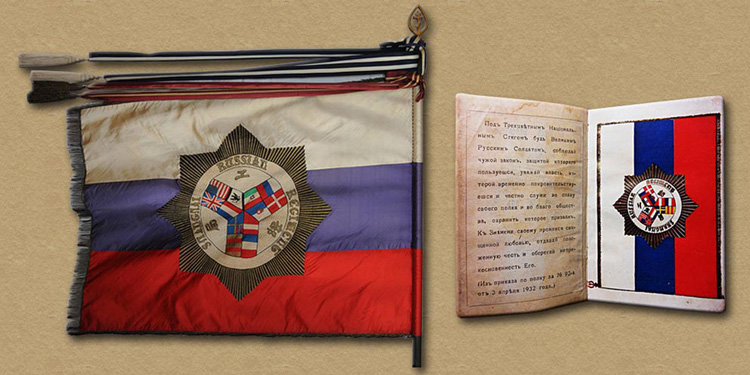
Banner of the Russian Shanghai Regiment and commemorative book with its description
Russian Group of Marshal Zhang Zuolin's army, 1923-1928
1st Brigade of the 1st Army of the Mukden Forces and 109th Independent Brigade
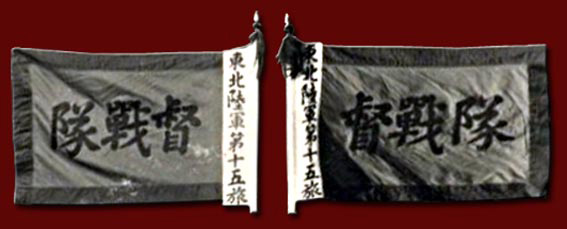
Flags of the Mukden Army captured by the Red Army during the conflict on the Chinese Eastern Railway in 1929
Strangely enough, the Russian mercenaries in this army did not have their own banner until late in 1926.
2nd Composite Regiment, Dungan Fortress, February 1928
One of the officers distributed this money to the soldiers, and they drank it away. And the officers were thoroughly drunk too. They were unable to do anything and were disarmed by the enemy. They managed to burn the standard and gave a piece of it to Borodinskiy so that he could bring it to us and report what had happened.
August 1928
There was another event – the presentation of flags from the neighbouring villages of Karmanov and Terekhov for not harming the population. The presentation was solemn, but Karmanov did not even organise tea.
August 1928
Once again, we received tokens of appreciation from the population of the surrounding villages, including an honorary umbrella and flags.
Balmassov, S. S. in "White émigrés in military service in China", Moscow, 2007, pp.187, 253, 278, 286, from the diaries of Colonel A. A. Tikhomirov.
Home — State Symbols — Flags — Uniforms — Badges & Medals — Money — Other
Pygmy Wars Notes
The original of this page is at http://kolchakiya.ru/vexillologiya/emigration_flags.htm.