
Uniforms of the Volunteer Division, 1919-22
Material and reconstructions by A. Karevskiy
Volunteers wore black shoulder-boards with red piping, while officers wore the same shoulder-boards with red stripes. The shoulder-boards bore a large capital letter "D". Volunteer officers did not wear gold shoulder-boards at all.
Filimonov, B. B. in "White Rebels: The Khabarovsk Campaign, Winter 1921-1922 Vol. 1", Shanghai, 1932, p.45.
Tomsk Infantry Military School
The cadets were dressed in brand new English uniforms. ... In July 1919 the first class graduated as second lieutenants and was sent to the regiments. When General Kramarenko's Volunteer Division was formed, for example, almost the entire 3rd Company went to man the 2nd Volunteer Regiment.
Elenevsky, A. in "Military Schools in Siberia (1918-1922) // Cadets in the White Struggle and Abroad", Moscow, 2003, p.439.
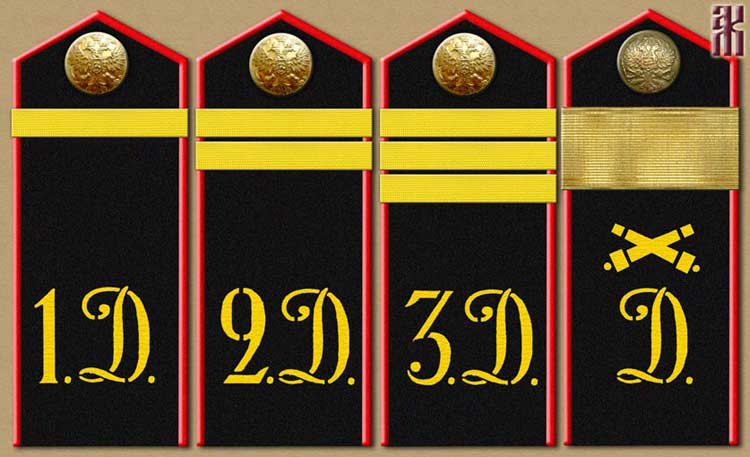
Shoulder-boards of the other ranks of the Volunteer Division:
1 – lance-corporal of the 1st Volunteer Rifle Regiment;
2 – corporal of the 2nd Volunteer Rifle Regiment;
3 – sergeant of the 3rd Volunteer Rifle Regiment;
4 – sergeant-major of the Volunteer Artillery Divizion
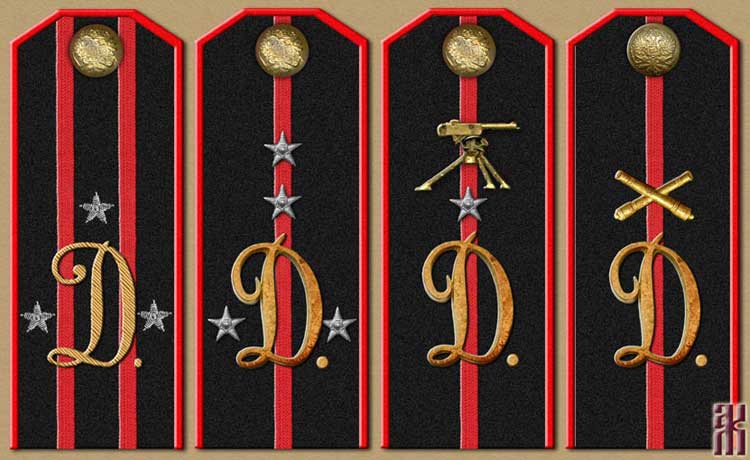
Shoulder-boards of officers of the Volunteer Division:
1 and 2 – lieutenant-colonel and staff-captain of a Volunteer Rifle Regiments;
3 – ensign of the regimental Machine Gun Komand ;
4 – captain of the Volunteer Artillery Divizion
The reconstructions are in two variants – those with numbers in the ciphers and those without, in accordance with the description by Filimonov.
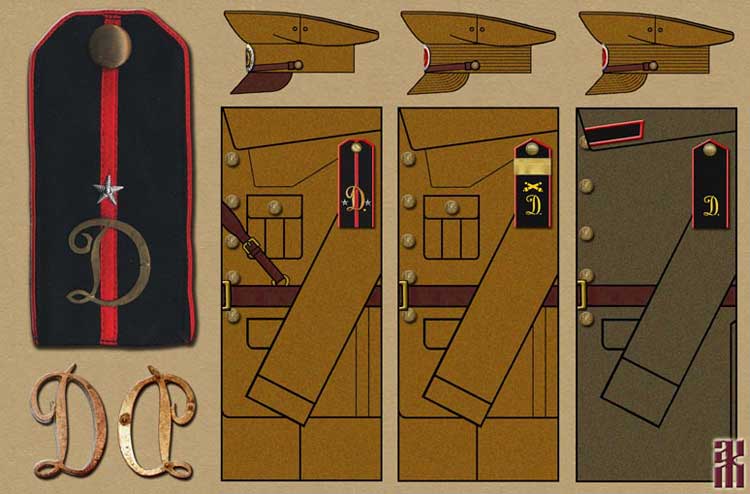
Uniforms of the Volunteer Division:
1 – ensign's shoulder-boards;
2 – cipher "D"; 3, 4 and 5 – uniform schemes
Figure 1 is a reconstruction by K. Kulagin. Figure 2 is from sammler.ru – note the letter is almost identical to that for Imperial dragoon regiments, but smooth rather than ribbed.
sammler.ru/index.php?showtopic=52697.
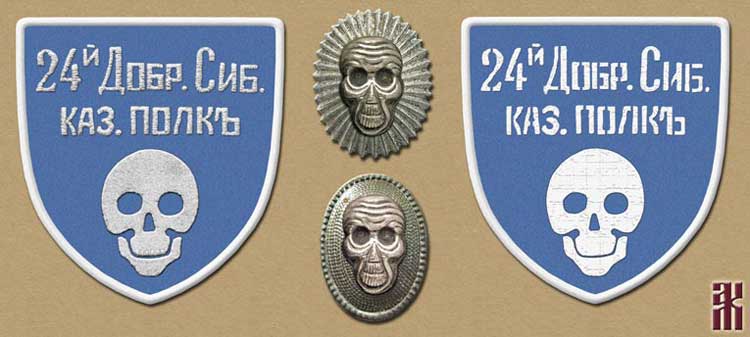
Sleeve insignia and cockades of the 24th Volunteer Siberian Cossack Regiment.
In his article, Selivanov points out that this regiment, being a volunteer unit, was not part of the Siberian Cossack Host and was assigned to the Special Detachment, which was later expanded to the Volunteer Division. The reconstruction was made based on photographs of the officer's sleeve insignia and NCO's cockade provided to me by Selivanov. The skull emblem was made using an appliqué technique, and the inscription was machine-embroidered. Dimensions: 112 by 102 mm.
Selivanov, M. in "History of Civil War Insignia in Russia. X. Cossack Troops of Eastern Russia, No. 9", Moscow, 2012, p.120.
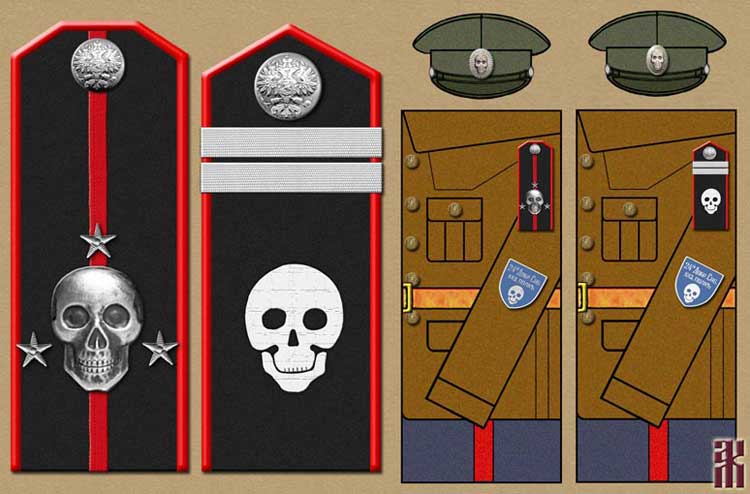
Shoulder-boards and uniforms of the 24th Siberian Cossack Volunteer Regiment
Since the regiment was considered a volunteer regiment and was not part of the regular regiments of the Siberian Cossack Host, the reconstruction of the regiment's shoulder-boards is based on the shoulder-boards of volunteers. The skull emblems were extrapolated from the sleeve insignia and cockades. The presence of a cipher of "24.Сб." on the shoulder-boards is doubtful – it would not have been necessary on the sleeve insignia if it had been on the shoulders. British tunics are shown as the division was generally supplied with British uniforms.
Home — State Symbols — Flags — Uniforms — Badges & Medals — Money — Other
Pygmy Wars Notes
The original for this page is at kolchakiya.ru/uniformology/volunteer_div.htm.
Note the regiment had a Latin "D", not the Cyrillic "Д", such as for Drozdovskiy.
There is another page dedicated to the infantry regiments of this division, here.
The uniforms of the cavalry component are shown here.
Discussion on the translation choices I have made can be found here.
History of the Volunteer Division
Taken from Volkov:
The division formed in the summer of 1919 in Omsk as a "Special Detachment", created with the aim of linking the extreme left wing of Kolchak's Eastern Front with the Armed Forces of South Russia. So-called "Southerners" – officers of the Volunteer Army who had made their way to Siberia across the steppes of southern Russia and Central Asia – played a leading role in the units being formed. However, by the time Special Detachment's was ready, the situation at the front no longer permitted the planned link.
In late autumn 1919 the detachment was renamed the Volunteer Division, took part in fighting east of the Ural Mountains, in Western Siberia. The division had three volunteer rifle regiments (later four) and an artillery divizion. Around the same time, Bakhterev's Independent Detachment – two squadrons and two companies, formed in August 1919 from officers of various units – was attached to it.
During the Siberian Ice March, officers from various units and various small units, joined the remnants of the division: these included the 4th Battalion of Marine Rifles and General Makri's detachment. Upon its arrival in Transbaikalia in February 1920, the division was reorganised into a brigade, of the 1st Volunteer Regiment, the 3rd Composite Volunteer Regiment and the Volunteer Artillery Divizion (two batteries), with Colonel Bakhterev's detachment, reorganised as an Independent Cavalry Divizion, attached. It went into the 2nd Rifle Corps.
On reaching Primor'e, the brigade split in March 1921. The bulk of the 1st Volunteer Regiment and the artillery went to the Grodekov Group (ex-Semenovtsy). These forces dwindled significantly. During the Khabarovsk Campaign, the Independent Krasnoufimsk Cavalry Squadron was merged with it, and the regiment changed its name to the Composite Volunteer Regiment. It became part of the Izhevsk-Votkinsk Brigade. In August 1922, it was incorporated into the Prikamsk Regiment.
The 3rd Composite Volunteer Regiment and the cavalry stayed with the 2nd Rifle Corps. By the time of the Khabarovsk campaign in the autumn of 1921 it had 350 men, including former officers from Bakhterev's cavalry that had been incorporated into the regiment. Despite being a "composite" unit, it proved to be more cohesive and stronger than the 1st Volunteer Regiment. It had two battalions, each of three rifle companies, and a third composite battalion of an officers company (60 men), a mounted reconnaissance squadron (80 sabres), a machine-gun komand (5 machine guns) and a signals team. After the campaign, it was renamed the 6th Volunteer Regiment. In August 1922, it was incorporated into the East Siberian Rifle Regiment