
Uniforms of Units under the command of Ataman Semenov in 1919-1920, based on memoirs and photographs
Material and reconstructions by A. Karevskiy, unless noted otherwise.
The initial basis of Semenov's troops was the so-called Special Manchurian Detachment (SMD), whose main distinguishing feature was a yellow cloth badge with the letters "OMO" worn by all ranks of the detachment on their left sleeve. It seems that it was introduced precisely to visually distinguish it, since in the early period of the struggle against the Bolsheviks (until the detachment's establishment in Transbaikalia in August 1918), they wore the uniforms and, accordingly, the insignia of various units of the former army.
Later, G.M. Semenov, describing his position in Transbaikalia, liked to use an aphorism of his own invention: "The earth rests on three pillars, and the people's power in Transbaikalia rests on three divisions". He was referring to the 1st Transbaikal Cossack Division, the Special Ataman Semenov Manchurian Division (later the Composite Manchurian Division), and the Non-Russian Horse Division (later Asiatic Horse Division).
The 1st Transbaikal Cossack Division was recreated on the basis of the surviving members of the former division, consisting of the 1st Chita, Troitskosavask, Verkhneudinsk and Nerchinsk Cossack Regiments (on 21 September 1918 they were given the numbers 1st to 4th). A 2nd Transbaikal Cossack Division was established as other Transbaikal Cossack regiments were formed, based on self-defence units, numbering from 5th to 10th.
The Special Ataman Semenov Manchurian Division was formed on the basis of the former Special Manchurian Detachment. It included a Rifle Brigade (1st Ataman Semenov and 2nd Manchurian Rifle Regiments, a Jaeger Battalion and the 1st Manchurian Artillery Divizion) and a Horse Brigade (1st Ataman Semenov Horse Regiment, the 2nd Ussuri Cossack Regiment and the 1st Manchurian Horse Artillery Divizion).
Uniforms
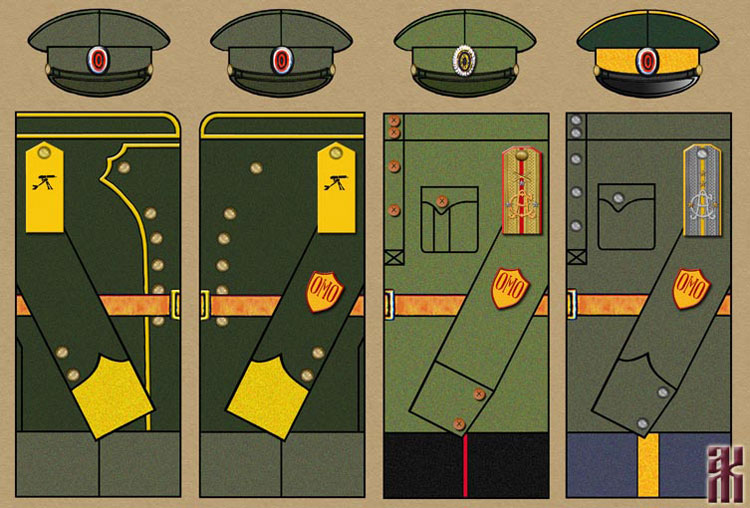
Uniforms of units under the command of Ataman Semenov:
1 and 2 – machine gun platoon of the Special Manchurian Detachment, June 1918;
3 – "Semenovets " of the armoured train division;
4 – staff-captain of the 1st Ataman Semenov Horse Regiment.
Figures 1 and 2 are based on a photograph published in the photo album "White Russia", Moscow, 2003. Figure 3 is based on a photograph published at amurec.ucoz.ru. Figure 4 is based on B. B. Filimonov's memoirs.
amurec.ucoz.ru/forum/12-68-1 [link dead]
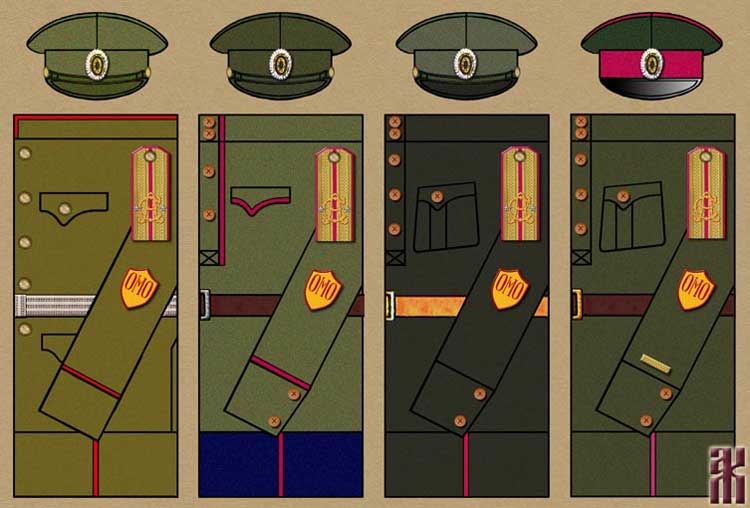
Uniforms of rifle units under the command of Ataman Semenov
These reconstructions are based on photographs published at www.xxl3.ru/kadeti/tirbakh.htm and foto.mail.ru/list/shkurkin/362/168.html [links dead]
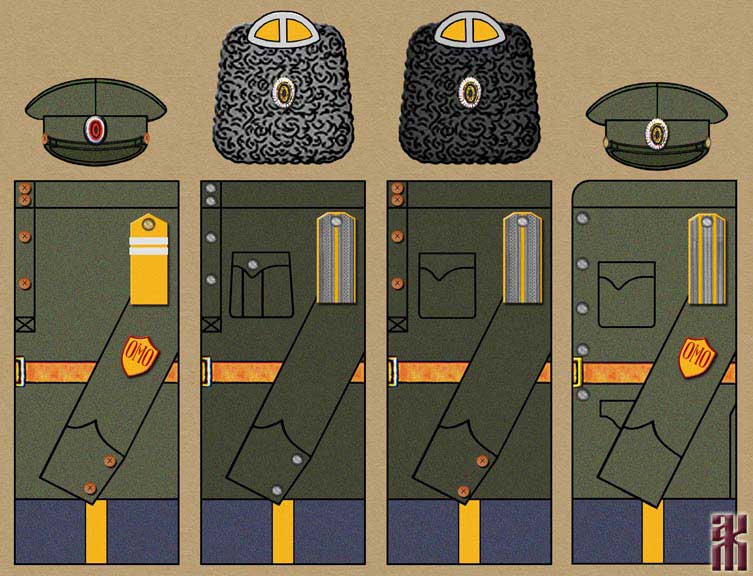
Uniforms of Cossack horse units of the Transbaikal Host
These reconstructions are based on photographs published in amurec.ucoz.ru/forum/12-68-1 and www.predistoria.org/index.php?name=Forums&file=viewtopic&p=26159 [links dead].
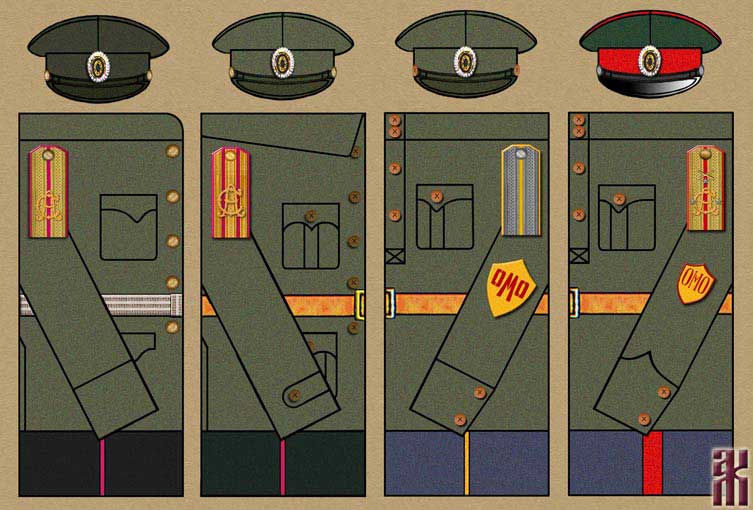
Uniforms of units under the command of Ataman Semenov:
1 and 2 – rifle units; 3 – cavalry unit; 4 – artillery unit
These infantry reconstructions are based on photographs published at www.xxl3.ru/kadeti/tirbakh.htm and the cavalry from www.rus-sky.com/history/library/latyshev/index.htm [links dead].

Shoulder-boards of the 1st Transbaikal Cossack Division:
1 and 2 – officers of the Chita and Nerchinsk regiments (until September 1918);
3 and 4 – artillery batteries of the Transbaikal Cossack Host
After September 1918 the regiments were assigned numbers.

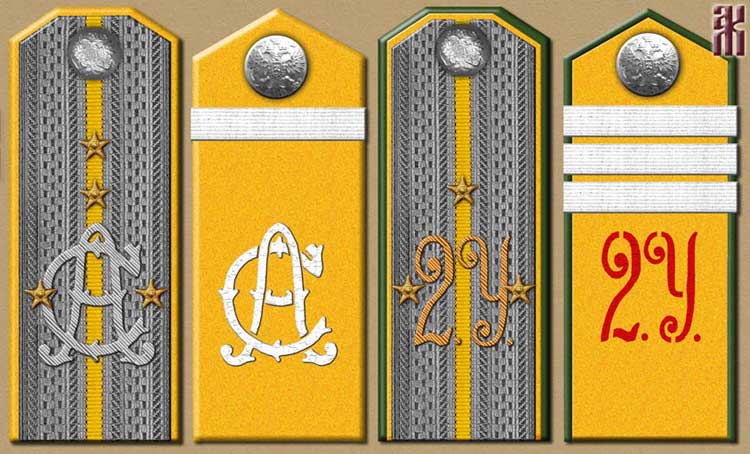
Shoulder-boards of the 1st Transbaikal Cossack Division after September 1918:
1st Chita, 2nd Troitskosavask, 3rd Verkhneudinsk and 4th Nerchinsk Cossack Regiments.
Shoulder-boards of the Composite Manchurian Division's Horse Brigade from June 1919:
1 and 2 – 1st Ataman Semenov Horse Regiment; 3 and 4 – 2nd Ussuri Cossack Regiment.
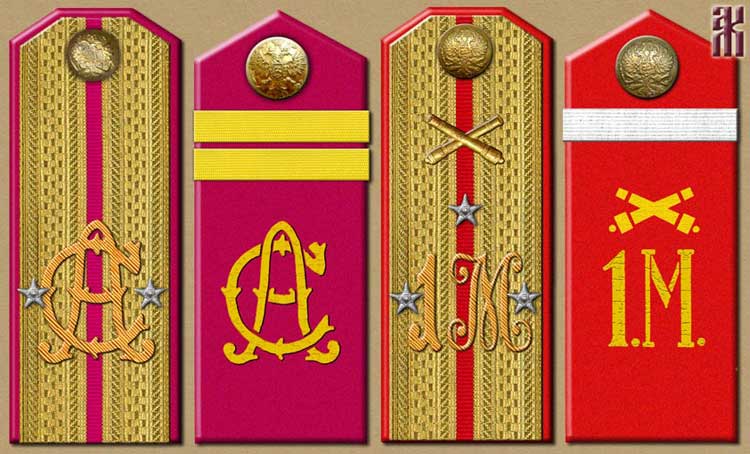
Shoulder-boards of the Composite Manchurian Division from June 1919:
1 and 2 – 1st Ataman Semenov Manchurian Rifle Regiment;
3 and 4 – 1st Manchurian Light Artillery Divizion
It remains unclear whether the shoulder boards of the artillery had italic or solid letters, so both possible variants are presented here.
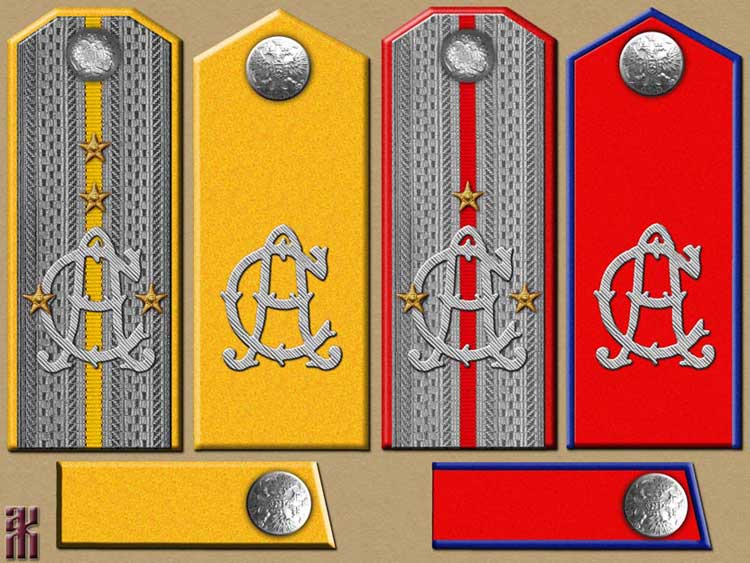
Shoulder-boards of the Horse Brigade of the
1st Ataman Semenov Composite Manchurian Division:
1 and 2 – 1st Ataman Semenov Horse Regiment;
3 and 4 – Independent Simbirsk Lancer Divizion
From 1 June 1920 all the units of the division were named for Ataman Semenov.
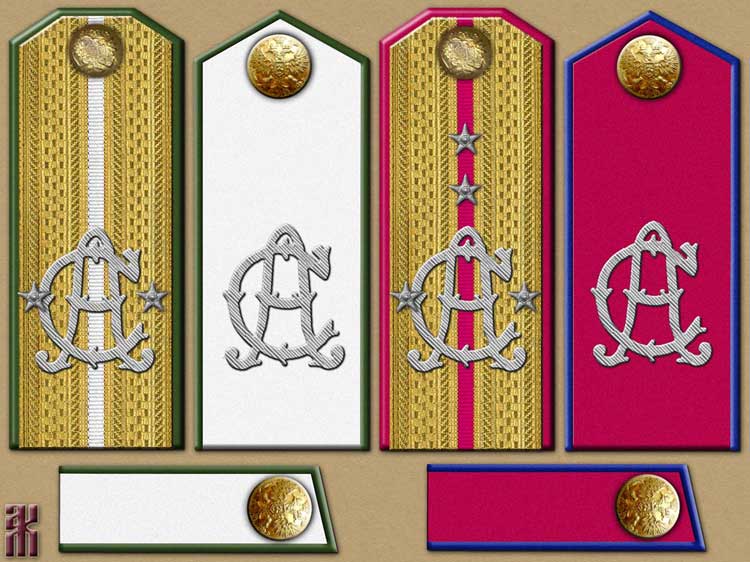
Shoulder-boards of the Horse Brigade of the
1st Ataman Semenov Composite Manchurian Division:
1 and 2 – Independent Kazan Dragoon Divizion ;
3 and 4 – Independent Ekaterinburg Lancer Divizion
The General Kislitsin's memoirs confirm that from May 1920 Ataman Semenov's monogram was worn by the ranks of the former 1st Cavalry Division.
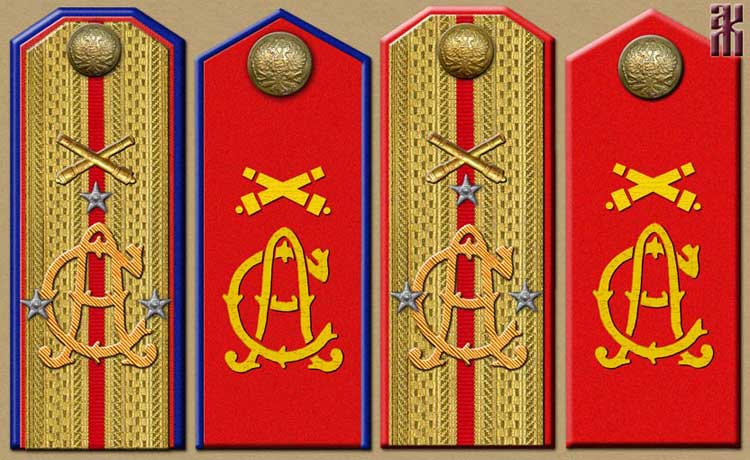
Shoulder-boards of the artillery of the 1st Ataman Semenov Composite Manchurian Division (from May 1920; from 1 June 1920, all the division's units were named
"Ataman Semenov"):
1 and 2 – 1st Horse Artillery Divizion of the 2nd Horse Brigade;
3 and 4 – 1st Manchurian Artillery Divizion of the 1st Rifle Brigade.
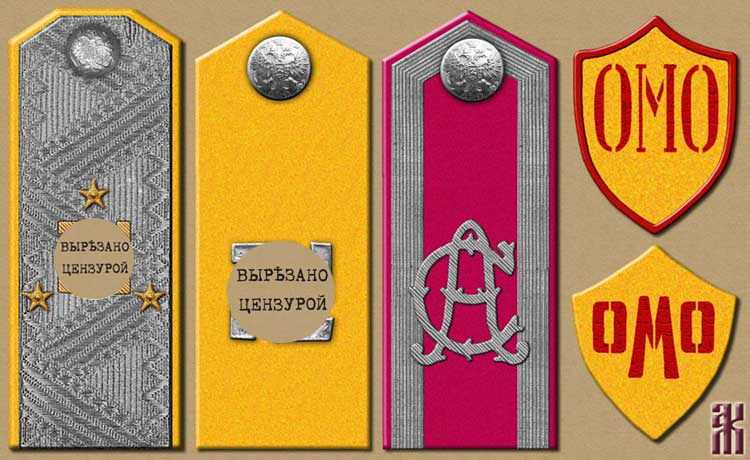
1 and 2 – shoulder-boards of a general and private in the Buryat Cavalry Regiment;
3 – shoulder-boards of a sub-ensign of the Composite Regiment at the Commander-in-Chief's HQ
4 and 5 – varieties of sleeve insignia of the Special Manchurian Detachment
Figures 1 and 2 of the Dorzhi Banzarov's regiment are reconstructed based on General Sakharov's memoirs and the Kuznetsov book. The Composite Regiment would later become the Independent Escort Divizion. Figures 4 and 5 were reconstructed based on a photograph of General Kislitsin taken from the preface to his memoirs, as well as on the breast insignia of the Special Manchurian Detachment.
Kuznetsov, N. A. in "The White God of War: Baron R. F. von Ungern-Shternberg and the Asiatic Horse Division // Dobrovolets, No. 2", Moscow, 2003, p.25.
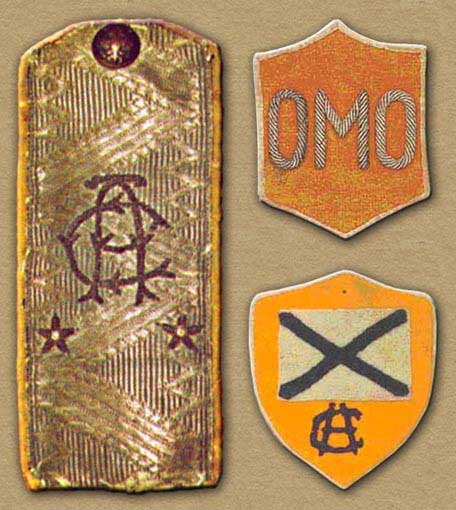
Authentic items of units under the command of Ataman Semenov:
1 – Major General's shoulder-board with Ataman Semenov's monogram;
2 – SMD sleeve insignia (fabric, embroidered with braid, 75 by 60 mm);
3 – sleeve insignia of Ataman Semenov's Shilka River Combat Flotilla (fabric, 72 by 62 mm)
The shoulder-board belonged to Baron von Ungern-Shternberg. It was taken from the "Baron Ungern in Documents and Memoirs" book. Figure 3 is from the Selivanov article.
"Baron Ungern in Documents and Memoirs", Moscow, 2004.
Selivanov, M. in "Distinctions and differences of the Civil War era // www.mirnagrad.ru/cgi-bin/exinform.cgi?page=29&ppage=3 [link dead]
In Memoirs
Ataman Semenov, March 1920
Tall, with a large head and broad, powerful shoulders, dressed in a Russian poddëvka coat with shoulder-boards bearing the Mongolian "swastika" symbol – the uniform of the Mongolian-Buryat Division – the ataman looked like a natural-born warrior.
Sakharov, K. V. in "White Siberia (The Civil War of 1918-1920)", Munich, 1923, p.301.
Ataman Semenov Military School
The composition of the first class of cadets was described by one of them as follows:
Among all kinds of blouses, tunics and pea coats: there were two or three tertiary or secondary students, which looked strange in that military setting. There were many cadets from the Irkutsk, Khabarovsk and Siberian corps ..."
The variety of uniforms was eliminated after the school was given clothing from the warehouse of the Chita regional prison, and although it was not very attractive, a uniformity was achieved for the regiment: wide, grey soldier's cloth trousers, grey flannel blouses, soldier's boots, short coats and papakhi. Strangely enough, although it seemed that one could buy anything one needed in the nearby Chinese Eastern Railway Exclusion Zone, in reality there was either nothing or things like the famous blue uniform made of dyed burlap, which had to be withdrawn after two weeks of wear because it not only stained underwear but also caused skin diseases.
The cadets' appearance remained unpresentable, and the administrative staff had to work hard before they finally managed to obtain decent uniforms. Overcoming this difficulty required not only the establishment of an administrative system, but also an understanding of psychology. Finally, well-tailored and neatly fitted yellow cloth greatcoats and black uniforms appeared – the uniforms and trousers of the Chita Escort Komand, which immediately made any Chita cadets on leave noticed on the streets of Chita and other cities.
Elenevsky, A. in "Military Schools in Siberia (1918-1922) // Cadets and Junkers in the White Struggle and Abroad", Moscow, 2003, pp.425-426.
Special Manchurian Detachment, Dauriya Front, April 1918
Two men in Japanese cloth soldier's uniforms stood surrounded by Red Guards. Silently, like wolves, they looked around. On their shoulders were khaki shoulder-boards with the letters OMO.
Zhigalin, Y. in "Partisan Detachments Occupied the Cities", Irkutsk, 1986, p.55.
The detachment had raspberry shoulder-boards with the letters "AS" – for Ataman Semenov.
Volkov S. V. in "The White Movement: Encyclopedia of the Civil War", St. Petersburg, 2003, p.381.
A characterisation of SMD armoured train commander, Stepanov
He appeared in the Special Manchurian Detachment in January 1918 in the uniform of an artillery captain. That he was indeed an artillery officer is beyond doubt, as attested to by his colleagues and his knowledge of artillery. Another peculiarity was that Stepanov had an incredible number of wound bars on his sleeve, which idle people counted as 16, it seems – even his colleagues did not believe him about this.
Markovchin, V. V. in "Three Atamans: A. Dutov; G. Semenov; D. Tundutov-Dundukov", Moscow, 2003, pp.199-200.
Early 1919
All the detachment's officers, as a sign of their affiliation, wear a small yellow cloth shield (the colour of the Transbaikal Cossacks) on their left sleeve with the initials O.M.O. and the designation of their military unit.
"Activities of Ataman Semenov's Special Manchurian detachment", Harbin, 1919, pp.11-12.
Memorandum by Ataman Dutov after his trip to the Far East, mid-1919
The Mongols are very eager to enlist as volunteers, and Semenov is forming a Wild Division from them. The Mongols insist on Russian uniforms and Russian weapons, which is quite characteristic.
Markovchin, V. V. in "Three Atamans: A. Dutov; G. Semenov; D. Tundutov-Dundukov", Moscow, 2003, pp.74
The Cossacks
Semenov's men were dressed in Cossack style, in sheepskin or fur hats, jauntily pulled down over one ear, with long curved sabres (which they brandished at the slightest provocation), automatic pistols dangling from their right hips, or rifles slung over their shoulders, and carrying something like "get out of the way, you, – – – " in their air.
Latchford, E. U. in "With the White Army in Siberia", 1933 at www.zaimka.ru/white/latchford.shtml
The White Cossacks of Transbaikalia, in their wide trousers with yellow stripes, their grey goatskin papakhi jauntily pulled back over their heads, their belts hung with grenades, carbines slung over their shoulders and whips in their hands, made a threatening impression just by their appearance.
Ehrenpreis, L. in "The Struggle for the Soviets in the Barguzin District // The Struggle for Soviet Power in Buryat-Mongolia", Moscow, 1940, p.183
April 1918.
In order to support the Onon Cossacks in their fight against the Bolsheviks, Semenov ordered the stanitsa atamans of Bukunsk, Verkhnee-Ulkhunsk, Mogoytuevsk, Akshinsk, Mangutsk, Durulguysk, Tsasucheevsk, Chindan-Grodkovsk, 2-Chindan, Tsagan-Oluyevsk, Abagaytuevsk, Duroevsk, Mankegursk, and Onon-Borzinsk to immediately summon all officers, doctors, and officials under the age of 45 and Cossacks between the ages of 21 and 29 (i.e., those who served between 1911 and 1918). It was proposed that the above categories be sent: from the upper stanitsas up to and including Mogoytuya – to Akshu at the disposal of Captain N. F. Shilnikov, and from the remaining lower stanitsas – to Borzya Station at the disposal of a special commission. All Cossacks were to arrive on horseback and, if possible, with weapons and in uniform.
Simonov, D. G. in "The White Siberian Army in 1918", Novosibirsk, 2010, p.49, citing RGVA F.39539 Op.1 D.3 L.36-38.
Verkhneudinsk, August 1918
At night, the doors of the prison opened several times, and Cossacks with white arm-bands took their victims away to be shot.
Petrov-Trofimov, G. in "The Bolsheviks in the Struggle against Intervention and the White Guard in the Baikal region // The struggle for Soviet power in Buryat-Mongolia", Moscow, 1940, p.45.
Semenov's men in Irkutsk
On 6 September several Cossacks from Captain Semenov's detachment arrived in Irkutsk. Their appearance attracted attention due to their distinctive clothing: Cossack uniforms, but with only one shoulder-board on their blouses.
"Siberian Life [newspaper], No. 111", 17 September 1918.
Transbaikal Cossack Artillery Divizion, Makkaveevo station, March 1919
First of all, General Nikonov noted the "brilliant appearance" of the honour guard, which was sent by the divizion on the orders of the detachment commander, Lieutenant-Colonel A. Tirbak: "The guard marched magnificently in a ceremonial march." All the personnel of the divizion had "excellent posture", despite being dressed in "Chinese fur coats and Russian sheepskin coats, with fur or Tatar boots on their feet".
Romanov, A. The Special Manchurian Detachment of Ataman Semenov. Irkutsk, 2013, p.208.
Utan-Pashennaya, April 1920
They rushed into battle with frenzied ferocity. The Kappelevtsy panicked. The 1st Semenov Buryat Regiment was cornered at Pashennaya at the confluence of the raging rivers. The rivers calmly accepted the fur coated Semenovtsy into their waters.
Zimin, P. in "A Whirlwind on Horseback // Taiga Expeditions", Khabarovsk, 1972, p.430
Stanitsa Kyra, 1921.
In a warehouse abandoned by the Whites, we found a decent amount of food, several hundred rifles, 1,500 rounds of ammunition, and a barn full of uniforms and boots – blouses with sewn-on shoulder-boards, woollen trousers – all of Japanese manufacture.
Strod, I. in "Semenovshchina and Ungernovshchina // Proletarian Revolution, No. 9", 1926, p.128
Japanese equipment
The Semenovtsy, who receive all their weapons directly from Japan, are armed, as they say, "to the teeth". Semenov's units number up to 12,000 men. Their distinctive uniform features one shoulder-board on the right shoulder and a black cord piping on the chest of the tunic.
"On the Work of Underground Bolshevik Organisations in Siberia (1918-1919) // Historical Archive, No. 2", 1962, p.105.
Special Ataman Semenov Manchurian Division
The Manchurians wore the letters "АС" (Ataman Semenov) on their raspberry shoulder-boards.
Filimonov, B. B. in "White Rebels: The Khabarovsk Campaign, Winter 1921-1922, Book 1", Shanghai, 1932, p.48.
9 January 1920
The shoulder-boards remained proudly on their shoulders, some with the monogram "AS" – the chief Ataman's units. Some faint-hearted riflemen on the left flank tried to tear off their shoulder-boards, but were brusquely stopped by their comrades.
"Memories of the Baikal Tragedy // Ray of Asia, No. 4", Harbin, 1934, p.47.
Romanov, A.
Uniforms and Symbols of Ataman Semenov's units
The history of Ataman Semenov's armed formations would be incomplete without a description of the uniforms and symbols of the Special Manchurian Detachment (SMD) and units of Ataman Semenov's Composite Manchurian Division. Military uniforms and insignia have always been of great importance in any army in the world. During the Russian Civil War, the external symbols of the forces were particularly relevant, as they carried a heavy ideological burden.
At the beginning of the Civil War in Russia, all armed formations, both White and Red, wore the same military uniform of the former Tsarist army. Both sides began to introduce their own systems of insignia, primarily for visual distinction, but also to emphasise their ideological and political positions.
When he began to form the SMD, Ataman Semenov retained all the old symbols and uniforms of the old Russian army, considering his detachment to be an integral part of it. From the very beginning, the SMD was modelled on the units of the Imperial Russian Army. An important element of the military uniform of Semenov's detachment, emphasising its political affiliation, was the presence of shoulder-boards. In this respect the SMD differed, for example, from the "democratic" Siberian Army of the summer of 1918, in which shoulder-boards were replaced by sleeve insignia with intricate distinguishing marks.
The appearance in Chita in September 1918 of SMD Cossacks wearing the shoulder-boards of the old Russian army caused discontent among part of the population. In relation to that, the commander of the SMD vanguard, Colonel Artamonov, ordered the distribution of an announcement in the regional centre, in which he stated, in particular: "The troops appeared in the prescribed uniform. I warn you that I will not tolerate any such actions against the officers of the detachment!" {1}
Along with the traditional symbols of the Russian army, new elements were also introduced into the SMD uniform. A distinctive feature of the Semenovtsy was a sleeve insignia in the form of a shield. Established for the detachment's officers in early 1918, the base colour was yellow (the distinctive colour of the Transbaikal Cossack troops) with the letters "ОМО" embroidered on it. {2}
There is information, unconfirmed by other sources, that the units of the Special Manchurian Detachment also used another symbol that was popular during the Civil War. In particular, this was recounted by a participant in the battles on the Dauriya Front, Red Cossack N. K. Vershinin of the 1st Argun Regiment: "Semenov's White Army in 1918 was called the Special Manchurian Detachment. To intimidate the Red Guard troops and the population of our region, the White Guards wore an insignia on the left sleeve of their uniforms – a human skull and two crossed bones on a yellow background, which meant "Death to the Soviets". {3}
Traditions quickly emerged during the short-lived Civil War. By the autumn of 1918 the local volunteer units of the SMD were already acting as the "old guard". When he began forming his corps, Ataman Semenov retained the distinctive insignia of his detachment for them. Order No. 11 of the 5th Amur Corps dated 26 October 1918 stated: "The units of the Special Manchurian Detachment shall have insignia on their left sleeves in the form of a yellow shield with the initials "O. M. O.". {4}
During the hostilities in the spring and summer of 1918, the SMD was distinguished by the diversity of its uniforms. The main uniform of Ataman Semenov's Cossack, infantry and artillery units was the field uniform of the Russian army. Alongside them Mongolian horsemen wore their national robes, and Chinese and Japanese infantrymen were dressed in the field uniforms of their armies. Gradually, with the formation of the 5th Amur Corps, the military uniforms of all Semenov's units were standardised. It is characteristic that the ataman, while having some financial resources at his disposal, did not seek to introduce any special, distinctive uniforms into his troops, such as the impressive black uniform of Kornilov's units or General Gaida' escort, who dressed in the uniform of Nicholas II's imperial escort. The uniform of the Independent East Siberian Army remained based on the 1912 field uniform of the Russian army.
In February 1920, having been appointed Commander-in-Chief of all Armed Forces of the Russian Far East, Ataman Semenov announced the newly established uniform in Order No. 154. The new uniform was simple and practical and was based on the same field uniform of the Russian army.
The general list in Order No. 154 included a description of the shoulder-boards of 60 different units, subunits and institutions, including military schools, the police, local and special commands. Contrary to popular belief, the shoulder-boards with the monogram "А.С." were used by only a few units, and by no means his entire army. Distinctive shoulder-boards with the letters "А.С." were established for the core units, the so-called "named" or "patron" units: {5}
1st Ataman Semenov Horse Regiment. Officers had a yellow shoulder-boards with white piping. The shoulder-boards had a stenciled monogram "А.С." of the established pattern in white paint.
1st Ataman Semenov Manchurian Rifle Regiment. Officers had a raspberry shoulder-boards with raspberry piping. The shoulder-boards had a stenciled monogram "А.С." of the established pattern in yellow paint.
Ataman Semenov Armoured Division. Officers had red shoulder-boards with black edging and red piping. The shoulder-boards had a stenciled monogram "А.С." of the established pattern in yellow paint.
In addition to the units above, shoulder-boards with the "А.С." monogram were assigned to Ataman Semenov's Escort Sotnia:
Officers have a yellow stripes, black edging and yellow piping. The stenciled monogram "А.С." is in white paint.
By Order No. 402 of the Commander-in-Chief of all Armed Forces of the Russian Far East of 1 June 1920, all units of the Composite Manchurian Division were given the name "Ataman Semenov". {6} The commander of the Composite Manchurian Ataman Semenov Division. Lieutenant-General V. A. Kislitsin, later recalled:
By the next order of the division, Ataman Semenov awarded silver "А.С." monograms. All the officers of the division were delighted with such kindness from their commander. The division became, as it were, a guard division and was one of the best in Transbaikalia. It was well supplied and stood out from the other units. {3}
1. "Inevitable Retribution: Based on the materials of the trials of traitors to the Motherland, fascist executioners and agents of imperialist intelligence services", Moscow, 1979, p.122.
2. "The Activities of the Ataman Semenov's Special Manchurian Detachment", Harbin, 1919, p.12.
"3. In the fire of 1918 // Border Guards of Transbaikalia", 23 Feb 1991.
4. GAZK F.329 Op.1 D.39 L.15.
5. GAZK F.329 Op.1 D.13 L.191-192.
6. "Guide to the White Army Archives", RGVA. F.39539.
7. Kislitsin, V. A. in "In the Fire of the Civil War: Memoirs", Harbin, 1936, p.97.
Romanov, A. in "Ataman Semenov's Special Manchurian Detachment", Irkutsk, 2013, pp.210-213.
Home — State Symbols — Flags — Uniforms — Badges & Medals — Money — Other
Pygmy Wars Notes
The original for this page is at kolchakiya.ru/uniformology/Semenov_unit_01.htm.
The "Manchuria" that these units were named after was Manchuria Station (Manzhouli, Inner Mongolia, China, 49.58 N 117.44 E) on the Far Eastern Railway, rather than the Province of Manchuria.
Semenov's detachment in the period prior to this is on this page. For the later period, when the remnants of Kolchak's army came under his command, is here.
The OMO stands for Osobyy Man'chzhurskiy Otryad, the Special Manchurian Detachment.
The original does have Armoured Train "Division", but I strongly suspect it was actually "Divizion".
An enlarged version of the photograph at xxl3.ru is here. The photograph of the rifle unit at xxl3.ru is this one.
The censored images on the Buryat shoulder-boards are anti-clockwise swastikas, which cannot be depicted under Russian law.
The following illustration by. A. Lebedeva was originally on the page and later removed.
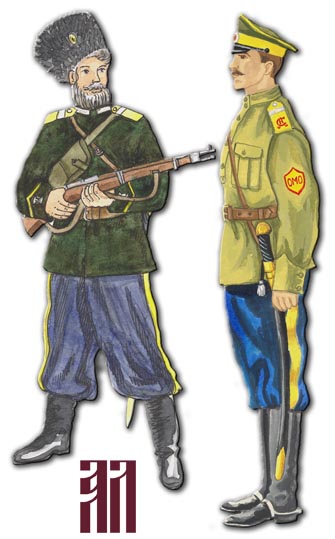
Lower ranks of the 1st Ataman Semenov Horse Regiment
The "Non-Russian" of the Non-Russian Horse Division is a translation of inorodnyy, which is a term relating to some ethnic groups in Russia that had a somewhat different legal status: in this case largely Mongols. Discussion of other translation choices I have made can be found here.
History of Ataman Semenov's Army
While it is expensive, White Terror: Cossack Warlords of the Trans-Siberian by Jamie Bisher is the go-to book on Semenov in English.