
Uniforms of Ataman Semenov's Special Manchurian Detachment, 1918-19
Material and reconstructions by A. Karevskiy, unless noted otherwise
Ataman Semenov's Special Manchurian Detachment
Romanov, A. M.
Irkutsk, 2013
The history of Ataman Semenov's armed formations would be incomplete without a description of the uniforms and symbols of the Special Manchurian Detachment (SMD) and units of Ataman Semenov's Composite Manchurian Division. Military uniforms and insignia have always been of great importance in any army in the world. During the Russian Civil War, the external symbols of the forces were particularly relevant, as they carried a heavy ideological burden.
At the beginning of the Civil War in Russia, all armed formations, both White and Red, wore the same military uniform of the former Tsarist army. Both sides began to introduce their own systems of insignia, primarily for visual distinction, but also to emphasise their ideological and political positions.
When he began to form the SMD, Ataman Semenov retained all the old symbols and uniforms of the old Russian army, considering his detachment to be an integral part of it. From the very beginning, the SMD was modelled on the units of the Imperial Russian Army. An important element of the military uniform of Semenov's detachment, emphasising its political affiliation, was the presence of shoulder-boards. In this respect the SMD differed, for example, from the "democratic" Siberian Army of the summer of 1918, in which shoulder-boards were replaced by sleeve insignia with intricate distinguishing marks.
The appearance in Chita in September 1918 of SMD Cossacks wearing the shoulder-boards of the old Russian army caused discontent among part of the population. In relation to that, the commander of the SMD vanguard, Colonel Artamonov, ordered the distribution of an announcement in the regional centre, in which he stated, in particular: "The troops appeared in the prescribed uniform. I warn you that I will not tolerate any such actions against the officers of the detachment!" {1}
Along with the traditional symbols of the Russian army, new elements were also introduced into the SMD uniform. A distinctive feature of the Semenovtsy was a sleeve insignia in the form of a shield. Established for the detachment's officers in early 1918, the base colour was yellow (the distinctive colour of the Transbaikal Cossack troops) with the letters "ОМО" embroidered on it. {2}
There is information, unconfirmed by other sources, that the units of the Special Manchurian Detachment also used another symbol that was popular during the Civil War. In particular, this was recounted by a participant in the battles on the Dauriya Front, Red Cossack N. K. Vershinin of the 1st Argun Regiment: "Semenov's White Army in 1918 was called the Special Manchurian Detachment. To intimidate the Red Guard troops and the population of our region, the White Guards wore an insignia on the left sleeve of their uniforms – a human skull and two crossed bones on a yellow background, which meant "Death to the Soviets". {3}
Traditions quickly emerged during the short-lived Civil War. By the autumn of 1918 the local volunteer units of the SMD were already acting as the "old guard". When he began forming his corps, Ataman Semenov retained the distinctive insignia of his detachment for them. Order No. 11 of the 5th Amur Corps dated 26 October 1918 stated: "The units of the Special Manchurian Detachment shall have insignia on their left sleeves in the form of a yellow shield with the initials "O. M. O.". {4}
During the hostilities in the spring and summer of 1918, the SMD was distinguished by the diversity of its uniforms. The main uniform of Ataman Semenov's Cossack, infantry and artillery units was the field uniform of the Russian army. Alongside them Mongolian horsemen wore their national robes, and Chinese and Japanese infantrymen were dressed in the field uniforms of their armies. Gradually, with the formation of the 5th Amur Corps, the military uniforms of all Semenov's units were standardised. It is characteristic that the ataman, while having some financial resources at his disposal, did not seek to introduce any special, distinctive uniforms into his troops, such as the impressive black uniform of Kornilov's units or General Gaida' escort, who dressed in the uniform of Nicholas II's imperial escort. The uniform of the Independent East Siberian Army remained based on the 1912 field uniform of the Russian army.
1. "Inevitable Retribution: Based on the materials of the trials of traitors to the Motherland, fascist executioners and agents of imperialist intelligence services", Moscow, 1979, p.122.
2. "The Activities of the Ataman Semenov's Special Manchurian Detachment", Harbin, 1919, p.12.
"3. In the fire of 1918 // Border Guards of Transbaikalia", 23 Feb 1991.
4. GAZK F.329 Op.1 D.39 L.15.
Ataman G. M. Semenov's Special Manchurian Detachment
Deryabin, A. I.
beloedelo-spb.livejournal.com/775817.html
From the very beginning SMD personnel wore uniforms of various types and countries (mainly Japanese), but most preferred Russian uniforms, both summer and winter field versions.
From 1918 the left sleeve of blouses, uniforms and greatcoats had a yellow shaped shield with black piping and the letter "С" (or according to other sources – "АС"). However, most likely by 1918 the shield had had the letters "ОМО" for some time. There is a version that it had red piping and the letters "OMO", but the memoirs definitely point to a black letter "C" (the Kalmykovtsy had black piping and the letter "K" on a yellow shield) . The collection of M. S. Selivanov includes an arm-band with the letters "OMO", apparently an officer's.
All the Semenovtsy in 1918 wore shoulder-boards, but the colours for that period is still unknown. Of interest is Order No. 27, §3 of 27 January 1919 to the troops of the 5th Amur Corps, which stated: "I forbid the wearing of the arm-band of the "Special Manchurian Detachment" by any army officers who are not on the detachment's lists or my personal escort". {5}
Semenov, then serving as assistant commander of the Amur Military District, noted in Order No. 384 of 31 October 1919: "I have noticed the extremely varied forms and poor condition of the officers' uniforms. The reason for this is the lack of cloth and its high cost on the market. In order to improve the material situation of the officers, I order that loan funds for officers be organised in the military units, and that tailoring and shoemaking workshops be opened."
The orders issued by Semenov in early 1920 are quite interesting:
1. "... I order district quartermasters to issue free government uniforms to all officers, doctors, military officials, wartime officials, and military clergy of all units, headquarters, and administrations upon request, in accordance with the following standards: Per year: 1 sheepskin coat, 1 greatcoat, 1 field cap, 1 papakha, 2 pairs of boots, 1 pair of woollen trousers, 1 woollen uniform, 2 summer uniforms or blouses, 2 summer trousers and 4 changes of underwear. ..." {6}
2. "... I have noticed soldiers wandering aimlessly around the city, often not dressed in uniform and not saluting. ... " {7}
5. RGVA F.40307 Op.1 D.25 L.44ob.
6. Order of the Commander-in-Chief of the Far Eastern and Irkutsk Military Districts, 2 January 1920.
7. Order No. 105 of the Commander-in-Chief of all Armed Forces of the Russian Eastern Frontier for the Chita garrison, 30 January 1920.
Other Literature
Early 1919
All ranks of the detachment, as a sign of belonging to it, shall wear a small yellow cloth shield (the colour of the Transbaikal Cossacks) on their left sleeve with the initials "O.M.O." and an indication of the military unit.
"Activities of Ataman Semenov's Special Manchurian Detachment", Harbin, 1919. pp.11-12.
Order to the troops of the 5th Amur Independent Corps, No. 11 of 26 October 1919, Chita
§1. Units of the troops belonging to the SMD shall have insignia on their left sleeves in the form of a yellow shield with the initials "O.M.O.".
Corps Commander, Colonel Semenov
Selivanov, M. in "History of the Insignia of the Civil War in Russia: X – Cossack Troops of Eastern Russia // Antiques, No. 10", Moscow, 2012, p.97.
Order to the Troops of the Independent Cossack Corps, No. 10 of 19 November 1919, Chita
§ 5. Colonel Voskresenskiy and Captain Maliy, in accordance with their petition set forth in reports Nos. 1184 and 1016, shall remain on the lists of the SMD Horse Artillery Divizion with the right to wear the established detachment insignia.
Corps Commander, Colonel Semenov
Selivanov, M. in "History of the Insignia of the Civil War in Russia: X – Cossack Troops of Eastern Russia // Antiquities, No. 10", Moscow, 2012, p.97.
The detachment had raspberry shoulder-boards with the letters "AC" – Ataman Semenov.
Volkov, S. V. in "The White Movement: Encyclopedia of the Civil War", St. Petersburg, 2003, p.381.
Ataman Semenov's cavalry regiment
Wore the uniform of the Transbaikal Cossack troops with the letters "AC" on the shoulder-boards.
Volkov, S. V. in "The White Movement: Encyclopedia of the Civil War", St. Petersburg, 2003, p.258.
Dauriya Front, April 1918
Two men in Japanese soldier's uniforms stood surrounded by Red Guards. Silently, like wolves, they looked around. On their shoulders were khaki shoulder-boards with the letters OMO on them.
Zhigalin, Y. in "Partisan Detachments Occupied the Cities", Irkutsk, 1986, p.55.
A characterisation of SMD armoured train commander Stepanov
He appeared in the Special Manchurian Detachment in January 1918 in the uniform of an artillery captain. That he was indeed an artillery officer is beyond doubt, as attested to by his colleagues and his knowledge of artillery. Another peculiarity was that Stepanov had an incredible number of wound stripes on his sleeve, which idle people counted as 16. It seems that even his colleagues did not believe him in this.
Markovchin, V. V. in "Three Atamans: A. Dutov, G. Semenov, D. Tundutov-Dundukov", Moscow, 2003, pp.199-200.
Ataman Semenov's Mongolian Units
Memorandum by Ataman Dutov after his trip to the Far East, mid-1919: "The Mongols are very eager to enlist as volunteers, and Semenov is forming a Wild Division from them. The Mongols insist on Russian uniforms and Russian weapons, which is quite characteristic."
Markovchin, V. V. in "Three Atamans: A. Dutov, G. Semenov, D. Tundutov-Dundukov", Moscow, 2003, p.74.
Semenov's men were dressed like Cossacks, in sheepskin or fur hats, jauntily pulled down over one ear, with long curved sabres (which they brandished at the slightest provocation), automatic pistols dangling from their right hips, or rifles slung over their shoulders, and carrying something like 'get out of the way, you...' in the air.
Latchford, E. U. in "With the White Army in Siberia", 1933, translation and commentary by V. Krupnik at www.zaimka.ru/white/latchford.shtml [link dead].
April 1918
In order to support the Onon Cossacks in their fight against the Bolsheviks, Semenov ordered the stanitsa atamans of Bukunskaya, Verkhnee-Ulkhunskaya, Mogoytovsk [Mogoitui], Akshinskaya, Mangutskaya, Durulguyskaya, Tsasucheevskaya, Chindan-Grodkovskaya, 2nd Chindanskaya, Tsagan-Olu, Abagait, Durovo, Mankegur, and Onon-Borzino to immediately call up all officers, doctors, and officials under the age of 45 and Cossacks between the ages of 21 and 29 (i.e., those who served between 1911 and 1918). It was proposed that the above categories be sent: from the upper stanitsas up to and including Mogoytovsk – to Akshu at the disposal of Captain N. F. Shilnikov, and from the other lower stanitsas – to Borzya Station at the disposal of the special commission. All Cossacks were to arrive on horseback and, if possible, with weapons and in uniform.
Simonov, D. G. in "The White Siberian Army in 1918", Novosibirsk, 2010, p.49, quoting RGVA F.39539 Op.1 D.3 L.36-38.
Verkhneudinsk, August 1918
The doors of the prison opened several times during the night, and Cossacks with white arm-bands took their victims away to be shot.
Petrov-Trofimov, G. in "The Bolsheviks in the Struggle against Intervention and the White Guard in the Baikal region // The struggle for Soviet power in Buryat-Mongolia", Moscow, 1940, p.45.
The White Cossacks of Transbaikalia, in wide trousers with yellow stripes, with grey goatskin papakhi jauntily pulled back over their heads, their belts hung with grenades, carbines on their shoulders and whips in their hands, made a threatening impression just by their appearance.
Erenpreis, L. in "The Struggle for the Soviets in the Barguzin District // The Struggle for Soviet Power in Buryat-Mongolia", Moscow, 1940, p.183.
Irkutsk, September 1918
On 6 September, several Cossacks from Captain Semenov's detachment arrived in Irkutsk. Their appearance attracted attention due to their unusual clothing: Cossack uniforms, but with only one shoulder-board on their blouses.
"Siberian Life [newspaper], No. 111", 17 September 1918.
Transbaikal Cossack Artillery Divizion, Makkaveevo Station, March 1919
First of all, General Nikonov noted the "brilliant appearance" of the honour guard, which was put up by the divizion on the orders of the detachment commander, Lieutenant-Colonel A. Tirbak: "The guard performed a ceremonial march magnificently". All the personnel of the division had "excellent posture", despite being dressed in "Chinese fur coats and Russian sheepskin coats, with Chinese or Tatar boots".
Romanov, A. in "Ataman Semenov's Special Manchurian Detachment", Irkutsk, 2013, p.208.
The village of Utan-Pashennaya, April 1920
They rushed into battle with a frenzied onslaught. Panic broke out among the Kappelevtsy. Semenov's 1st Buryat Regiment was cornered at Pashennaya, at the confluence of two raging rivers. The rivers calmly accepted the fur-coat-clad Semenovtsy into their waters.
Zimin, P. in "Horse Whirlwinds // Taiga campaigns", Khabarovsk, 1972, p.430.
Stanitsa Kyra, 1921
In the warehouse the Whites left behind, there was a decent amount of food, several hundred rifles, 1,500 rounds of ammunition, and a barn full of uniforms and boots – blouses with sewn-on shoulder-boards, woollen trousers – all of Japanese manufacture.
Strod, I. in "Semenovshchina and Ungernovshchina // Proletarian Revolution, No. 9", 1926, p.128.
Feeling neither restraint nor fear, the Ataman's officers continued their misdeeds. They differed from other officers in the insignia on their sleeves: the letters A.C. or A.K. were stamped in black paint on a yellow cloth shield. Chita, Khabarovsk and the Trans-Baikal Railway remained under arbitrary rule.
Andrushkevich, N. A. in "The Last Russia // White Cause: Chronicle of the White Struggle, Vol. 4", Berlin, 1928, p.130.
Reconstructions
The following reconstructions of the uniforms of Ataman G. M. Semenov's Special Manchurian Detachment are based on photographs published in:
Selivanov, M. in "History of the Insignia of the Civil War in Russia: X – Cossack Troops of Eastern Russia // Antiquities, No. 10". Moscow, 2012, pp. 96-111; and "No. 11", Moscow, 2012, pp. 112-132;
Yakovkin, E. V. in "Russian Soldiers of the Kwantung Army", Moscow, 2014.
amurec.ucoz.ru/forum/12-68-1 [link dead]
humus.livejournal.com/2272496.html and humus.livejournal.com/2246884.html [photos dead]
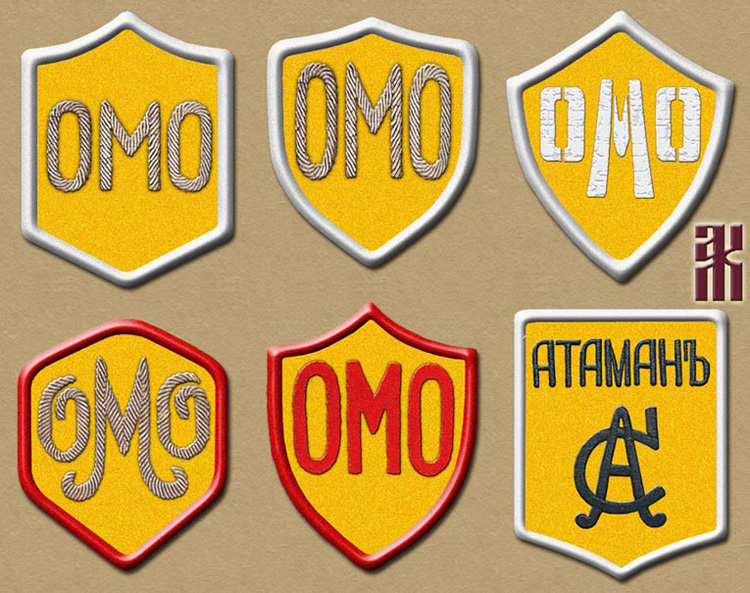
Sleeve insignia of the Special Manchurian Detachment:
1 – based on Selivanov's description, 75 by 60 mm; 2 – not described
3 – inscriptions made with white paint using a stencil;
4 – Selivanov's description for artillery – 70 by 58 mm;
5 – artillery, 115 by 92 mm, applied red cloth;
6 – 140 by 110 mm, embroidered with black silk
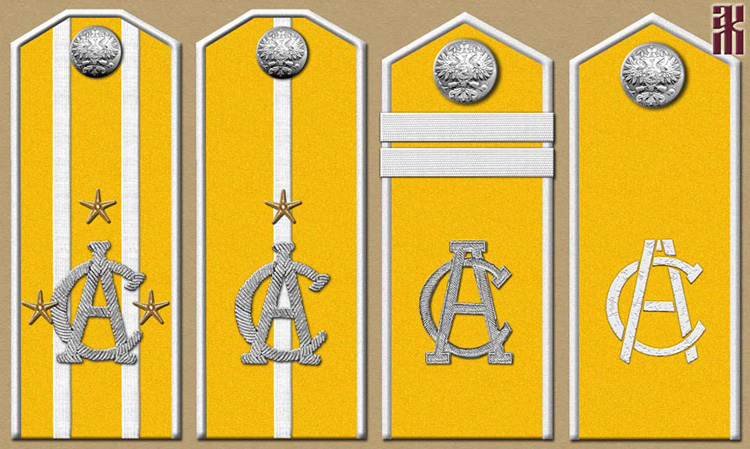
Shoulder-boards of the cavalry units of the Special Manchurian Detachment,
here, the Ataman Semenov Cavalry Regiment
A photograph of the shoulder-boards of a lieutenant of the SMD (yellow cloth and a monogram embroidered in silver thread, with cloth piping and strip) is published in Selivanov. He also has photographs of the shoulder-boards of a cadet (raspberry with white piping) and the head of the Chita Military School (yellow with white piping and black general's zigzag). The reconstructions of the insignia were made based on those photographs.
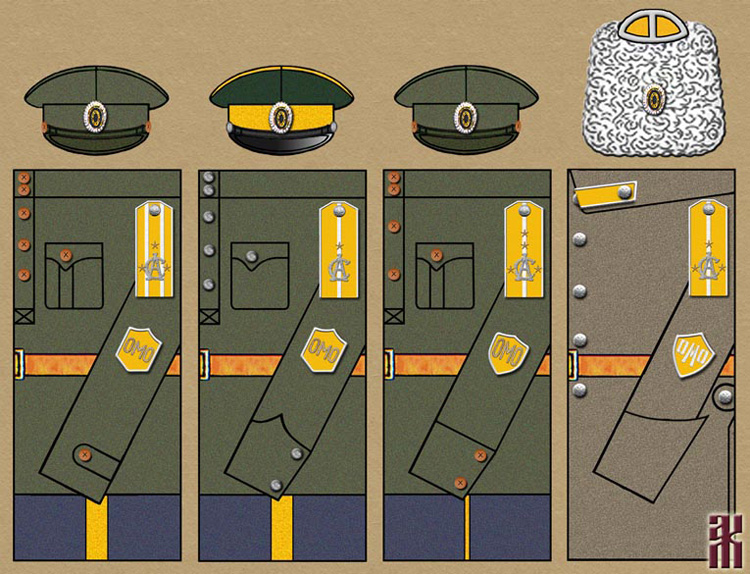
Uniforms of the officers of the cavalry units of the Special Manchurian Detachment
Although B. B. Filimonov's work indicates that the regiment's officers wore the uniform of the Transbaikal Cossack Army, photographs show a considerable variety of uniforms, including those of the regular cavalry.
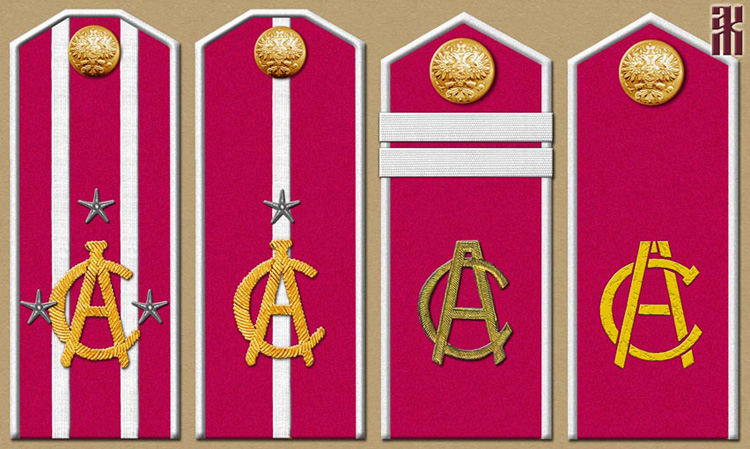
Shoulder-boards of the rifle units of the Special Manchurian Detachment
here, the Semenov Infantry, later the 1st Manchurian Ataman Semenov Rifle Regiment
The reconstruction of the metal monogram on the shoulder-boards of the lower ranks was made based on a photograph published in the Yakovkin book.
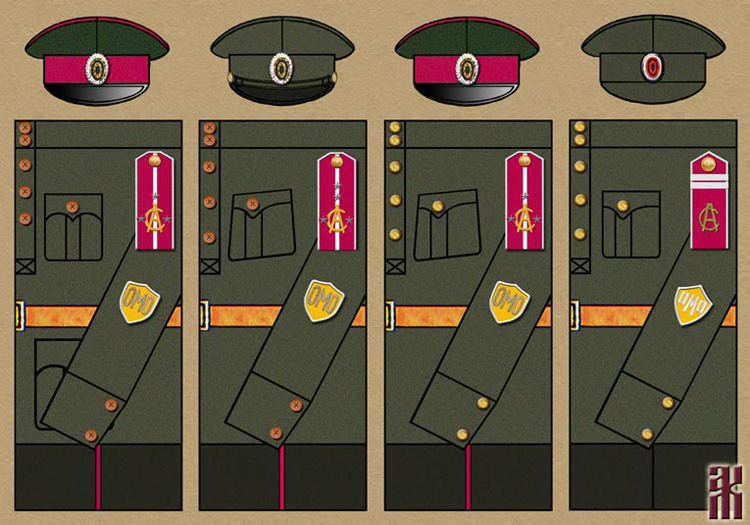
Uniforms of the rifle units of the Special Manchurian Detachment
Figure 1 has with an interesting blouse with hip pockets – the only example of this type known to the authors of the website.
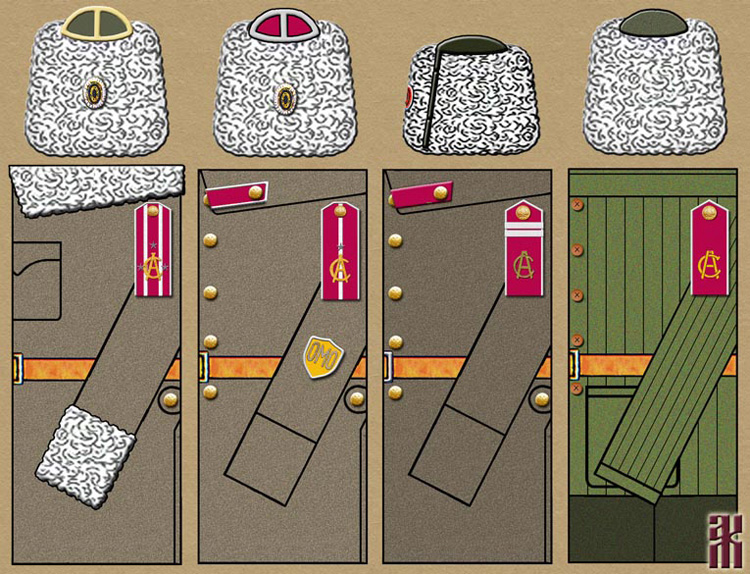
Uniforms of the rifle units of the Special Manchurian Detachment
The question remains open as to whether the rifle units of the SMD had a uniform winter headdress or not – photographs show the use of both "Manchurian" and 1910 model papakhi.
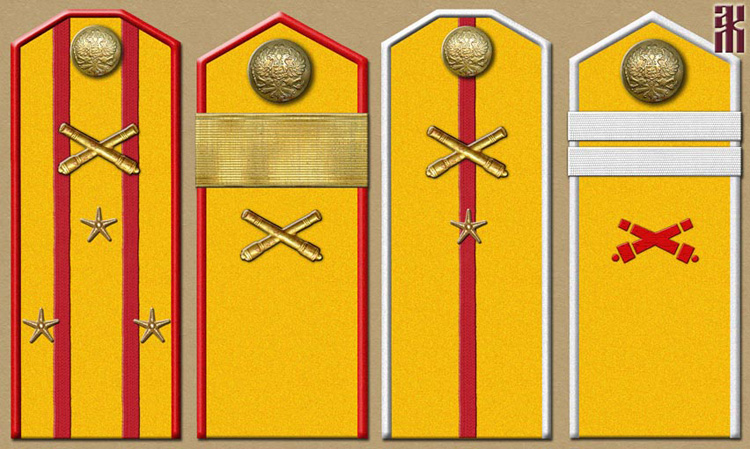
Shoulder-boards of the artillery units of the Special Manchurian Detachment;
1 and 2 – lieutenant-colonel and sergeant-major of foot artillery;
3 and 4 – ensign and corporal of horse artillery unit
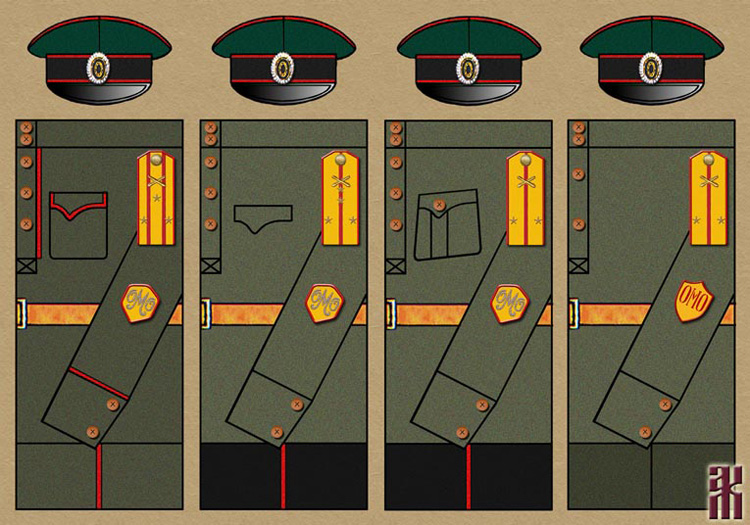
Uniforms of foot artillery units of the Special Manchurian Detachment
Almost all the officers are wearing coloured caps in the known photographs.
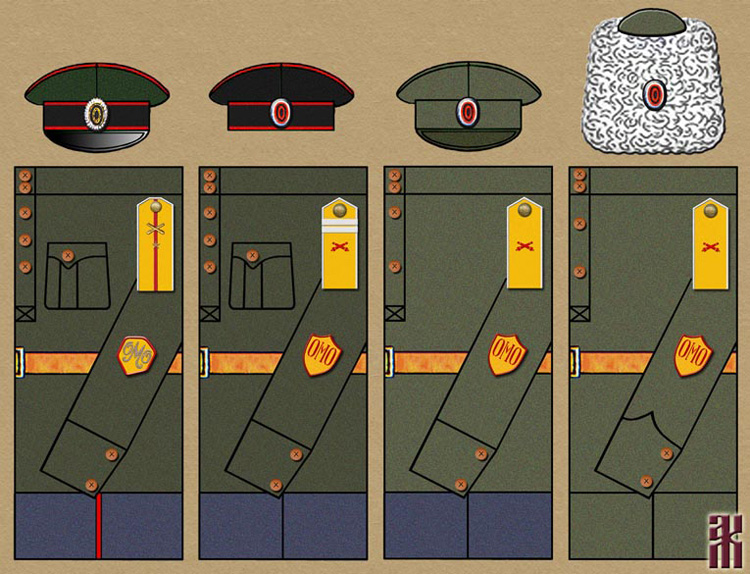
Uniforms of the horse artillery units of the Special Manchurian Detachment
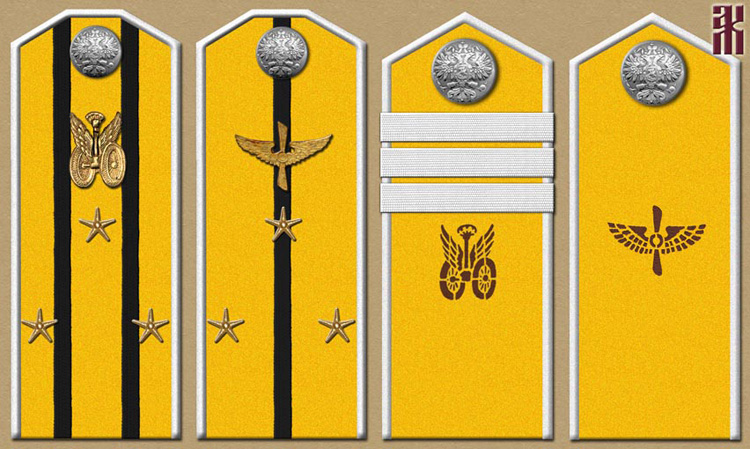
Shoulder-boards of the technical units of the Special Manchurian Detachment
here, the Motorised Company and the Aviation Detachment
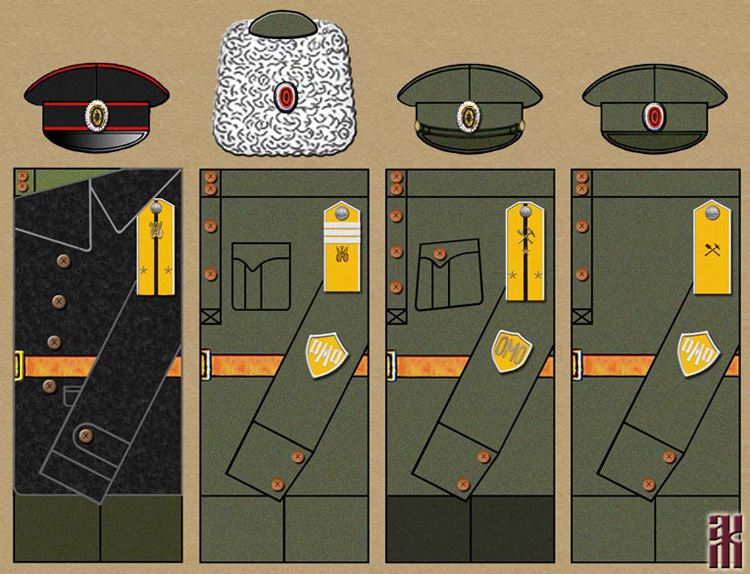
Uniforms of the technical units of the Special Manchurian Detachment
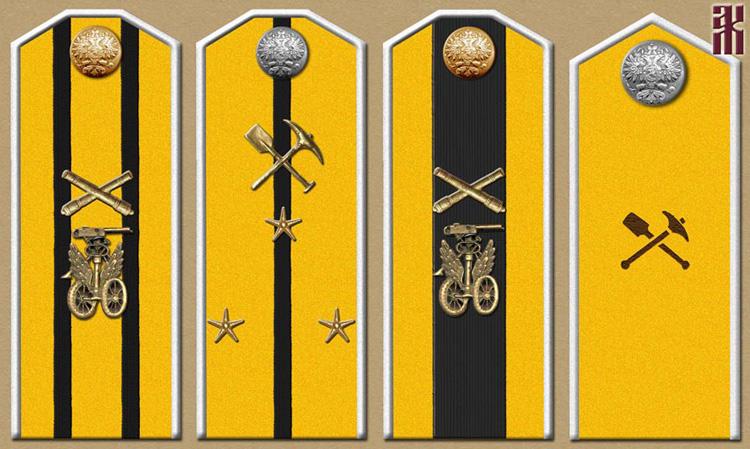
Shoulder-boards of technical units of the Special Manchurian Detachment
here, armoured trains and engineer company
The special insignia on the shoulder-boards of the armoured train crews is questionable, but all the breast badges of the train crews published by Selivanov feature this combination – the insignia of the Imperial armoured units with the addition of artillery barrels.
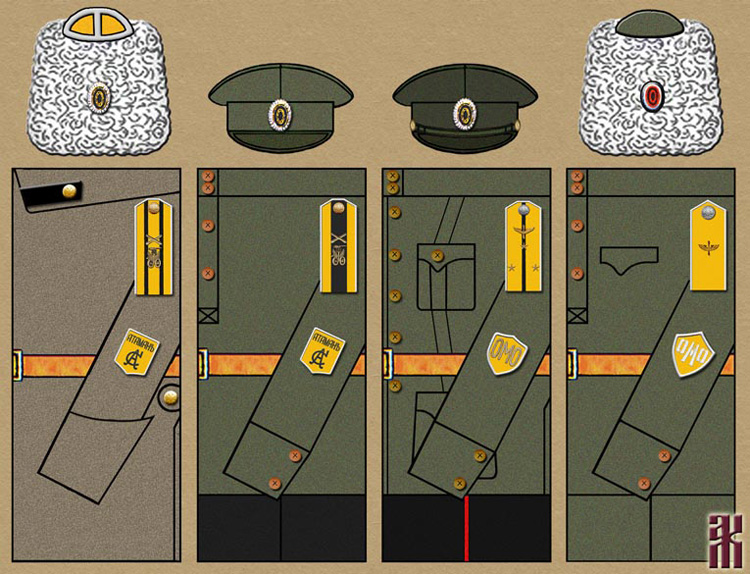
Uniforms of technical units of the Special Manchurian Detachment
here, armoured trains and engineer company
Home — State Symbols — Flags — Uniforms — Badges & Medals — Money — Other
Pygmy Wars Notes
The original for this page is at kolchakiya.ru/uniformology/Semenovs_manchzhursky_group.htm.
The "OMO" stands for Osobyy Man'chzhurskiy Otryad, the Special Manchurian Detachment. Note that the "Manchuria" that this unit was named after was Manchuria Station (Manzhouli, Inner Mongolia, China, 49.58 N 117.44 E) on the Far Eastern Railway, rather than the province of Manchuria.
The Cyrillic "AC" is Latin "AS", for Ataman Semenov.
The Latchford link is dead, but the document can be seen here.
The uniforms of the SMD in the later period is discussed here.
Discussion on the translation choices I have made can be found here.