
Uniforms of Units Subordinate to Ataman Semenov, 1920
Material kindly provided by V. V. Romanov (Moscow). As the documents have not yet been made available for scientific use, at his request we are not publishing any archive references.
Reconstructions by A. Karevskiy.
Order
Commander-in-Chief of all Armed Forces and Field Ataman of all Cossack troops of the Russian Eastern Frontier, No. 154, 12 February 1920 (Chita)
I hereby announce the new uniform I have established:
Clothing items for officers, cadets and soldiers.
Tunic or blouse – khaki material of the existing model, with yellow braid on the sleeve cuffs for officers of all units, departments and institutions (pointed for mounted units) and yellow cloth for soldiers.
Trousers – short or long (off duty) made of khaki material of the existing model, with raspberry piping for the infantry and red for the artillery.
Trouser stripes for horse units and the Military Academy:
b) 1st Horse Regiment, named for Ataman Semenov – yellow,
c) 1st Transbaikal Horse Regiment, named for General Krymov – blue,
d) 1st Tatar Horse Regiment – green,
e) 2nd [Tatar Horse Regiment] – red,
f) Buryat Horse Regiment – yellow,
g) Mongol Horse Regiment – purple,
h) Administrations and institutions – red,
i) Cossacks – wide yellow of the established pattern. Cossack Artillery – wide red.
Greatcoat – grey, of the standard model, double-breasted with buttons for officers, with hooks for soldiers. Tabs on the collar corresponding to the shoulder-boards of each unit, administration, or institution, with piping on the tabs for artillery and engineer units.
papakhi without cockades and field caps of the existing model (addition by V. V. Romanov).
Shoulder-boards – khaki, with stripes, edging and piping according to regiments, namely:
1) Escort Sotnia: the officers have yellow stripes and yellow edging with black piping. The shoulder-boards have a stenciled monogram in white paint "АС".
2) 1st Horse Regiment named for Ataman Semenov: the officers have yellow stripes with white rank markings. The shoulder-boards have a stenciled monogram in white paint "АС" of the established model.
3) 1st Transbaikal Cossack Regiment: officers have yellow stripes with yellow piping. The shoulder-boards have a stenciled number "1" in white paint.
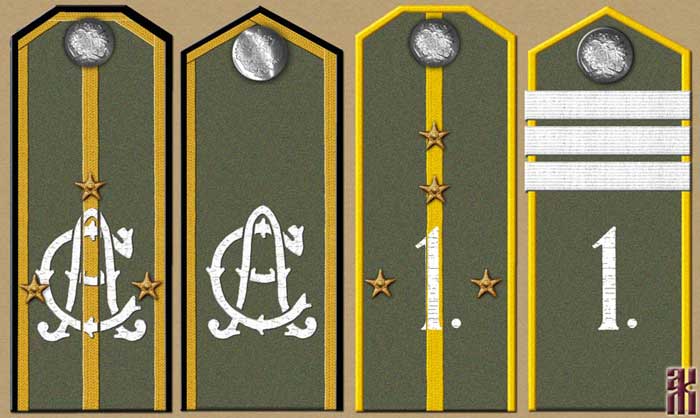
Shoulder-boards of the escort sotnia and the 1st Transbaikal Cossack Regiment
4) The 2nd, 3rd, 4th, 5th, 6th, 7th, and 8th Transbaikal Cossack Regiments: officers have the same as in the 1st Regiment. The shoulder-boards have the corresponding stenciled numbers.
5) 1st Tatar Horse Regiment: officers have khaki cloth with green stripes and yellow piping; the cavalrymen have green cloth with yellow piping.
6) 2nd Tatar Horse Regiment: officers have green cloth with red stripes and red piping; the cavalrymen have green cloth with red piping.
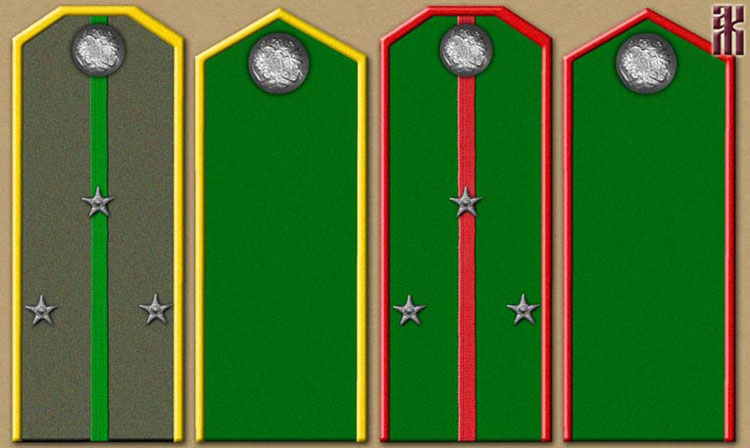
Shoulder-boards of the 1st and 2nd Tatar Horse Regiments
as specified in the 12 February 1920 order
7) Buryat Horse Regiment: officers have khaki cloth with yellow stipes and purple piping.
8) Mongolian Horse Regiment: officers have khaki cloth with purple stripes and yellow piping.
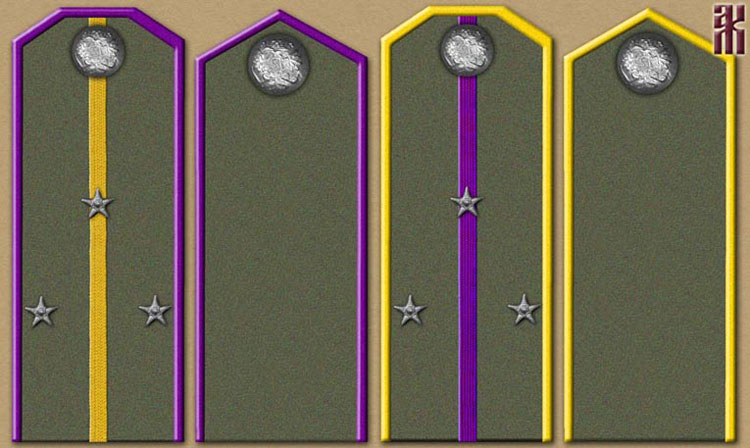
Shoulder-boards of the Buryat and Mongolian Horse Regiments
as specified in the 12 February 1920 order
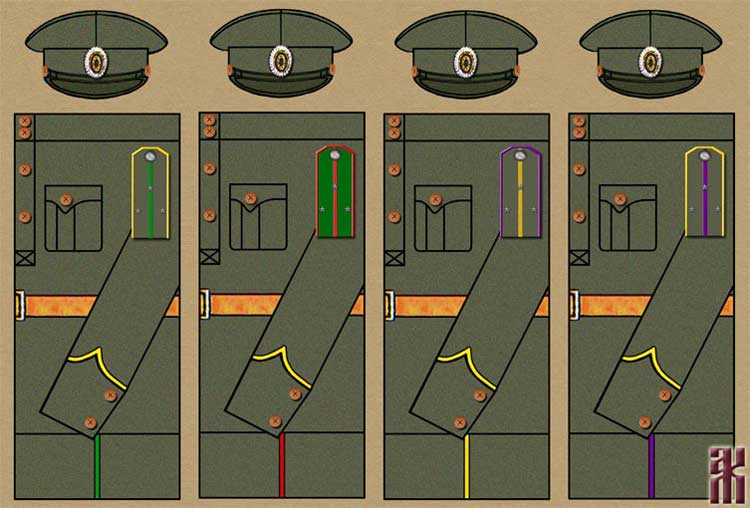
Uniforms of the 1st Tatar, 2nd Tatar, Buryat and Mongolian Horse Regiments
as specified in the 12 February 1920 order
9) Independent Horse Divizion of General-Lieutenant Krymov: officers have khaki cloth with yellow stripes and blue piping; the cavalrymen have khaki cloth with yellow edging and blue piping.
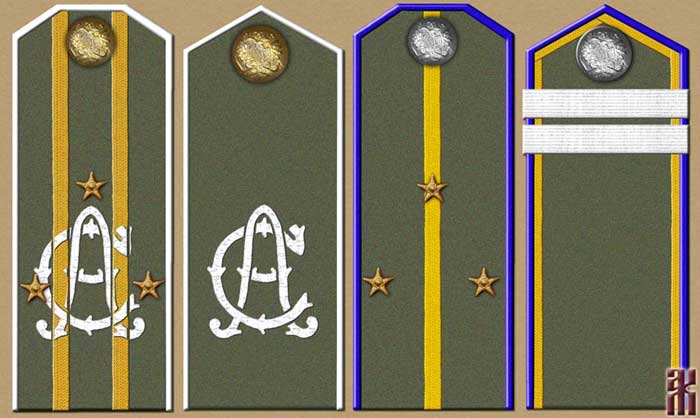
Shoulder-boards of the 1st Horse Regiment named after Ataman Semenov and the 1st Transbaikal Horse Regiment named after General Krymov
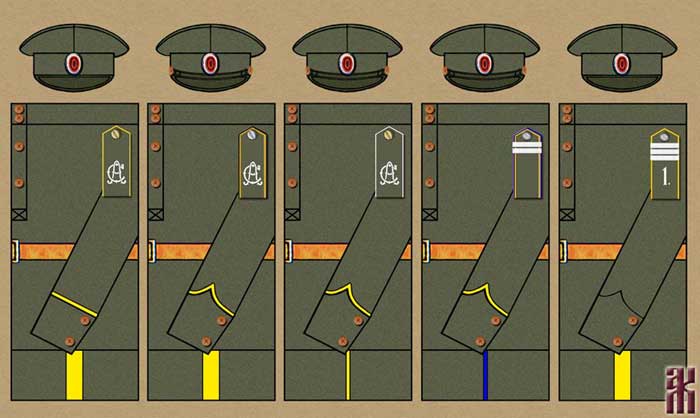
Uniforms: 1 – Escort Sotnia of the Independent Transbaikal Cossack Plastun Battalion;
2 – Escort Sotnia ; 3 – 1st Horse Regiment named after Ataman Semenov;
4 – 1st Transbaikal Horse Regiment; 5 – 1st Transbaikal Cossack Regiment
10) 1st Manchurian Rifle Regiment named after Ataman Semenov: officers have raspberry stripes and piping. The shoulder-boards have a stenciled monogram "А.С." in yellow paint of the established pattern.
11) 2nd Manchurian Rifle Regiment: officers have the same as in the 1st Regiment. The shoulder-boards have a stenciled "2.М." in yellow paint.
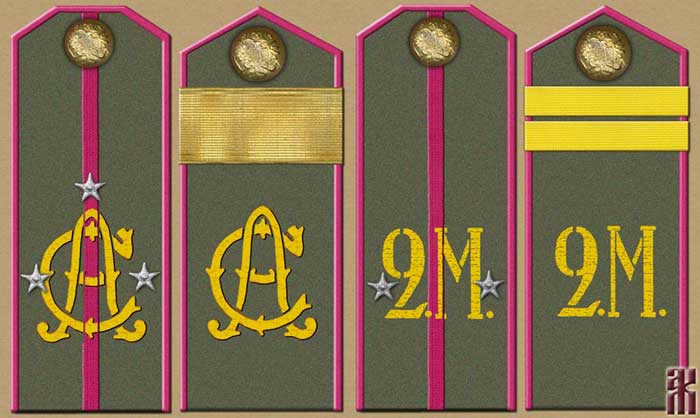
Shoulder-boards of the 1st and 2nd Manchurian Rifle Regiments
12) 1st Transbaikal Rifle Regiment: officers have raspberry stripes and piping. The shoulder-boards have a yellow stencil "1.Зб.".
13) 2nd Transbaikal Rifle Regiment: officers have the same as in the first regiment. The stencil is "2.Зб.".
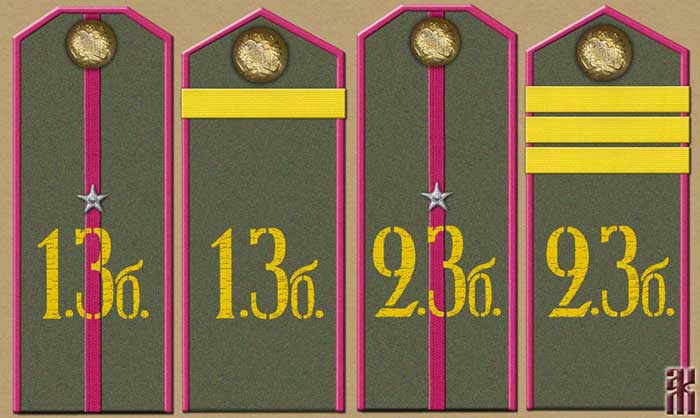
Shoulder-boards of the 1st and 2nd Transbaikal Rifle Regiments
14) 1st Independent Transbaikal Cossack Plastun Battalion: officers have yellow stripes and piping. The shoulder-boards have a white stencil "1. Пл.".
Escort Sotnia of the 1st Independent Cossack Plastun Battalion: stenciled monogram in white paint "А.С." of the established pattern (addition by V. V. Romanov).
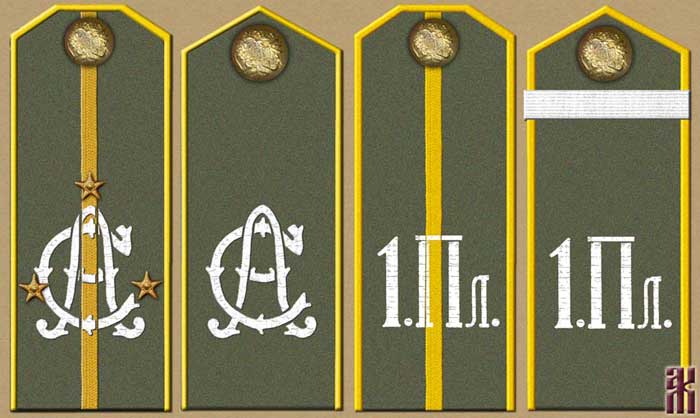
Shoulder-boards of the Escort Sotnia of the Independent Transbaikal Cossack Plastun Battalion and the Independent Transbaikal Cossack Plastun Battalion.
15) Armoured Division named after Ataman Semenov: officers have red stripes and red edging with black piping. The shoulder-boards have a stencil monogram "А.С." in yellow paint of the established pattern.
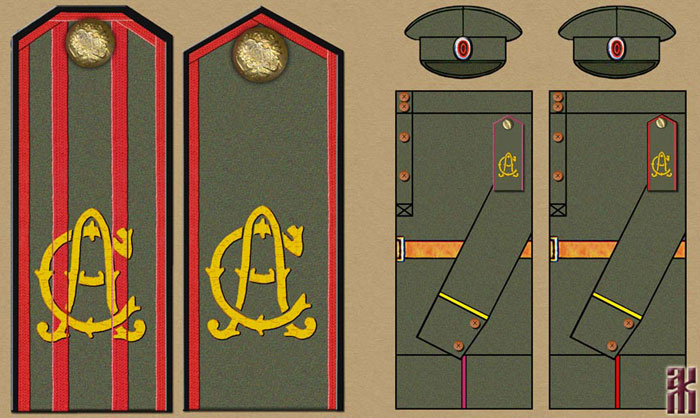
1 and 2 – shoulder-boards of the Ataman Semenov Armoured Division;
3 – uniform of the 1st Manchurian Ataman Semenov Rifle Regiment;
4 – uniform of the Ataman Semenov Armoured Division.
16) Artillery units: officers have red stripes and piping; black piping for horse artillery. The shoulder-boards have the artillery insignia and a stencil below it in yellow paint for each unit of:
a) 1st Manchurian Artillery Regiment – "1.М.".
b) 1st Manchurian Horse Artillery Regiment – "1.М.к.".
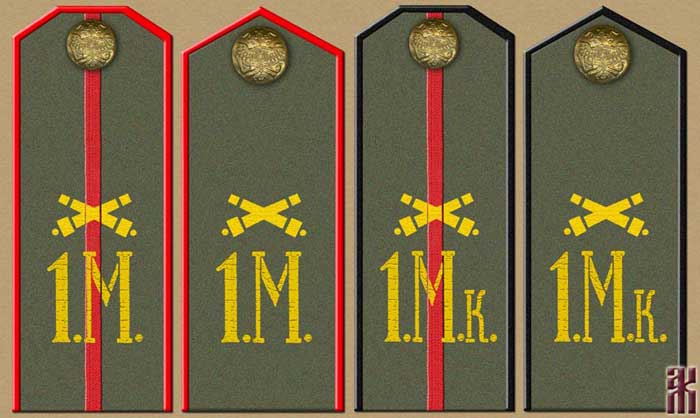
Shoulder-boards of the 1st Manchurian Artillery Regiment and the
1st Manchurian Horse Artillery Regiment
c) 1st Transbaikal Rifle Artillery Regiment – "1.З.б.".
d) 1st Transbaikal Cossack Artillery Divizion – "1.З.к.".
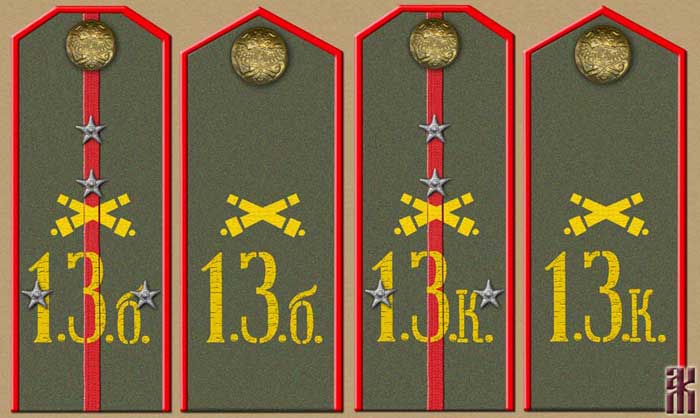
Shoulder-boards of the 1st Transbaikal Rifle Artillery Regiment and the
1st Transbaikal Cossack Artillery Divizion
e) 2nd Transbaikal Cossack Artillery Divizion – "2.З.к.".
f) Independent Heavy Artillery Divizion – "T.".
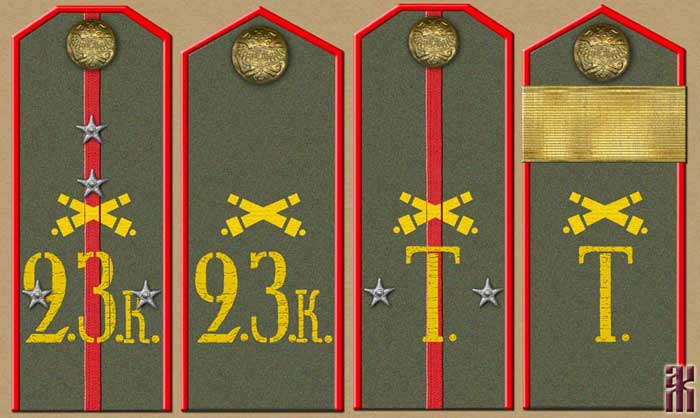
Shoulder-boards of the 2nd Transbaikal Cossack Artillery Divizion and the
Independent Heavy Artillery Divizion.
17) Manchurian Aviation Detachment: officers have red stripes and piping. On the shoulder-boards there is a white metal aviation symbol (propeller with wings) and below it, a white stencil "M.".
18) Transbaikal Railway Battalion: officers have black stripes and piping. The shoulder-board had a white metal insignia (an anchor and an axe) and below it a yellow stencil "З.б.ж.".
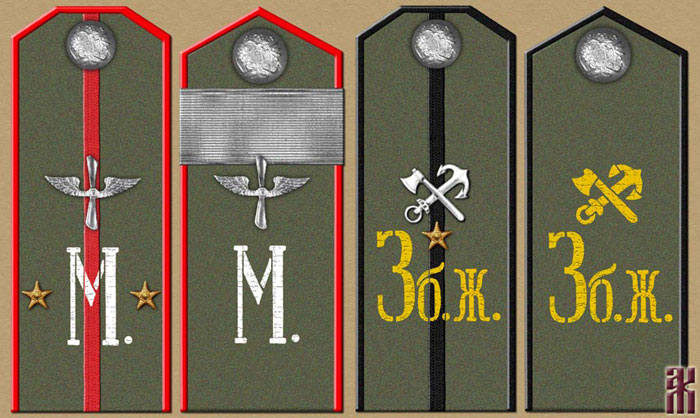
Shoulder-boards of the Manchurian Aviation Detachment and Transbaikal Railway Battalion
19) Independent Sapper Company: officers have black stripes and piping. On the shoulder-board is the white metal insignia for engineers (shovel and pickaxe) of the established type.
20) Motor Transport Divizion: officers have black stripes and piping. The shoulder-boards have the white metal insignia assigned to motor transport units (wheels with wings) and below it a standard yellow stencil "Ав.Тр" ["Av.Tr" for Auto Transport].
21) Motorised Komands: officers have black stripes and piping. The shoulder-boards have the motorised unit insignia and below it, a yellow stencil "Ав.м.".
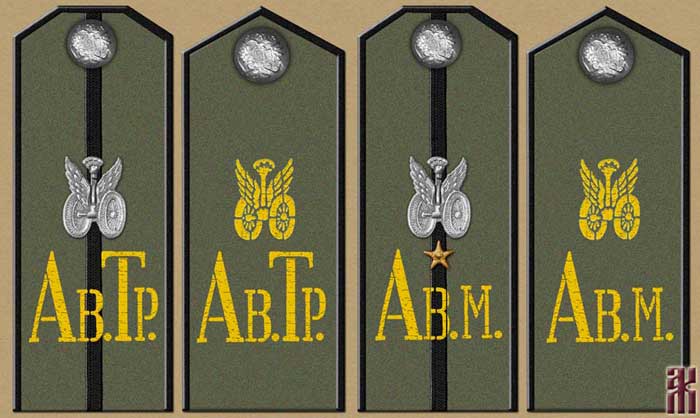
Shoulder-boards of the Motor Transport Divizion and Motorised Komands
22) Independent Telegraph Company: officers have black stripes and piping. The shoulder-boards have the telegraph insignia (two zigzag sparks) of the established pattern.
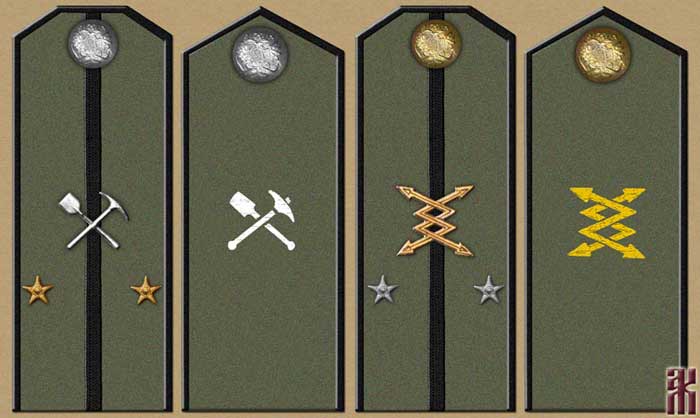
Shoulder-boards of the Independent Sapper Company and Independent Telegraph Company
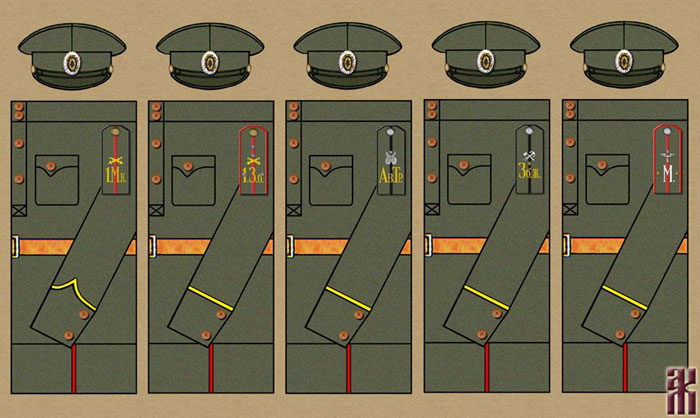
Uniforms of: 1 – 1st Manchurian Horse Artillery Regiment;
2 – 1st Transbaikal Rifle Artillery Regiment; 3 – Motor Transport Division;
4 – Transbaikal Railway Battalion; 5 – Manchurian Aviation Detachment
24) District Headquarters Jaeger Battalion: officers have green stripes and piping. The shoulder-boards have a stenciled letter "E" in white paint.
25) Transbaikal Military District Headquarters: officers have red stripes and edging with white piping. The shoulder-boards have a yellow stencil "Зб.".
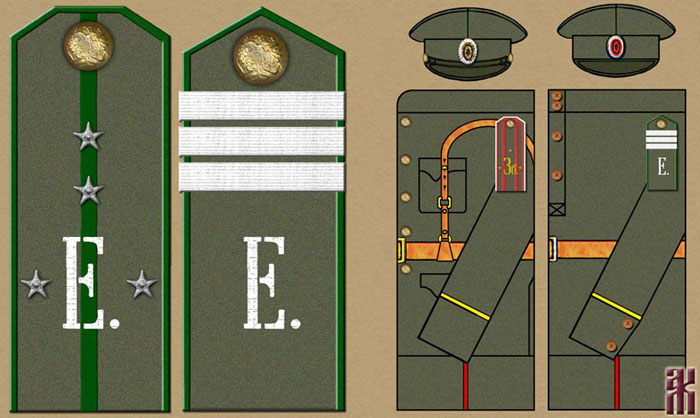
Shoulder-boards and uniforms of the Jaeger Battalion of the Transbaikal Military District HQ: staff-captain, sergeant, lieutenant-colonel and sergeant
26) Units, departments, and institutions subordinate to the Commander of the Transbaikal Local Brigade: officers have red stripes without piping and soldiers khaki without piping. The shoulder-boards have a stencil in yellow paint: a) Military Command Administration – "В.Н."; b) Chita Local Battalion – "Ч.м.", c) Petrozavodsk Local Company – "Пз.м.", d) Verkhneudinsk Local Battalion – "В.м.", e) Troitskosavsk Local Company – "Тр.м.", f) Sretensk Local Company – "С.м.", g) Nerchinsk Local Komand – "Н.м.", h) Selenginsk Local Komand – "Сл.м.", k) Chita Escort Komand – "Ч.к.", l) Nerchinsk Escort Komand – "Н.к", m) Perm Escort Komand – "П.к.", n) Troitsokosavsk Escort Komand and Troitsokosavsk Prison Guard Detachment– "Т.В.".
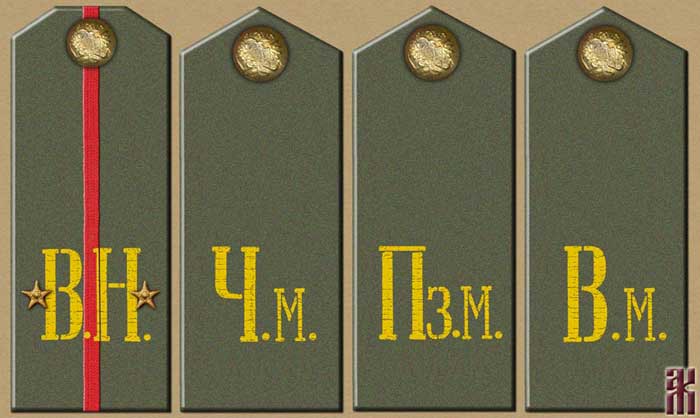
Shoulder-boards of the Military Command, Chita Local Battalion,
Petrozavodsk Local Company, and Verkhneudinsk Local Battalion
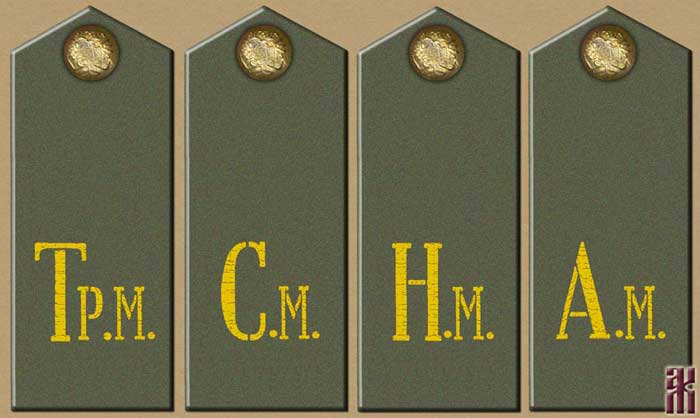
Shoulder-boards of the Troitsokosavsk Local Company, Sretensk Local Company,
Nerchinsk Local Komand, and Akshinsk Local Komand
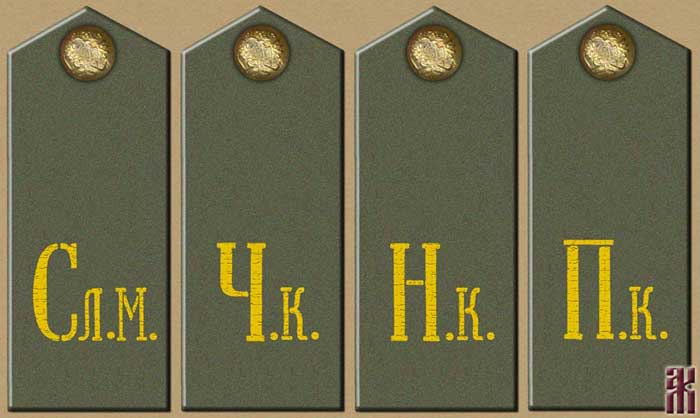
Shoulder-boards of the Selenginsk Local Komand, Chita Escort Komand,
Nerchinsk Escort Komand, and Perm Escort Komand
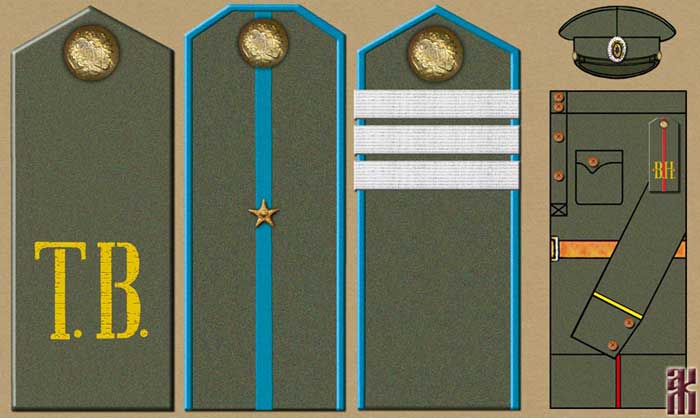
Shoulder-boards of the Troitsokosavsk Escort Komand, the Troitsokosavsk Prison Guard Detachment, and the police. Uniform of the Military Command Administration
27) Directorate of Military Communications: officers have red stripes with blue edging and black piping. The shoulder-boards have a yellow stencil "В.с.".
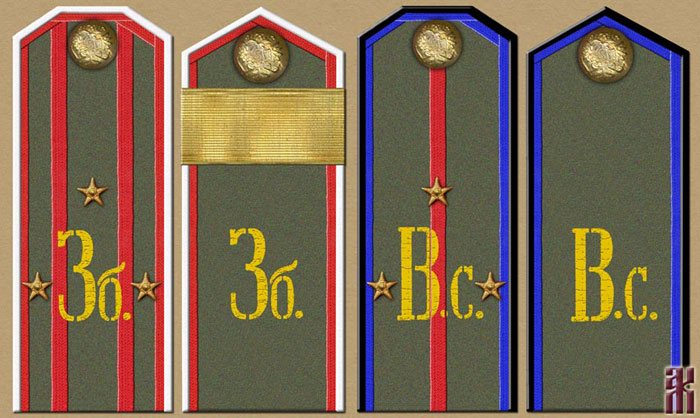
Shoulder-boards of: 1 and 2 – lieutenant-colonel and sergeant-major of the Transbaikal Military District Headquarters; 3 and 4 – lieutenant and private of the Military Communications Administration.
28) Police: officers have a blue stripes and piping.
29) Quartermaster's Office and food stores: officers have red stripes without piping, and soldiers have khaki shoulder-boards. The shoulder-boards have a yellow stencil for: a) Quartermaster's Office – "Н", b) Chita Clothing Warehouse – "Ч.в.", c) Chita Food Store – "Ч.пр.", d) Sretensk Food Store – "С.пр.", e) Nerchinsk Food Store – "Н.пр.", f) Peschansk Food Store – "Пс.пр.", g) Troitsokosavsk Food Store – "Тр.пр.".
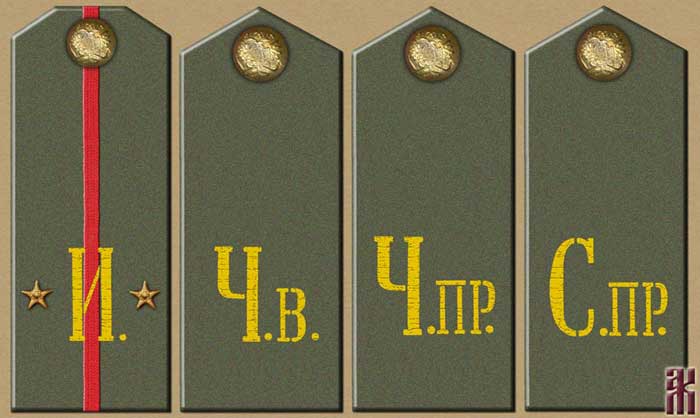
Shoulder-boards of the Quartermaster's Office, Chita Clothing Warehouse, Chita Food Store, Sretensk Food Store
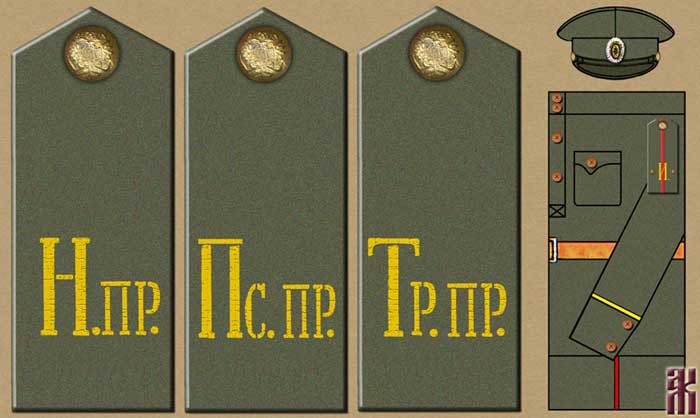
Shoulder-boards of the Nerchinsk Food Store, Peschansk Food Store, Troitsokosavsk Food Store and uniform of the Quartermaster Department
30) Horse Reserve: officers have yellow stripes and piping.
31) Chita Artillery Depot: officers have red stripes and piping.
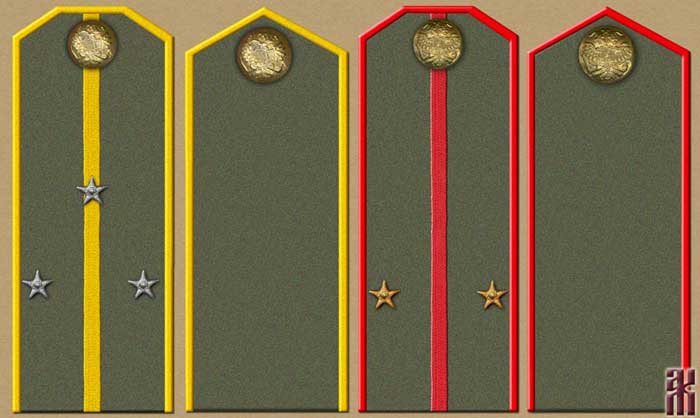
Shoulder-boards of: lieutenant and private of the Horse Reserve;
and second-lieutenant and private of the Chita Artillery Depot
32) Doctors: officer-style shoulder-boards with black stripes without piping, and veterinary doctors with blue piping. For soldiers, khaki shoulder-boards without piping.
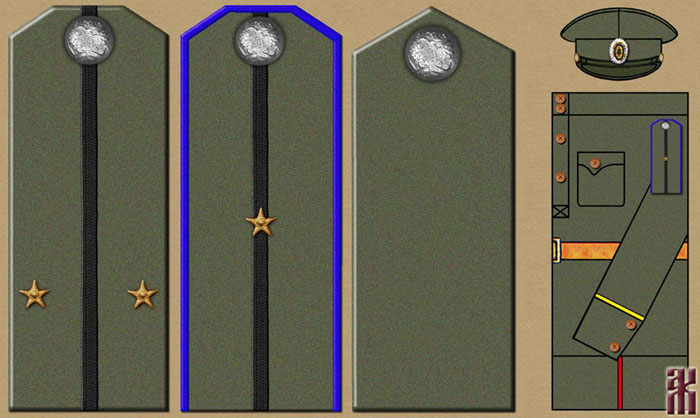
Uniform and shoulder-boards of medical staff: 1 – doctor (second-lieutenant);
2 – vet (ensign); 3 – private; 4 – uniform of a vet (ensign)
33) For all officials: black stripes without piping. Yellow braid along the lower edge of the shoulder-board.
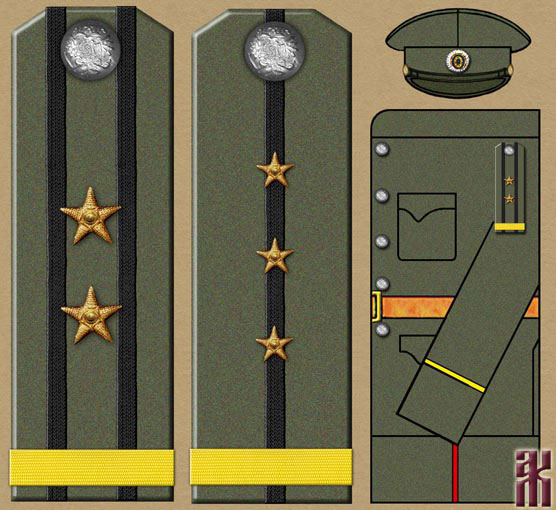
Uniform and shoulder-boards of military officials
Note 1: The font for the insignia of the shoulder-boards is specified in an appendix to the order.
Note 2: 1) Officers' ammunition is brown leather with a single shoulder strap. 2) Medals are worn with the dress uniform. 3) The dress uniform is worn during parades, funerals, official dinners, balls, soirés, meetings and farewells. 4) Both officers and soldiers are allowed to wear long khaki trousers when off duty. 5) Spurs are only for cavalry units, horse artillery and officers who are entitled to a horse by virtue of their position. 6) khaki shoulder-boards are to be worn by chiefs of staff and adjutants. 7) Gloves shall be of the established brown colour in all cases. 8) In order to achieve a uniform colour, officers are required to obtain or purchase materials only of the colour samples available at the quartermaster's office. 9) Officers shall switch to khaki shoulder-boards within 3 months of the date of the order.
Signed: Commander-in-Chief, Lieutenant-General Semenov
Order
Commander-in-Chief of all Armed Forces and Field Ataman of all Cossack troops of the Russian Eastern Frontier, No. 445 of 6/14 June 1920, Chita
It has been noted that, despite the shoulder-boards for military officials having yellow braid along the lower edge (as established by Order No. 154, paragraph 33), many military officials have not switched to the new design and continue to wear shoulder-boards with black piping without braid, or even officer-style shoulder-boards. Confirming the strict enforcement of my order No. 154, I order the ranks of the military department (military officials, wartime officials, etc.) to immediately switch to the new shoulder-board uniform . All those found to be in violation of the uniform shall be brought to trial on the basis of Article 196 22 of the 1869 edition of the Code of Military Regulations, Supervision of the execution of this order shall be entrusted to city commandants, garrison commanders and superiors of all ranks.
Signed: Commander-in-Chief Lt.-Gen. Semenov
In Memoirs
1st Cavalry Regiment of Ataman Semenov
As a Transbaikal Cossack Regiment, the Atamantsy ... wore the uniform of that Host. They wore the letters "АС" on their shoulder-boards – standing for Ataman Semenov.
Filimonov, B. B. in "White Rebels: The Khabarovsk Campaign, Winter 1921-1922 Book 1", Shanghai, 1932, p.49.
Chita Ataman Semenov Military School (in 1920, the Composite Regiment at the Commander-in-Chief's HQ; in Primor'e, the Independent Escort Divizion)
The escort guards wore the same shoulder-boards as the Manchurians.
Filimonov, B. B. in "White Rebels: The Khabarovsk Campaign, Winter 1921-1922 Book 1", Shanghai, 1932, p.49.
Summer 1920
The summer uniform, new and smart, made the formation look good. Cadets who did not have greatcoats were given short brown American cavalry overcoats to go with their summer uniforms.
Elenevsky, A. in "Military Schools in Siberia (1918-1922) // Cadets and Junkers in the White Struggle and Abroad", Moscow, 2003, p.432.
November 1920
When the Far Eastern Army left Transbaikalia, physically broken but retaining its spirit, a handful of young people in officer and cadet shoulder-boards with the silver stencil "А.С." marched alongside it. These were officers and cadets from the Chita Military School.
"Chita Cadets // Ray of Asia, No. 1", Harbin, 1934, p.47.
1st Composite Manchurian Division of Ataman Semenov, April 1920
After the battles near Chita, my division was recalled to that town, and Ataman Semenov offered me command of the Ataman Semenov Division. The First Cavalry Division merged with the Ataman Semenov Division, which had the following composition: 1st Brigade had two infantry regiments, the 2nd had two cavalry regiments. The cavalry brigade consisted of a regiment formed from my former division and the 1st Ataman Semenov Horse Regiment.
The new division was called the First Composite Manchurian Division of Ataman Semenov. A yellow sleeve badge with the letters "OMO" was established for it. The letters "OMO" stood for Special Manchurian Detachment, on which this division had been built. By the next order of the division, Ataman Semenov specified a silver monograms "АС".
All the division's officers were delighted with such kindness from their chief. The division became, as it were, a guard division and was one of the best in Transbaikalia. It was well supplied and stood out from the other units.
Kislitsyn, V. A. in "In the Fire of Civil War: Memoirs.", Harbin, 1936, p.97.
Home — State Symbols — Flags — Uniforms — Badges & Medals — Money — Other
Pygmy Wars Notes
The original for this page is at kolchakiya.ru/uniformology/Semenov_unit_03.htm.
"A.C." is "A.S." for Ataman Semenov. "Зб." is "Zb." for Zabaikal'e = TransBaikalia. "Пл." is "Pl" for Plastun.
The original does have Armoured "Division", but I strongly suspect it was actually "Divizion".
This page covers only the Transbaikal units under Semenov's command. The other Cossack units are here.
Discussion on the translation choices I have made can be found here.