
Uniforms of the Independent Partisan Division of Ataman Annenkov
All material and reconstructions are by A. Karevskiy unless noted otherwise.
Telegram to the commander of the 2nd Steppe Siberian Corps of 27 May 1919
I request you petition the Supreme Ruler to grant the right to wear the following distinctive insignia, chevrons and shoulder-boards to the division entrusted to me:
1) Chevrons on the left sleeve made of black and red ribbon with a piping in the unit colour for all officers and partisans.
2) Chevrons made of St. George ribbon on the left sleeve below the chevron made of black and red ribbon, which the detachment wore during the fight against the Bolsheviks until the overthrow of Soviet power in Siberia.
3) Coloured shoulder-boards for officers and partisans, varying according to the unit.
4) Images of a skull and bones on buttons, cockades and on the left sleeve at the top of the black and red chevron.
I request the above on the basis that, firstly: the black and red ribbon chevrons were assigned to the Partisan Detachment when it was formed in 1915 in the D. Army, as were the skulls on the cockades and buttons, as distinctive features. The partisans remained faithful to that uniform during the difficult times of Bolshevism. ... In February 1918, I introduced coloured shoulder-boards to create a uniform and distinguish between the different units in the detachment, and I myself had to approve this distinction in view of the absence in Siberia at that time of an authority to which I could apply for the necessary approval. ... Appreciating the hard work that the partisans had to do before the coup, in the most unfavourable conditions, I gave the new recruits the right to wear a St. George ribbon chevron. ... This uniform existed under the Bolsheviks, was recognised by the Provisional Siberian Government, and to this day the Partisan Division has participated in all its battles wearing this uniform.
Document kindly provided by Moscow researcher V. V. Romanov.
Order No. 285 of the Ataman Annenkov Partisan Division of 11 November 1919
§3. Partisans who have served in the Partisan Detachment for at least one year, regardless of rank, have the right to wear a black chevron 4 vershki below the shoulder-board on the right sleeve, ? inch wide. The number of chevrons is determined by the number of years served by the partisan. The right to wear chevrons is to be granted in orders by the units, indicating the number of chevrons. The order is to be implemented immediately upon receipt.
Document kindly provided by Moscow researcher V. V. Romanov.
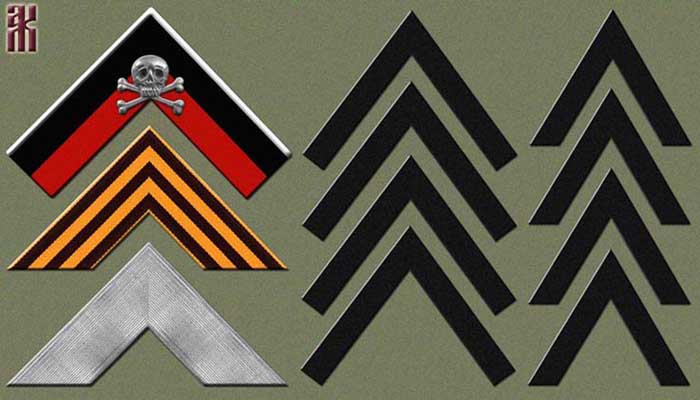
Chevrons of Ataman Annenkov's Partisan Division:
1 – "Partisan" chevron (the colour of the upper edge depended on the unit's uniform colour;
2 – chevron for those who had joined before the overthrow of Soviet power in Siberia;
3 – Silver braid chevron; 4 and 5 – Length of service chevrons
The reconstructions are based on photographs published in the publications listed below. Figure 3 is seen in photographs of officers of the Black Hussars Regiment and the Life-Ataman Regiment. The photographs show various ways of wearing the long service insignia.
White Russia.: Photo album", Moscow, 2003.
Ganin, A. V. "Ataman A. I. Dutov", Moscow, 2006.
Goltsev, V. A. "Siberian Vendée: The Fate of Ataman Annenkov", Moscow, 2009.
Shuldyakov, V. A. "The Demise of the Siberian Cossack Army, 1917-1920", Moscow, 2004.
Deryabin, A. I. "The Civil War in Russia 1917-1922: The White Armies", Moscow, 1998.
Khvostov, V. "The Russian Civil War (2): White armies // Men-At-Arms 305", London, 1997.
Each of Annenkov's regiments had its own uniform and distinctive colours. The men were proud of their regimental uniforms and always defended the honour of their dress.
It should be noted that when designing the uniforms for his units, Annenkov retained elements of the uniforms worn by his partisan detachment during the First World War in the form of a patch on the left sleeve – black with a red chevron, a skull and crossbones – and a badge with the same emblems and the inscription: "God is with us". The right sleeve indicated the partisan's length of service: two years was marked by a chevron, and below that were horizontal stripes for wounds. These symbols became mandatory in Annenkov's uniforms, and the chevron on the left sleeve came to be called the "partisan's chevron". It was made of black and red ribbon. Annenkov noted that the uniform introduced to the partisans at the front remained in use until their departure for China. "All the units that were formed under my command wore those insignia", he noted.
The cockade was made in the shape of a circle with a skull and crossbones inside it. They were made in the detachment by local craftsmen. Red partisan Nikolai Dmitrievich Vydrin recalls: "Winter 1919. Annenkov's volunteer regiment is being formed in Ust-Kamenogorsk. Officers walked the streets, strutting about in their tall papakhi and wide lapels on long cavalry overcoats."
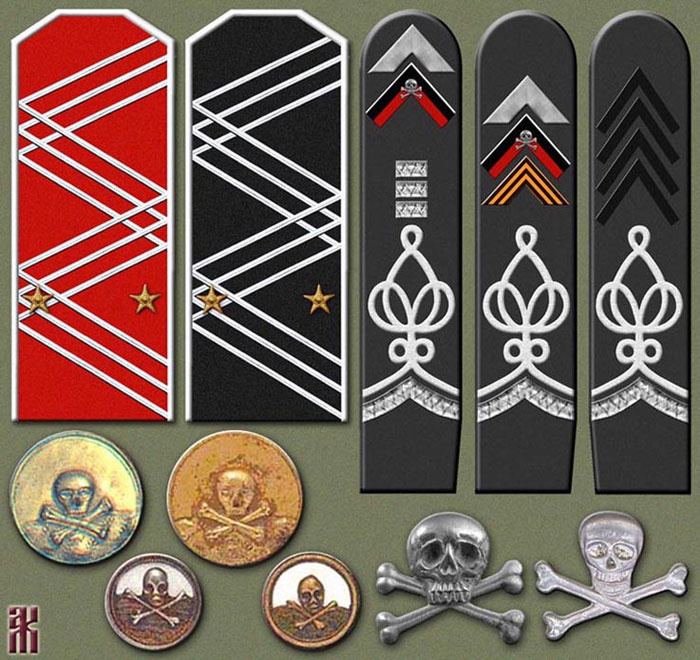
1 – shoulder-board of the Life-Ataman Regiment; 2 – shoulder-board of the Black Hussars;
3 to 5 – examples markings on the sleeves, here for the Black Hussars;
6 to 9 – partisan cockades (actual); 10 and 11 – reconstructions
The rectangular stripes above the "hussar knots" on Figure 3 are most likely wound markings – similar marks can be seen in photographs of B.V. Annenkov himself. Figure 6 is from Kharitonov. Figures 7, 8 and 9 are from Selivanov. The skull and bones "partisan" insignia was used on sleeve chevrons, caps and boot rosettes.
Kharitonov, O. V. and Gorshkov V. V. in "The Russian Army 1917-1920", St. Petersburg, 1991.
Selivanov, M. in "Distinguishing Insignia and Markings of the Civil War era in Russia at www.mirnagrad.ru [link dead]
The detachment cockades were partisan versions or the ordinary army soldier and officer ones.
The 1st Partisan Rifle Regiment had raspberry shoulder-boards, partisan chevrons on the left sleeve, and partisan cockades.
The 1st Siberian Regiment had red shoulder-boards, red trouser stripes and the same partisan insignia.
The Orenburg Cossack Regiment had blue shoulder-boards and blue trouser stripes, caps with blue bands and the insignia of the partisan detachment (division).
The 1st Battalion of the Orenburg Regiment had red shoulder-boards and wide red trouser stripes.
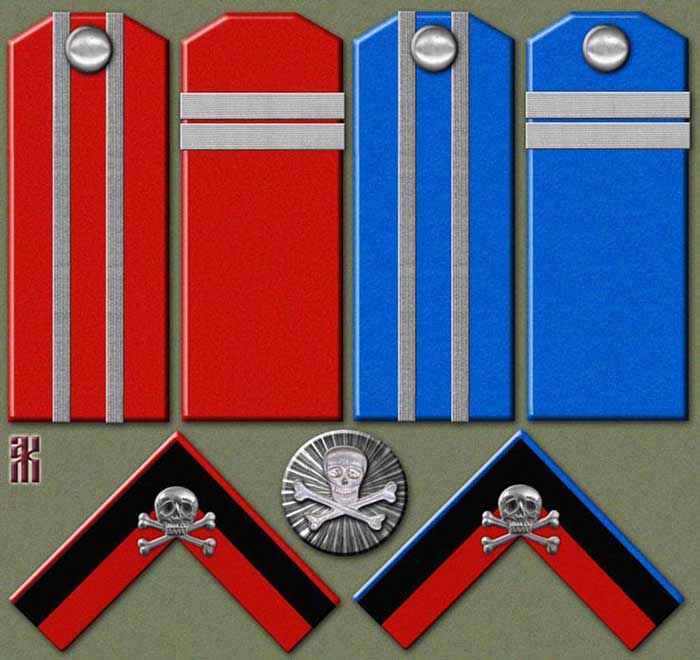
Shoulder-boards and "partisan" chevrons of the 1st Siberian and Orenburg Cossack Regiments.
The 1st Jaeger Regiment was distinguished by yellow shoulder-boards and partisan insignia. It did not have trouser stripes.
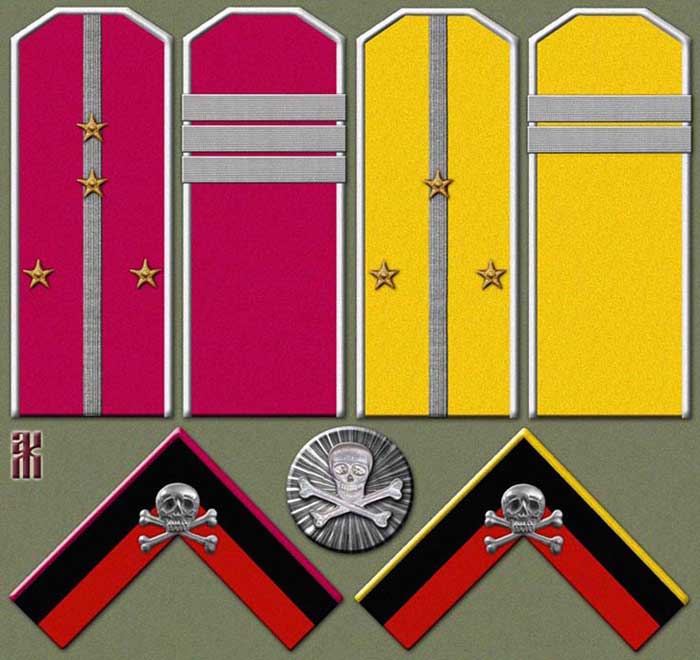
Shoulder-boards and "partisan" chevrons of the 1st Partisan Rifle Regiment and 1st Jaeger Regiment
The Independent Upper Ural and Tatar Battalions had shoulder-boards that were identical to those of the 1st Partisan Rifle Regiment, but their ranks did not wear "partisan" chevrons.
The cavalry did not have trouser stripes, but they did have spurs.
The Black Hussar Regiment had black shoulder-boards, black caps with white piping, black blouses and partisan insignia, as well as silver Caucasian belts and bright red bashlyki.
The Blue Lancer Regiment had blue shoulder-boards, blue caps and general partisan insignia.
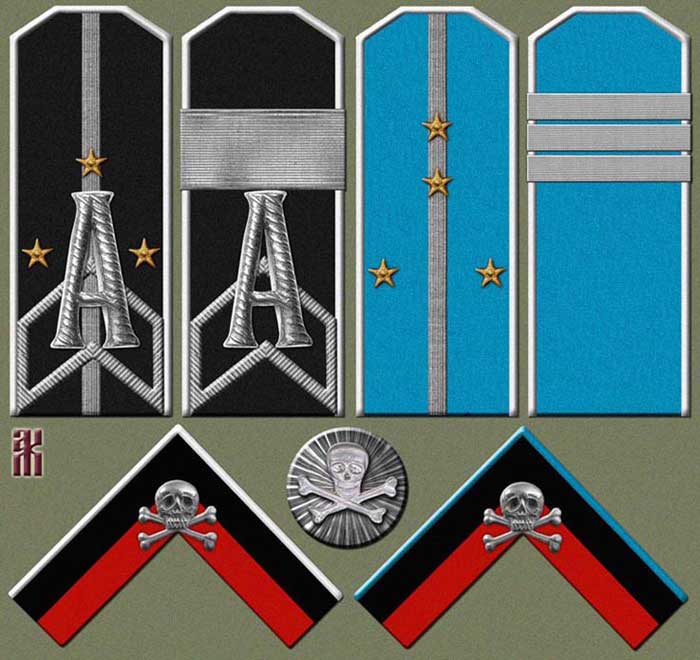
Shoulder-boards and "partisan" chevrons of the Black Hussars and Blue Lancers (Barnaul Regiment of Blue Lancers)
It is possible that the "A.A." monogram had a slightly different appearance. According to Deryabin, the Black Hussars' shoulder-boards were red, but in all other sources they are described as black.
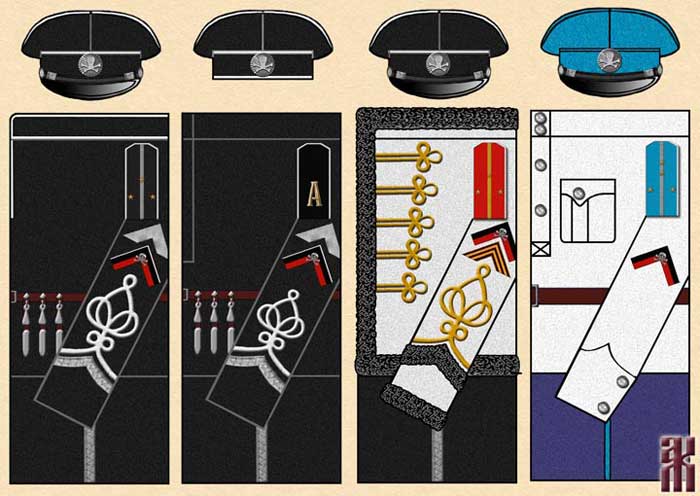
Uniforms of the Black Hussars and Blue Lancers (Barnaul Regiment of Blue Lancers)
There are no known photographs of the Blue Lancers, so the reconstruction of the uniform is approximate.
The Reserve Cavalry Regiment was distinguished by red shoulder-boards and red trouser stripes.
Annenkov's division included the 3rd Kirghiz (Alash) Regiment. It had green shoulder-boards, greatcoat tabs and stripes, with the rest of the insignia being partisan.
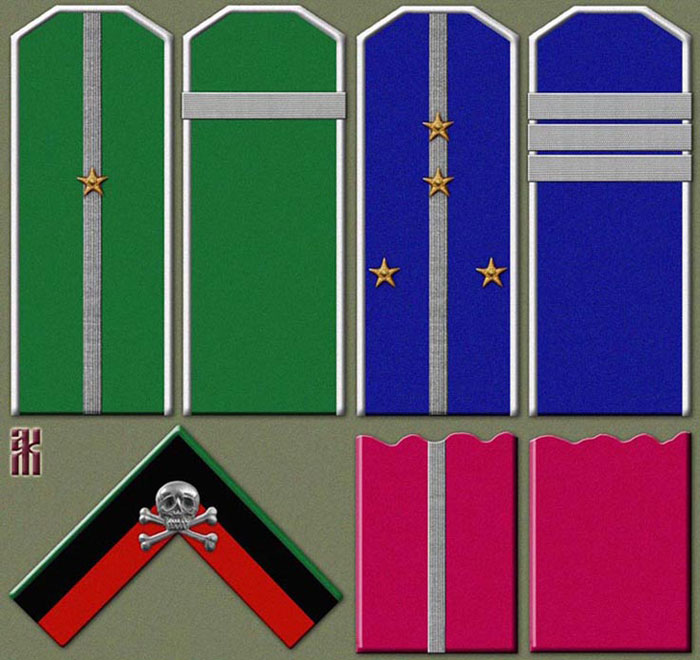
1, 2 and 5 – Shoulder-boards and "partisan" chevron insignia of the 3rd Kirghiz Regiment;
3 and 4 – Shoulder-boards of the Gendarme Divizion ; 6 and 7 – Shoulder-boards of the Field Gendarme Squadron (in the colour of the Semirechensk Cossack Host)
The Independent Upper Ural Battalion wore the same uniform as the rifle units.
In the Artillery Divizion, the battalions were distinguished by colour: the first had red shoulder-boards and trouser stripes, the second had blue shoulder-boards and trouser stripes, as the artillerymen belonged to the Siberian and Orenburg Cossack Hosts respectively. They also wore "partisan" chevrons.
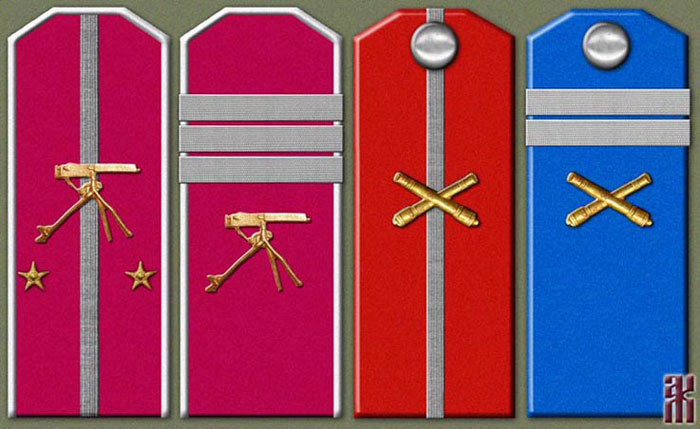
The shoulder-boards of the Machine Gun Komand and Artillery Divizion :
1st Battalion – in the colour of the Siberian Cossack Host;
2nd Battalion – with the colour of the Orenburg Cossack Host.
The Tatar Battalion wore the standard uniform of rifle units with raspberry shoulder-boards. It did not wear partisan insignia.
The [Independent] Cavalry Squadron had black shoulder-boards and partisan chevrons.
The Machine Gun Komand had the same insignia as the 1st Rifle Regiment.
The scouts had white stripes down their shoulder-boards.
The Gendarmes wore blue shoulder-boards and floor-length greatcoats.
The Field Gendarme Squadron wore the Semirechensk Cossack uniform with raspberry shoulder-boards and raspberry trouser stripes.
The Serbs wore Turkish-style caps with tassels.
Non-combatant officers and soldiers wore black patches with rank markings on the shoulder.
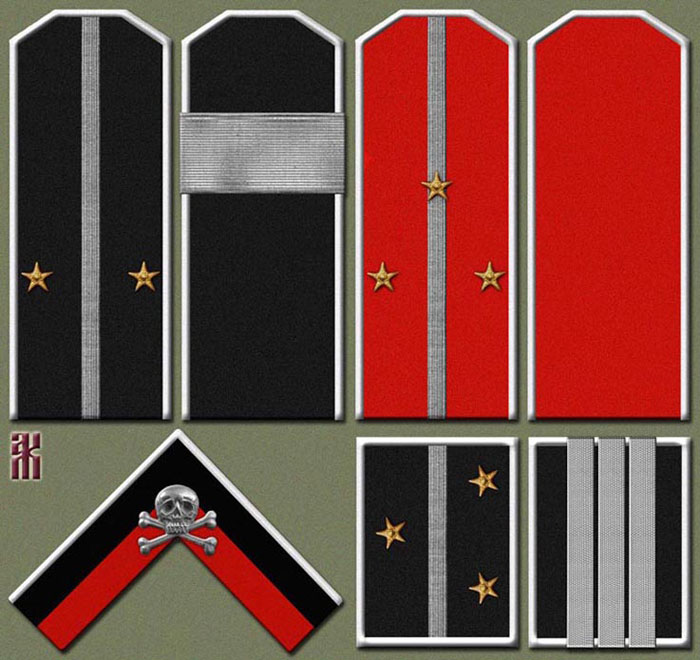
1, 2 and 5 – Shoulder-boards and "partisan" chevrons of the Independent Cavalry Squadron;
3 and 4 – Shoulder-boards of the Reserve Horse Regiment;
6 and 7 – markings for non-combatant lieutenant and sergeant.
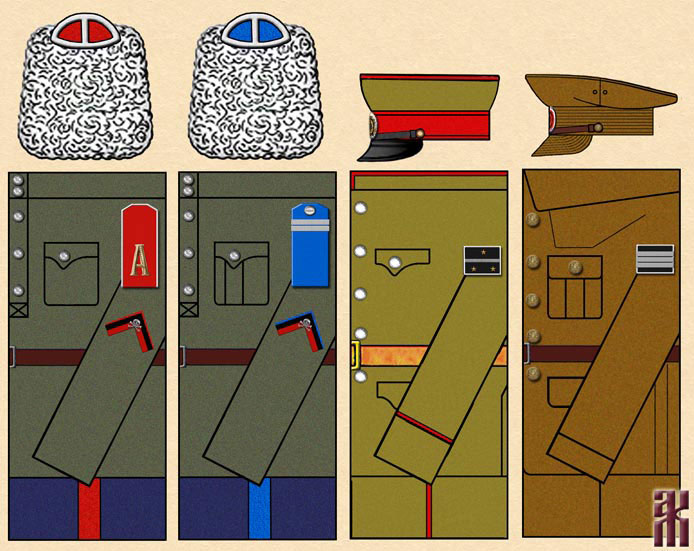
1 – Uniform of the 1st Siberian Cossack Regiment;
2 – Uniform of the Orenburg Cossack Regiments;
3 – Uniform of a non-combatant lieutenant in Japanese Imperial Army uniform;
4 – Uniform of a non-combatant sergeant in British Royal Army uniform
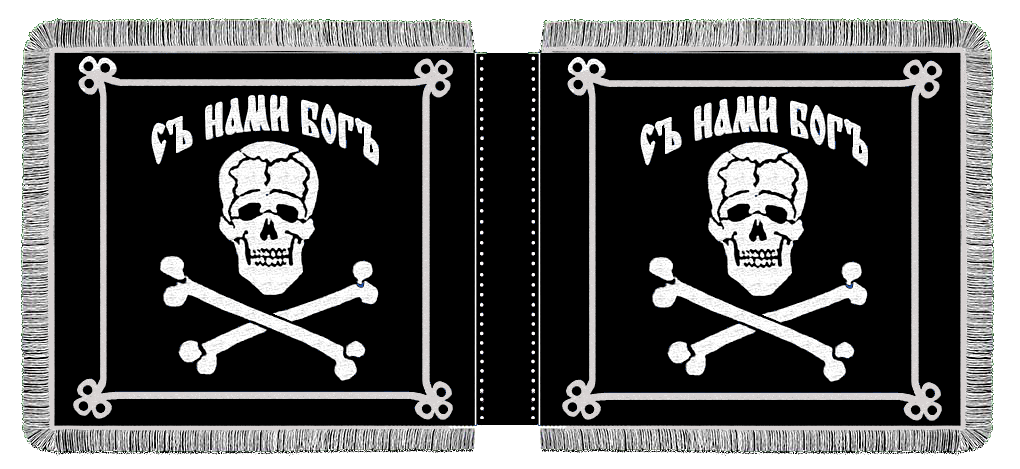
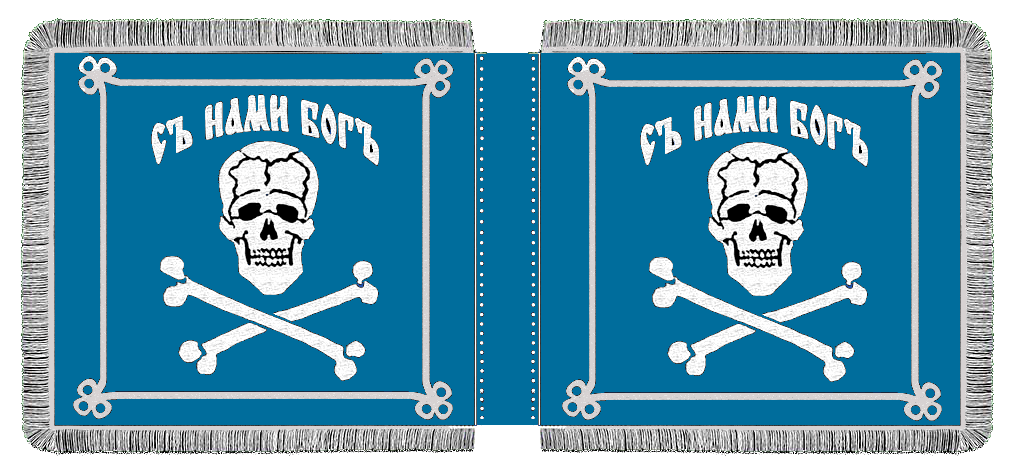
Only the detachment (division) had a banner. It was black with the inscription "God is with us". The words "and Ataman Annenkov" were not added. "That is fiction", Annenkov claimed. There were no banners in the regiments, but there were regimental flags. They were 90 cm square pieces of cloth of various colours, with an emblem of a skull and crossbones, the name of the regiment and the inscription "God is with us". That of the Cuirassier Regiment, for example, was yellow.
The inscription "God is with us" was already the official motto during the First World War, and was written everywhere, including on soldiers' heated railway carriages. Annenkov retained that slogan in his detachment (division) on the detachment's banner and flags and on other objects chosen by the partisans. The words "and the Ataman" were added by the partisans themselves on their own initiative and were not mandatory.
Annenkov wore the uniforms of various of his regiments: the uniform of the Black Hussars with black shoulder-boards, and the uniform of the Siberian Cossacks with red shoulder-boards and red stripes. He wore partisan cockade and all the partisan insignia, and a Caucasian Cossack sabre in a richly decorated silver scabbard.
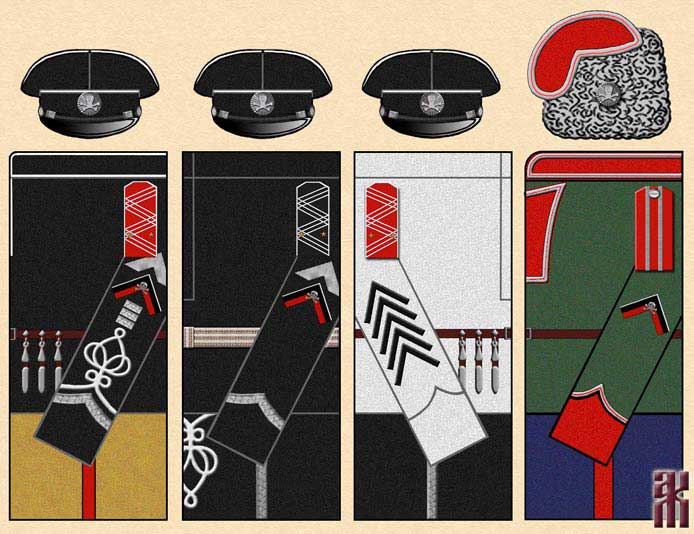
Uniforms of Ataman B. V. Annenkov himself, based on photographs:
1 to 3 – Black Hussar Regiment; 4 – Siberian Cossack Host
A characteristic feature of the "Annenkov" units were the coloured hexagonal, soft, sewn-on shoulder-boards. These were worn by all ranks of the Independent Partisan Division – both officers and lower ranks.
Horses of different colours were selected for different regiments. In the Black Hussars regiment, they were black; in the Blue Hussars they were light bay. The 1st Squadron of the Death Hussars rode black horses, and the rest horses of mixed colours. The Lancers were on foot. The Life-Ataman Regiment had chestnut horses; the Orenburg Regiment had bay, and the Cuirassier Regiment had dark bay.
The Life-Ataman Regiment, Annenkov's personal escort, and the Escort Regiment wore cherkeski and papakhi with partisan emblems. They did not wear rosettes on their boots, although they can be seen in photographs of the escort soldiers. "The Life-Ataman Regiment was always elegantly dressed in the latest fashions", Annenkov asserted.
In the final stage of the struggle, the blouses and greatcoats of Annenkov's units were Japanese and English.
I would like to note that the description of the uniforms and insignia of Annenkov's division was the subject of an entire session (27 July 1927) of the trial of Annenkov and Denisov, and was later revisited in other sessions, but there is no complete description of them, and it is unlikely that anyone will now be able to provide one.
In Memoirs and Historiography
As for the shoulder-boards with the stencil "AA" (for "Ataman Annenkov"), despite references to this in the literature, I will not assert their presence or absence. Annenkov does not mention such shoulder-boards.
Goltsov, V. A. in "Siberian Vendée: The Fate of Ataman Annenkov", Moscow, 2009, pp.127-129.
From the interrogation of the clerk Mataganov, of the headquarters of the Partisan Division
"Did you serve in the supply department?" the court asked him. "Where did you get your uniforms?"
"I got them from the quartermaster's office: some of the uniforms were British and Japanese. Later, we received blue Chinese moleskin."
Goltsov, V. A. in "Siberian Vendée: The Fate of Ataman Annenkov", Moscow, 2009, p.142.
From the interrogation of Ataman B.V. Annenkov
"Now tell us about the uniforms!" the chairman changed the subject.
"They came like this: all the outer garments and greatcoats were British, but some were sent from Japan. A large amount of cloth was sent from there, from which greatcoats were made here.
Goltsov, V. A. in "Siberian Vendée: The Fate of Ataman Annenkov", Moscow, 2009, p.249.
Questioning of Kuminov, an NCO in the Black Hussars regiment
Taken prisoner on 9 October 1919 near the village of Redut. In addition to military information, the Red intelligence officer noted some details about the prisoner's colourful uniform: black trousers and blouse, a black cap without a visor, black shoulder-boards with white piping and the letters "A.A.". On the sleeve was a chevron with a deaths' head, and instead of a cockade he wore a skull.
Russian State Military Archive, posted by Moscow researcher O. Vinokurov at pehota.zbord.ru/viewtopic.php?t =291 [link dead]
Annenkov's men wore a special uniform. They had bright red bashlyki hanging behind their backs. They stood out from all the other soldiers; they were mistaken for the admiral's escort. In reality, Kolchak's escort wore the usual English-style uniform for Omsk.
Gins, G. K. in "Siberia, the Allies and Kolchak", Moscow, 2007, p.530.
Supplies were provided centrally. ... A significant amount of the supplies came through foreign missions. My units had English and Japanese rifles and heavy guns. Machine guns were Japanese, American (Vickers and Colt), French (Saint-Étienne), and Lewis and Chauchat (French) automatic rifles. All outer clothing and greatcoats were British except for some Japanese. A large quantity of cloth was supplied from there, from which the greatcoats were made. "French" tunics and trousers, blankets and equipment, boots and bandages – everything was British or Japanese...
The ataman had a penchant for beautiful, colourful, varied uniforms, and while all the soldiers of the White Army were dressed in khaki, under Ataman Annenkov each regiment had its own distinctive colour: black hussars, blue lancers, the ataman regiment, his personal escort, cuirassiers, etc. All this was colourful, but at the same time it gave the volunteers the opportunity to show off their uniforms and defend the "honour" of their uniforms.
The Life-Ataman regiment named for Ataman Annenkov and the Black Hussars were, apparently, his childhood dream. A special personal escort (headed by Captain F. K. Cherkashin) was formed in Semirech'e, largely through the ataman's selection of outstanding Red Army prisoners and rebels. The Life-Ataman regiment was made up of Cossacks with whom Annenkov had begun his partisan warfare against the Bolsheviks: the name of the regiment testifies to the special closeness of its officers to the ataman. The Life-Atamans, like Annenkov's Black Hussars, Blue Lancers or cuirassiers, had a smart uniform that made them stand out sharply from the other officers, soldiers and Cossacks of Admiral Kolchak's Russian army. Their summer uniform in 1919 consisted of the following items: a cap with a raspberry crown, blue band and "Adam's head" (a skull with crossed bones underneath) instead of a cockade, a blue blouse with red shoulder-boards bearing the monogram "A.A." ("Ataman Annenkov"), a Caucasian chokha belt with metal plaques, raspberry trousers with wide double "general's stripes", high leather boots, and rosettes with the "Adam's head" attached to the upper front part. The officers of the Life-Ataman Regiment wore ermakovkas, which were traditionally popular among Siberian and Semirechensk Cossacks, i.e. blouses with front-piece, cartridge holders and silver braid along the edges of the front-piece and stand-up collars. For wear during the cold season, the Life-Ataman regiment had tall, shaggy black papakhi with long bright red bags, at the end of which was attached a large "Adam's head", as well as short fur coats, overcoats and bright red bashlyki. The sleeves of the tunics, blouses and outer garments of the Life-Atamans, as well as those of other Annenkovtsy, had various insignia, namely: on the left sleeve, between the shoulder and the elbow, there was a chevron (with the top pointing towards the shoulder) made of black and red ribbon with an "Adam's head" on it; on the right sleeve, there were black chevrons with the apex pointing upwards, which showed how many years a particular partisan had served under Annenkov (one chevron for each year);. In addition, partisans who were in the detachment during the first Soviet regime wore another chevron on the left sleeve, below the black and red chevron, made of St. George ribbon. The Cossacks of the Life-Ataman Regiment were required to have long forelocks, a "fringe" haircut, and generally look neat and trim, in a word, dashing. In general, the Life-Atamans were very well equipped. Each lower rank had a three-line rifle, a revolver (usually a Nagant), a sabre, and some even had a dagger. In terms of the quality of its personnel and horses, the level of combat training, internal cohesion, loyalty to the ataman and the White cause, and bravery, it was perhaps one of the best cavalry regiments in Kolchak's army.
He demanded that the partisans be well-groomed, and sent those who were ragged to the quartermaster with a verbal order to issue them with uniforms, after which they had to report to him in person in their new attire.
Shuldyakov, V. A. in "The Demise of the Siberian Cossack Army, 1920-1922", Moscow, 2004, pp.35, 41-42.
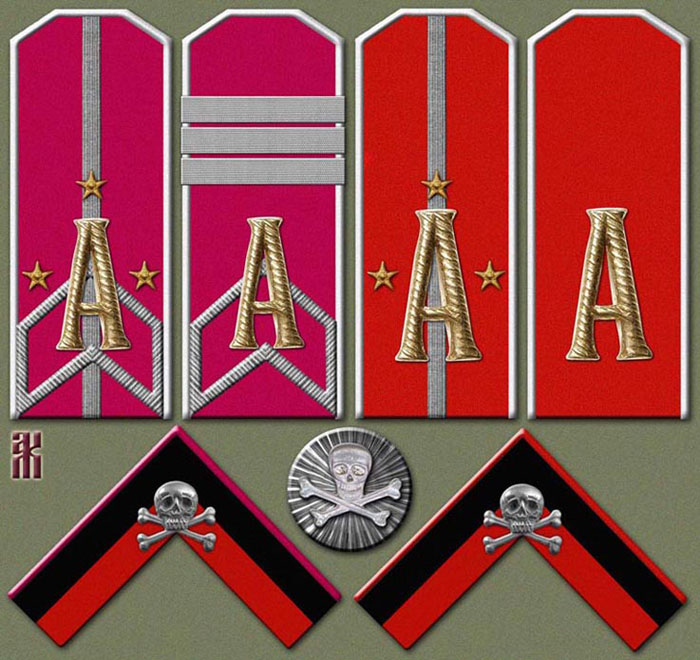
Shoulder-boards of the Life-Ataman (Escort) Regiment. The colour of the shoulder-boards is described differently in various sources, so both variants are presented
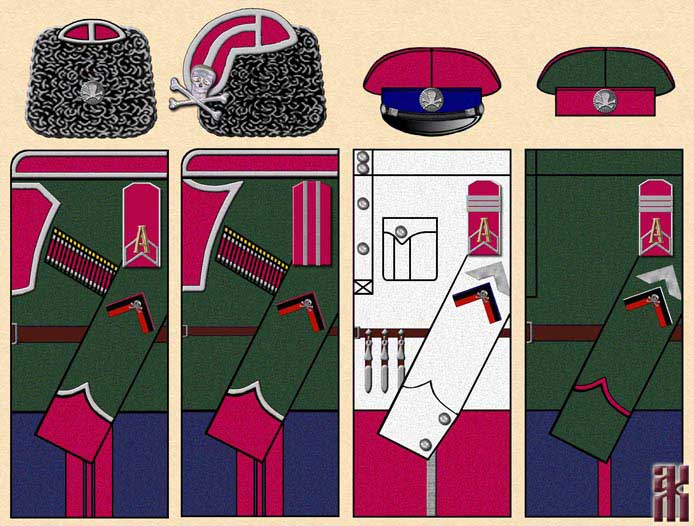
Uniforms of the Life-Ataman Regiment
Ataman Annenkov's partisans were distinguished by their very distinctive uniforms. As early as 1915 Annenkov's partisan detachment was assigned black and red ribbon chevrons and skull and bones on their cockades and buttons. As the ataman himself wrote, "in February 1918 I introduced coloured shoulder-boards to create a uniform appearance and distinguish between the different units of the detachment (no order has been found regarding this, and the colour of the shoulder-boards is unknown. – A.D.), and I myself had to approve this distinction due to the absence in Siberia at that time of an authority to which I could apply for the necessary approval." From 23 October of the same year all officers and partisans of the division were required to wear on their left sleeve, halfway between the shoulder and the elbow, a black and red ribbon point upwards, with a strip of the unit's uniform colour along the upper side of the ribbon; at the point was a skull and crossbones. Partisans who had been in the detachment "during the Bolshevik era" also wore another chevron below that one, made of St. George ribbon. Unfortunately, the dimensions of both chevrons are unknown.
On 27 May 1919 Annenkov sent a telegram to the commander of the 2nd Steppe Siberian Corps requesting "the Supreme Ruler grant the right to wear the above-mentioned distinctive insignia, chevrons and shoulder-boards to the officers of the division entrusted to me", since "the specified uniform existed under the Bolsheviks, was recognised by the Provisional Siberian Government, and until now the Partisan Division has participated in all battles in the that uniform". Apparently, the request was approved.
On 11 November 1919 Annenkov emphasised in his order that all partisans who had served in the detachment for at least one year were entitled to wear a black chevron ⅛ vershok wide on the right sleeve, 4 vershki below the shoulder-board. The number of those chevrons was determined by the number of years served by the partisan, and the right to wear them was granted in an order specifying the number of chevrons.
The Black Hussars and Life-Ataman (or Escort) Regiments stood out with their uniforms. The former wore entirely black caps with white piping and a skull and crossbones instead of a cockade, black blouses (with knots on the sleeves) and trousers with stripes, red shoulder-boards with white piping and the letters "A.A.", white pelisses with black trim and boots with skull and crossbones rosettes. The second regiment wore raspberry and blue caps with skulls and crossbones, blue blouses with red shoulder-boards (which were supposed to bear the letters "A.A."), raspberry trousers with stripes, and boots similar to those worn by the Black Hussars. Both regiments wore Caucasian belts. They also wore tall, shaggy black papakhi with red bags.
Other units had mainly British and some Japanese uniforms (tunics and trousers), greatcoats, boots with puttees, and equipment. Instead of cockades, everyone wore skulls and crossbones on their caps. In addition, Annenkov's men had bright red bashlyki.
Annenkov demanded that his subordinates always be dressed immaculately and, knowing his harsh temper, the units looked like they were on parade, as can be seen in many surviving photographs.
Deryabin, A. I. in "The Civil War in Russia 1917-1922: White Armies", Moscow, 1998, p.30.
Annenkov's partisans had their own unique insignia dating back to 1915, when Annenkov had been fighting the Germans. At that time his detachment had skull-and-crossbones device on their cockades, buttons, and sleeve patches. Annenkov later had his men wear black chevrons on the right sleeves – one for each year of service, and a black over red chevrons on the left sleeve (each regiment of his "Partisan Division" had these chevrons piped in regimental colour). Annenkov's personal bodyguard wore a flamboyant hussar-style uniforms consisting of black peak-less cap with white piping, a short black blouse of hussar style, a white pelisse trimmed with black fur, and black leather breeches with silver hussar knots and silver side stripes. Their leather equipment was Caucasian in style.
The sentry is an uriadnik (NCO) of the Semirechensk Mounted Regiment. His beskozirka cap has the crimson band of the Semirechensk Cossacks and a dark green crown. The coat is blue with crimson shoulder-boards (with silver lace) and cuffs. Sharovari trousers are also crimson with silver hussar lace on the seams. His weapons are a Cossack shashka sword and a British rifle.
Khvostov, V. in "The Russian Civil War (2): The White armies // Men-At-Arms 305", pp.21-22, 40.
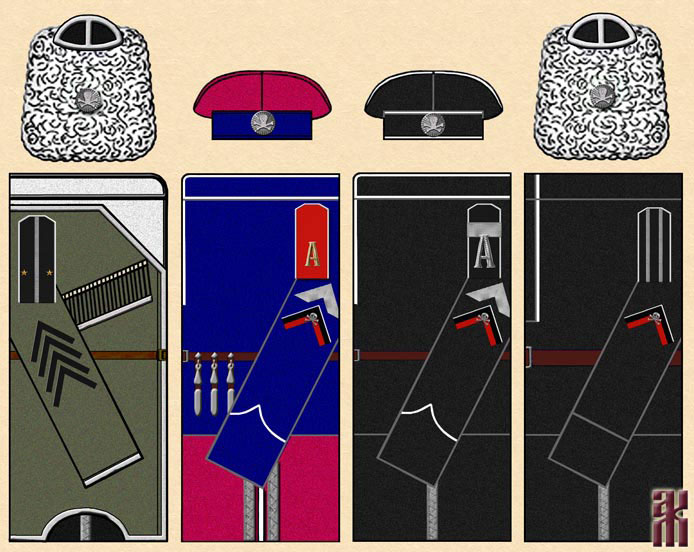
Uniforms of Annenkov's personal escort. Whether it wore black uniforms is unknown at present, as the available photographs do not allow for definitive identification of the colours
Annenkov continued to be very active in forming and deploying his units. By Order No. 56 of the 2nd Steppe Corps of 7 May 1919, the units of the Partisan Division were reduced to three independent brigades. The Independent Rifle Brigade included the 1st and 2nd Partisan, 3rd Composite Partisan Rifle Regiments and the Manchurian Jaeger Battalion. The Independent Cavalry Brigade consisted of the Black Hussar Regiment and the Barnaul Regiment of Blue Lancers. The Independent Cossack Brigade included the 1st Orenburg, 1st Partisan, and 2nd Ust-Kamenogorsk Partisan Cossack Regiments, as well as the 1st Kirghiz Partisan Regiment. However, the division's units were scattered across the vast territory of the Semirechensk, Semipalatinsk and Altai regions, and none of Annenkov's brigades ever assembled in their full strength. During May-July 1919 the ataman formed the Manchurian Horse-Jaeger and the 2nd and 3rd Kirghiz Horse Regiments. On 26 May Staff Captain Salnikov was replaced as chief of staff of the Partisan Division by Captain Alekseev, later Lieutenant-Colonel and Colonel (acting chief of staff until 11 June 1919). The division headquarters was located in the village of Uch-Aral.
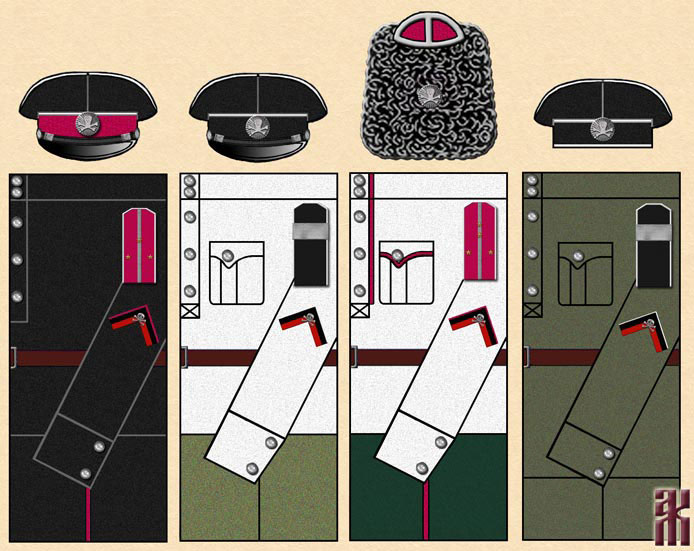
Uniforms of unidentified units of the Independent Partisan Division based on photographs
Shuldyakov, V. A. in "The Demise of the Siberian Cossack Army: 1917-1920", Moscow, 2004.
Testimony of Nikolai Romodanovskiy:
While working, the ataman had the orchestra play military music in his room and give symphony concerts in the evenings, to which officers were invited. There was a special choir in the Ataman Regiment. The Cossacks of that regiment wore trousers with general's stripes and were required to have forelocks and fringes.
Their shoulder-boards bore the monogram "A. A.", and their cockades featured a skull and crossbones. Ivan Martynenko managed to hide from Annenkov's punitive forces. He recalls how Annenkov's detachment once arrived in the village of Vesely Yar.
His men had the letters "A. A." on their shoulder-boards and emblems with two crossed bones and a skull on their sleeves.
Zaika, D. M. and Bobrenev, V. A. in "Ataman Annenkov // Military History Journal, 1990-1991", at lib.rin.ru/doc/i/57535p14.html [link dead]
Novonikolaevsk, early March 1919
In the evening six of us went out to fetch firewood. We asked the guards to leave the door open. Those who were still able to stand gathered near it. We stared at the passers-by. Soon an officer appeared – some kind of commander of our escorts, accompanied by several other soldiers, dressed to the nines, looking smart in their polished boots with jingling spurs, gold braid on their sleeves, armed with sabres and revolvers. One of them, a tall blond man, had insignia with a human skull on his sleeves and cap.
Seybullin, S. in "The Thorny Path (In the Death Cars of Ataman Annenkov)", Alma-Ata, 1964, at s-seifullin.ru/thorn-path.htm [link dead]
Arrival of the remnants of the Orenburg Army in Semirech'e, late 1919
The promised land was finally reached, the desert steppe was crossed – the Ayaguz picket on the Sergiopol-Kopal road was already at Annenkov's disposal. The arrivals were met by snub-nosed partisans in red trousers, with forelocks, well-fed, who urged them to move on without delay.
Kamsky, V. in "Russian White Guards in China", Moscow, 1923, p.5.
"Only on 18 and 19 September 1919 did a cavalry brigade under the command of Colonel Belavents begin to arrive at the front in the Petropavlovsk trakt area. The Black Hussars cavalry regiment, part of the brigade and commanded by Captain Danilenko, was formed in the city of Petropavlovsk, mostly from volunteers. After training at the Stenetskaya hamlet, 40 kilometres west of Isil-Kul Station, the regiment made a cavalry march to the front line through the village of Bogodukhovo. It consisted of four squadrons, commanded by Second-Lieutenant Vishnevetskiy, Lieutenant Khrenkov, Second-Lieutenant Antsiferov and Lieutenant Kiselev, with a total of about 550 sabres and eight machine guns. The appearance of the soldiers attracted attention with their unusual uniform. Their black peak-less caps with white piping and a skull and crossbones instead of a cockade were particularly striking. Their uniforms were complemented by black blouses and trousers with stripes, black shoulder-boards with white piping and the letters "AA". On their sleeves, the regiment's soldiers wore a shock chevron with a skull and crossbones, and they were all armed with sabres. Another equally striking part of the brigade was the Barnaul "Blue Lancers" cavalry regiment, commanded by Colonel Andrushkevich. At the same time, a battery of Maclean guns arrived.
Information from Moscow researcher O. Vinokurov at www.siberia.forum24.ru/?1-4-0-00000035-000-10001-0-1286712022
Months of imprisonment passed. In January 1919 a detachment of heavily armed Annenkovtsy arrived in Akmolinsk. White skulls peered menacingly from their sleeves and caps. Their belts glowed like blood.
Asylbekov, A. in "In the Carriage of Death // Kazakhstan in the Fire of Civil War", Alma-Ata, 1960, p.258.
Departure from Kopal, November 1919
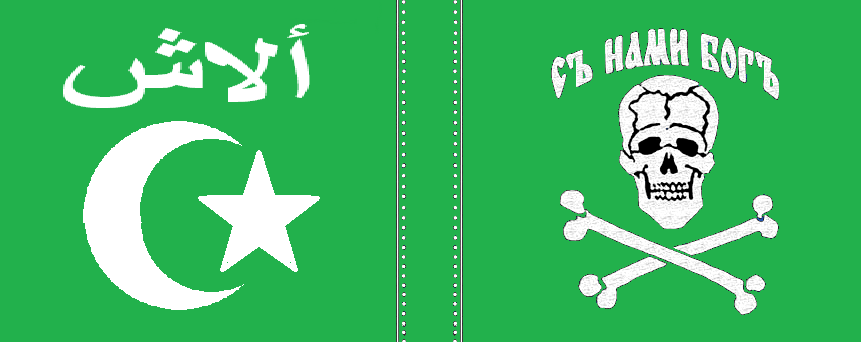
Annenkov's troops, which included Tatar, Taranchi and Alash sotnias, were also located in the Dzharkent-Przhevalsk area. There were 48 people in it. There were also combined units of Cossack regiments. Red Army intelligence reported that the sotnias had no guns or machine guns, "20 to 60 rounds of ammunition per person. The standard is a green flag with a white skull and crossbones and the inscription "God is with us", and on the other side, a white crescent with a star and the Muslim inscription "Alash". The chevrons on the papakhi of the Cossacks are red, those of the Taranchi are green, and those of the Alash are white. The Muslim population's attitude towards the Whites is friendly."
Amanzholova, D. in "Kazakh Autonomism and Russia: The History of the Alash Movement", Moscow, 1994, p.179
Omsk, 19 June 1919
In the village of Isilkul, Annenkov organised a shoemaker's and tailor's workshop and in a few days dressed the detachment in a uniform: ermakovkas with cartridge holders, trousers with general's stripes, caps with black tops and red bands. The detachment's emblem was on the sleeves and shoulder-boards: a skull and crossbones. Only after this re-equipping did Annenkov's men set off by rail to Omsk station, where they arrived on the evening of 19 June 1918.
Shuldyakov, V. A. in "Siberian Cossacks in the Partisan Detachment of Ataman B. V. Annenkov // Cossacks of Siberia from Ermak to the present day: history, language, culture. Materials from the All-Russian scientific and practical conference with international participation. 25-28 October 2012", Tyumen, 2012, p.260
Omsk Cadet Corps, June 1918
Below, to the right of the main entrance, by the small door where the corps' teachers used to enter, I saw two cadets standing guard with rifles, wearing caps with black crowns and black shoulder-boards bearing the emblem of the ataman: a white skull and crossbones.
Olenich-Gnenko, A. G. in "Harsh Days // Harsh Times", Novosibirsk, 1959, p.150.
Tomsk, September 1918
The next morning, as we were washing in the fresh air, the gate opened and the sentry let two officers through, one after the other. The one in front walked across the courtyard with quick steps, with a kind of catlike grace, bending his slender waist, dressed in a beshmet and cherkeska with silver cartridge holders and a Caucasian belt. The scabbard of his curved sabre was also richly decorated. As he walked, the ends of his scarlet bashlyk, carelessly thrown over his cherkeska, fluttered like wings. A dashingly pushed-back kubanka [low fur hat] revealed a swarthy, eagle-profiled, thin face with a dark moustache. It was Ataman Annenkov.
Olenich-Gnenko, A. G. in "Harsh Days // Harsh Times", Novosibirsk, 1959, p.150.
Semipalatinsk, January 1919
Shortly after my arrival, I saw two cavalrymen with black shoulder-boards, on which the Annenkov death emblem was emblazoned, entering the gate. To my unpleasant surprise, I recognised one of them as my classmate from the Omsk gymnasium, Ershov. They crossed the courtyard and disappeared around the corner of the house. I went into the owners' room and learned from Pavel Andreevich that a squadron of Annenkov's hussars was stationed nearby.
... In the evening, around eight o'clock, drunken singing could be heard in the courtyard. The door opened, and three half-drunk Annenkovtsy stumbled into the room with a balalaika and an accordion. All three were wearing visorless caps with skull cockades and overcoats thrown over their shoulders. I looked closely. It was Ershov again!
Olenich-Gnenko, A. G. in "Harsh Days // Harsh Times", Novosibirsk, 1959, p.203.
From the testimony of Annenkov's assistant driver, N. A. Romadanovskiy
Stepan was mainly in charge of his wardrobe, which contained his suits, three pairs of boots with high heels and copper horseshoes, underwear, chocolate, cigars, tea, cognac, a fur coat, a silver dagger, a Japanese carbine, silver buttons with skulls (made in the armoury, delivered on demand by a messenger).
Markovchin, V. V. in "The Odyssey of Ataman Annenkov", Kursk, 2010, p.261.
He introduced his own uniform for the detachment. All partisans had to wear trousers with general's stripes, partisans had to have forelocks and fringes, shoulder-boards with the monogram "A.A.", skulls on their cockades, combat badges on their sleeves, and on the right sleeve, black markings (indicating how long they had been in the division), chevrons made of St. George ribbon for illegal work against the Bolsheviks, horses branded with a skull stamp, carts, cars. All banners bore the inscription "God and Ataman Annenkov are with us". He replaced the Cossacks' greatcoats with cherkeski and abolished titles. ... ...He personally appointed officers, which intensified after the fall of Semipalatinsk, and replaced the officer stars on the shoulder-boards with square ones. His personal escort was dressed in Circassian coats, papakhi, red bashlyki, American stripes and American revolvers. He renamed the regiments: Life Ataman, 1st Cuirassier, 2nd Lancer, 1st Alash Jaeger, etc. He travelled with his retinue to China to negotiate with the Chinese authorities about food supplies. He rode at the front, followed by a standard-bearer with a banner (embroidered with silver, which was always kept near the tent, like a division standard), with a trumpeter and personal guards on either side.
Markovchin, V. V. in "The Odyssey of Ataman Annenkov", Kursk, 2010, p.262.
Annenkov's men blocked all the exits from the village and began their reprisals. Soldiers with the letters "БС" (for death battalion) on their shoulder-boards roamed the village, grabbing partisans, beating them, and herding people into a gathering place.
siberia.forum24.ru/?1-4-0-00000075-000-0-1-1358611955.
Archival criminal cases reveal that in early November 1918, due to tense relations between the commandant of Barnaul and the commander of the cavalry sotnia created to guard the city, the latter was sent to Semipalatinsk, where it was transformed into a divizion and then into a regiment of "blue lancers". The regiment differed from other units in its distinctive uniform: grey greatcoat cloth with blue fronts, trouser stripes and a deaths-head emblem (skull and crossbones) on the cap and shoulder-boards.
siberia.forum24.ru/?1-4-0-00000071-000-0-1-1358691412.
Annenkov had previously stated categorically that his units had not received any uniforms from foreigners, while Motoganov claims that he personally issued the partisans with batteries, English greatcoats and Japanese shirts.
"Soviet Siberia [newspaper]" on the trial of Ataman Annenkov at siberia.forum24.ru/?1-9-0-00000166-000-220-0#195<./p>
Annenkov's partisans were well dressed, their regiments had impressive names such as cuirassiers, lancers and hussars, and differed from each other in their very diverse uniforms; the officers' stars were replaced by special stripes, and all the partisans wore chevrons with skulls on their sleeves.
Kamsky, V. in "Siberian Action", 1922, p.36 at siberia.forum24.ru/?1-4-0-00000024-000-100-0.
According to the accounts of those who fled Petropavlovsk on 09/09/19. ... In the city there were ... and Annenkov's detachment – 500 bayonets with red shoulder-boards and 500 sabres with black shoulder-boards, wearing headgear with a deaths-head and uniforms with red breastplates. The banner bears the inscription – "God and the Ataman are with us".
RGVA F.1324 Op.2 D.181 L.285-286 (operational reports 27sd),published by Oleg Vinokurov at siberia.forum24.ru/?1-4-20-00000061-000-180-0.
It was getting light. The darkness was slowly dissipating in the cell. Several armed soldiers dressed in unfamiliar uniforms appeared in the corridor. Each of them had machine gun belts crossed over their chests. On their heads they wore tall, black, shaggy papakhi with red tops. They had red shoulder-boards with piping on their shoulders. They carry themselves briskly. Soon the entire long corridor was filled with soldiers in unusual uniforms. The butts of their rifles tapped against the stone floor.
"Annenkov's detachment... Annenkov's detachment!" the alarmed voices of the prisoners could be heard in the pre-dawn gloom.
... All the prisoners were led out into the prison courtyard. About thirty guards surrounded us in a tight circle. The prison warden and two officers went back and forth to the prison office several times, one handing us over, the others receiving us. Finally, the commander of the city garrison arrived, and we were led in formation out of the prison gates. A convoy was waiting there, thirty horsemen and twenty foot soldiers. Only those who searched us and led us out of the prison were dressed in identical uniforms. It was not only their strange uniforms that attracted attention, but above all their insolent, rough manners. They were Annenkov's thugs, who had arrived from Omsk.
... There were about seventy guards – loyal and reliable Kolchakevtsy, the admiral's right-hand men. Kolchak did not trust soldiers from the common people to guard the Bolsheviks. Our escort consisted entirely of Cossacks, except for my Kazakh relative and another son of a wandering merchant, a half-Uzbek. The fifteen atamantsy who arrived from Omsk looked like the most brutal bandits. Two letters on their shoulder-boards, "A. A.", written in silver paint, caught the eye, meaning "Ataman Annenkov".
Seifulin, s. in "The Thorny Path" at www.e-reading.org.ua/chapter.php/147061/30/Seiifullin_-_Ternistyii_put%27.html
Retreat of the Southern Army
Not far from Sergiopol, a two-seater open car rolled up to meet us. At the wheel sat Ataman Annenkov himself, in his clean, distinctive, colourful (and somewhat theatrical) uniform. On his companion's papakha, we read: "God and Ataman are with us".
Khitun, S. E. in "Noble Piglets", USA, 1975 at militera.lib.ru/memo/russian/hitun_se/01.html
Ataman Annenkov's "blue lancers" left a strange memory among the townspeople. They wore an image of a human skull with two crossed bones on their sleeves (it is strange that the Gestapo followed that beaten path).
"Kamyshlov", Sverdlovsk, 1968, p.34 at kam-news.ru/?p=15180
Ataman Annenkov's "blue lancers", who had stolen thoroughbred horses in Altai, also toured the Siberian villages. Annenkov's gang consisted entirely of volunteers. They wore red and black chevrons on their sleeves, with crossed bones and a skull above them embroidered in the middle. The savage reprisals made a heavy impression even on those wavering middle peasants who were waiting for the arrival of the Whites.
Ryapolov, D. in "Notes of a Red Partisan" at www.plati.ru/asp/pay.asp?id_d=1471130.
Vyazovaya station on the Samara-Zlatoust railway, July 1919
The punitive detachment sent all those arrested to the courtyard of Ivan Romanovich Kashkarov, a resident of Vyazovaya. From there, they were forcibly taken one by one to a room where 16 executioners in death battalion uniforms were sitting at a common table, and officers in the same uniforms were sitting at tables in the corners of the room.
"Civil War in the Southern Urals: Collection of Documents and Materials", Chelyabinsk, 1962, p.173.
Lebedev: What White Army units were in Semipalatinsk in 1919, and what were the major headquarters?
Merkuryev: I don't know, except for the training detachment, Annenkov's komand, whose soldiers and officers wore crossed bones and a skull on their caps and sleeves.
Lebedev: Did your lancer regiment wear the same insignia?
Merkuryev: No, we wore tricolour cockades.
Published by Y. Goncharov at siberia.forum24.ru/?1-4-0-00000071-000-0-0-1340879241.
On 6 December the enemy attacked Kopal in Semirech'e, surrounded it, but was repelled; details are not yet known. On 30 November, there was an attack on Dzharkent; a captured Cossack revealed that the detachment has a green banner with a white crescent; the enemy's official forms are stamped: "Special Representative for the Organisation of Troops in the Tarbagatai Province. Col. Bryantsev." The detachment's headquarters is in Nikolaevsk; the detachment's task is to advance to the rear of Dzharkent as part of Annenkov's detachment, which has promised to send another 5,000 Cossacks.
Frunze, M. V. in "On the Fronts of the Civil War", Moscow, 1941, p.240.
Home — State Symbols — Flags — Uniforms — Badges & Medals — Money — Other
Pygmy Wars Notes
The original for this page is at kolchakiya.ru/uniformology/Annenkov_units.htm.
Generally only officers wore the "hexagonal" shoulder-boards shown on this page, while the usual practice was for other ranks to wear pentagonal shoulder-boards, i.e. coming to a point at the neck.
The original has the artillery in "battalions", which is unusual since the Russians almost always used "divizion" for units that size: I do not know why this is different.
I have left the text from the Osprey exactly as written, but I prefer "raspberry", which is the literal translation, to "crimson" when discussing that particular shade of red.
The difference between "banner" and "flag" in the context of this page, and discussion on other translation choices I have made can be found here.
The following illustrations by A. Lebedeva were originally on the page but later removed.
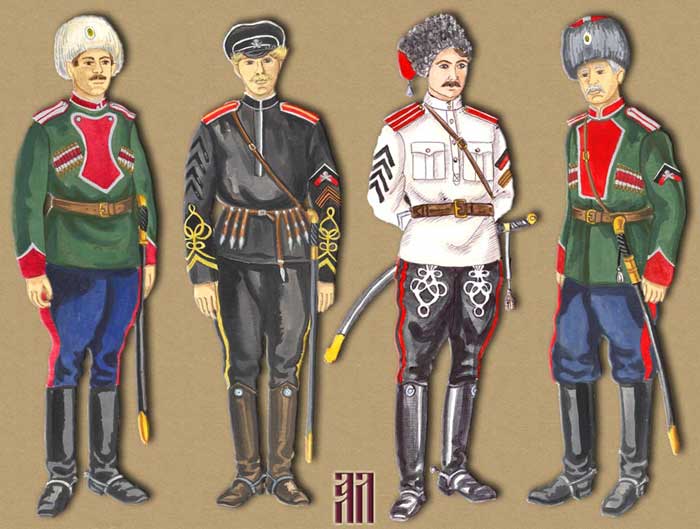
1 – Officer of the Semirech'e Cossack Army in full dress uniform;
2 – officer of the Black Hussars regiment;
3 – officer of the Black Hussars regiment in summer uniform;
4 – officer of the Life-Ataman regiment
Figures 1 and 4 are wearing ermakovki which was particularly associated with the Siberian and Semirechensk Cossack Hosts.
There is also some other discussion on Annenkov's cavalry on the Kolchakiya cavalry page.
Some more information on Ataman Annenkov's forces can be seen here.
Flags
Annenkov's units officially only had one "banner", which was a black square flag with a skull and bones and "God is with us", shown here, which was probably carried by his Black Hussars. It was quite a small flag.
However the individual regiments probably all carried versions of the same flag in their respective colours. This is one for the Blue Lancers, his second oldest unit.
Annenkov also fielded local tribesmen (Kazakhs, Taranchi and Mongols) and one of the flags was apparently the standard front and a reverse with crescent and star and the word "Alash" in Arabic.
History of Ataman Annenkov's Division
Information on the Semirechensk in the Russian Civil War, which is where Annenkov spent most of his time, can be found here.
Annenkov's time in China is discussed in A. V. Popov's article Failed campaign to India: Ataman Boris Vladimirovich Annenkov and his detachment in Xinjiang PSTGU Bulletin. Series II. 2007. 1. p 7-20.