
Uniforms of the Bashkir Corps in Eastern Russia
All material and reconstructions are by A. Karevskiy unless noted otherwise.
On 13 July 1918, the Bashkir Military Soviet (BMS) issued a firman (order) establishing a commission to develop a uniform for the Bashkir units. The chief of staff of the 2nd Bashkir Division, Lieutenant-Colonel Emelyanov, was appointed chairman of the commission: its members included the senior adjutant of the BMS, Lieutenant G. Mukhliyo, the head of the mobilisation department, Ensign H. Teregulov, and BMS member S. Magazov.
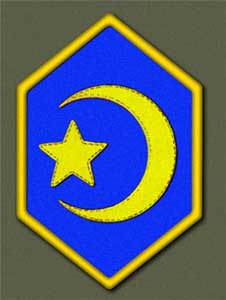 The commission's first meeting took place on 13 July 1918. The result of its work was the development of a sleeve badge, worn on the left sleeve of the uniform and consisting of a blue hexagonal cloth shield with yellow piping. The shield bore an image of a yellow crescent moon, facing left, and a five-pointed star. This was followed on 15 August 1918 by a decree of the BMS, which strictly prohibited the wearing of the previous insignia: "... order that no officer or soldier in the Bashkir units shall wear shoulder-boards. The sleeve insignia shall continue to be worn until the commission has developed and the Bashkir Military Soviet has approved the dress code for the Bashkir units."
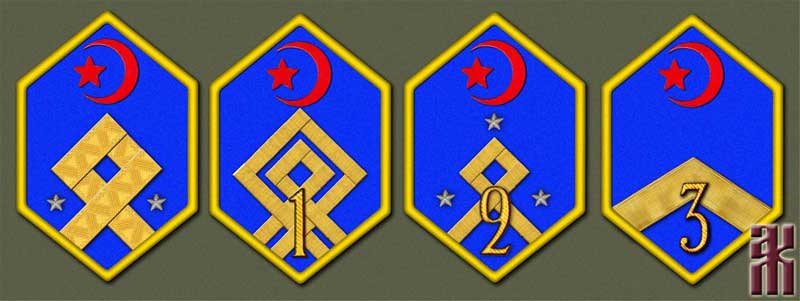
The need to establish insignia for military ranks soon led to another change in the appearance of the sleeve insignia. The crescent and star emblem was reduced in size, changed from yellow to red, and moved to the upper part of the hexagon. The lower part featured distinctions "from private to full general" (copied entirely from the KOMUCH People's Army), as well as a metal number of the unit. On 20 August 1918, BMS Firman No. 4547 approved a national flag for the Bashkir Republic, consisting of three horizontal stripes of equal width in blue, green and white. The same flag was initially used as a general military banner. A ribbon of the same colours was used as a cockade on headgear and worn diagonally from right to left.
On 13 August 1918, Firman No. 17 established a new commission to finalise the uniforms of Bashkir military units. Lieutenant Mukhliyo, Ensign Teregulov, Lieutenant Gabitov (commander of the 1st Bashkir Regiment), Staff Captain Enikeev (commander of the 4th Bashkir Regiment) and civil servant Magazov were included among the members. The result of this commission's activities was BMS Firman No. 29 of 28 August 1918, which approved the draft it had submitted. In general, this order largely copied the People's Army (KOMUCH) Order No. 20 of 25 July 1918, which was explained by the BMS's dependence on material supplies from Samara. In accordance with the decree, the field uniform of the Bashkir units included the following six items:
1) A khaki blouse with narrow shoulder-straps of the same colour.
2) Khaki trousers for the infantry and artillery, grey-blue for the cavalry. Blue stripes 3 cm wide were sewn onto the trousers.
3) A greatcoat made of grey greatcoat cloth with narrow shoulder-straps of the same colour.
4) A yellow rawhide belt with a white metal buckle.
5) Footwear – boots or puttees (cavalrymen were allowed to wear spurs).
6) Headgear. It was noted that this would be "designated separately", i.e., it would apparently have to take into account the characteristics of national clothing. Until then, the previous khaki caps and sheepskin hats with long fur continued to be used.
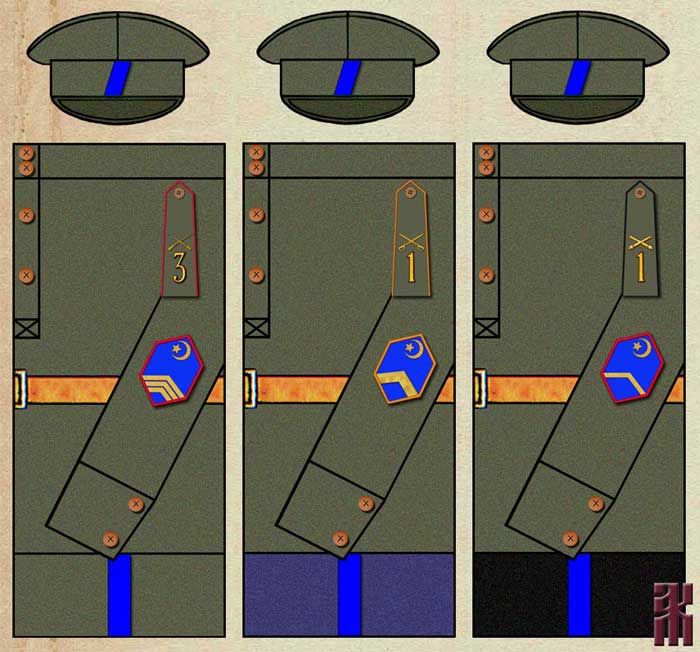
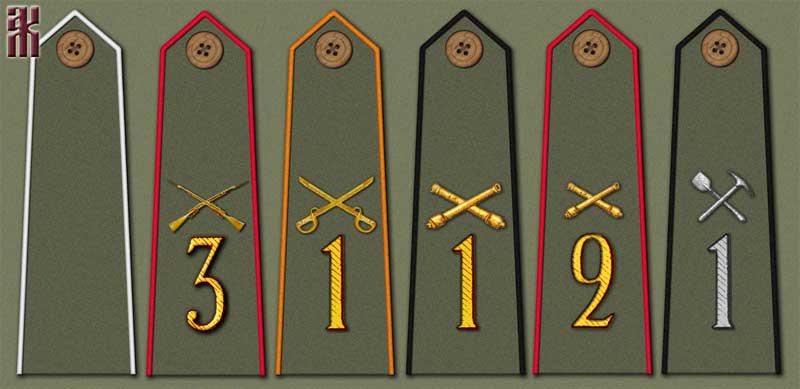
The system of insignia underwent some changes. A blue ribbon worn diagonally across the cap from right to left was to be used as a cockade. Shoulder-boards were standardised for all military ranks, with coloured piping: red for all combat units except cavalry, orange for cavalry, white for combat headquarters (starting with divisional headquarters), and black for all other institutions and establishments of the War Department and for non-combat komands and companies. The shoulder-boards also featured a smooth metal number of the unit in the colour of the device (moved there from the sleeve insignia), and above the number there were specialist markings to distinguish between the branches of the armed forces: crossed rifles for riflemen, crossed cannons for artillerymen and crossed sabres for cavalrymen,. Engineers and other technical units retained their previous ones.
The blue cloth sleeve shields retained their previous appearance of a vertically elongated hexagon. The crescent-shaped emblems with a star located at the top were now to be made "in the colour of the braid" (i.e. silver or gold, depending on whether the unit was combat or non-combat). The yellow piping, which had previously been the same for everyone, was now replaced by coloured piping the same as used on the shoulder-straps.
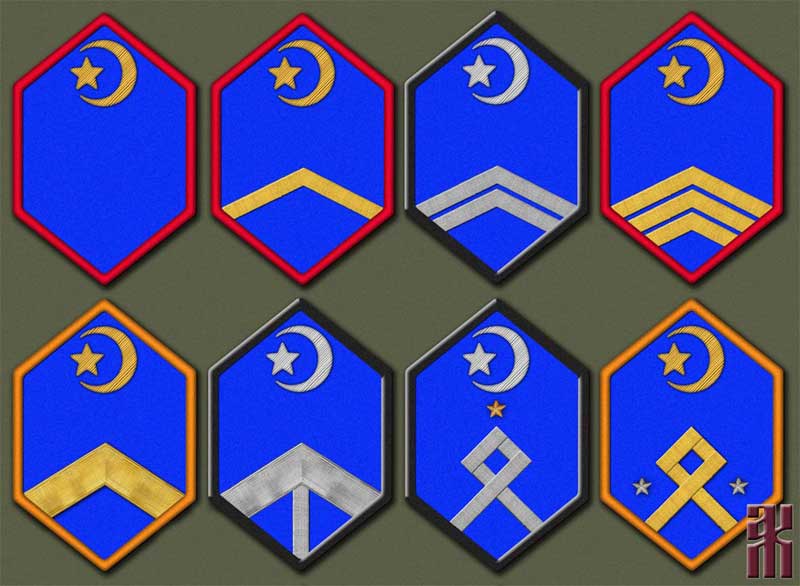
Sleeve insignia rank markings:
1 – rifleman; 2 – lance-corporal; 3 – corporal (non-combatant); 4 – sergeant;
5 – sergeant-major (cavalry); 6 – sub-ensign (non-combatant); 7 – ensign (non-combatant);
8 – second-lieutenant (cavalry).
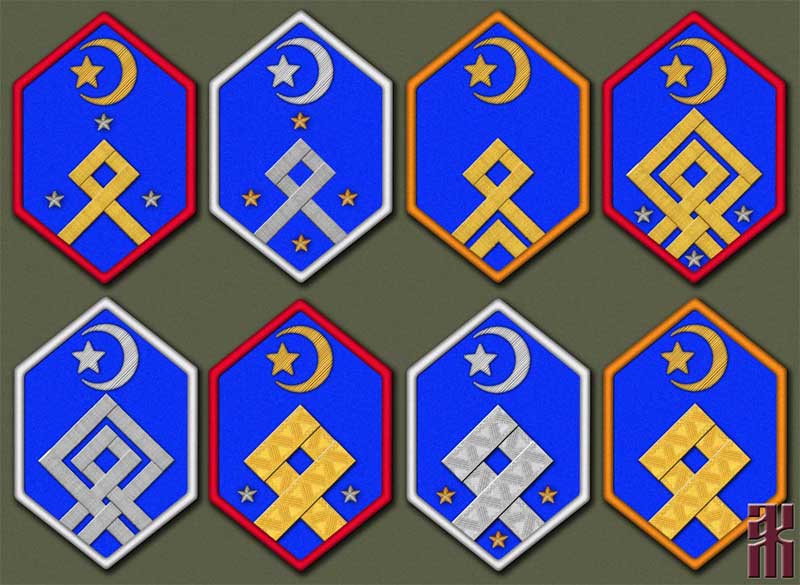
Sleeve insignia rank markings:
1 – lieutenant; 2 – staff captain (staff); 3 – captain (cavalry); 4 – lieutenant colonel;
5 – colonel (staff); 6 – major-general; 7 – lieutenant-general (staff); 8 – general of cavalry
In accordance with the branch of service, Bashkir servicemen were issued with bayonets, sabres and Cossack swords as cold weapons. Officers and ensigns had Caucasian-style swords with braid and silver tips on the scabbards. Staff officers were allowed to carry daggers instead of swords. Shoulder-boards were issued to general staff officers and topographers.
Shayakhmetov, I. O. in "Military-historical Reconstruction of the Uniforms and Symbols of the Bashkir Units of 1917-19 // Vatandash, No. 8", Ufa, 2007 at www.vatandash.ru/index.php?article=1477.
Taimasov, R. in "The Bashkir Corps: Fiction and Reality // Vatandash No. 8", Ufa, 2000, pp.114-115.
Private communications from V. V. Romanov of Moscow.
Order No. 29 of the Bashkir Military Council, Headquarters of the Bashkir Army, 28 August 1918, Orenburg
§2. A special appendix hereto contains a description of the uniform of the Bashkir troops.
Appendix: Description of the uniform.
Description of the uniform of the Bashkir Army.
1. The field uniform for units, headquarters, administrations and institutions of the Bashkir Army is established as follows:
a) a blouse of khaki colour, with narrow shoulder-straps of the same colour, is the uniform for all ranks and branches of the army, with smooth metal numbers for the army units.
b) trousers for infantry and engineer units – khaki, for artillery – black, and for cavalry – grey-blue with blue stripes three centimetres wide.
c) headgear will be designated separately.
d) A grey-blue cloth greatcoat with narrow shoulder-straps. The shoulder-strap at the base (at the sleeve) is 1 vershok wide, the upper end is ¾ of a vershok wide, made of the same cloth and with a smooth metal unit number on it.
e) A yellow belt made of rawhide with a white metal buckle.
f) High boots or [low boots and] puttees.
g) Spurs – for those who are required to be in formation on horseback.
h) To distinguish military personnel by their rank, sleeve insignia shall be placed on the left sleeve, the full-size drawings of which are attached.
Lower NCOs, bombardiers, and master gunners wear a metal braid chevrons on their sleeve insignia in the colour of their unit: one, two or three stripes; sergeant-majors wear one wide braid chevron. The shape of the stripes is shown in Figure No. 1. Sub-ensigns, in addition to the sergeant-major's chevron, have a vertical stripe of braid from the inner corner to the lower edge of the shield.
Officers: see Figure No. 2. The braid is the same as for soldiers. Ensigns have one star above the braid; second lieutenants have two stars, according to the drawing, one above the braid and one below. Lieutenants have three stars: two stars according to the drawing and one above the braid. Staff captains have four stars: two according to the drawing, one above the braid and one below. Captain have no stars but an additional chevron underneath, of the same braid.
Staff officers: see Figure No. 3. Lieutenant-colonels have three stars according to the drawing, colonels have no stars. Generals: see Figure No. 4. Major-generals, according to the drawing, have two stars, lieutenant-generals have three stars: two according to the drawing and one below the braid chevron. Full general have no stars.
On the sleeve shield above the braid stripe, all ranks of the Bashkir troops have an image of a crescent moon and a star in the colour of the branch.
Above the unit number on the shoulder-boards, there is a distinction according to the type of troops:
Riflemen – two crossed rifles.
Artillery – two crossed cannons.
Engineers (aviation, motorised rifle) and all other special units have their own external distinction on their shoulder-boards.
Sleeve insignia consist of a shield, the size of which is indicated on the attached drawing. The shield is dark blue. The trim on the shoulder-boards is red for all combat units, except for the cavalry who have orange. For combat staffs, starting with division level, it is white. For other institutions and establishments of the Military Department and for non-combat commands and companies, it is black. The uniforms of doctors and military officials will be announced separately.
Weapons: Soldiers by branch of service: bayonets, sabres and swords. Officers and warrant officers – Caucasian-style swords or daggers. Scabbards are leather for soldiers, braided with silver tips for officers.
Aiguilettes are by rank: for officers of the General Staff and topographers.
Signed: Acting Chairman of the Bashkir Military Soviet, Mutin
Certified true copy: on behalf of the Chief of Staff, Lieutenant-Colonel Emelyanov.
"Orenburg Cossack Herald, No. 58", 14 September 1918, p.5. Document kindly provided by Vladimir Romanov of Moscow.
In Memoirs and Historiography
October 1918
The personnel of the 1st Bashkir Regiment wore a Muslim emblem on their left sleeves as a distinguishing mark – a blue shield with a white crescent.
Memoirs of N. Starikov
Well-dressed and handsome, they always attract attention when they march through the city with their orchestra, wearing their national insignia on their caps and shoulder-boards. I saw the Bashkir cavalry, which was a sight to behold...
Ganin, A. V. in "Ataman A. I. Dutov", Moscow, 2006. pp.221, 325-353.
In the summer of 1918, the government of Bashkortostan began to create its own regiments, which took part in hostilities against the Blyukherovtsy. The long-term goal was to create an army with all the necessary attributes. An order of the Bashkir military command introduced for the units a special "national emblem": a crescent moon depicted on blue fabric, inside which a star was placed. The emblem was to be worn on the sleeve. Soldiers were ordered to respond to their commanders' greetings with "Sau-bul" instead of "Zdraviya zhelayem" (We wish you health). As in the Russian army, shoulder-boards with stars were the main sign of officer rank. Thus, according to the description of the uniform of the Bashkir troops (appendix to the order of the Bashkir Military Council No. 29 §2 of 1918), a major general was entitled to two stars. According to the document signed by the chairman of the Bashkir Military Soviet, Validov, he himself held this rank. Later, Validov became a lieutenant general. The attitude towards military uniforms, especially officer's uniforms, shows that the Bashkir authorities were against the abolition of military ranks, titles and insignia by the Soviet authorities.
Iskhakov, S. in "Russian Muslims and the Revolution // Social and Political Thought", Moscow, 2004, p.502, citing RGVA F.40786 Op.1 D.20 L.90, RGVA F.40204 Op.1 D.3 L.124, RGVA F.40204 Op.1 D.5. L.79-79ob. and RGVA F.40786 Op.1 D.20 L.246, 254, 255.
Home — State Symbols — Flags — Uniforms — Badges & Medals — Money — Other
Pygmy Wars Notes
The original for this page is at kolchakiya.ru/uniformology/bashkir_korp.htm.
This page is for the Bashkirs in the White forces in 1918 and 1919. For the 1920 period, after the Ice March in the Far East, see here.
The blue used for this page is sineva, which is the generic word for any blue, but note that one citation notes it is "dark blue".
The reference to Blyukherovtsy is to the southern Urals partisan units under Vasiliy Blyukher which were trapped behind White lines and who made a long march to join the Red Army in the Summer of 1918.
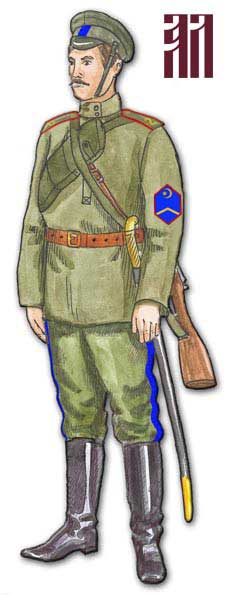
This illustration of a Bashkir was originally on the page, but later removed.
Discussion on the translation choices I have made can be found here.
Flags
One flag is known, for the 2nd Regiment. It uses the same iconography as the sleeve badges, with the number "2" in the corner (shown in Arabic).
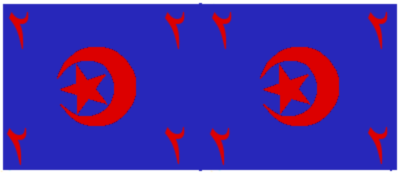
Another flag for the unit has been reconstructed here.
History of the White Bashkir Units
For some more information about the Bashkirs, see here.