
Uniforms of the Bashkir Units of the Russian Far East, 1920
All material and reconstructions are by A. Karevskiy.
Order No. 543 of the Commander-in-Chief of all Armed Forces and Field Ataman of all Cossack Units,
11 August 1920, Chita
In addition to my Order No. 154 of 12 February this year, I hereby announce the new uniform I have established for the Bashkir units, with the meaning of the colours: green – common to all Muslims, and blue – the national colour of the Bashkirs, as applied to the former uniform of the Bashkir Army of 1862.
Names of items of clothing for officers and soldiers (dzhigit):
Papakha: (dress). Low, black, modelled on the former Bashkir cap with a blue top and piping along the seams, with green braid for dzhigits and silver braid for officers, respectively; everyday cap – any colour.
Description: orders according to V.V. 1920 No. 433.
Tunic: (beshmet) made of dark blue cloth in the style of a Caucasian beshmet with braid around the collar (upper and lower), the opening and the lower hem, and the lower edge of the sleeves and its slits. For dzhigits the braid is in green wool, as wide as that used on the shoulder strap [rank markings]: for officers in silver braid with a blue stripe. On the chest there are cartridge pockets for 15 cartridges on each side, like on a cherkeska, trimmed along the upper and lower edges with the same braid. The beshmet reaches to the knees.
Tunic: (everyday). The same beshmet of any colour cloth, without piping (it may be piped it with thin black cord in the style of cherkeska), with an opening in the sleeves and collar for NCOs and sergeant-majors. The edges are trimmed with standard silver braid.
Blouse: (field). Description: according to order No. 218 of 1920, with the following changes: upright collar, cartridge pockets on the chest for 15 cartridges on each side, cuffs trimmed with green braid.
Greatcoat: standard model with green button tabs. Description: Order No. 305 of 1892, No. 621 of 1907, No. 518 of 1909.
Trousers: standard Cossack type. Description: order No. 51 of 1909 with the following changes. The outer side seams are trimmed with green cloth for dzhigits and silver braid for officers. For everyday wear, green trim is permitted instead of metal.
Kushak [belt]: green weave for Cossacks (silk for officers). For everyday Caucasian-style uniforms, any style. Description: Order No. 31 of 1881 and No. 72 of 1881.
Shoulder-boards: attached to the field blouse. Description: as per order No. 218 of 1912, but with the following additions: green piping, a stenciled crescent moon with a star and the Arabic letter "B" in yellow paint for the dzhigits. Officers have green piping, blue stripes, a crescent moon with star and capital Arabic letter "B" embroidered in yellow silk. The dress dzhigits' uniform has dark blue cloth with green piping, with a stenciled crescent moon and star and the capital Arabic letter "B" under the sign in yellow paint. Officers have silver braid with blue stripes and green piping, a crescent moon with a star and the capital Arabic letter "B" under the sign, embroidered in gold. NCOs have green braid rank stripes. Sergeant-majors have a silver braid [cross] stripe.
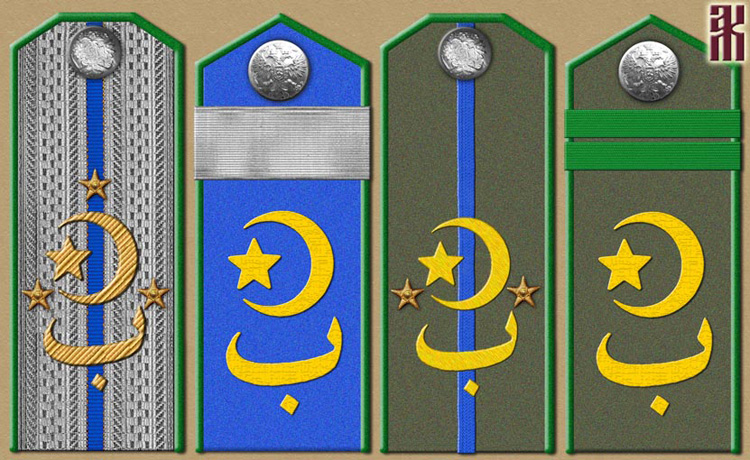
Shoulder-boards of the Bashkir units of the Russian Far East:
1 – lieutenant, parade and everyday, embroidered in gold;
2 – sergeant-major, parade and everyday, other NCOs have green braid;
3 – second-lieutenant field uniform, embroidered with silk;
4 – corporal field uniform
Sword: (Asiatic). Description: order No. 363 of 1903, based on order No. 37 of 1883.
Bashlyk: Asiatic.
Sword belt: Caucasian.
Note: a) a burka is part of the parade uniform. A description of the cherkeska will be announced later; b) the national headdress "tyubeteyka" is permitted with the parade uniform,.
Lieutenant-General Ataman Semenov
Originally published atvk.com/wall-64201306?own=1&offset=40, then republished: at siberia.forum24.ru/?1-8-0-00000046-000-0-0-1418934484.
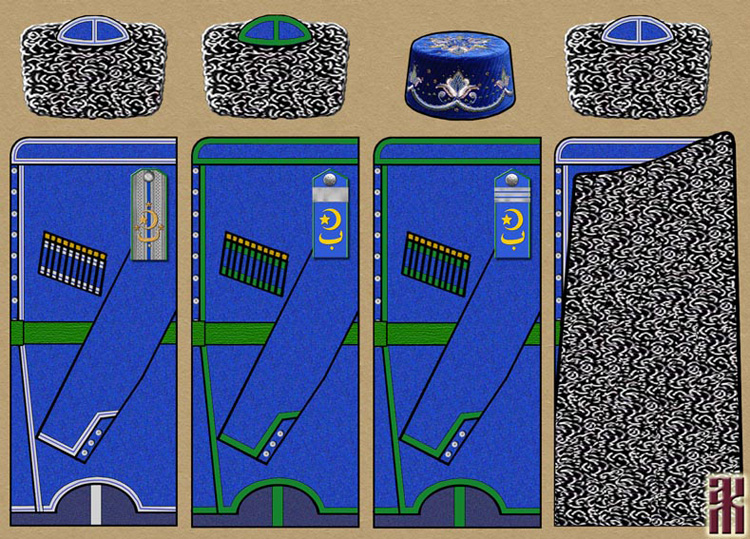
Parade uniforms of the Bashkir units of the Russian Far East
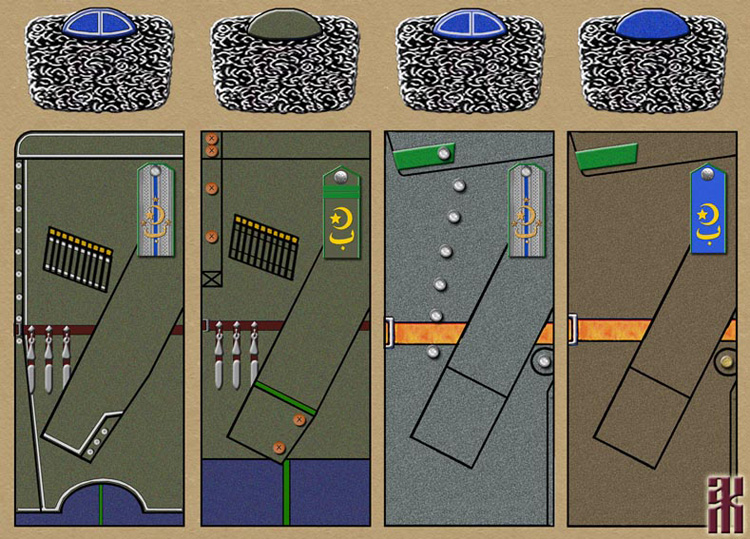
Everyday and field uniforms of the Bashkir units of the Russian Far East
Home — State Symbols — Flags — Uniforms — Badges & Medals — Money — Other
Pygmy Wars Notes
The original for this page is at kolchakiya.ru/uniformology/bashkir_formations_1920.htm.
These units were formed from the men who fought in the Bashkir units for Kolchak.
Discussion on the translation choices I have made can be found here.