
Banners of National Formations in Kolchak's Russian Army
All material and reconstructions by A. Karevskiy, unless otherwise noted.
Taras Shevchenko Regiment
On 14 October the Chelyabinsk Ukrainian Rada consecrated and presented a magnificent banner of Taras Shevchenko.
"Siberian Herald", 17 October 1918 at siberia.forum24.ru/?1-4-0-00000027-000-0-1-1392578799.
Buzuluk area, May 1919
Our command strained every effort to help the Western Army. ... Due to the shortage of time, the rear could not provide a single regiment at that time. So all the more or less combat-ready units were gathered and sent to the front. Among them was the 6th Corps and the "Taras Shevchenko Regiment", composed of Ukrainian separatists, with their yellow and blue banner and the Khokhol dialect as their command language. [1]
Sakharov, K. V. in "White Siberia: The Civil War of 1918-1920", Munich, 1920, p.90.
Kazakh Units and Armed Detachments of the Alash Orda
Three dozen Russian officers who were members of the Semipalatinsk underground organisation took part in the formation of the first armed detachments of the Alash Orda in the steppe in late spring-early summer 1918 as commanders and instructors. On 18 June 1918, after the Bolsheviks had fled, these detachments entered the town, about three hundred men under the command of I. A. Zubarev-Davydov. The next day Semipalatinsk became the residence of the Alash Orda. Their banners were adorned with the inscriptions "Long live the faithful sons of the Motherland!" and "Long live the All-Russian and Siberian Constituent Assembly!"
"Siberian Speech [newspaper]" at siberia.forum24.ru/?1-4-0-00000027-000-0-1-1392578799
At around 6 p.m. on 19 June the Alash Orda detachments arrived in Semipalatinsk. Three hundred militiamen led by an officer welcomed the representative of the Provisional Siberian Government and the military authorities. During the meeting, Bukeikhanov arrived at the square. At the suggestion of Lieutenant-Colonel Tokhtamyshev, the horsemen shouted "Allahu Akbar!" in his honour Their white banners bore slogans in the Kyrgyz language: "Long live the loyal sons of the motherland!" and "Long live the All-Russian and Siberian Constituent Assembly!" [2]
Amanzholova, D. A. "Kazakhstani Autonomism and Russia", Moscow, 1994, p.44 (quoting "Siberian Speech" of 30 June 1918).
1st Carpathian-Russian Rifle Regiment
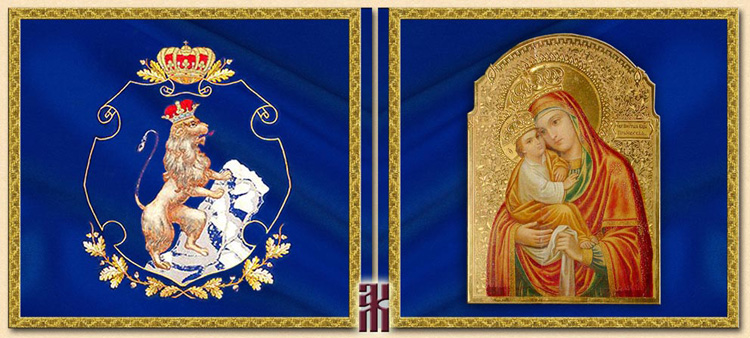
Reconstruction of the banner of the 1st Carpathian-Russian Rifle Regiment
The reconstruction is based on:
1) the banner of Galician Ruthenia, adopted by the Golovna Ruska Rada [Chief Rusyn Rada] on 18 May 1848. This was a self-governing body in the Rusyn part of the Austro-Hungarian Empire during the 1848 revolution; and
2) the banners of the Rusyn Guard units, the formation of which began at the call of the Golovna Ruska Rada on 20 September 1848. These were to have an image of a golden lion climbing a rock on a blue field on one side, and the patron saint of the town church on the other side.
http://tsdea.archives.gov.ua/ru/sections/flag/flag.php.
On 12 October a solemn send-off was held for an entire regiment of Carpathian-Russian volunteers to the front. The celebration began the day before, at the Central Committee of the Carpathian-Russians, where a meeting was held to attach the banner to the pole.
The banner of the Carpathian-Russians is very beautiful and artistically executed: on one side it depicts the icon of the Pochaiv Mother of God, patroness of the Carpathian-Russians, and on the other a lion storming a mountain – a symbol of the strength and fortitude of a people who fought tirelessly for six centuries for their independence from Germanism and Catholicism.
At noon on Sunday, after Mass in the cathedral, a procession left the church and proceeded to Senate Square, where the regiment of Carpathian-Russians had already formed a square. His Eminence Silvestr served a prayer service, during which the banner held by the kneeling regiment commander was consecrated and sprinkled with holy water.
"The Triumph of the Carpathian-Russians // Russkoe Delo, No. 8", Omsk, 14 October 1919 .
"The Russian Orthodox Church and the White Movement // White Guard, No. 10", Moscow, 2008, p.193.
The fate of the banner remains unknown to this day. According to one version, it was destroyed by the Carpathian-Russians themselves at the time of the regiment's disbandment. According to Moscow researcher V. Zh. Tsvetkov, the banner was captured by the enemy when one of the regiment's units surrendered, and may subsequently have been transferred to the Museum of the History of Religion and Atheism in Leningrad (where so-called "church images" were sent). There is no information about the banner going into exile.
http://wap.1918.borda.ru/?1-12-0-00000011-000-0-0.
2nd Bashkir Rifle Regiment of the Bashkir Corps
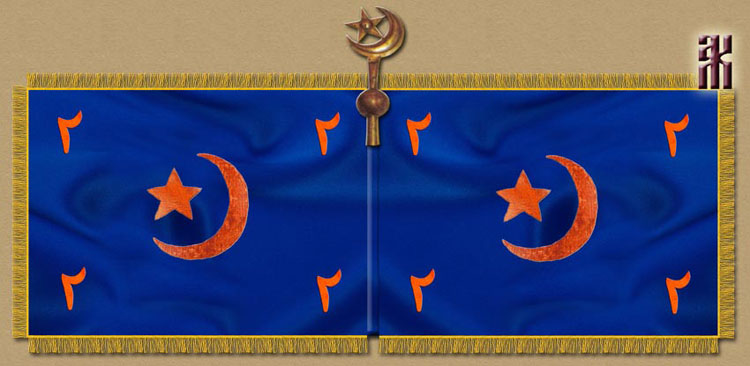
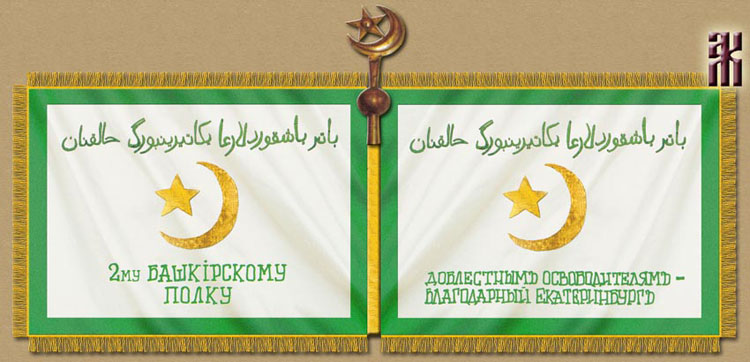
Both banners were made and presented on the initiative of the population of Ekaterinburg, which was liberated by the Siberian Army on 25 July 1918. They were ceremoniously presented to the 2nd Bashkir Rifle Regiment on 7 August 1918 in front of a large crowd of townspeople.
The regimental banner was made of blue silk, with a red crescent and a red five-pointed star in the centre of the cloth; the Arabic number "2" was applied to the four corners of the banner.
The honorary gift banner was made of white silk with a green border, depicting a gold-embroidered crescent moon with a five-pointed star. On the front at the top, was an inscription in Bashkir Arabic script: "Brave Bashkirs – Ekaterinburg people", and at the bottom was an inscription in Russian: "To the valiant liberators – grateful Ekaterinburg". On the reverse the inscription at the top was identical to the front, and at the bottom was the inscription "To the 2nd Bashkir Regiment".
The banners were attached to poles crowned with a crescent moon and five-pointed star especially cast in silver.
Shayakhmetov, I. O. in "Military-historical reconstruction of the uniforms and symbols of the Bashkir troops of 1917-19. // Vatandash, No. 8", Ufa, 2007, at www.vatandash.ru/index.php?article=1477.
Home — State Symbols — Flags — Uniforms — Badges & Medals — Money — Other
Pygmy Wars Notes
The original of this page is at kolchakiya.ru/vexillology/national_flags.htm.
1) The White Russians generally did not regard Ukrainian as a separate language. The "Khokol dialect" meant that they were speaking Ukranian.
2) The Alash Orda were a Kazakh group aiming for self-rule, so I'm not sure why the banner would be in Kyrgyz. However the Russians of the time were not very precise in distinguishing the various ethnic groups.