
Uniforms of the 7th Urals Mountain Rifle Division
This reconstruction is based on research conducted by the Ekaterinburg Military History Club "Mountain Shield" and uniform schemes created by K. Novikov, published at bergenschild.ru.
The available photographs of the division's officers, as well as a more careful reading of sources relating to the period of the division's formation in the summer and autumn of 1918, allow for significant additions to be made.
The reconstruction of the shoulder-boards of the rifle regiments, as well as the artillery divizion and engineer company, was carried out on the basis of Order No. 11 of the Siberian Army dated 10 September 1918, which stated, in particular, the following:
The commander of the army has ordered that in cases where officers, doctors, officials and riflemen are unable to obtain khaki-coloured shoulder-boards, they are permitted to wear braided or arm of service coloured shoulder-boards instead.
RGVA F.39512 Op.1 D.58 L.77.
Order No. 10 of the Military Department of the Provisional Siberian Government, dated 24 July 1918, announced the description of sleeve insignia to distinguish between the ranks of officers and soldiers of the army of the Provisional Siberian Government. The colour of the insignia for rifle regiments was specified as raspberry, and for artillery and engineer units as black with red piping; with gold and silver metal respectively.
RGVA F. 39597 Op.1 D.12 L.25-25ob.
Uniforms which have been preserved from the period show coloured cloth stripes in the arm of service colour, as established by Order No. 12 of the Military Department of the Provisional Siberian Government dated 27 July 1918:
Cotton and cloth campaign blouses are to have [lace] on the chest opening, from the edge of the collar along the lapel to the end of the opening, along the outer edge of the slit
Greatcoats are to have it along the upper edge of their cuffs.
The cloth strip should be a ¼ vershok wide, with the outer edge folded inward on the blouse, and a ¼ vershok wide without folding on the overcoat.
Raspberry is to be used for riflemen, and other arm in the colour of the sleeve insignia, temporarily red.
Officer's tunic and "French" style coats are to have similar strips placed on the sleeves (as on the greatcoat).
RGVA F.39597 Op.1 D.12 L.27.
The shoulder-boards of the rifle regiments, artillery divizion and engineer company have been reconstructed on the basis of the above information.
Reconstructions by A. Karevskiy
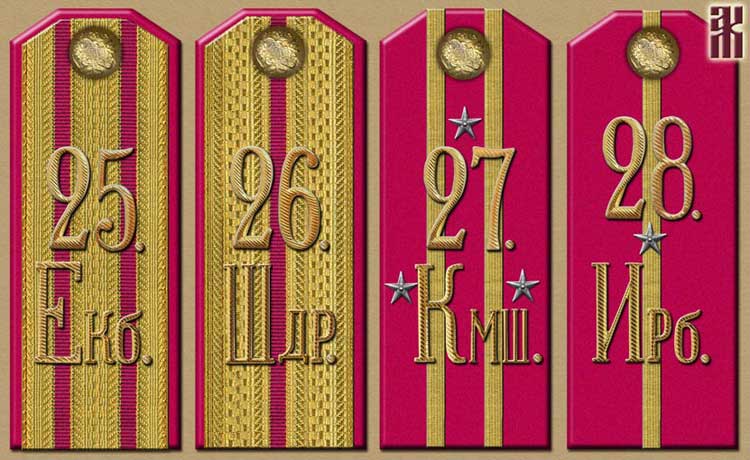
Lace and cloth coloured shoulder-boards of officers of the Mountain Rifle Regiments:
1 – 25th Ekaterinburg; 2 – 26th Shadrinsk; 3 –27th Kamyshlov-Orovay; 4 – 28th Irbit-Pernovsk
K. Novikov's reconstruction has white stripes shown on the raspberry shoulder-boards, but our reconstruction is based on the assumption that they were made of lace metal (i.e. gold).
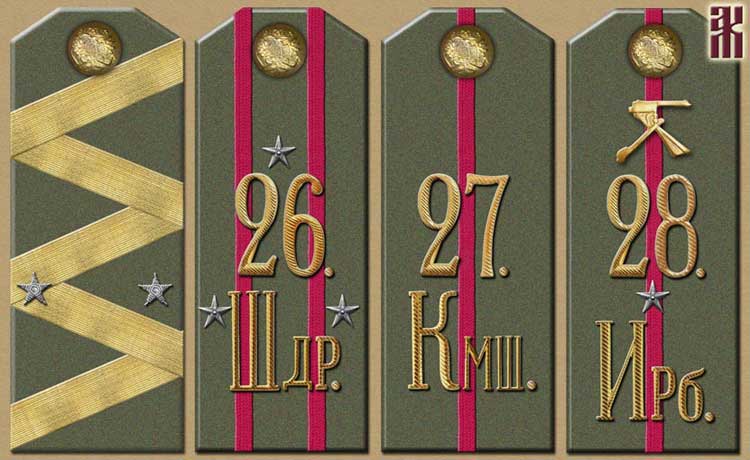
Khaki shoulder-boards for the rifle regiments of the 7th Urals Mountain Rifle Division:
1 – major-general; 2 – lieutenant-colonel; 3 – sub-ensign; 4 – ensign, machine-gun komand
The reconstruction for the major-general is based on a famous photograph of Major-General V. V. Golitsyn.
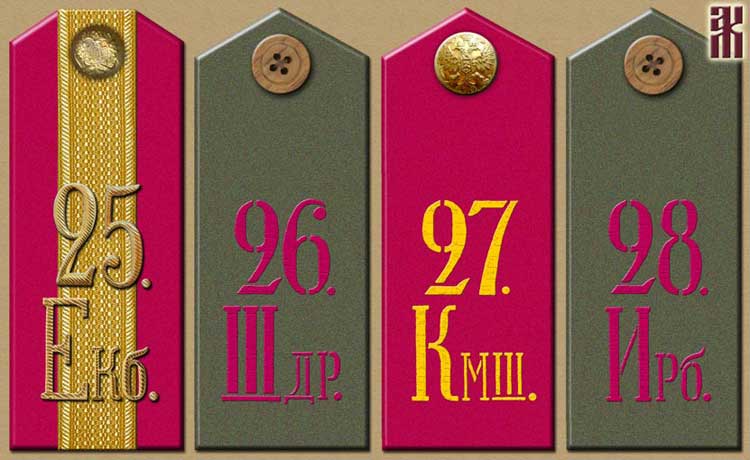
Coloured and khaki shoulder-boards of a sub-ensign and privates of the 25th Ekaterinburg,
26th Shadrinsk, 27th Kamyshlov-Orovay and 28th Irbit-Pernovsk Mountain Rifle Regiments
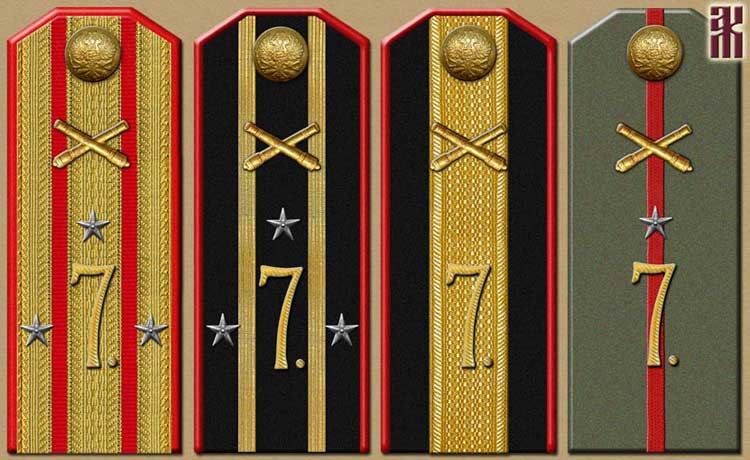
Shoulder-boards of officers of the 7th Urals Mountain Rifle Artillery Divizion :
1 – standard braid shoulder-board of an artillery lieutenant-colonel;
2 – artillery lieutenant-colonel based on the Siberian Army's 1918 system;
3 – sub-ensign in the same system; 4 – khaki shoulder-board for an artillery ensign
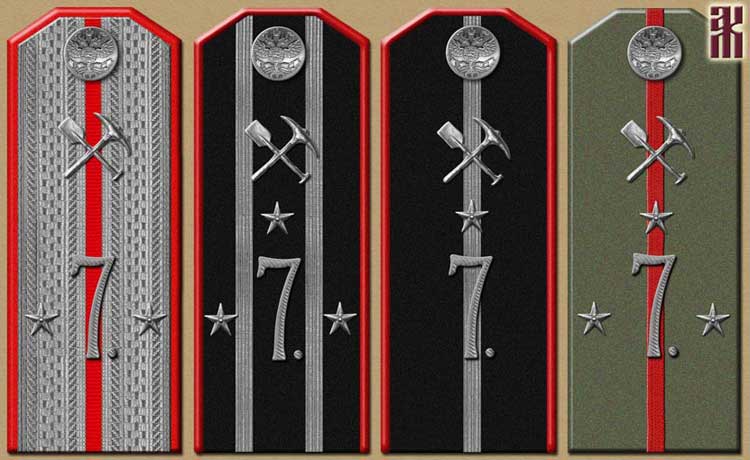
Shoulder-boards of officers of the engineer company of the 7th Urals Mountain Rifle Division:
1 – standard braid shoulder-board of a second-lieutenant in the engineers;
2 – lieutenant in the engineers, based on the Siberian Army's 1918 system;
3 – ensign of engineers, in the same system; 4 – khaki version for an engineer lieutenant
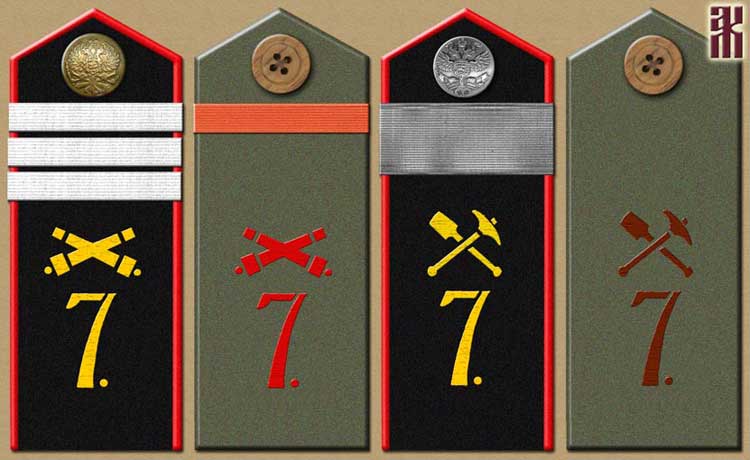
Shoulder-boards of other ranks of the 7th Urals Mountain Rifles Artillery Divizion
and Engineer Company of the 7th Urals Mountain Rifles Division
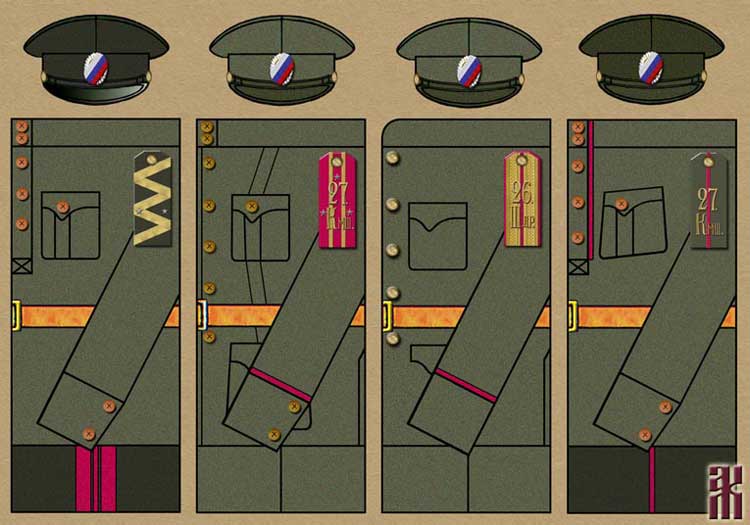
Uniform of officers of the rifle regiments of the 7th Urals Mountain Rifle Division
The reconstruction for the major-general is based on a famous photograph of Major-General V. V. Golitsyn.
The cockades are shown with overlaid ribbons of the national colours, which was established by Order No. 7 of the Supreme Commander-in-Chief on 2 October 1918 and which subsequently became widespread in the Russian Army, especially in the Western Army (later the 3rd Army of the Eastern Front)
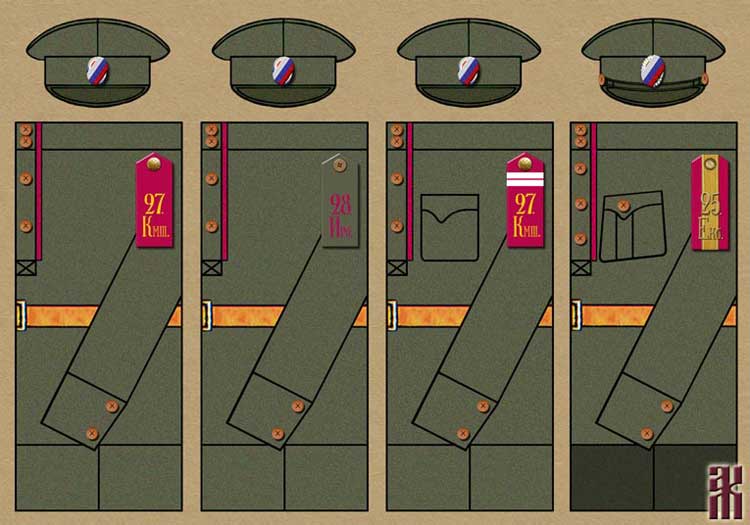
Uniforms of other ranks of the rifle regiments of the 7th Urals Mountain Rifle Division
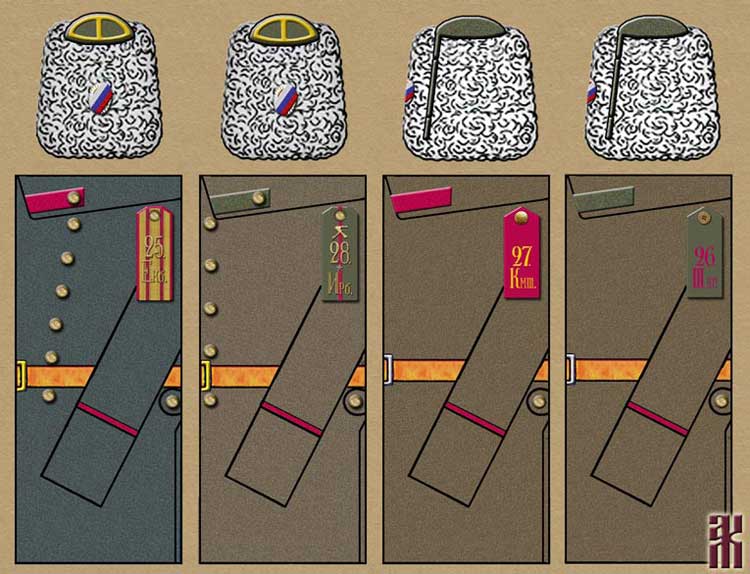
Winter uniforms of the rifle regiments of the 7th Urals Mountain Rifle Division
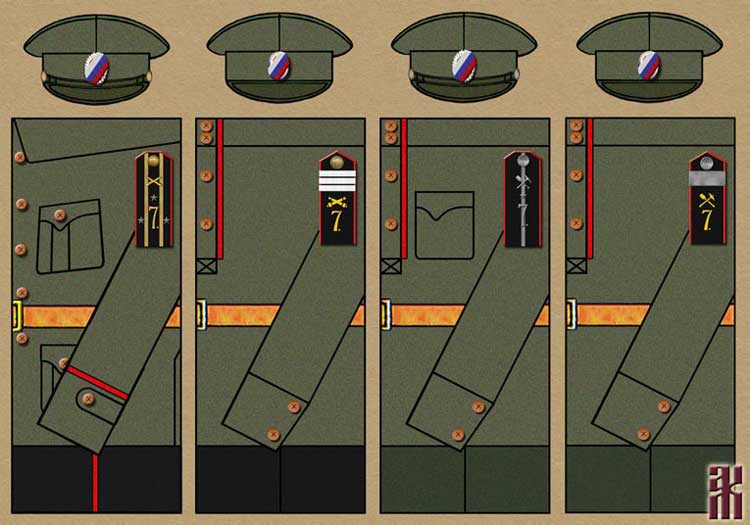
Uniforms of the 7th Urals Mountain Rifle Artillery Divizion and Engineer Company
of the 7th Urals Mountain Rifles Division.
Home — State Symbols — Flags — Uniforms — Badges & Medals — Money — Other
Pygmy Wars Notes
The original for this page is at kolchakiya.ru/uniformology/7_Ural_div.htm.
The bergenschild.ru site no longer exists, but the schemes for this division can be seen here in pdf form.
The 25th Ekaterinburg Mountain Rifle Regiment was in this division. Later it would be named in honour of Admiral Kolchak and be given different uniforms.
For a while the 1st Ural Hussar Regiment acted as the cavalry divizion for this Division. Its uniforms can be found here.
Discussion on the translation choices I have made can be found here.
Flags
The 27th and 28th Regiments received old Imperial Rifle Regiment banners, see here. Printable versions are shown:
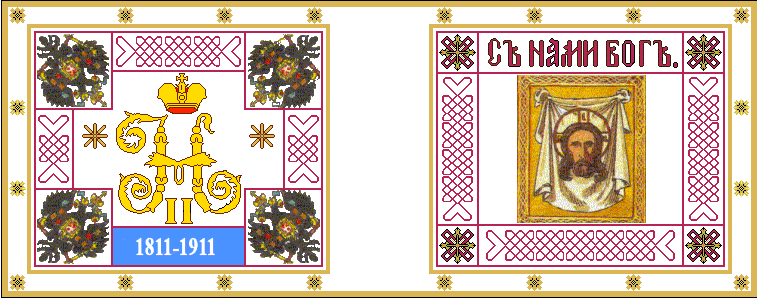
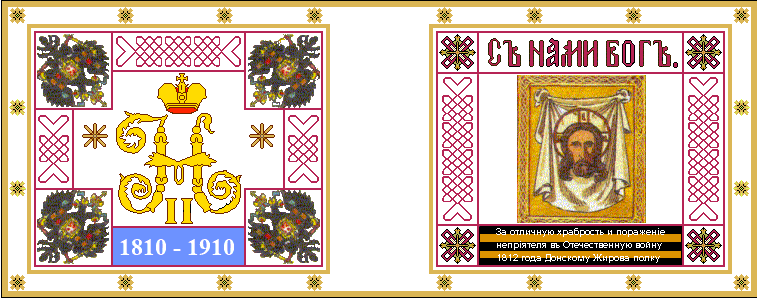
The banner of the 25th Regiment, also an old Imperial one, but a St. George not a Nikolai, can be seen here.
History of the 7th Ural Mountain Rifle Division
This is largely taken from here.
Formed in August 1918 in Ekaterinburg from volunteer units of the first days of the anti-Bolshevik uprising as the 2nd Ural Rifle Division, with the 5th to People's Regiments, but soon afterwards it was renamed the 7th Ural Mountain Rifle Division and the regiments given new numbers: the 25th Ekaterinburg, 26th Shadrinsk (or Verkhisetsky), 27th Kamyshlov (Kamyshlov-Orovay), 28th Krasnoufimsk (Irbit-Pernovsk Grenadier) Mountain Rifle Regiments and the 7th Ural Mountain Rifle Artillery Divizion. The double names of the regiments are explained by the fact that these regiments carried the banners of the old regiments of the Imperial Army. The 25th was later named for the Supreme Ruler Admiral Kolchak.
By the end of October 1918 the division had 21 combat-ready companies, with just over 2,000 men. Later a Jaeger Battalion was added (in December 1919 numbering 750 bayonets).
The division was considered the best of the Ural units. It was sent to the front in late autumn-winter 1918 near Kushva, taking part in the spring offensive. It was then moved to the Kungar area. It lost half its strength in January 1919 in the fighting around Osa.
In February 1919 it joined the 3rd Ural Mountain Rifle Corps, with whom it took part in the Spring offensive, capturing Ufa. The continuous fighting took a heavy toll on the best volunteer fighters, and the replacement conscripts meant it lost much of its volunteer spirit, but it remained one of the better units in Kolchak's army.
It appears the 25th "Admiral Kolckak" Regiment was reformed in about July 1919, absorbing the remnants of the Siberian Shock Corps as reinforcements.
It was tasked with covering the retreat of units of the 3rd Army into the Shcheglovsk taiga. The division was almost entirely wiped out near the village of Dmitrievskaya in the taiga on 25 December 1919. Most of the survivors surrendered a week later, though a few made it to Mongolia.