
Uniforms of the Yakut People's Army and the Siberian Volunteer Militia
(Yakut uprising of 1921-23)
All material and reconstructions are by A. Karevskiy unless noted otherwise.
The People's Army consisted of the Northern Volunteer Group, commanded by Oshiverskiy, which arrived from Okhotsk; the Lensk Volunteer Detachment, and the Left Bank Vanguard Group. The Northern Volunteer Group consisted of three companies with a total of up to 300 mounted fighters. The commander of the 1st Company was Second Lieutenant Protasov, and the commander of the 2nd Company was Lieutenant Semenov. The Left Bank Vanguard Group consisted of 320 mounted fighters and was led by N. F. Dmitriev. The Lensk Volunteer Detachment consisted of 440 fighters led by Ensign Kharkov, with A. Ryazanskiy as chief of staff. The detachment included three small units:
Unit 1 – 200 mounted fighters under the command of Lebedev;
Unit 2 – 180 cavalrymen under the command of Kharlampiev;
Unit 3 – 80 cavalrymen under the command of Ensign A. Ryazansky.
In total, the People's Army operating around Yakutsk numbered 1,000-1,200 soldiers. The Northern Anti-Bolshevik Detachment, operating in the Verkhoyansk and Kolyma districts, had 100-200 men. In the Vilyuy district, there were about 300 soldiers in six partisan detachments, which merged into one "Southern Anti-Bolshevik Detachment" under the command of P. T. Pavlov. All the anti-Bolshevik detachments had good communications with each other, and although the officers of the Northern Anti-Bolshevik detachment did not recognise the Provisional Yakut Region People's Administration, they did maintain communication with Okhotsk. They had two infirmaries, where two doctors and seven nurses treated the wounded. The People's Army consisted of 25 Russian officers and a total of 80 Russians.
They were armed with three-line rifles, their main weaponry being hunting rifles with 30 rounds of ammunition per soldier, and four light machine guns (three Chauchats and one Colt). The officers wore military uniforms, while the ordinary rebels had shoulder-boards with company numbers and insignia on their sleeves.
14mp.ru/i-interesnaya-yakutiya/istoriya-yakutii/yakutskaya-narodnaya-armiya.html [link dead]
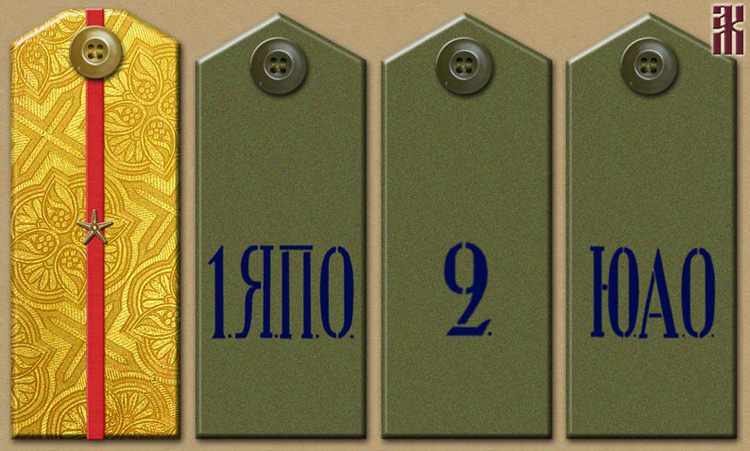
Shoulder-boards of the Yakut People's Army:
1 – ensign's shoulder-board, cut from church vestments;
2 – private of the 1st Yakut Partisan Detachment of the Lensk Volunteer Detachment;
3 – private in the 2nd Company of the Northern Volunteer Group;
4 – private in the Southern Anti-Bolshevik Detachment
Yakut Campaign
The following units were formed: three rifle battalions, an independent cavalry divizion, an independent battery, an independent sapper platoon, and a training company.
Upon arrival in Ayan, a quartermaster's office was formed. Lieutenant-Colonel Maltsev was appointed quartermaster. In the village of Nelkan, the positions of supply chief and rear chief were established, to which Colonel Shnaperman was appointed, with the rights of assistant commander of the detachment for economic affairs. A. G. Sobolev was appointed his assistant for supplies.
The militia was supplied in Vladivostok with food for 4-5 months, winter clothing (sheepskin coats, felt boots and papakhi) for only 400 people, and summer clothing for the entire militia.
Vishnevskiy, E. K. in "Argonauts of the White Dream: Description of the Yakut Campaign of the Siberian Volunteer Corps", Harbin, 1933, at lib.rus.ec/b/232061/read#t26

Shoulder-boards and insignia of the Siberian Volunteer Militia
Three well-known photographs of the Pepelyaev detachment, published in the Yakutia Atlas, show all ranks wearing shoulder-boards, with some clearly distinguished by white piping, white stripes for officers and white bars for NCOs. Given Pepelyaev's initial desire to abolish shoulder-boards altogether and their subsequent preservation under pressure from his colleagues, it is logical to assume that only khaki versions were used in the Militia.
The same applies to cockades: according to the literature, they were replaced with white and green ribbons after the start of the expedition, but in the photographs taken in Ayan in the autumn of 1922, the cockades on the caps are clearly distinguishable with their characteristic oval shape. Presumably,Pepelyaev had to compromise there as well, returning to the version with an added white-green ribbon.
A white-green arm-band with a militia cross was presumably a distinctive symbol of the 3rd Battalion of the Militia, formed from the remnants of the Yakut rebel detachments. The cross was made using appliqué technique, and the cipher was drawn with a chemical pencil. The original arm-band is kept in the Museum of Anti-Bolshevik Resistance in Podolsk.
"Yakutia: A Historical and Cultural Atlas", Moscow, 2007, pp.357-368.
natpopova.livejournal.com/353326.html?page=1.
The plan was to land on the coast of the Sea of Okhotsk, capture Yakutsk, unite the forces of the rebels, capture Irkutsk, form a Provisional Siberian Government there, and prepare for elections to the Constituent Assembly. Taking into account the mood of the Yakuts and Siberians in general, Pepelyaev decided to march not under the white-blue-red Russian flag, but under the white-green Siberian flag, the flag of the Siberian Autonomy that existed in 1918. The detachment, called the "Militia of the Tatary Strait", was armed with 1,400 rifles of various models, two machine guns, 175,000 rounds of ammunition, and 9,800 hand grenades. Warm uniforms were obtained in Vladivostok, some of which were purchased by representatives of the Yakut authorities. The core of the detachment was the 1st Siberian Rifle Regiment under the command of Major-General Evgeny Vishnevskiy. Many Siberian volunteers, both officers and riflemen, joined the detachment: 493 people from Primor'e and 227 from Harbin. Three rifle battalions, an independent cavalry divizion, an independent battery, an independent sapper platoon and a training company were formed. The battalions and companies were commanded by colonels and lieutenant-colonels who were as young as their commander.
Muzrukov, E. in "The Battle for Yakutia" at topwar.ru/29299-bitva-za-yakutiyu.html

1 and 2 – officers of the Siberian Volunteer Militia;
3 – Yakut rebel in national dress with an arm-band;
4 – officer of the Yakut People's Army
Figure 4 is dressed in a Yakut fur kukulka and ushanka fur hat purchased on the coast.
Siberian Volunteer Militia
Korobeinikov and his staff coordinated the actions of individual detachments led by White officers. Yakut commanders were given officer ranks. The son of the Amga Toyon, Afanasy Ryazansky, promoted by Korobeinikov to ensign, made himself shoulder-boards from gold-embroidered church vestments. (p.49)
In order to unite the volunteers with an inspiring sense of equality, Pepelyaev wanted to abolish shoulder-boards, but the officers were outraged, and he had to back down. The protest was led by Colonel Arkady Seifulin. A nobleman, he somehow ended up on the German front as a private and, according to Pepelyaev, earned his colonel's rank with the blood of 27 wounds. For people like Seifulin, who worked hard to earn their daily bread in the cooperative workshops created by Pepelyaev, officer shoulder-boards remained the only visible confirmation of their success in life. (p.78)
Half of the detachment received winter uniforms, but Pepelyaev was eager to sail to Ayan as soon as possible. He hoped to capture Yakutsk before the onset of the frost. (p.81)
In the uplifted atmosphere that usually accompanies the start of a voyage, an order was read out on the ships renaming the Northern Territory Militia the Siberian Volunteer Militia. After that, the cockades on the caps were replaced with white and green ribbons – the former distinction of the Siberian Army. (pp.85-86)
He wrote something else to Kulikovskiy: "The men are starving, lightly clothed and barefoot. They have a hundred pairs of felt boots, and have to wrap their feet in skins." (August 1922, Ayan, p.134)
Winter clothes arrived yesterday from Ayan and are now being distributed: mittens, warm underwear and fur hats are being handed out. The fur coats have not yet arrived. Once we receive everything, stock up on food, and Vishnevskiy arrives, we will move on. (September 1922, Ayan, letter from Pepelyaev to his wife, p.138)
Everyone felt loneliness and isolation. The new situation required new relationships between people, and in his order issued on New Year's Eve, Pepelyaev specifically stipulated that from 1 January 1923, "to strengthen unity", the militia should use the word "brother" before their rank when addressing each other – "brother-volunteer", "brother-colonel", "brother-general" ... The innovation quickly took root, although not all officers approved of it at first. (p.166)
Soon ... an unknown horseman arrived. "Tying his horse in the yard," Strod recalled, "he entered the yurt, took off his old, shabby, short reindeer coat. On his blouse were shoulder-boards with the letters "1.Ya.P.O." written in pencil, which stood for "1st Yakut Partisan Detachment". (p.175)
After talking to Baikalov on the phone, Strod sent Vychuzhanin from Amga with Nakha and an unwittingly captured a Pepelyaev soldier in a blouse with soldier's shoulder-boards, on which everything that is usually present in the form of stencils or embroidery was schoolboyishly drawn in pencil. (p.181)
Five men in clothes without shoulder-boards were sitting at the table. When asked which of them was Pepelyaev, a sixth man, whom the negotiators had not noticed at first, responded. ... He was wearing reindeer kamus (fur leggings) and a "knitted red jacket" that was clearly of domestic origin. (Defence of Sasyl-Sysy, p.214)
There were no shamans at the headquarters of the Siberian Militia, and Pepelyaev did not turn to them for predictions, as Ungern did to the Mongolian lamas. He knew barely a dozen Yakut words, did not attempt to introduce national symbols into his military uniforms or banners, had no idea about Yakut mythology, and did not refer to it in his manifestos. He disliked any ideological eccentricity. (p.228)
The NCO, mortally wounded in the temple, fell face down in the snow. ... Next to the Colt machine gun lay the huge, clumsy body of a Pepelyaev sergeant-major. (Defence of Sasyl-Sysy, note the presence of recognisable insignia on the uniforms), pp.241-242
Its garrison consisted mainly of officers. Many fought to the end and only in a hopeless situation raised their rifles with the butts pointing upwards. This signified their willingness to surrender. Attempts to deal roughly with them were suppressed, but three Red Army soldiers who had been captured, joined the Siberian Militia and did not manage to remove the white and green ribbon from their caps in time were killed on the spot. The ferocity of the battle was taken out on the unfortunate "traitors". (The capture of Amga by the Reds, p.265)
Yuzefovich, L. A. in "General A. N. Pepelyaev and Anarchist I. Ya. Strod in Yakutia, 1922-1923", Moscow, 2015.
Pepelyaev's men arriving from Harbin were housed in barracks set aside for them in Vtoraya Rechka, seven kilometres from Vladivostok. Pepelyaev's former comrades-in-arms from other places began to flock there, as did White Guards who had fled from the ranks of the Primor'e Army. Soon a detachment of 750 men, half of whom were officers, had gathered. According to the general's plan, such a large number of officers was needed for the future "people's army", which he dreamed of deploying from the kulaks who had rebelled against Soviet power. For the sake of secrecy, the detachment was formed under the guise of the Northern Region police.
The leader of the Siberian regionalists, the populist Sazonov, the "grandfather of the Siberian counter-revolution" – who had managed to establish close ties with the Japanese General, Fukuda – attempted to lead Pepelyaev's uprising, but the general rejected those efforts. Nevertheless, he made a concession to the regionalists, allowing them to organise an intelligence department to work among the population during the Yakut expedition. As a sign of ideological solidarity, the white and green banner was recognised as the symbol of Siberian autonomy. Pepelyaev, in turn, ordered his detachment to wear white and green ribbons instead of cockades. And he clearly expressed his regional aspirations for Siberia in his orders to the personnel before sailing to Yakutia.
At the beginning of the formation of the militia in Harbin and Vladivostok, Pepelyaev proposed abolishing shoulder-boards. He thought this would achieve the appearance of democracy and distinguish the new army from the old one. But the majority of the officers were against that innovation and Pepelyaev had to reconcile himself to the shoulder-boards. Before the occupation of Amga, Pepelyaev tried to "democratise" his militia from the other end. He issued a lengthy order in which he declined the word "people" in all cases and ordered everyone to call each other "brothers", while not omitting their rank.
The White Guards formed the 3rd Independent Yakut Battalion in Ayan from the remnants of the ingloriously defunct "Yakut People's Army", consisting of about two hundred men. Under the leadership of several officers loyal to Pepelyaev, the battalion began intensive military training.
In the afternoon, an unknown armed horseman arrived. Tying his horse in the yard, he entered the yurt and took off his old, short reindeer coat with worn wool. He was wearing shoulder-boards on his blouse. The White was very surprised when he realised that there were Reds in the yurt. He said that he had been sent to the Amga district with a proclamation from Pepelyaev and was now returning.
Upon receiving that report, Vishnevskiy ordered his chains to quickly move forward, surround the yurts, and take the fighters prisoner. Ten minutes later, a hundred Whites approached the yurts. Some of them remained in the yard and began to examine the cargo in our wagons. Groups of ten men entered the yurts. There, they first threw wood into the stove and only then began to wake their prisoners.
The Red fighters stirred; the commanders woke up and rubbed their eyes in surprise:
"What the hell is this? Who are these people? Hey, they have shoulder-boards!"
They reached for their rifles, but it was too late.
"Drop your weapons, don't move! You are surrounded, and any resistance is futile! We won't hurt you. It's good that it all ended without bloodshed. Let's have a smoke, we have Harbin tobacco, top quality. Would you like some?"
The door creaked, and a colonel entered the yurt, along with a rush of cold air. The conversations stopped. Glancing quickly around the interior of the yurt and pausing for a few seconds to look at the prisoners, the colonel addressed his subordinates:
"Brothers! Shooting has started on the right. Four of you stay here, and the rest of you go out into the yard."
Returning after pursuing the Whites, the first squadron made its way through the bushes and stumbled upon the motionless body of the colonel. At first, they thought he was dead. They came closer and looked closely – he was breathing. It turned out that the colonel was wounded and unconscious. They took him with them, brought him to the yurt and laid him in a corner on the hay. A few minutes later, a medic who had been freed asked the Red Army soldiers to bring the wounded man closer to the fire. They took off his coat, unbuttoned his tunic – his blouse was covered in blood.
The door to the yurt creaked open. Behind the cloud of frosty air that rushed in, it was impossible to see the person who had entered. He silently approached the stove and only then spoke:
"I'm frozen, let me warm up!"
They made room for him. The newcomer, who was very tall and powerfully built, was dressed in wide trousers and a grey cloth tunic. He wore neither a greatcoat nor a sheepskin coat. From the shoulder-boards on his tunic, it was easy to see that he was a sergeant-major.
Only in the yurt did the negotiators remove their blindfolds. At the table, they saw about five officers – obviously the staff.
"Which one of you is General Pepelyaev?" Volkov asked.
"I am", replied a tall, black-bearded man standing by the crackling stove.
He was wearing woollen trousers, reindeer skin boots, and a knitted red jacket without shoulder-boards.
The pre-dawn silence was broken by the warning rattle of our machine guns. The White trench responded with a fiery volley of gunfire. Then a cacophony of shots began. The men in sheepskin coats at the front fell, and others took their place. The forest edge threw wave after wave of new troops onto Lisya Polyana. Ignoring their losses and leaving the dead and wounded behind, the Whites pressed forward, spurred on and encouraged by their officers.
Strod, I. Ya. in "In the Yakut Taiga", Moscow, 1961 at libatriam.net/book/922068
Home — State Symbols — Flags — Uniforms — Badges & Medals — Money — Other
Pygmy Wars Notes
The original for this page is at kolchakiya.ru/uniformology/Yakut_revolt.htm.
Discussion on the translation choices I have made can be found here.
Flags
A banner is known for the volunteers, here.
History of Peplyaev's Expedition
Peplyaev's expedition with the Siberian Volunteer Militia was the last action by regular White forces in the Russian Civil War. A brief history of it can be found in Serebrenikov's history of last years of White forces in China, Mongolia and the Far East. He had intended to join forces with the Yakut rebel People's Army but arrived after it had been suppressed.