
Banners of Anti-Bolshevik Units in the Far East 1920-1922
All material and reconstructions by A. Karevskiy unless otherwise noted.
Priamur Zemsky Sobor
Presented to the Supreme Ruler of the Priamur Zemstvo Region, General Diterikhs, on 23 September 1922 in Nikolsk-Ussuriysk by the commander of the Votkinsk Artillery Battery, Colonel Almazov. Made by members of the battery's families on their own initiative.
It is a white silk rectangular cloth with narrow gold edging. On the right side is an image of the Saviour in a crown of thorns and the inscription "God is with us; on the left side is an image of the black imperial double-headed eagle and the inscription "For holy Russia". The pole is black. The finial is in the form of a slotted spear with a militia cross. Gold or silver cords with tassels were attached to the banner.
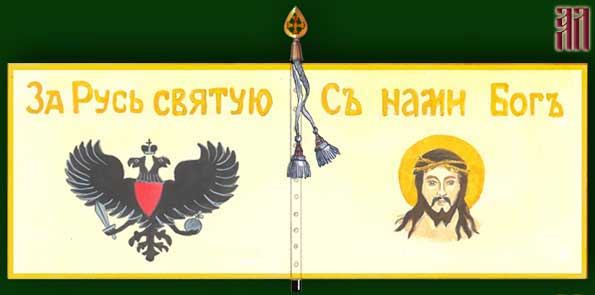
Drawing of the banner by A. V. Lebedeva
It served as the standard of the Priamur Zemstvo Army. It was taken into exile in Shanghai.
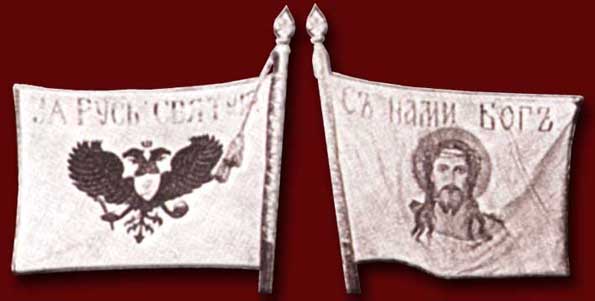
The photographs are taken from illustrations in "General Diterikhs"
"The Votkintsy: For the Ruler // The Russian Army, No. 181", Vladivostok, 4 October 1922. Published in "General Diterikhs", Moscow, 2004, pp. 467-468.
Prikama Rifle Regiment
This was a white silk rectangular cloth with narrow blue edging. On the front was embroidered an image of the Saviour and the inscription in Slavonic script "God is with us". On the reverse was an appliqué image of a St. George Cross medal on a bow made of St. George ribbon and an inscription in Slavonic script in three lines. The finial was brass, in the shape of a slotted spear.
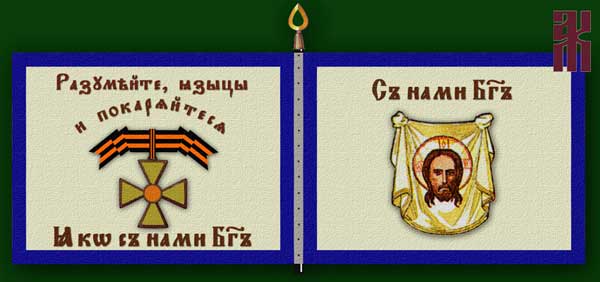
It was exhibited at the exhibition "History of the Russian Army: 15th-20th centuries" at the Moscow Regional Museum of Local History.
Independent Officer Company, named for General Kappel'
(attached to the Volga Rifle Brigade)
Embroidered by the wives of the company's officers. In April 1920 it was consecrated and presented in Chita to the company commander, Lieutenant Colonel Meybom, by the army commander, General Voitsekhovskiy.
It was a white silk banner embroidered with gold letters reading: "For Holy Russia" and below "Officer Company named for General Kappel". On the right side, in the upper corner, on a yellow field, there was an imperial double-headed eagle embroidered in black silver. In the centre of the banner was embroidered the insignia of the military order "For the Ice Campaign".
Meybom, F. F. in "The Thorny Path // Pervopokhodnik, No. 32", Los Angeles, 1976, p.11.
Flag of the Votkinsk Cavalry Divizion (1st Cavalry Regiment)
This was captured by the Reds from a wounded standard-bearer during the Khabarovsk campaign in the winter of 1921-1922, during a battle near Kazakevichev, but was immediately recaptured. It was carried on a cavalry lance.
Filimonov, B. B. in "White Rebels: The Khabarovsk Campaign: Winter 1921/22 // The Last Battles in the Far East", Moscow, 2005, p.212.
General A. N. Pepelyaev's Siberian Volunteer Brigade (1922-1923)
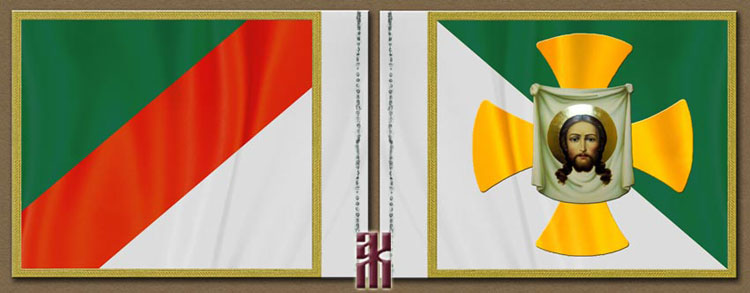
Reconstruction of the flag of Lieutenant-General Pepelyaev's Siberian Volunteer Corps during the Yakutsk Campaign (1922-1923), based on its description
This material was kindly provided by Votkinsk researcher S. K. Prostnev. He believes that the banner depicted a cross in the shape of a militia cross.
Greetings, Aleksei Anatol'evich,
In February we had a visit from Yakutsk local historian M. Teterin. He gave me General Pepelyaev's diaries from the Yakutsk landing of 1922-23, published in the journal Sibir No. 6, p.37, 1990. The publication was prepared by P. K. Konkin.
6 February ... The emblem of the Siberian National People's Revolutionary Army is a white and green flag on one side with a golden cross symbol, and a wide red stripe diagonally across the other: the revolution ends with an appeal to Christ, to the cross of the entire nation and cities of Siberia. ... This banner depicts a cross. It will remind us of our cross to bear, that we will not refuse to carry the cross of suffering for the good of the people. This banner depicts the face of our Saviour, Not Made by Human Hands. In difficult moments, we will pray to him. He will bless and strengthen us. ...
Brothers! volunteers! you saved this banner with your blood, the blood of your brothers who are invisibly present here. ... Brother volunteer Berezkin! I present you with the banner of the Siberian volunteer brigade, our sacred relic. Keep it safe and never give it to the enemy.
The diaries of General Pepelyaev, published in "Sibir, No. 6." 1990, p.37.
Address to the Red Army soldiers in the village of Nelkan. 1922.
Brothers of the Red Army! We and you are both Russian people. We equally cherish the interests of the Motherland and we are proud of its greatness. Those who you send to shoot the people will flee at the first sign of trouble. ... Those who join us before and during the battle will be given the right to join our ranks under the white and green banner of freedom.
Gubanov, P. P. in "Awakening", Moscow, 1990, p.237.
Initially the Provisional Amur Government, for various reasons, refused to send a special detachment to occupy the Yakutsk region. Then the Yakut delegates turned to the Soviet of Representatives of Siberian Organisations, which existed completely autonomously during the Merkulov government, but with Siberian rather than coastal issues in mind. The Soviet of Representatives of Siberian Organisations contacted General Pepelyaev, who was living in Harbin. He agreed to go undertake the campaign. It was decided that the detachment would be recruited exclusively from volunteers from the Siberian Army, and so subsequently the expedition set off under the Siberian white-green banner.
Vishnevskiy, E. K. in "Argonauts of the White Dream: the Yakutsk Campaign of the Siberian Volunteer Corps", Harbin, 1933, pp.15-16.
The symbolism of the white and green flag only partially expressed the purpose of his campaign, so the banner he designed for the Siberian Volunteer Corps differed from the canonical one. On it, also diagonally crossing the dividing line between "snow" and "taiga", stretched a wide red stripe – a symbol of the revolution, as interpreted by Pepelyaev. He did not consider the revolution to be evil, but viewed it as a temporary phenomenon, so on the other side of the banner was depicted an Orthodox cross and the face of Christ Not Made by Hands, as a sign that "the revolution ends with conversion to Christ".
Yuzhefovich, L. A. in "General A. N. Pepelyaev and anarchist I. Ya. Strod in Yakutia, 1922-1923", Moscow, 2015, p.113.
Capture of Amga.
The victory was important in a psychological sense, but what was much more valuable was that Amga could serve as a base for an attack on Yakutsk. Pepelyaev rushed there on 7 February, and the next day, at a solemn ceremony with the carrying out of the banner, he delivered a speech, which he had drafted the day before in his diary. ... The white and green banner became the focus of the speech. Now it was in Pepelyaev's hands, his arm clasping the pole. He proposed to make the banner a "symbol of brotherly unity", speaking of the image of Christ Not Made by Hands and the cross depicted on it, which reminds them of their "crossroads", of the fact that they did not refuse to "bear the cross of suffering for the good of the people".
The speech reached its climax: "Who knows what lies ahead? Perhaps this summer we will leave the Yakutsk region and become peaceful citizens. Then I will keep our banner and will wait for the time when it will fly again over the vast expanses of Siberia, then gather us all under its canopy once more. Perhaps we are destined to fight again, and then it will fly where the fighters are weary, where it will be difficult." And then an appeal to the standard-bearer: "Brother volunteer Berezkin! I hand you the banner of the Siberian Volunteer Corps, our common sacred treasure. Keep it safe and never give it to the enemy."
Yuzhefovich, L. A. in "General A. N. Pepelyaev and anarchist I. Ya. Strod in Yakutia, 1922-1923", Moscow, 2015, pp. 194-195.
End of February 1923.
To top it all off, the Siberian Militia lost its main symbol – a white and green banner with a red diagonal stripe, a cross and the image of Christ Not made by Human Hands. The standard-bearer Berezkin, to whom Pepelyaev had solemnly presented that sacred object in front of the ranks a month earlier, was killed during a night battle in the Elesin Basin, and the banner fell to Kurashov (Krasok).
Yuzhefovich, L. A. in "General A. N. Pepelyaev and anarchist I. Ya. Strod in Yakutia, 1922-1923", Moscow, 2015, p.283.
8th Kama "Admiral Kolchak" Rifle Regiment
Danilovka. 10 February 1922.
In the bushes near the village, we found meagre trophies left behind by the Whites. Two pairs of oxen harnessed to sleds, one sled carrying carcasses of meat, the other a large box with surgical instruments, sacks of flour, several cans of sugar sweets, cans of lard and a little sugar. We collected belts with pouches, cartridge belts, and several Remington rifles scattered in the village street. At one house was a white silk banner hung at the gate with the inscription: "1st Kama Regiment", with an image of the head of Jesus and crosses in the corners.
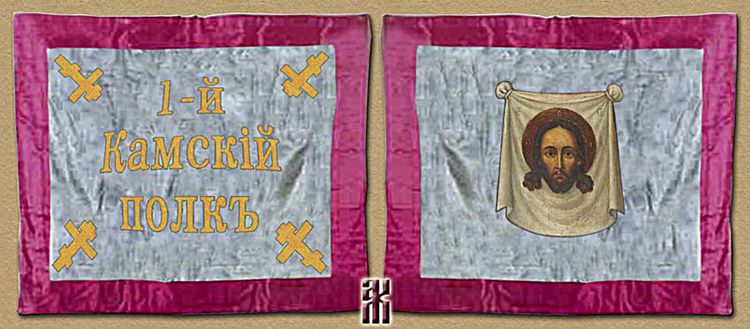
Reconstruction of the flag of the Kama Rifle Regiment
(raspberry was chosen because it is the colour for rifle units)
Leskov, M. in "Consolidating Positions and Building on Success // Taiga Expeditions", Khabarovsk, 1972, p.600. Quoted from siberia.forum24.ru/?1-4-0-00000027-000-10001-1
Banner of the Old Believers, July 1922
The Old Believers presented General Diterikhs with a banner embroidered with an eight-pointed cross and the inscriptions "In this sign you will conquer" and "God is with us", thereby blessing him in his struggle against the godless authorities.
Kutuzov, B. P. in "On the phenomenon of Old Belief" at http://iks2010.org/?p=16240
Ataman Semënov's Special Manchurian Detachment
From the appeal of the Military Revolutionary Headquarters of Verkhneudinsk. 12 January 1920.
Comrades! The followers of the satrap Semenov are free again, and the "yellow banner" – the emblem of the bayonet and the whip – is flying over the buildings of the city.
"The Struggle for Soviet Power in Buryat-Mongolia", Moscow, 1940, p.253. Quoted from: siberia.forum24.ru/?1-4-0-00000027-000-10001-1
It is interesting to note that the "special Manchurian detachment" had the slogan "All power to the Constituent Assembly" on its yellow banner.
Reichberg, G. in "On the history of the Japanese intervention // Marxist Historian, No. 2", 1934, p.91. Quoted from: siberia.forum24.ru/?1-4-0-00000027-000-10001-1
Home — State Symbols — Flags — Uniforms — Badges & Medals — Money — Other
Pygmy Wars Notes
The original of this page is at kolchakiya.ru/vexillology/far_east_zabaikal_flags.htm.
The Priamur Zemsky Sobor (the "Pri-" part means "beside") is also known as the Priamur Zemstvo Government and was a renaming of the Provisional Priamur Government. It was the last White controlled area of Russia, surviving around Vladivostok area until 1922. Its banner in the original Kolchakiya uses "styag", which presumably is a reference to the deliberately return to medieval terms of Diterikhs's government, down to calling the army a "host".