
Uniforms of the Independent Ural Army
All material and reconstructions are by A. Karevskiy unless noted otherwise.
The reconstructions used photographs published in:
"White Russia: Photo Album", Moscow, 2003.
"Cossacks of Russia in the White Movement // White Guard special issue", Moscow, 2005
gorynychforum.forum24.ru/?1-9-0-00000033-000-10001-0 and gorynychforum.forum24.ru/?1-16-150-00000347-000-10001-1 (History of the Ural (Yaik) Cossack Host and the Ural Region)
zema.su/album/uralskie-kazaki/8133#main
sammler.ru/index.php?showtopic=72800
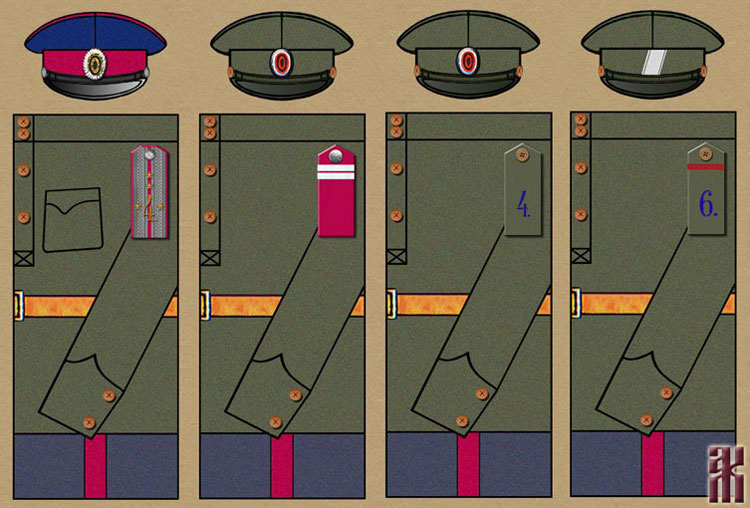
Uniforms of Cossack units in the Independent Ural Army
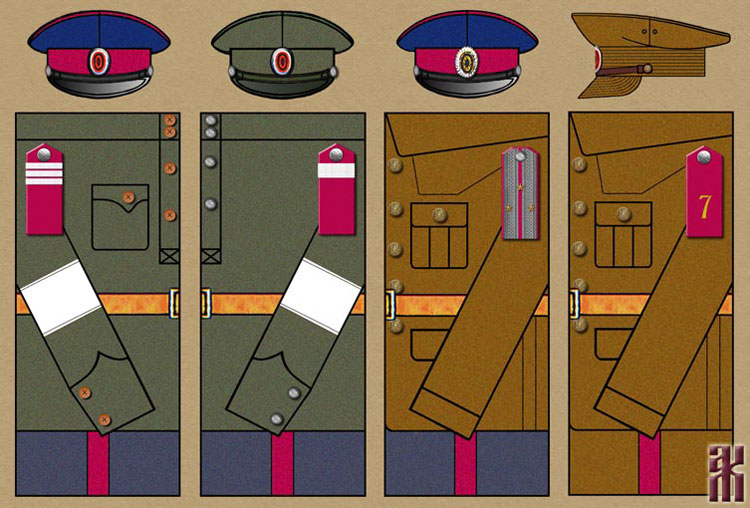
Uniforms of Cossack units in the Independent Ural Army:
1 – 1st Partisan Cavalry Regiment (based on Lieutenant Albin);
2 – units that took part in the Lbishchensk raid;
3 and 4 – with British uniforms
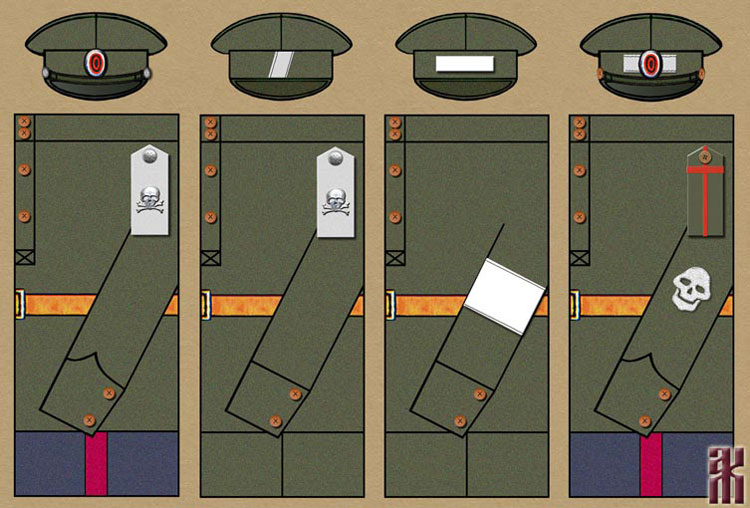
Uniforms of independent detachments of the Independent Ural Army:
1 and 2 – Steppe Partisan Detachment of the Astrakhan Region;
3 – Novouzensk Partisan Detachment (Pozdnyakov);
4 – Eryklinchev's partisan detachment
The Steppe Partisan Detachment of the Astrakhan Region included Cossacks and non-Cossacks (under Kozhin) and the Dergachevsk Horse Partisan Detachment (Reshetnikov).
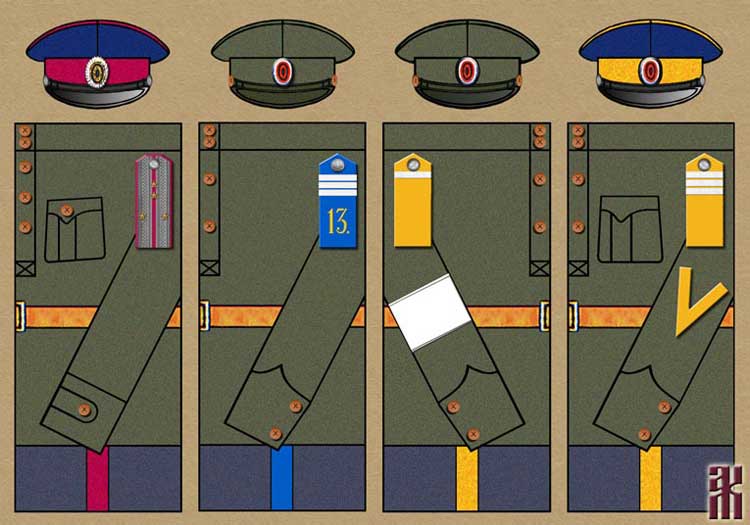
Uniforms of Cossack units in the Independent Ural Army:
1 – Urals Cossack Regiment; 2 – 13th Orenburg Cossack Regiment;
3 and 4 – Astrakhan Cossack Divizion
The 13th Orenburg Cossack Regiment and Astrakhan Cossack Divizion were part of the Independent Ural Army.
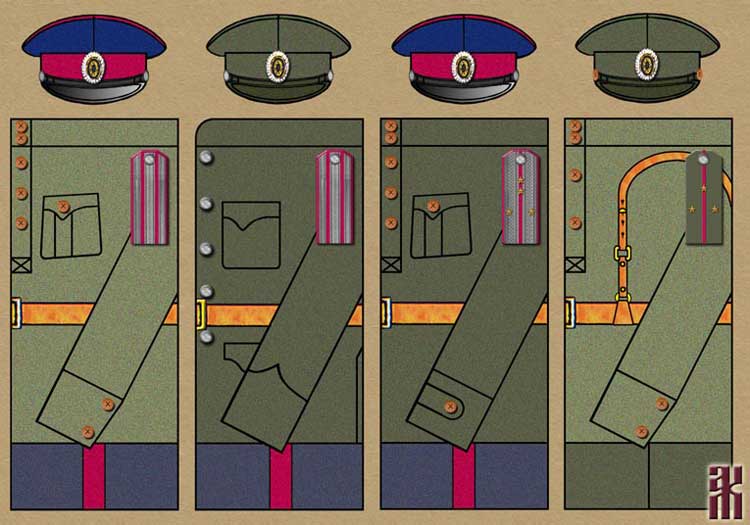
Uniforms of officers of Cossack units of the Independent Ural Army, based on photographs
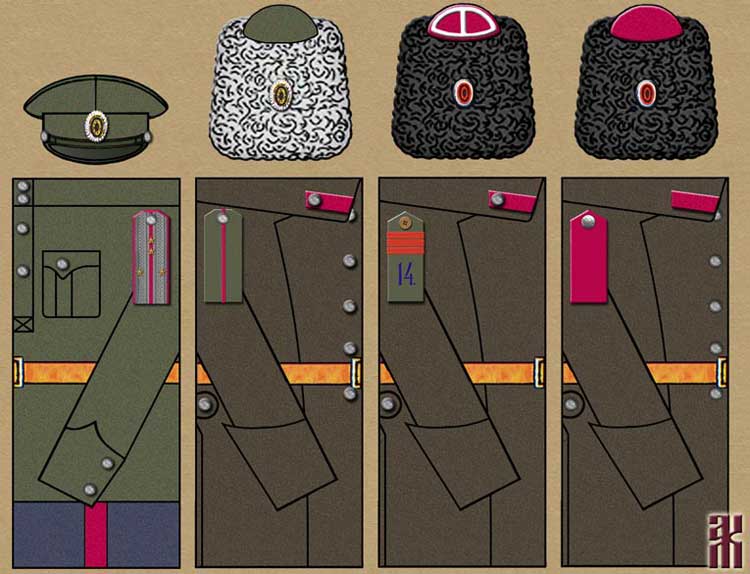
Uniforms of officers of Cossack units of the Independent Ural Army, based on photographs
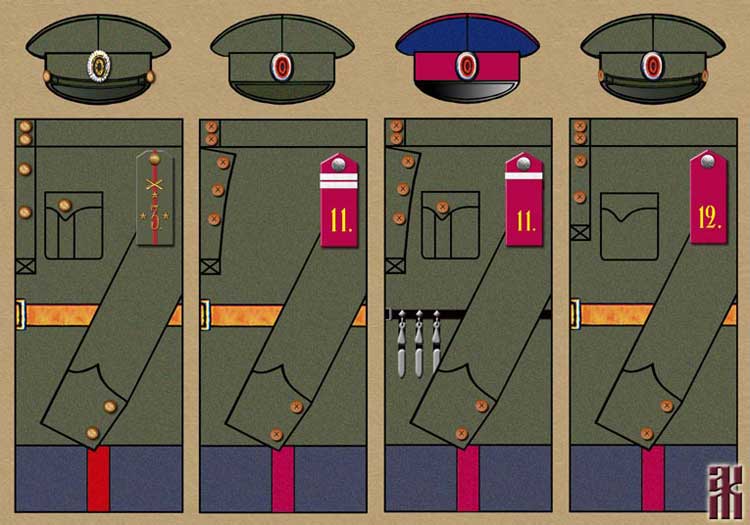
Uniforms of officers of Cossack units of the Independent Ural Army, based on photographs
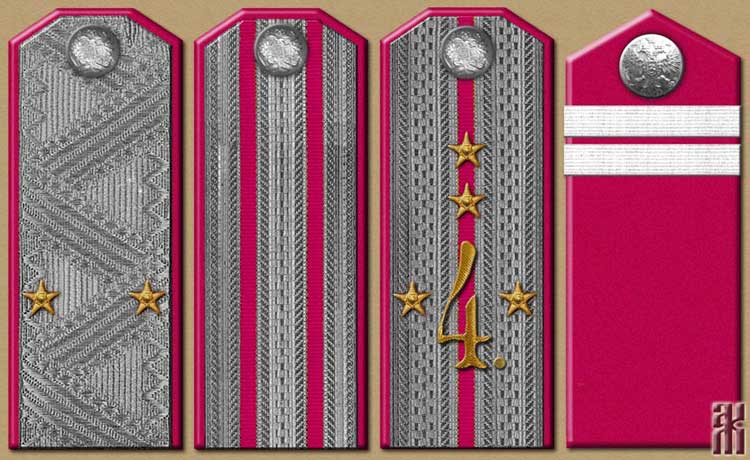
Coloured shoulder-boards of Cossack units of the Ural Cossack Host
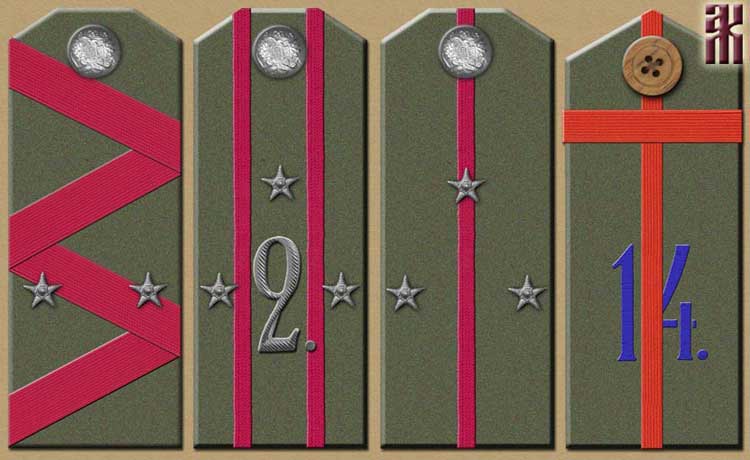
Khaki shoulder-boards of Cossack units of the Ural Cossack Host
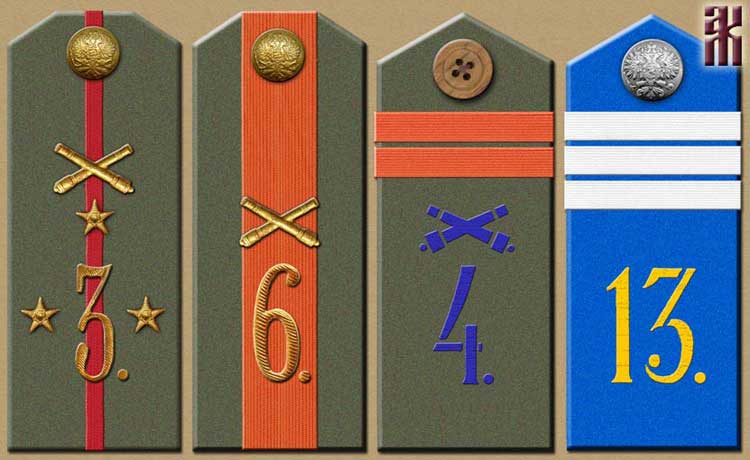
Khaki shoulder-boards of Cossack units of the Ural Cossack Army:
1, 2 and 3 – Ural Cossack Artillery; 4 – 13th Astrakhan Cossack Regiment
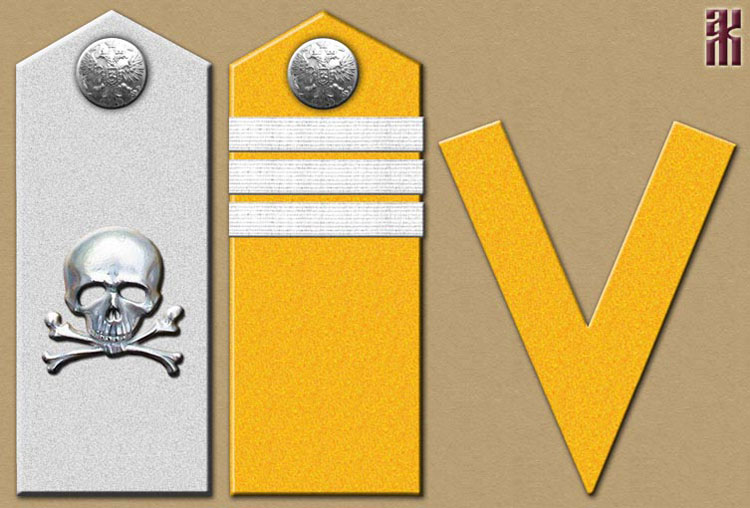
Insignia of independent units in the Independent Ural Army:
1 – shoulder-boards of the Astrakhan Province Steppe Partisan Detachment (Kozhin)
and the Dergachevsk Horse Partisan Detachment (Reshetnikov);
2 and 3 – shoulder-board and sleeve chevron of the Astrakhan Cossack Divizion
In Memoirs and Historiography
Material from the forum "History of the Ural (Yaik) Cossack Army and the Ural Region" on gorynychforum.forum24.ru can be viewed here.
December 1918
It became absolutely clear to all of us, the Cossacks of the 1st and 8th Ural Regiments, that we could not hold the front any longer, and, having gathered at the 1st Regiment's location for a general brigade meeting, we decided to go home to the Urals. On 25 December, having chosen me as commander, we left our position and set off for the Urals (26 December). Taking command of both the 1st and 8th Regiments, I made it a prerequisite to "move home with weapons in hand and in our former military uniform – with shoulder-boards and cockades", in which I was supported by all the officers of both Regiments.
Borodin, N. M. in "The beginning of the struggle of the Ural Cossacks against the Bolsheviks" at gorynych.gixx.ru/Gorynych/G2/g2-06.htm [link dead]
January 1919
The army was stripped bare. In winter, the Cossacks and officers were at the front in light soldier's greatcoats, torn boots, felt boots and sheepskin coats. Ten felt boots and sheepskin coats were sent per regiment. Once, while on a business trip to the city, I went to Colonel Setchikov to ask for warm clothes for the regiment and for myself. He replied that there was literally nothing in the warehouses. After the surrender of Uralsk, it turned out that the Reds had left behind quite large warehouses of clothing, footwear and warm clothes. But the quartermasters and almost all the army leaders had several chests of cloth and all kinds of material.
Kirov, B. N. in "On the Struggle against the Bolsheviks on the Front of the Ural Cossack Army // The Ural Cossacks in the Civil War: Memoirs of participants", Moscow, 2012, p.120.
Election of Ataman V. S. Tolstov, 11 March 1919
Finally, General Tolstov appeared on the balcony. Dressed in a grey soldier's fur coat, a black tall shaggy papakha, and khaki shoulder-boards. Tall, with a sharp gaze from his deep-set eyes, he involuntarily attracted everyone's attention.
Kirov, B. N. in "On the Struggle against the Bolsheviks on the Front of the Ural Cossack Army // The Ural Cossacks in the Civil War: Memoirs of participants", Moscow, 2012, p.137.
Clothing from prisoners
The Cossacks, under the command of the ensign, began to change into the Reds' clothes. That is, they took their good uniforms from them and distributed them to the Cossacks, while giving old and torn Cossack uniforms in return. Thus, the sotnia was dressed. After a while the group of prisoners was sent to the rear under escort.
Kirov, B. N. in "On the Struggle against the Bolsheviks on the Front of the Ural Cossack Army // The Ural Cossacks in the Civil War: Memoirs of participants", Moscow, 2012, p.162.
The storming of Uralsk on 11 May 1919
In order to distinguish the Cossacks from the Reds at night, each Cossack wore a white arm-band on his left arm.
Kirov, B. N.in "On the Struggle against the Bolsheviks on the Front of the Ural Cossack Army // The Ural Cossacks in the Civil War: Memoirs of participants", Moscow, 2012, p.165.
1st Partisan Regiment, Lbishchensk Raid, August 1918
In general, it was difficult to take stock of all the uniforms and equipment we captured in Lbishchensk. Everyone saw that after the battle of Lbishchensk, the Cossacks of the division's regiments were dressed "like grooms", and, in addition, each regiment had some reserve items.
Faddeev, P. A. in "Episodes from the battles on the Ural Front // The Ural Cossacks in the Civil War: Memoirs of participants", Moscow, 2012, p.296.
2nd Training Cavalry Regiment, early May 1918
From 2 May the Cossacks began to gather at the assembly point. ... Since almost all of their fathers and brothers were at the front facing Novosergievka, each family, due to their difficult would send 2-3 Cossacks from their youth, hoping that they would all be accepted into the regiment, as promised by the Military Government. Two-thirds of them arrived on foot, or on horseback but without saddles. ... Uniforms were also needed, as the Cossacks did not have them and there was nowhere to buy them.
Faddeev, P. A. in "Episodes from the battles on the Ural Front // The Ural Cossacks in the Civil War: Memoirs of participants", Moscow, 2012, p.327.
We were issued rifles, ammunition (some without cartridge belts) and greatcoats at the Zelenaya. There were no other items, such as bags, flasks, belts (and even some of the rifles had no belts) and such. ... This caused difficulties for us: there was nowhere to put the ammunition – so we had to carry it in our pockets. Another might have no [rifle] belt – so would unbuckle his own and carry the rifle on that. Another had nowhere to put his bread – so would leave it behind, etc., etc.. We were completely unprepared and ill-equipped for the campaign. A simple example: a Cossack had not yet been taught how to fold his greatcoat, and carry a rifle and a bag, so because of this, he suffered triple torment on the march.
Faddeev, P. A. in "Episodes from the battles on the Ural Front // The Ural Cossacks in the Civil War: Memoirs of participants", Moscow, 2012, pp.330-331.
Home — State Symbols — Flags — Uniforms — Badges & Medals — Money — Other
Pygmy Wars Notes
The original for this page is at kolchakiya.ru/uniformology/Ural_cossacs.htm.
Discussion on the translation choices I have made can be found here.
History of the Ural Cossacks
The Ural host was largely cut off from the other White Armies. They officially fell under Kolchak, although in 1919 they got some supplies from Denikin, but they were effectively fighting alone: these units historically would not have mixed with the other units in the Kolchakiya pages. The result was that they were always short of material, especially weapons and ammunition, and struggled to field effective infantry.
Some more background on the Ural Cossacks can be found here.