
Banners of Anti-Bolshevik Cossack Units
Ural Cossack Host
Ural Cossack Regiment
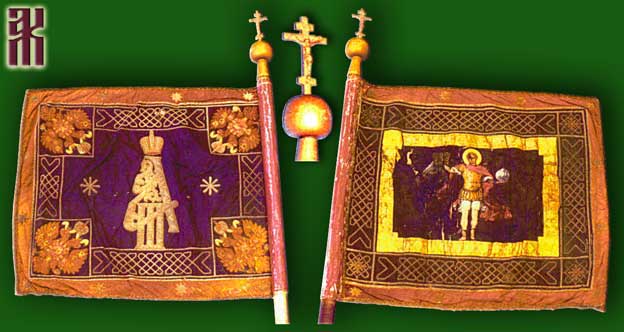
Photo from the book "Cossack Hosts of Russia"
An anniversary banner, granted to one of the nine Ural Cossack regiments in connection with the 300th anniversary of the Ural Cossack Host (with the dates "1591-1891" on the preserved ribbons). A simple banner of the 1883 model in dark blue cloth, with a raspberry border and silver embroidery. The icon is a full-length image of St. Michael the Archangel.
It was taken by Ataman V. S. Tolstov first to Iran and then to Australia. In 1939 he handed it over for safe-keeping to St. Nicholas Church in Brisbane. On 23 September 2008 it was returned to Russia by Ataman Tolstov's son and the rector of the church, Father Gavriil. It is currently kept by V. I. Annenko, a member of the Commission on Cossack Affairs under the Council of the Russian Federation. It was restored at the State Research Institute of Restoration (by S. A. Martyanova).
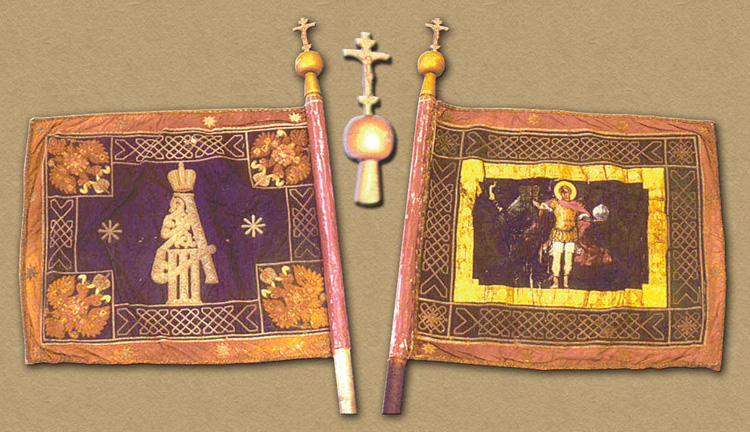
Photographed in May 2000 at St. Nicholas Church in Brisbane
Zvegintsev, V. V. in "Banners and Standards of the Russian Army of the 16th Century - 1914 and Naval Flags", Moscow, 2008, p.126.
"Cossack Hosts: Reference book of the Imperial Headquarters", St. Petersburg, 1912, pp. 220-221.
"To whom and why were the Ural banners given?" at www.gipanis.ru/?level=362&type=page&lid=360
"Cossack Hosts of Russia", Moscow, 2008.
1st Training Horse Regiment of the Ural Cossack Host
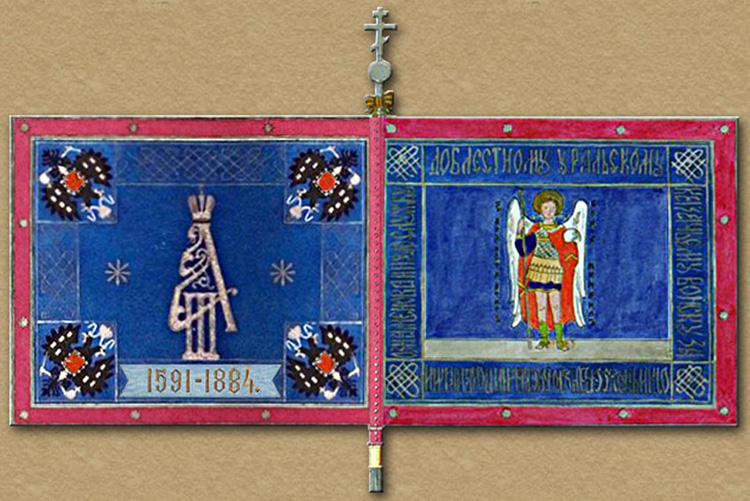
Reconstruction of the St. George Anniversary Banner of the Ural Cossack Host,
based on a drawing by V. V. Zvegintsev
Bestowed upon the Ural Cossack Host on 4 May 1884. It was dark blue cloth with a raspberry border and silver embroidery, with the inscriptions "1591-1884" on the reverse and "To the valiant Ural Cossack Army for its excellent, diligent service marked by military exploits" on the front. The icon was the Archangel Michael, depicted with his wings lowered.
On 9 July 1891 an Alexander Jubilee Ribbon was granted with the inscription "In memory of the three hundred years of existence of the Ural Cossack Host" and "1891" on the bow.
It was issued to the 1st Training Horse Regiment (from June 1918, the 1st "General Kurin" Training Horse Regiment) upon its formation at the end of March 1918. It was flown in the celebrations for the Military Holiday of the Ural Cossack Host in 1918 by an honour guard from the regiment. It served with the regiment throughout its entire combat history until October 1919, repeatedly being carried into battle during cavalry attacks. It was taken by Ataman V. S. Tolstov first to Iran, then transferred to one of the Orthodox churches in Serbia. All traces of the banner were lost after World War II, and its current location is unknown.
Zvegintsev, V. V. in "Banners and Standards of the Russian Army of the 16th Century - 1914 and Naval Flags", Moscow, 2008, p.126.
"Cossack Hosts: Reference book of the Imperial Headquarters", St. Petersburg, 1912, pp. 221-224.
Kirov, B. N. in "On the struggle against the Bolsheviks at the Ural Cossack Host Front // The Ural Cossacks in the Civil War: Memoirs of participants", Moscow, 2012, pp.85-87.
Ural Cossack Regiments / Training Horse Regiments
Granted to the 1st, 2nd, 3rd, 4th, 5th, 6th, 7th, 8th and 9th Ural Cossack Regiments on 9 July 1891. These were simple anniversary banners with the dates "1591-1891", on dark blue cloth with raspberry borders and silver embroidery. The icon was the Archangel Michael, with wings spread out to the sides. Alexander anniversary ribbons were attached.
Three banners were also issued to the 2nd, 3rd and 4th Training Cavalry Regiments when they were formed in May 1918. The 2nd Training Cavalry Regiment's banner was probably confiscated after the regiment left the front without permission in July 1918 and was subsequently disbanded on 1 August 1918. The banner of the 3rd Regiment participated in battles alongside the military banner of the Ural Cossack Host when the 1st and 3rd Training Regiments were combined into the 1st Training Brigade on 28 July 1918.
The two banners were taken by Ataman Tolstov first to Iran, then to Australia, and in 1939 he transferred them to the Church of St. Nicholas the Wonder Worker in Brisbane for safekeeping. One of the banners was cut from its pole (it is thought that, due to the extraordinary circumstances of the Civil War, the standard-bearer kept the cut banner cloth on his chest). In Australia, the pole and finial of this banner were remade, and the cut-off part of the banner (the so-called "reserve") was replaced with raspberry velvet.
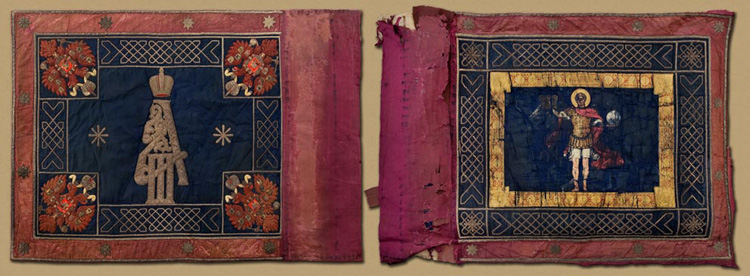
The first of the two Ural banners in the process of restoration
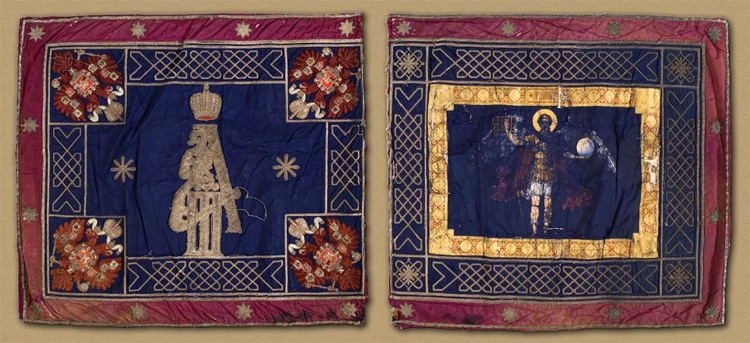
The second of the two Ural banners (with the reserve cut off)
On 23 September 2008 they were returned to Russia by Ataman Tolstov's youngest son and the rector of St. Nicholas Church in Brisbane, Father Gavriil. One of the banners was restored at the State Research Institute of Restoration (restorer S. A. Martyanova) and transferred to the Museum of the History of the Orenburg Cossacks. The second is currently kept by V. I. Annenko, a member of the Commission on Cossack Affairs under the Council of the Russian Federation.
Zvegintsev, V. V. in "Banners and Standards of the Russian Army of the 16th Century - 1914 and Naval Flags", Moscow, 2008, p.126.
"Cossack Hosts: Reference book of the Imperial Headquarters", St. Petersburg, 1912, pp. 221-224.
Kirov, B. N. in "On the struggle against the Bolsheviks at the Ural Cossack Host Front // The Ural Cossacks in the Civil War: Memoirs of participants", Moscow, 2012, pp.85-87.
Ataman Divizion of the Orenburg Cossack Host
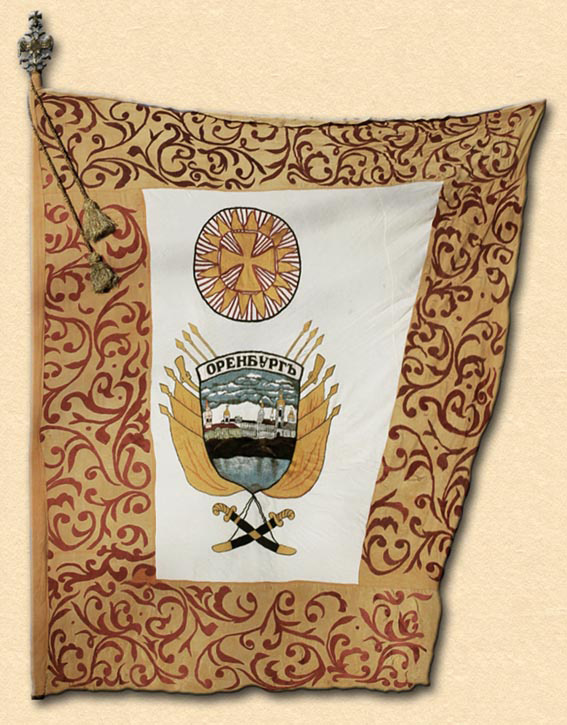
Modern reconstruction of the banner of the "Thousand" Regiment, which served as the military banner
The banner of the Thousand [Man] Regiment of the Orenburg Cossack Host, granted on 21 May 1756 by Empress Catherine II. It was presented by Ataman Dutov to the Ataman Divizion on 6 May 1919 in Troitsk, during the celebration of the military holiday (St. George Day). Its further fate is unknown.
Ganin, A. V. in "Ataman A. I. Dutov", Moscow, 2006, p.401.
"Cossack Hosts: Reference book of the Imperial Headquarters", St. Petersburg, 1912, pp.246.
11th Orenburg Cossack Regiment
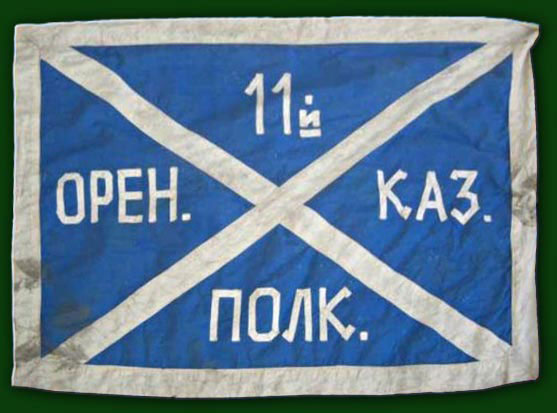
Published at pohodd.ru/gal/v/starye/znamy/oren_z2.jpg.html [link dead]
Siberian Cossack Host
1st Siberian Cossack Division
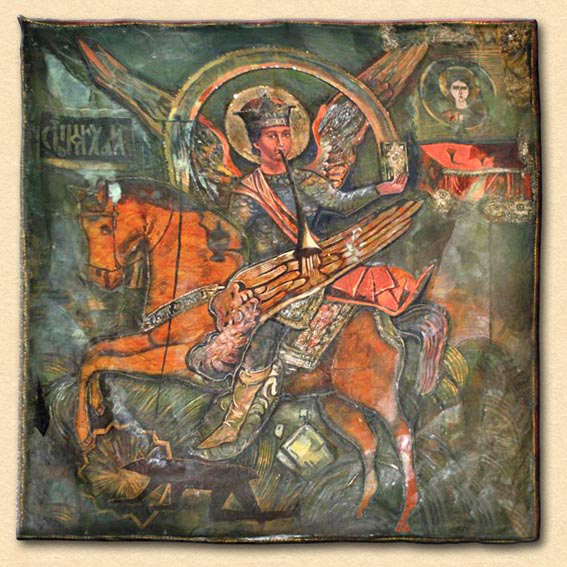
A modern reconstruction of Ermak's banner, used by the Siberian Cossack Host.
Kept in Omsk
Made by order of the 5th Extraordinary Military Circle of the Siberian Cossack Host, which decided to award the division with a special banner "for excellent combat work" in the defensive battles near Ufa and in the Urals.
One side of the banner depicts a copy of the military relic – Ermak's Banner, and the other side depicts an icon of St. Nicholas the Wonder Worker.
It was consecrated and presented to representatives of the division in Omsk on 14 September 1919. On 6 January 1920, during the surrender of the Siberian Cossack Group at Minino (northwest of Krasnoyarsk) during the retreat, the banner platoon abandoned it. It was saved by senior officer A. A. Gryzov, who picked up the banner near a cattle yard and delivered it to one of the Host regiments that had decided to break through to Transbaikalia. For this feat, he was awarded the St. George Cross, 4th class.
In 1920-1922 it served as the banner of the Siberian Cossack Brigade, the Siberian Cossack Regiment and the Siberian Cossack Host. When they went into exile, it was taken to China, and after World War II, to Australia.
Shuldyakov, V. A. in "The Demise of the Siberian Cossack Army, 1917-1920", Moscow, 2004, pp.323, 557.
1st Siberian Cossack Regiment
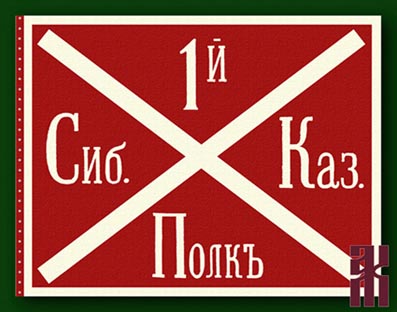
Captured by the enemy in Transbaikalia, during the retreat. Currently on display at the Central Military Museum.
Regiments of the Siberian Cossack Host
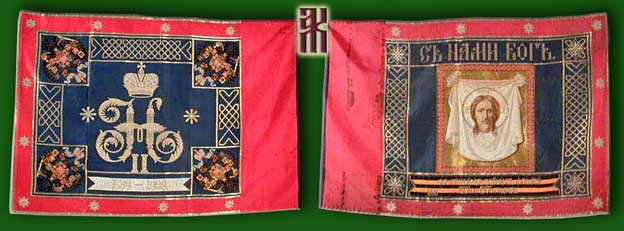
Banner of the 7th Siberian Cossack Regiment,
on display at the Omsk Museum of History and Local Lore
On 14 April 1909 the 1st, 2nd and 3rd Regiments of the Siberian Host received banners with Alexander ribbons and the inscriptions: "1582-1909".
On 10 September 1906, the 4th, 5th, 7th and 8th regiments Received St. George banners with the inscription: "For distinction in the war with Japan in 1904-1905".
The 9th Regiment received a banner (without distinctions) on 2 August 1900. They were issued to the newly formed Siberian Cossack Regiments from the end of 1918.
Ataman Semënov's Army
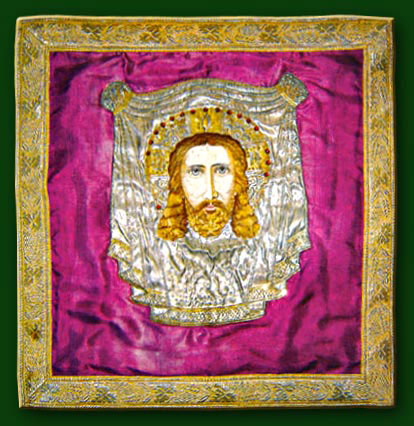
Embroidered in haste in December 1919 by nuns of the Irkutsk Znamensky Convent, with the blessing of Abbess Rafaila. This banner was intended to be presented to Ataman Semënov's troops, who were moving to suppress the anti-government uprising in Irkutsk and liberate Admiral Kolchak (General Skipetrov's expedition). After their defeat and retreat to Transbaikalia, it was cut into two pieces and all the inscriptions were destroyed.
Until October 1928 it was stored in the attic of building No. 4 of the monastery, and then transferred to [the nun] A. A. Shchegoleva. On 16 January 1929 it was seized during a search by the Irkutsk Okrotdel of the OGPU and appeared as material evidence of the "counter-revolutionary activities" of the nuns. In 1940 it was transferred to the Irkutsk Regional Museum of Local Lore.
Originally, it was a rectangular cloth with an image of Christ Not Made by Hands on the front and St. George the Victorious on the back, sewn onto square blue silk material trimmed with gold brocade fringe. Only part of the banner, the side with the embroidered image of the Saviour, was transferred to the museum. The side with the image of St. George, from which the inscription indicating that the banner was intended for Ataman Semënov had been torn off by nun M. M. Potapova, was either lost or deliberately destroyed before it was transferred to the museum. In the 1930s, the banner was exhibited in the anti-religious section of the Irkutsk Museum, located in the Church of the Exaltation of the Cross, with the label "Banner embroidered by nuns for the meeting of Ataman Semënov's gangsters". The banner was displayed in a wooden box with glass, nailed to its back wall.
The part of the banner remaining in the museum (measuring 100 by 108 cm) depicts the face of Christ Not Made by Hands, embroidered on a piece of silver brocade framed with purple silk, which is attached to a heavily faded greyish fabric. The face is sewn with coloured silk threads using the so-called "face" stitch, a type of "split" stitch. The area of the embroidered image is 216 cm². The cloth is made of silver brocade, and the folds of the fabric are imitated by a relief stitch made of twisted cannetille thread. The upper semicircle of the halo is decorated with red glass beads, 17 of which have been preserved, while 8 sockets are empty. The letters on the halo – W O H – are made of flat silver metal rings attached to gold brocade inserts. The same sequins, attached with a loop stitch of silver thread, are used to decorate the silver brocade field under the face of Christ. The lower part of the brocade cloth is embroidered with a gold mesh pattern.
The cloth with the image of Christ Not Made by Hands is attached to a piece of purple silk measuring 49.5 by 45 cm. The fabric is framed with a 5.3 cm wide gold braid. At the corners of the banner are images of cherubim: the faces are lithographed on cotton glued to cardboard and framed with a relief stitch made with a chain stitch. The banner is trimmed with fringe, a fragment of the fringe at the top is missing, and one of the four tassels located at the corners is also lost.
Dobrynina, E. A., Kryuchkova, T. A., and Spets, E.N. in "The Banner for Ataman Semenov" at http://irkutsk.orthodoxy.ru/statiji/detail.php?ID=1965.
Asiatic Horse Division
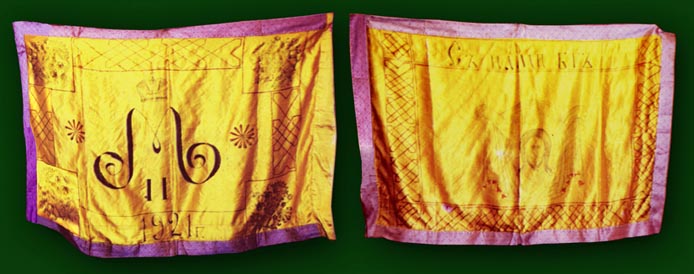
Photo from the book "Baron Ungern in Documents and Memoirs"
Most likely made for the celebrations at the coronation of Bogdo-Gegen on 26 February 1921, based on a sketch by Lieutenant General Baron R. F. Ungern von Shternberg. On 21 May 1921 it was carried in the division commander's personal escort during the division's departure from Urga,.
Designed in the style of the 1883 banners, it is a rectangular piece of yellow silk (satin) trimmed with reddish-purple brocade with a Mongolian pattern. The images are painted in black, white and red. On the front side is an image of Christ Not Made by Hands and the motto "God is with Us" in Slavonic script in the upper border. On the reverse is the monogram "M. II" (for Mikhail II) under the imperial crown, with two 12-pointed stars on either side. Below the monogram is the date "1921" in the border.
It was taken by the remnants of the division that fled to China. It is now kept by the Society of Russian Veterans of the Great War in San Francisco, USA.
Blinov, M. Y.in "Baron Ungern's Banner // Stanitsa, No. 2 (32)", Moscow, 2000, pp.36-39.
Kuznetsov, N. A. in "The White God of War: Baron R. F. von Ungern-Shternberg and the Asiatic Horse Division // Dobrovolets, No. 2", Moscow, 2003, p.24.
Tornovsky, M. G. in "Events in Mongolia-Khalka in 1920-1921. Military-historical essay (memoirs) // The Legendary Baron: Unknown Pages of the Civil War", Moscow, 2004, p.255.
Lavrentiev, K. I. in "The capture of Urga by Baron Ungern // Baron Ungern in documents and memoirs", Moscow, 2004, p.329.
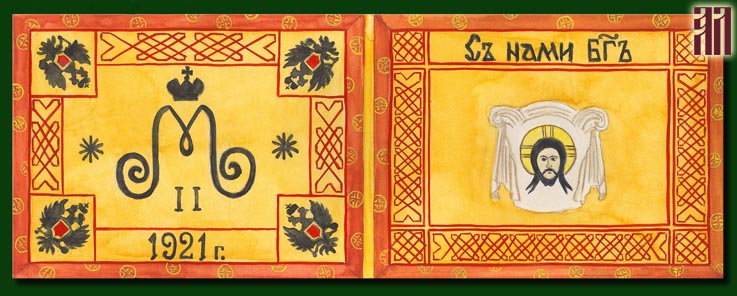
The banner of the Asian Horse Division, by artist A. V. Lebedeva
May 1921.
For example, our detachment had a banner with the letter "M" on it.
Lavrentiev, K. I. in "The capture of Urga by Baron Ungern // Baron Ungern in documents and memoirs", Moscow, 2004, p.329.
July 1921
A small tent stood to one side, above which a silk yellow banner with the symbols of Chinggis Khan fluttered in the wind – this was the general's residence.
19 August 1921.
But they did not have the courage to kill him openly, so they fired at the tent, above which fluttered a large yellow silk divisional banner with the insignia of Chinggis Khan.
Gizhitsky, K. in "Through Uriankhai to Mongolia // Baron Ungern in documents and memoirs", Moscow, 2004, pp.411-413.
21 May 1921.
The musicians were followed by General Ungern's headquarters, led by Colonel Lvov. Behind the HQ was Ungern's escort, which had a banner with the monogram and initials of Emperor Mikhail Alexandrovich.
Tornovsky, M. G. in "Events in Mongolia-Khalka in 1920-1921. Military-historical essay (memoirs) // The Legendary Baron: Unknown Pages of the Civil War", Moscow, 2004, p.255.
In addition to information about the banner of the Asiatic Horse Division, there are scattered mentions of the presence of flags in the units. Two (according to other sources, four) of them were captured by the enemy's Sretensk Cavalry Brigade on 8 June 1921 in the battle near Troitskosavsk. Ungern's adjutant and division commander N. N. Knyazev mentions "the sacred yellow banner with the sign of Chinggis Khan (swastika), which became, for the Whites. ... and the Mongolian people, a symbol of the struggle against the Communists". The presence of the swastika on the flags of the division's units is also confirmed by French researcher V. Gerson. It can be assumed that all of them were made after the capture of Urga.
Knyazev, N. N. in "The Legendary Baron // Ray of Asia, No. 5", Harbin, 1935, p.15.
Gerson, V. in "Nazism: A Secret Society", Moscow, 1998, p.128.
Ataman Kazagrandi's detachment, Uliastai
A silk yellow banner with a double-headed eagle flew proudly above the detachment.
Noskov, K. in "The Black Year, or the Adventures of the Russians in Mongolia in 1921 // Baron Ungern in Documents and Memoirs", Moscow, 2004, p.518.
Other formations
1918.
The Special Manchurian Detachment had the slogan "All power to the Constituent Assembly" on its yellow banner.
Reichberg, G. in "On the history of the Japanese intervention // Marxist historian, No. 2", 1934, p.91.
On 24 June 1919 the Irkutsk Slavic Society, through a special delegation, presented the valiant troops under the command of Ataman Semenov with a banner depicting St. George the Victorious. At the same time, the following address was presented to Ataman Semenov:
To the Honourable and Glorious Russian Knight
Ataman Grigory Mikhailovich Semenov
Valorous Ataman
Borisov, V. in "The Far East", Toronto, 1921, p.45.
Home — State Symbols — Flags — Uniforms — Badges & Medals — Money — Other
Pygmy Wars Notes
The original of this page is at kolchakiya.ru/vexillology/cossacs_flags.htm.
Note that the flag for the 1st Siberian Cossack Regiment is given as a flag, not a regimental banner (znamya). That makes sense, since it is not in the style of regimental banners. I presume it was a marker for the commander, rather the banner, which would be at the HQ. The difference between the two is discussed in the notes to the main flag page.
I assume the flag shown for the 11th Orenburg Cossack Regiment, so stylistically similar to the Siberian one is also a flag. A publication at vexillographia.ru seems to think so. However if the original regimental banner for the 11th Regiment (which would have been a Nikolai) did not make it to the civil war, perhaps the flag took the place of the banner.