
Uniforms of the Asiatic Horse Division, 1918-1921
All material and reconstructions are by A. Karevskiy unless noted otherwise.
The Asiatic Horse Division in Dauriya (1918-1920).
Order for the Independent Asiatic Horse Brigade, 22 January 1920
§2. For non-combat units of the brigade, I establish the wearing of shoulder-boards of the following colour and pattern:
1) for the quartermaster corps, red shoulder-boards with the pattern "Д. Инт.";
2) for the veterinary infirmary, blue shoulder-boards with the pattern "Д. Вет.";
3) for workshops, purple shoulder-boards, stencilled "Д. Маст.".
The technician shall ensure that the shoulder-boards and stencils are manufactured as soon as possible, and the commanders shall immediately sew them onto greatcoats, tunics and blouses upon receipt from the workshops.
This document was kindly provided by Moscow researcher V. V. Romanov.
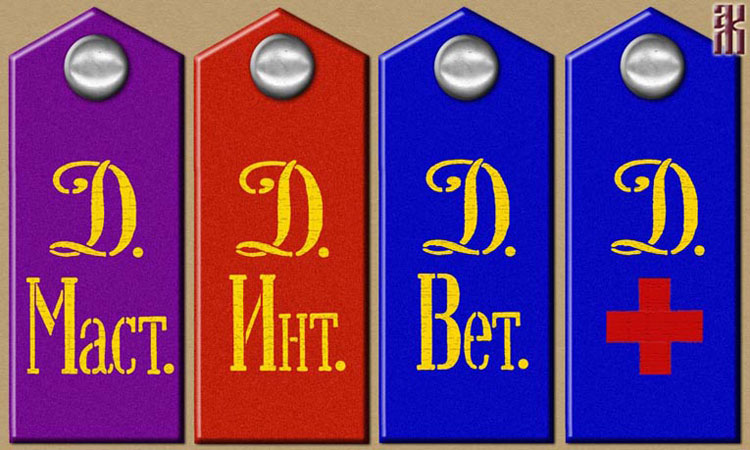
Shoulder-boards for non-combatant ranks of the Independent Asiatic Horse Brigade:
workshops, quartermaster corps, veterinarians, paramedics and orderlies
The introduction of shoulder-boards for non-combatant members of the division is documented. On 22 January 1920, division Order No. 25, instructed that for the quartermaster corps they would be red, for the veterinary services they would be blue, and for workshops they would be purple. The same order stipulated: "...to ensure the manufacture of shoulder-boards and stencils as soon as possible, and commanders are to immediately sew them onto greatcoats, tunics and blouses, upon receiving them from the workshops". The following day, Order No. 26 approved shoulder-boards for paramedics, orderlies and other lower-ranking medical personnel – a blue field with a red cross.
The letter "Д" on the shoulder-boards most likely stands for Dauriya, the military town where the division's units were based at that time. The colour of the cipher and letters is not specified in the order, but it can be assumed that they were yellow.
Kuznetsov, N. A. in "The White God of War: Baron R.F. von Ungern-Shternberg and the Asiatic Horse Division // Dobrovolets, No. 2", Moscow, 2003, p.25 citing RGVA. F.39454 Op.1 D.7 L.28, 29.
Order of the Commander-in-Chief of all Armed Forces and Field Ataman of all Cossack Units
of the Russian Far East, No. 154, 12 February 1920, Chita
Uniform items for officers, cadets and soldiers.
Tunic or blouse – khaki of the existing model with yellow piping on the sleeve cuffs for officers of all units, departments and institutions (pointed for cavalry units) and yellow ribbon for soldiers.
Trousers – short or long (off duty), khaki of the existing model with raspberry piping for infantry and red for the artillery. Piping for cavalry units is:
(...)
d) 1st Tatar Horse Regiment – green,
e) 2nd [Tatar Horse Regiment] – red,
f) Buryat Horse Regiment – yellow,
g) Mongolian Horse Regiment – purple,
(...)
Shoulder-boards – khaki, with stripes, piping and edging according to regiment, namely:
(...)
5) 1st Tatar Horse Regiment: for officers – khaki cloth with green stripes and yellow piping; for cavalrymen – green cloth with yellow piping.
6) 2nd Tatar Horse Regiment: for officers – green cloth with red stripes and red piping; for cavalrymen – green cloth with red piping.
7) Buryat Horse Regiment: for officers – khaki cloth with yellow stripes and purple piping.
8) Mongolian Horse Regiment: for officers – khaki cloth with purple stripes and yellow piping
(...)
Signed: Commander-in-Chief, Lieutenant-General Semenov
Document kindly provided by Moscow researcher V. V. Romanov.
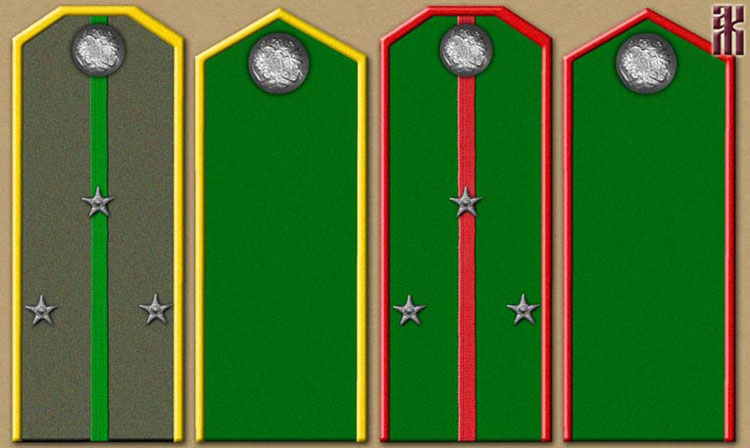
Shoulder-boards of the 1st and 2nd Tatar Horse Regiments,
as described in the February 1920 order
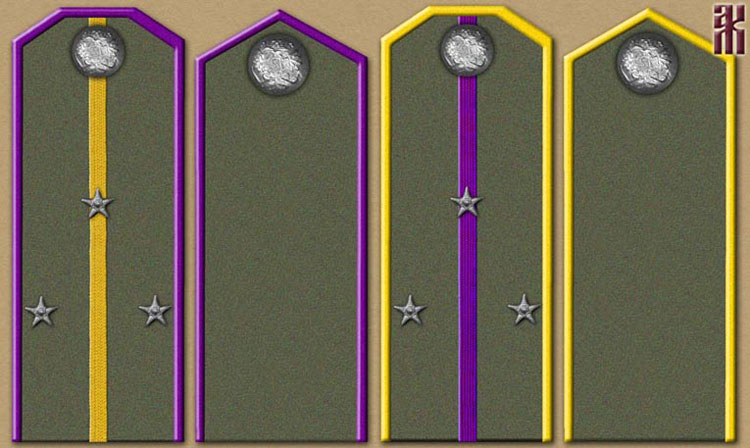
Shoulder-boards of the Buryat and Mongolian Horse Regiments,
as described in the February 1920 order
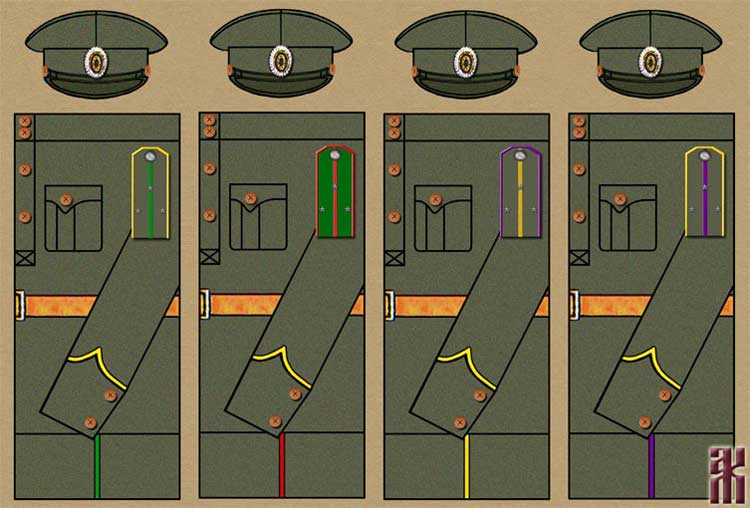
Uniforms of the 1st Tatar, 2nd Tatar, Buryat and Mongolian Horse Regiments,
as described in the February 1920 order.
Early Days
The division was formed on the principle of voluntarism, rather than conscription. The conditions for enlistment in the division also included the following:
1. Young Cossacks who have not previously been trained elsewhere are required to serve for four months upon enlistment in the division. They must bring a horse with a saddle, as well as a fur coat, ichigi boots, underwear, and a papakha. A one-time allowance of 50 rubles is paid through the stanitsa atamans, who pay the recruit 75 rubles for clothing. ...
2. Veteran Cossacks are accepted on the same terms. The term of service is three months.
Belov, E. A. in "Baron Ungern von Shternberg: Biography, Ideology, Military campaigns, 1920-1921", Moscow, 2003, p.26.
The division was very disciplined, dressed and shod strictly according to regulations (khaki blouses and blue trousers). Officers, horsemen and horses were well provided for ...
Shayditsiky, V. I. in "Lieutenant-General Baron Roman Fedorovich Ungern-Shternberg von Pilkau // Vestnik Pervopokhodnika, No. 92", Los Angeles, 1970, p.53.
Although there were many ethnic groups present while it was in Dauriya (including Bashkirs, Buryats, Kirghiz, and Tatars), the Asiatic Division was predominantly Eastern Cossacks.
Pershin, D. P. in "Baron Ungern, Urga, and Altan-Bulak (Notes of an eyewitness on the turbulent times in Outer (Khalka) Mongolia in the first decade of the 20th century)", Samara, 1999, p.86
Despite the fact that Ungern spent his entire military service in the [combat] ranks, he was well acquainted with the economic side of things and paid great attention to it. His units had excellent uniforms, weapons and food. There were no standards for the issuance of uniforms in Dauriya. It was enough for a soldier to be seen by Ungern in an untidy appearance or in torn uniforms, and he would be issued new clothes.
Golubev, in "Memoirs // Baron Ungern in Documents and Memoirs", Moscow, 2004, p.523.
Order for the 3rd Khamar Horse Regiment, 12 January 1919, Dauriya.
In fulfilment to Order No. 20 of the Independent Eastern Cossack and 5th Amur Corps, §4: temporarily, due to the lack of braid in the stores, khaki shoulder-boards are permitted, but officers are required to procure braided shoulder-boards at the earliest opportunity.
Signed, garrison commander, Colonel Ungern-Shternberg,
Regiment commander, Lieutenant-Colonel Chuprov.
Kuznetsov, N. A. in "The White God of War: Baron R.F. von Ungern-Shternberg and the Asiatic Horse Division // Dobrovolets, No. 2", Moscow, 2003, p.25, citing RGVA F.39454 Op.1 D.6 L.12.
Asiatic Horse Division near Urga (October 1920-February 1921)
His detachment was in dire need of military equipment, manpower, uniforms, and, perhaps, horses. There was a shortage of everything, everywhere.
Pershin, D. P. in "Baron Ungern, Urga, and Altan-Bulak (Notes of an eyewitness on the turbulent times in Outer (Khalka) Mongolia in the first decade of the 20th century)", Samara, 1999, p.86
Camp on the Kerulen River near Urga, December 1920
The only place where supplies could be replenished was the village of Mandal, which was in Chinese hands – which is why Ungern decided to raid it. Approaching Mandal at night without firing a shot, he drove out the Chinese, who fled in panic as they had not at all expected a raid. Upon Ungern's return from the raid, he asked what equipment the regiments needed. The undressed regiments presented their requirements in such numbers that even with all of Ungern's desire to satisfy them, there was nowhere near the indicated quantities. So the regiments received everything in very limited quantities, and two-thirds of the men were literally undressed.
Golubev, in "Memoirs // Baron Ungern in Documents and Memoirs", Moscow, 2004, p. 532.
The first assault on Urga, 27 October 1920
The sharp autumn dampness penetrated the light raincoats and worn-out English greatcoats in which Ungern's men were then dressed.
Knyazev, N. N. in "The Legendary Baron // The Legendary Baron: Unknown Pages of the Civil War", Moscow, 2004, p.41.
Camp on the Barun-Terelj River, second assault on Urga, 3 November 1920
In the November cold, accompanied by the biting Mongolian wind, hungry, half-frozen men fought with the greatest effort. But the frosty days and even more dreadful nights on the hills, without fires, broke the heroic spirit of the soldiers. And this is not surprising, because they were not dressed for the season. At best, the horsemen and officers had a light greatcoat brought from Dauriya. As for those who lost their outer clothing on the march or in the first battle near Maimachen, they had to make do with only a blouse. And the detachment's footwear, torn by sharp stones, had long since ceased to serve its intended purpose.
Knyazev, N. N. in "The Legendary Baron // The Legendary Baron: Unknown Pages of the Civil War", Moscow, 2004, pp.45-46.
The division enters Urga, 2 February 1921
And then, at about three o'clock in the afternoon of 3 February 1921, ... through our binoculars we noticed a group of horsemen quietly approaching us. Judging from horses, papakhi and weapons, we realised that they were Russian Cossacks.
Pershin, D. P. in "Baron Ungern, Urga and Altan-Bulak (Eyewitness accounts of the turbulent times in Outer (Khalka) Mongolia in the first decade of the 20th century)", Samara, 1999, p.116.
Ungern's temporary residence in Maimachen after the capture of Urga
Everywhere there were Cossacks, horses, carts and more Cossacks in a wide variety of clothing, which could hardly be called uniforms. The fact that they were in fact Cossacks was indicated by their headgear – papakhi – and their weapons – sabres and rifles.
Pershin, D. P. in "Baron Ungern, Urga and Altan-Bulak (Eyewitness accounts of the turbulent times in Outer (Khalka) Mongolia in the first decade of the 20th century)", Samara, 1999, p.123.
Maimachen, 3 February 1920
Someone was banging on our iron shutters with powerful blows. A bright light blinded us. At the window, peering into the darkness of our cell, stood a broad-shouldered Cossack with the yellow shoulder-boards of the Transbaikal Host.
Khytun, S. E. in "Noble Piglets // Baron Ungern in Documents and Memoirs", Moscow, 2004, p.588.
Exhausted by a hundred days in a dimly lit cell, we could only drag ourselves to the first guard post. Two Cossacks with yellow shoulder-boards of the Transbaikal Cossack Host looked at us in surprise – dirty, hairy ragamuffins.
Khytun, S. E. in "Noble Piglets // Baron Ungern in Documents and Memoirs", Moscow, 2004, p.590.
Asiatic Horse Division in Urga, February-May 1921
Mobilised by our liberators, we received Chinese clothing (for lack of anything else) to replace our worn-out, dirty prison clothes. It was strange to see soldiers in long Chinese robes with the shoulder-boards of colonels, captains and lieutenants. This continued until the quartermaster's office was formed, which gradually replaced the robes with newly sewn uniforms of the Transbaikal Cossacks.
Khytun, S. E. in "Noble Piglets // Baron Ungern in Documents and Memoirs", Moscow, 2004, p.591.
Baron Ungern's troops, who arrived in Urga after a three-month stay in the steppe, were quite worn out. Urga gave them the opportunity to get dressed up. All kinds of materials were collected from the Chinese shops destroyed by the Mongols, mainly silk items, ready-made Chinese coats and robes, and all kinds of furs. After a while, it was possible to see officers, Cossacks, and other soldiers transformed from head to toe in a mixture of Mongolian and Chinese uniforms, mainly, of course, light silk: wide trousers of all shades and colours, large blouses, light fur coats, and light fur Chinese robes. Of course, everyone still wore the shoulder-boards of their assigned unit. ... I remember an officer from Kyakhta named Nemchinov. He was a man of enormous stature, wearing wide red silk trousers and a shirt of the same colour. He looked like some kind of executioner or a merchant. ... This change of clothing did not go well for many: when the baron suddenly issued an order to move the units to Choyrin-Sumé, many were caught in silk clothes and suffered frostbite, recalling reasonably: "We were in Kerulen in torn sheepskin coats and were unharmed, and here we are without noses and fingers."
Lavrentiev, K. I. in "The capture of Urga by Baron Ungern // Baron Ungern in Documents and Memoirs", Moscow, 2004, p.323.
An officer who came with the division from Dauriya
He strode away, standing out from the others in his raspberry Mongolian caftan, on which his yellow captain's shoulder-boards and papakha stood out.
Khytun, S. E. in "Noble Piglets // Baron Ungern in Documents and Memoirs", Moscow, 2004, p.593
Supplying the division during its stay in Urga
Alexei Zyablikov, a refugee from Kulusutai ... offers you Mongolian and high boots for your detachment: a sample of the Mongolian boots is enclosed. Cost: one pair of Mongolian boots with delivery to Urga approximately 8 rubles in gold, one pair of government-issue boots approximately 10 rubles in gold, depending on the batch (footwear from the Khailar, Chita, and Akulov factories). The footwear is already ready. Zablikov has already sent 100 pairs of Mongolian boots and a number of high boots, both government-issue and Russian-style, of the highest quality with pointed toes, the cost of the latter being up to 15 rubles in gold...
"Letter from Lieutenant-Colonel Laurents to Ungern, dated 7 February 1921 // Baron Ungern in Documents and Memoirs", Moscow, 2004, p.117.
There were no deliveries to the baron's quartermaster's office from Manchuria – neither in the form of military equipment, nor in the form of uniforms, nor in general anything necessary for conducting military operations. It was fortunate that the baron himself had set up workshops in Urga, which produced sufficient quantities of linen and footwear, otherwise his Cossacks would have been left barefoot or would have had to wear uncomfortable Mongolian gutuls, which were unsuitable for either cavalrymen or infantrymen.
Pershin, D. P. in "Baron Ungern, Urga, and Altan-Bulak (Notes of an eyewitness on the turbulent times in Outer (Khalka) Mongolia in the first decade of the 20th century)", Samara, 1999, pp.154-155.
Leather uniforms
The division rested, while the quartermaster's department hurriedly sewed blue terligs, high fur boots, officers' high boots, and leather coats for everyone in specially equipped workshops.
Makeev, A. S. in "The God of War – Baron Ungern: Memoirs of the Former Adjutant to the Commander of the Asiatic Horse Division // Baron Ungern in Documents and Memoirs", Moscow, 2004, p.445.
Urga Bazaar, May 1921
Occasionally one saw the soldiers of Baron Ungern rushing about in long blue coats
Ossendovsky, F. in "Men, Beasts, and Gods", Moscow, 1994, pp.250-251.
Of all the baron's business ventures, the most interesting was the tannery. This enterprise had once belonged to Jewish merchants, but had fallen into decline long before the baron occupied Urga. Ungern instantly revived the business. By spring, the factory was already producing excellent leather for boots and thin coloured suede for clothing (the baron gave orders to dress the division in leather jackets and matching trousers). Over 2,000 sets of ready-made leather uniforms went to the Reds in Urga.
By the beginning of July 1921 Ungern's quartermaster's office had procured several thousand sets of such uniforms. But the situation had become so dire by that time that the supplies had to be abandoned in Urga.
Knyazev, N. N. in "The Legendary Baron // The Legendary Baron: Unknown Pages of the Civil War", Moscow, 2004, pp.71-72, 75.
There was a large tannery in Urga, owned by the Russian-Asian Company, which, as a Jewish enterprise, was confiscated and put into operation by a great specialist, the elderly Gordeev. Gordeev was formerly a major tanner and factory owner on the Volga. He quickly and productively organised the work of the factory, thanks to the huge amount of raw materials requisitioned from Chinese merchants. Sewing workshops made excellent jackets and breeches from suede and leather. Boot workshops made boots from sheepskin.
Tornovsky, M. G. in "Events in Mongolia-Khalka in 1920-1921: Military-historical essay (memoirs) // The Legendary Baron: Unknown Pages of the Civil War. Moscow", 2004, p.230.
Urga Commandant's Office
As he passed us, I noticed the shoulder-boards of a colonel and the green cap with a visor.
Ossendovsky, F. in "Men, Beasts, and Gods", Moscow, 1994, p.247.
Captain Bezrodniy, Urga, February 1921
A lone refugee, who appeared from nowhere. According to Volkov, he dismounted his horse in Urga wearing a tattered sheepskin coat, and three days later was showing off a brand new military uniform.
Yuzefovich, L. in "The Autocrat of the Desert (The Phenomenon of Baron R.F. Ungern-Shternberg)", Moscow, 1993, p.119.
Captain Bezrodniy, Zain-Shabi Monastery, April 1921
wearing a huge fur hat pulled down over his head and a black Caucasian cape with a picturesque red bashlyk thrown back.
Ossendovsky, F. in "Men, Beasts, and Gods", Moscow, 1994, p.223.
The division at the coronation of Bogdo-Geghen on 26 February 1921
On the eve ... The Asiatic Horse Division was given the order: "At 3 o'clock in the morning, saddle up, put on your new uniforms, be armed, accompanied by a band, and march from Maimachen to Urga, where you will line up from the Bogdo Palace to the main shrine."
Makeev, A. S. in "The God of War – Baron Ungern: Memoirs of a Former Aide-de-Camp to the Commander of the Asiatic Horse Division // Baron Ungern in Documents and Memoirs", Moscow, 2004, p.446.
Several senior officers, elevated to hereditary princely dignity, sat at the table. All the Russians participating in the ceremony were dressed in Mongolian national costumes and wore globes on their hats, according to their rank and title. ... Two days before the coronation, Bogdo signed a manifesto listing the names of Russian officers of Ungern's detachment who had received awards for services rendered to Mongolia. Staff officers and senior officers who had distinguished themselves in the battles near Urga were awarded hereditary princely rank. It is recalled that two of them were elevated to the rank of prince of the 5th class, the so-called ulsyn-tushe-gun, while the majority were awarded the rank of junior gun of the 6th class (tuslagchi-gun). Some officers became personal princes. The rest of the officers and many of the sergeants were assigned to the ranks of the first eight Mongolian classes.
Knyazev, N. N. in "The Legendary Baron // The Legendary Baron: Unknown Pages of the Civil War", Moscow, 2004, pp.68-69.
In the preparation of Russian and Mongolian units for the celebration, the entire Russian command staff were dressed in Mongolian clothing, with Mongolian hats, according to rank. It should be noted that after the capture of Urga, all Russian commanders received Mongolian ranks, and some even received princely titles.
Lavrentiev, K. I. in "The capture of Urga by Baron Ungern // Baron Ungern in Documents and Memoirs", Moscow, 2004, p.328.
After the capture of Urga, the officers of the Asiatic Division were elevated by Bogdo-Geghen to the rank of Mongolian officials according to the former Qing system, which had been abolished in China itself after the revolution. They were paid salaries from the treasury, and some were given traditional caps with globes of different colours corresponding to one of the six official classes (note: the first, highest class was assigned a red coral globe; the second, a red globe with ornamentation; the third, a blue transparent globe; the fourth class had an opaque blue globe; the fifth class had a transparent colourless globe; and the sixth class had a white porcelain globe). Colonels, lieutenant-colonels, captains, and lieutenants became tuslahchis, zakirakchis, merenovs, dzalanovs, dzangis, and khunduevs.
Yuzefovich, L. in "Autocrat of the Desert (The Phenomenon of Baron R.F. Ungern-Shternberg)", Moscow, 1993, p.120.
On the eve of the coronation, the best units of the Asiatic Division, stationed in Maimachen, were ordered to put on their new uniforms and, in full regalia, accompanied by an orchestra, march to Urga. The new uniforms, freshly sewn in Urga's tailors' workshops, consisted of a dark blue Mongolian terlig (a kind of short coat, covered with fabric on top) instead of a greatcoat, a cap with a silk top and a bashlyk, also made of silk on the inside. The bashlyki, like the caps, differed in colour: the Tatar
Yuzefovich, L. in "Autocrat of the Desert (The Phenomenon of Baron R.F. Ungern-Shternberg)", Moscow, 1993, p.122.
A tashur is a cane of one and a half arshins, with a strap at one end. The Mongols used the tashur instead of a nagayka whip for horses, but in the Asiatic Division it became a kind of commander's baton, a sign of rank and authority. Most officers, including Ungern himself, almost never parted with them. The tashur was a mandatory accessory of the parade uniform.
Yuzefovich, L. in "Autocrat of the Desert (The Phenomenon of Baron R.F. Ungern-Shternberg)", Moscow, 1993, p.120.
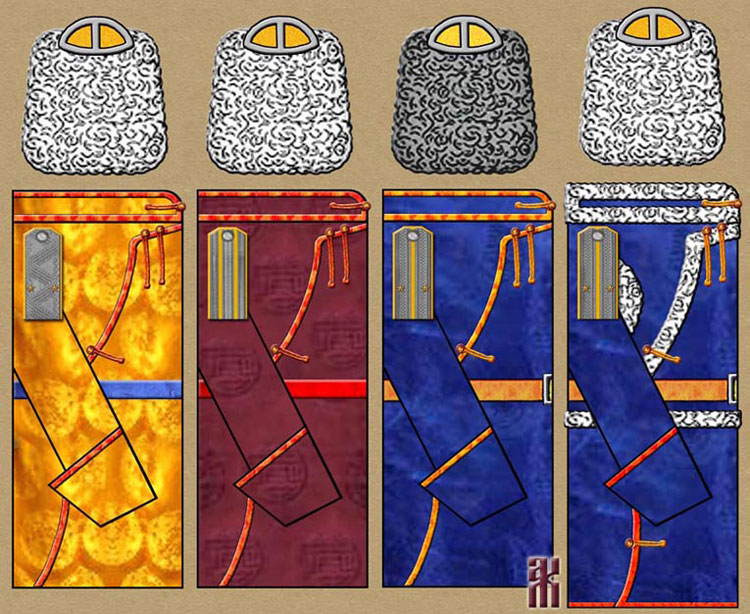
Coronation uniforms of the Asiatic Horse Division:
1 – robe of a 1st degree prince (General B. P. Rezukhin); 2 – robe of a 2nd degree prince;
3 and 4 – deel robes of senior officers (one of the five Mongolian official ranks)
Shoulder-boards for non-combatants
Order of the Asiatic Horse Division No. 15 of 15 May 1921.
I am aware of the shameful desire of many officers and soldiers to seek employment in headquarters and non-combatant positions, as well as in rear military units. The most rigorous measures are necessary to prevent this. Where possible, men who are truly incapable of combat should be appointed to headquarters and non-combat positions, and, unlike combat officers and soldiers, they should wear transverse shoulder markings.
Yuzefovich, L. in "Autocrat of the Desert (The Phenomenon of Baron R.F. Ungern-Shternberg)", Moscow, 1993, p.232.
Order No. 15 required all officers and soldiers in non-combat positions to alter their shoulder-boards and wear them across the shoulder rather than along it. This matter caused a storm of indignation, a delegation appeared before Ungern, and in the end the order was revoked.
Yuzefovich, L. in "Autocrat of the Desert (The Phenomenon of Baron R.F. Ungern-Shternberg)", Moscow, 1993, p.181.
This famous order caused an uproar. Many quartermasters immediately submitted reports on their transfer to the front, and Ungern imposed a resolution on some of them: "I authorise the wearing of longitudinal shoulder-boards."
Makeev, A. S. in "The God of War – Baron Ungern: Memoirs of a Former Adjutant to the Commander of the Asiatic Horse Division // Baron Ungern in Documents and Memoirs", Moscow, 2004, pp.445-446.
After leaving Urga, May 1921
The Asiatic Horse Division entered Troitskosavsk in line. It was a colourful and unprecedented sight. All the men and officers were dressed in dark blue Mongolian terligs and silk hats, equipped with sabres, rifles and tashurs. Tashurs are special bamboo sticks, each with one end resting in the stirrup and the other end resting on the hand. Their shoulders were adorned with bright shoulder-boards decorated with pure silver ciphers: a double-headed eagle and the regiment number below it. On their backs were colourful silk bashlyki: green for the Tatar sotnia, yellow for the Transbaikal sotnia, bright red for the Baron's headquarters, etc.
Makeev, A. S. in "The God of War – Baron Ungern: Memoirs of a Former Adjutant to the Commander of the Asiatic Horse Division // Baron Ungern in Documents and Memoirs", Moscow, 2004, p.452.
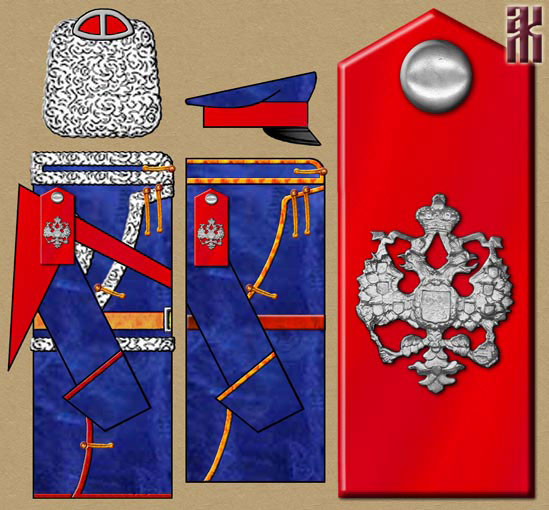
Uniforms of the Asiatic Horse Division Headquarters (winter and summer)
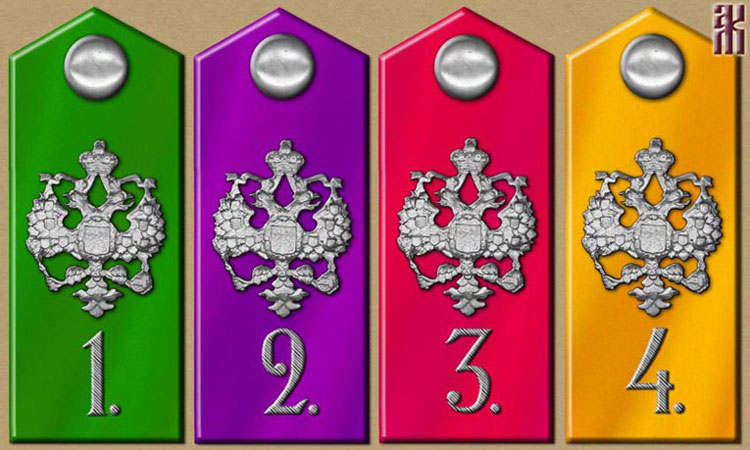
Shoulder-boards of the Asiatic Horse Division, May 1921:
1st Tatar, 2nd Mongolian, 3rd Horse, and 4th Transbaikal Horse Regiments.
The colours of the shoulder-boards of the 1st and 4th Regiments are based on Tornovskiy, and the ciphers are based on Makeev. The purple colour for the 2nd Mongolian Regiment and the cherry colour of the 3rd Horse Regiment are shown by analogy with the colours of the 1920 model shoulder-boards. The shoulder-boards were presumably made of silk (broadcloth was not common in Mongolia), and silk of the colours shown were the most common.
Ungern's regiments had very impressive uniforms: multicoloured terligs (Mongolian-style caftans); light blue, raspberry, red, blue and navy blue shirts and trousers; white papakhi; and wide belts made of coloured silk. It goes without saying that not only the outer clothing, but also the underwear was made of high-quality Chinese silk. The Eastern peoples retained their national uniforms. Only instead of greatcoats, they received blue cloth terligs. We subsequently used those terligs to distinguish our horsemen from strangers. Each sotnia had to have seven blue terligs in the main platoon, and reconnaissance no stronger than a platoon had to have three, regardless of the nationality of the horsemen.
Knyazev, N. N. in "The Legendary Baron // The Legendary Baron: Unknown Pages of the Civil War", Moscow, 2004, pp.74-75.
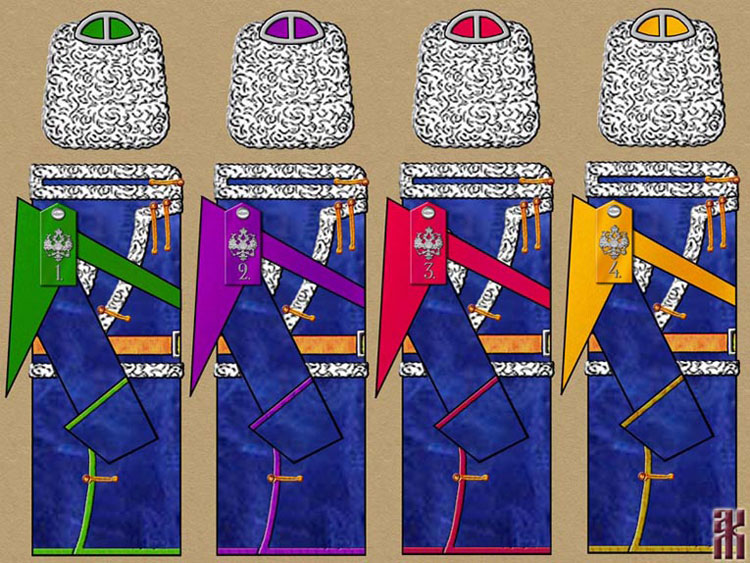
Winter uniforms of the horse regiments of the Asiatic Horse Division in Urga in terligs
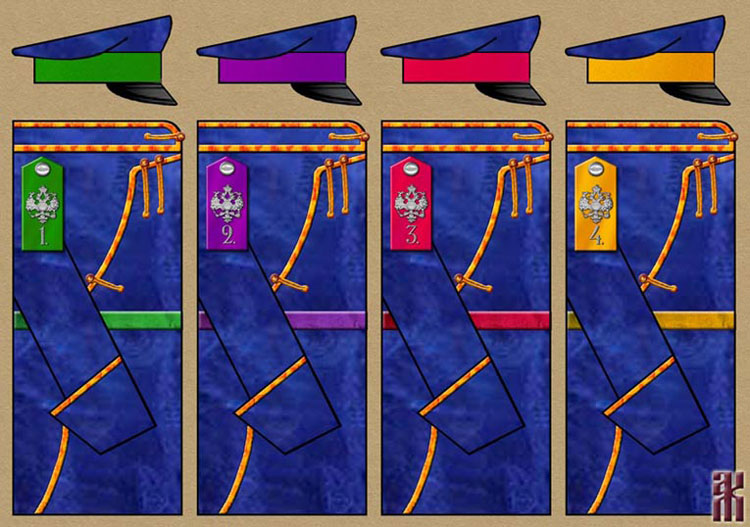
Summer uniforms of the horse regiments of the Asiatic Horse Division in Urga in deel
Next came the 1st Tatar Regiment, led by Colonel Parygin – the best regiment with the best regimental commander in the division. All the horsemen were dressed in light blue terligs with green shoulder-boards and green bashlyki. The 4th Horse Regiment of Lieutenant-Colonel Markov was dressed in dark blue terligs with bright yellow shoulder-boards and bashlyki. Each unit passing by had its own colourful distinctions.
Tornovsky, M. G. in "Events in Mongolia-Khalka in 1920-1921: Military-historical essay (memoirs) // The Legendary Baron: Unknown Pages of the Civil War", Moscow, 2004, p.255.
Testimony of Colonel V. Yu. Sokolnitskiy of Kaigorodov's Non-Russian Partisan Altai-Mountain Detachment, 23 May 1921
The soldiers marched in brilliant order, and I somehow involuntarily thought back to the good old days. The formation was like a parade. No one was omitted. The long column of cavalry and artillery went on powerfully for kilometres, marching into the unknown. ... The bright clothing of the regiments – Mongolian, Chinese, Buryat – dazzled the eyes.
Serebrennikov, I. I. in "The Great Retreat: The Dispersal of the White Russian Armies across Asia, 1919-1923", Moscow, 2003, p.117.
The use of Chinese uniforms
After crossing the Burgut Mountains, we entered the Tola River valley, in whose upper reaches Urga was located. Greatcoats, blouses, boots and mess tins lay scattered on the road. They had been discarded by the Chinese as they retreated.
Ossendovsky, F. in "Men, Beasts and Gods", Moscow, 1994, p.243.
The soldiers were well armed and clothed thanks to the abandoned Chinese warehouses in Urga captured in the battle. There was a huge warehouse of cloth and cotton material suitable for underwear: enough for an army of several tens of thousands.
Tornovsky, M. G. in "Events in Mongolia-Khalka in 1920-1921. Military-historical essay (memoirs) // The Legendary Baron: Unknown Pages of the Civil War", Moscow, 2004, p.246.
Report signed by Repin, head of the intelligence department of the 5th Army, and Sorokovnikov, head of the information department
Ungern left Urga on 20 May. ... Armed mainly with Japanese rifles, carrying 200 rounds of ammunition per person. Uniform: Chinese-style khaki tunics, khaki (Cossack) shoulder-boards, officer's with white braid, saluting is mandatory.
Pershin, D. P. in "Baron Ungern, Urga and Altan-Bulak (An eyewitness account of the turbulent times in Outer (Khalka) Mongolia in the first decade of the 20th century)", Samara, 1999, p.246, citing RTsKhIDNI F.372 Op.1 D.1180.
Lake Khuvsgul area, June 1921
The baron talked to him for a long time. His tone of questioning was dry and stern, but when he received a calm answer about the number of wounds the corporal had received in the German War, he asked briefly: "Were you a sergeant in Imperial Service?" "Yes, Your Excellency." "Well, now you will be a corporal, and if you serve well, I will promote you to sergeant," said the baron. "I will be glad to try," thundered the prisoner of war, who turned spiritedly and cheerfully left the tent. Five minutes later, he could be seen tearing clean footcloths and making himself shoulder-boards.
Makeev, A. S. in "The God of War – Baron Ungern: Memoirs of a Former Adjutant to the Commander of the Asiatic Horse Division // Baron Ungern in Documents and Memoirs", Moscow, 2004, p.464.
Allied and Subordinate Units of the Asiatic Horse Division in Mongolia, 1919-1921
The Chidorga Bataar Pog Zhibholant (Major-General Levitskiy) Detachment:
the Dauriya and Khamar Horse Regiments
On 31 August 1919, Order No. 15 approved the design of shoulder-boards for officers of the horse regiments: "...the field of the shoulder-board is yellow, the stripes and piping are purple, and the button and Chingghis Khan's symbol are in white metal." The commander of the detachment demanded strict compliance with the rules for wearing the insignia. In order No. 13, he wrote: "I have noticed that many officers of the detachment entrusted to me are wearing non-standard shoulder-boards. I remind you that the shoulder-boards must be yellow with purple stripes." In Order No. 243 of 5 September 1919, the Khamar Horse Regiment was instructed: "All officers are to arrange for the manufacture of shoulder-boards for themselves and their men, in the form specified in Regiment Order No. 246" (i.e Order No. 15 above).
Kuznetsov, N. A. in "The White God of War: Baron R.F. von Ungern-Shternberg and the Asiatic Horse Division // Dobrovolets, No. 2", Moscow, 2003, p.25, citing RGVA F.39454 Op.1 D.6 L.194.
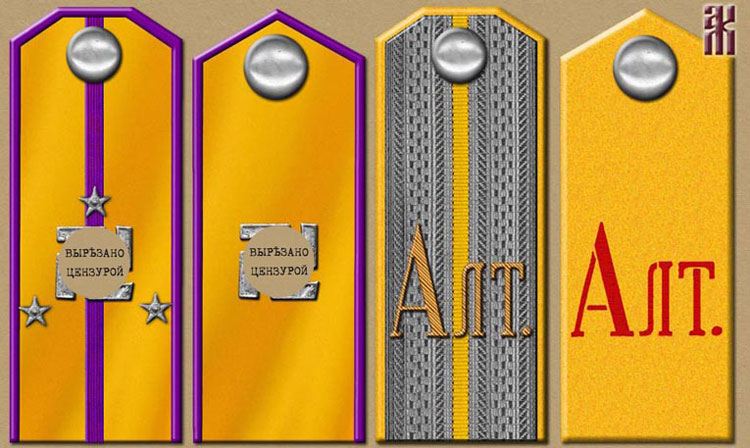
Shoulder-boards of units subordinate to the Asiatic Horse Division:
1 and 2 – Chidorga Bataar Pog Zhbholant's (Major-General Levitskiy) detachment;
3 and 4 – Captain Kaigorodov's Composite Russian-Inorodnyy Partisan Detachment
The "symbol of Chingghis Khan", or swastika, was most likely the form most commonly found in Buryat ornamentation and religious painting, i.e straight, anti-clockwise, with rays shortened in relation to the central crossbar.
Independent Asiatic Horse Brigade of Colonel N. N. Kazagrandi (Van-Khure):
The 1st Khatkhil and 2nd Dzhidinsk Horse Regiments
As soon as Kazagrandi was certain that Ungern had taken Urga, he immediately sent an officer to Urga ... expressing his complete readiness to obey him as commander-in-chief and asking for help in arming all his volunteers and providing them with warm clothing. Everything Kazagrandi requested was sent immediately: 200 rifles, 50,000 rounds of ammunition, and 250 sets of warm Chinese uniforms.
Tornovsky, M. G. in "Events in Mongolia-Khalka in 1920-1921: Military-historical essay (memoirs) // The Legendary Baron: Unknown Pages of the Civil War", Moscow, 2004. p.244.
Composite Russian-Non-Russian Partisan Detachment of the Altai Mountain Region of Captain A. P. Kaigorodov (Kobdo)
The detachment was dressed in the uniform of the Altai Cossack Host approved by Admiral Kolchak – papakhi with yellow cloth and Siberian Cossack uniforms – breeches with yellow stripes.
Dolgopolov, A. in "The Altai Cossack Army // Pervopokhodnik, No. 8", Los Angeles, 1972, pp.14-15.
Mongolian Units
Mongolian divizion of Prince Sundui-gun, Urga, May 1921
There you could see ... Mongols and Tibetans in red uniforms with yellow shoulder-boards carrying a swastika – the magical sign of Chingghis Khan – standing out.
Ossendovskiy, F. in "Men, Beasts, and Gods", Moscow, 1994, pp.250-251.
The soldiers' uniforms were red, with light yellow shoulder-boards embroidered with swastikas: the same sacred symbol adorned banners and official documents.
Gerson, V. in "Nazism: A Secret Society", Moscow, 1998, p.128.
Prince Bair-gun's detachment, June 1921
One of the Kalmyks recalled how he chased after a Mongol with NCO shoulder-boards on his robe.
Yuzefovich, L. in "Autocrat of the Desert (The Phenomenon of Baron R.F. Ungern-Shternberg)", Moscow, 1993, p.184.
Mangulovsk detachment of the Asiatic Horse Division
The division's Mangulovsk detachment flaunted blue trousers with stripes and the yellow letters "КАД" on their shoulder-boards.
Sedykh, K. in "My Father's House", Moscow, 1961, p.165.
Chinese Divizion
After the defeat of the Chinese, two thousand of those brave men turned to the Living Buddha with a request to enlist in his legions, pledging to serve faithfully. Their request was granted, and two regiments were immediately formed, whose soldiers wore the ancient Chinese emblem – silver dragons – on their shoulder-boards and headgear.
Ossendovsky, F. in "Men, Beasts, and Gods", Moscow, 1994. pp.250-251.
Returning to Urga after the battles on the Kalgan Road, Ungern formed a Chinese Divizion from the Chinese prisoners of war, for which 2 poods of "yambo silver" were allocated for cockades and ciphers on shoulder-boards. According to B. N. Volkov, a representative of the Omsk Foreign Ministry who lived in Urga, the emblem depicted on them, personally designed by Ungern, was a bizarre combination of a Chinese dragon and a Russian double-headed eagle, symbolising the unity of the historical destinies of the two monarchies.
Yuzefovich, L. in "Autocrat of the Desert (The Phenomenon of Baron R.F. Ungern-Shternberg)", Moscow, 1993, p.132.
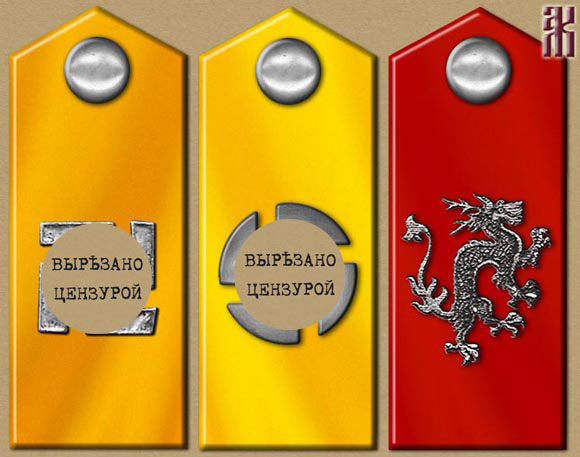
Shoulder-boards of the national formations of the Asiatic Horse Division:
1 – Independent Tibetan Divizion; 2 – Mongolian Divizion ; 3 – Chinese Divizion.
The Tibetan swastika is assumed to be the straight anti-clockwise variant, most common in Tibetan religious ornamentation, whereas the Mongolian swastika used is the version with rounded rays.
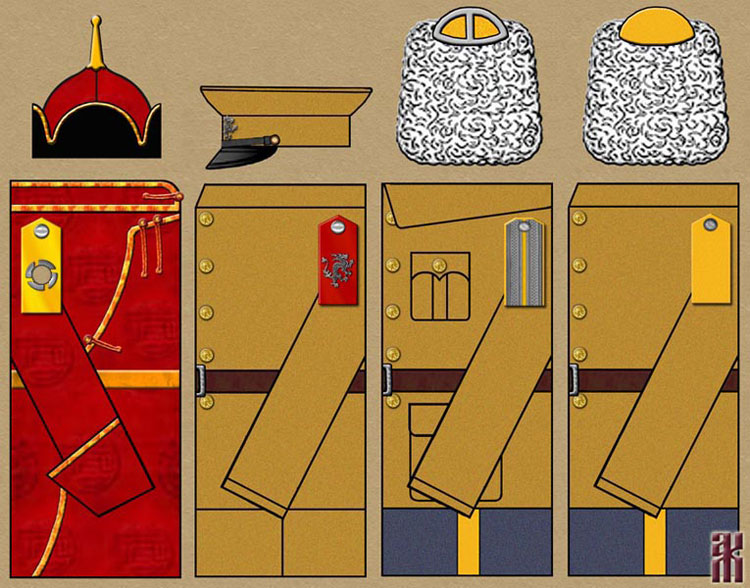
Uniforms of the national formations in the Asiatic Horse Division:
1st Mongolian Divizion ; 2 – Chinese Divizion ;
3 and 4 – captain and private of the Transbaikal Cossacks in a captured Chinese tunics (officer's and soldier's)
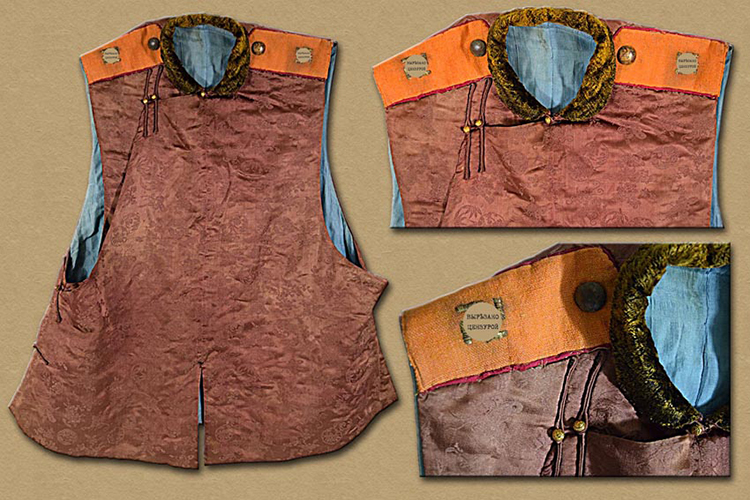
Robes of a private in the Asiatic Horse Division
The photo was posted online. It remains unclear whether this kurma belonged to a soldier of the Asiatic Horse Division itself or to one of its national Mongolian units. The kurma is made of thick reddish-brown silk fabric, although according to all recollections, the rank and file of the division's regiments were dressed in blue uniforms. The shoulder-boards are made of coarse yellow material with raspberry cloth piping, and the swastikas are embroidered with gold thread, with a mirror image (one clockwise and one anti-clockwise). The fur collar is also noteworthy.
forum-falerist.com [link dead]
Home — State Symbols — Flags — Uniforms — Badges & Medals — Money — Other
Pygmy Wars Notes
The original for this page is at kolchakiya.ru/uniformology/Ungern_div.htm.
The original page has the shoulder-boards of the non-combat units with a Cyrillic "D" in the text, but the illustration clearly uses a Latin "D", such as used for Dragoons.
I have left the Mongolian place names in the Russian forms of the original: in particular, Urga is Ulaanbataar. The Khamar unit was presumably named after the Khamar mountains in Buryatia.
The swastikas on the shoulder-boards of the Tibetan and Mongolian units have been censored in accordance with Russian legislation.
The uniforms of Captain Kaigorodov's Composite Russian-Inorodnyy Partisan Detachment are discussed in more detail here.
The original text uses the term tyrlyk, which is the traditional Buryat coat, but they are slightly different from the Mongolian terlig, so I have used the latter version. Gutuls are traditional Mongolian pointed low boots. Discussion on other translation choices I have made can be found here.
The following illustration, by A. Lebedeva, was in the original page but later removed.
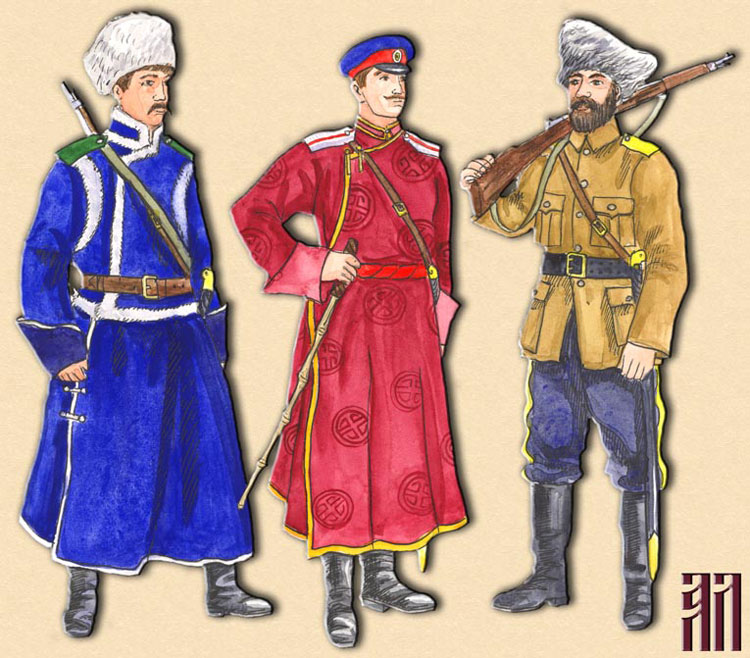
Ranks of the Asian Horse Division in Urga, 1921:
1 – horseman of the Tatar sotnia in the "coronation" uniform;
2 – officer of the staff sotnia in a "Mongolised" version of the everyday uniform;
3 – Transbaikal Cossack in a "French" taken from the Chinese