
Uniforms of the Combined Russian-Inorodnyy Detachment
of the Altai Mountain Region
On 29 March 1921 Captain A. P. Kaigorodov captured Kobdo and turned it into his base. After mobilising the Russian subjects in the district, he formed the "Combined Russian-Inorodnyy Detachment of the Altai Mountain Region" (three horse companies, a reconnaissance detachment, a machine gun komand, for a total of around 500 men). He drew on his Cossack project of 1919, dressing his detachment in Oralgo and Kobdo in the uniform of the Altai troops, allegedly approved by Admiral Kolchak: black uniforms, yellow trouser stripes, papakhi with yellow crown, etc. Sending his chief of staff, Colonel V. Y. Solkolnitskiy, from Kobdo to Urga, the "Ataman of the Altai Sich" instructed him to petition Baron Ungern for the creation of an Altai Cossack host.
Shishkin, V. V. in "The Shishkins in the History of Russia: 1339-1905: Almanac", Novokuznetsk, 2016, p.607.
The detachment was dressed in the uniform of the Altai Cossack Host, approved by Admiral Kolchak – papakhi with yellow bags and Siberian Cossack uniforms – breeches with yellow stripes.
Dolgopolov, A. in "The Altai Cossack host // Pervopokhodnik, No. 8", Los Angeles, 1972, pp.14-15.
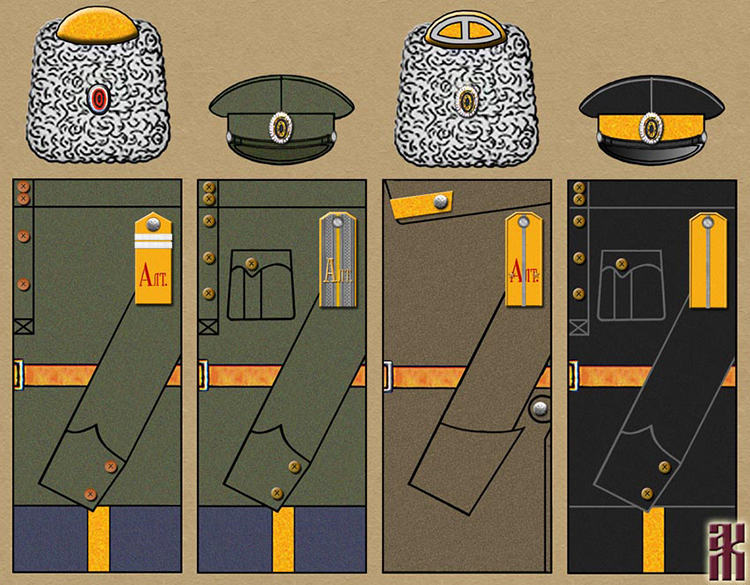
Uniforms of the partisans of the Combined Russian-Inorodnyy Partisan Detachment of the Mountain Altai Region.
Figures 1 to 3 are ordinary Cossack uniforms, based on the model of the Transbaikal Cossack Host (the quote above from Dolgopolov is mistaken about being Siberian). Figure 4 is reconstructed in a black uniform, which Shishkin says was made in Kobdo in the spring of 1921.
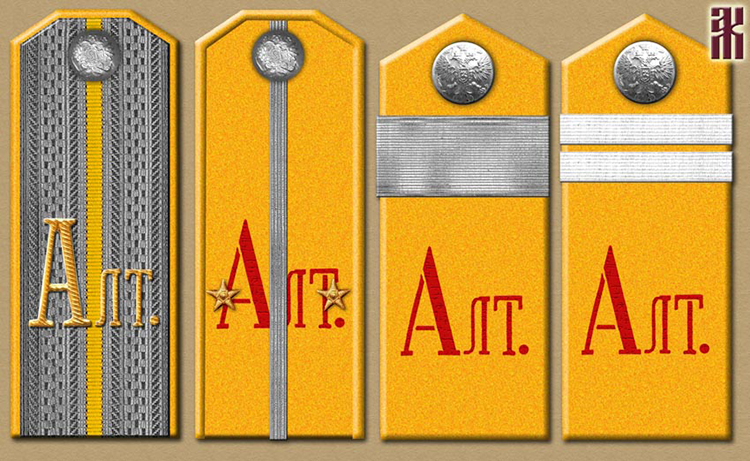
Shoulder-boards of the Combined Russian-Non-Russian Partisan Detachment of the
Altai Mountain Region.
The shoulder-boards of a Captain (Figure 1) are shown as braided – such shoulder-boards may have been preserved by some officers from the previous period. It is believed that when the detachment was re-equipped with uniform clothing in Kobdo in the spring of 1921, the shoulder-boards were made by hand for the entire detachment using available materials of a suitable color. The Enisei Cossack Brigade had the same shoulder-boards (i.e. yellow with silver metal).
Home — State Symbols — Flags — Uniforms — Badges & Medals — Money — Other
Pygmy Wars Notes
The original for this page is at kolchakiya.ru/uniformology/Altai_mountain_squad.htm.
Inorodnyy means "foreigner", but in this context also means people with a somewhat different legal status in the Russian Empire (Kazakhs, Buryats etc). On this page it really just means the indigenous Altai peoples.
Kobdo is modern Khovd in Mongolia. Oralgo is modern Oyu Tolgoi. Urga is modern Ulaanbataar.
Discussion on the translation choices I have made can be found here.
Some history of this unit can be found in Serebrennikov's book here and an article by M. A. Bogdanov here (in Russian).