
Uniforms of the 1st Carpathian-Russian Rifle Regiment
All material and reconstructions are by A. Karevskiy.
...the soldiers of the Carpathian-Russian regiment wore Russian and English uniforms. To distinguish themselves, they had orange shoulder-boards with black piping and a black letter "K" on them.
Tinchenko, Ya. in "Ukrainian Armies, 1917-1920", Moscow, 2002, p.106.
What do our cockades signify?
The cockades worn by our soldiers on their caps depict our Galician-Russian coat of arms, i.e. a yellow lion on a blue field, climbing a rock. The coat of arms is bordered by a Russian national ribbon as a sign that our homeland is united with the entire Russian people.
Catechism of a Carpathian-Russian Volunteer, Omsk, 1919.
October 1919
The first chain of Carpathian-Russians, about 20-40 men, who broke into the village were surrounded and taken prisoner. Immediately, the Reds stripped the prisoners and, dressed in their light greatcoats, continued to shoot at the advancing Carpathian-Russians.
"The truth is brighter than the sun" published by V. Zh. Tsvetkov at 1918.borda.ru/?1-12-0-00000011-000-0-0
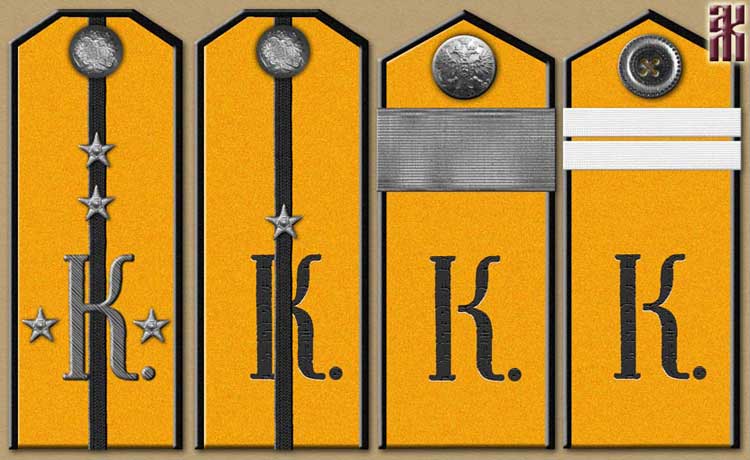
Shoulder-boards of the 1st Carpathian-Russian Rifle Regiment
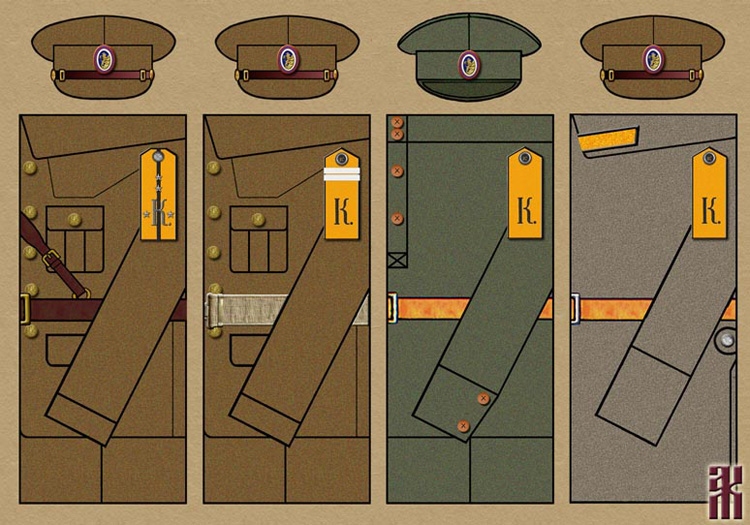
Uniforms of the 1st Carpathian-Russian Rifle Regiment:
1 and 2 – staff-captain and corporal in British uniforms;
3 – private in Russian uniform; 4 – private in Russian greatcoat and British uniform
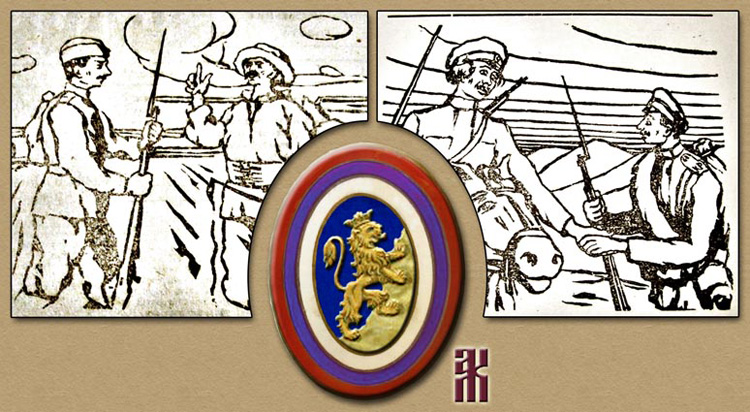
The cockade is a reconstruction of that for Carpathian-Russian servicemen (concept by Oleg Plyut). Left and right are fragments of 1919 propaganda posters depicting officers of the Carpathian-Russian regiment. The headdress on the left, resembling a side cap, is odd. On the right, the cipher "К.Р." on the shoulder-boards is of interest.
siberia.forum24.ru/?1-5-0-00000023-000-60-0-1389549825
Home — State Symbols — Flags — Uniforms — Badges & Medals — Money — Other
Pygmy Wars Notes
The original for this page is at kolchakiya.ru/uniformology/Ukrain_units_2.htm.
This was not a mixed unit: "Carpathian Russians", also called the Rusyn or Ruthenians, are a distinct Slavic ethnic group. Now largely Ukrainian Halychyna (Galicia), prior to WWI their lands were almost all in the Austro-Hungarian Empire, so I imagine most of the men of this unit were former POWs from the KuK.
Discussion on the translation choices I have made can be found here.
Flag
The banner of the Carpathian-Russian Regiment is known from its description. A reconstruction is here.
History of the 1st Carpathian-Russian Rifle Regiment
An Independent Carpathian-Russian Volunteer Battalion formed at the end of 1918 in Omsk. It expanded to a Regiment in mid-1919.
This unit seems to have been, more or less, independent of any higher formation. It later surrendered in its entirety.