
Uniforms of the Cossack Units under the Command of Ataman Semenov,
1920-1921
Material kindly provided by V. V. Romanov of Moscow. As the documents have not yet been made available for scientific use, at his request we are not publishing any archive references. Reconstructions by A Karevskiy, unless noted otherwise.
Order No. 412/16 of the Commander-in-Chief of all Armed Forces and Field Ataman of all Cossack Units of the Russian Far East, 30 May 1920, Chita
In connection with the arrival in the Russian Far East of Cossack combat units, headquarters, administrations, komands and individual officers, and the formation of new units in the Transbaikal Army, I hereby announce changes and additions to my Order No. 154 of 12 February this year on uniforms, which are to be adopted by all Cossack troops located in the above-mentioned territory.
List of changes:
Additions and amendments:
Add to "Tunic or blouse": For Cossack troops – khaki cloth, but without piping and braid on the cuffs.
For "Trousers", items "J" and "L" are excluded, and instead of them, after item "I", add: For Cossack troops – khaki material, of the same cut, with stripes in the established pattern.
Colour of trouser stripes:
a) for artillery units and men listed as artillery – red.
b) for units and men of other types (Staffs and Administrations) – in the host colour:
Transbaikal Host – yellow;
Orenburg Host – light blue;
Enisei Host – yellow;
Siberian Host – red;
Ussuri Host – yellow;
Don Host – red;
Amur Host – yellow;
Ural Host – raspberry;
Astrakhan Host – yellow;
Semirechensk Host – raspberry;
Irkutsk Host – yellow.
Shoulder-boards: Paragraphs 3 and 4 to be amended as follows:
For combat units – the stencil markings of:
For training units – "Уч.",
For independent sotnias, batteries, and platoons – the letter "O".
For Army Headquarters – the matching initial stencil letter and below it the number of the army unit.
For the Headquarters of the Field Ataman – a letter "A." in Slavonic script. For Army Headquarters – the letters "В.Ш.".
For Army Administration – the letters "В.П.".
For combat artillery units and men listed as artillery – an artillery insignia above the stencil.
For engineer units and officers listed as engineers – an engineer insignia above the stencil.
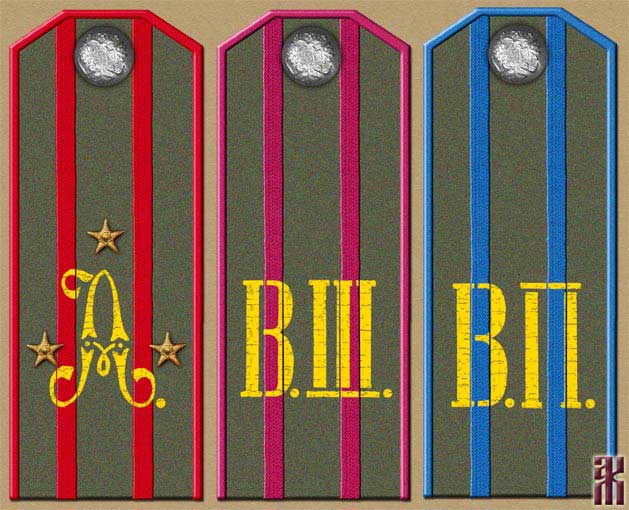
Shoulder-boards of senior officers:
1 – lieutenant-colonel at the Field Ataman's Headquarters;
2 – colonel at Army Headquarters;
3 – colonel of the Army Administration of the Orenburg Host
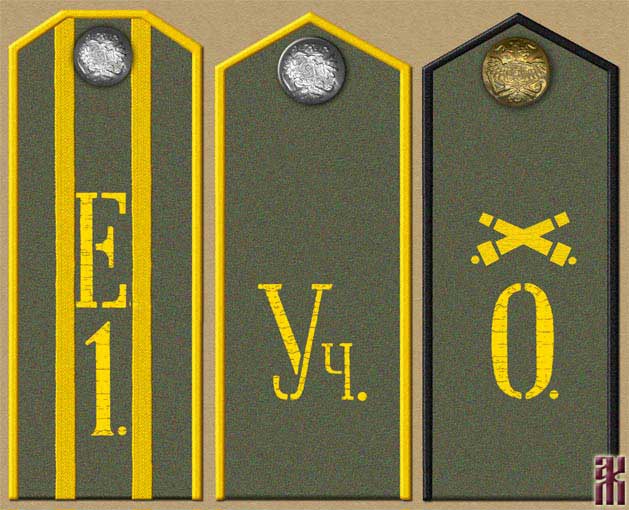
1 – shoulder-boards of a colonel of the Staff of the Enisei Cossack Host;
2 – Cossack of a training unit; 3 – Cossack of an independent battery
With the following differences:
Transbaikal Host: For generals, according to the drawing, light-coloured, stitched with yellow stripes, yellow piping. For staff and senior officers – yellow stripes, yellow piping; for all other ranks – yellow piping.
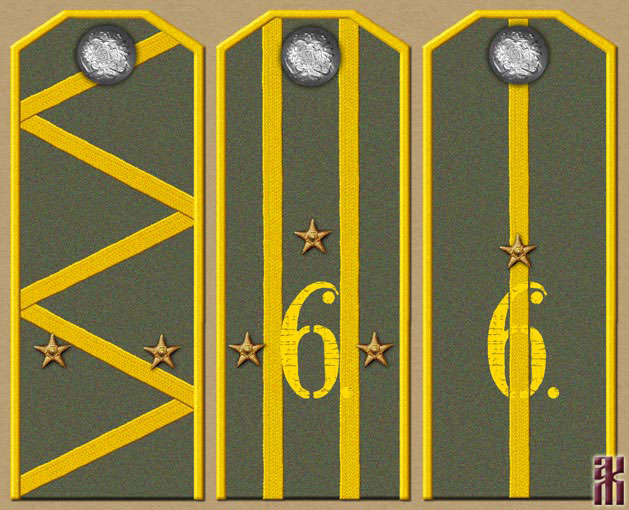
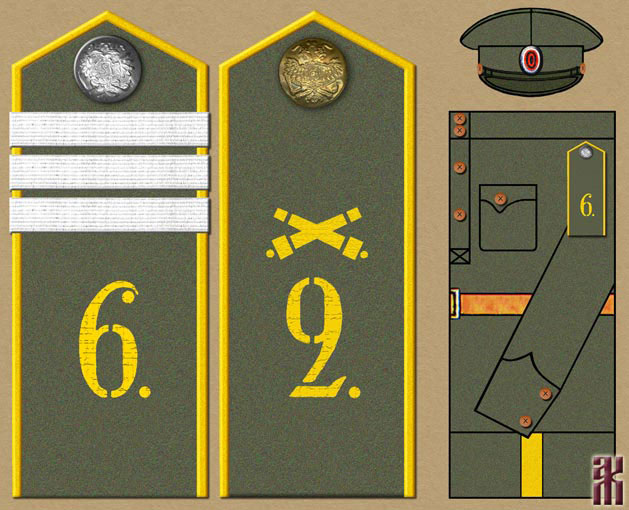
Shoulder-boards and uniform of Cossacks of the Transbaikal Host: 1 – major-general;
2 – lieutenant-colonel; 3 – ensign; 4 – sergeant; 5 – artillery private; 6 – Cossack
Orenburg Host: For generals, as shown in the illustration, light-coloured, stitched with blue thread; blue piping. For staff and senior officers – blue stripes, blue piping. For military ranks of all grades – blue piping.
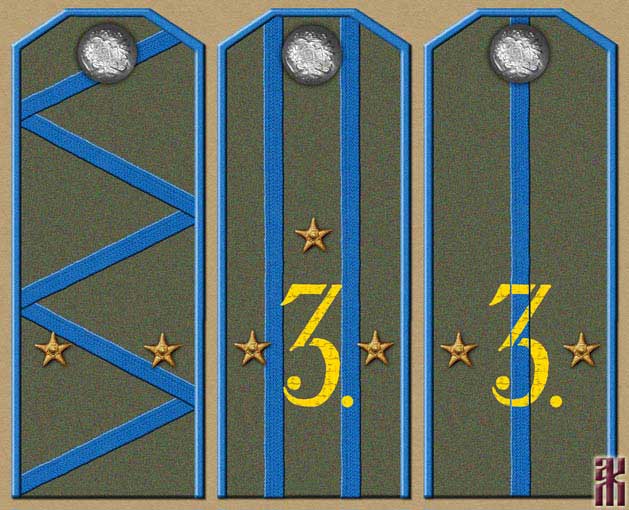
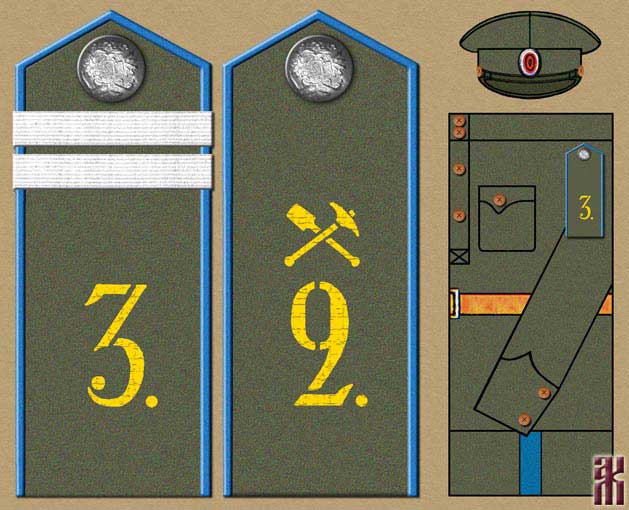
Shoulder-boards and uniform of Cossacks of the Orenburg Host: 1 – major-general;
2 – lieutenant-colonel; 3 – second-lieutenant; 4 – corporal; 5 – engineer private; 6 – Cossack
Enisei Host: with the stenciled letter "Е" (in addition to the unit number). For generals, light-coloured, stitched with yellow stripes, yellow piping. For staff and senior officers – yellow stripes, yellow piping. For all other ranks – yellow piping.
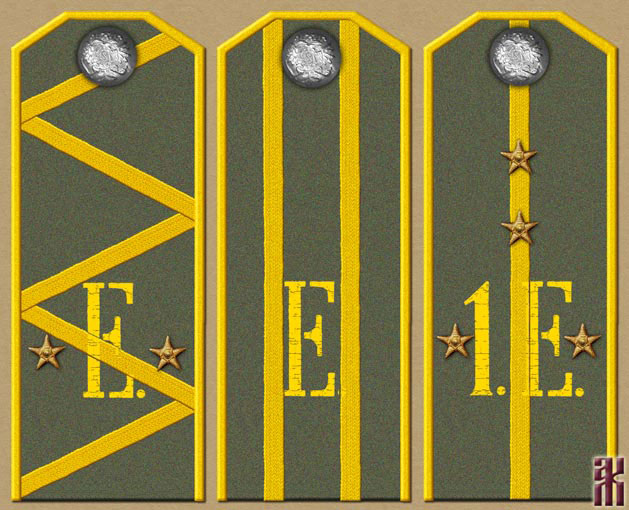
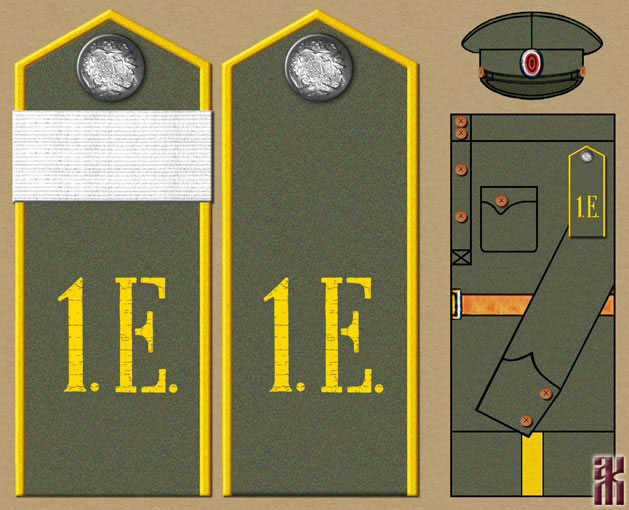
Shoulder-boards and uniform of Cossacks of the Enisei Host: 1 – major-general;
2 – colonel; 3 – staff-captain; 4 – sergeant-major; 5 – Cossack; 6 – Cossack
Siberian Host: For generals, light-coloured, stitched with red stripes, red piping. For staff and senior officers – red stripes and red piping. For all other ranks – red [piping].
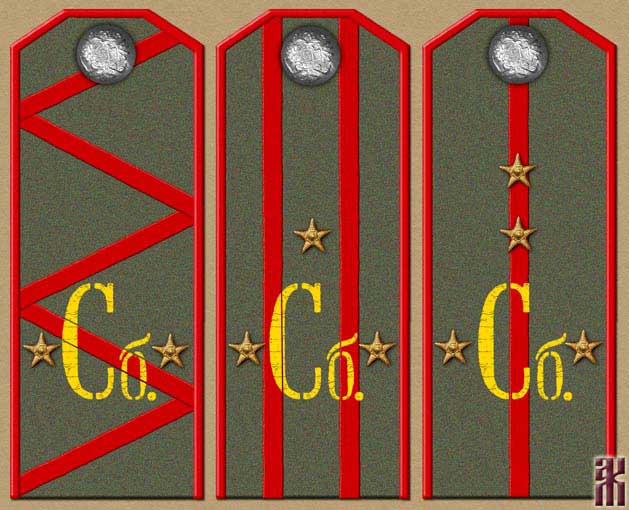
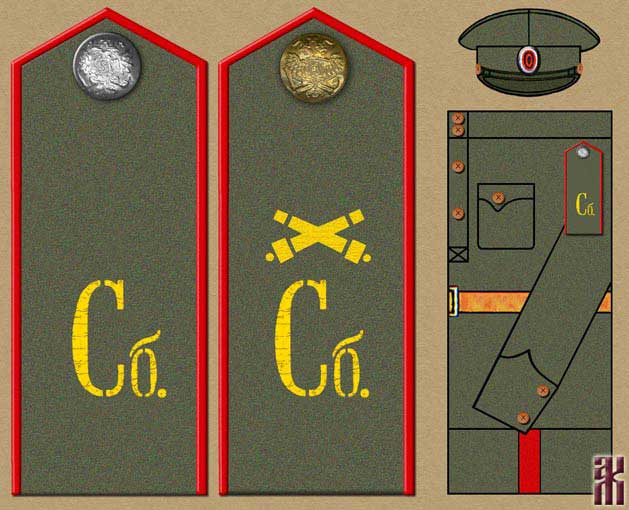
Shoulder-boards and uniform of Cossacks of the Siberian Host: 1 – major-general;
2 – lieutenant-colonel; 3 – staff-captain; 4 – Cossack; 5 – artillery private; 6 – Cossack
Ussuri Host: with the stenciled letter "У" (in addition to the unit number); for generals, as shown in the illustration, light-coloured, stitched with yellow stripes; black piping. For staff and senior officers – yellow stripes and black piping. For all other ranks – black piping.
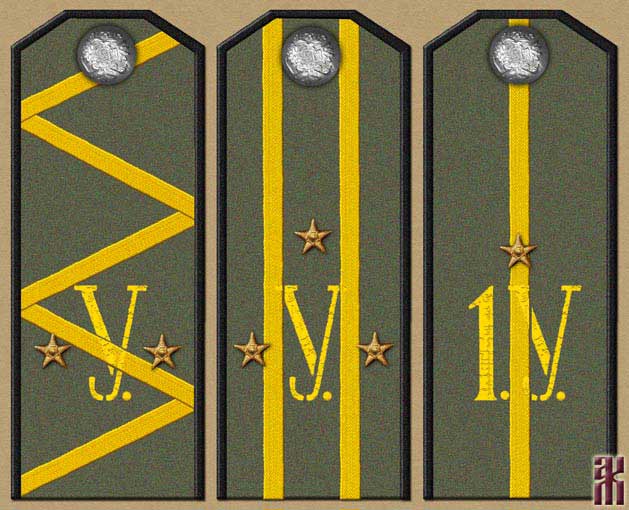
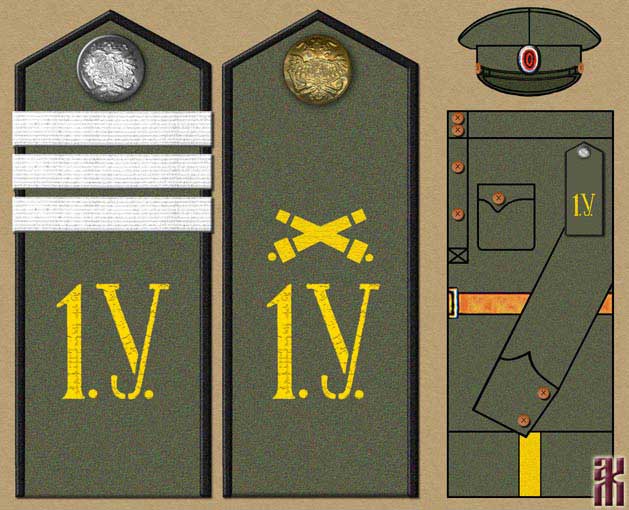
Shoulder-boards and uniform of Cossacks of the Ussuri Host: 1 – major-general;
2 – lieutenant-colonel; 3 – ensign; 4 – sergeant; 5 – artillery private; 6 – Cossack
Don Host: Blue piping. For generals, light-coloured, stitched with blue stripes; red piping. For staff and senior officers – blue stripes and red piping. For all other ranks – red piping.
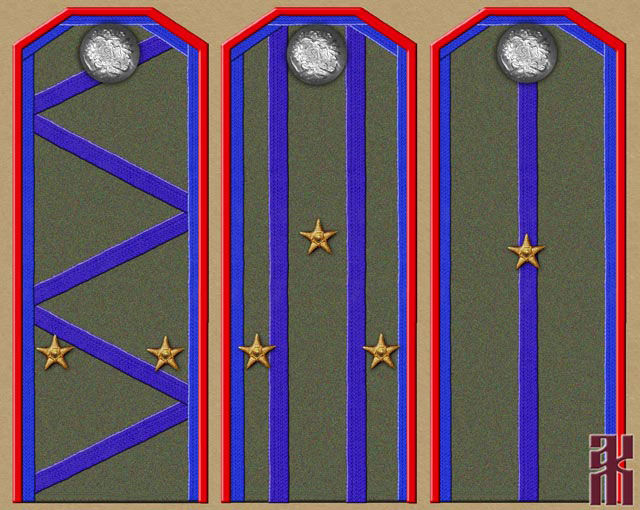
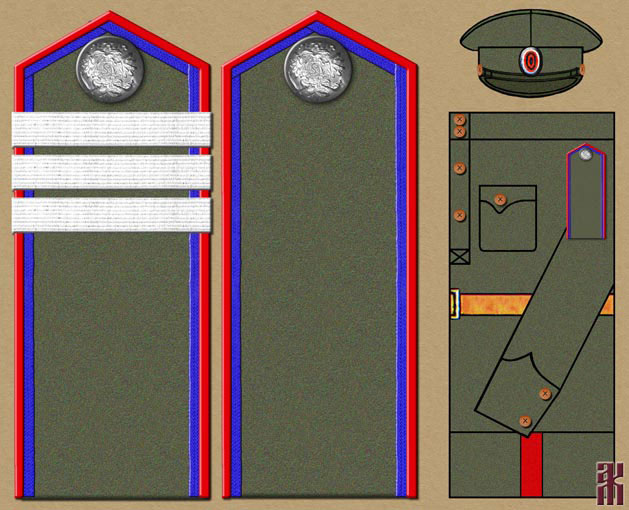
Shoulder-boards and uniform of Cossacks of the Don Host: 1 – major-general;
2 – lieutenant-colonel; 3 – ensign; 4 – sergeant; 5 – Cossack; 6 – Cossack
Amur Host: With the stenciled letter "A" (in addition to the unit number). For generals, according to the drawing: light-coloured, stitched with black stripes, yellow piping. For staff and senior officers – black stripes, yellow piping. For all other ranks – black piping.
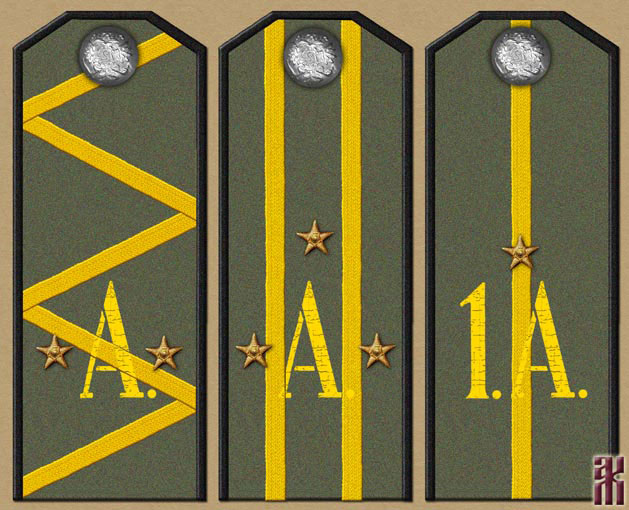
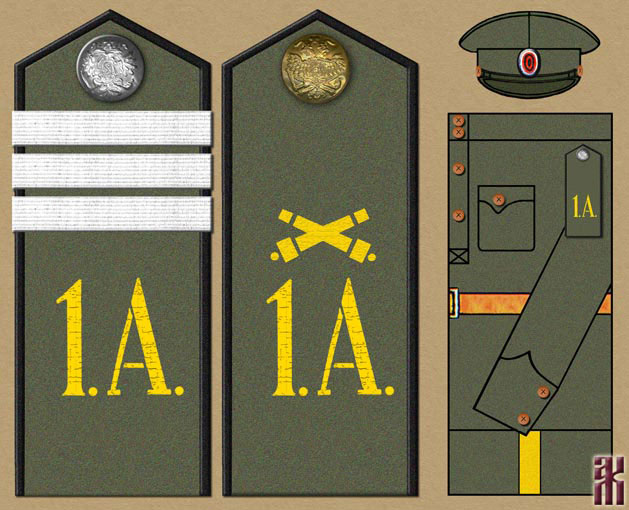
Shoulder-boards and uniform of Cossacks of the Amur Host: 1 – major-general;
2 – lieutenant-colonel; 3 – ensign; 4 – sergeant; 5 – artillery private; 6 – Cossack
Ural Host. For generals, as shown in the illustration, light-coloured, stitched with raspberry stripes, raspberry piping. For staff and senior officers – raspberry stripes, raspberry piping. For all other ranks – raspberry piping.
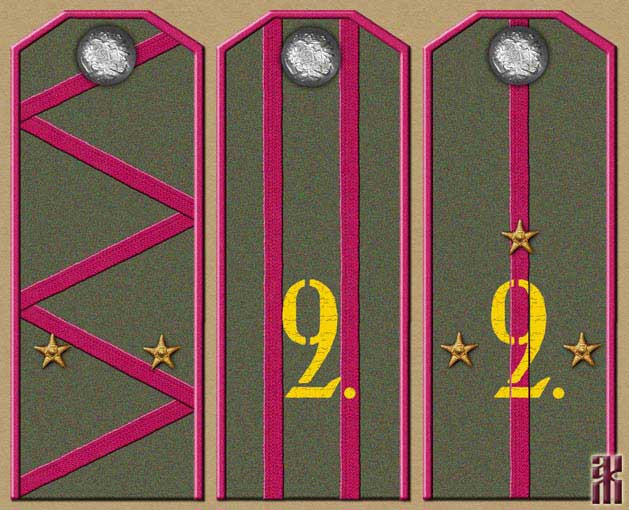
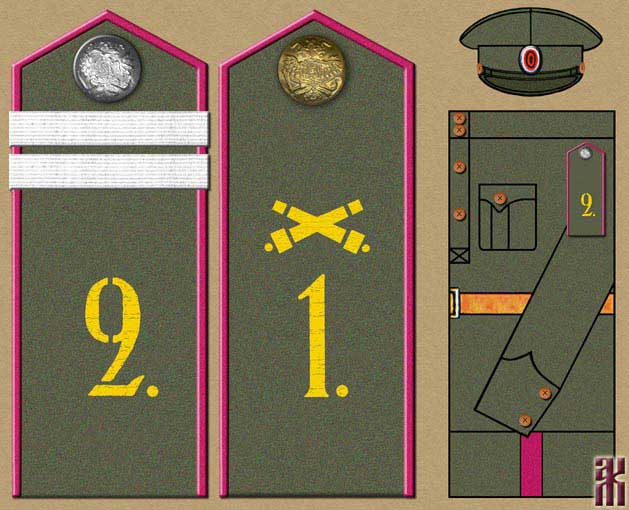
Shoulder-boards and uniform of Cossacks of the Ural Host: 1 – major-general;
2 – colonel; 3 – lieutenant; 4 – corporal; 5 – artillery private; 6 – Cossack
Astrakhan Host: with the stenciled letter "A" (in addition to the unit number). Otherwise identical to the Transbaikal Host.
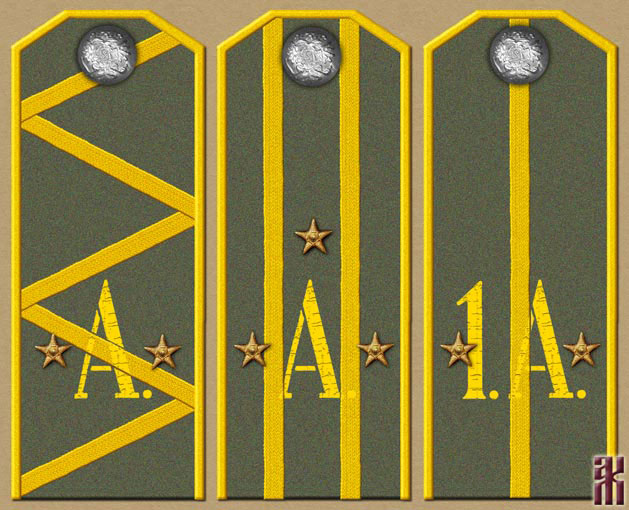
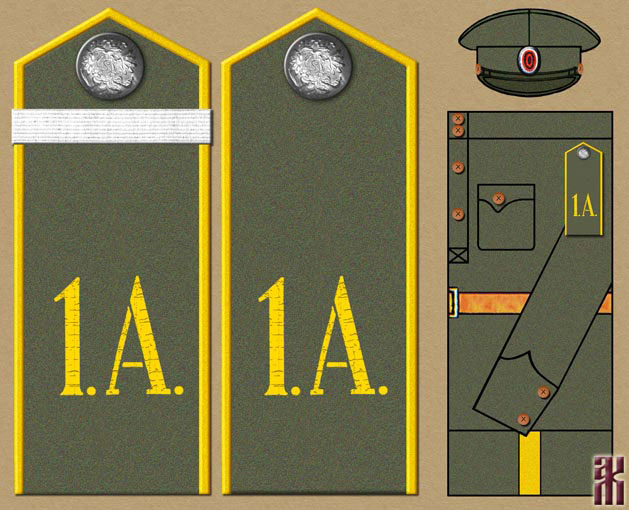
Shoulder-boards and uniform of Cossacks of the Astrakhan Host: 1 – major-general;
2 – lieutenant-colonel; 3 – second-lieutenant; 4 – lance-corporal; 5 – Cossack; 6 – Cossack
Semirechensk Host: with the stenciled letter "С" (in addition to the unit number). Otherwise identical to the Ural Host.
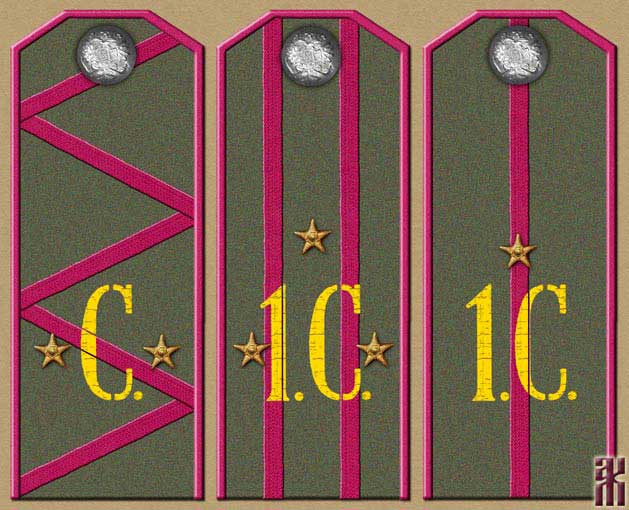
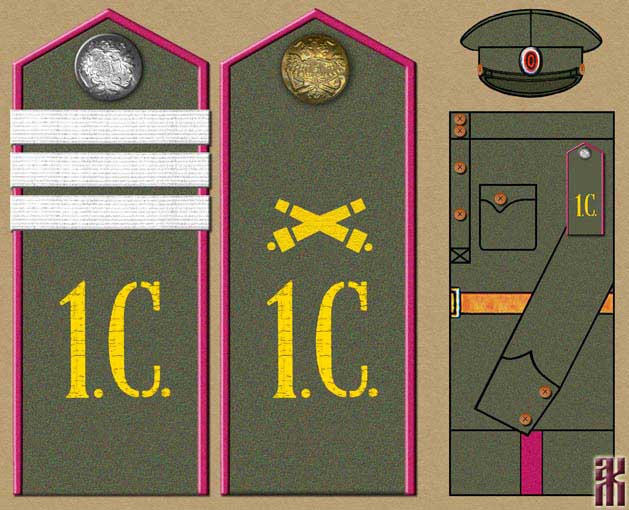
Shoulder-boards and uniform of Cossacks of the Semirechensk Host: 1 – major-general;
2 – lieutenant-colonel; 3 – ensign; 4 – sergeant; 5 – artillery private; 6 – Cossack
Irkutsk Host: with the stenciled letter "И" (in addition to the unit number). Otherwise identical to the Transbaikal Host.
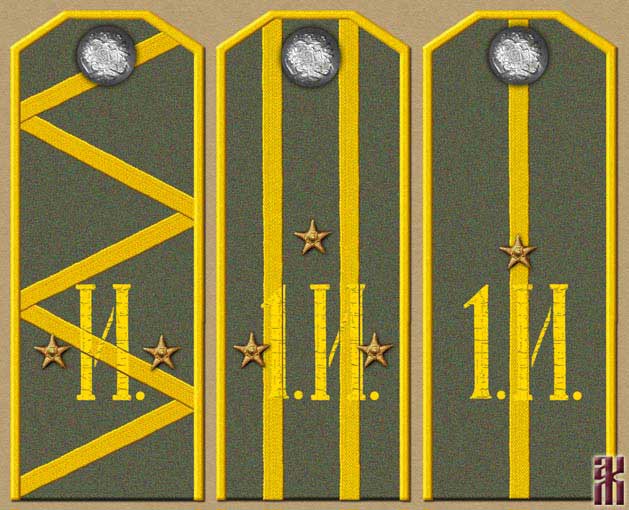
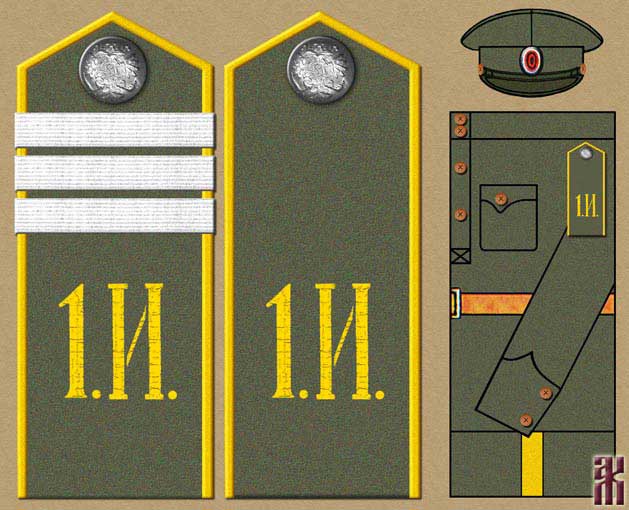
Shoulder-boards and uniform of Cossacks of the Irkutsk Host: 1 – major-general;
2 – lieutenant-colonel; 3 – ensign; 4 – sergeant; 5 – Cossack; 6 – Cossack
Items "D" and "E" on p.16 are cancelled.
Note.
1) The shoulder-boards of the escort sotnia of the 1st Independent Cossack Plastun Battalion are to be in accordance with Paragraphs 1 and 14 of Order No. 154.
2) For doctors and officials serving in Cossack units, the shoulder-boards shall be in accordance with Paragraphs 33 and 34.
3) Stenciled numbers, letters and specialist insignia shall be applied in yellow paint.
4) Samples of shoulder-boards are shown in the appendix to the order.
5) The wearing of metal braid shoulder-boards, strictly adhering to the uniform, is permitted with peacetime clothing (on coats, tunics, frock coats, cherkeska, pea jackets, greatcoats, etc., as well as with greatcoats, if they are made with metal buttons). On field clothing, shoulder-boards shall be worn in accordance with this order.
6) In all other respects, follow Order No. 154.
Signed: Lieutenant-General, Ataman Semenov.
Order No. 519 of the Commander-in-Chief of all Armed Forces and Field Ataman of all Cossack Units of the Russian Far Ears, 31 June 1920, Chita
Further to my order No. 412/16 of 30 May 1920 on the uniforms of the Cossack units, in view of the fact that there is only one Siberian Cossack regiment in the Russian Far East, without a number, I order all Cossacks of the Siberian Cossack Army to have a stenciled cipher "Сб." on their shoulder-boards instead of a number.
Signed: Lieutenant-General Akintievskiy
Home — State Symbols — Flags — Uniforms — Badges & Medals — Money — Other
Pygmy Wars Notes
The original for this page is at kolchakiya.ru/uniformology/Semenov_unit_02.htm.
This page is for the Cossack units in 1920 when the remnants of Kolchak's Russian Army made it to Transbaikalia, after the disastrous Ice March. For the period before, more or less 1919, when he had established control in Transbaikalia is here, and for the Transbaikal units in 1920 is here.
Discussion on the translation choices I have made can be found here.