
Uniforms of the Chinese Eastern Railway Exclusion Zone in 1918
(Orlov's Detachment)
Material and reconstructions by A. Karevskiy, unless noted otherwise.
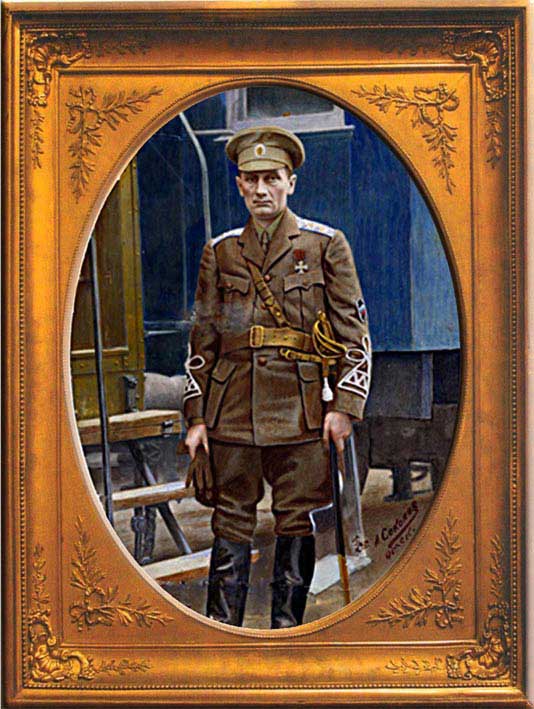
Artist A. Sokolov, Omsk, 1919, water colour
A. A. Petrov: Notes on the portrait of A. V. Kolchak
The Russian State Library's Department of Russian Literature Abroad kindly provided a unique portrait of Alexander Vasil'evich Kolchak, which has never been reproduced before.
At first glance, the portrait is striking for the unusual uniform worn by Alexander Vasil'evich. He is dressed in an English officer's khaki uniform: a tunic with an open collar, shirt and tie, breeches with boots, a cap and an English sword belt with a single shoulder strap. He wears the shoulder-boards of a lieutenant-general, silver braid with three gold stars and blue piping. But of particular interest are the distinctive marks on the sleeves of his uniform. This is a shield on the left sleeve above the elbow, which has a black field and piping made of silver cord, with a Russian national tricolour ribbon sewn diagonally across the field. In addition, on both sleeves above the cuffs, there are triangles made of silver cord, ending at the top with a "hussar knot"; along the lower side of the triangle, the same cord outlines a peculiar horizontally positioned quadrilateral across which runs a "general's zigzag" of silver braid. It would be reasonable to assume that these triangles are a kind of insignia of rank.
On the admiral's breeches, we also see a narrow stripe of silver cord or braid.
This portrait can be attributed to a photograph of Kolchak taken in Harbin in the summer of 1918, in which Alexander Vasil'evich is dressed in the same uniform as in the portrait. As is well known, Kolchak arrived in Harbin on 10 May 1918. At the invitation of the Director of the Chinese Eastern Railway, Lieutenant-General D. L. Khorvat, he accepted the post of Commander of Russian troops in the Chinese Eastern Railway's exclusion zone. However, due to disagreements with Ataman Semenov and the Japanese military mission that supported him, Kolchak was forced to resign that post and he left for Japan on 30 June. This happened five days before Khorvat's troops entered the Primor'e region, an offensive that Kolchak was supposed to lead as commander of those units.
The exact attribution of the uniform depicted in the portrait is hampered by the almost complete lack of reliable information about the uniforms of the units formed in the Chinese Eastern Railway exclusion zone. In addition, no images of any other person in a similar uniform are known to exist.
It would be tempting to see in this uniform the one presented to Kolchak by the officers of Colonel N. V. Orlov's detachment as a sign of recognition of the admiral as the head of the detachment. If we turn to Kolchak's portrait, both details mentioned by Budberg: a double-row of general's stripes and the cipher "O" with a curl above, are absent from the uniform depicted. Orlov, in turn, mentions only the distinctive arm patches introduced in his detachment. However, Semenov and Kalmykov's men also wore sleeve insignia: their appearance (unlike Orlov's shield) is known, and it differs from the shield depicted in the portrait. It is quite possible that all the white units formed at that time in the Chinese Eastern Railway's exclusion zone had different shields. Thus, the uniform depicted in the portrait could, in principle, belong to Orlov's detachment, the Sino-Russian Railway Guard, or the highest ranks of the Russian army headquarters. But in any case, it is undoubtedly a "commander's uniform", which existed in a single copy, with differences that no one else was entitled to claim.
Alexander Vasil'evich's awards deserve special mention. On his chest, we see the Order of St. George, 4th class, received in the Baltic in 1915. However, the most interesting thing is that the admiral's belt has a St. George sword attached to it – a gold sabre "For Bravery" with a St. George ribbon and a silver tassel. It was this very sabre that Alexander Vasil'evich, not wanting to be disarmed in disgrace, threw into the waves of the Black Sea from the bridge of his flagship on 6 June 1917. According to some sources, his colleagues later presented Kolchak with an identical weapon. This portrait seems to confirm that.
Kolchak is depicted standing on the tracks at the foot of a carriage. Indeed, he lived in his carriage the entire time he was in Harbin. Therefore, although the portrait itself is marked Omsk, it can be assumed that it was made based on a photograph from the Harbin period.
Published on the website of the Russian Abroad Library and Foundation at domrz.ru/news/kolchak_16_11_2004/petrov_annot.htm [link dead] as materials for A. S. Kruchinin's lecture "Admiral Kolchak – Commander and Ruler" on 16 November 2004.
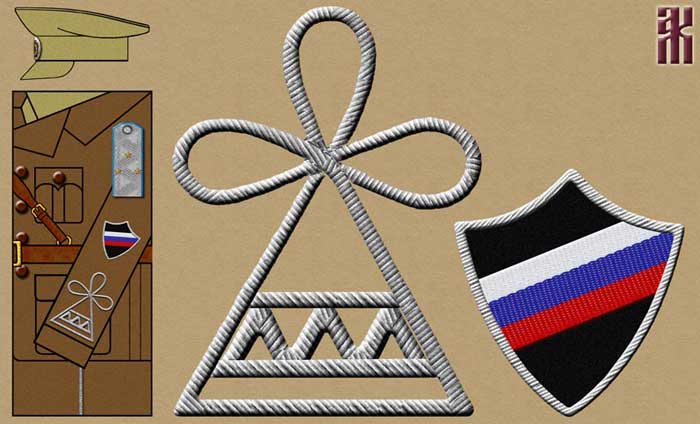
Drawing of Vice Admiral A.V. Kolchak's uniform during his tenure as a member of the Board of Directors of the Chinese Eastern Railway based on the 1919 picture by A. Sokolov
The image itself is a colour water colour from 1918, apparently made from a photograph and currently stored in the Russian State Library.
Orlov Unit
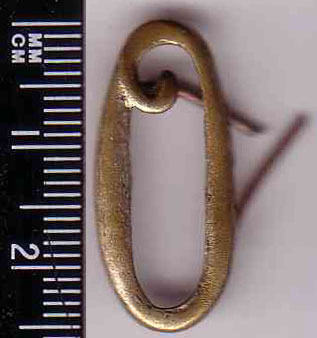
Harbin, 21 April 1918
Local military organisations invent various, sometimes ridiculous uniforms for themselves and then approve them. The Orlovtsy dressed up in general's shoulder-boards, and on them they depicted some circles with intricate squiggles: according to the most candid, this is supposed to symbolically represent the nooses on which they would hang all the Reds and "comrades", and to divert attention, something resembling the letter "O" – the first letter of their boss's surname – was added.
Budberg, A, p.in "Diary of a White Guard // Archive of the Russian Revolution, Vol. 13", Berlin, 1922, p.203.
On the left is a possible monogram of Orlov's detachment, with traces of silver plating. The photograph was kindly provided by "Rotmistr Ivanov".
Harbin, 1 June 1918
Orlov's men gave a dinner in Kolchak's honour and spent 25,000 rubles on it. They also presented the admiral with their detachment's parrot-like operetta uniform. Thanking them for the reception, the admiral went overboard and blurted out that the uniform presented to him made him as happy as he was on the day he received the St. George Cross.
Budberg, A, p.in "Diary of a White Guard // Archive of the Russian Revolution, Vol. 13", Berlin, 1922, pp.217-218.
Harbin, 1918
By nine o'clock in the evening, the guests began to arrive. They were mainly relatives and close friends of the Orlovtsy and their families. At the entrance, they were greeted by young, handsome, and slender officers, proud of their celebration and their new uniforms with the detachment's insignia attached to the left sleeve of their tunics. ...
Admiral Kolchak did not win the sympathy of our Russian generals either. They did not like the ovations given to the Admiral by the Orlovtsy. He was presented with an "Orlov uniform" and they organised a celebration for the occasion.
Orlov, N. V. in "Troubled Days in Harbin and Admiral Kolchak. Excerpt of the commentary by A. A. Petrov // Yearbook of the A. Solzhenitsyn House of Russian Emigrés", Moscow, 2010. pp.243, 248, also at www.rp-net.ru/book/articles/ezhegodnik/2010/17-Petrov.php#_ednref27
The British supported Orlov a little – that was the only thing the British did, and they mainly provided material support, because they had no weapons.
"Minutes of the meetings of the extraordinary investigative commission on the Kolchak case // Prisoner of the Fifth Chamber", Moscow, 1990, p.353.
[Kolchak] changed his civilian clothes for the military uniform established for the Border Guard Corps.
Bogdanov, K. A. in "Admiral Kolchak", St. Petersburg, 1993, p.131.
... in addition to shoulder-boards, all ranks of the detachment wore special sleeve insignia ... It is far from certain that those markings the same for everyone. It is known that the detachment included units from virtually all branches of the military: infantry (jaegers), cavalry, artillery, sappers, and even a naval company. Most likely, they wore shoulder-boards of different colours, depending on their branch of service. Furthermore, it is known that a significant number of officers served in the detachment in the ranks. Therefore, it is possible that, in addition to shoulder-boards, there were some differences in rank. In this regard, the arm-band on Admiral Kolchak's tunic should perhaps be interpreted as a distinctive sign of a "general" ... Sleeve insignia, shoulder-boards, the colour and piping of the shield – all of this could well have varied depending on rank and unit.
Petrov, A. A. in "My response to Alexei Karevskiy // Dobrovolets: XX Century, No. 2 (4)", Moscow, 2004, p.55.
Naval Company
According to memoirs, naval officers and midshipmen of the company wore the uniform and external insignia of the Russian Imperial Navy, with midshipmen wearing shoulder-boards with the white field of the Naval Academy rather than the black field of the Separate Midshipmen's Classes. The company had a sleeve insignia, the description of which has not yet been found. In his memoirs, A. A. Rakhmaninov says on this subject: "The guards immediately put on white shoulder-boards and insignia of the naval company on their sleeves." It can be stated with some certainty that this was the insignia of the Russian Imperial Navy's marines – a blue embroidered admiralty anchor on the left sleeve.
Kritskiy, N. N. in "On the question of external insignia of the White Movement's naval rifle formations in the Far East and Siberia (1918-1922) // History of White Siberia: Materials from the 6th international conference, 7-8 February 2005", Kemerovo, 2005, p.77, citing Rakhmaninov, A. A. in "A Brief History of the 1920 Graduates of the Naval Academy", Manuscript no later than 1931.
From Rachmaninov's memoirs
In an article written "in the heat of the moment" in 1923, he writes much more sharply and frankly: "The glorious Marine Company was housed in the Miller Barracks, preparing for the campaign and drinking and causing scandals in the already overcrowded military city of Harbin. ... Despite the efforts of the valiant commander, the whole company totally collapsed and bore little resemblance to a military unit. Everyone was dressed in civilian clothes, of very poor quality, and many dressed in whatever God had sent them. A private received 80 rubles a month, which was a decent amount of money for that time, and therefore everyone, from young to old, partied and drank while preparing to go and save Russia. At that time they saw salvation in the Constituent Assembly.
Kuznetsov, N. A. in "The War on the Amur in 1918, Little-Known Pages of History // Morskoy Sbornik, No. 7", 2010. Vol. 1960, p.86.
Orlov
Returning to Harbin, Colonel Orlov continued to form a detachment, which included, in addition to the existing units, the 3rd and 4th Companies, two independent artillery batteries, a machine-gun komand, motor and medical detachments, engineer, non-combat and musician companies, as well as a communications service. Captain V. V. Vrashtil's 2nd Company was turned into a horse divizion. Orlov arbitrarily seized uniforms and weapons (including guns and machine guns) for his detachment from the warehouses of the former Trans-Amur District Guard. "We had a hard time getting anything from General Samoilov," Orlov later recalled. "We asked, we were refused, and we took it by force!" By May 1918 the ranks of the "Homeland Defence Detachment" already numbered about 2,000 volunteers.
Simonov, D. G. in "The White Siberian Army in 1918", Novosibirsk, 2010. pp.54-55.
Meanwhile, some of the luckiest members of the aristocracy, bourgeoisie, and officer corps escaped the clutches of the revolutionaries and fled to the outskirts of the empire. Over time they formed combat units and were ready to fight the communists. Among these belated "restorers of Russia" were a few who chose Manchuria. Colonel Orlov was the first in that field. However, having no competitors and being unrestrained in his initiative, he did not go further than dressing hundreds of his followers in remarkably bright uniforms. At the time the city of Harbin thought it had been captured by an army of butlers and porters from the capitals of Europe.
Alioshin, D in "Asian Odyssey", New York, 1940, p.30
Guards of the Chinese Eastern Railway, 1901
The guards wore uniforms: black tunics and blue breeches with yellow stripes, caps with yellow piping and crowns. There were no shoulder-boards: the officers' shoulder-boards were replaced with images of golden dragons. The dragon (yellow or golden) was depicted on cockades, buttons, and sotnia pennons.
Shishov, A. V. in "Russia and Japan: History of Military Conflicts", Moscow, 2001, p.61.
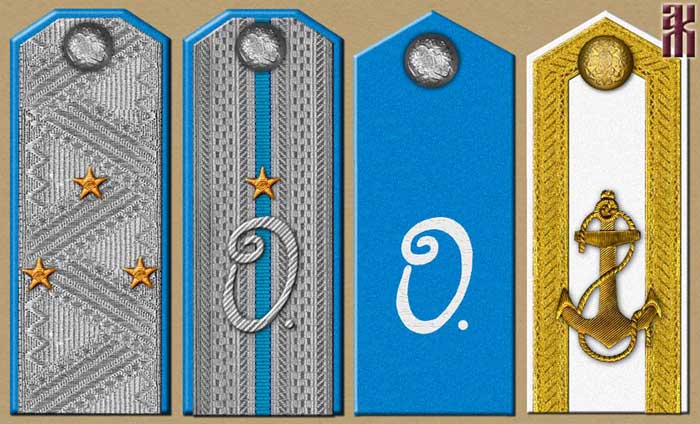
1 to 3 – shoulder-boards of Colonel Orlov's detachment (possible variant):;
4 – shoulder-boards of the detachment's Marine Company.
Light blue (sky blue) was chosen as the base colour for this reconstruction because it was the colour of the piping on Vice Admiral Kolchak's uniform. The monogram was reconstructed based on Budberg's memoirs.
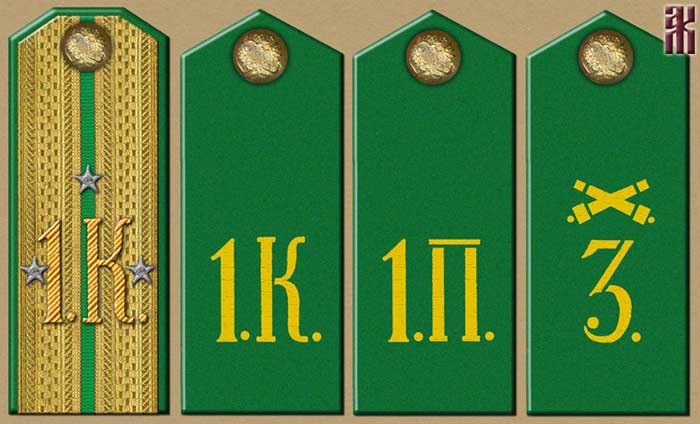
Shoulder-boards of the Trans-Amur District Independent Border Guard Corps:
1 and 2 – lieutenant and private of the 1st Trans-Amur Cavalry Regiment;
3 – private of the 1st Trans-Amur Infantry Regiment;
4 – 3rd Trans-Amur Horse Mountain Battery.
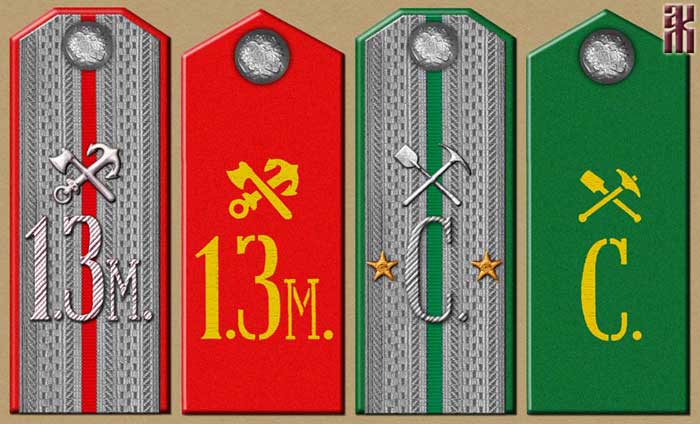
1 and 2 – shoulder-boards of a captain and private of the Trans-Amur Railway Brigade;
3 and 4 – shoulder-boards of a second lieutenant and private of the Trans-Amur Engineer Company
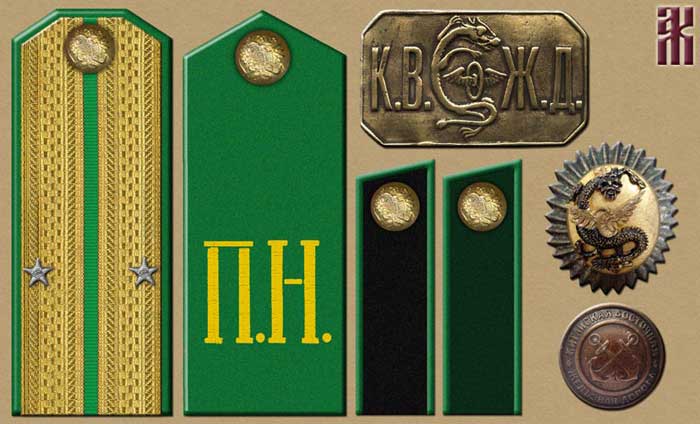
1 and 2 – shoulder-boards of a second lieutenant and private of the CEREZ police;
3 to 7 – buckle, tabs, officer's cockade and button of the CEREZ Security (until 1901)
Home — State Symbols — Flags — Uniforms — Badges & Medals — Money — Other
Pygmy Wars Notes
The original for this page is at kolchakiya.ru/uniformology/Orlov_unit.htm.
Discussion on the translation choices I have made can be found here.
History of Orlov's Detachment
The Chinese Eastern Railway military forces had fought quite well against the Chinese in 1900 and had expanded in the period before WWI to over 30,000 men. However almost all the fit men were withdrawn to the WWI fronts and the force dwindled to a quarter the size. With the revolution the Russians in China split into opposing factions, with the railwaymen in particular being Bolshevik.
It is in this context Orlov formed his force in Harbin, soon numbering 400 or so, and eventuall reaching four companies and support. But there was little or no fighting in China, however, as the Chinese took control and ejected most of the Bolshevik soldiers. The Whites (principally Orlov, Semenov, Kalmykov and Vrashtel) fought across the border into Transbaikalia and Primor'e, surviving under Japanese patronage.
When Kolchak went back to Japan, Orlov was removed from command of his detachment. After a brief retirement, upon Kolchak's coup he took command of the 32nd Siberian Rifle Regiment, taking a couple of dozen of his loyal officers with him. He served with them until the collapse of the front, eventually reaching China.
This general period is covered briefly but quite well in M. M. Walker's "The 1929 Sino-Soviet War: The War Nobody Knew" (2017).
There is further information about Kolchak's uniforms in the CER zone at this page.