
Uniforms of Admiral A. V. Kolchak
Material and reconstructions by A. Karevskiy
The evolution of the military uniforms worn by Admiral A. V. Kolchak during the period 1917-1920 deserves separate consideration, as it reflects the ideological and symbolic development of the revolution and the Civil War that followed it in Russia.
From August to October 1917, while in the United States as part of the Russian naval mission, Vice Admiral Kolchak wore the uniform established by Order No. 125 of the Minister of the Navy on 16 April 1917. In particular, there are photographs in which he is wearing a black double-breasted tunic with an open collar with two rows of five buttons, a white shirt with a turn-down collar and a black silk tie, as well as photographs with him in a blue jacket (without the changes in cut prescribed by the order). On the sleeves are the insignia established for a vice admiral, but the two stars are placed not under the shoulder-boards, as required by the order, but above them, above the round curl.
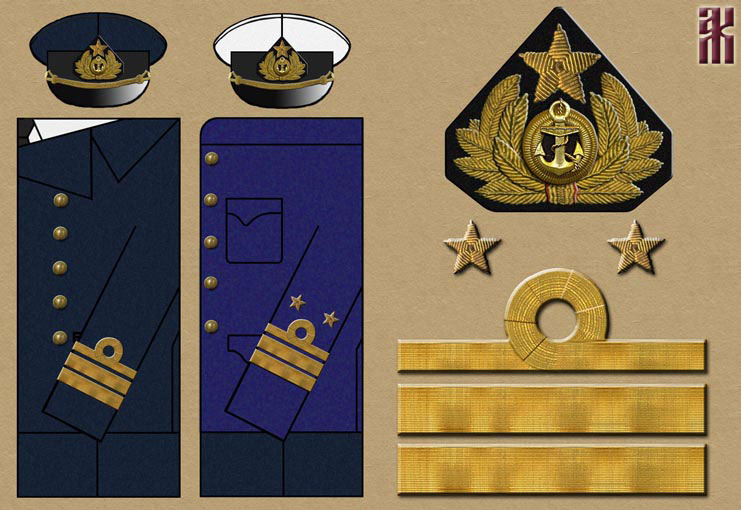
The uniforms of Vice Admiral Kolchak during his stay in the United States
as part of the Russian naval mission (August-October 1917)
Arriving in Japan in October 1917 as a private citizen, after completing his mission, Kolchak wears a civilian suit. He appears in the same attire in March 1918 in Harbin. After joining the Board of Directors of the Chinese Eastern Railway and being appointed Commander of Russian troops in the Chinese Eastern Railway exclusion zone, he once again donned his naval uniform. According to the memoirs of one of the officers of Colonel N. V. Orlov's detachment, in May 1918:
... both companies were called to the headquarters on alert, to a large hall, where they waited silently for their commanders. ... Finally, the commanders appeared. The head of the detachment, his assistant, and someone tall and slender in a black overcoat. The order was given to form a circle, and the commanders entered the middle, along with the newcomer. Some, from the Turkish front, immediately recognised him as Admiral Kolchak."
Kruchinin, A. S. in "Admiral Kolchak: Life, Deeds, Memory", Moscow, 2010, pp.226-227.
Orlov's detachment, which was the most genuine organised military force in the Chinese Eastern Railway's exclusion zone (not counting Ataman Semenov's Special Manchurian Detachment, which was not subordinate to the Chinese Eastern Railway Board), generally received the most attention from Kolchak. General A. P. Budberg, who was in Harbin at the time, noted in his diary on 1 June 1918:
Orlov's men gave a dinner in Kolchak's honour and spent 25,000 rubles on it; they also presented the admiral with their detachment's parrot-like operetta uniform. Thanking them for the reception, the admiral went overboard and blurted out that the uniform presented to him made him as happy as he was on the day he received the St. George Cross.
Budberg, A. P. in "Diary of a White Guard // Archive of the Russian Revolution, Vol. 13", Berlin, 1922, pp.217-218.
Kolchak's reference to the Cross of St. George was not accidental – because the admiral rightly saw attempts to revive the former Russian army in the Orlov detachment, which in his eyes was of undoubted value. Modern historian A. S. Kruchinin notes:
However, it is possible that the anecdote about the "Orlov trousers" is significantly distorted. It is contained in the "Diary" of General Baron A. P. Budberg – a collection of memoirs, gossip, rumours, and more or less scandalous news; and a number of anachronisms suggest that the entries in the "Diary", at least as published, were made after the fact. Incidentally, the date of the anecdote (1 June in Budberg's account) is questionable, since Orlov's biographer mentions Kolchak's enrollment in the detachment immediately after recounting the admiral's first meeting with his new subordinates: "The evening roll calls with prayer took place in an orderly and solemn manner: according to the detachment's lists, the duty officer called out "Private 1st Company – Admiral Kolchak, General Khorvat, General Pleshkov ..." To which the sergeant ... replied in a thick, not very fresh deep voice: "on official business", "on duty", "on leave", etc." Logically, enrollment in the unit's lists should have been accompanied by the presentation of the unit's uniform, and it is possible that Budberg's "Diary" postpones the event by two weeks from its actual moment.
Kruchinin, p.228.
The uniform in question is captured in two well-known photographs, as well as in a water colour by the artist O. Sokolov, currently stored in the Russian Emigrant Literature Department of the Russian State Library. In them, Kolchak is depicted wearing an English officer's tunic with an open collar, breeches and a cap, all in dark khaki. The cap is entirely light khaki (crown, brim and cloth-covered visor), without a chin strap, with a Russian officer's cockade. The tunic has four patch pockets and is fastened at the side with four large buttons covered with light brown leather. The buttons on the pockets are smaller and also covered with leather. A shirt with a tie is visible in the collar opening; the tie matches the colour of the uniform exactly, and the shirt is slightly lighter in colour. The shoulder-boards are those of a lieutenant general, made of silver braid with three gold stars and blue piping. The equipment is of the English type, with a belt slung diagonally across the right shoulder; the straps are light brown and the buckles are copper. On his feet are black cavalry boots with spurs, and in his hand are brown leather gloves. In addition, the uniform has the following distinctive features
- A shield on the left sleeve above the elbow with a black field and a silver cord piping, with a tricolour (white-blue-red) Russian national ribbon sewn diagonally across the field;
- On both sleeves above the cuffs, there are triangles of silver cord ending at the top with a hussar knot; inside the triangle at the bottom, the same silver cord outlines a frame in the form of a horizontal shoulder-board, along which (khaki-coloured) runs a "general's zigzag" of silver braid. The entire background of these distinctive insignia or rank insignia is the same colour as the uniform, i.e. khaki.
- On the breeches, there is a narrow stripe made of the same silver cord.
Contemporary researcher A. A. Petrov believes that "the uniform depicted in the portrait could, in principle, belong to Orlov's detachment, the Imperial Russian Railway Guard, or the highest ranks of the Russian army headquarters. But in any case, it is undoubtedly a "boss's uniform", which existed in a single copy, with distinctions that no one else was entitled to claim." However, in the photograph of Kolchak and his chief of staff, General M. M. Pleshkov, the latter is in an ordinary khaki tunic and trousers – the only difference being the silver general's shoulder-boards and aiguillette, indicating that the general belongs to the General Staff. This once again indicates that Kolchak's unusual uniform belonged to Orlov's detachment.
Petrov, A. A. in "Kolchak in "Khorvatia" // Dobrovolets, No. 2", Moscow, 2003, p.40, published on the website of the Russia Abroad Library and Foundation domrz.ru/news/kolchak_16_11_2004/petrov_annot.htm
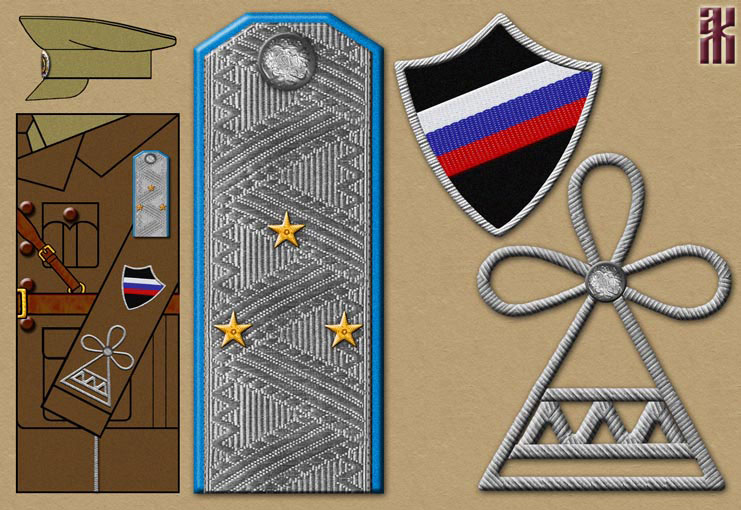
The uniform of Vice Admiral Kolchak during his tenure as Commander of Russian troops in the CER exclusion zone (May-September 1918)
After resigning from his duties as a member of the Chinese Eastern Railway Board and Commander of Russian troops in the Chinese Eastern Railway exclusion zone in September 1918, Kolchak once again wore civilian clothes during his forced stay in Japan and then in Vladivostok, emphasising his status as a private individual. It was in this suit, already worn and with evidence of extreme financial hardship, that the admiral arrived in Omsk on 13 October 1918 and introduced himself to the All-Russian Provisional Government (the Ufa Directory) and the Supreme Commander-in-Chief of all Russian land and naval forces, General V. G. Boldyrev.
His consent to take up the post of Minister of War and Navy in the Directory's government and his subsequent appointment on 4 November 1918, which marked his return to military service, restored his military image. In a photograph capturing the admiral in his new capacity, he is seated in a black naval tunic (apparently preserved from his time with the Russian naval mission in the United States), but without any insignia on his sleeves. Shoulder-boards can be seen but it is not possible to determine their appearance. Based on the fact that the order to restore the wearing of shoulder-boards by officers of the Naval Department and to abolish the sleeve insignia introduced by the Provisional Government was only issued on 29 November 1918 (Order No. 19 of the Fleet and Naval Department of 29 November 1918), and the fact that there are no distinctive braided shoulder-boards on the tunic, it can be assumed that A.V. Kolchak was wearing shoulder-boards based on the model he had established in 1917 for the Black Sea Fleet, i.e., the colour of the uniform, but with insignia identical to those on the sleeves. Since the photo was taken indoors, the appearance of the cap remains unknown, but we assume that Kolchak continued to wear his previous cap (of the model established by the Provisional Government), since the wearing of caps of the previous model (with white piping, a small visor and the old cockade) was only restored by Order No. 19.
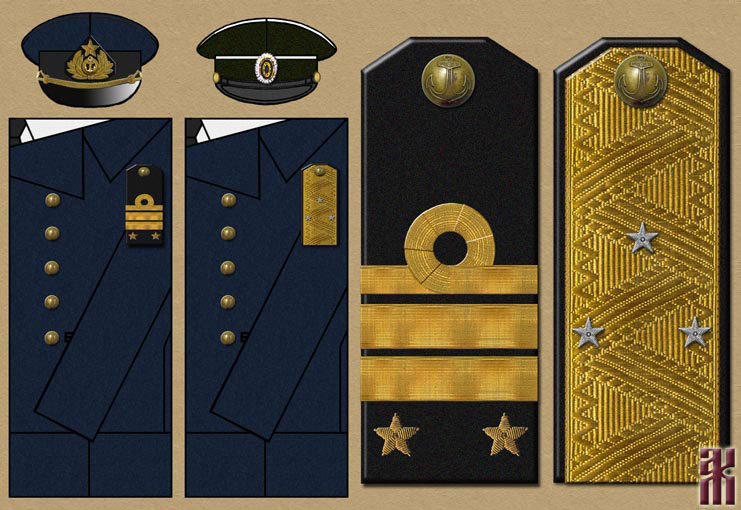
The uniform of Vice Admiral Kolchak during his tenure as Minister of War and Navy of the Provisional All-Russian Government (4-18 November 1918) and in the first days after his proclamation as Supreme Ruler of Russia
His proclamation as Supreme Ruler of Russia, his appointment as Supreme Commander-in-Chief of all land and naval forces, and his promotion to full admiral on 18 November 1918 forced Kolchak to once again pay close attention to his appearance, since his figure now personified the Russian state and its armed forces. The admiral himself paid close attention to military symbols; later, when asked by Alekseevskiy during interrogations in Irkutsk: "How did you personally feel about shoulder-boards?", he replied firmly:
I personally had a positive attitude towards them, arguing that they were a purely Russian distinction that did not exist anywhere else abroad. I believed that when our army wore shoulder-boards, it fought, and when it removed its shoulder-boards, it was associated with a period of great collapse and disgrace. I personally believed that there was no reason to remove the shoulder-boards. Our entire army had always worn shoulder-boards."
"Minutes of the meetings of the Extraordinary Investigative Commission on the Kolchak case // Prisoner of the Fifth Cell", Moscow, 1990, p.401.
His first steps in this direction are discussed in an article by A. Buyakov, N. Kritskiy, and N. Kuznetsov:
According to eyewitnesses, A. V. Kolchak put on his new shoulder-boards immediately on the day of his inauguration. A report by British Colonel D. Ward dated 18 November 1918 states that Kolchak came to him "in full Russian admiral's uniform".
Krasnov, V. G. in "Kolchak: Life and Death for Russia, Book 2", Moscow, 2000, p.49.
On 21 November 1918 General Boldyrev met with Kolchak. According to his recollections, Kolchak "was wearing new admiral's shoulder-boards. His friends took care of it."
Krasnov p.46.
However, documents found in the archives of the Russian State Naval Archives cast doubt on the accuracy of this information. For example, a telephone message dated 27 November 1918 recorded a conversation between the commander of the 1st and 3rd Divizions of the River Combat Fleet (in practice the senior officer in the area of operations and commander of the entire flotilla) Rear Admiral G. K. Stark and the chief of staff of the River Combat Fleet, Captain N. G. Fomin, who was in Omsk at the time. When Stark asked, "What is the current uniform for officers?", Fomin replied, "We have put on gold shoulder-boards and removed our patches, following the example of the admiral [Kolchak], but the uniform has not yet been approved due to the absence of the Ministry of the Navy." When asked, "What shoulder-boards does the admiral have?", Fomin replied, "For now, those of a lieutenant general of the Admiralty, as there are no eagles. They have been ordered from Vladivostok." Indeed, at the time of Kolchak's promotion, samples of the new admiral shoulder-boards did not yet exist. It was probably the need to manufacture shoulder-boards for the Supreme Commander-in-Chief that accelerated their development and the adoption of official documents. Finally, on 6 December 1918, Order No. 22 of the Fleet and Naval Department approved the description and drawings of the admiral's shoulder-boards. Kolchak was to wear shoulder-boards of that particular design.
Buyakov, A., Kritskiy, N. and Kuznetsov, N. in "The shoulder-boards of A. V. Kolchak // Tseykhgauz, No. 17", Moscow, 2002, p.35, citing RGA VMF F.r.1722 Op.1 D.44 L.12ob and RGA VMF F.r.17.22 Op.5 D.348 L.7.
Those shoulder-boards were hexagonal in shape, with a gold braid field of a standard pattern. They were lined with black cloth and had buttons bearing the image of the Admiralty anchor. The unusual pattern of double-headed eagles with outstretched wings, devoid of their former state attributes (crown, sceptre and orb) and superimposed on two crossed Admiralty anchors, attracts attention. On the chest of the eagles, perched on a blue St. Andrew's ribbon, there was a shield with a red field and gold piping, embroidered with the image of St. George the Victorious. The embroidery was done with black cotton thread, and the details of the plumage were worked in gold metal thread.
Numerous published photographs of the Supreme Ruler allow us to reconstruct his appearance at different moments of his life. Kolchak's main "work" clothing was an "English" khaki tunic with four patch pockets (with bow folds and non-fastening "toe" flaps), a turn-down collar, five buttons, and with cuffs fastened with one button each. It was complemented by narrow breeches of the same colour, tucked into high boots, and an English belt with a shoulder strap. During trips to the front, the gold admiral's shoulder-boards described above were replaced with cloth khaki shoulder-boards with a zigzag pattern of narrow gold braid sewn on. At first, the admiral wore a standard officer's cap – made of light khaki cloth, with a leather visor and chin strap. Then a cap was made for him to match his tunic, without a chin strap and with a visor covered with the same fabric. The cockade on all of them was of the previous officer's model.
As outer wear in winter, Kolchak initially wore a soldier's greatcoat made of thin light grey cloth with khaki shoulder-boards and buttonholes (with covered buttons on both). According to eyewitnesses, Kolchak was repeatedly urged to dress more warmly, but he invariably refused, arguing that he had to share all the hardships of his subordinates and had no right to dress up while the troops under his command were undressed. The result was severe pneumonia, contracted during a parade in Omsk in December 1918. Later, from the spring of 1919, Kolchak wore a different greatcoat – still of a soldier's cut, but made of much thicker and denser cloth and with "cavalry" cuffs and a peaked collar. The colour of the overcoat changed to dark; the buttons on the lapels and flaps were metal (most likely with the image of an admiralty anchor), but the lapels and shoulder-boards themselves remained khaki. On both overcoats, a ribbon of the Order of St. George, 4th class, was always sewn on the right side.
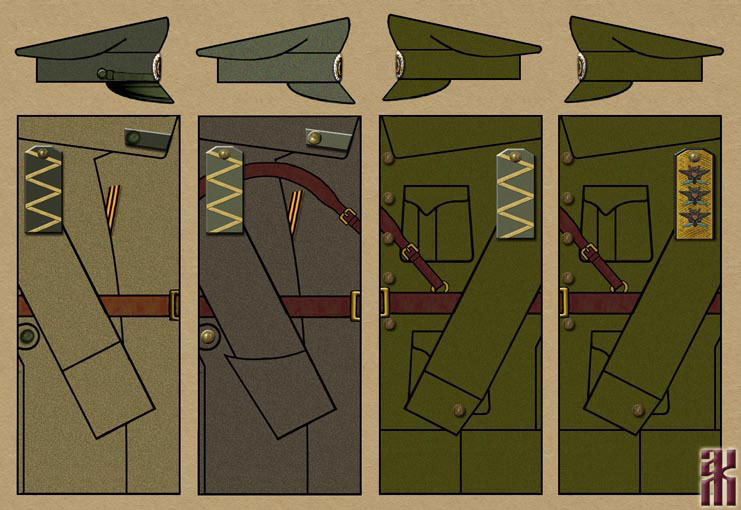
Uniforms of Supreme Commander-in-Chief Admiral Kolchak, November 1918-January 1920
In addition, during particularly cold periods, Kolchak also wore a long bekesha made of dark cloth (with black lambskin lining, collar and cuffs), as well as a light grey fur papakha. This is how he is depicted in photographs preserved from his visit to Orenburg in February 1919. It is characteristic that the admiral practically never wore his naval uniform – there is only one photograph in which he is dressed in a black officer's coat with gold admiral's shoulder-boards and a black officer's naval cap with white piping.
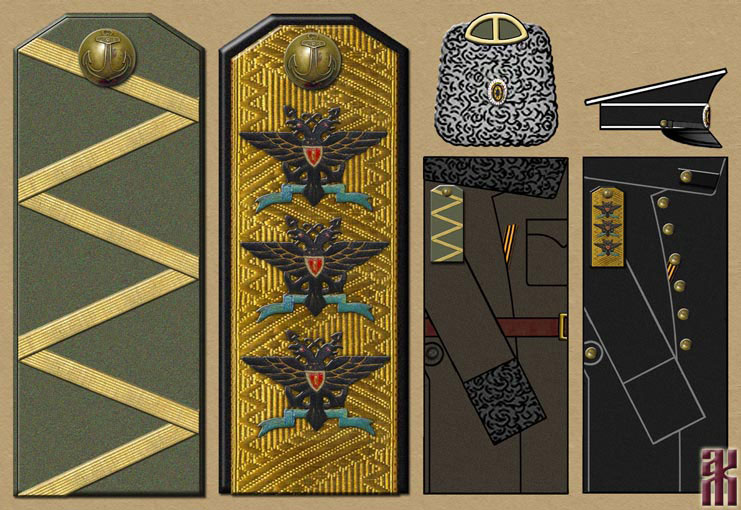
Uniforms of Supreme Commander-in-Chief Admiral Kolchak, November 1918-January 1920
The ascetic appearance of the Supreme Ruler and Supreme Commander-in-Chief was harshly criticised by the Minister of War, General Budberg, who noted in his diary on 31 May 1919:
The troops' ignorance of what is happening at the front and in the rear is staggering; as an example, there is a letter from one soldier saying that "some English admiral Kilchak, probably one of the new speakers, came and handed out cigarettes" ... This is what the unvarnished impression of the admiral's visits, which he attaches such importance to, boils down to. I see that I was right when I advised the admiral to go to the front in a general's uniform, not a khaki one, but with shoulder-boards and red lapels; one must understand the habits of our soldiers and ordinary officers, who believe that a high-ranking official should have a lot of red on his uniform.
Budberg, A. P. in "Diary of a White Guard", Minsk, 2001, p.92.
Nevertheless, it seems that it was precisely this image of a modest soldier that most closely corresponded to Kolchak's views on the nature of his power and his own position as, first and foremost, a military leader exercising his authority until the restoration of law and order in the country and the resumption of normal state life.
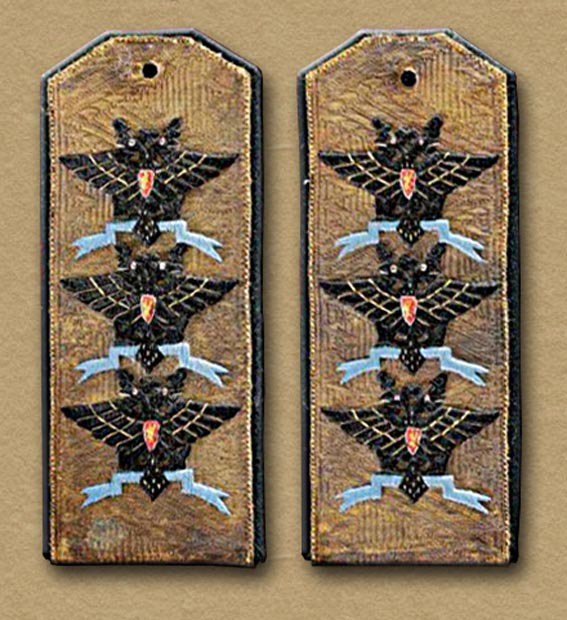
The shoulder-boards of a full admiral, allegedly belonging to Admiral Kolchak
(according to an Andreas Thies auction)
Home — State Symbols — Flags — Uniforms — Badges & Medals — Money — Other
Pygmy Wars Notes
The original for this page is at kolchakiya.ru/uniformology/Kolchak_portrait.htm.
There is some more discussion of Kolchak's uniform while in the CER zone at this page.
Discussion on the translation choices I have made can be found here.