
Uniforms of the 2nd Syzran Rifle Division
Material and reconstructions by A. Karevskiy
The uniforms of the 2nd Syzran Rifle Division have been reconstructed on the basis on the field uniforms of the former Russian Army, with elements preserved from the uniforms of the Volga People's Army (black trousers in the artillery and dark green in the engineer units). This division was the only one that, after the fall of the KOMUCH's Volga Front, retreated to the Independent Orenburg Army. It and the 5th Orenburg Rifle Division became that host's main infantry units. It is assumed that coloured shoulder-boards were never introduced in the division, remaining khaki from the autumn of 1918 onwards.
This conclusion is indirectly confirmed by the 1931 painting by E. A. Tikhmenev, "The Battle on the Salmysh River". The artist had moved to Orenburg in 1928, worked as a designer for the local museum of local lore, and collected relevant historical material for his work. The painting depicts an episode from the Orenburg operation of the White Army's Eastern Front, in which the 4th Orenburg Army Corps was involved. The units of the 2nd Syzran Division crossing the Salmysh River at the end of April 1919 are depicted in khaki uniforms with the same shoulder-boards. Coloured elements in the form of blue trousers with stripes and coloured shoulder-boards are shown only on the Orenburg Cossacks.
Most of the ciphers on the shoulder-boards are shown as stenciled. Due to an acute shortage of the necessary fittings, the experience of the summer of 1918 was again used here, when by Order No. 31 of the division commander, Colonel (later General) A. S. Bakich, dated 5 September 1918, the following was established:
In view of the fact that the insignia of soldiers' ranks must now be made on shields rather than on shoulder-boards, the numbers of the latter should be stenciled in the middle of the shoulder-board, carefully observing uniformity.
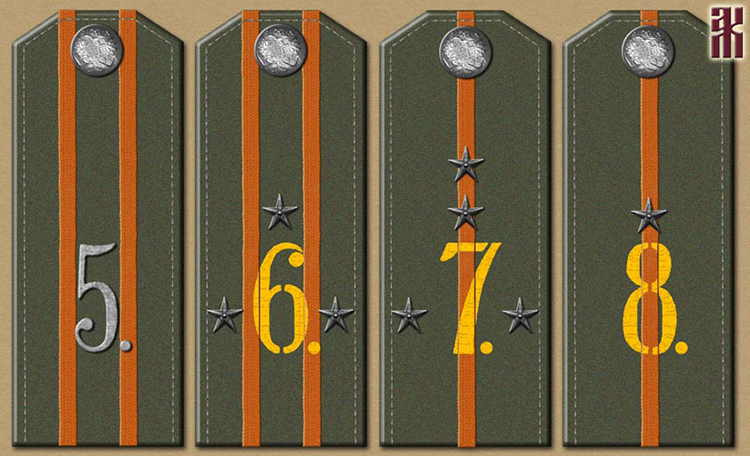
Shoulder-boards of officers of the rifle regiments of the 2nd Syzran Rifle Division:
1 – colonel of the 5th Syzran Rifle Regiment;
2 – lieutenant-colonel of the 6th Syzran Rifle Regiment;
3 – staff-captain of the 7th Khvalynsk Rifle Regiment;
4 – ensign of the 8th Vol'sk Rifle Regiment
The cipher in Figure 1 is shown with metal number, on the assumption some were preserved from the uniform of the Volga People's Army.
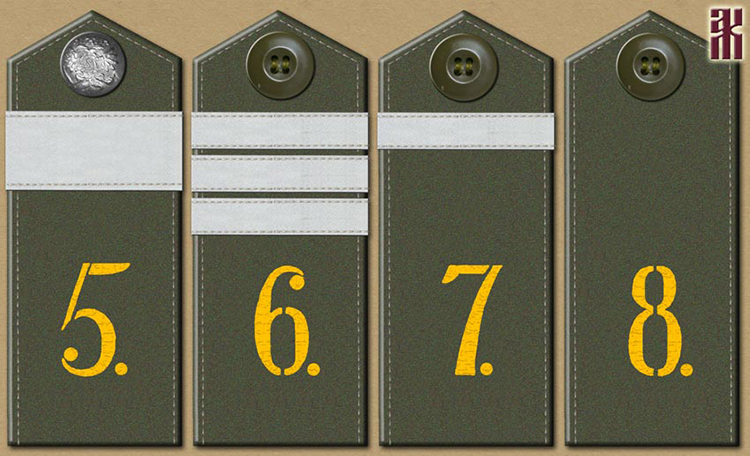
Shoulder-boards of lower ranks of rifle regiments of the 2nd Syzran Rifle Division:
1 – sergeant-major of the 5th Syzran Rifle Regiment;
2 – sergeant of the 6th Syzran Rifle Regiment;
3 – lance-corporal of the 7th Khvalynsk Rifle Regiment;
4 – private of the 8th Vol'sk Rifle Regiment
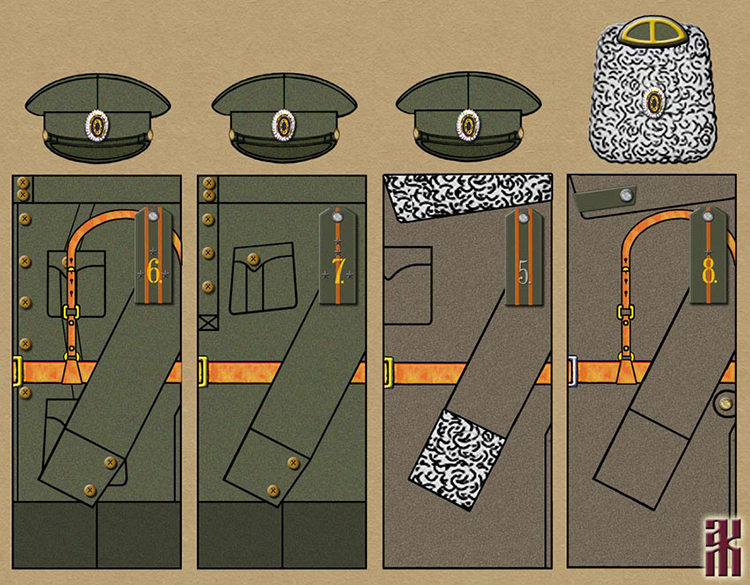
Uniforms of officers of the rifle regiments of the 2nd Syzran Rifle Division
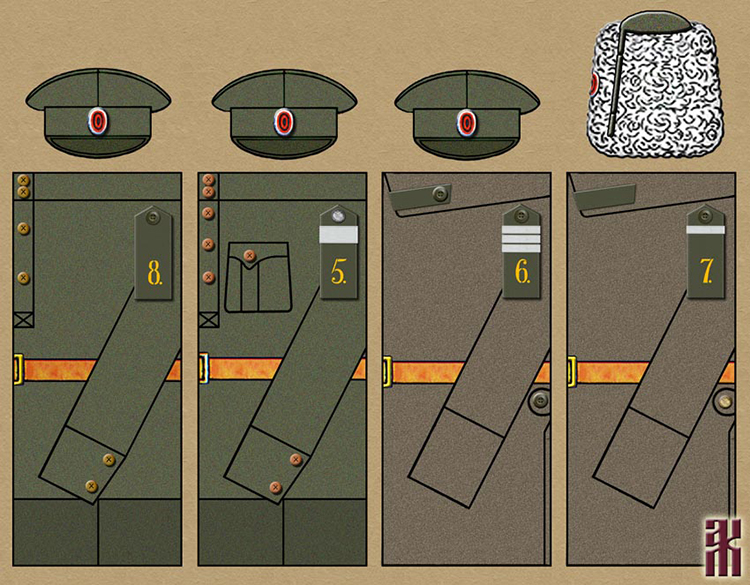
Uniforms of other ranks of the rifle regiments of the 2nd Syzran Rifle Division
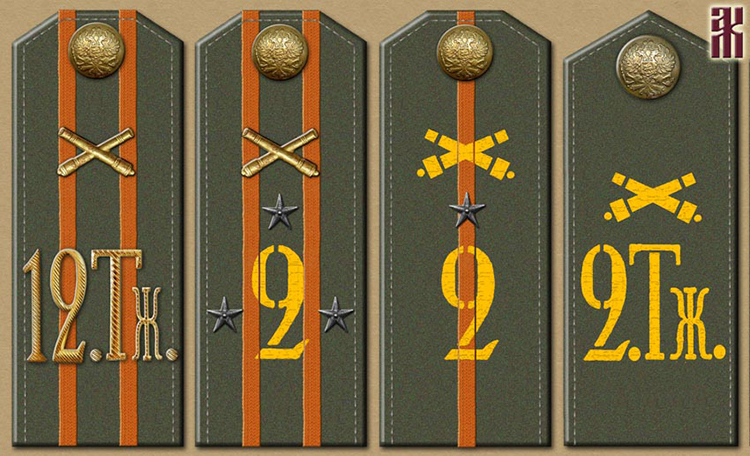
Shoulder-boards of artillerymen of the 2nd Syzran Rifle Division;
1 – colonel of the 12th Heavy Artillery Divizion with metal insignia from the imperial period;
2 – lieutenant-colonel of the 2nd Syzran Light Artillery Brigade;
3 – ensign of the 2nd Syzran Artillery Brigade;
4 – gunner of the 2nd Heavy Artillery Divizion
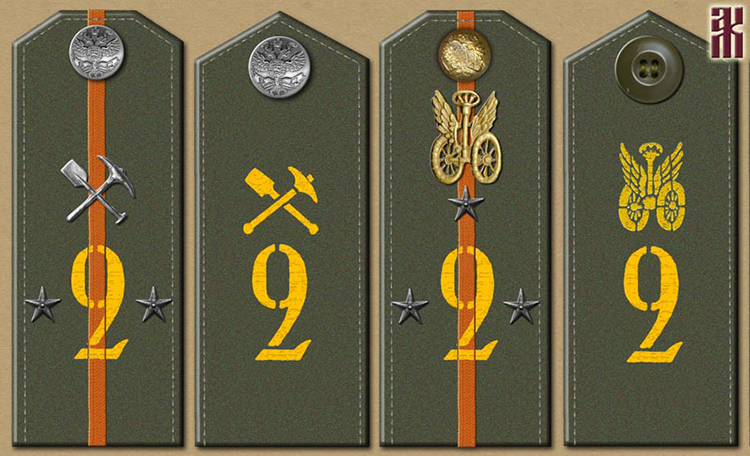
Shoulder-boards of specialists in the 2nd Syzran Rifle Division;
1 and 2 – second lieutenant and sapper in the 2nd Syzran Engineer Company;
3 and 4 – lieutenant and private of the 2nd Syzran Motor Transport Company
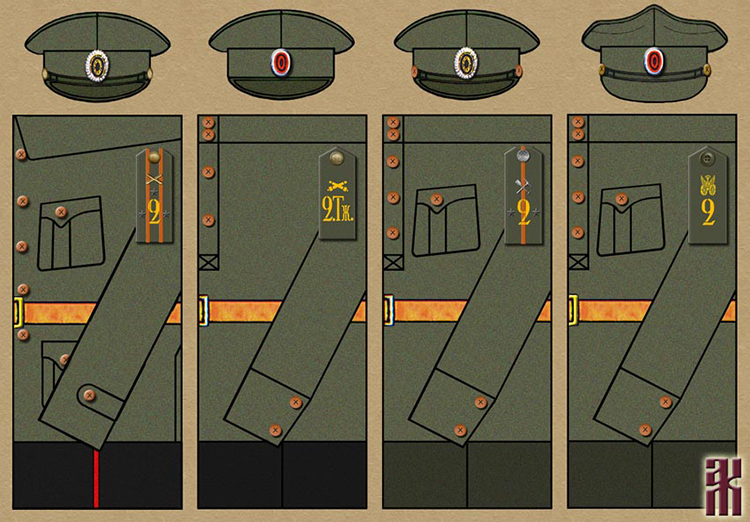
Uniforms of the technical units of the 2nd Syzran Rifle Division
Home — State Symbols — Flags — Uniforms — Badges & Medals — Money — Other
Pygmy Wars Notes
The original for this page is at kolchakiya.ru/uniformology/2_Syzran_div.htm.
Tikhmenev's painting "The Battle on the Salmysh River" can be seen here.
Discussion on the translation choices I have made can be found here.
Flags
Early on the original regiments flew largely red flags or those in the colours of St George (yellow and black stripes). I think it unlikely that the red flags would have survived into Kolchak's army, but the St George colours likely did.
It seems unlikely that they had former Imperial flags.
A unit marker, rather than ceremonial banner has survived in the Chapaev Museum.
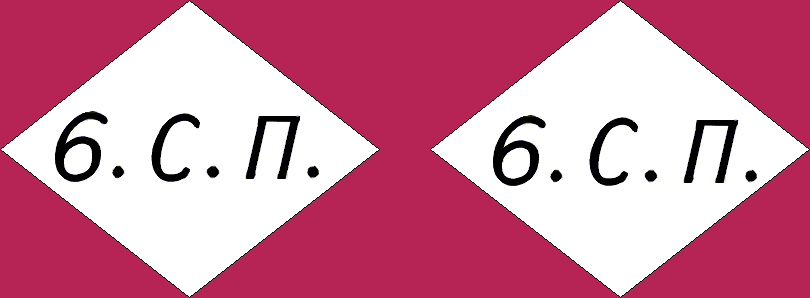
It is in rifle raspberry and the letters make sense as the 6th Syrzan Regiment. Moreover that unit fought in the same area as Chapaev.
History of the 2nd Syzran Rifle Division.
Taken from Volkov and Ganin's biography of General Bakich, the unit's commander.
The division was formed July 1918 as part of the People's Army from units in the Syzran district: during the retreat across the Volga, the Southern Group (advancing towards Saratov under Colonel Makhin) and the Syzran Group (covering Samara from the Penza side under Colonel Bakich) were merged. It was made up of the 5th Syzran (formerly the 1st Syzran Volunteer), 6th Syzran (formerly the 1st Syzran Reserve), 7th Khvalyn (formerly battalion), and the 8th Vol'sk Rifle Regiments, the 2nd Syzran Cavalry Regiment (formerly the Syzran Horse Detachment), 2nd Syzran Artillery Brigade (four batteries), 1st Syzran and 12th Field Heavy Artillery Divizions, the 1st Kuznetsk Independent Battalion, the 1st Syzran Partisan Detachment, a detachment of Menshevik "Defenders of the Constituent Assembly", an engineer company, a motor transport company, a searchlight platoon, a radio station, and a platoon of the 3rd Aviation Detachment. Many of the units were largely volunteers, whereas others had mostly conscripts, and numbers were quite healthy.
It operated with the Czechs in the Syzran area until the weight of Red numbers forced them back to Samara. From December 1918, after the retreat from the Volga, it was part of the 4th Orenburg Army Corps, and from that time provided the bulk of the Orenburg host's infantry. In March the division was down to just over 1,000 bayonets, 42 MGs and the 5 guns of the 2nd Rifle Artillery Divizion. Numbers grew from that point until it suffered massively at the defeat on the Salmysh in the culminating point of Kolchak's southern drive.
The division withdrew across the Urals and held for a while, apparently regaining much of its ability. However, at the end of 1919, with the defeat of the Orenburg host, it retreated south-east to the Semirech'e (rather than east with the main Siberian army) and became part of the Orenburg Army detachment of the Independent Semirechensk Army. Many of the remaining men withdrew with Bakich into China.