
Uniforms of the Marine Rifle Units, 1918-1922
All material and reconstructions are by A. Karevskiy unless noted otherwise.
The first order regulating the uniform and insignia of the Marine Rifle Brigade was Order No. 29 of the Fleet and Naval Department dated 12 December 1918, signed by Rear Admiral M. I. Smirnov, head of the Naval Ministry. The text of the order stated:
The Independent Marine Rifle Brigade shall be assigned a khaki uniform of the type established for army infantry units, with the following distinctions:
The left sleeve shall have a blue anchor embroidered on it.
Officers shall have shoulder-boards of the type adopted for naval officers, embroidered with the letters "М.С." (Marine Rifles) in the colour of the device and with copper fittings depicting:
a) Two crossed rifles – for officers in the Naval Rifles.
b) Two crossed cannons – for officers in the artillery of the Naval Rifles.
Non-commissioned officers and privates shall have the black letters "М.С." on their shoulder-boards.
Officers shall carry weapons accepted in the navy.
Note: Due to the difficulty of obtaining naval weapons, those who do not have them shall carry sabres.
Officers seconded to the Marine Rifle Brigade shall wear the uniform of their main units. {53} (...)
Concerning the "blue anchor embroidered" on the sleeve, it was most likely based on similar insignia worn during the World War by naval units operating on land. Apparently, there was no single standard for such insignia, and we assume that the anchors, in particular, would repeat the design of the red embroidered anchor established by the Provisional Government by Order No. 142 of the Maritime Department of 21 April 1917 to distinguish military sailors from the sailors of the Volunteer and commercial fleets. (...) The basis here was the image of the Admiralty anchor, approved for midshipmen's shoulder-boards on 25 June 1832 which remained unchanged until 1917. By analogy with other insignia of that type, we can assume that the anchor was embroidered on a small oval or diamond-shaped piece of fabric in the colour of the uniform. Similarly, it could be cut out of blue fabric and sewn to the backing along or across the edges.
There was some inconsistency in the assigned uniforms: officers received naval shoulder-boards, while privates received army-style khaki shoulder-boards. Soon, however, there was a change in the insignia for the lower ranks of the brigade. On 1 February 1919, Order No. 45, signed by the head of the Naval Ministry, introduced the following changes: "Non-commissioned officers and privates of the Independent Brigade of Naval Riflemen shall have black shoulder-boards with yellow letters "M.C." and yellow arms." {58} Obviously, the "arms" mentioned in the order refers to the crossed rifles for naval riflemen and crossed gun barrels for naval rifle-artillerymen described in Order No. 29.
Since the brigade was in the early stages of formation at that time, the reality was that not everything was going smoothly with its uniforms. This is evidenced by a number of orders from its commander, Rear Admiral Stark. Thus, in order No. 41 of 14 February 1919, the brigade commander wrote:
On 12 February, three riflemen from the brigade were detained at the cinema for being dressed out of uniform and without documents. I propose that battalion commanders only allow people to leave the barracks with leave passes and strictly ensure that all ranks have shoulder-boards. At the same time, I have noticed that many riflemen appear on the street dressed extremely carelessly, often in torn uniforms and unbuttoned greatcoats, and do not have the proper military appearance. I instruct company commanders and all command personnel to strictly monitor the uniforms of their companies and to explain to all riflemen that each of them must carefully monitor their own uniforms, go on leave neatly dressed, and have the proper military appearance befitting a rifleman of the brigade. They should follow the example of foreign military units and impress upon the riflemen that they should be dressed just as neatly and behave in a manner befitting a rifleman of the Naval Brigade so as not to undermine its dignity in front of strangers. (...). Some riflemen arriving to replenish the brigade have uniforms that are not entirely serviceable, and sometimes even unsuitable. Appropriate reports should be drawn up when accepting people. At the same time, in view of the arrival of the Field Controller in the brigade, it is now possible to appoint a commission to reject unsuitable property. {59}
In brigade Order No. 49 of 22 February 1919, Stark noted the fact that the guard outside the brigade warehouse was standing in a torn sheepskin coat in 15-degree frost "...although the brigade has sheepskin coats". {60} But, judging by all appearances, there were only enough of them to provide for the sentries. In the brigade order of 25 April 1919, No. 112, its commander also noted such a characteristic violation of the dress code:
I have repeatedly noticed that the brigade's riflemen wear sailor caps. I propose that the battalion commanders immediately replace those caps with infantry-style caps and, in general, ensure that the riflemen's clothing is more uniform, as well as ensure that the riflemen do not go without greatcoats and belts. {61}
Meanwhile, in the spring of 1919, the command was concerned with purchasing or manufacturing a large batch of uniform clothing for all brigade personnel. In January-March, the issue of purchasing 7,000 sets of soldier's uniforms and 3,000 sets of sailor's uniforms in Vladivostok for the needs of the Ministry of the Navy was intensively discussed. The soldier's uniforms were obviously intended primarily for the marine rifle battalions.
But on 18 March 1919 the Ministry of the Navy in Omsk received an attractive offer from Vladivostok to purchase uniforms in Japan:
There is an offer from the counterpart of Glavmorhoz Lukin to supply 5,000 sets of French-style soldier's uniforms in khaki, which differs little from ours, with the exception of the jacket. The set consists of a greatcoat, a cloth jacket, trousers, two summer blouses and trousers, and three sets of underwear. Payment in rubles at the daily exchange rate for the yen, the cost of a set is 82 yen. Russian-style caps are available. The material is of good quality and, according to references, the price is low. Admiral Timirëv and I consider this uniform to be highly desirable for the units of the Naval Brigade. The uniforms can be shipped within six days and in large quantities, at least up to 20,000 sets. Approximately 2.5 million rubles will be required, which, if you agree, must be transferred urgently to PomorVup. The million added in is intended for partial payment for sailors' uniforms. {62}
The Ministry of the Navy readily accepted this proposal; a contract was signed for the supply of 10,000 sets. At the same time, some additional conditions were agreed upon. Thus, a telegram from Vladivostok dated 24 April 1919 reported:
All 10,000 French-style sets must have additional items: one blanket, one cap, two towels, three scarves, two pairs of footcloths, which will increase the cost of the set by 20 yen, the cost of a belt [with] a bag by 2 yen, thus bringing the total cost of the set to 104 yen. {63} (...)
It seemed that the Marine Brigade was provided for with uniforms. But time passed, and the purchased uniforms still did not arrive. Finally, on 1 July 1919, a telegram was sent from Omsk to Vladivostok, signed by the head of the Naval Economic Administration, Major General N. A. Egunov, with the following content:
By order of the Acting Minister of the Navy, I hereby report that to date, 317 greatcoats, 758 uniforms, 760 pairs of trousers, 12,593 blouses, 12,568 pairs of underwear, and 4,000 boots have been delivered from Lukin's order. Please urgently inform me when and what equipment [from] this order was sent [to] Omsk, [and] also how much was left for your needs. {64}
During the investigation, a striking fact came to light: it was not Lukin who was to blame for the disruption of deliveries, but the Ministry of the Navy itself. According to a telegram sent to Omsk from Vladivostok on 30 September 1919. {65} The main reasons for the delay in fulfilling the clothing contracts were the extreme difficulties in receiving cargo at customs warehouses, requiring up to a week to receive and deliver port cargoes received by bill of lading; the inability of the representative of the Ministry of the Navy to pay the bills of lading (apparently, in this case, customs duties), as agreed in the contracts, which forced the counterparty to redeem the bills of lading at its own expense; unacceptable delays in transferring credits to the representative of the ministry, which was repeatedly reported by telegram to Omsk; lack of currency not transferred to the representative of the ministry before the telegram was signed, despite repeated promises to do so. It was necessary to borrow currency from other departments; but by the beginning of September, this possibility had also been exhausted, so that payment for the uniforms supplied by Lukin ceased completely; finally, the July strike of the Volunteer Fleet delayed the shipment of uniforms for two weeks. The sharp fall in the value of the Siberian ruble, organised by the Minister of Finance of the All-Russian Government himself, did not contribute to successful purchases. To this should be added further delays in transit due to the extreme congestion of the Trans-Siberian Railway. The conclusion made by the author of the telegram is telling: given the situation, the fulfilment of the Navy Ministry's orders should be considered "relatively successful", especially considering that the supplier is willing to deliver the remaining uniforms on credit. (...)
Without waiting for the ordered uniforms, the Ministry of the Navy was forced to request some from the War Department. The first batch of 1,000 sets was received by the Marine Rifle Brigade back in February 1919, and since the men arriving to replenish the brigade came from land units, usually "fully equipped by their former units", those sets lay in storage for some time. The Ministry of the Navy even found it possible to send 250 sets to Perm on 23 February for the crews of the Flotilla's main base. {67} A month later, on 15 March 1919, 3,500 sets of uniforms and equipment were received for the brigade from the warehouses of the War Department in Omsk and Novo-Nikolaevsk. Each set was to consist of a greatcoat, a moleskin blouse and matching trousers, two pairs of underwear (tops and bottoms), a pair of boots, two towels, 2 arshins of coarse calico for footcloths, two handkerchiefs, a belt, a strap for a roll, a knapsack, a camping tent, a mess tin, two pairs of shoulder-boards (for the blouse and greatcoat), a pair of leather pouches, a spare cartridge bag, a cartridge pouch, a flask, a winter hat and a summer field cap.
In reality, the brigade's receivers were not given everything they requested: only one pair of underwear per person (instead of two); and less than the required number of greatcoats (1,450 were issued), knapsacks (500 were issued) and summer caps (3,000 were issued instead of 3,500). Those kits were distributed by the Ministry of the Navy as follows: 1,000 kits were sent to Perm and Ufa for the 3rd and 4th Battalions of marine rifles being formed there at the base camps of the River Combat Flotilla, 150 sets were sent to the Machine and Motor School in Tomsk, and 1,350 sets were left in Krasnoyarsk for the headquarters and the first two battalions of the Marine Rifle Brigade. Greatcoats and knapsacks were sent to Perm and Ufa – 725 greatcoats and 250 knapsacks each. Summer caps were left in Krasnoyarsk for the time being (they were sent in equal batches of 1,500 to Perm and Ufa at the end of April). {68} The uniforms were sent from Omsk to the units on 11 April; due to delays on the way, they arrived in Perm only on 23 April and in Ufa on 3 May. {69}
But even that was not enough. On 12 April the following telegram was received from Captain P. V. Tikhmenev in Ufa, who was forming the 4th Battalion of Marine Riflemen there: "Replenishments to the battalion are pouring in like a cornucopia, but there is not enough uniforms." {70} Admiral Smirnov supported this request from Perm: "For Ufa, in addition to what has not been received as requested, another 500 complete sets of uniforms are needed." Additional uniforms were also needed in Perm, so the admiral insisted: "It is necessary to replenish the shortfall and, in addition, to obtain another 1,000 sets. Ask the War Department to give us everything mentioned, [in] extreme cases, on loan at the expense of French uniforms from Vladivostok." {71} The Maritime Administration, in turn, added several more points to this request: "English uniforms – perhaps the Assistant Minister of War for Supplies will find it possible to approve these uniforms for riflemen at the front. (...) Black shoulder-boards – there are about 4,000 pairs of shoulder-boards in the Omsk Quartermaster's Department's supply warehouse, which the Naval Department needs for naval riflemen – would it be possible to accept them?" {72} The War Department agreed: on 6 May, it was announced that 500 sets would be issued, and by 20 May, "after intense efforts, the War Ministry managed to obtain 3,500 sets", apparently including black shoulder-boards. However, those sets were incomplete: "as for greatcoats, boots, handkerchiefs and knapsacks or duffel bags, they cannot be issued due to lack of availability". But 4,000 pairs of boots were sent from Vladivostok, and by 20 May they had already reached Ekaterinburg. {73} (...)
On 22 April Admiral Smirnov, the Minister of the Navy, ordered 3,000 cockades for military ranks to be sent to Perm. In response, on 25 April 1919, the Naval Economic Administration notified Perm that it was sending 1,960 cockades and was "looking for the rest". {74} On 23 April another order followed – 3,000 black shoulder-boards to be sent to the same place. {75}
The above correspondence concerning supplies allows us to reconstruct the general appearance of a naval rifleman at the end of May 1919. He was dressed in a moleskin blouse and trousers, high boots, and a papakha, which was replaced in mid-May with a khaki field cap. His shoulder-boards could have been either khaki (from the first batches) or black (from the batch received in mid-May); he most likely received a cockade for his headgear. However, "luxuries" such as ciphers on the shoulder-boards and an embroidered anchor on the sleeve were most likely only available to the first two battalions of the brigade, which were equipped with less haste. His equipment included a belt with two pouches, a canvas cartridge belt, a mess tin and a flask with a cover. On the other hand, there was a serious shortage of backpacks and duffel bags, which were most likely replaced by "bread bags" of arbitrary design.
The situation was worst with greatcoats. There were very few of them, so the Ministry of the Navy gladly accepted any styles and colours. The documents mention "black and brown" greatcoats and even "canvas greatcoats". {76} It is known that the soldiers of the special companies in the naval rifle battalions tried to wear mainly black greatcoats (possibly of the naval type). Thus, the officers of the special companies of the 1st and 2nd Battalions of the brigade were dressed in black greatcoats at a parade held in April 1919. {77} (...)
From June 1919 the French-style uniforms finally began to arrive in Omsk in small batches. In July, without waiting for the bulk of the order, individual sets of that uniform began to be distributed in Omsk to employees of the Ministry of the Navy. By 8 August 1919 a total of 126 people, exclusively officers and officials of the Navy, had received French uniforms. Perhaps it was this distribution that prompted the curious telegram from the Chief Quartermaster dated 4 September 1919, quoted in Order No. 21 of the Marine Rifle Division dated 27 September 1919:
Due to some misunderstandings and idle talk, many people have come to believe that the Quartermaster's Office should issue special officer's uniforms, and necessarily of the English type: tunics, breeches, binoculars, and so on, to officers [and] senior officials in general. I request that measures be taken to dispel these illusions. Officers should be issued with soldier-style uniforms, and in the rear only when our supplies allow. There are no special officer uniforms, and none are planned. {79}
The bulk of the French-style uniforms supplied by Lukin arrived in Omsk only in August and were used to re-equip the newly formed Marine Rifle Division (...). However, from October onwards, the sailors of the flotilla were also issued with special new-style naval uniforms (approved by Admiral Kolchak on 31 January 1919), 3,000 sets of which were ordered from Lukin. But since this uniform was to be delivered by Lukin after the army uniform, most of it arrived in Omsk less than a month before its fall. {80}
In the conditions of the Civil War, strict adherence to dress code was not always possible, even among officers. This is evidenced by Order No. 128 of the Marine Rifle Brigade dated 11 June 1919:
I hereby announce Order No. 20 §2 of the Commander of the River Combat Flotilla. Officers – Naval Riflemen – are to wear standard shoulder-boards by 5 May of this year, in accordance with Order No. 29 of the Fleet and Naval Department dated 12 December 1918. If it is impossible to sew gold braid letters onto the shoulder-boards, these shoulder-boards shall be replaced with khaki shoulder-boards with the corresponding letters by the specified date. Those guilty of failing to comply with this order shall be subject to disciplinary action. {82}
It is difficult to say whether this order was carried out, but two months later, when the Marine Rifle Division was being reorganised in Novo-Nikolaevsk and was being heavily reinforced, including with officers transferred from other units, it was necessary to return to the same issue:
In order to establish uniformity in dress, I propose that all officers of the Marine Rifle Corps wear shoulder-boards with black stripes and the letters "M.C." stenciled on them. Officers who have not been transferred to the Marine Rifle Corps should wear standard army shoulder-boards. In addition, I have noticed that many officers wear shoulder-boards that do not correspond to their rank. I order that all officers wear shoulder-boards strictly according to their rank. The commanders of the Division units are to monitor this. Riflemen must wear shoulder-boards as soon as possible. Without shoulder-boards, they are not to be dismissed from the barracks or assigned to duty. {83}
Two other orders from the same period address the issue of officers' personal weapons. The first is Order No. 20 of the Marine Rifle Division dated 25 September 1919:
At the inspection of the Jaeger Battalion, I noticed that most of the officers are in formation without any weapons. I draw the attention of the commanders of individual units to this and demand that officers in formation and in the performance of their official duties be armed. If there are no revolvers, issue rifles. {84}
In his very next order on the same subject, Admiral Stark quotes Order No. 271 of 5 September 1919 to the troops of the Omsk Military District (Order No. 21 of 27 September 1919 to the Marine Rifle Division):
The district military commander has ordered that it be announced that the Supreme Commander-in-Chief has allowed officers on foot duty and without sabres to obtain bayonets from artillery warehouses and carry them instead of sabres. {85}
From the very beginning, the independent marine training battalion stood out from other units because of its uniform. On 31 July 1919, the acting commander of the 1st Divizion of the River Combat Flotilla, which no longer existed at that time, and the future commander of the 4th Company of the battalion, Lieutenant G. A. Meyrer, sent a request to the head of the Naval Supply Administration, Major-General Egunov, asking:
... issue or order the following items of clothing for the aforementioned battalion: 1) 500 sets of French uniforms (each set includes a tunic and trousers); 2) 500 anchors cut from black fabric; 3) 1,500 anchors embroidered with black satin stitch; 4) 1,500 pairs of black shoulder-boards with the letters "M.S."; 5) 1,500 soldier's cockades... {86}
Attached to the request was a drawing of an anchor, possibly made by Meyrer himself. At the request of the head of the Maritime Economic Administration, on 5 August 1919 the representative of the Ministry of Supply and Procurement for the Akmolinsk region ordered the allocation of 55 square arshins of khaki fabric, on which black anchors were to be embroidered, and 20 square arshins for appliqué anchors. {87} However, instead of French uniforms, the battalion received English ones. According to the memoirs of Meyrer himself,
The uniforms were received directly from the British and consisted of a variety of items. Only the greatcoats were French – light grey with a bluish tint. From the beginning of the training the inconvenience of English boots became apparent, and many riflemen had to be excused from classes. {88}
The blue French greatcoats were most likely from the batch supplied by Lukin. Thus on 12 August, in response to an enquiry about the availability of English overcoats, the Maritime Economic Administration replied: "There are no English or French greatcoats, French-style greatcoats are expected [from] Vladivostok." {89}
There is also an interesting document describing how black shoulder-boards were sewn for the battalion in a single day. This is a report by a representative of the Naval Supply Administration dated 19 August 1919, describing his conflict with a representative of the control authority over the overspending of funds. It states:
In order to supply the ranks of the Independent Naval Training Battalion, which was leaving for the front, it was necessary to urgently manufacture about 2,000 soldier's shoulder-boards. Those 2,000 pairs of shoulder-boards were ordered from the local firm Ivanov and Sons at a price of 1 ruble per pair, with the material for the shoulder-boards (broadcloth) being provided by the Maritime Economic Administration from a donation received from the American Red Cross. Prior to placing the order, the company was asked to lower the quoted price, but it refused, citing the high cost and difficulty of purchasing thread and the urgency of the order, for which it would be forced to have its workers work overtime, which is usually paid at a significantly higher rate than normal work. In view of this and, mainly, in view of the urgent need for shoulder-boards, the Economic Administration, seeing no other solution, no other source where the necessary shoulder-boards could be sewn urgently at cheaper prices, was forced to agree to the stated price and on 6 August No. 939, it gave Ivanov's firm an order to manufacture 2,000 pairs of shoulder-boards at the specified price, with the shoulder-boards to be made no later than 8 August, i.e. only one day was given to complete the entire order. On 8 August, the ordered shoulder-boards were accepted. The representative of the Control Department who was present at the acceptance of the shoulder-boards recognised the price for sewing them as excessively exaggerated and subject to revision. {90}
Apparently, the shoulder-boards were urgently needed for the upcoming review, but it seems doubtful that they had time to apply the cipher before leaving for the front.
But what is most interesting is that when the Training Battalion was reorganised into a regiment in Omsk in November 1919, it was issued with new uniforms of the naval type. The fact that "the regiment's uniform is naval" is mentioned in the operational report of the headquarters of the Soviet East Siberian Army dated 29 January 1920. {91} This is not surprising, since, as mentioned above, the regiment was in fact created from the crews of the ships of the Ob-Irtysh Flotilla, to whom that uniform was most likely distributed when they were discharged from the ships. Without going into details, we note that the main difference between it and the uniform of the lower ranks of the Imperial Russian Navy was that it was made of dark blue cloth rather than black. Most likely, this was due to the fact that there were no stocks of black cloth in Siberia, and on the foreign market, particularly in Japan, where the main purchases were made, it was easier to obtain dark blue cloth. After all, the naval uniform in Japan (as in most European countries) was dark blue. Of course, during the reorganisation, the Training Regiment was issued with winter uniforms, which included a "Nansen hat" (a type of ushanka). The Maritime Economic Administration had been concerned with the procurement of warm clothing since the end of August, when it reported that:
Warm clothing is being procured in Vladivostok, with the exception of felt boots and hats. The purchase of felt boots will be clarified soon, and hats are being sewn in Omsk. Warm clothing should arrive at the end of September. {94}
So in November-December 1919, the sailors from the Training Regiment were most likely dressed in blue navy greatcoats, pea coats and trousers, complemented by "Nansen hats" and felt boots. This is how they made their journey through the Siberian taiga, which ended so sadly for them.
Kuznetsov, N. and Petrov, A. in "Admiral A.V. Kolchak's Marine Riflemen in Siberia, 1918-1920 // Staryi Tseikhgauz", Moscow, 2012, pp.60-67
53. RGA VMF F.r-1722 Op.5 D.348 L.11.
58. GARF. F.1471 Op.1 D.42 L.24.
59. Ibid. D.53 L.51; Kritskiy, I. N. "On the question of external insignia of the White Movement's naval rifle formations in the Far East and Siberia (1918-1922) // History of White Siberia: materials from the 6th international scientific conference, 7-8 February 2005", Kemerovo, 2005. pp.78-79.
60. State Archives of the Russian Federation. F.1471 Op.1 D.53 L.59.
61. Ibid. L.152.
62. Russian State Archives of the Navy. F.-r.-1722 Op.7 D.212 L.9.
63. Ibid. D.202 L.57.
64. Ibid. L.61.
65. Ibid. D.183 L.318-324.
67. RGA VMF: F.r.-1722 Op.7 D.198 L.30-30ob.
68. Ibid. D.212 L.17-18.
69. Ibid. D.198 L.141, 143.
70. RGA VMF: F.r.-1722 Op.7 D.198 L. 63.
71. Ibid. L.81.
72. Ibid. L.83.
73. Ibid. L.104, 130.
74. Ibid. L.54-55.
75. Ibid. L.189.
76. Ibid. L.122, 143.
77. "Naval Riflemen // Russian Army, No. 79", 16 April 1919.
79. RGA VMF: F.r.-1722 Op.5 D.220 L.22ob.
80. Ibid. Op.7 D.198 L.222.
82. State Archives of the Russian Federation. F.1471 Op.1 D.53 L.152.
83. Order of the Marine Rifle Division No. 12 of 9 September 1919. (RGA VMF. F.r-1722 Op.5 D.220 L.14.
84. RGA VMF. F.r.-1722 Op.5 D.220 L.21ob.
85. Ibid. L.22ob.
86. Ibid. Op.7 D.198. L.221-221ob.
87. Ibid. L.220.
88. Meyrer, G. A. "War on the Volga. 1918 // From the shores of America", New York, 1939, p.69.
89. RGA VMF. F.r-1722 Op.7 D.198 L.182.
90. Ibid. D.183 L.180.
91. "The Last Days of Kolchakism: Collection of Documents", Moscow-Leningrad, 1926, pp.198-199. Kuznetsov, N. A. and Petrov, A. A. Op. cit. pp.44-45.
94. RGA VMF. F.r-1722 Op.7 D.198 L.203.
1. Independent Naval Rifle Brigade
By Order No. 19 of the Minister of the Navy, Rear Admiral M. I. Smirnov, dated 12 December 1918, the brigade was issued with khaki uniforms modelled on those of the infantry, but with a number of differences. A blue embroidered anchor was worn on the left sleeve. Officers were provided with naval-style shoulder-boards embroidered with the letters "M.C." in a contrasting colour with copper fittings depicting two crossed rifles, or crossed cannons for naval rifle-artillery officers. NCOs and privates were entitled to a black "M.S." on their shoulder-boards. Officers were required to carry naval-style weapons, i.e. a dagger, but sabres were also permitted. On 1 February 1919, by Order No. 29, NCOs and privates of the brigade were assigned black shoulder-boards with the letters "M.S." and yellow markings.
Kuznetsov, N. A. in "For a United and Indivisible Russia: Naval Units on the Land Front // Sailors in the Civil War", Moscow, 2000, p.54.
The decision to form an independent brigade of naval rifles was made even before A. V. Kolchak's arrival in Omsk. The brigade's staffing, the details of its uniform and external insignia, and the regulations governing the corps of naval rifles were developed simultaneously. On 12 December the formation of the brigade was announced, and at the same time, by Order No. 19 of the Minister of the Navy, Rear Admiral Smirnov, the uniform for the brigade was established. On 17 December, Rear Admiral Stark took office. In Order No. 1 of the Independent Marine Rifle Brigade (IMRB), he stated:
By Order No. 2 of the Supreme Ruler of 12 December 1918, I have been appointed commander of the IMRB with the rights of a division commander. On that date, I assumed command of the brigade.
According to paragraph 8 of Order No. 28 of the Minister of the Navy dated 12 December 1918, the Independent Brigade of Marine Rifles was assigned khaki uniforms of the type established for army infantry units, with the following differences: a blue anchor embroidered on the left sleeve. Officers were required to have shoulder-boards of the type adopted for naval officers, with the letters "MC" embroidered in the facing colour and with copper fittings depicting: a) two crossed rifles for [rifle] officers, b) two crossed cannons for artillery officers. NCOs and privates were to have white letters "MC" on their shoulder-boards. Officers were to carry weapons accepted in the navy (due to the difficulty of obtaining naval weapons, they carried sabres – Author). Evidently, the brigade commander did not have the text of the order at hand, so he indicated the incorrect order number for the naval riflemen's uniform, and most importantly, the letters "MC" on the riflemen's shoulder-boards in the order of the Minister of the Navy are black, while G.K. Stark orders them to be white (a review of the brigade's orders does not reveal any order cancelling this order). The brigade wore these shoulder-boards for a month.
Kritskiy, N. N. in "On the question of external insignia of the White Movement's naval rifle formations in the Far East and Siberia (1918-1922) // History of White Siberia: Materials from the 6th international conference, 7-8 February 2005", Kemerovo, 2005, p.78, citing RGA VMF F.r-1722 Op.5 D.120 L.1.
On 1 February 1919, by Order No. 45 of the Navy and the Maritime Department, amending Order No. 29 of 12 December 1918, NCOs and privates of the IMRB were assigned black shoulder-boards with yellow letters "MC". These changes were announced in Brigade Order No. 38 on 11 February. In his orders, the brigade commander repeatedly drew attention to the need for riflemen to comply with the established uniform. ... The order of 25 April stated: "I have repeatedly noticed that the brigade's riflemen wear sailor's caps. I order that battalion commanders immediately replace them with infantry-style caps and generally ensure that the riflemen's clothing is more uniform." After the brigade was reorganised into a division, in an order dated 29 August 1919, Stark stated: "I propose that the commanders of the division's units pay the utmost attention to the riflemen's mastery of the rules for saluting in single formation and, in general, to the appearance of the riflemen: strictly ensure that everyone has shoulder-boards and cockades."
Kritskiy, p.78, citing RGA VMF F.r-1722 Op.5 D.120 L.18; D.120 L.112; D.220 L.9.
2. Independent Marine Rifle Division
The Marine Division suffered heavy losses among its officers in the battles of spring and summer 1919. One of the reasons was the wearing of gold braided shoulder-boards of the naval type on field uniforms. Therefore, the officers began to wear field shoulder-boards on their own initiative. A description of them has been preserved in a division order dated 9 September:
In order to establish uniformity in dress, I propose that all officers of the Marine Rifle Corps wear shoulder-boards with black piping and the letters "MC". Officers who have not been transferred to the Rifle Corps should wear standard army shoulder-boards. ... Riflemen must wear shoulder-boards as soon as possible. Without shoulder-boards, they should not be dismissed from the barracks or assigned to duty.
Kritskiy, N. N. in "On the question of external insignia of the White Movement's naval rifle formations in the Far East and Siberia (1918-1922) // History of White Siberia: Materials from the 6th international conference, 7-8 February 2005", Kemerovo, 2005, p.79, citing RGA VMF F.r-1722 Op.5 D.220 L.14.
Perm, June 1919
The division was excellently dressed in English uniforms and armed with Russian three-line rifles.
Sitnikov, M. G. in "The Perm period in the life of General Radola Gaida // White Army, White Cause, No. 14", Ekaterinburg, 2005, p.45.
Verkhne-Chusovskaya, 6 July 1919
There, on the Chusovaya River, the 61st Rybinsk Regiment encountered a division of naval rifles, already familiar to them from the fighting of the 23rd Verkhne-Kamsk Regiment near Ilyinskoye. The Marine Rifle Division was well equipped with British weapons and equipment and dressed in British uniforms.
Kesarev, S. P., Korolev, A. N. and Pichugov, S. G. in "The Special Brigade", Moscow, 1962, p.159.
In an effort to delay the advance of our troops along the Chusovaya River and the Gornozavodsk railway line, Kolchak threw a newly formed marine brigade from his reserves into that sector. That brigade was recruited in the Ufa province from Tatars, dressed in English uniforms and fully equipped with English weapons and equipment.
Korolev, A. N. in "The Kizelovsk Regiment // Under the Red Banner", Molotov, 1957, p.335.
Kopalno village on the Chusovaya River, 10 July 1919
G.L. Isupov, military commissar of the 22nd Kizelovsk Regiment, recalled:
Within two days, more than 2,000 soldiers and two young officers surrendered to us. We didn't know what to do with so many prisoners. We offered them the opportunity to voluntarily join the Red Army. The entire naval brigade was dressed in new British uniforms. This was very convenient for our regiment, and more than half of the regiment wore British tunics and greatcoats. ...
After the defeat of the naval division, a correspondent for The Times wrote with understandable disappointment: "Paradoxical as it may sound, the fine British uniforms worn by some of the White units contributed to the Reds fighting more fiercely to capture their owners."
Kesarev, S. P., Korolev, A. N. and Pichugov, S. G. in "The Special Brigade", Moscow, 1962, pp.164-166.
Soviet questioning of prisoners of war
On 12 October 1919, Alexander Bakirov, 22 years old, from the Ufa province, was taken prisoner near Dianovo. He was wearing an English uniform with black shoulder-boards.
RGVA F.176 Op.3 D.445. L.71. Information kindly provided by Moscow researcher O. Vinokurov, who adds that marine buttons with anchors are found in the areas where Tikhmenev's marine battalion fought.
3. Independent Far Eastern Marine Rifle Battalion
The Independent Far Eastern Marine Rifle Battalion, stationed in the Vladivostok area, wore the same uniform as the brigade. The riflemen's uniform included: a "French" tunic, trousers, a greatcoat, a field cap, gloves, footcloths, an undershirt, long johns, a belt, and low boots with puttees. The introduction of external insignia was slow. On 29 June 1919 the battalion commander, by Order No. 150, demanded that the head of the supply department:
...take care of purchasing paint for the stencils of the naval riflemen's shoulder-boards. ... The deadline for completion is 7 July. All officers of the battalion entrusted to me, until the establishment of a uniform outer garment, shall sew blue anchors on the left sleeves of their tunics (above the elbow) and on their coats. Officers assigned to the marine rifle corps shall, in addition to the above, wear shoulder-boards of the appropriate design. I give you one week to do this. The head of the supply department is to procure blue material for cutting out the anchors and sew them onto the left sleeves of the summer blouses, tunics and greatcoats of the riflemen of my battalion. The deadline is one week.
It is obvious that the officers were in no hurry to carry out the orders, since on 5 September 1919, the battalion commander again demanded that the officers wear the uniform of naval riflemen, in strict accordance with his order of 29 June. On 26 September, the battalion commander again demanded that company commanders: "Now begin preparing shoulder-boards with stencils on greatcoats and uniforms for the entire company and komand."
Kritskiy, p.79, citing GARF F.r-75-48 Op.1 D.1 L.25, L.75ob, L.220.
The main external insignia of the White Movement's marine infantry in the Far East and Siberia was a sleeve insignia worn on the left sleeve in the form of a blue admiralty anchor. It was embroidered with thread or cut out of blue fabric (where the commanders were infantry officers, since in the War Department, unlike the navy, such insignia were usually cut out rather than sewn with thread). Both officers and lower ranks wore this insignia on their field and naval uniforms. Marine riflemen wore black shoulder-boards with the yellow letters "MC", and only officers assigned to the marine rifle corps wore such letters embroidered with braid with fixed arm-of-service insignia (crossed rifles or gun barrels) on navy-style shoulder-boards. The field uniforms apparently had khaki shoulder-boards with black stripes, stencilled letters and arm-of-service insignia. Navy and army officers who were not assigned to the corps wore the shoulder-boards of their respective departments.
Kritskiy, p.80.
Origins
The history of this unit began with Order No. 11 of the Navy and Maritime Department dated 10 January 1919, which announced Order No. 89 of the Supreme Ruler and Commander-in-Chief dated 28 December 1918: to form, from the Harbin Marine Company, in accordance with a battalion staffing table, a battalion of four companies of the Independent Brigade of Marine Riflemen (introduced by Order No. 73 of 12 December 1918), to be named the: "Independent Far Eastern Marine Rifle Battalion". Three companies of that battalion shall serve the Amur River Flotilla, and the fourth shall serve the detachment of ships based in Vladivostok. Supplies and reinforcements for the battalion shall be provided by the military department. According to the Order No. 73 of the Supreme Ruler, the independent marine rifle battalion, in four companies, was to consist of 75 officers, 8 officials, 1,496 soldiers, and 207 horses.
By Order No. 13 of the Navy and Naval Administration of 12 January 1919, on the management of naval personnel, the battalion was assigned the uniform previously introduced for the ranks of the Independent Marine Rifle Brigade (Order No. 29 of 12 December 1918).
The battalion was armed with 750 Japanese rifles, 11 domestic three-line rifles, 160 Berdan rifles, two Hotchkiss machine guns, and Japanese hand grenades (which were sent from the marine reserves in Vladivostok, together with 500 Mills grenades). As for uniforms, by 1 September 1,700 woollen tunics and trousers, greatcoats, summer blouses and trousers, as well as boots and low boots had been received, but the footwear was of very poor quality. According to the battalion commander, it was enough for no more than a couple of weeks of wear in dry weather and only three days in the rain, so a third of the riflemen ended up barefoot. In view of this, as well as the lack of camping equipment, at the beginning of September, the unit was not yet properly combat-worthy and limited itself to a couple of short expeditions in the vicinity against small groups of partisans and bandits. However, during that month, the situation improved somewhat: combat training was finally completed, the riflemen took the oath of allegiance, and, most importantly, they received 700 pairs of good American low boots.
As of 1 October, the battalion had 3 staff officers, 46 senior officers, 5 officials and 587 riflemen on its rolls. After the creation of the demolition komand on 19 September, the personnel were distributed among the units as follows: 1st Company – 125 riflemen, 2nd Company – 133 riflemen, 3rd Company – 128 riflemen, communications komand – 42 riflemen, demolition komand – 51 riflemen, machine gun komand – 32 riflemen, training komand – 25 riflemen, non-combat komand – 51 riflemen. In reality, the battalion could field 360 bayonets with two machine guns, although it still lacked march equipment. It was in this state that on 28-30 September it was brought to combat readiness due to the ultimatum of the foreign command to withdraw Russian troops from the Vladivostok fortress area. At the same time, the headquarters of the Commander of the Naval Forces in the Far East developed a plan for the battalion to perform garrison duty along the Primor'e coast.
kortic.borda.ru/?1-17-60-00000050-000-0-0-1215805468, citing RGA VMF F.r-1722 Op.7 D.212 L.34; Op.1 D.25 L.10ob; RGA VMF. F.r-2028 Op.2 D.95 L.141-144, L.220ob-221.
4. Independent Company of Marine Riflemen
in the Armed Forces of the Provisional Amur Government
After the fall of Kolchak's government in Vladivostok on 31 January 1920 and until 25 May 1921, the Siberian Flotilla did not wear shoulder-boards. Nominally, it was subordinate to the People's Revolutionary Fleet of the Far Eastern Republic from 1 January 1921, but the flags on the ships were St. Andrew's, and the sleeve insignia were of the model of the Provisional Government of the Primor'e Zemstvo. There were no insignia for marine riflemen.
After the coup on 25 May 1921, the wearing of shoulder-boards was restored. When creating and equipping the Independent Company of Marine Riflemen, the commander of the Siberian Flotilla, Rear Admiral G. K. Stark, ordered that the Regulations on the Marine Riflemen Corps and the relevant 1919 orders of the Supreme Ruler, Admiral Kolchak, be followed. An independent company of naval riflemen served as the personal guard of the flotilla commander and Chairman of the Government S. D. Merkulov and was dressed in the uniform used by the navy for landing troops – pea coats, trousers and boots. The caps of the lower ranks bore the inscription "Сибрск флтил – ["Siberian Flotilla"], and the shoulder-boards bore the standard letters "MC". In addition, there was a special insignia on the sleeve of the pea jacket – a circle on a white background with an anchor intertwined with the two letters "M.C.". A. M. Buyakov found this description in the archives of the Hoover Institution on War, Revolution and Peace at Stanford University, USA (since the chairman of the local government was Merkulov Spiridon, the letters "M.C." on the shoulder-boards of local wits were associated with his name. – N. K.). The officers of the command staff wore the usual uniform – a tunic and trousers. Officers who held the positions of ordinary soldiers were initially supplied with sailor's uniforms, and then began to be issued with standard-cut tunics and trousers and peaked caps. They purchased "distinguishing marks of officer rank" at their own expense.
Kritskiy, p.80.
Reconstructions
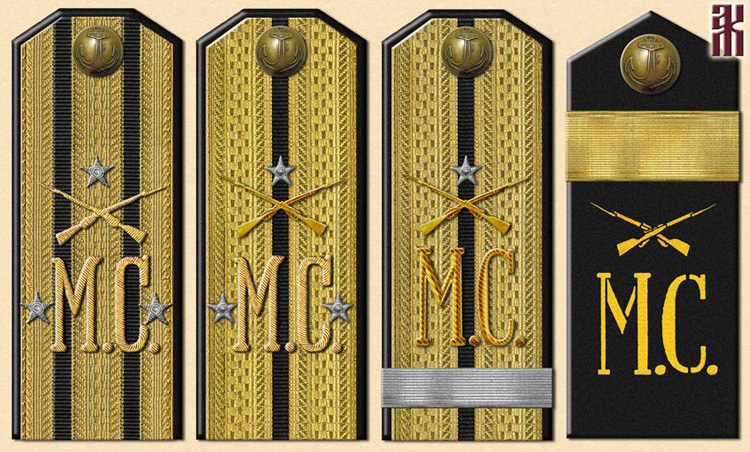
Shoulder-boards of the rifle units of the Independent Brigade of Naval Rifles:
1 – with embroidered cipher and arm of service;
2 – with embroidered cipher and metal arm of service (in accordance with the order);
3 – with metal cipher and arm of service (here, an ensign of the wartime Admiralty);
4 – with stencilled ciphers (sergeant-major)
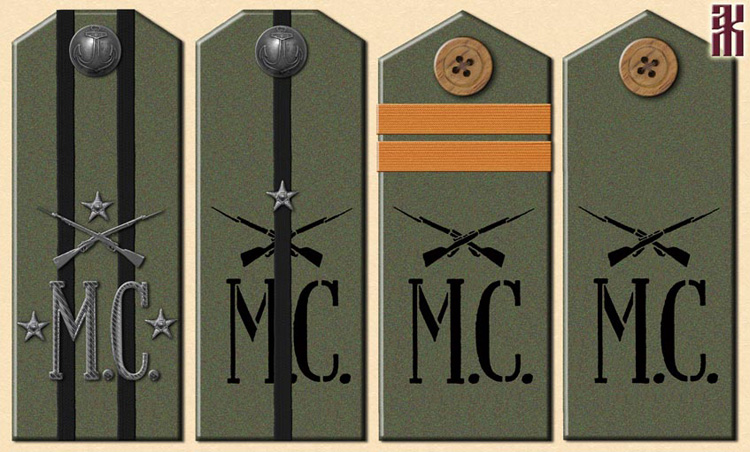
Khaki shoulder-boards of the rifle units of the Independent Brigade of Marine Rifles
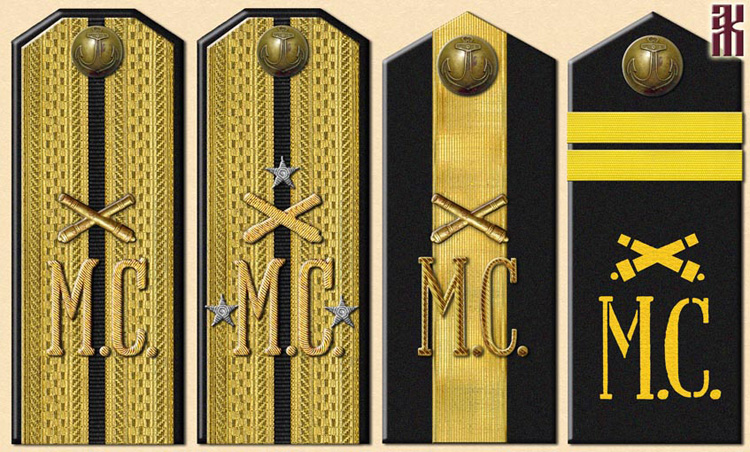
Shoulder-boards of the artillery units of the Independent Brigade of Marine Rifles:
1 – with embroidered cipher and metal arm-of-service (in accordance with the order);
2 – fully embroidered cipher and arm-of-service;
3 – with metal cipher and arm-of-service (here, senior boatswain);
4 – with stencilled cipher (here, quarter-master [junior NCO]).
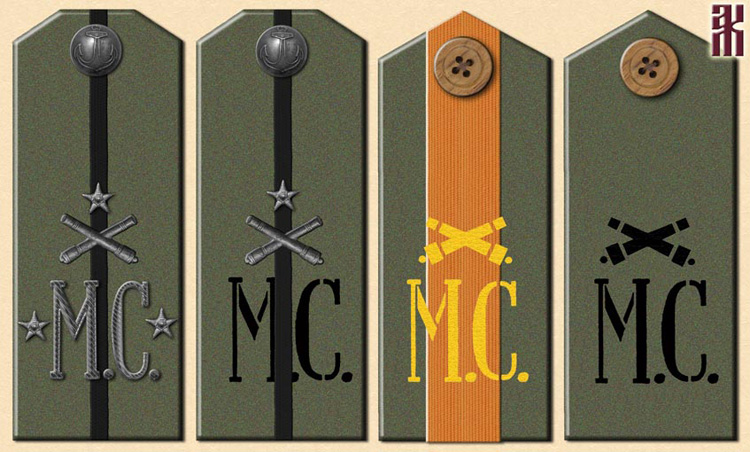
Khaki shoulder-boards of artillery units of the Independent Brigade of Marine Rifles
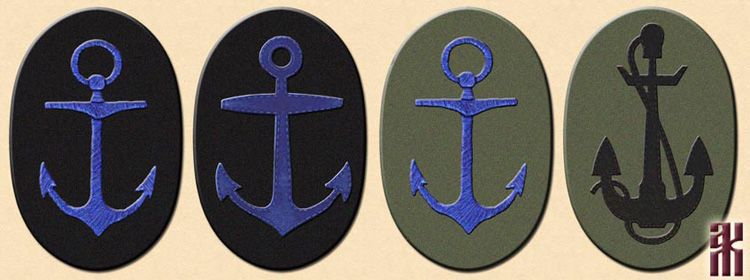
Variants of the arm-band anchor for officers of the Independent Brigade of Marine Riflemen:
1 – embroidered with blue thread; 2 – cut out of blue cloth;
3 – embroidered with blue thread, when wearing khaki shoulder-boards;
4 – Independent Training Battalion
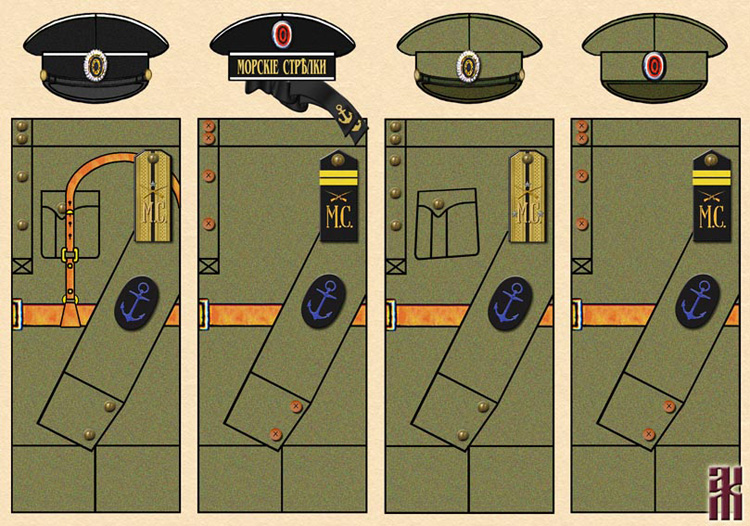
Khaki (moleskin) uniforms of the Independent Brigade of Marine Rifles:
1 and 2 – mixed variants, with naval caps; 3 and 4 – full khaki variants, with infantry caps
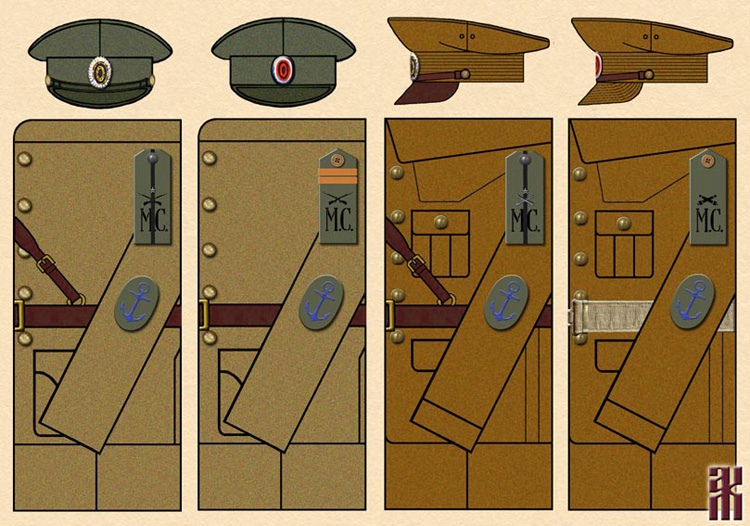
Foreign model uniforms of the Independent Brigade of Marine Riflemen:
1 and 2 – French colonial troops; 3 and 4 – British army
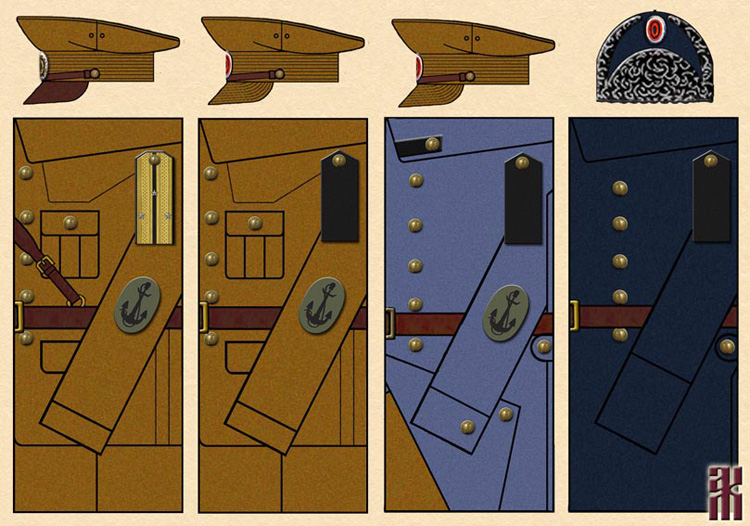
Uniforms of the Independent Training Battalion (Naval Training Regiment):
1 and 2 – British Army uniform used in the battalion; 3 – with French overcoat,;
4 – new model uniform adopted by the naval forces of Eastern Russia
and used by the Naval Training Regiment.
Home — State Symbols — Flags — Uniforms — Badges & Medals — Money — Other
Pygmy Wars Notes
The original for this page is at kolchakiya.ru/uniformology/navy_corps.htm.
Discussion on the translation choices I have made can be found here.
Flags
The banner of the Marine Rifle Brigade is known. It was the standard white on blue St. Andrew's cross of the Tsarist navy.
History of the Marine Rifle Brigade/Division
Taken from warriors.fandom.com.
In December 1918 Kolchak ordered the formation of a Marine Rifle Brigade of six battalions, to be trained two battalions at a time. It was to assist with the operations of the flotillas on the Volga, Kama and Belaya Rivers.
The first two battalions were formed by March 1919 in Krasnoyarsk, numbering some 1,700 men, only 15% volunteers. While it was subordinate to the Naval Ministry, it had only a few naval personnel in command positions, the rest being infantry officers. The third and fourth battalions were formed in April-May 1919 in Perm and Ufa.
From 23 December 1918 to 14 March 1919 the brigade had an armoured train armed with one 75 mm and three naval guns, until it was transferred out.
Little is known about its combat operations. While it did see action on the boats, mostly it was a purely land formation. The 1st Battalion was moved to the front in mid-April 1919, and the others followed. It seems that they acted independently of one another, spread across the front.
In June 1919 it was reorganised as a division, on the same structure as a Siberian rifle division. This required the formation of a Naval Artillery Brigade, which commenced in Biysk.
In July, after the retreat from Perm, the division was brought together in a "fairly shabby" state and received an independent section of the front as part of the Northern Group of the Siberian Army. During the heavy fighting of July-August the division lost almost all its personnel.
In August an order was given to form a Jaeger battalion from the remnants of the division and assign it to the 2nd Army. But this order was cancelled, and in mid-September the division was reorganized in Novonikolaevsk. Soon after the division moved to the front without having time to complete its formation, in order to defend Omsk. The naval rifle artillery was in Barnaul with about 12-16 English light guns, participating in the defense of the city against the Red partisans in December.
During the retreat the division was in the rearguard and performed honourably in the Siberian Ice Campaign. By the time it approached Lake Baikal, late February 1920, only about 300 people remained in the division. It was merged, and ceased to exist as an independent unit.
History of the Independent Far Eastern Marine Rifle Battalion
A separate naval training battalion began to form in Omsk on in August 1919. It numbered around 70 officers and 1,700 other ranks, many being from ships of the Vladivostok fleet.
At the beginning of September the battalion was sent to the front in the 3rd Army. It fought continuously and well. By the end of October only a few dozen men remained. It was withdrawn and reorganised as a two-battalion regiment. The regiment set out on from Omsk towards Novonikolaevsk on 13 November. The next night Omsk was taken by the Reds.
It participated in the Siberian Ice Campaign, negotiating permission with partisans for further unhindered movement in the direction of Irkutsk. Eventually the regiment was forced to surrender.
Other Marine units
In 1921-1922 there were several temporary and permanent naval rifle units formed in the Far East.
One was the Independent Marine Rifle Battalion, attached to the Siberian Flotilla. It was stationed near Vladivostok, on the Chernaya River (near Okeanskaya). It consisted of three companies. In October 1922 it numbered 350 men.