
Uniforms of the Czecho-Slovak Legion Generals, 1917-1920
All material and reconstructions are by A. Karevskiy.
The main sources for this material are:
Tatarov, B. "Czechoslovak Military Formations in Russia: Part 1, 1917-1918 // Staryi Tseykhgauz, No. 5-6", Moscow, 2015. pp. 54-76; and " ... Part 2, 1919-1920 // Staryi Tseykhgauz, No. 3", Moscow, 2016, pp.73-83.
Orian, E., Panus, B., Stechlik, E. and Steidler, F. "Ceskoslovenska Legie v Rusku, 1914-1920", Prague, 2014.
Bullock, D. "The Czech Legion // Men-at-Arms No. 447", Oxford, 2007.
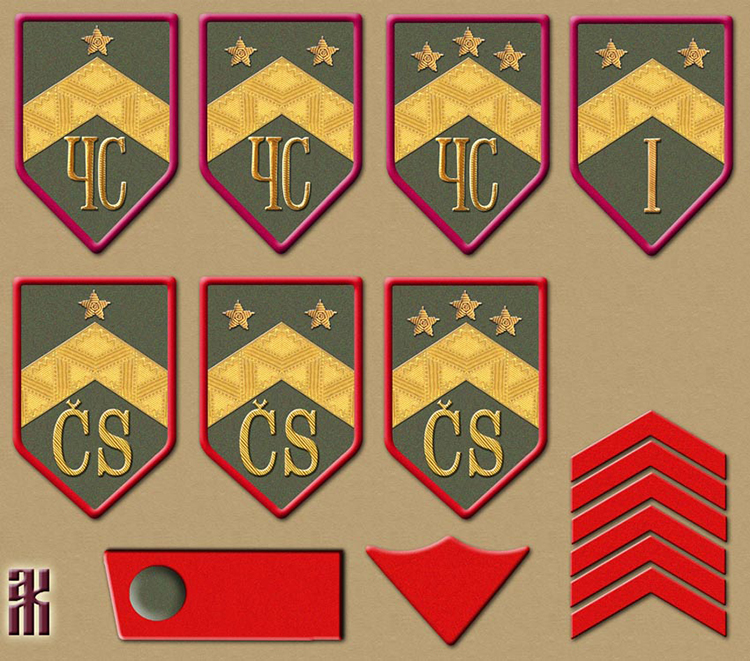
Insignia of the generals of the Czechoslovak Army in Russia:
First row, as per the 30 December 1917 order: 1 – Major-General; 2 – Lieutenant-General;
3 – General; 4 – Major-General, Commander of the 1st Division;
Second row, as per the 27 October 1918 order: 5 – Major-General;
6 – Lieutenant-General; 7 – General;
Third row: buttonhole tabs, tunic collar tab of the "Vladivostok uniform", service stripes
Order No. 15 of 30 December 1917 stated:
§3. For officers of all branches of the armed forces ... the shield shall be piped in raspberry.
§4. To distinguish generals, in addition to a wide gold braid [chevron], stars of the same colour as the braid are attached, as shown in the samples.
In the illustration accompanying the order, the insignia bear the code "ЧС", but for the rank of major general, the division number (in Roman numerals) is also shown. In practice the Russian officers used only the numbers (until they were dismissed from the corps).
The insignia was amended by Order No. 117 of 27 October 1918:
§4. Ranks are designated as follows: major general – one wide gold stripe with one star above the stripe; lieutenant general – one wide gold stripe with two stars above the stripe; general of infantry, general of cavalry, general of the artillery – one wide gold stripe with three stars above it.
§7. The branches of the armed forces and services are distinguished by the colour of the piping on the sleeve shields and the buttonhole tabs on the collars of greatcoats. The following are established: ... generals have scarlet piping.
§8. The designation of the unit and speciality is placed in the lower half of the shield ... Established: ... for the army corps headquarters and seconded units, the letters "ČS".
Major-General Y. Syrový
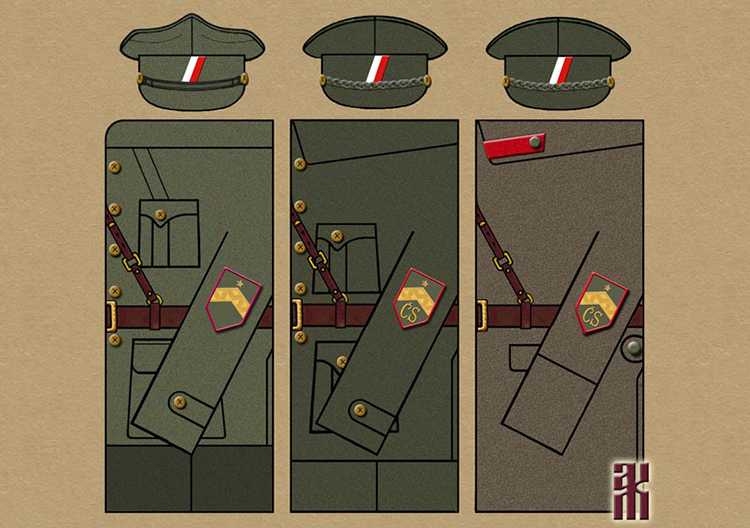
Uniforms of Major-General Y. Syrový
1 – summer 1918; 2 and 3 – October 1918 to June 1919
Syrový was commander of the Czechoslovak Corps from August 1918. Note the unique woven cloth chin strap on a cap with a cloth visor.
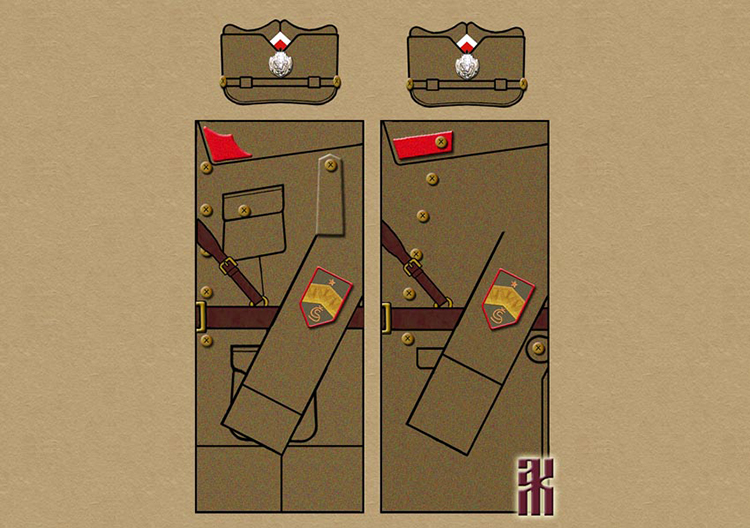
Uniforms of Major-General Y. Syrový:
1 – "Vladivostok uniform" tunic; 2 – "Vladivostok uniform" greatcoat
This uniform was introduced in June 1919. Scarlet collar tabs became the distinctive feature of generals.
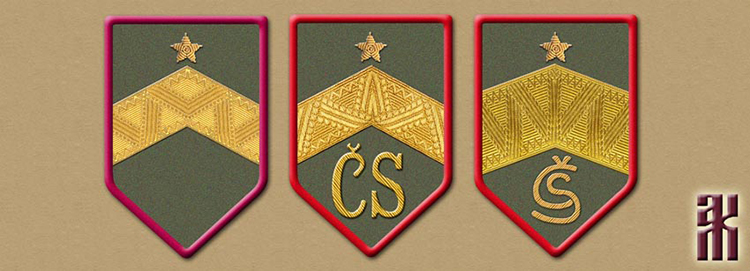
Major-General Y. Syrový's sleeve shields:
1 – summer 1918; 2 – autumn 1918 to summer 1919; 3 – from summer 1919
The first shield uses "general's" braid. The second uses Austro-Hungarian staff officer's braid. The third uses wide general's braid. Syrový was the only general who had the letters "ČS" in the form of an intertwined monogram.
Major-General S. Čeček
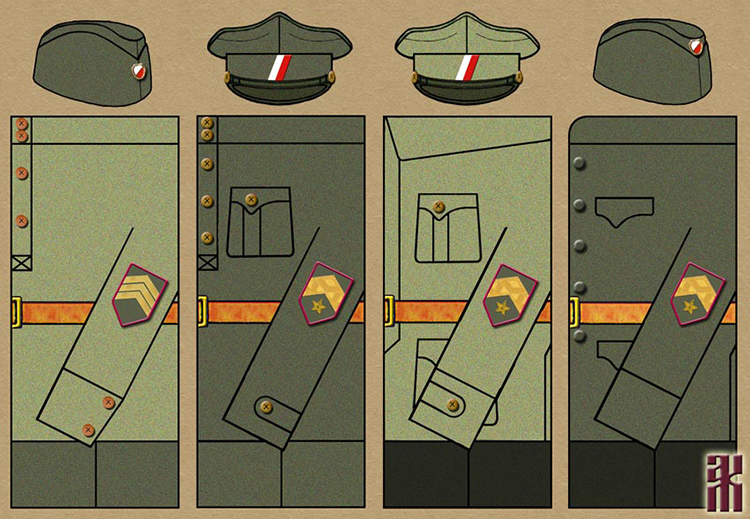
Uniforms of Major-General S. Čeček in late 1918
Čeček was commander of the 4th "Prokop the Great" Regiment and commander of the Penza Group from June 1918, then commander of the 1st Czechoslovak Division from July 1918, then commander of the Czechoslovak forces in Siberia from January 1919.
Figures 1 and 4 show the headdress he personally designed and introduced into the 4th Regiment, which received the unofficial nickname of a Chechenka. Figure 3 shows a lightweight "French" tunic.
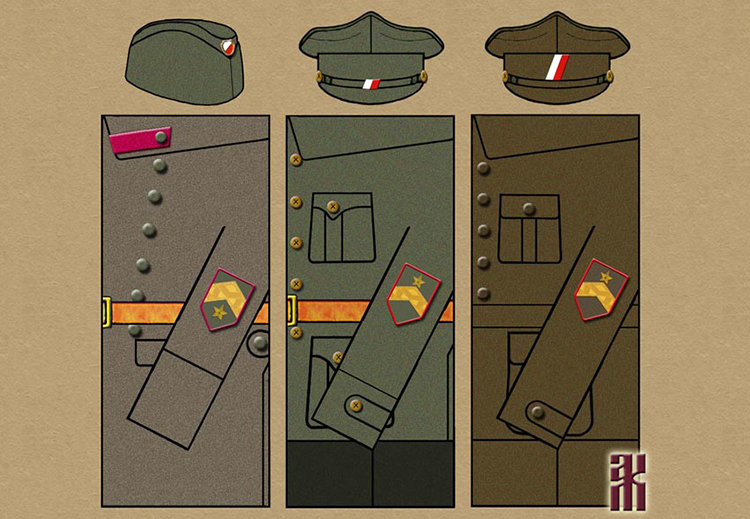
Uniforms of Major-General S. Čeček, autumn 1918-early 1919
Figure 1 is the sole example of wearing a Chechenka cap with a greatcoat.
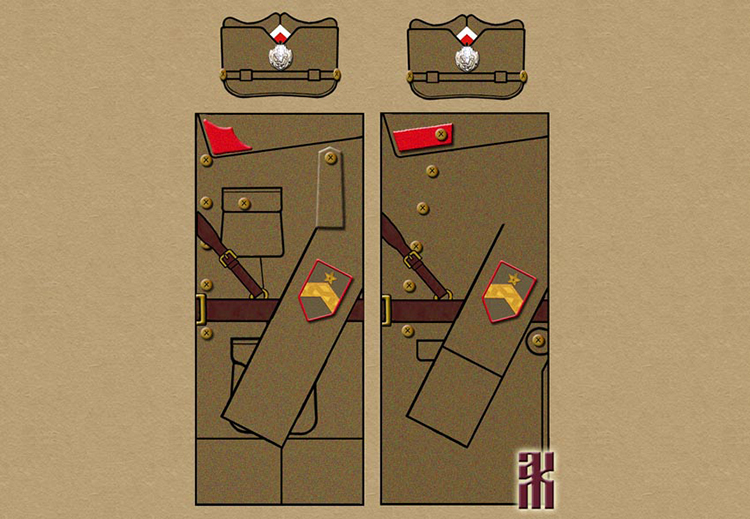 ">
">
Uniforms of Major-General S. Čeček, late 1919 on
The so-called "Vladivostok uniform", introduced in June 1919.
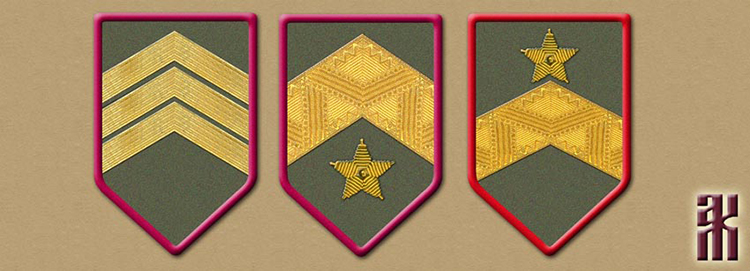
Major-General S. Čeček's sleeve badges
Figure 1 is for the summer of 1918, while still a colonel. Figure 2 is autumn 1918-summer 1919, after his promotion to major general on 2 September 1918. The very large embroidered general's star is striking and, contrary to regulations, is located below the braid. Figure 3 is from summer 1919.
Lieutenant-General V. N. Shokorov
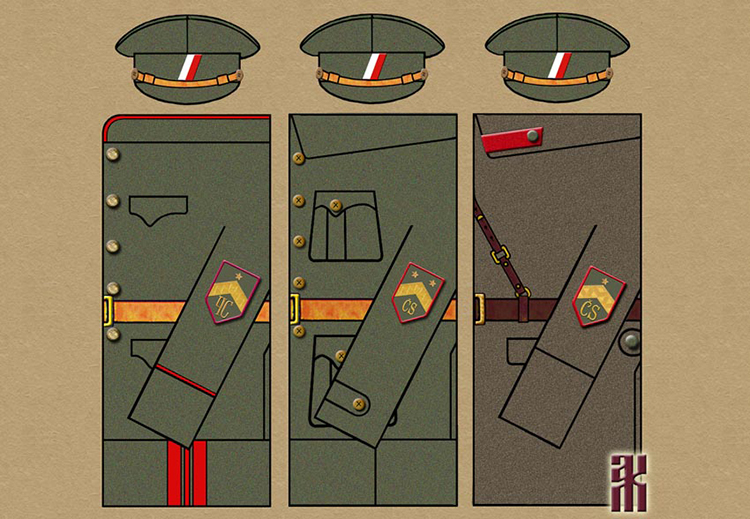
Uniforms of Lieutenant-General V. N. Shokorov:
1 – before October 1918; 2 and 3 – after October 1918
Shokorov was commander of the corps until August 1918, then inspector of the Czechoslovak Army in Russia.
Figure 1 is a general's uniform in the former Russian army, with red piping on the collar and cuffs and with trouser stripes.
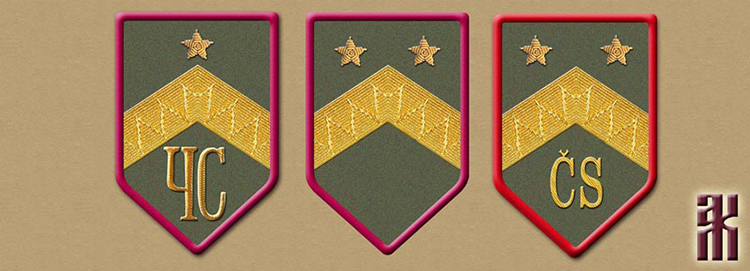
Lieutenant General V. N. Shokorov's sleeve shields:
1 – before October 1918; 2 – from August to October 1918; 3 – after October 1918
Figure 1 is according to the 30 October 1918 order. Figure 2 is after his promotion to lieutenant-general. A characteristic detail is that the shields use "hussar" braid rather than "general's" braid.
Major-General R. Gaida
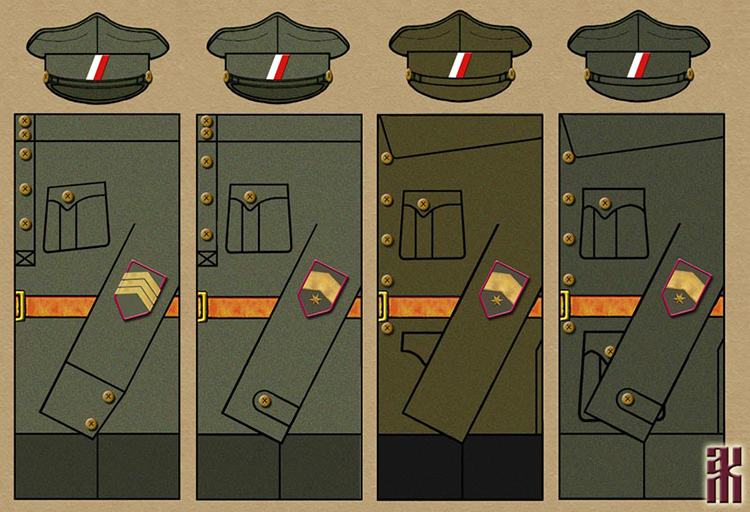
Uniforms of Major-General R. Gaida:
1 and 2 – with the Novonikolaevsk Group; 3 and 4 – September-October 1918
Gaida was the commander of the 7th "Tatran" Regiment, commander of the Novonikolaevsk Group from June 1918, and then commander of the 2nd Czechoslovak Division from July 1918. He entered Russian service in January 1919.
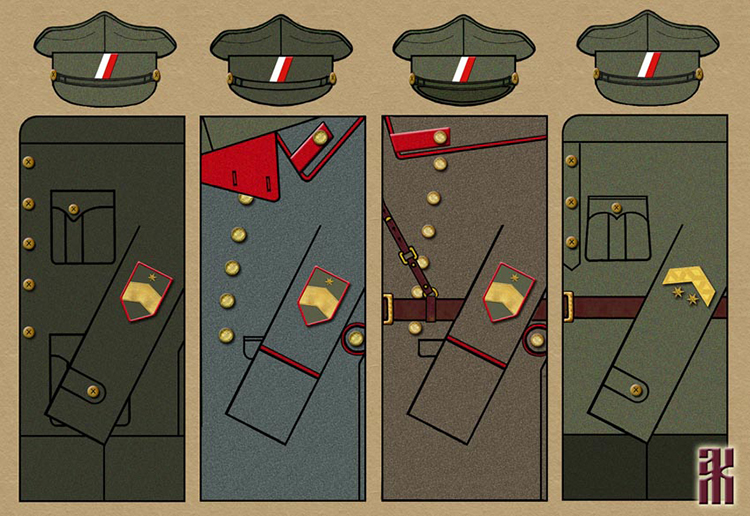
Uniforms of Major-General R. Gaida:
1 to 3 – November-December 1918; 4 – Vladivostok mutiny in November 1919
It is noteworthy that Gaida was the only man who wore a Russian peacetime general's coat (with red lapels, tabs and piping). Figure 4 shows Gaida during the time of his mutiny in Vladivostok, wearing the uniform of the "Siberian Volunteer Army", which he designed and established himself.
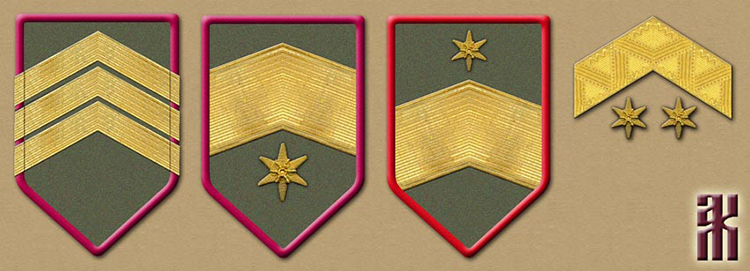
Major-General R. Gaida's sleeve shields:
1 – summer 1918; 2 – autumn 1918; 3 – late autumn-winter 1918; 4 – November 1919
Figure 1 shows him while still a colonel. Figure 2 is after promotion to major general on 2 September 1918. Note that the star is located under the braid, contrary to regulations. Gaida was again unique among the Czechoslovak generals in using six-pointed stars instead of the five-pointed stars specified in the orders (in this he was following the manner of the Austro-Hungarian army). An interesting detail is that he did not use zigzag braid, preferring simple wide braid.
General M. K. Diterikhs
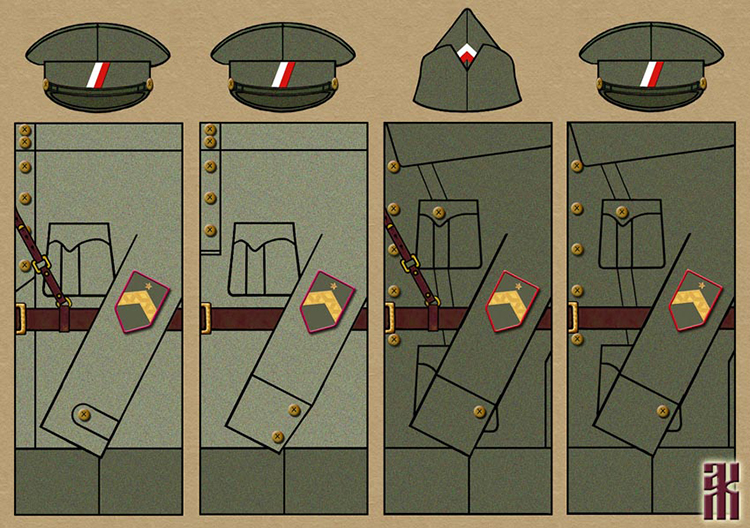
Uniforms of Major-General M. K. Diterikhs:
1 and 2 – Vladivostok, summer-autumn 1918; 3 and 4 – Vladivostok, autumn 1918
Diterikhs was Chief of Staff of the Czechoslovak Corps in the summer of 1918. From June 1918 he was also Commander of the Vladivostok Group. In January 1919 he entered Russian service.
Figures 1 and 2 are during the period of active operations of the Vladivostok Group. Figure 3 shows a headdress modelled on the French sidecap, which became widespread in Czechoslovak units from 1918 onwards.
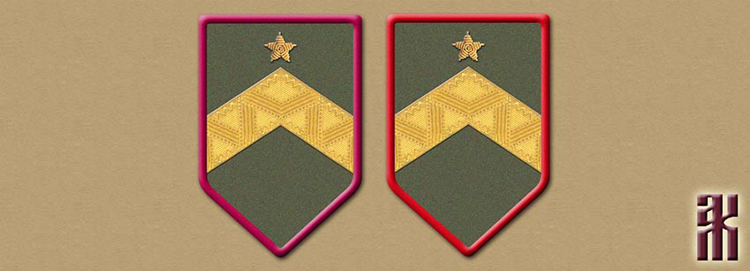
Major-General M. K. Diterikhs's sleeve shields:
1 – according to the 30 December 1917 order; 2 – according to the 27 October 1918 order
Diterikhs was the only general who kept his sleeve insignia to the simplest possible form while remaining within the framework specified by the orders.
Home — State Symbols — Flags — Uniforms — Badges & Medals — Money — Other
Pygmy Wars Notes
The original for this page is at kolchakiya.ru/uniformology/czech/generals.htm.
Note, Generals Shokorov and Diterikhs were Russian, hence the Russian army features of Shokorov's uniforms. Despite entering Russian service after his attempted coup, Gaida was ethnically Czech. Gaida's uniforms at the time of the coup are described here.
Discussion on the translation choices I have made can be found here.