
Distinctions of the Participants in General Gaida's Mutiny,
November 1919
All material and reconstructions are by A. Karevskiy unless noted otherwise.
And what transpired: yes, the battalion rebelled ... but, thank God, there was no bloodshed. ... Their own sergeants, corporals and men with white and green ribbons kept the rebels in perfect order.
Hartling, K. in "Guarding the Motherland // The Great Siberian Ice March", Moscow, 2004, p.599.
My cadets came across General Gaida, who was crossing the railway tracks, apparently heading for the American barracks, while wounded in the leg. ... Gaida was wearing an unbuttoned peacetime general's greatcoat with two St. George Crosses and a ribbon on his chest, but instead of shoulder-boards he had two white and green ribbons sewn across his shoulders. On his tunic, as they said later, he had gold lieutenant-general's shoulder-boards.
Hartling, K. in "Guarding the Motherland // The Great Siberian Ice March", Moscow, 2004, p.613.
Some of the rebels had white and green ribbons on their shoulders. It was possible to describe the distinguishing marks of the participants in the anti-Kolchak uprising in detail thanks to a coincidence: while working in the Hoover Archives, Alexei Buyakov discovered part of the archive of General Reinhold Gaida in the B. Kryukov archive, which had been seized by Kolchak's counter-intelligence. It included a sketch of the insignia for the rebel officers, obviously made by Gaida himself, as well as a draft order and an order on the introduction of external distinctions, signed by Gaida:
Citation missing
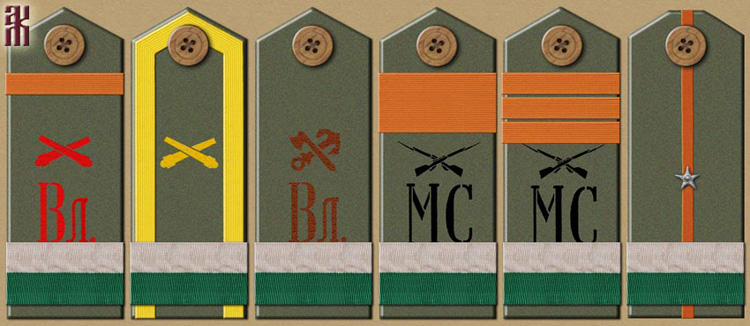
Shoulder-boards of servicemen who joined the mutiny:
1 – Vladivostok Fortress Artillery; 2 – Artillery School Company on Russkiy Island;
3 – Vladivostok railway base; 4 and 5 – marine rifle battalions;
6 – officers of an infantry unit
Order No. 6
Acting Commander of the Siberian People's Army, Vladivostok, 16 November 1919
§1. I order all units to immediately remove their gold shoulder-boards and replace them with khaki ones only.
§2. I order the cockade to be sewn over or replaced with the national Siberian white-green ribbon.
§3. This order is to be read out in all units.
Lieutenant General Gaida
Order to the units of the Column, Vladivostok, 16 November 1919
In order to distinguish the units of the column from the troops of Kolchak's government, until a permanent uniform is established, I order:
§1. Officers shall replace their braided shoulder-boards with khaki ones, sewing a white-green ribbon (the colours of the national flag of Siberia) along the lower edge.
§2. The following changes shall be made to the soldiers' shoulder-boards:
1). A white-green ribbon shall be sewn along the lower edge of the shoulder-boards.
2). To distinguish military ranks, silver stars are introduced instead of stripes on the shoulder-boards: a private has 1, a lance-corporal has 2, a corporal has 3, and a sergeant has 4. In addition to 4 stars on the shoulder-board, a sergeant-major has 1 white cloth stripe across the upper edge of the shoulder-board. A sub-ensign has 2 stripes and four stars. The position of the stars on the shoulder-board corresponds to their position on officers' shoulder-boards.
§3. Those who do not have shoulder-boards are allowed to wear stars and white-green ribbons directly on their greatcoats, tunics or blouses.
§4. Cockades on headgear remain the old style. White-green ribbons may be worn on the cockade, or in the absence of the latter, replaced with a ribbon only.
§5. Escort and company commanders shall immediately dress their men in accordance with this order and report their readiness to my assistant.
Signed: Lieutenant-General Gaida
For the Chief of Staff, Lieutenant-Colonel Krakovetskiy.
The text of the order allows us to reconstruct the appearance of the shoulder-boards of soldiers and non-commissioned officers, but it is clear that most of the participants in the uprising either did not have new insignia or limited themselves to white and green ribbons sewn on instead of shoulder-boards.
Kritskiy N. and Buyakov, A. in "Shoulder-boards for Three Days; the Distinguishing Marks of Participants in General R. Gaida's Anti-Kolchak Uprising in Vladivostok. 1919 // Staryi Tseykhgauz", Moscow, 2013, pp.53-54.
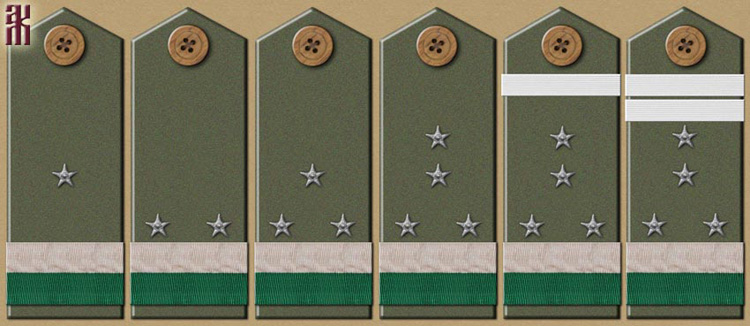
Designated insignia introduced by General Gaida for lower ranks:
1 – private; 2 – lance-corporal, 3 – corporal; 4 – sergeant;
5 – sergeant-major; 6 – sub-ensign
The article by A. Buyakov and N. Kritskiy, cited above, gives a reconstruction of their appearance, with the ribbons sewn with a green stripe on top. This reconstruction offers another option, where the colours of the Siberian flag have the white stripe at the top.
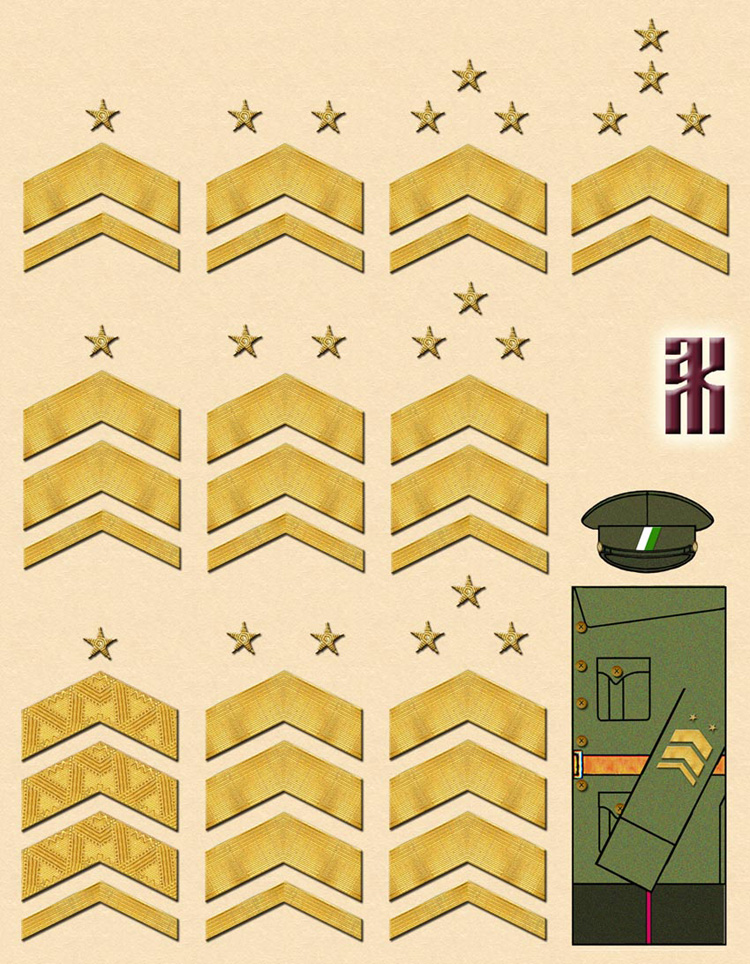
Reconstruction of the insignia planned by General Gaida for officers:
1 – ensign; 2 – second-lieutenant; 3 – lieutenant; 4 – staff-captain;
5 – captain; 6 – lieutenant-colonel; 7 – colonel;
8 – major-general; 9 – lieutenant-general; 10 – general
This reconstruction is drawn from Gaida's own sketches, published in the article by Buyakov and Kritskiy.
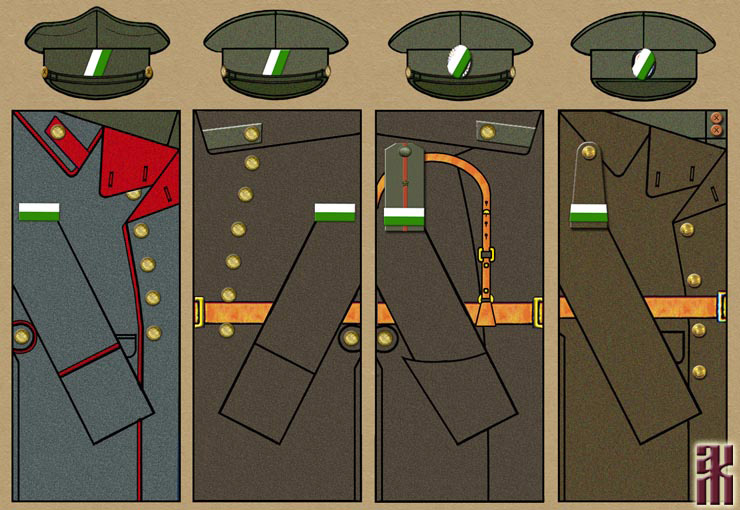
Uniforms of participants in General Gaida's mutiny: 1 – General R. Gaida;
2 – political emissaries, 3 – officer in Russian uniform, 4 – private in English greatcoat
Home — State Symbols — Flags — Uniforms — Badges & Medals — Money — Other
Pygmy Wars Notes
The original for this page is at kolchakiya.ru/uniformology/Gaida%27s_rebels.htm.
Discussion on the translation choices I have made can be found here.