
Uniforms of the Canadian Expeditionary Forces in the East of Russia
October 1918-April 1919
All material and reconstructions are by A. Karevskiy unless noted otherwise.
The following sources were used in the reconstruction of the uniforms of the Canadian Expeditionary Force in the east of Russia:
Ladygin, I. "Canadian Expeditionary Force in Siberia 1918-1919 // Tseykhgauz, No. 40-41", Moscow, 2011, pp.108-113.
Perederiy V. "Symbols of the Canadian Expeditionary Force in Siberia // Tseykhgauz, No. 40-41", Moscow, 2011, pp.114-117.
Funken, F. and Funken, L. "The First World War, 1914-1918, Part 1: Infantry – Armoured Vehicles – Aviation", Moscow, 2002.
Law, C. "Khaki uniforms of the Canadian Expeditionary force", Ottawa, 1997.
Summers, J. and Chartrand, R. "Military Uniforms in Canada", Ottawa, 1981.
Canada's expedition to Siberia at siberianexpedition.ca
The Canadian Siberian Expeditionary Force, stationed in and around Vladivostok from October 1918, included the Expeditionary Force Headquarters, Treasury Service, the 16th Infantry Brigade (259th and 260th Infantry Battalions), the 85th Battery Canadian Field Artillery, the 16th Field Engineer Company, the 20th Machine Gun Company, Squadron "B" of the Royal North West Mounted Police, the 6th Signals Company, the 1st Divisional Transport Company, the 16th and 17th Supply Service Depot Offices, the 11th Inpatient Hospital, the 10th Sanitary Branch, the 4th Forward Medical Detachment, the 9th Logistics Service Detachment, and the 5th Military Field Mail Detachment.
Special Siberian Insignia
From Perederiy
The uniforms of the Canadian Expeditionary Force in Siberia were not much different from the standard British khaki soldier and officer uniforms established in January 1902. However, there were an impressive range of special clothing items prepared in view of the expected harsh Siberian winter...
Distinction Patches
Distinguishing patches, designed to clearly distinguish between units and subunits, became very popular in the armies of Great Britain and its colonies upon the outbreak of the First World War. ... In the home units, preference was generally given to signs with some symbolic or historic meaning, initiated by the soldiers themselves. In the expeditionary forces of the larger dominions – Canada, Australia and New Zealand – the distinctions were centrally adopted, being some combination of abstract geometric figures of different shapes and colors, subject to a published system (...).
For the expeditionary forces in Siberia, purple rectangles were chosen, previously arranged for the never formed 5th Division. They were officially established by Order No. 77 of the Canadian Expeditionary Force in Siberia of 31 December 1918.
Distinguishing patches shall be worn by all ranks of the Canadian Expeditionary Force in Siberia as follows:
Squadron "B" of the Royal North West Mounted Police – a purple patch with [red] five-pointed star on it.
16th Infantry Brigade – purple patch with a red rectangular stripe above it.
259th Battalion – purple patch with a red circle above it.
260th Battalion – purple patch with a red semicircle above it.
1/9th Battalion, Hampshire Regiment – purple patch with red triangle above it.
25th Battalion, Middlesex Regiment – purple patch with a red square above it.
16th Field Engineer Company – purple patch with embroidered red letters "CE".
20th Machine Gun Company – purple patch with a red arrow above it.
All other units must wear a purple patch [without additions].
The purple patch should be placed horizontally 1 inch from the shoulder seam.
The cipher "Canada" must be worn on shoulder straps.
The bronze emblem in the form of a maple leaf should not be worn on shoulder straps.
All the above insignia must be worn on all uniforms, including special winter ones.
Distinctive patches can be issued by the logistics service ready-made, following the established rules.
Apparently the sleeve patches appeared long before the publication of the quoted order, as evidenced by a photo of officers of the 20th Machine Gun Company taken in November 1918, which was before being sent to Vladivostok. It is also curious that the machine gunners preferred to sew the required arrows not above the stripes, but directly on them, as was customary in divisional machine gun units (...)
British military custom stipulated that each regiment, separate unit or army service should have its own emblems on their headgear, collars and uniform buttons. Badges for infantry battalions formed to participate in the Siberian expedition are described in detail in Order No. 1096 for the Canadian Expeditionary Force in Siberia, dated 20 September 1918.
The following special instructions regarding the uniform of officers and other ranks of the 259th and 260th Battalions (Canadian Rifles) (...) are announced for information to those to whom this applies:
Officers
Emblems on hats – silver plated hunting horn with maple leaf inside. The emblem is placed on a red cloth lining.
Collar badges – silver plated letter "C", with the number 259 or 260 below it. Both the letter and each digit is ⅝" tall and ½" wide.
Insignia – silver plated. Must be worn on red-lined shoulder straps.
The cipher "Canada" – silver plated; worn on shoulder straps.
Buttons – black, rifleman pattern.
Tunic – of the set pattern, without marks on the sleeves, with pointed cuffs.
Other Ranks
Emblems on headgear – of the same type as for officers, but bronze.
Collar badges – of the same pattern as for officers, but brass.
Cipher "Canada" – standard, worn on shoulder straps.
Buttons – black, rifleman pattern.
Tunic – with brass buttons.
Note the special mention of the removal of cuff embroidered and braid-stripe rank markings on officer tunics, and their replacement with metal insignia on the shoulder straps. This practice had spread gradually and was officially permitted in 1917. The coexistence of the two systems continued until the complete abolition of sleeve insignia in 1920.
There are also the artillerymen, engineers, machine gunners, doctors, etc. but the emblems of their service branches were firmly embedded. Meanwhile the British wore the corresponding emblems of their own regiments.
Winter Uniforms
Canada, which does not have a mild climate, had used winter uniforms for a long time. Now they decided to supplement them. This was first mentioned by the Edmonton newspaper "Morning Bulletin" in its 28 September 1918 issue: "Arctic Uniform":
With the equipment they now receive, the soldiers of the Canadian Siberian Expeditionary Forces will be strikingly different in appearance from what their compatriots are used to seeing. Indeed (...) they will look completely unusual and (...) resemble a party of Arctic explorers.
Among the additional items they will receive are Eskimo parkas, knitted hats, sheepskin coats, moccasins, thick plaid jackets, fur hats, mittens and protective goggles. This significant addition to the normal set of equipment makes it impossible for one person to carry all the items and they will be transported separately.
Various CEFS documents repeatedly mention all these items, plus felt boots.
Uniform Reconstructions
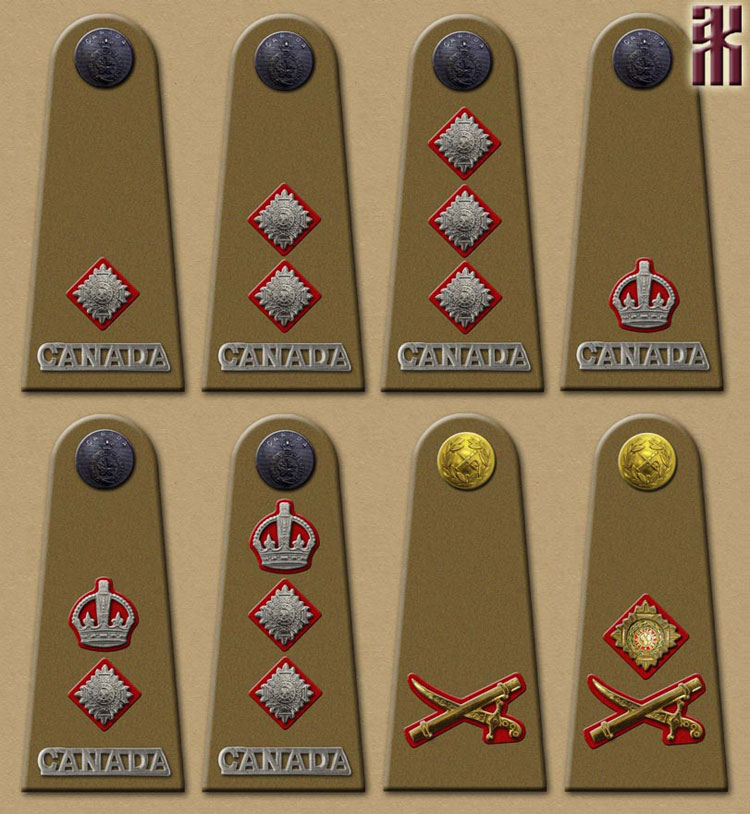
Shoulder-straps of officers of the 16th Infantry Brigade of the Canadian Expeditionary Force:
1 – second lieutenant; 2 – lieutenant; 3 – captain; 4 – major:
5 – lieutenant-colonel; 6 – colonel; 7 – brigadier-general; 8 – major-general
These are reconstructed in accordance with Order No. 77 of 31 December 1918. Judging by that order, these insignia were only distributed to battalions of the 16th Brigade. Photographs show that officers of other units continued to wear sleeve emblems (see the section "Uniforms of the British Expeditionary Force in the East of Russia").
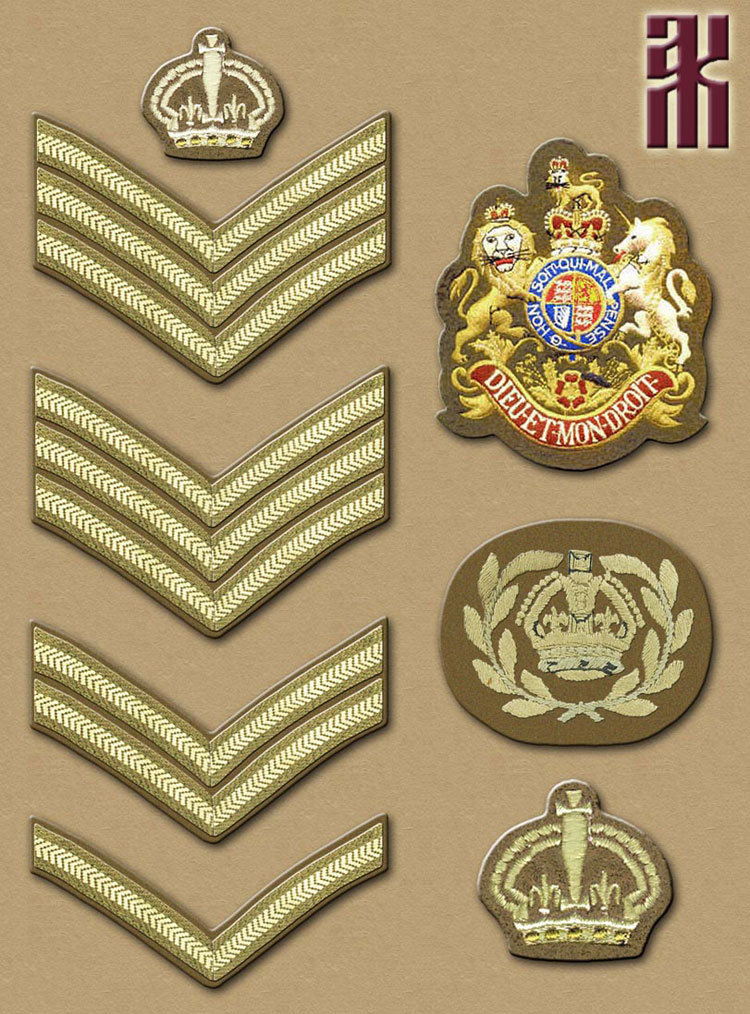
Rank insignia of other ranks of the Canadian Expeditionary Force:
From left, going down: 1 – staff sergeant; 2 – sergeant; 3 – corporal; 4 – lance corporal;
5 – regimental sergeant-major; 6 – company sergeant-major; 7 – platoon sergeant-major
A characteristic detail was the braid on the chevrons of non-commissioned officers, made of yellowish-brown worsted fabric, which was identical to that used on the cuffs and lapels of officers' uniforms.
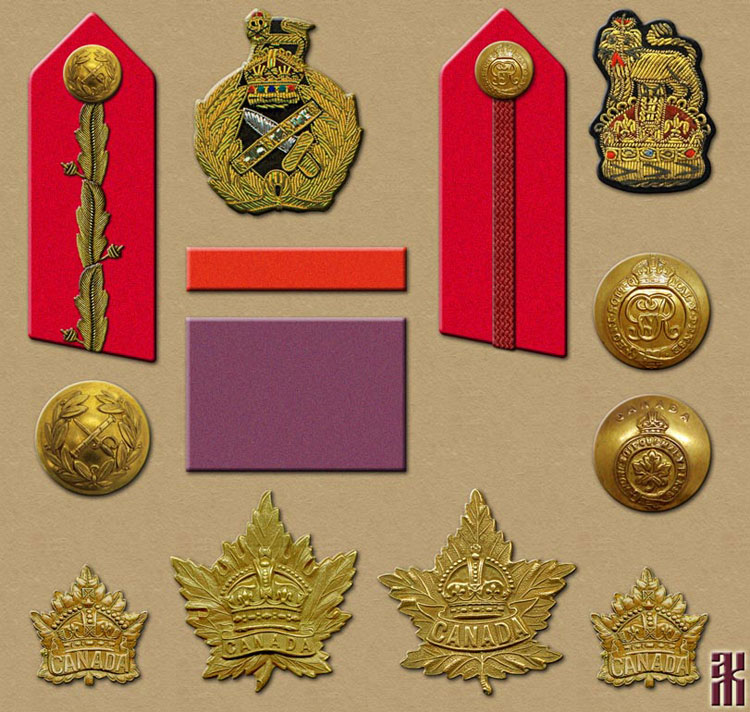
Details of the uniforms of generals, colonels and staff officers:
1 – general's collar tab; 2 – general's cockade; 3 – officer's collar tab; 4 – officer's cockade; 5 – general's button; 6 – sleeve patch for the 16th IB HQ; 7 – general service button;
8 – colonel's button; 9 to 12 – cockades and collar badges (two variants)
Figure 1 has embroidered oak leaves. Figures 2 and 5 have a laurel wreath around crossed marshal's baton and sabre, with the cockade adding a crown and the British heraldic lion. Figure 6 has the Order of the Garter under the crown and the monogram of the reigning monarch George V. The cockades and collar emblems, Figures 9 to 12 are the general service type, for Expeditionary Force personnel not assigned to those branches of the military with specialist insignia.
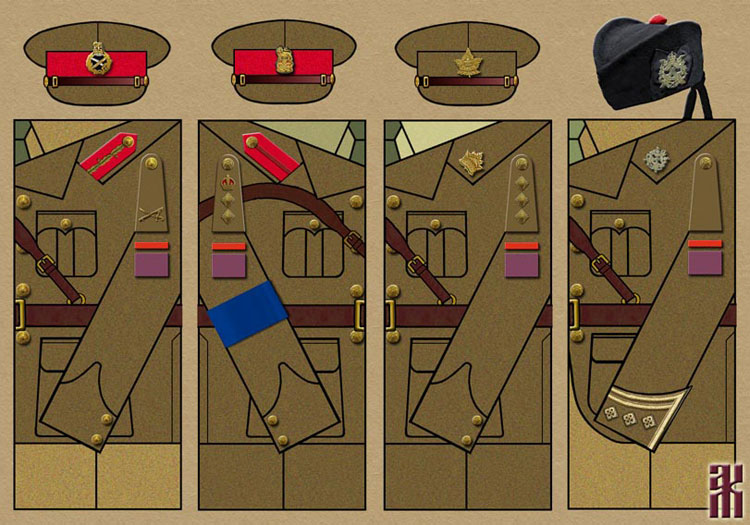
Uniforms of Canadian Expeditionary Force: officers of the 16th Infantry Brigade HQ:
1 – Brigadier-General H. Bixford; 2 – colonel of the brigade staff;
3 – captain of the brigade staff; 4 – captain from a Canadian Scottish regiment.
The blue arm-band of Figure 2 was assigned to officers of brigade staffs. Figure 3 has the general service cockade and collar badges. Figure 4 has cuff rank insignia as was originally established for the field uniform: the uniform also has distinctive Scottish features of a rounded hem to the tunic, differently shaped cuffs and the traditional Scottish glengarry cap.
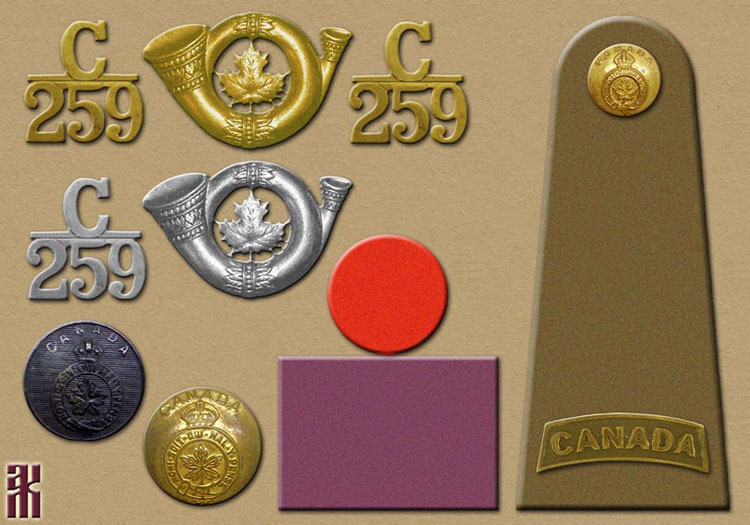
Insignia of the 259th Infantry Battalion of the 16th Infantry Brigade:
1 to 3 – other ranks cockade and collar badges; 4 and 5 – officer collar badge and cockade;
6 – officer's button; 7 – other ranks button; 8 – sleeve insignia;
To the right is an other ranks shoulder-strap
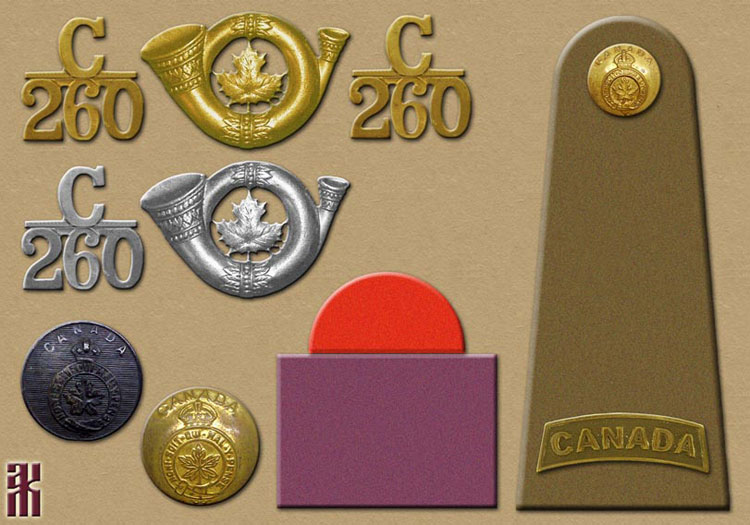
Insignia of the 260th Infantry Battalion of the 16th Infantry Brigade:
1 to 3 – other ranks cockade and collar badges; 4 and 5 – officer collar badge and cockade;
6 – officer's button; 7 – other ranks button; 8 – sleeve insignia;
To the right is an other ranks shoulder-strap
For both units above, the other ranks insignia is bronze, while that for the officers is plated silver. The emblem of the newly formed 259th and 260th Infantry Battalions was a hunting horn with a maple leaf in the centre. The officers' buttons were black and other ranks were bronze: both carried an image of the Order of the Garter under a crown with a maple leaf in the centre.
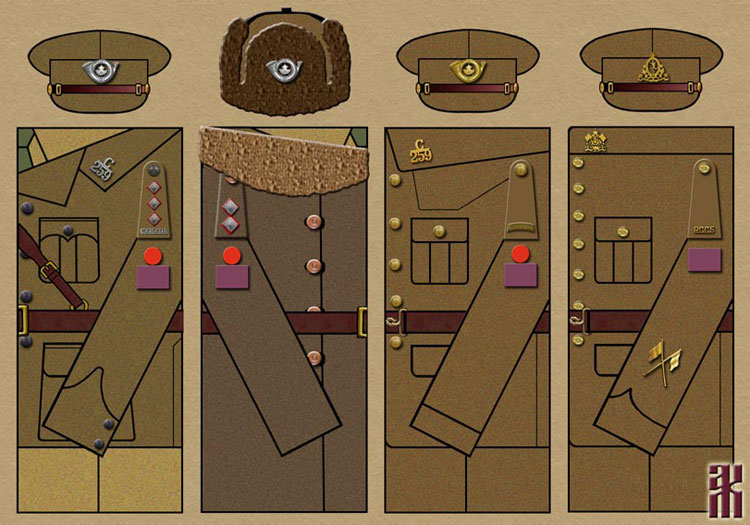
Uniforms of Canadian Expeditionary Force, 259th Infantry Battalion and 6th Signal Company:
1 – infantry captain; 2 – infantry lieutenant; 3 – infantry private; 4 – signals private
Figure 1 is the 1914-model British officer uniform. The trousers are lighter in colour than his tunic, which was quite common. Insignia is standard. Figure 2 shows an officer in a fur coat and Canadian-style winter cap (the crown of Canadian caps was significantly lower than that of British caps and was made of khaki cloth). Figure 3 wears the British 1902-model uniform. Figure 4 is in a Canadian 1903-model uniform (with 7 metal buttons, cuffs, a stand-up collar and no shoulder pads). Both privates wear British leather equipment of the 1899 model (with the bronze buckle in the form of a snake in an "S").
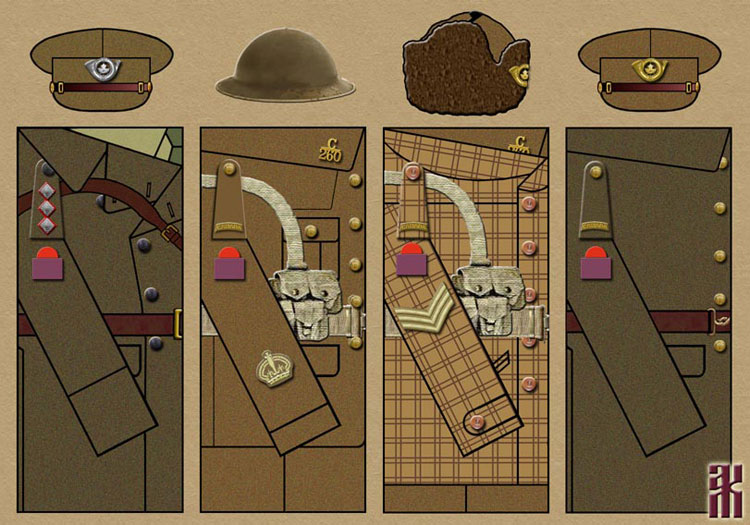
Uniforms of Canadian Expeditionary Force, 260th Infantry Battalion:
1 – captain; 2 – platoon sergeant major; 3 – sergeant; 4 – private
Figure 1 and 4 wear the 1902-model uniform greatcoat. Figure 2 has full webbing equipment and British Brodie helmet. Figure 3 has a thick plaid coat and Canadian-style fur hat.
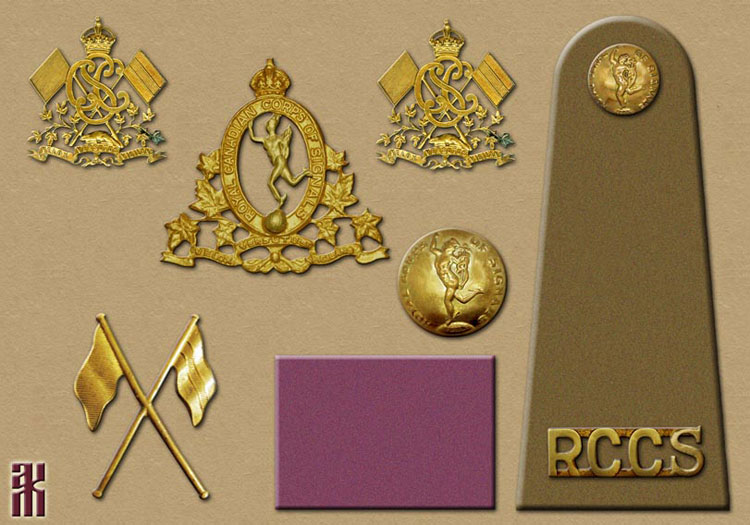
Insignia of the 6th Signal Company of the Canadian Expeditionary Force:
1 to 3 – cockade and collar badges; 4 – button; 5 – signals insignia; 6 – sleeve patch;
To the right, a private's shoulder-strap
The cockade features an image of the god Hermes and the motto of the Signals Corps, "Velox Versutus Vigilans" ("speed, skill, vigilance"). The collar badges have the intertwined monogram "CSC": above is a crown, behind the two crossed flags of signal units, and below is a beaver (an unofficial symbol of Canada) and the motto. The "RCCS" on the shoulder-strap stands for Royal Canadian Corps of Signals.
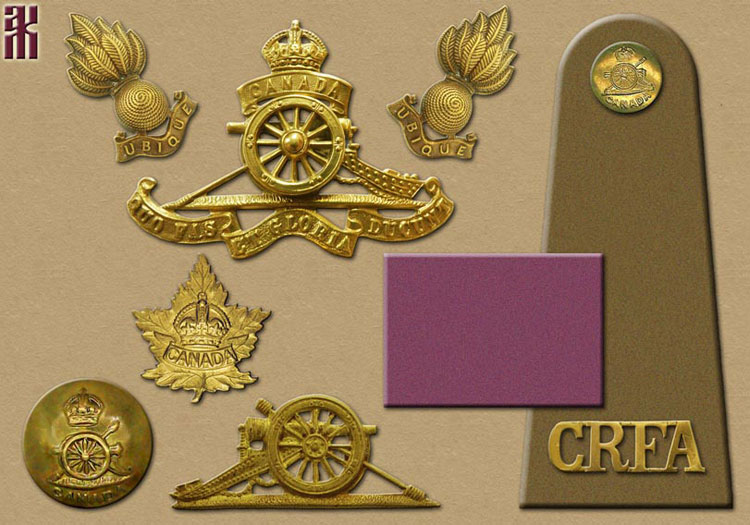
Insignia of the 85th Battery of the Canadian Expeditionary Force:
1 to 4 – cockade and collar badges; 5 – sleeve insignia; 6 – button; 7 – specialist insignia;
To the right, a private's shoulder-strap
Judging by the photographs, both officers and men wore the same cockade: an antique cannon under the inscription "Canada" and a crown, with the artillerymen's motto "Quo Fas et Gloria ducunt" ("Where duty and glory lead"). However officers preferred to wear British-style collar badges of flaming grenades and the motto "Ubique" ("Everywhere"), while the men wore the general Canadian maple leaf badge. The "CRFA" stands for Canadian Royal Field Artillery.
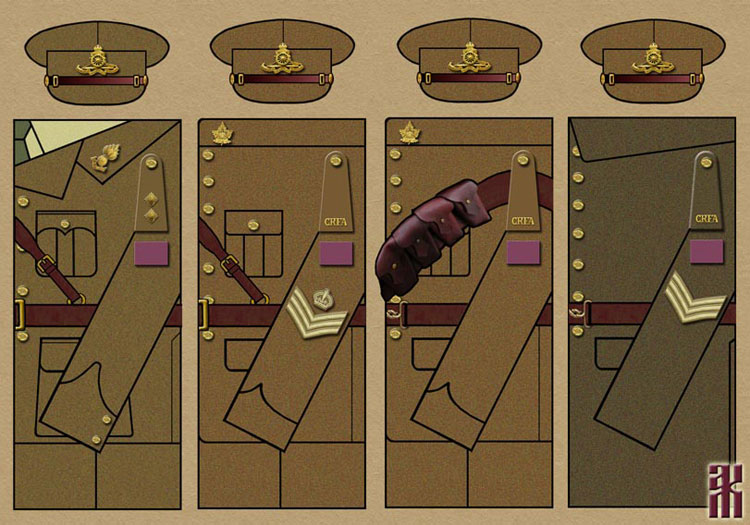
Uniforms of Canadian Expeditionary Force, 85th Battery:
1 – lieutenant; 2 – staff sergeant; 3 – private; 4 – sergeant
Figure 1 has British-style collar badges, while the rest have Canadian. Figure 2 has with officer-style equipment. Judging by the photographs, NCOs and privates wore Canadian 1903-model uniforms and greatcoats. Figures 3 and 4 have leather equipment of the 1899-model with the buckle in the form of a snake, which was outdated by this time but continued to be actively used in Canadian units.
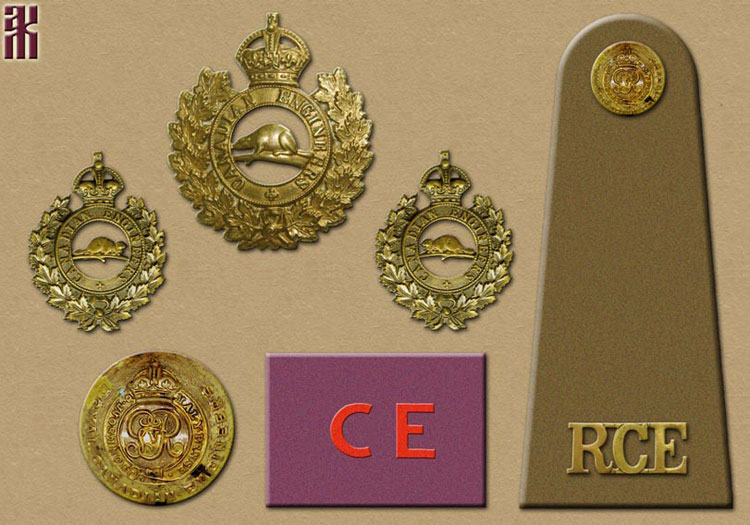
Insignia of the 16th Field Engineer Company of the Canadian Expeditionary Force:
1 to 3 – cockade and collar badges; 4 – button; 5 – sleeve insignia;
To the right, a private's shoulder-strap
The cockade differs from the British model in that it has a maple wreath (instead of laurel) and the king's monogram is replaced by a Canadian beaver in the centre. The button carries the same device. "RCE" stands for Royal Canadian Engineers.
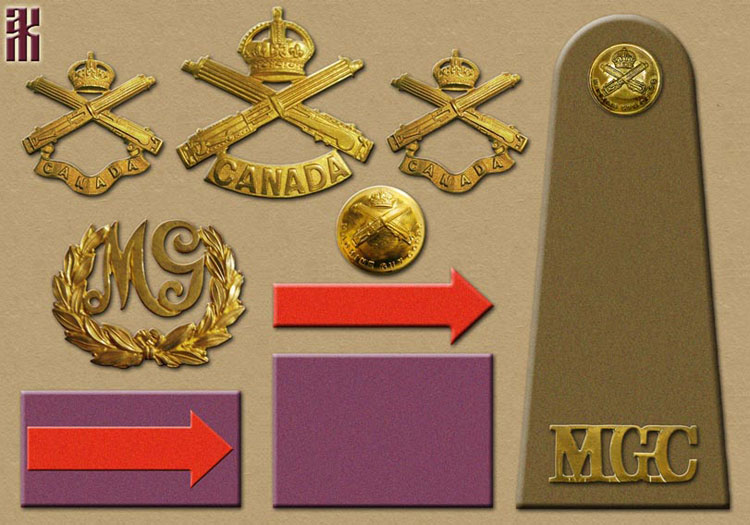
Insignia of the 20th Machine Gun Company of the Canadian Expeditionary Force:
1 to 3 – cockade and collar badges; 4 – specialist insignia; 5 – button;
6 and 7 – sleeve insignia. To the right, a private's shoulder-strap
According to descriptions, Canadian machine gun units used British-style cockades and lapels (crossed machine gun barrels under a crown), but with the inscription "Canada" added underneath. For some time there was a rule that in machine gun companies attached to infantry units that the letter "I" (Infantry) was added above the code "MG" on the specialist insignia. Figure 7 shows the sleeve patch in accordance with Order No. 77 of 31 December 1918, while Figure 6 shows it as actually worn in the company.
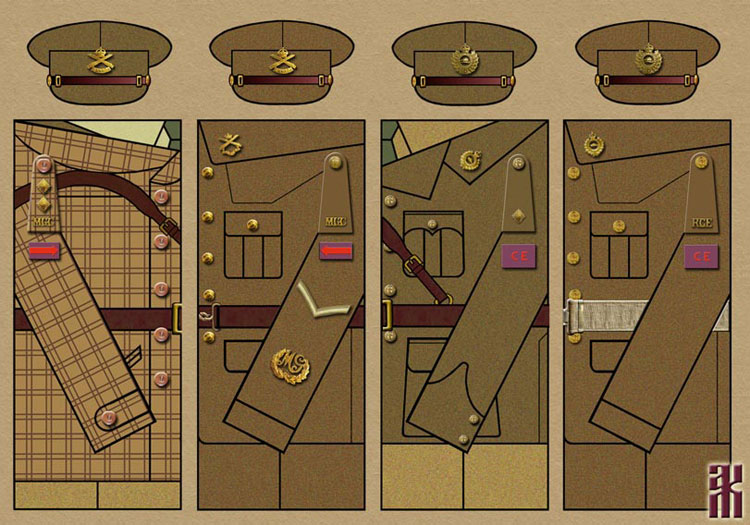
Uniforms of the 20th Machine Gun Company and 16th Field Engineer company:
1 – lieutenant of the MG company in warm coat; 2 – lance-corporal of the MG Company;
3 – second-lieutenant of the engineers; 4 – private of the engineers
Figure 2 wears a British-style uniform. Figure 4 has new cloth equipment of the 1908 model.
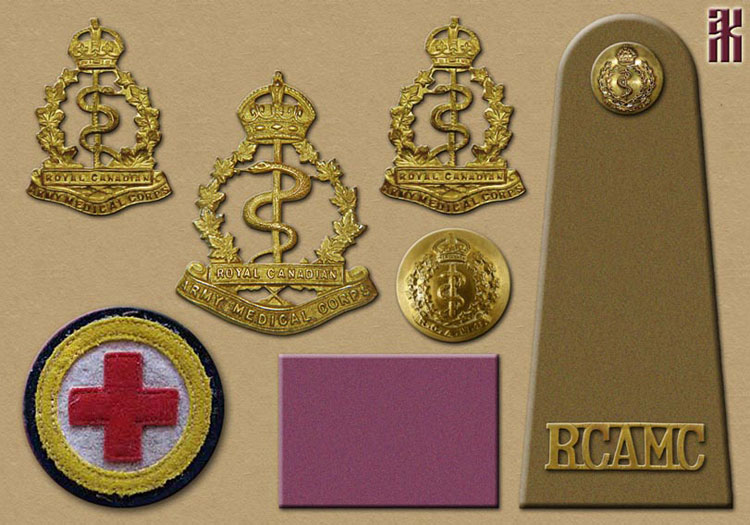
Insignia of the medical units of the Canadian Expeditionary Force in Siberia:
1 to 3 – cockade and collar badges; 4 – button; 5 – specialist insignia;
6 and 7 – sleeve insignia. To the right, a private's shoulder-strap
The laurel wreath of the British cockade has been replaced with a maple wreath and their title of "Royal Canadian Army Medical Corps". The specialist sleeve insignia is that for other ranks.
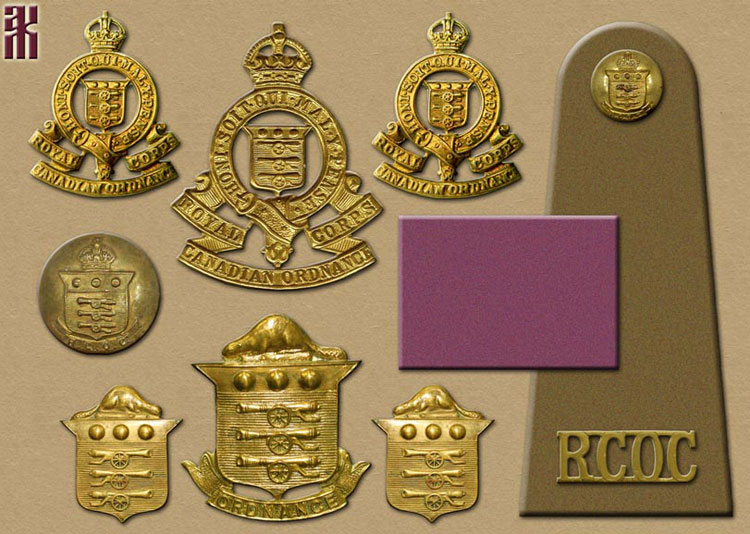
Insignia of the Royal Canadian Ordnance Corps of the Canadian Expeditionary Force:
1 to 3 – officer cockade and collar badges; 4 – button; 5 – sleeve insignia
6 to 8 – other ranks cockade and collar badges;
To the right, a private's shoulder-strap
The cockade has the coat of arms of the corps (three antique cannons under three cannonballs) inside the Order of the Garter and under a crown. The button has the crowned coat of arms above "RCOC". The other ranks cockade and collar badges are the coat of arms under a beaver.
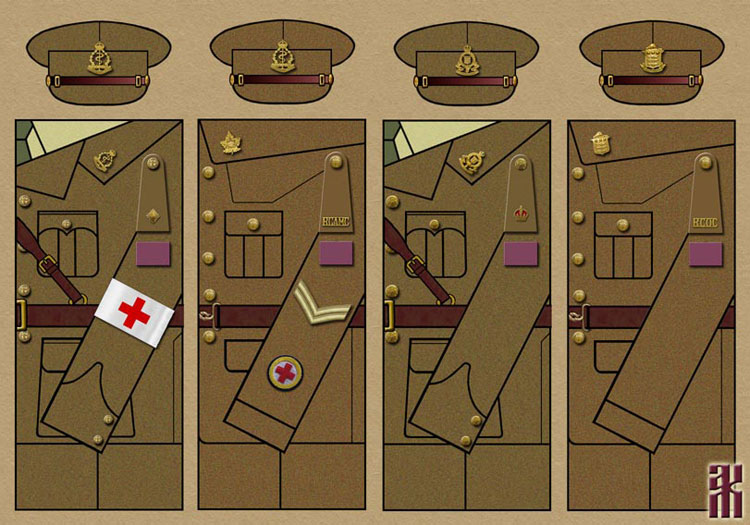
Uniforms of the Canadian Expeditionary Force Medical and Ordnance Corps:
1 – second-lieutenant of the medical corps; 2 – corporal of the medical corps;
3 – major of the ordnance corps; 4 – private of the ordnance corps
Photographs show that medical officers wore collar badges of the Rod of Asclepius in a maple wreath, while other ranks often wore the general Canadian maple leaf version.
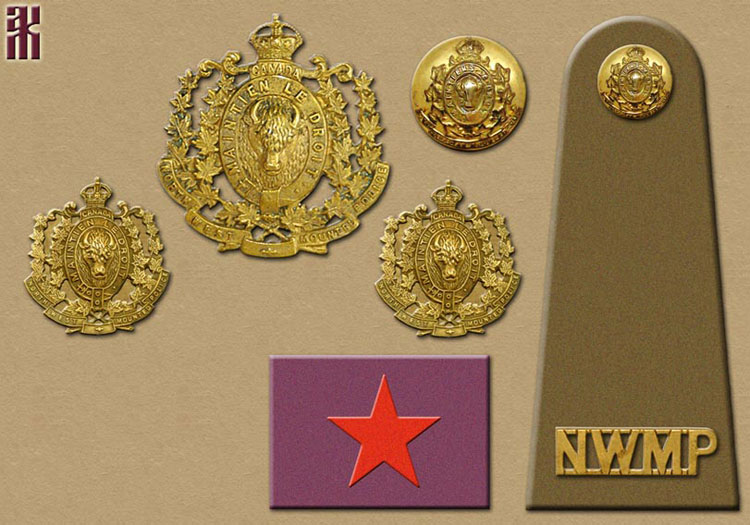
Insignia of Squadron B of the Royal North-West Mounted Police:
1 to 3 – cockade and collar badges; 4 – button; 5 – sleeve insignia;
To the right, a private's shoulder-strap
The emblem of the Mounted Police is the head of a Canadian wood bison inside a garter with the motto "Maintien le droit" ("Keep the law"), framed by maple wreaths, with a crown above and their name below.
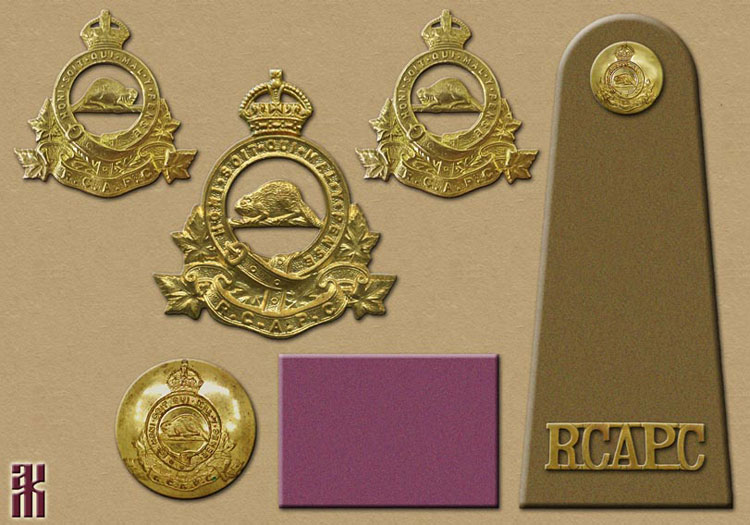
Insignia of the Treasury Service of the Canadian Expeditionary Force:
1 to 3 – cockade and collar badges; 4 – button; 5 – sleeve insignia;
To the right, a private's shoulder-strap
The cockade is a beaver inside the Order of the Garter, under a crown and above maple branches and a ribbon with the abbreviation "RCAPC", for Royal Canadian Army Pay Corps.
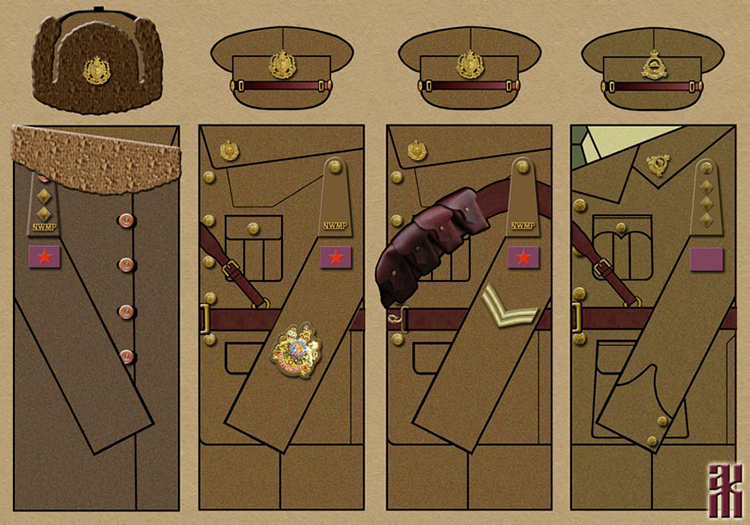
Uniforms of the Royal North-West Mounted Police and the Treasury Service in Siberia:
1 – lieutenant of the RNWMP; 2 – regimental sergeant major of the RNWMP;
3 – senior constable of the RNWMP; 4 – captain of the treasury service.
Figure 1 wears Canadian-style fur coat and hat.
Home — State Symbols — Flags — Uniforms — Badges & Medals — Money — Other
Pygmy Wars Notes:
The original for this page is at kolchakiya.ru/uniformology/Canadian_expeditionary_force.htm.
I believe "platoon sergeant-major" at this time was actually Warrant Officer Class II and "company sergeant-major" was Warrant Officer Class I.
Discussion on the translation choices I have made can be found here.