
Uniforms of the British Expeditionary Forces in the East of Russia
July 1918-November 1919
All material and reconstructions are by A. Karevskiy unless noted otherwise.
The British Expeditionary Forces in Siberia consisted of two battalions, which in the autumn of 1918 came under the command of the Canadian Expeditionary Forces in Siberia. In July 1918 the 25th Battalion of the Duke of Cambridge's Own Middlesex Regiment arrived in Vladivostok. In November 1918 it was joined by the 1/9th Bicycle Battalion of the Hampshire Regiment. Both were formed in 1916 as territorial units and were part of the "New Army" battalions. In October, they were redeployed to Omsk, then in April 1919 to Ekaterinburg, performing duties for the British Military Mission.
In addition to these units, individual officers and commands from the North Staffordshire Regiment, the Durham Light Infantry, the Royal Engineers and the Royal Field Artillery were present in Siberia as instructors for the newly formed units of Kolchak's army. For some time in the spring of 1918 a detachment from the Royal Marine Corps was used to guard British representatives.
The following sources were used in the reconstruction of the uniforms of the British Expeditionary Force in the east of Russia:
Ladygin, I. "Canadian Expeditionary Force in Siberia 1918-1919 // Tseykhgauz, No. 40-41", Moscow, 2011, pp.108-113.
Perederiy V. "Symbols of the Canadian Expeditionary Force in Siberia // Tseykhgauz, No. 40-41", Moscow, 2011, pp.114-117.
www.kaisersbunker.com/ceftp/ranks.htm
North, D. "Soldiers of the First World War, 1914-1918: Uniforms, insignia, equipment and weapons", Moscow, 2015. pp.38-81.
Funken, F. and Funken, L. "The First World War, 1914-1918, Part 1: Infantry – Armoured Vehicles – Aviation", Moscow, 2002.
Funken, F. and Funken, L. "The First World War 1914-1918, Part 2: Cavalry – Artillery – Engineers – Navy", Moscow, 2002.
Chappell, M. "The British Army In World War I (1): The Western Fronts 1914-1916 // Men at Arms, No. 391", Oxford, 2003.
Chappell, M. "The British Army In World War I (2): The Western Fronts 1916-1918 // Men at Arms, No. 402", Oxford, 2005.
Chappell, M. "The British Army In World War I (3): The Eastern Fronts // Men at Arms, No. 406", Oxford, 2005.
Chappell, M. "British Territorial Units 1914-1918 // Men at Arms, No. 245", Oxford, 1991.
Chappell, M. "British battle insignia (1) 1914-18 // Men at Arms, No. 182", Oxford, 1986.
Fosten, D. and Marrion, R. "The British Army 1914-18 // Men at Arms, No. 81.", London, 1978.
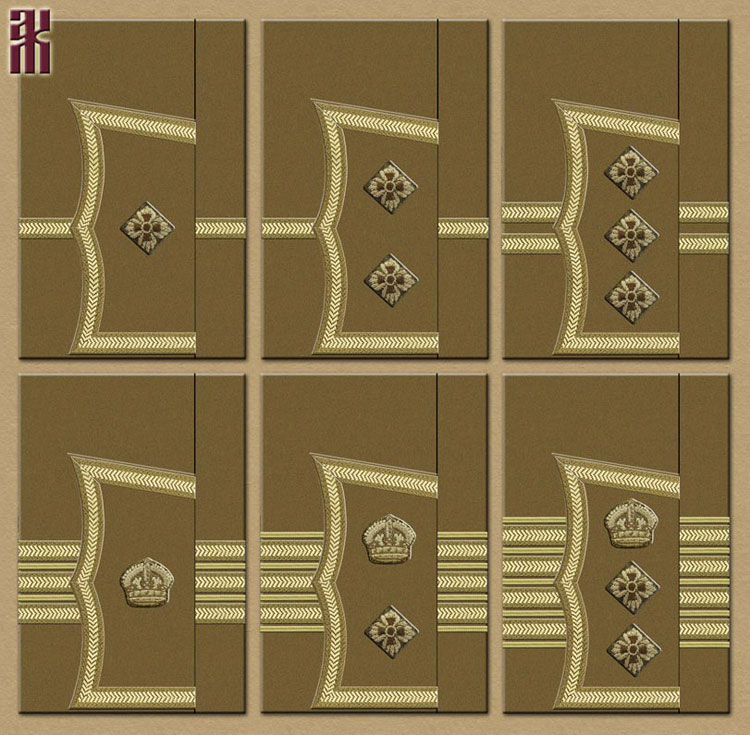
Insignia of British Army officers, rank markings on tunic cuffs:
1 – 2nd lieutenant; 2 – lieutenant; 3 – captain; 4 – major;
5 – lieutenant-colonel; 6 – colonel
A characteristic detail was that the lace on the sleeve chevrons of NCOs was identical to that used on the cuffs of officers' uniforms. It was made of worsted fabric and, for senior officers, was supplemented with braid. From 1917 the practice of placing officer rank insignia on shoulder-straps became widespread and officially approved in the British Army.
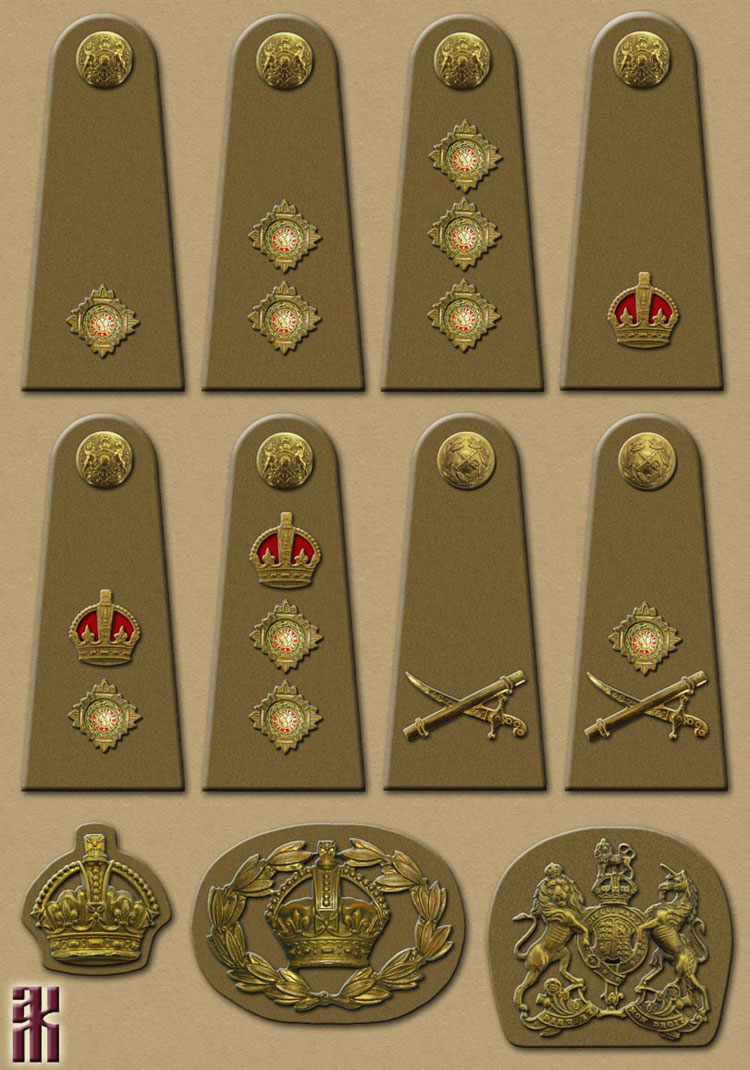
Insignia of officers and warrant officers of the British Royal Army, variant on shoulder-straps:
1 – 2nd lieutenant; 2 – lieutenant; 3 – captain; 4 – major:
5 – lieutenant-colonel; 6 – colonel; 7 – brigadier-general; 8 – major-general;
9 – platoon sergeant-major; 10 – company sergeant-major; 11 – regimental sergeant-major
The tradition of placing metal insignia on shoulder-straps began in 1915 and was finally established in 1920, when cuff markings were removed.
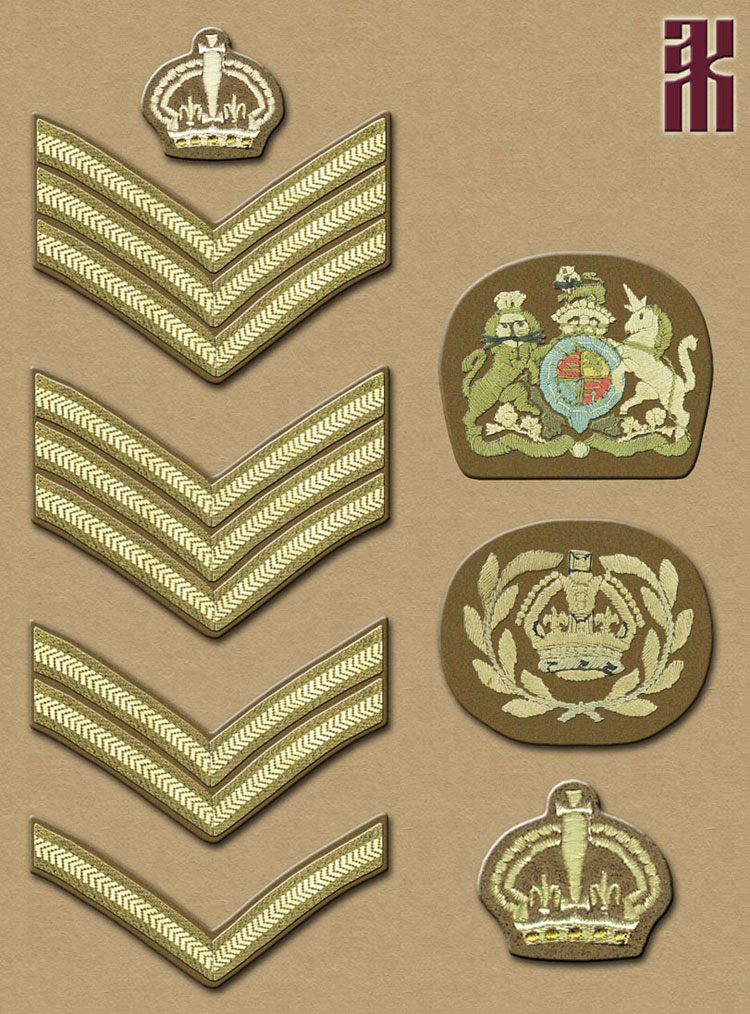
Insignia of other ranks in the British Army:
From left, going down: 1 – staff sergeant; 2 – sergeant; 3 – corporal; 4 – lance corporal;
5 – regimental sergeant-major; 6 – company sergeant-major; 7 – platoon sergeant-major
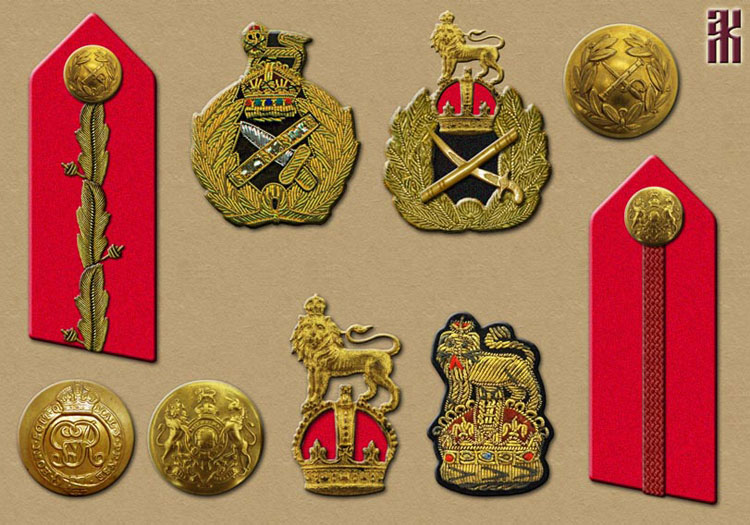
Details of the uniforms of generals, colonels and staff officers:
First row, generals: 1 – collar tab; 2 and 3 – cockades; 4 – button;
Second row, colonels and staff officers: 5 – general service button; 6 – colonel's button;
7 and 8 – officer cockades; 9 – collar tab
Figure 1 has embroidered oak leaves. Figures 2 to 4 have a laurel wreath around crossed marshal's baton and sabre, with crown and the British heraldic lion above for the cap badges. Figure 3 is partially embroidered and partially metal variants. Figure 6 has the Order of the Garter under the crown and the monogram of the reigning monarch George V. Figures 7 and 8 are metal and embroidered respectively. Figure 9 has burgundy braid down the centre.
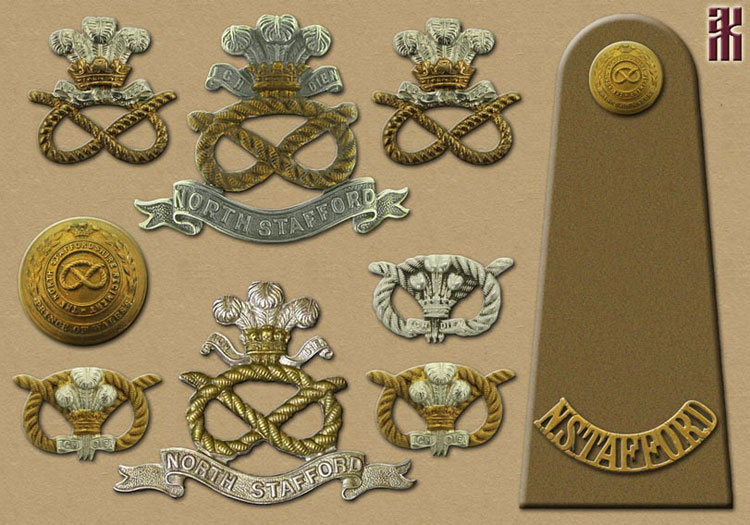
Insignia of the North Staffordshire Regiment: cockades, collar badges, button and shoulder-strap.
The cockades and collar badges are the officer model, which differed by being in two metals (bronze with silver-plated overlays). The regiment's emblem was the Stafford knot, crowned with the three feathers of the Prince of Wales's and the heraldic motto "Ich dien" ("I serve"). The regimental button has the inscription "Prince of Wales's" and "The North Staffordshire Regiment". In the centre is the regiment's volunteer badge (in white metal). The shoulder-strap is for a private. Brass ciphers were introduced in 1907 for lower ranks and replaced cloth stripes on the sleeves.
This unit were instructors to Kolchak's Russian Army.
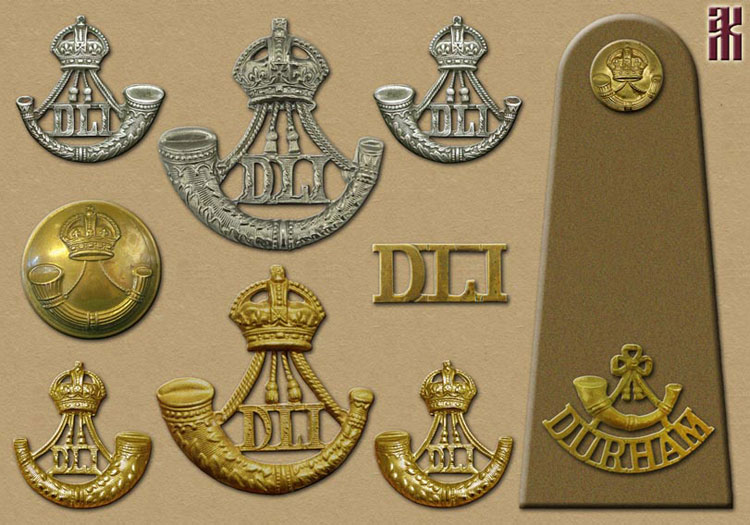
Insignia of the Durham Light Infantry Regiment: cockades, collar badges, buttons and shoulder-strap.
The silvered cockade and collar badges at the top are the officer model, and the bronze ones below are for NCOs. The regiment's emblem was a hunting horn with cords, hanging from a crown, with the cipher "DLI". The shoulder-strap is for a lower rank.
This unit were instructors to Kolchak's Russian Army.
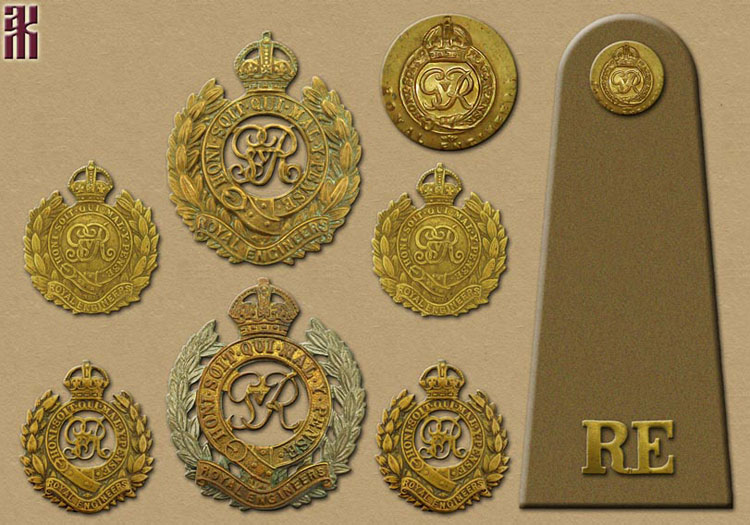
Insignia of the Royal Corps of Engineers: cockades, collar badges, and shoulder-strap
The cockade and badges at the top are for other ranks (the one in the middle is a cheaper, simplified wartime model), with the officer versions below in two metals. The emblem is the monogram of the reigning monarch (King George V) inside an image of the Order of the Garter, under a crown and with the inscription "Royal Engineers" at the bottom. The shoulder-strap is for a lower rank.
This unit were instructors to Kolchak's Russian Army.
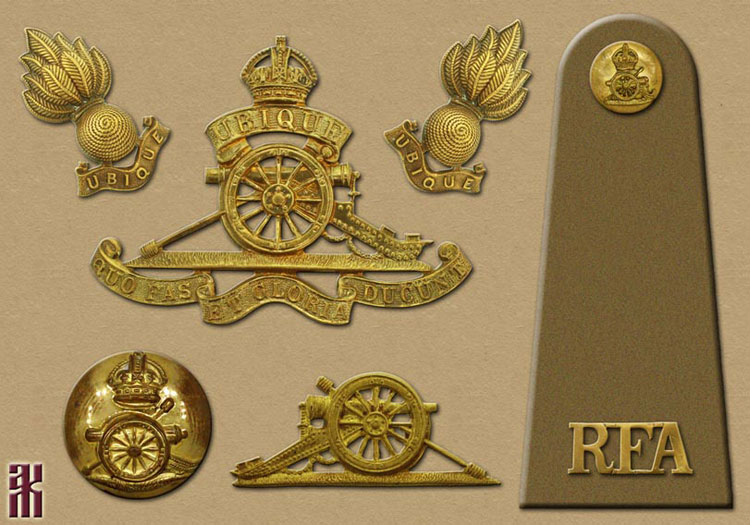
Insignia of the Royal Field Artillery: cockade; button, collar badges and shoulder-strap.
At the top is a cockade and rank badges. The emblem of the British artillery was an old style cannon with a banner with the motto "Ubique" ("Everywhere") under a crown and at the bottom the motto "Quo Fas et Gloria ducunt" ("Where duty and glory lead"). The badges were in the form of an old-model flaming grenade with the motto "Ubique" on a ribbon below. Below is the button and the sleeve insignia of an artillery specialist. The shoulder-strap is for a lower rank.
Artillery was an independent branch of the British army and it continued to be called the Royal Artillery Regiment.
This unit were instructors to Kolchak's Russian Army.
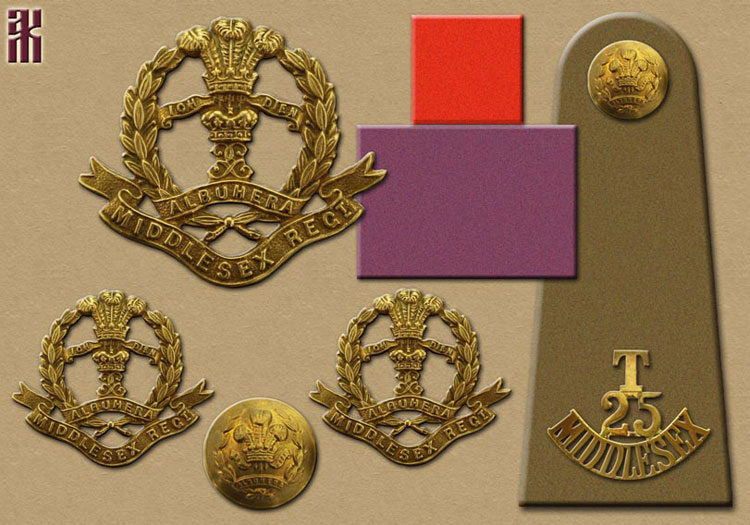
Insignia of the 25th Battalion of His Royal Highness the Duke of Cambridge's Middlesex Regiment: cockade, collar badges, button, shoulder-strap and patch
As it was a territorial regiment, officer cockades and collar badges were not bimetallic. Otherwise the regiment's emblem remained the same, being based on the Duke of Cambridge's cipher under a crown with the Prince of Wales's feathers and motto ("Ich dien"), enclosed in a laurel wreath. An inscription "Albuhera" was placed in memory of the battle on 16 May 1811 near the Spanish village of that name, where a combined Anglo-Portuguese-Spanish force defeated Marshal Soult's French troops. The "T" on the cipher of the lower rank's shoulder-strap indicates that it is a Territorial unit. The patch at the top is in accordance with Order No. 77 of 31 December 1918 for the Canadian Expeditionary Corps in Siberia, to which the battalion was officially subordinate.
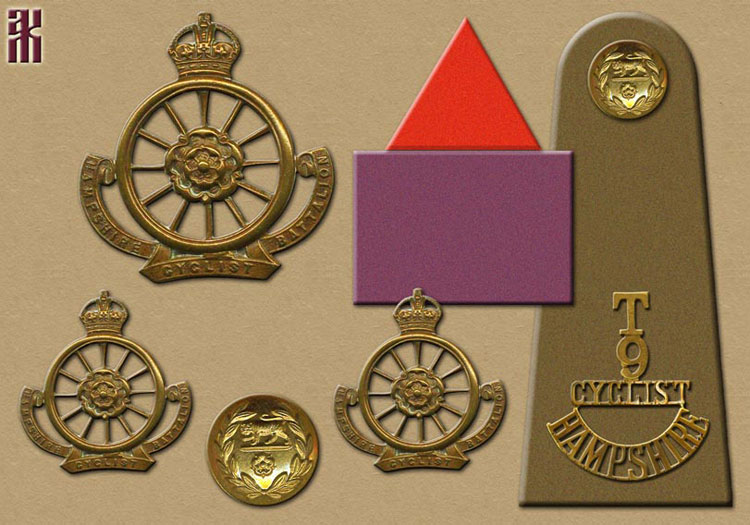
Insignia of the 1/9 Bicycle Battalion of the Hampshire Regiment: cockade, collar badges, button, shoulder-strap and patch
As this was a bicycle battalion, its emblem differed from those used in the Hampshire Regiment. The emblem of the Army Bicycle Corps was taken as a basis, being a crowned bicycle wheel, on which the emblem of the Hampshire Regiment (a heraldic rose) was superimposed. The inscription at the bottom reads "Hampshire Cyclist Battalion". The regimental button depicts a Bengal tiger above a heraldic rose, framed by a laurel wreath. The lower-rank shoulder-strap again has a "T" for Territorial. The patch at the top is in accordance with Order No. 77 of 31 December 1918 for the Canadian Expeditionary Corps in Siberia, to which the battalion was officially subordinate.
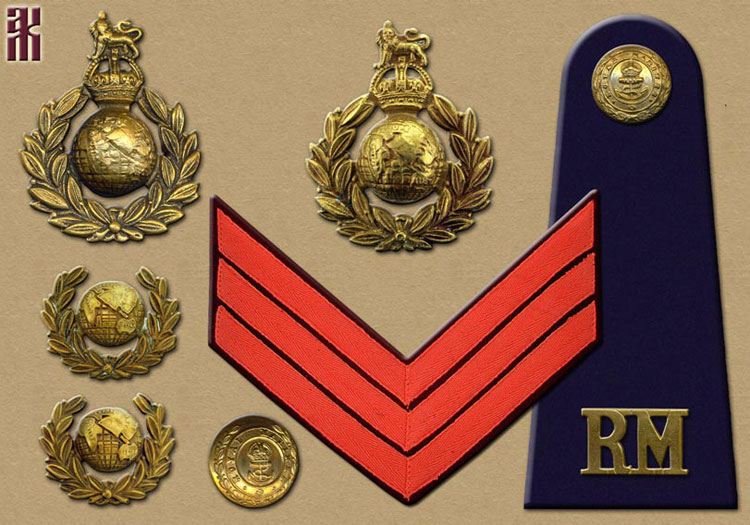
Insignia of the Royal Marine Corps
The two cockades at the top carry an image of the eastern hemisphere on a globe framed by laurel branches, under a crown and the British heraldic lion. The collar badges are the same without the crown and lion. The button features an image of a crowned anchor, with a laurel wreath around the edge and the inscription "Royal Marine". The shoulder-strap is for a lower rank. In the centre are sergeant's chevrons, which differed from the army model when worn with a blue uniform, being made of red wool braid.
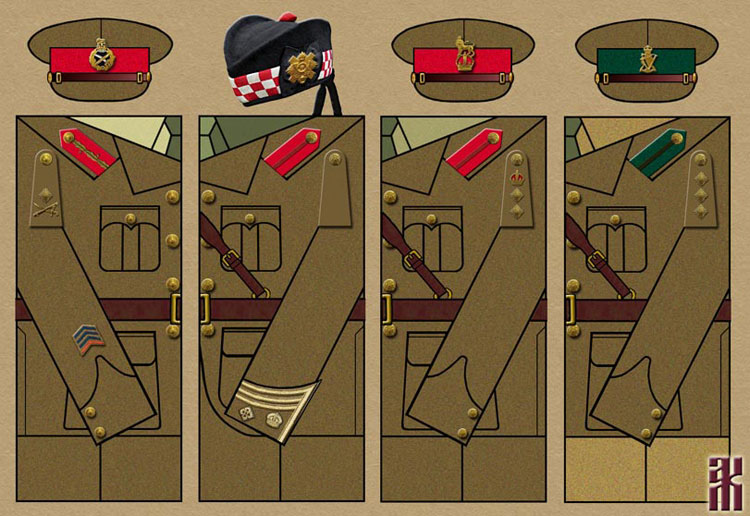
Uniforms of the British Military Mission in the East of Russia:
1 – Major-General A. Knox; 2 – Chief of Staff to General Knox:
3 – colonel of the staff; 4 – 2nd class staff officer
Knox has the standard general's uniform of the 1914 model. Generals were supposed to have gold embroidery of a double row of oak leaves on the cap visor, but it was generally not present in field conditions). His sleeve has chevrons for service abroad. Figure 2 is based on a photograph: this major is wearing the uniform of a Scottish regiments – a tunic with rounded cut opening at the bottom, a different cuff design, and the traditional Scottish headdress, the glengarry (wearing kilts with field uniform was abolished by this time). His collar has the patch of a staff officer. 1st class staff officers had burgundy collar tabs instead of dark green.
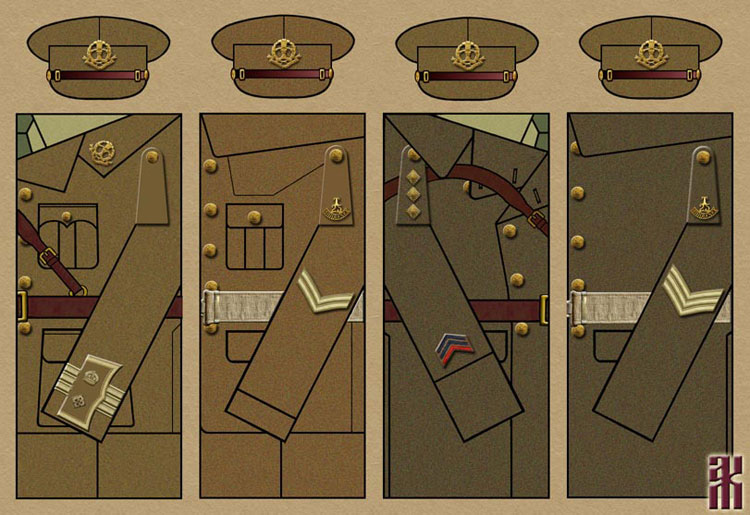
Uniforms of the 25th Battalion of the Middlesex Regiment:
1 – lieutenant-colonel; 2 – corporal; 3 and 4 – officer and sergeant in winter uniform
British Army officers at that time wore the 1914-model uniforms and 1905-model caps. Judging by photographs, battalion officers continued to wear insignia on their cuffs. Officers' shirts were officially supposed to be made of grey-brown fabric, but in practice, shirts of various shades were encountered, from light green to dark khaki. The same was true of the tie, the colour of which varied from greyish-brown to dark green. Figure 1 wears leather equipment with a single shoulder strap, nicknamed the "Sam Browne belt". The lower ranks of the British Army wore 1902-model uniforms (with shoulder-straps) and 1905-model caps. Figure 2 has a webbing belt from the 1908-model equipment.
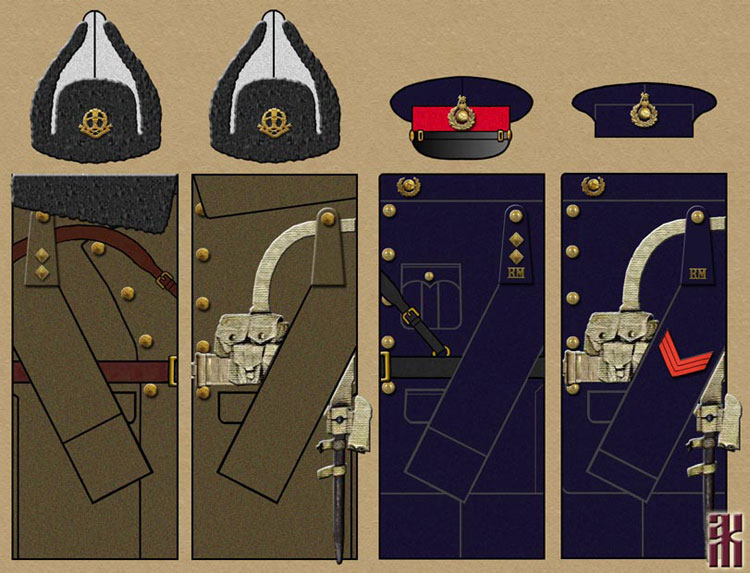
Uniforms of the 25th Battalion, Middlesex Regiment and the Royal Marine Corps:
1 and 2 – officer and soldier of the Middlesex Regiment in winter uniforms;
3 and 4 – officer and sergeant of the Royal Marine Corps
Figures 1 and 2 wear fur hats, introduced in the British Army for cold climates. The officer has a fur collar. The private wears the full 1908-model equipment (webbing). In Europe the marines wore standard infantry uniforms with distinctive insignia. However, judging by photographs, in eastern Russia they used their dark blue uniforms.
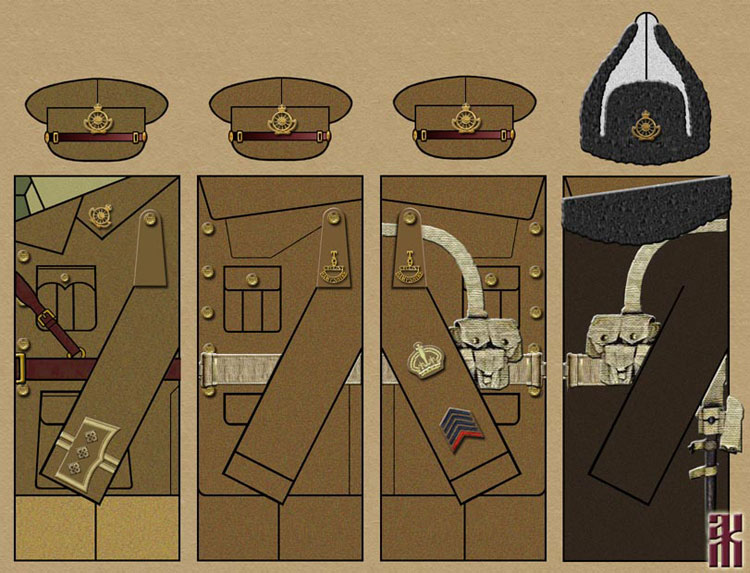
Uniforms of 1/9 Battalion, Hampshire Regiment:
1 – officer; 2 – private; 3 – platoon sergeant-major; 4 – private in winter uniform
Officer trousers were often a lighter shade. Figure 3 has the sleeve chevrons for service abroad. Figure 4 is in a fur coat: loose-fitting fur coats trimmed with dark-coloured wool were included in the special uniform items for units sent to Siberia.
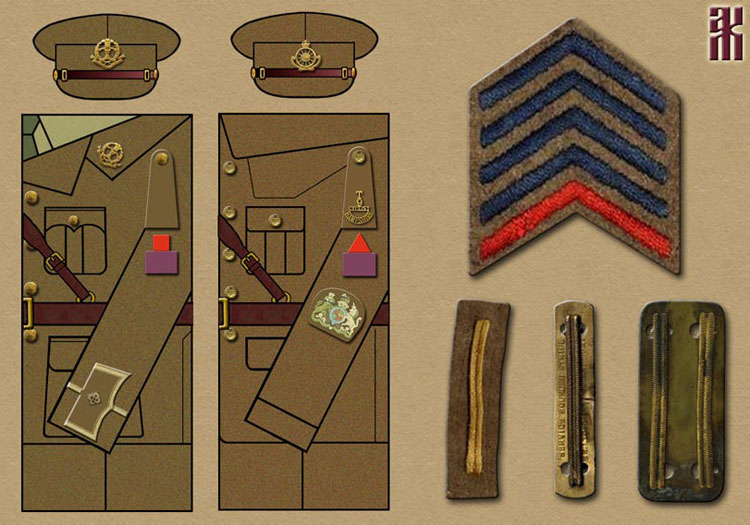
Uniforms of the British Expeditionary Force personnel in Siberia
1 – officer, Middlesex Regiment; 2 – regimental sergeant-major, Hampshire Regiment;
3 – chevrons for service abroad; 4 – wound bars (cloth and metal versions)
Figures 1 and 2 wear the insignia corresponding to Order No. 77 of 31 December 1918 for the Canadian Expeditionary Corps in Siberia, to which the battalions were subordinate. Judging by photographs, this order was not carried out in practice by the British units. While formally subordinate, they operated in completely different locations.
Chevrons introduced in 1918 for service abroad, worn on the right sleeve. One chevron was awarded for each year of service: red before 1915 and blue after. The maximum number of chevrons is shown above. Wound bars were introduced in 1916, worn on the left sleeve above the cuff.
Home — State Symbols — Flags — Uniforms — Badges & Medals — Money — Other
Pygmy Wars Notes:
The original for this page is at kolchakiya.ru/uniformology/British_expeditionary_force.htm.
I believe "platoon sergeant-major" at this time was actually Warrant Officer Class II and "company sergeant-major" was Warrant Officer Class I.
Discussion on the translation choices I have made can be found here.