
Uniforms of the 8th Kama Admiral Kolchak Rifle Division
Material and reconstructions by A. Karevskiy
The Ufa and Kama Regiments had more peasants in their ranks – the population of those areas definitely stood against the Bolsheviks. As an example, I can cite the 30th Askinsk Rifle Regiment, formed from residents of the district of that name, which fought beyond praise-worthiness. The district provided not only reinforcements, it supplied the regiment with clothes, footwear, carts and food products.
Sakharov, K. V. in "White Siberia (the Internal War 1918-1920)", Munich, 1923, p.48.
General Sakharov about the 30th Askinsk Regiment and 8th Kama Jaeger Battalion, 4 September 1919
The soldiers look cheerful, dressed variedly, English uniforms are good, Russian ones are bad, not everyone has greatcoats, good footwear.
... The jaegers are dressed well and neatly, in English uniforms, the footwear is good.
RGVA F.39624 Op.1 D.135 L.616-617. Information kindly provided by Moscow researcher O. Vinokurov.
Admiral Kolchak's patronage was assigned to the division in the spring of 1919. At the same time, a cipher was also assigned. K. A. Blinov said that the shoulder-boards in the division were stencilled by the men themselves – they laughed at him that instead of "АК" he should write the opposite, since his first name and patronymic was Konstantin Alekseevich. The shoulder straps were double-sided (raspberry/khaki), and in addition to the monogram, the regiment number was also given.
From the memoirs of private of the 29th Birsk Rifle Regiment, K.A. Blinov. Information courtesy of his grandson, K. Blinov of Kurgan.
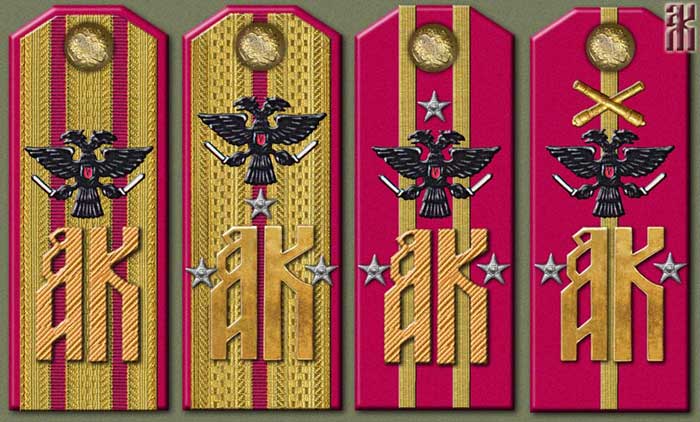
Possible appearance of the shoulder-boards of the officers of the 8th Kama Admiral Kolchak Rifle Division (rifle regiments and the 8th Kama Artillery Divizion)
The presence of any differences [i.e. numbers] for the regiments that were part of the 8th Kama Rifle Division after it was awarded the patronage of the Supreme Ruler remains in doubt.
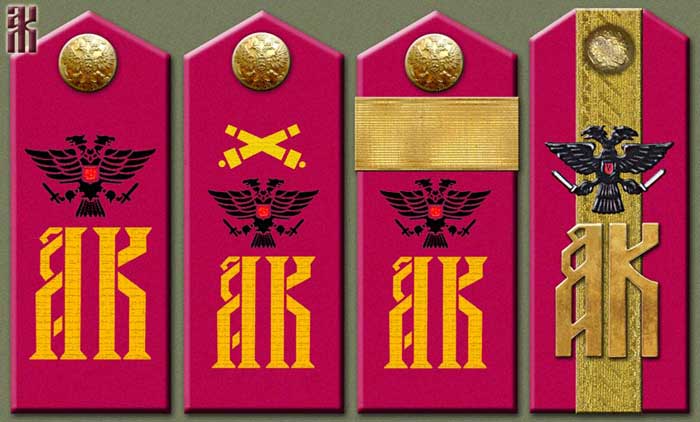
Possible appearance of the shoulder-boards of the other ranks and sub-ensign of the 8th Kama Admiral Kolchak Rifle Division (rifle regiments and the 8th Kama Artillery Divizion)
8th Kama "Admiral Kolchak" Rifle Regiment
In Transbaikalia the division was reduced to a single regiment. It continued as such in Primor'e until the end.
As rifle units, the (...) Kamtsy had raspberry shoulder-boards, cuffs and tabs. They had an "АК" under the admiral's eagle, standing for "Admiral Kolchak".
Filimonov, B. B. in "White rebels: the Khabarovsk campaign, Winter 1921-1922, Book 1", Shanghai, 1932, p.34.
.jpg)
8th Kama "Admiral Kolchak" Rifle Regiment in Transbaikalia in 1920
1 – reconstruction of a shoulder-board for a lieutenant;
2 – reconstruction of a shoulder-board for a sergeant-major
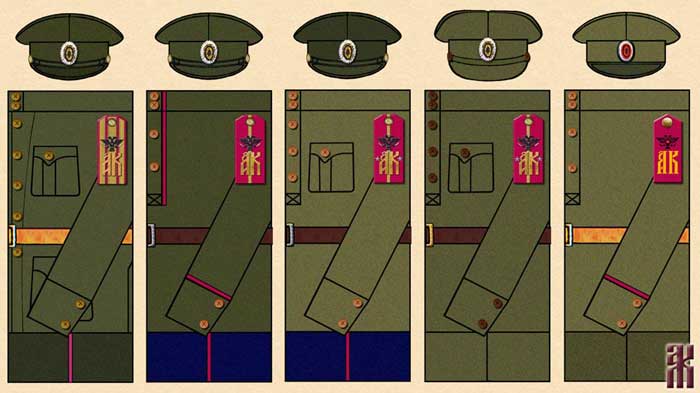
Dress uniforms of the 8th Kama Admiral Kolchak Rifle Regiment in Primor'e, 1921
These reconstructions are based on a photograph in Filimonov's "White Rebels".
Home — State Symbols — Flags — Uniforms — Badges & Medals — Money — Other
Pygmy Wars Notes
The original for this page is at kolchakiya.ru/uniformology/8_Kamsk_shooter_div.htm.
This illustration by A. Lebedeva is a captain of the regiment in Primor'e, with a St. George chevron for the Great Siberian Campaign on the sleeve.
.jpg)
Discussion on the translation choices I have made can be found here.
Flags
A banner is known for the Primor'e period, here.
History of the 8th Kamsk Rifle Division
Taken from Volkov.
Formed in September 1918 from units of the Kamsk-Buinsk Front as the Composite Ufa Rifle Division. Its core was peasant rebel detachments which in June and July 1918 had liberated almost the entire Ufa Province from the Bolsheviks, in assistance with the Czechoslovaks. Three regiments were composed exclusively from volunteer insurgent detachments and the fourth, formed in the autumn, was also largely volunteers. It was one of the largest divisions on the Eastern Front, with between 16,000 and 20,000 men, and one of the most renowned. The officers and men were mostly Russians and Tatars from the Belaya River and the left bank of the lower Kama areas.
It was renamed the 8th Kamsk Division on 1 January 1919. It was part of the 2nd Ufa Army Corps, and then from August 1919, the Ufa Group of the 3rd Army.
It was made up of the 29th Birsk, 30th Askinsk, 31st Sterlitamak, and 32nd Prikamsk Rifle Regiments, the 8th Kamsk Rifle Artillery Divizion (later Brigade, then Regiment), and Shchegolikhin's Cavalry Divizion (also formed from a partisan detachment). Units of the former 8th Perm Rifle Division were incorporated into it.
It played a leading role in the offensive in March 1919. During the retreat to the Ural Mountains and on to Chelyabinsk, it bore the brunt of the Red Army's attacks. In the second half of November, losses in the regiments reached between one-third and two-thirds of their combat strength. At one point there were only 150-200 combat-ready men per regiment. During the Siberian Ice March, up to 100% of the soldiers and 50% of the officers fell ill with typhus. It lost approximately half of its remaining combat strength near Krasnoyarsk and, upon arrival in Chita, was reformed into the 8th Kamsk Rifle Regiment in February 1920.
The 8th Kamsk Rifle Regiment
This was the largest regiment in the Far Eastern Army in Transbaikalia. Upon the withdrawal from Transbaikalia the regiment was disbanded by its commander, at Manchuria station. The remaining officers of the regiment joined the Ufa Regiment as a battalion, which briefly was known as the Kamsk-Belsk Rifle Regiment, although soon returning to simply the Ufa Regiment. Only about 150 men from the Kamsk Regiment arrived in Primor'e.
The regiment was reconstituted after the May 1921 coup and the arrival from Harbin of the regiment's former first commander, Colonel Sotnikov, but initially only as a single battalion. In the summer of 1921 the regiment was joined by Colonel Matrosov's battalion, which had previously been part of General Petukhov's detachment. The regiment was Russians (more than half), Tatars and Bashkirs. Each battalion had three companies; plus there was an officer company, a machine-gun company and a non-combat company. It was part of the Volga Brigade.
When it set out on the Khabarovsk campaign in November 1921, the regiment was able to field no more than 330 men. After the campaign, having suffered heavy losses, it was effectively reduced to a battalion. In August 1922 it was merged into the Kamsk Battalion (Company) as part of the Volga Regiment of the Volga Group.
The Independent Kamsk Cavalry Divizion was another successor unit in Primor'e.