
Uniforms of the 16th Ishim Rifle Siberian Regiment
Material and reconstructions by A. Karevskiy
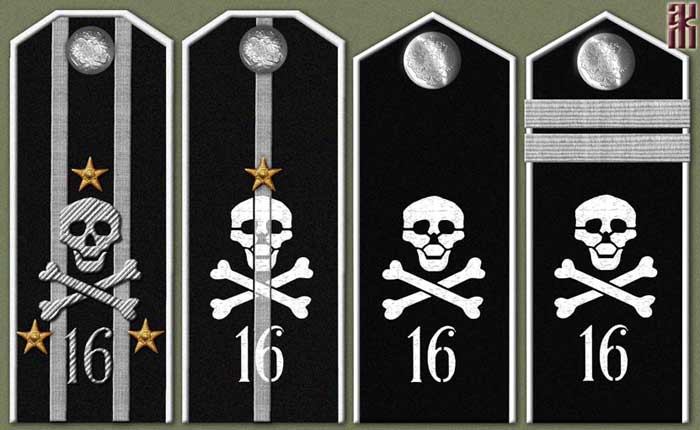
Possible shoulder-boards for the 16th Ishim Rifle Siberian Regiment
1 – lieutenant-colonel; 2 – ensign; 3 – private; 4 – corporal
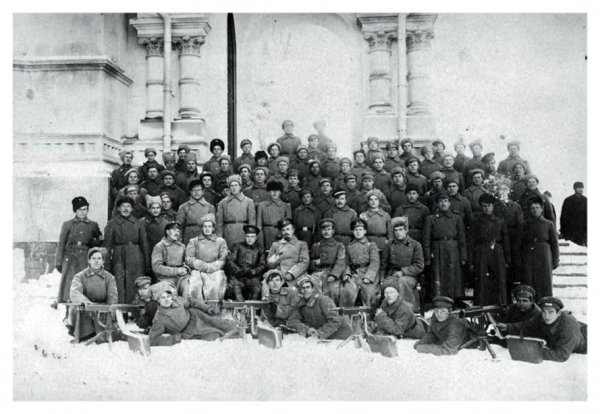
Note: the reconstructions show a possible "ideal" version of the shoulder-boards. However a photograph of the Ishimtsy show that their black shoulder-boards have white piping and stripes, but no skulls or numbers.
www.bergenschild.com/Reconstruction/photosaloon/civil_war/white/group_portrait/Ishim_01.jpg [link dead]
From the autumn of 1918, the 16th Ishim Siberian Rifle Regiment (4th Siberian Rifle Division of the 2nd Steppe-Siberian Corps) wore black shoulder-boards with white piping and a stencil in the form of a skull with crossed bones underneath and a small number "16". This was introduced on the initiative of the regiment's commander, Staff-Captain N. N. Kazagrandi, who in 1917 was the commander of the 1st Revel Volunteer Detachment. Later Kazagrandi petitioned the commander of the Siberian Army to preserve the appearance of the regimental shoulder-boards as the successor to the unit that had fought heroically and perished during the general collapse of the former Russian army.
Private communication from Votkinsk local historian S.K. Prostnev.
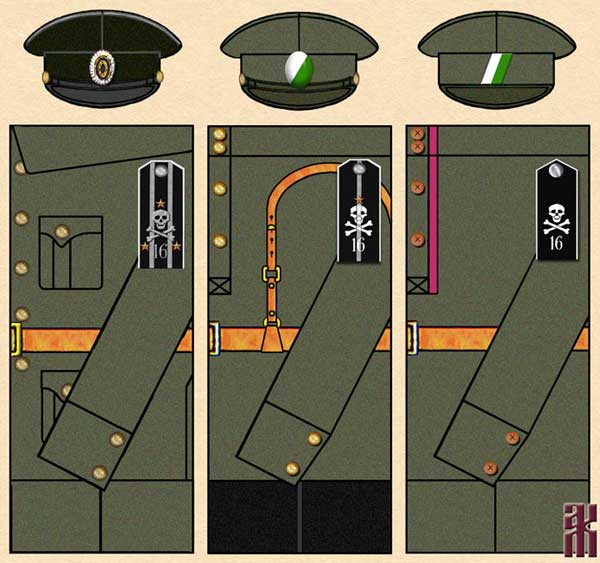
Possible uniforms of the 16th Ishim Rifle Siberian Regiment:
1 – lieutenant-colonel; 2 – ensign; 3 – private
From the report of N. N. Kazagrandi dated 20 February 1919 it follows that the soldiers of the 1st Omsk Officer Partisan Detachment, and later the 16th Ishim Regiment, wore the 1914 soldier's uniform and black and white insignia – black shoulder-boards with white braid, with a skull and crossed bones and the number "16". The reasons for this choice are contained in the document itself, which is reproduced in full below. It should be noted that the relevant permission from the division commander was obtained, as reported in a reply telegram dated the same day.
Commander of the 16th Ishim Siberian Rifle Regiment
No. 83 of 20 February 1919
To the commander of the 4th Siberian Rifle Division
Report
Since 7 June 1918, the 1st Omsk Officer Detachment, now the 16th Ishim Siberian Rifle Regiment, has been fighting a relentless battle against the Bolsheviks. After the order for the army to wear external insignia, the regiment, which had been at the forefront throughout and due to the fact that there were no specific instructions regarding insignia, unofficially adopted a black and white set (shoulder-boards and tabs) – the colours of infantry shock units. Since then the black and white insignia has become the traditional insignia of the regiment.
Taking into account that the combat qualities of the regiment, repeatedly noted in orders and operational reports, and its current affiliation with a division referred to in official operational reports of the corps as "shock", the assignment of a black insignia appears suitable. On behalf of the officers and riflemen of the regiment, I request that the 16th Ishim Siberian Rifle Regiment be assigned black and white insignia.
I also base my request on the fact that the Revel Naval Death Battalion, which operated independently under my command during the Russo-German War, wore the above-mentioned uniform with honour until the end of its existence. When the old army was no longer actually fighting the Germans, the Death Battalion, which had black and white insignia, continued to fight for the Motherland on the islands, knowing nothing of Bolshevism and having no traitors or betrayers in its ranks, neither among the officers nor among the riflemen.
Report of the commander of the 16th Ishim Siberian Rifle Regiment No. 48,
Colonel Kazagrandi
Acting adjutant Ensign Kharievich
Nemytov, O. A. and Dmitriev, N. I. in "The 16th Ishim Rifle Regiment: Essays on History", Ekaterinburg, 2009, pp.53-54, citing RGVA F.39632 Op.1 D.6 L.54.
Verkhotur'e District, Perm Province, 5 October 1918
Taborinskoe is occupied. The bodies of White Guards with black shoulder-boards lie scattered across the street.
"From the memoirs of Red Guard V. Zotov" at TsDOOSO F.41 Op.2 D.199 L.35. Material kindly provided by Ekaterinburg researcher D. V. Kadochnikov
Osinsk area, February 1919
To move westward, a strike column was formed under the command of Lieutenant-Colonel N. N. Kazagrandi, which included the Shock Volunteer and 16th Ishim Regiments and two Cossack sotnias. Kazagrandi's regiment became a shock regiment. Its black shoulder-boards were adorned with crossed bones, and the sleeves bore the insignia of the shock troops.
Sitnikov, M. G. in "Colonel N. N. Kazagrandi and the combat columns // White Army, White Cause, No. 17", Ekaterinburg, 2009, p.22.
The 248th Volodarsky Regiment, under the command of Lunts, was in reserve in Votkinsk in January 1919 and had three full battalions at its disposal.
On 29 January the regiment marched from Votkinsk to positions near the village of Kuzya-Bogdashki.
On 1 February the 16th Ishim Regiment attacked the village. Its insignia featured a skull and crossbones. Its task was to bypass and attack the rear of the 5th Ural Division. The battle was fierce. After five hours of fighting, the 16th Ishim Regiment retreated, abandoning its machine guns and equipment.
On 4 February the 16th and 17th Regiments attacked the 248th Regiment. The 248th Regiment retreated. They suffered losses due to frostbite, as there were severe frosts.
Alekseev, A. A. in "Pages from the Civil War. (Memoirs of a participant in the Civil War in Udmurtia)", Izhevsk, 1959, p.30.
We ask you to donate black velvet and cloth for shoulder-boards for the riflemen of the 4th Reserve Battalion of the 1st Kungur Reserve Regiment, which is to reinforce the 16th Ishim Shock Regiment.
Address: City College, Kitarskaya St 14, Office of the 14th Company.
Commander of the 4th Reserve Battalion, Lieutenant Kugensky
"Kungursky Bulletin" 11 February 1919, at siberia.forum24.ru/?1-4-0-00000084-000-0-1-1381410945
Home — State Symbols — Flags — Uniforms — Badges & Medals — Money — Other
Pygmy Wars Notes
The original for this page is at kolchakiya.ru/uniformology/16_Ishim_reg.htm.
The bergenschild photo of the Ishimtsy can be seen here. Another photo of them in winter 1919 is here.
I have used "shock" for udarnyy but "storm" is sometimes seen. Discussion on other translation choices I have made can be found here.
Flag
According to the information here, the Ishimtsy fought under a banner made by the nuns of the Verkhotur'e Pokrovsk Convent and presented to the regiment, by decision of the Verkhotur'e district council and townspeople, in gratitude for the liberation of the town from the Bolsheviks. The banner was presented by Archimandrite Xenophon to the regiment's commander, Colonel N. N. Kazagrandi, in early December 1918. It was a woven cloth bearing the image of St Nicholas the Wonderworker and the words "God is with us".
However the same page also gives another banner for the unit, shown below in printable form, with a tatty long silver fringe around it:

History of the 16th Ishim Siberian Rifle Regiment
Taken from the "Viki-Polyany" Encyclopedia, which can be found here.
Formed on the Eastern Front on 16 September 1918 from the 1st Omsk Partisan Officer Detachment, briefly the 4th Steppe Rifle Regiment, under the command of Staff-Captain Kazagrandi. It was created with considerable help from the people of Ishim. At formation is numbered just under 1,000 men and 6 MGs.
It was part of the 4th Siberian (formerly 1st Steppe Siberian) Rifle Division, but operated independently of it from the start. If fought well in the Alapaevsk and Verkhotur'e area. In mid-December it was moved to the reserve for a couple of weeks. By now Kazagrandi was a lieutenant-colonel
In late December General Pepelyaev's corps, which included Kazagrandi's column, advanced across the Ural Mountains, surprising the Reds and breaching their lines. Pepelyaev's troops took Perm. By February 1919 the regiment numbered 3,173 men and 249 officers, with 1,659 bayonets, 104 sabres and 34 machine guns. The regiment had victory after victory, and absorbed at lot of captured Red Army men.
In April 1919 Kolchak launched a new offensive. The regiment was critical in the capture of Votkinsk, capturing the HQ of the Red Army's 7th Division of the Red Army, and forcing five of its regiments to retreat after an out-flanking move. from the rear; these regiments were forced to retreat, joining neighbouring military units. Kazagrandi moved to command the 18th Siberian Rifle Division and was replaced by Captain, later Colonel, Metelev.
In mid-May the regiment and the 15th Omsk Regiment crossed the flooded the Vyatka River, but were held for three days bridgehead on the right bank north of the city of Malmyzha, but could not build on their success. The Red counter-attacked and drove the Whites back into the river, most of them drowning in a chaotic retreat. Only 484 bayonets remained in the regiment.
By August 1919, the regiment consisted of 43 officers, 885 soldiers and 228 non-combatants.
The retreat was now gathering speed. In autumn 1919 the regiment fought on the Tobolsk Front. It survived the "Siberian Ice Campaign" without major collapse.
In Primor'e in 1921 the division, thinned out in battle, was consolidated into the 4th Omsk Rifle Regiment, consisting of the Omsk, Ishim and Barnaul Battalions, in total about 700 men. That regiment fought until the end of 1922 and then retreated to China.